
Key Findings: Skills in Demand 2026
If you’re trying to figure out which skills in demand matter in 2026, stop looking at “top skills” lists. They flatten everything into one pile.
What we’re seeing (when you track hiring signals properly) is that demand behaves in three very different ways.
Some skills are speeding up fast because companies are under pressure to build, ship, and operate real systems, not experiments. These are the skills that sit close to execution and scale. They show up across more job families, not just in specialist teams.
Some skills are still heavily requested, but they are no longer spiking. They have become table stakes. They keep appearing in postings because they are baseline, not because they are “new.” A static list will call these “hot” every year, but a skills demand index will show they’ve entered a steadier phase.
And then some skills look “niche” if you only read global averages, but they are exploding in specific industries and regions. This is where a lot of workforce planning goes wrong. The signal is real, but it is localized, so it gets missed.
This report uses a skills demand index approach to map velocity, spread, and concentration, turning real-world hiring signals into actionable workforce intelligence so teams can make better calls on in-demand roles, internal build versus buy decisions, and where to place workforce investments instead of reacting late.
Why a Skills Demand Index Matters More Than a “Top Skills” List in 2026
Every year, there’s a fresh list of “hot skills 2025” or “top skills for the future.” They get shared in leadership decks, thrown into hiring plans, and used to justify training budgets.
The issue is not that those lists are useless. The issue is what they leave out.
A static list tells you what shows up a lot in job descriptions right now. What it does not do is interpret underlying labor market data to show whether demand is accelerating, stabilizing, or spreading across industries. It does not tell you whether demand is picking up speed, slowing down, or just repeating because it has become a basic requirement. It also hides the most important detail: where the demand is coming from. A skill that looks “average” globally might be on fire in one region or one industry. If you miss that, you will feel it later in the form of slow hiring cycles and rising offer pressure.
A skills demand index is built to answer a different question.
Instead of asking, “What is popular?” it asks, “What is changing?”
That sounds subtle, but it completely changes how you interpret workforce trends:
- Some skills appear everywhere because they are table stakes. They keep showing up because companies cannot hire without them, not because demand is accelerating.
- Some skills look small if you only count frequency, but they start showing up in new teams, new job families, and new industries. That is usually the early signal that hiring demand is about to spread.
- Some skills spike hard in one region or sector, even if they look flat at a global level. These are the skills that break workforce planning when you treat the world like one market.
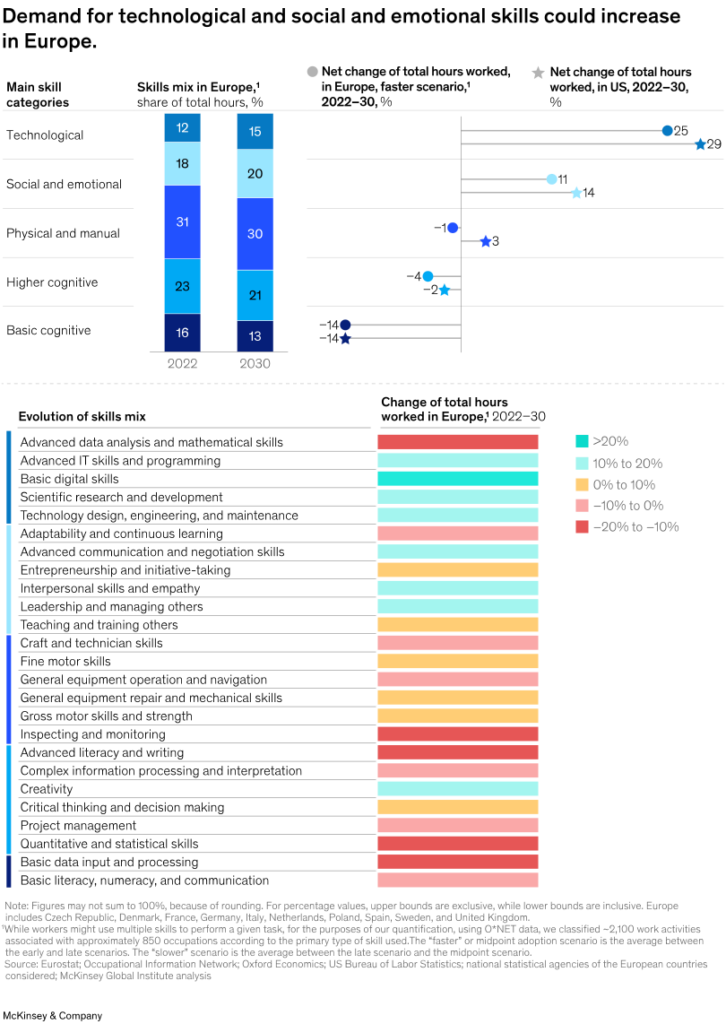
Image Source: McKinsey
This is where static rankings fail most enterprise teams.
If your workforce planning is built only on frequency, you tend to over-invest in “safe” skills that are already everywhere and under-invest in the capabilities that will become hard to hire six months from now. You also end up making build-versus-buy decisions too late. Skills are easiest to build internally when they are still emerging. Once demand peaks, you are forced into expensive hiring, contractor dependency, or rushed vendor decisions because the timeline is gone.
That is the whole point of the Global Skills Demand Index 2026.
It is built to make the signal easier to read. Not in a “pretty chart” way, but in a decision-making way. You can see which skills in demand are starting to pick up pace, which ones are still important but not moving, and which ones are quietly dropping out of job descriptions.
The other thing it does, and this is where it becomes useful for real workforce planning, is it does not pretend the market is one flat global average. It separates what is happening by industry and region, because that is how hiring pressure shows up in the real world.
How the Global Skills Demand Index 2026 Was Built (And What Signals Actually Matter)
Before we get into which skills in demand are accelerating or cooling, it is worth pausing on the methodology.
A skills demand index is only useful if the underlying signals are real. This index is not built on employer surveys alone. It is grounded in structured analysis of live and historical labor market data across industries and regions. Surveys tell you what companies intend to do. Labor market data shows you what they are actively hiring for in real time.
To make this meaningful for workforce planning, the index tracks four core dimensions.
Demand Velocity: Measuring Momentum, Not Just Presence
Frequency alone does not tell you much. A skill can appear in thousands of job postings and still be flat year over year. That usually signals maturity, not acceleration.
Demand velocity measures how quickly a skill is growing or declining relative to its own baseline. When velocity increases across consecutive quarters, it often reflects real capital allocation and operational rollout.
To put this into context, McKinsey’s 2024 Global AI Survey found that 65% of organizations report regular use of generative AI in at least one business function. That kind of adoption rate changes hiring behavior. It shifts demand from experimentation roles to implementation, governance, and scaling capabilities. Velocity is where that shift becomes visible in labor market data.
Cross-Industry Spread: From Niche to Embedded Capability
Some skills are tightly clustered within one industry. Others begin in a narrow segment and gradually spread across sectors.
Tracking cross-industry spread helps identify when a capability is becoming economically embedded. When a skill moves from technology firms into manufacturing, healthcare, financial services, and energy, it signals mainstream adoption. That is usually when competition for talent intensifies.
For workforce strategy teams, this matters because cross-industry adoption often drives salary inflation and longer hiring cycles.
Skill Adjacency and Co-Occurrence: Reading Capability Evolution
Job descriptions rarely list skills in isolation. The combinations reveal deeper shifts.
When AI skills begin appearing alongside compliance language, cybersecurity requirements, or domain expertise, that signals integration. It shows companies are moving from pilots to production systems. Watching these co-occurrence patterns allows the skills demand index to capture capability evolution rather than just expansion.
Regional Concentration: Workforce Trends Are Not Flat
Global averages flatten reality.
A skill may appear stable at a worldwide level but surge within a specific geography due to policy shifts, infrastructure spending, or industry clustering. For example, energy transition investments continue to influence hiring patterns regionally. The International Energy Agency’s World Energy Employment analysis has shown sustained growth in clean energy jobs in recent years, reinforcing that sustainability-linked capabilities are not short-term spikes but structural shifts.
Ignoring regional concentration is one of the most common mistakes in workforce analysis. Hiring pressure is always felt locally, even when reports present it globally.
By combining velocity, spread, adjacency, and regional concentration, the skills demand index moves beyond basic counts. It turns structured labor market data into forward-looking workforce intelligence for strategic planning.
Move Beyond Reports. Act on the Data.
See how JobsPikr Insights helps enterprise teams turn job data into strategic workforce decisions.
Skill Demand Velocity in 2026: Which Skills in Demand Are Accelerating, Stabilizing, or Cooling
Demand for skills does not move evenly. Some capabilities are still ramping up rapidly due to real business needs. Some have become ubiquitous baseline skills. Others are tapering off even though they may still appear in many postings.
Demand for skills does not move evenly. Some skills keep gaining momentum, some stay high but stop growing, and some lose steam over time. We used our 2024 Global Skill Index to capture the same kind of demand curve before updating it for 2026.
Below are updated findings grounded in multiple 2025–2026 workforce sources.
Accelerating Skills in Demand: Applied Digital, Data, Cybersecurity, and Operational Capability
In 2026, the strongest acceleration patterns are showing up in skills tied to digital execution, data fluency, and security integration, supported by multiple labour and learning data sources.
Data & Digital Fluency
Coursera’s Job Skills Report 2026, which aggregates learning activity from 6 million learners, identifies data-centric skills (like data interpretation and managing AI-driven analytics workflows) as among the fastest-growing areas across global teams. This reflects employer hiring signals that value applied data fluency in real business functions (e.g., decision intelligence, dashboards, domain analytics).
Cybersecurity & Digital Platform Skills
LinkedIn and OECD work highlight ongoing digital transformation, where cybersecurity competence remains crucial not just in tech firms but across industries facing digital threats. Roles that combine digital platform knowledge with security (e.g., secure cloud operations) are showing stronger momentum.
Tech + Applied Integration
Recent Gulf workforce reporting confirms growing demand for cybersecurity, cloud, and digital infrastructure skills tied to national development and enterprise transformation initiatives in 2026.
Growing demand in these areas indicates that employers are not just seeking standalone tech specialists, they are hiring for roles where digital, data, and security responsibilities converge and deliver measurable business impact.
Stabilizing In-Demand Roles: Foundational Digital & Analytical Capabilities
Certain skills remain vitally important, but their growth rates have slowed, reflecting broad adoption rather than explosive demand.
Cloud, Core IT, & Data Analytics
Cloud and foundational analytics are no longer “emerging.” According to ManpowerGroup’s 2026 workforce trends and other skills outlooks, digital literacy and infrastructural tech skills have become embedded across sectors. These capabilities still appear frequently in job postings but without the rapid year-over-year acceleration seen in earlier cycles.
Soft and Adaptive Skills
For several years, the World Economic Forum has pointed out that analytical thinking and problem-solving are essential, not optional, for 2025–2030. These capabilities along with adaptability and communication are stabilizing into baseline expectations across roles, not just leadership tracks.
The stabilization pattern reflects industry-wide adoption of these skills as core operating requirements. Hiring remains strong, but the velocity, the rate of new demand growth, is moderating because these skills are deeply integrated into standard job descriptions across sectors.
Cooling Skills: Experimental Technical Roles and Legacy Administrative Functions
Some roles that were prominent during early digital and automation waves are showing slowing demand relative to newer operationally tethered skills.
Early Experimental Tech Roles
LinkedIn’s 2026 labour analysis shows that while broad AI-related job growth persists, demand is shifting from experimental research-centric positions towards roles that integrate technology into business operations. Pure research roles and isolated innovation titles are no longer growing fastest.
Legacy Administrative IT
Several workforce trend reports indicate ongoing declines in demand for purely administrative IT tasks, driven by automation, platform-as-a-service adoption, and integrated digital operations. While such skills remain necessary in certain contexts, they are not expanding as hiring priorities compared to strategic digital and data roles.
Balancing Tech and Human Skills
For example, recent analyses emphasize the rising importance of interpersonal skills like collaboration, creativity, and adaptability, not in lieu of technical skills but alongside them. These human-oriented capabilities often appear in postings more as integrated job expectations rather than as standalone categories, meaning their standalone hire-demand velocity softens when counted purely as discrete “skills.”
Why Tracking Velocity Still Matters
The real story in 2026 is not which skills appear most often in job listings but which ones are changing fastest in the marketplace. Growth in data fluency, cybersecurity, and operational digital capability is not just visible, it is measurable in hiring patterns and skills uptake.
Demand velocity helps separate baseline expectations from emerging strategic capabilities. Understanding this allows talent planners to anticipate where hiring pressure will intensify, where incentives must shift toward internal reskilling, and where external recruitment may soon become more competitive and costly.
Industry Breakdown 2026: Sector-Level Skills in Demand
One line before we jump in: “skills in demand” is not one global list.
A CHRO in a bank feels a different talent market than a CHRO in manufacturing, even if they both say “we need AI.” The skills may share labels, but the work behind those labels is different, and the hiring pressure shows up in different places.
Here’s the sector view.
Technology and Digital Services: Shipping AI, Securing AI, Running AI
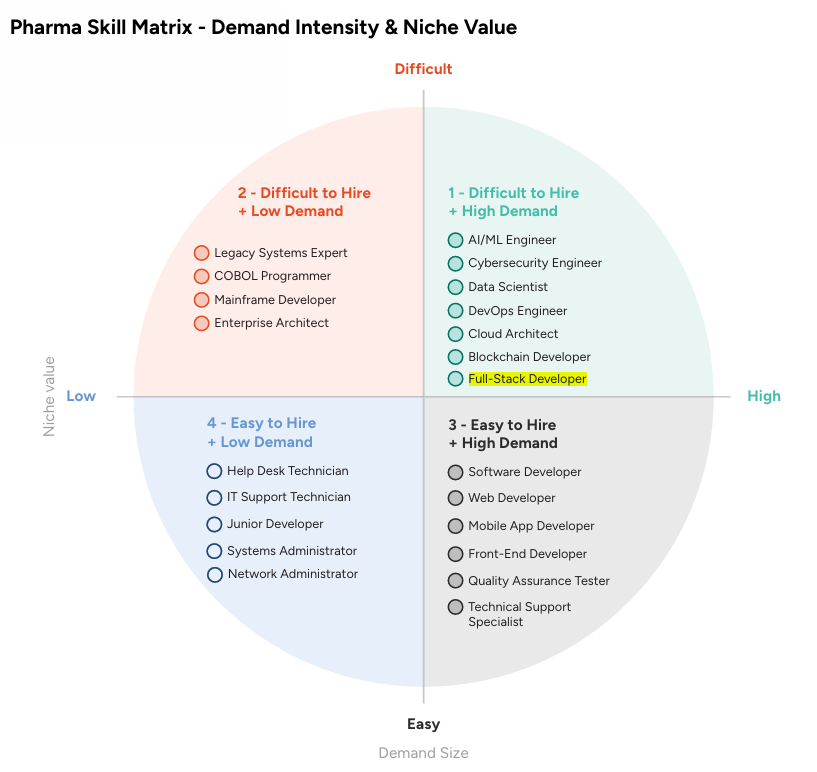
Image Source: Taggd
In tech, the shift is pretty clear. The market has moved past “let’s try AI” and into “make it work at scale.”
The World Economic Forum’s Future of Jobs Report 2025 still flags AI and big data, cybersecurity, and tech literacy as fast-growing skill categories.
But what matters for 2026 is what those categories turn into inside job descriptions. LinkedIn’s 2026 workforce analysis points to growth in AI roles overall, and the mix leans toward applied engineering and deployment work rather than “lab-only” research titles.
McKinsey’s 2025 State of AI lands on the same reality from a different angle: AI usage is broadening across functions, which tends to pull hiring toward integration, operations, and reliability.
So when we say skills in demand in tech in 2026, it is less “knowing AI” and more “keeping AI alive in production,” with security and governance sitting right next to it.
Financial Services: AI Talent, But Through a Risk Lens
Banks and insurers are hiring for AI, too. They just hire for it like banks.
The constraint is not imagination. It is model risk, auditability, and regulatory posture. The Bank for International Settlements’ 2025 technology and supervisory updates reflect a consistent theme: supervisors are paying close attention to technology risk, including model risk and governance as AI use increases.
That pressure changes the profile of in-demand roles. You see more weight on validation, governance, controls, and data stewardship, not just experimentation. If tech is asking, “Can we build it?” financial services is asking, “Can we defend it?”
Energy and Utilities: Clean Energy Growth, Plus Grid and Systems Skills
Energy hiring is not a short-term bump. It is tied to infrastructure investment and policy timelines.
The International Energy Agency’s World Energy Employment reporting (2025 edition) shows clean energy employment remains on a growth path globally.
What that translates to in 2026 is practical demand around systems: grid modernization, renewables integration, storage, and the analytics that sits around those systems. When companies talk about skills in demand here, they’re often hiring people who can handle messy operational complexity, not just sustainability messaging.
Healthcare and Life Sciences: Data Plumbing, Privacy, and Clinical Workflow Fit
Healthcare has a very specific pattern: digital systems expand, and then everything becomes a data problem.
The OECD Health at a Glance 2025 points to continued digitization across health systems.
As that happens, the “hot” skill isn’t just AI. It’s the ability to move data reliably between systems, keep it secure, and make it usable in real clinical workflows. The healthcare version of AI adoption is slower, but it is also less forgiving. If a model is wrong in a consumer app, you lose users. If a system is wrong in clinical settings, you trigger a much bigger failure mode.
Manufacturing and Advanced Industry: Automation Work That Hits Output, Not Slide Decks
Manufacturing demand tends to be brutally outcome-driven. If it does not improve throughput, quality, or downtime, it does not survive the budget cycle.
The World Economic Forum’s manufacturing coverage in 2025 continues to emphasize smart factory adoption and advanced automation as a competitiveness lever.
So the skills in demand here skew toward robotics, industrial automation, controls, and operations analytics. It is less about “digital transformation” as a slogan and more about operational performance.
What this means for workforce planning
Across sectors, the common thread is not “everyone wants AI.”
It’s that the market is rewarding capability stacks. AI paired with governance. Engineering paired with analytics. Cloud paired with security. The sector decides which pairing matters most, and that’s exactly why a sector lens is non-negotiable for workforce analysis.
Regional Workforce Trends 2026: Where Skills in Demand Are Concentrated
Global averages hide pressure.
A capability can look “stable” worldwide while exploding in one region and cooling in another. For workforce planning teams operating across markets, this is where the skills demand index becomes more than a ranking exercise.
Here is how 2026 looks regionally, based on current 2025–2026 labor and economic data.
North America: AI Deployment, Cybersecurity, and Advanced Manufacturing
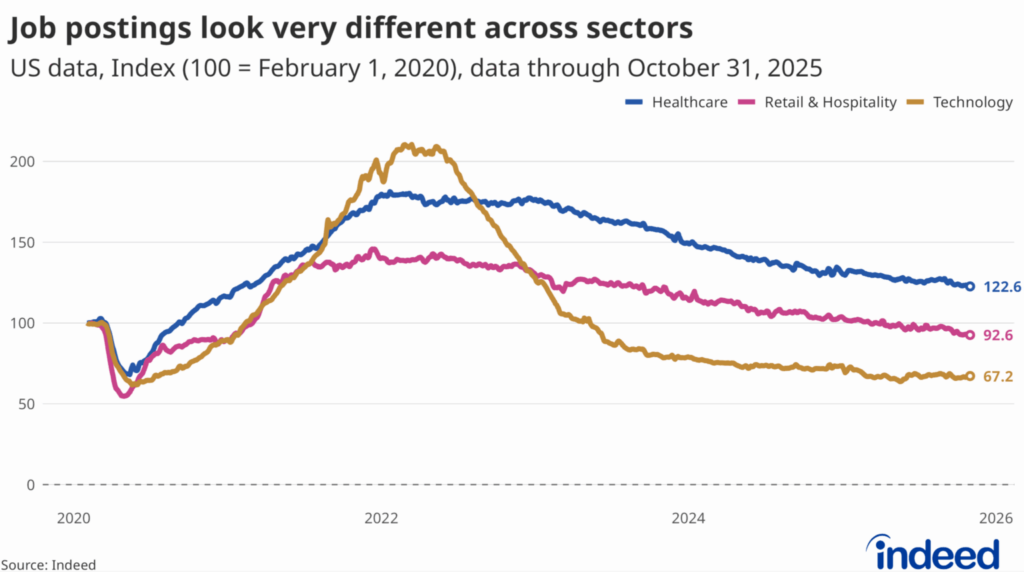
Image Source: Indeed
In the United States and Canada, AI hiring continues to expand, but again, it is implementation-heavy.
The World Economic Forum Future of Jobs Report 2025 highlights strong projected growth in AI, big data, and cybersecurity roles across advanced economies.
U.S. labor data also continues to show strength in computer and mathematical occupations. The U.S. Bureau of Labor Statistics 2025–2033 projections update forecasts above-average growth for software developers, data scientists, and information security analysts.
In parallel, federal investment through industrial policy and manufacturing incentives has reinforced demand for advanced manufacturing and semiconductor-related skills. This creates regional clusters, not just generic tech hiring.
In North America, the pressure point for skills in demand is scaling digital systems securely while modernizing industrial capacity.
Europe: Green Transition, Regulatory Tech, and Industrial Digitization
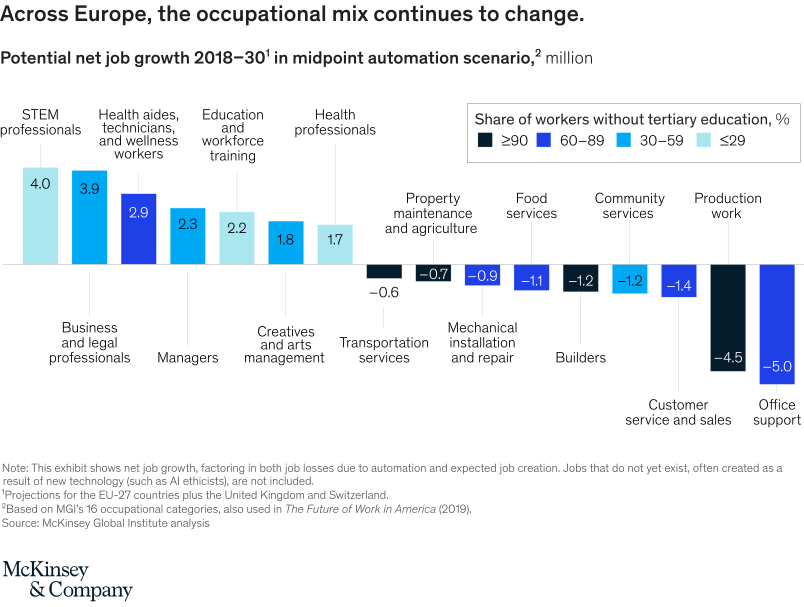
Image Source: McKinsey
Europe’s skill demand pattern in 2026 is strongly influenced by climate and regulatory policy.
The European Commission’s employment and green transition updates (2025) continue to emphasize growth in renewable energy, energy efficiency, and sustainability-related roles as part of long-term climate targets.
At the same time, regulatory complexity around AI and digital services has created hiring demand for compliance-heavy digital roles. The European regulatory environment tends to embed governance early, which shifts hiring toward AI oversight, data protection, and reporting expertise.
Industrial digitization also remains active, particularly in Germany and Northern Europe, where advanced manufacturing investment continues.
For European enterprises, in demand roles often sit at the intersection of engineering, sustainability, and compliance.
Asia-Pacific: Digital Expansion, Semiconductor Growth, and Talent Competition
Asia-Pacific presents a more varied picture.
In economies like India and Southeast Asia, digital services growth continues to drive hiring in cloud, software development, and data engineering. National digital infrastructure initiatives have reinforced demand for platform and cybersecurity talent.
In East Asia, semiconductor and advanced electronics manufacturing remain key drivers. Industrial policy in countries like South Korea and Taiwan continues to support advanced chip manufacturing ecosystems, reinforcing demand for engineering and materials science capabilities.
The OECD Skills Outlook 2025 highlights uneven skill transformation across regions, with Asia-Pacific economies showing both rapid digital expansion and skill gaps in advanced technical domains.
In APAC, the defining feature of skills in demand is scale. Large populations entering the digital workforce create volume, but competition intensifies for advanced, specialized capabilities.
Middle East: Energy Diversification and Cybersecurity Growth
The Middle East continues to diversify beyond hydrocarbons.
Large-scale investment in digital infrastructure, smart cities, and renewable energy projects is shaping demand patterns. Cybersecurity and cloud platform skills are particularly visible in hiring, aligned with national transformation agendas.
Regional workforce reporting in 2025–2026 consistently highlights AI, cybersecurity, and cloud engineering among top hiring categories as governments push digital modernization programs.
Here, skills in demand are closely tied to state-led economic strategy.
Latin America and Africa: Digital Services, Youth Demographics, and Remote Talent
In Latin America and parts of Africa, digital services and remote work integration continue to influence hiring.
The African Development Bank and related labor reports highlight the scale of youth demographics entering labor markets, while digital connectivity expands cross-border employment opportunities.
These regions show strong growth in software development, cybersecurity, and digital operations roles often serving global markets remotely.
For multinational firms, this creates both opportunity and competition in distributed workforce planning.
Why Regional Context Changes Workforce Strategy
The 2026 labor market is not synchronized.
- North America emphasizes AI scale and security.
- Europe emphasizes sustainability and compliance.
- Asia-Pacific emphasizes digital expansion and advanced manufacturing.
- The Middle East emphasizes diversification and infrastructure.
A global benchmark will not capture those differences.
For CHROs and workforce strategy leaders, regional analysis determines where hiring will tighten first, where wage pressure will rise fastest, and where reskilling investments should be prioritized.
From Insight to Action: Using the Skills Demand Index for Workforce Planning and Build-vs-Buy Decisions
Data is only useful if it changes a decision. That is where workforce intelligence becomes more valuable than static reporting.
A skills demand index is not meant to sit in a dashboard. It is meant to inform three specific workforce questions:
- Where do we hire?
- What do we build internally?
- What do we stop investing in?
In 2026, those questions are more tightly linked to capital allocation than ever before. AI readiness, digital infrastructure, compliance exposure, and productivity goals all run through capability decisions.
Here is how leading workforce strategy teams are applying skills demand signals.
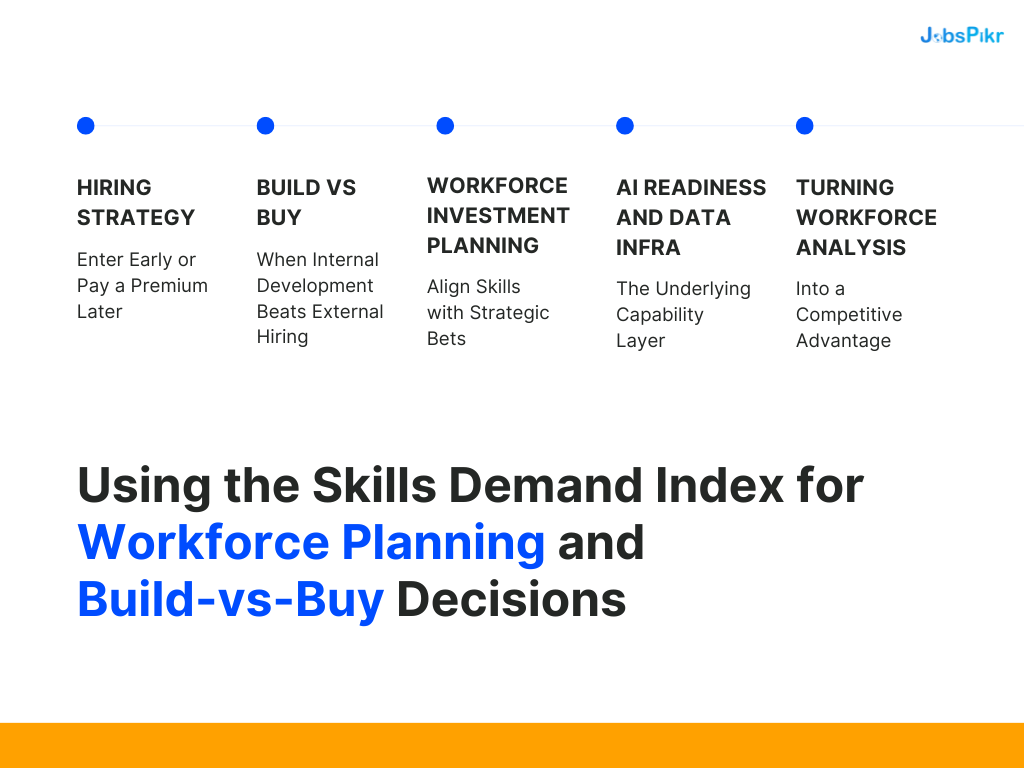
1. Hiring Strategy: Enter Early or Pay a Premium Later
When a skill shows sustained velocity across sectors and regions, it is usually a sign that hiring competition will intensify.
For example, AI implementation and cybersecurity integration roles are no longer isolated to tech firms. As McKinsey’s 2025 State of AI confirms, AI adoption is spreading across functions. That means more industries are competing for similar capability stacks.
If you wait until velocity peaks, you are entering a crowded market. Offer inflation, longer time-to-fill, and retention pressure follow.
A workforce planning approach grounded in the skills demand index allows teams to identify rising capabilities before the hiring curve steepens. That creates a window for earlier recruitment, targeted internal mobility, or structured reskilling.
This is less about reacting to “hot skills 2025” headlines and more about anticipating hiring pressure before it becomes visible in HR metrics.
2. Build vs Buy: When Internal Development Beats External Hiring
Not every accelerating skill should trigger a hiring spree.
Some capabilities are better built internally, especially when they intersect with proprietary systems, regulated workflows, or institutional knowledge.
For example, in financial services, AI model governance skills are often tightly coupled with internal risk frameworks. Buying external talent may solve short-term gaps, but long-term sustainability usually requires internal capability development.
The skills demand index helps here by identifying whether a capability is broadly diffusing or still highly specialized. Broad diffusion often increases external hiring competition. Highly specialized or sector-specific capabilities may favor internal development.
Build-versus-buy is no longer a procurement decision. It is a workforce investment decision.
3. Workforce Investment Planning: Align Skills with Strategic Bets
Every enterprise makes long-term bets. Digital platforms. Energy transition. Advanced manufacturing. AI-enabled customer systems.
The question is whether workforce investment aligns with those bets.
The World Economic Forum’s 2025 projections suggest a significant share of core skills will shift over the next five years. That transformation is uneven, but it is persistent. Enterprises that treat workforce analysis as an annual HR exercise risk misalignment with strategy.
Using a skills demand index, leadership teams can:
- Identify capability gaps tied directly to strategic initiatives.
- Prioritize reskilling in areas where demand is rising but supply remains manageable.
- Reduce exposure to declining skill clusters that no longer align with long-term growth.
This moves workforce planning from reactive hiring to portfolio management.
4. AI Readiness and Data Infrastructure: The Underlying Capability Layer
Across industries and regions, one pattern is consistent: many of the fastest-moving skills in demand are tied to digital infrastructure and AI operations.
That means workforce strategy cannot be separated from data infrastructure strategy.
- AI deployment requires data engineering.
- Cybersecurity requires platform architecture.
- Sustainability reporting requires analytics capability.
When these layers are missing, hiring alone does not fix the gap.
Enterprises that treat skills intelligence as part of AI readiness planning are better positioned to scale systems without overreliance on external talent.
5. Turning Workforce Analysis into a Competitive Advantage
At its core, the skills demand index reframes workforce analysis as competitive intelligence.
If you can see where capability demand is accelerating across your industry, you gain time. Time to invest. Time to reskill. Time to adjust geographic hiring strategy by tracking how tech giants restructure geographically.
That time advantage compounds.
Workforce planning in 2026 is no longer about filling open roles. It demands a job architecture aligned to skills in demand, where roles evolve with market velocity rather than static job descriptions.
What the Global Skills Demand Index 2026 Signals for the Next 3–5 Years
If you step back from the sector and regional detail, a clearer picture starts to form.
The Global Skills Demand Index 2026 is not pointing to a single breakout skill. It is pointing to a structural change in how capabilities are valued, combined, and deployed.
Three signals stand out for CHROs and workforce strategy leaders thinking beyond the next hiring cycle.
First, specialization alone is no longer enough. The strongest skills in demand are hybrid. AI paired with governance. Engineering paired with analytics. Sustainability paired with reporting and finance. The labor market is rewarding capability stacks, not isolated expertise.
Second, velocity matters more than volume. Some roles appear frequently because they are foundational. Others appear less often but are accelerating quickly across industries. The latter group is where competitive pressure builds fastest. Workforce planning that focuses only on headcount demand misses this dynamic.
Third, regional divergence is widening. North America is doubling down on AI scale and advanced manufacturing. Europe continues to embed sustainability and compliance into digital transformation. Asia-Pacific is balancing digital expansion with advanced industrial growth. These differences shape where in-demand roles concentrate and where hiring friction increases first.
The broader implication is this: workforce strategy must be tied directly to business strategy.
- If your enterprise is investing in AI-enabled products, you will compete for AI systems and infrastructure talent.
- If you are investing in energy transition or industrial modernization, you will compete for digitally fluent engineers.
- If you operate in heavily regulated markets, governance and risk capabilities will sit at the center of your hiring model.
The World Economic Forum’s 2025 analysis reinforces that a substantial share of core job skills will evolve before the end of the decade. That shift is not theoretical. It is already visible in job data.
The role of a skills demand index is to make that movement visible early enough to act on.
For CHROs and workforce planning leaders, the next three to five years will not be defined by a shortage of talent in general. They will be defined by misalignment between where the organization is headed and where its skill portfolio is concentrated.
Organizations that treat workforce intelligence as strategic infrastructure, not reporting overhead, will move faster.
See the Skills Demand Index in Action
Explore how real-time workforce intelligence can sharpen your hiring strategy and reduce long-term skill gaps.
FAQs
1. What are the top skills in demand in 2026?
If you look at what companies are struggling to hire for, it’s not vague “AI skills.” It’s people who can make AI systems work in production. That means data engineers, AI engineers, platform architects, and security professionals who understand cloud environments. On the sustainability side, companies aren’t just hiring ESG heads. They need people who can handle reporting, systems integration, and operational changes tied to regulation. The skills in demand right now are practical and execution-heavy.
2. How is the Global Skills Demand Index different from a “hot skills 2025” list?
A hot skills list is basically a popularity contest. It tells you what showed up a lot in job descriptions last year.
A skills demand index is trying to answer a different question: what is picking up speed, what has leveled off, and what is quietly fading. That matters because workforce planning decisions last years, not quarters. If you hire based on popularity alone, you’re usually late.
3. Why are hybrid capability stacks becoming more in demand roles?
Because work itself is layered now.
An AI system touches compliance. A cloud migration touches security. A sustainability program touches finance and reporting. So the in demand roles aren’t cleanly separated anymore. Hiring managers don’t want someone who only knows one tool. They want someone who understands how that tool sits inside the broader system. That’s why profiles are getting more blended.
4. How can workforce planning teams use skills in demand data strategically?
The real advantage is timing.
If you can see a skill starting to accelerate across your industry, you can act before hiring becomes expensive and slow. You can reskill internally while the market is still manageable. You can shift geography before wage pressure builds. Using skills in demand data this way turns workforce planning into an early-move advantage instead of a reaction to attrition reports.
5. Are AI skills the only major workforce trend in 2026?
No. AI is part of the story, but it’s not the whole thing.
Cybersecurity pressure is rising. Energy transition is reshaping engineering demand. Manufacturing is still automating. In many cases, AI just sits on top of these shifts. The bigger trend is that digital capability is now embedded in almost every sector. That’s why understanding skills in demand means looking at industry context, not just tech headlines.