

A global analytics company had tripled its workforce in four years through a combination of aggressive organic growth and multiple strategic acquisitions. But with this rapid scaling came deep-seated confusion. In the same department, titles like “Data Specialist,” “Analytics Engineer,” “Data Analyst II,” and “Insight Partner” coexisted with little clarity on how they differed. Some teams had only three levels between junior and senior roles, while others had six. Promotions often felt subjective, depending more on a manager’s influence than an individual’s achievements.
During annual compensation reviews, HR teams discovered wide, indefensible pay discrepancies among employees doing similar work. Managers struggled to explain career progression, and employees grew frustrated, unsure of what “growth” actually meant at the company. Leadership faced a stark reality: they didn’t just have a pay problem—they had a fundamental architecture problem.
The Challenge
The company’s organizational structure had been completely outpaced by its growth. Each acquired business brought its own legacy job titles, grading systems, and role definitions, creating a chaotic and inefficient internal state. The negative effects were visible everywhere:
- Inconsistent Titles: Similar roles carried wildly different names, confusing both employees trying to map their careers and external candidates trying to understand where they might fit.
- Pay Inequity: Without clear levels or defined responsibilities, compensation decisions became inconsistent, leading to unequal pay for equal work.
- Ambiguous Promotions: Employees had no clear line of sight into what was required to advance to the next level, leading to perceptions of favoritism and bias.
- Recruitment Inefficiency: Hiring managers struggled to benchmark new offers against a chaotic internal landscape, slowing down the entire hiring process.
This is a classic scaling challenge. Without a solid foundation, organizational growth leads to complexity and unfairness, a problem that sophisticated talent platforms also have to solve.
| Client Archetype | Business Focus | The Core “Job Architecture” Challenge | The Strategic Consequence |
| Talent Intelligence Platform | AI-driven talent solutions | Needed granular metadata for mapping and classifying roles correctly. | Struggled with accurate classification and tagging, hurting data reliability. |
HR was spending weeks each compensation cycle just trying to reconcile titles and justify pay differences. The lack of a coherent structure was actively eroding trust and slowing down critical business decisions.
The Approach
The company’s leadership chartered a project to design a unified Job Architecture Framework, a single source of truth for all roles, levels, and career paths across every function and region. The initiative was guided by three core principles:
- Simplicity: The framework had to be easy for every employee and manager to understand and for HR to maintain.
- Fairness: Every role must have clearly defined expectations, scope, and a corresponding, equitable pay range.
- Scalability: The system needed to be robust enough to support future growth and the addition of new roles without requiring a constant, painful redesign.
HR partnered with leaders from each business unit to meticulously map every existing role into a new, streamlined structure. They grouped all positions into logical job families, such as Engineering, Product, Data Science, and Marketing. Within each family, they established defined levels—from entry-level to executive—each with a clear description of responsibilities, expected impact, and scope. For example, a Data Analyst at Level 2 was expected to execute tasks under guidance, while a Level 4 Analyst was responsible for designing methodologies and mentoring others.
Implementation
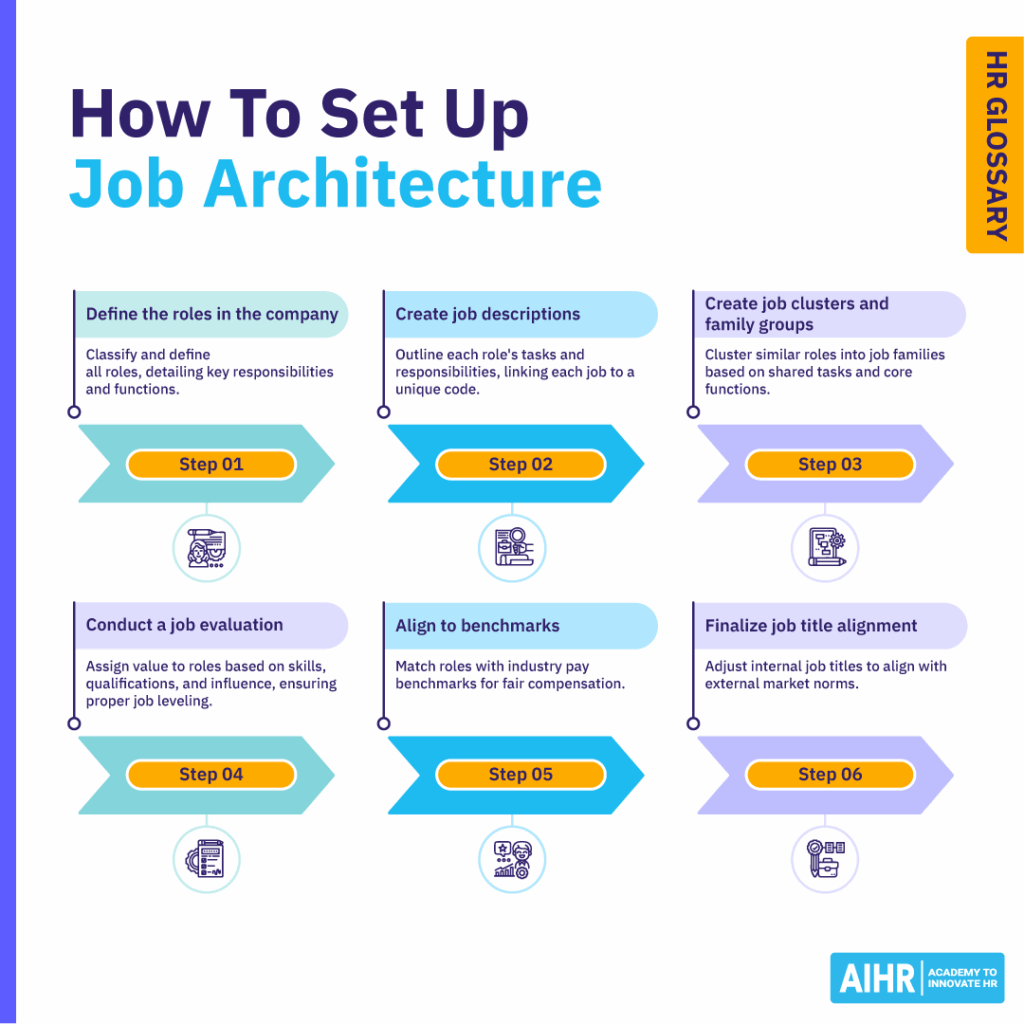
Image Source: AIHR
The global rollout was a carefully staged, nine-month process.
- Phase One: Audit and Alignment. HR conducted a comprehensive review of over six hundred unique roles across all regions. By eliminating duplicates and merging overlapping titles, they reduced the total number of distinct job titles by almost 40%.
- Phase Two: Validation. Functional leaders reviewed each proposed job family to ensure the definitions and levels accurately reflected the real work being done. They refined descriptions of responsibilities, decision-making scope, and key performance expectations.
- Phase Three: Communication and Training. HR launched an internal career portal that displayed every job family, its levels, and sample job descriptions. This became the go-to resource for employees. Concurrently, managers were trained to use the new architecture during hiring, performance reviews, and promotion discussions.
The company also introduced career maps, which were visual guides showing how employees could grow, not just vertically but also laterally. An engineer could now see a clear path to move into product management or data analytics, empowering them to own their career development.
Lessons Learned
The project yielded profound lessons about the importance of organizational design in a high-growth environment.
- Structure Enables Growth, It Doesn’t Slow It: A clear framework eliminates ambiguity and frees up time and energy. Instead of debating fairness, the organization could focus on developing its talent.
- Titles Should Reflect Purpose, Not Preference: While creative titles might seem appealing, clarity and consistency are what retain employees. A common language for roles is essential.
- Growth is a Shared Language: A transparent structure empowers employees and managers to have meaningful conversations about career development, turning abstract ambitions into actionable plans.
- Job Architecture is a Living System: A successful framework is not a one-time project. It must evolve with the business. A regular governance process is critical to keeping it relevant.
- Structure is the Bedrock of Fairness: When expectations and compensation are clearly and consistently defined, employees stop guessing about their value and can focus on their performance.
The Role of Data
Data was the key to the project’s credibility and long-term success. The company benchmarked each new role and level against live external market data to ensure its compensation bands were competitive. Internally, HR analytics tracked promotion rates, gender ratios by level, and compensation variance before and after the new system was implemented to measure its impact on pay equity.
The insights were revealing. The data showed that teams with clearer leveling and career paths had higher engagement and lower attrition. Over time, the organization used this data to fine-tune the model, forecasting when new roles or levels should be added based on shifting skill distributions and business needs.
Outcome
The new job architecture fundamentally changed the employee experience, replacing confusion with a coherent structure that restored fairness and clarity. The impact was felt across the entire company.
Pay equity improved dramatically, with roles at similar levels across different departments now aligning within a tight 5% compensation variance range. The time HR spent on manual compensation reviews and title reconciliation dropped by nearly half. Most importantly, the new transparency had a massive impact on morale; employee satisfaction scores related to “career clarity” rose by 30 points in internal surveys.
Recruiters also saw immediate benefits. With standardized job descriptions, they could benchmark offers against market data more accurately and maintain internal consistency, speeding up the hiring process. The most significant change, however, was in the level of trust. Employees who had felt overlooked now saw a structured, achievable path forward. Managers, armed with a clear framework, could justify promotions based on objective criteria, not just personal judgment.
Conclusion
The global analytics company emerged from this process with a system that didn’t just tidy up job titles, it transformed how people viewed their careers. The organization moved from a culture of negotiation to a culture of progression. Finance gained confidence that pay was consistent and defensible, and managers had a shared framework for developing their teams. Today, when a new role is created, the first question leaders ask is not “What should we call it?” but “Where does it fit?” That single, crucial shift in mindset ensures the organization remains agile, fair, and aligned as it continues to scale.