
Quick Take: How Workforce Intelligence Transformed This Firm’s Recruiting ROI
A mid-sized staffing firm was ready to grow, but expanding into new markets without reliable talent data was costing them time, money, and deals.
Key Takeaways:
- Entering new markets blind meant slow placements, misaligned offers, and missed opportunities
- JobsPikr gave the firm real-time visibility into talent supply, salary benchmarks, and competitor hiring activity across target markets
- Intelligence-driven market entry decisions replaced gut-feel expansion strategies
- Faster placements and improved offer acceptance rates directly improved recruiting ROI
- The firm’s shift from intuition to intelligence is a repeatable playbook for any staffing or RPO firm looking to scale
When the right data is built into every placement decision, recruiting ROI stops being a metric you measure after the fact and starts being something you design for from the start.
Meet the Firm: Big Ambitions, a Bigger Data Problem
Growth is easy to plan on a slide deck. It is a lot harder to execute when you are walking into markets you have never operated in before, with no real sense of where the talent is, what it costs, or who else is competing for it.
That was the exact position this mid-sized staffing firm found itself in. Specializing in technology and professional services placements, they had built a strong reputation in their existing markets. Clients trusted them. Candidates came back. The business was healthy. But healthy was not enough for where leadership wanted to take the firm.
The goal was geographic expansion, specifically into several new regional markets where they had little to no existing presence. And here is where things got complicated. Their entire way of working, sourcing candidates, pricing their services, and pitching clients, was built on years of accumulated knowledge about markets they already knew well. Strip that away, and what were they left with? Honestly, not much more than instinct and optimism.
They were not alone in this. According to the 2025 State of Staffing Report by Sense, more than two-thirds of staffing firm leaders identified client acquisition as their top priority but very few had a structured, data-backed approach to figuring out which markets were actually worth entering in the first place. Most firms were making expansion calls based on anecdotal signals, a client request here, a promising job board trend there, maybe a conversation at an industry event.
This firm was no different. And they were starting to feel the cost of that approach. Placements in new markets were taking longer than expected. Offers were falling through because compensation benchmarks were off. Business development conversations were stalling because the firm could not speak with any authority about local hiring conditions. The intelligence gap was not just slowing growth. It was actively getting in the way.
That is when they started looking for a better way to work.
Workforce Intelligence Built for Staffing Firms That Are Serious About Growth
The firms scaling faster into new markets are not doing it with bigger teams or bigger budgets. They are doing it with better data behind every placement decision.
This Case Study Is for You If…
You lead or own a staffing or RPO firm, and at least one of these sounds familiar: you are trying to break into new markets but have no reliable way to assess whether the talent or the demand is actually there. Your offer acceptance rates are lower than they should be, and you suspect compensation data is part of the problem. Your business development conversations are not closing as fast as you want because you cannot speak with authority about local market conditions. Or you are watching competitors move faster than you, and you are not entirely sure how.
This is not a case study about technology for its own sake. It is about what happens when the right intelligence gets built into the decisions that drive placement revenue. If that is the problem you are trying to solve, keep reading.
The Real Cost of Expanding Into New Markets Without Workforce Intelligence
Here is the thing about entering a new market without data: you do not always know you are flying blind until something goes wrong. And by the time something goes wrong in staffing, you have already spent weeks sourcing, screening, and submitting candidates for roles you did not fully understand in a market you did not really know.
For this firm, the problems showed up in three specific ways.

Problem 1: No Way to Map Where the Talent Actually Was
When you are recruiting in a market you know well, you have an instinctive sense of where the talent is concentrated, which companies are good hunting grounds, and which skills are genuinely scarce versus just hard to find quickly. In a new market, that instinct does not exist. The firm was spending more time than expected just figuring out whether enough qualified candidates existed in a target geography before they could even begin sourcing. That is not a recruiting problem. That is an intelligence problem.
Problem 2: Salary Benchmarks That Were Already Out of Date
Compensation expectations vary significantly from one region to another, even for the same role. Without reliable, real-time data on what the going rate looked like in each new market, the firm’s recruiters were working off national averages or outdated reference points. The result was offers that missed the mark. According to SmartRecruiters, the US offer acceptance rate sits at just 79% and misaligned compensation is one of the primary reasons candidates decline. For a firm trying to establish itself in a new market, every rejected offer is not just a lost placement. It is a dent in the client relationship they are trying to build.
Problem 3: Zero Visibility Into What Competitors Were Doing
Staffing is a market where timing matters enormously. If a competitor is already actively recruiting for a role type in a city you are just entering, you are not just competing for candidates. You are competing against a firm that already has relationships, pipelines, and local credibility. Without any visibility into competitor hiring activity, the firm had no way to identify where the white space actually was, which markets were already crowded, and which ones had genuine opportunity waiting.
Taken together, these three gaps were doing real damage to the firm’s recruiting ROI. Placements were taking longer. Offer acceptance rates were lower than they should have been. And business development conversations were harder to win because the firm could not back up their pitch with any local market authority.
What they needed was not more effort. They needed better intelligence. And that is exactly what led them to JobsPikr.
Why JobsPikr Made the Short List for Recruiting ROI
When the firm started evaluating workforce intelligence platforms, they were not short on options. The HR tech market is crowded, and nearly every vendor in the space will tell you they have the best data. So what actually made JobsPikr stand out?
Three things kept coming up in their evaluation.
Breadth and Freshness of Data

The firm needed coverage that matched their ambitions. Entering multiple new regional markets meant they needed reliable signals from geographies they had never recruited in before, not just the major metros where everyone already has decent visibility. JobsPikr pulls job signals from over 70,000 sources across 100+ countries, refreshed daily. That kind of breadth meant the firm was not working off a thin slice of the market. They were getting a wide, current view of hiring activity across the exact geographies they were targeting.
For a firm whose entire expansion strategy depended on understanding local talent supply and demand, data freshness was not a nice-to-have. It was the whole point. Stale data in staffing does not just lead to bad decisions. It leads to bad placements, and bad placements lead to lost clients.
The Depth of Workforce Intelligence Signals
There is a difference between a platform that gives you job posting data and one that gives you workforce intelligence. Raw job posting counts tell you something is happening. Workforce intelligence tells you what it means. JobsPikr sits firmly in the second category. The platform does not just surface job listings. It tracks hiring velocity across companies and sectors, maps geographic talent availability, benchmarks compensation by role and region, and monitors competitor hiring patterns over time.
For the firm’s leadership team, this distinction mattered a great deal. They were not looking for another job board aggregator. They were looking for something that could help them make smarter market entry decisions, price their services more accurately, and spot placement opportunities before their competitors did. JobsPikr’s talent strategy capabilities, including the kind of real-time AI hiring demand signals across regions, roles, and skills that the platform showcases in its global AI hiring signals demo, gave them exactly that kind of forward-looking intelligence.
API Flexibility That Fit Into How They Already Work
The third factor was practical but important. The firm had existing workflows, internal tools, and reporting systems that they were not going to rip out and replace. They needed a platform that could plug into what they already had, not one that required them to rebuild their entire tech stack around it.
JobsPikr’s API was built for exactly this kind of flexibility. The firm could pull structured, normalized job data directly into their own dashboards and planning models, query by job title, skill, location, or keyword, and schedule ongoing data delivery without manual intervention. JobsPikr integrates with ATS and CRM systems so recruiting teams get talent intelligence exactly where they need it, inside the tools they already use every day.
That combination, broad and fresh data, deep workforce intelligence signals, and flexible API integration, was what moved JobsPikr from a shortlist contender to the firm’s platform of choice.
See What Smarter Recruiting ROI Looks Like in Your Markets
JobsPikr gives staffing and RPO firms the workforce intelligence they need to enter new markets faster, place candidates more precisely, and grow with data behind every decision.
From Raw Data to Market Entry Decisions: How They Actually Used JobsPikr
Choosing the right platform is one thing. Actually building it into your day-to-day decision-making is another. This is where a lot of workforce intelligence investments fall flat. The data is there, but no one quite knows how to act on it, so it ends up as a dashboard that gets checked occasionally and influences nothing.
That did not happen here. The firm identified three specific use cases where JobsPikr data would feed directly into decisions that had real commercial consequences. Each one represented a moment where intelligence replaced guesswork, and where the impact on recruiting ROI was measurable.
Using Talent Supply Signals to Make Market Entry Calls
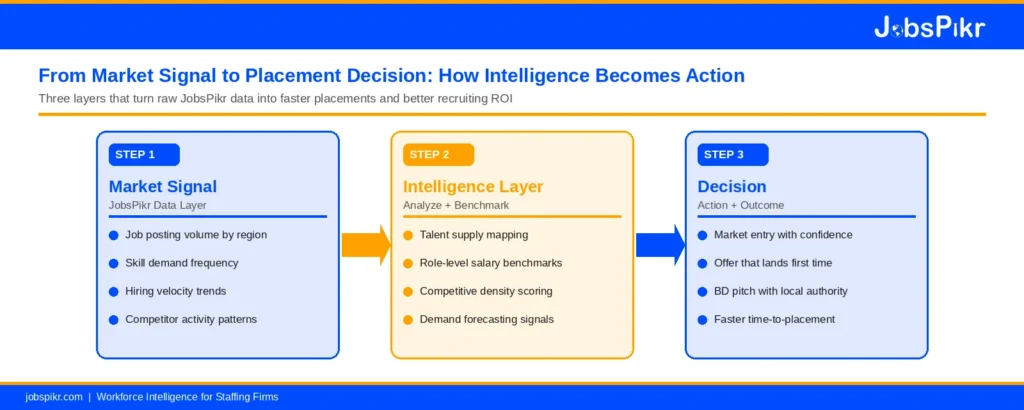
The first use case was the most fundamental one: figuring out which new markets were actually worth entering. Before JobsPikr, this was largely a gut call, informed by client conversations and broad industry intuition. After JobsPikr, it became a data-backed decision.
The firm used JobsPikr’s geographic talent mapping to analyse hiring activity and candidate availability across its target markets before committing resources. They could see where demand for specific role types was rising, where talent supply was strong enough to support consistent placements, and where the gap between open roles and available candidates was wide enough to create a real opportunity for a staffing partner.
This changed the sequencing of their expansion entirely. Instead of entering markets based on where a client happened to ask first, they started prioritising markets where the data showed the strongest combination of hiring demand and talent availability. It sounds like a small shift. In practice, it meant the difference between spending months building a presence in a market that was already oversupplied and walking into markets where clients genuinely needed help and candidates were there to be found.
Benchmarking Role-Level Salaries to Improve Offer Acceptance Rates
The second use case targeted the offer acceptance problem directly. The firm started pulling JobsPikr’s real-time compensation benchmarks for specific roles in each target market and using that data to calibrate the salary ranges they were recommending to clients.
The impact was straightforward. When a recruiter walks into a client conversation armed with current, location-specific salary data rather than a national average from six months ago, the offer that eventually goes out is far more likely to land. Candidates do not turn it down because it is out of step with what they know the market is paying. Clients do not push back because the range feels inflated. Everyone is working from the same picture of reality.
This matters more than it might seem. Every open position costs organisations between $4,000 and $9,000 per month in lost productivity, overtime, and project delays. For a staffing firm, a declined offer does not just delay the placement. It restarts a chunk of the process, frustrates the client, and pushes the revenue recognition further out. Getting compensation right the first time is not just good for the candidate. It is one of the most direct levers a staffing firm has on its own recruiting ROI.
Tracking Competitor Hiring Activity to Uncover Placement Opportunities
The third use case was arguably the most strategically interesting one. The firm used JobsPikr to monitor competitor hiring patterns across their target markets, specifically looking at which role types competitors were recruiting heavily for, and where they were not.
This gave the firm something they had never had before: a real-time read on where the white space was. If a competitor was flooding a particular market with recruiters for one role type, that was a signal to either compete head-on with better data and faster placements, or to pivot toward adjacent roles where the competition was thinner and the opportunity was cleaner.
JobsPikr tracks hiring velocity and workforce expansion patterns across companies and sectors, and that capability became a genuine competitive weapon for the firm’s business development team. Instead of walking into client conversations with a generic pitch about their capabilities, they could walk in with specific intelligence about what was happening in that client’s hiring market right now. That is a very different kind of conversation, and it closed a lot faster.
Faster Placements, Better Offers, More Revenue: The Results That Followed
At some point, every conversation about workforce intelligence has to answer the same question: what did it actually do for the business? Strategy is only as good as the outcomes it produces, and for a staffing firm evaluating any platform investment, recruiting ROI is the number that matters most.
Here is what changed for this firm after building JobsPikr data into their expansion strategy.

Time-to-Placement Came Down Significantly
The most immediate impact was on speed. When recruiters are walking into a market already knowing where the talent is concentrated, which skills are available, and what compensation looks like, they are not spending the first two or three weeks of every search just getting oriented. They can start placing candidates faster because the groundwork has already been done by the intelligence layer.
This matters enormously at the business level. Automation-enabled recruiting teams are 90% more likely to achieve placements in under 20 days, which pulls gross profit forward at scale. For a firm expanding into multiple new markets simultaneously, compressing time-to-placement even modestly across a high volume of searches adds up to a very meaningful revenue acceleration. The firm was not just placing faster in individual searches. They were building a compounding advantage across their entire new market operation.
Offer Acceptance Rates Improved
The salary benchmarking work paid off directly and measurably. With role-level, location-specific compensation data informing every offer recommendation, the gap between what candidates expected and what clients were willing to pay narrowed considerably. Offers started landing more consistently on the first attempt.
For context on why this is so commercially significant: staffing firms that adopted AI and automation tools were twice as likely to report revenue growth compared to firms that did not, according to the 2025 Bullhorn GRID Industry Trends Report. A meaningful part of that advantage comes down to precision, and compensation precision is one of the clearest examples of intelligence directly improving a placement outcome. Every offer that lands on the first try is a placement that closes faster, a client that stays happier, and a candidate who starts with a positive impression of the firm that placed them.
Geographic Footprint Expanded Without the Usual Growing Pains
Perhaps the most strategically significant result was the one that is hardest to put a single number on: the firm successfully entered new markets without the extended ramp-up period that typically comes with geographic expansion in staffing.
Normally, building a presence in a new market means months of relationship building, trial and error on sourcing strategies, and gradual accumulation of local knowledge before the operation becomes reliably productive. JobsPikr compressed that learning curve dramatically. Because the firm was entering each new market with intelligence already in hand, talent supply mapped, compensation benchmarked, and competitor activity understood, they could operate with the confidence of an established local player from a much earlier point.
According to the 2025 State of Staffing Report, staffing firms that adopted AI and data tools saw a 31% increase in revenue compared to those that did not. This firm’s experience tracks closely with that finding. The revenue growth they saw in new markets was not incidental. It was a direct consequence of making intelligence-driven decisions at every stage of the expansion, from market selection through to offer negotiation.
The Shift That Mattered Most
Beyond the individual metrics, something more fundamental changed in how the leadership team thought about growth. Market expansion stopped being a bet and started being a calculation. The question was no longer “do we think this market has potential?” It was “what does the data tell us about this market, and what is our move?”
That shift in mindset, from intuition-based to intelligence-driven, is arguably worth more than any single metric. Because it is not a one-time improvement. It is a permanent upgrade to how the firm makes decisions, one that compounds over time as they continue to expand into new markets with better and better data behind them.
See What Smarter Recruiting ROI Looks Like in Your Markets
JobsPikr gives staffing and RPO firms the workforce intelligence they need to enter new markets faster, place candidates more precisely, and grow with data behind every decision.
From Gut Calls to Intelligence-Driven Staffing: A Mindset Shift Worth Talking About
Numbers tell part of the story. But anyone who has led a staffing firm through a period of meaningful change knows that the metrics are often the last thing to shift. Before the numbers move, something else has to change first: the way the team thinks about how decisions get made.
That is what made this particular transformation interesting to observe from the inside. The recruiting ROI improvements were real and measurable. But the change that made those improvements sustainable was a cultural one.
Recruiters Stopped Guessing and Started Consulting
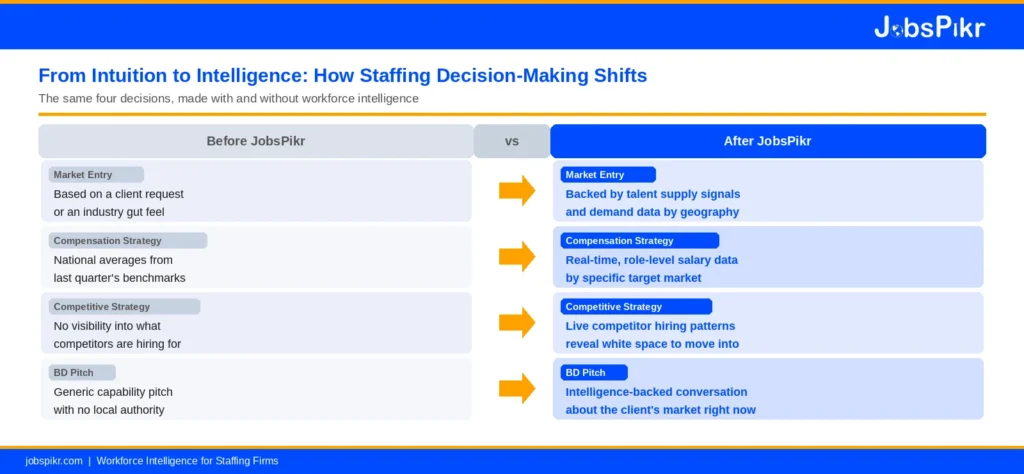
Before JobsPikr, a recruiter entering a new market was essentially operating on instinct and hustle. They would source hard, lean on whatever contacts they had, and figure out the local landscape as they went. That approach works eventually, but it is slow, inconsistent, and almost impossible to scale across multiple new markets at the same time.
After JobsPikr became part of the workflow, something shifted in how recruiters showed up, both internally and in client conversations. They were no longer just filling roles. They were bringing market intelligence into every interaction. A business development call stopped being a pitch about the firm’s capabilities and became a conversation about what was actually happening in the client’s hiring market right now, backed by real data.
That repositioning matters more than it might seem. Clients do not just want a staffing firm that can find candidates. They want a partner that understands their market well enough to give them an edge. When your recruiters can speak with authority about local talent supply, emerging skill demand, and competitor hiring patterns, you stop being a vendor and start being a strategic partner. That is a fundamentally different relationship, and it is a much stickier one.
Leadership Started Making Expansion Decisions Differently
The mindset shift was not just at the recruiter level. It changed how the leadership team approached growth planning altogether.
Previously, expansion decisions were made in leadership meetings where experience and intuition carried most of the weight. Someone would make a case for a new market based on a client conversation or a sense that demand was building there. The team would debate it, weigh it against the firm’s capacity, and make a call. It was not a bad process. It was just an incomplete one.
With JobsPikr data feeding into those conversations, the dynamic changed. Market entry proposals started coming in with talent supply analysis attached. Capacity planning discussions referenced real hiring demand signals rather than projections built on assumptions. The compensation strategy was grounded in current market data rather than last year’s benchmarks.
According to a 2026 industry survey, 85% of HR professionals said data analytics will play a critical role in hiring strategies going forward. This firm was ahead of that curve, and the competitive advantage of moving early on workforce intelligence showed up in their results before most of their peers had even started evaluating platforms.
The Compounding Effect of Better Decisions Over Time
One of the things that is easy to miss when you look at a case study like this is that the value of intelligence-driven decision-making is not linear. It compounds.
The first market the firm entered with JobsPikr data was better than their previous expansions. The second was better than the first, because the team was getting more comfortable reading the signals and acting on them faster. By the time they were into their third and fourth new markets, they had built an internal muscle for data-driven expansion that made each successive move faster, cheaper, and more productive than the one before it.
That is the real promise of workforce intelligence done right. It is not just about making one good decision. It is about building an organisation that makes consistently better decisions over time, and where the gap between your firm and competitors who are still relying on gut feel keeps getting wider with every passing quarter.
What Other Staffing and RPO Firms Can Take From This
Every staffing firm’s situation is different. Different specialties, different geographies, different client bases. But the core challenge this firm faced, trying to grow into new markets without reliable intelligence on talent supply, compensation, and competitive dynamics, is not unique to them. It is one of the most common growth barriers in the industry.
So what can other staffing and RPO leaders actually take from this story and apply to their own firms?
Start With the Intelligence Gaps, Not the Technology
The temptation when reading a case study like this is to jump straight to the platform decision. But the most important thing this firm did before they evaluated any technology was get clear on exactly where their intelligence gaps were costing them money.
They did not go looking for a data platform because it seemed like a good idea. They went looking because they could point to specific, recurring failures: placements taking too long in new markets, offers falling through because compensation was off, business development conversations stalling because they lacked local market authority. Every one of those failures had a measurable cost attached to it.
If you are a staffing or RPO leader thinking about workforce intelligence, start there. Map out where your current decision-making is running on assumptions rather than evidence. Quantify what those assumptions are costing you in delayed placements, declined offers, and missed market opportunities. That exercise will tell you exactly what you need from an intelligence platform, and it will make the ROI case internally a lot easier to build.
Treat Talent Sourcing ROI as a Strategy Input, Not Just a Scorecard Metric
Most staffing firms track talent sourcing ROI after the fact. They look at which channels produced the most placements, which searches took the longest, and which offers fell through. That retrospective view is useful, but it is fundamentally reactive.
The shift this firm made was to bring talent sourcing ROI thinking upstream, into the market selection and strategy decisions that happen before a single search is opened. Which markets give us the best ratio of talent availability to client demand? Which role types in which geographies are we most likely to place quickly and profitably? Which competitors are already well-entrenched, and where is the white space?
Those are recruiting ROI questions. But they are being asked at the strategy level, not the scorecard level. That upstream application of intelligence is what separates firms that grow efficiently from firms that grow by throwing more resources at the same problems.
Do Not Underestimate the Value of Competitive Intelligence
Of the three ways this firm used JobsPikr, the competitor hiring tracking capability is probably the most underutilised across the staffing industry broadly. Most firms have some sense of who their main competitors are. Very few have real-time visibility into what those competitors are actually doing in specific markets right now.
That visibility is genuinely valuable, not just for defensive purposes, but for finding opportunity. When you can see that a competitor is concentrating heavily on one role type in a market, you can make an informed decision about whether to go head-to-head with better data and faster execution, or to pivot toward adjacent opportunities where the competition is lighter. That kind of agility is very hard to build without an intelligence layer underneath it.
Build Intelligence Into the Workflow, Not Just the Dashboard
The final lesson is a practical one. Workforce intelligence only improves recruiting ROI if it actually changes the decisions people make day to day. A platform that lives in a separate tab and gets checked once a week will not move the needle on time-to-placement or offer acceptance rates. The data needs to be close enough to the work that it becomes a natural part of how recruiters source, how account managers pitch, and how leadership plans.
This firm succeeded partly because they were deliberate about this from the start. They integrated JobsPikr data into the workflows and tools their team was already using, rather than asking people to add another system to their day. JobsPikr’s API flexibility and integrations with existing ATS and CRM systems made that possible without a heavy implementation lift. The result was intelligence that actually got used, which is the only kind that actually matters.
Recruiting ROI Is Not a Metric You Chase. It Is a Decision You Make.
This firm did not improve its recruiting ROI by working harder or hiring more recruiters. They improved it by changing the quality of information behind every decision they were already making. Which markets to enter? What compensation to recommend? Where to focus business development effort. Those decisions were always going to happen. JobsPikr just made sure they were happening with real intelligence behind them instead of instinct and hope.
The results followed naturally from that shift. Faster placements, higher offer acceptance rates, successful expansion into new markets without the usual ramp-up pain. None of it was accidental. It was the compounding output of better decisions made consistently over time.
If your firm is facing a similar growth challenge, the question worth asking is not whether you can afford a workforce intelligence platform. It is what your current intelligence gaps are costing you in slow placements, missed markets, and declined offers every single quarter.
See What Smarter Recruiting ROI Looks Like in Your Markets
JobsPikr gives staffing and RPO firms the workforce intelligence they need to enter new markets faster, place candidates more precisely, and grow with data behind every decision.
Frequently Asked Questions
1. How does workforce intelligence actually improve recruiting ROI?
Recruiting ROI improves when the decisions behind every placement become more precise. Workforce intelligence platforms like JobsPikr give staffing firms real-time visibility into talent supply, compensation benchmarks, and hiring demand across specific markets and role types. That visibility directly reduces the time and cost associated with two of the biggest ROI killers in staffing: slow placements caused by poor market knowledge, and declined offers caused by misaligned compensation. When recruiters are working from accurate, current data instead of outdated assumptions, they place faster, close more offers on the first attempt, and spend less time recovering from avoidable mistakes. The compounding effect of those improvements across a high volume of searches is what shows up as meaningful recruiting ROI at the business level.
2. What are the most important recruiting ROI metrics staffing firms should be tracking?
The metrics that matter most are the ones closest to revenue. Time-to-placement tells you how efficiently your firm is converting searches into closed placements, and directly affects when gross profit hits the books. Offer acceptance rate tells you how well your compensation intelligence is working, since a declined offer restarts a significant portion of the placement process. Fill rate tells you what percentage of open orders you are actually closing, which is a direct measure of your firm’s capacity to deliver. In 2025, 31% of staffing agencies identified quality of hire as their top metric for evaluating talent sourcing ROI, followed by cost-per-hire and time-to-fill. Tracking all three together gives you a much fuller picture of where your recruiting ROI is strong and where it is leaking.
3. What makes JobsPikr different from other recruiting software when it comes to ROI?
Most job data providers give you volume. JobsPikr gives you intelligence. The distinction is important because raw job posting counts tell you something is happening in a market, but they do not tell you what it means or what you should do about it. JobsPikr pulls structured, normalized workforce data from over 70,000 sources across 100 plus countries, refreshed daily, and layers on capabilities like geographic talent mapping, role-level salary benchmarking, hiring velocity tracking, and competitor hiring pattern analysis. For staffing firms specifically, that combination means market entry decisions are backed by real supply and demand signals, compensation recommendations are grounded in current local data, and business development conversations are informed by competitive intelligence that most firms simply do not have access to. That is what makes the ROI case for JobsPikr different from a standard recruiting software investment.
4. How can staffing firms use job market data for global staffing expansion?
The key is to use job market data to answer the questions that normally get answered by gut feel during an expansion. Which geographies have strong enough talent supply to support consistent placements in your specialty? Where is hiring demand rising fast enough to create genuine opportunity for a staffing partner? Which markets are already crowded with competitors, and which ones have white space worth moving into? JobsPikr’s geographic talent mapping and hiring demand signals make it possible to answer those questions with data before committing resources to a new market. That approach, intelligence first, expansion second, is what allowed the firm in this case study to enter new markets with the confidence and speed of an established local player rather than spending months figuring out the landscape from scratch. For RPO firms managing global staffing mandates, the same principle applies at a larger scale, with the added benefit of being able to benchmark talent availability and compensation across multiple geographies simultaneously.
5. What is a realistic timeline for seeing recruiting ROI improvements after implementing a workforce intelligence platform?
The honest answer is that it depends on how quickly the intelligence gets integrated into actual decision making. Firms that plug workforce intelligence into existing workflows from day one, so that recruiters, account managers, and leadership are all working from the same data picture, tend to see the fastest improvements. In practice, the first measurable changes usually show up in offer acceptance rates and time-to-placement within the first few months, because those metrics respond quickly to better compensation data and more accurate talent mapping. Broader recruiting ROI improvements tied to market expansion and revenue growth take a little longer to fully materialise, typically two to three quarters, because they depend on decisions that were made earlier in the process beginning to compound. Staffing firms that adopted AI and automation tools saw a 31% increase in revenue compared to those that did not, but that kind of result is the output of sustained, intelligence-driven decision making over time, not a switch that flips overnight.