

“We stopped reacting to the talent market and started anticipating it.”
Sr. VP, Workforce Strategy
Anonymized
If you lead strategic workforce planning inside a large enterprise, you already know this tension. The business wants certainty. Finance wants predictability. The CEO wants confidence that talent will not become the bottleneck to growth.
But the labor market does not operate on your planning calendar. Skill demand shifts quietly. Competitors hire aggressively in new capability areas. Roles evolve faster than job architectures are updated. And suddenly, what looked like a stable workforce plan turns fragile.
This case study is about a Fortune 500 company that found itself in exactly that position. Annual workforce planning cycles were built on internal data, assumptions, and historical trends. What they lacked was visibility into external job data signals that were already pointing to change.
Instead of adding another consulting layer or running another static workforce analysis, they introduced a workforce intelligence engine powered by JobsPikr. What followed was not just better reporting. It was a shift in posture. Planning became predictive. Forecasting became defensible. And hiring surprises became measurable and manageable.
We’ll walk through what changed, why it mattered, and what the measurable impact looked like at enterprise scale.
Executive Summary
This Fortune 500 company thought its strategic workforce planning process was under control. It had dashboards. It had models. It had an annual cadence that everyone respected.
But every year, the same pattern repeated.
Midway through the cycle, hiring demand shifted. Certain skills suddenly became expensive and hard to find. Business units requested roles that had not been forecasted. Finance asked why budgets were off. HR had explanations, but they were always backward-looking.
The core issue was simple. Workforce planning relied almost entirely on internal data. Headcount history. Attrition rates. Manager projections. What it lacked was structured external job data that could show what competitors were doing and how skill demand was changing in the market.
Once JobsPikr was introduced, that gap closed. External workforce intelligence was layered into quarterly reviews. The team began tracking hiring velocity, skill concentration by region, and competitor talent moves.
Within twelve months, unplanned hiring dropped, forecasts aligned more closely with business growth plans, and workforce analysis became something leadership could trust.
This case study shows how adding external job data strengthened strategic workforce planning and reduced talent-related surprises at enterprise scale.
Add an Intelligence Layer to Your Workforce Strategy
Turn external job data into actionable insight with enterprise-grade labor market analytics built for workforce planning teams.
Client Snapshot: Enterprise Workforce Planning at Scale
A Large, Complex Organization
This was not a small or experimental setup. The company employed over 10,000 people and operated across multiple regions. It had mature business units, strict financial controls, and a leadership team that expected predictability.
Talent needs were not uniform. Technology hiring moved faster than operations. Certain regions were highly competitive. Others were stable but expensive. Workforce planning had to account for all of it at once.
How Workforce Planning Actually Worked
There was a central team responsible for strategic workforce planning. They worked with business leaders to forecast hiring demand for the year. Those numbers flowed into finance. Budgets were set. Headcount targets were locked in.
The team relied heavily on internal workforce analysis. They modeled attrition based on historical data. They reviewed internal mobility. They tracked hiring velocity from previous cycles. From a process standpoint, it looked disciplined.
But most of what they were modeling was history. Even their best hr forecasting work was based on what had already happened inside the company.
The Data Gap
They did not lack systems. Their HRIS was solid. Reporting was clean. Consultant reports were occasionally brought in for market context.
What they did not have was continuous external job data feeding into their planning rhythm. They could not see hiring spikes at competitors until recruiters started losing candidates. They could not track emerging skills across the market until managers began requesting them.
So the planning engine ran smoothly. It just wasn’t connected to the outside world.
The Problem: Planning in the Dark
When Internal Data Isn’t Enough
The company had data. A lot of it.
They tracked headcount closely. Attrition was modeled with care. Internal mobility reports were reviewed quarterly. Their strategic workforce planning deck was detailed and structured.
But almost everything they relied on came from inside the organization. That meant their workforce planning engine was excellent at explaining the past. It was not built to detect change happening outside the company.
If demand for a new skill started rising across the industry, it didn’t show up in their models until managers began asking for it. If competitors ramped up hiring in a specific role, they only felt it when recruiters started losing candidates.
Their workforce analysis was accurate. It just wasn’t connected to the external market.
The Cost of Late Signals
The cracks appeared slowly at first.
Mid-cycle hiring requests became more common. Time-to-fill projections stretched beyond what had been approved in budget reviews. Compensation bands had to be revisited because market rates shifted faster than expected.
Finance started asking sharper questions. Why were hiring assumptions drifting? Why were some roles consistently harder to fill than forecasted?
The HR team did not lack discipline. Their hr forecasting models were solid based on the inputs they had. The problem was that those inputs were incomplete. Strategic workforce planning was being asked to predict a moving market without access to live market signals.
The Moment It Became a Leadership Issue
The real turning point came when a competitor aggressively expanded hiring in a digital capability area that this company also depended on.
There was no early warning. No structured job data feeding into their planning cycle to show rising demand in that skill cluster. The first sign was practical: offer declines increased and recruiting pipelines slowed down.
By then, the shift had already happened.
That episode changed the tone of executive discussions. Strategic workforce planning was no longer just an HR exercise. It was tied directly to growth risk. Leadership wanted to know whether future workforce analysis would continue reacting to surprises or start anticipating them.
That was the moment the company began looking for a workforce intelligence layer that could sit on top of their existing systems and make their planning process market-aware.
The Search for a Solution
What the Team Knew They Needed
Once leadership accepted that strategic workforce planning was operating with limited visibility, the conversation shifted from “why did this happen?” to “what are we missing?”
The workforce planning team was not looking for another static report. They already had industry summaries and consultant slide decks. Those documents were useful for context, but they were snapshots. By the time they were reviewed, the market had often moved again.
What they needed was something more operational. Real-time job data that could show hiring trends as they were forming. Structured data that could be filtered by role, region, skill cluster, and competitor. And most importantly, something that could integrate into their existing planning rhythm rather than sit as a separate tool.
They were clear on one thing: if the data could not support ongoing hr forecasting and quarterly workforce planning reviews, it would not solve the problem.
Why Traditional Sources Fell Short
The team reviewed the usual options first. Public labor statistics were helpful for macro trends, but they were lagging indicators. For example, the U.S. Bureau of Labor Statistics’ Job Openings and Labor Turnover Survey provides national-level insight, but it does not show competitor-level hiring shifts or skill-level movement in real time. It is directional, not tactical.
Professional network insights and market reports were also evaluated. The issue there was standardization. Reports often summarized trends at a high level but did not provide raw, structured job data that could be embedded directly into workforce analysis models.
Internal business intelligence tools were strong, but they only reflected what was happening inside the company. They did not extend visibility into external hiring velocity, role evolution, or emerging skill patterns across the market.
Beyond trend tracking, the team began using structured job data for competitor talent intelligence. Instead of reacting to recruiter feedback about losing candidates, they monitored competitor hiring concentration by skill cluster and geography. When a competitor increased postings in a specific capability area, the signal surfaced during quarterly reviews. That visibility allowed HR to proactively adjust sourcing strategy, compensation positioning, and retention outreach before pressure escalated.
In short, the team realized they were not looking for another information source. They were looking for infrastructure.
Introducing JobsPikr as a Workforce Intelligence Layer
JobsPikr entered the discussion not as a recruiting tool, but as a workforce intelligence platform. What stood out immediately was the depth and structure of the job data. Instead of static summaries, the platform delivered normalized job postings aggregated across geographies and industries.
For the workforce planning team, that distinction mattered. Structured job data could be sliced by role, skill, industry, and competitor. It could be integrated into dashboards. It could be tracked over time.
This was the missing layer between internal workforce planning and external labor market movement. It did not replace their existing systems. It connected them to the market.
At that point, the decision was less about whether they needed external signals and more about whether they were ready to operationalize workforce intelligence inside their strategic workforce planning process.
They chose to move forward.
The Solution: JobsPikr as the Workforce Intelligence Layer
What JobsPikr Actually Added
The company did not rip out its existing systems. The HRIS stayed. Internal dashboards stayed. The annual workforce planning cycle stayed.
What changed was the layer sitting on top of them.
JobsPikr began supplying structured, normalized job data across competitors, regions, and role families. Instead of relying on anecdotal recruiter feedback, the workforce planning team could see hiring velocity trends by skill cluster. They could track how often specific capabilities appeared in job postings across the market. They could monitor which competitors were scaling certain roles and where.
This shifted strategic workforce planning from assumption-based modeling to signal-backed forecasting.
See how JobsPikr turns raw job data into actionable workforce intelligence in this short overview: https://youtu.be/MOcxh0LtRvw?si=_Vn2WZ-oiJA6OrZL
How the Data Was Operationalized
The team did not treat the data as a one-off research input. They embedded it into their quarterly workforce planning reviews.
They built dashboards that compared internal talent gaps with external demand trends. If a skill showed rising hiring intensity across competitors, it was flagged early. If a role was cooling in the market, that was also visible.
Job data was mapped against internal skill inventories to inform L&D investment. Instead of asking, “What should we train for?” they could ask, “Where is demand accelerating, and do we have exposure?”
They also established an early warning view for critical roles. When hiring velocity for specific capabilities increased sharply in key geographies, workforce planning discussions adjusted before recruiting pipelines tightened.
The Operational Efficiency Gain
Before JobsPikr, gathering external job market intelligence was manual and fragmented. Analysts pulled public reports, scanned job boards, compiled spreadsheets, and tried to reconcile inconsistent role titles. It took time, and it rarely resulted in structured insight.
With normalized job data feeding directly into their workforce analysis environment, that manual effort dropped significantly. The team estimated that the time spent collecting and cleaning external labor market information was reduced by more than half. Analysts who previously spent days assembling market snapshots were now able to focus on interpreting signals and refining hr forecasting models instead.
That shift mattered. Strategic workforce planning became less about chasing information and more about decision-making.
A Shift in Planning Posture
Within two planning cycles, the tone of executive discussions changed.
Workforce planning meetings no longer revolved around explaining variances after they occurred. They focused on anticipating pressure areas. HR came into conversations with external validation for hiring projections. Finance responded differently when forecasts were supported by market-backed job data rather than internal assumptions alone.
Strategic workforce planning became a cross-functional discussion grounded in workforce intelligence, not just internal headcount projections.
“The data provided by JobsPikr enables new labor market insights and opens doors to new possibilities for providing value to our clients. Working directly with the JobsPikr team has proven to be a collaborative effort where feedback is encouraged and solutions are customizable for our needs.”
At this stage, the platform was no longer viewed as an external data source. It was part of the planning infrastructure.
Build Market-Backed Workforce Plans
Discover how JobsPikr powers strategic workforce planning at enterprise scale.
The Outcomes: Measurable Impact
The company did not measure success by how many dashboards were built. They measured it by how often they were surprised.
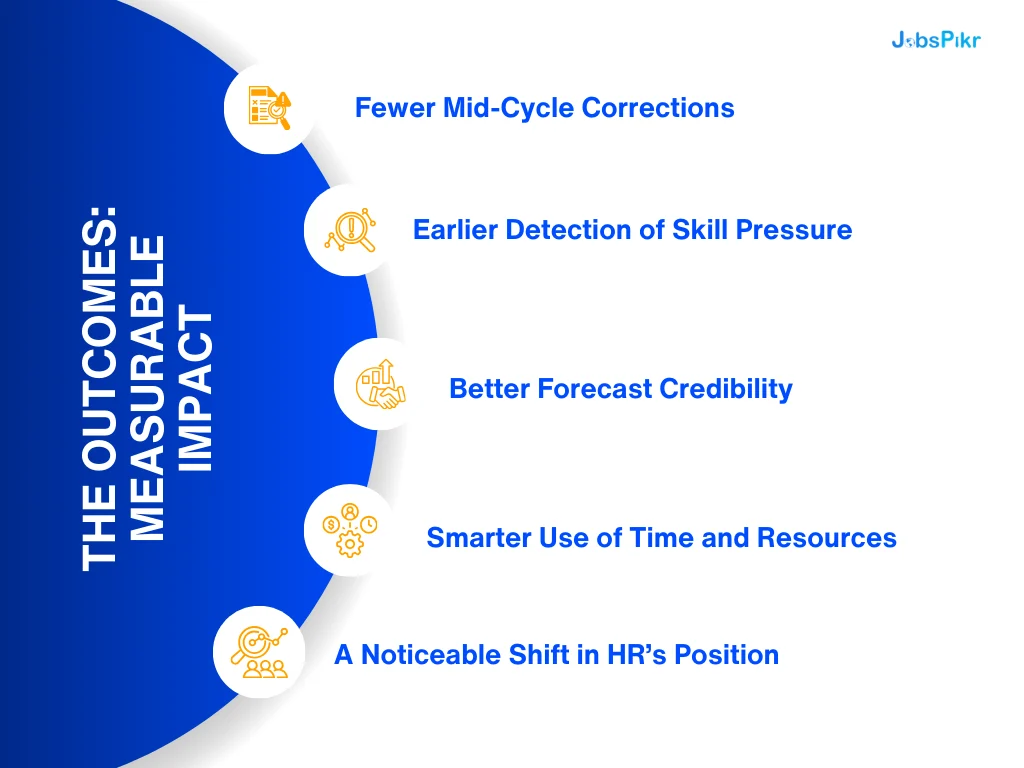
Fewer Mid-Cycle Corrections
In the year before external job data was introduced, it was common for certain roles to blow past hiring assumptions. Digital and analytics functions were the usual pressure points. Headcount had to be re-approved mid-cycle. Compensation ranges were revisited late.
Within twelve months of embedding workforce intelligence into their strategic workforce planning reviews, the frequency of reactive hiring adjustments dropped by roughly 30 percent. That number mattered internally. It meant fewer emergency approvals and fewer uncomfortable finance conversations.
More importantly, the tone shifted. Instead of explaining why something went off plan, the team could show how demand was trending and what they expected to happen next.
Earlier Detection of Skill Pressure
One example stood out.
External job data showed a steady increase in postings related to a specific cloud capability across competitors and adjacent industries. Internally, that skill had not yet surfaced as a shortage.
Because the signal appeared early, the company adjusted its sourcing strategy and initiated targeted internal training before the market tightened further. By the time hiring demand intensified, they were not starting from zero.
Without that external workforce analysis layer, the first signal would likely have been recruiter escalation or declining offer acceptance.
Better Forecast Credibility
Finance did not suddenly become easier to convince. But the conversation changed.
When HR presented hiring projections, they were supported by market-backed job data, not just historical internal averages. Strategic workforce planning discussions began referencing competitor hiring velocity and regional skill concentration trends.
That external validation increased confidence in hr forecasting models. Budget approvals became less about challenging assumptions and more about evaluating risk scenarios.
Smarter Use of Time and Resources
Before JobsPikr, external market research required manual effort. Analysts pulled job boards, compiled spreadsheets, and reconciled inconsistent role titles. It was slow and rarely comprehensive.
After implementation, structured job data fed directly into their planning dashboards. The team estimated that more than half of the time previously spent collecting and cleaning external information was eliminated. That capacity was redirected toward scenario modeling and deeper workforce analysis.
The output quality improved without increasing team size.
A Noticeable Shift in HR’s Position
The most subtle outcome was also the most important.
Strategic workforce planning was no longer framed as an HR forecast that might need revision later. It became part of enterprise risk and growth planning. Workforce intelligence began appearing in executive and board-level discussions.
HR moved from explaining surprises to identifying patterns.
For a company of this size, that shift changed how workforce planning was perceived. It was no longer administrative. It was strategic.
What Changed: Before vs. After
Below is a simple snapshot of how strategic workforce planning evolved once external job data and workforce intelligence became embedded in the process.
| Before JobsPikr | After JobsPikr |
| Annual, assumption-heavy workforce planning cycle | Rolling, signal-informed strategic workforce planning reviews |
| Internal data only: headcount, attrition, hiring history | Internal data combined with structured external job data |
| Reactive response to skill shortages | Early visibility into emerging skill demand |
| Hiring surprises triggered budget revisions | Fewer mid-cycle corrections and more stable forecasts |
| HR defending forecast gaps | HR presenting market-backed workforce intelligence |
| Manual labor market research | Automated, normalized job data integrated into dashboards |
| Workforce planning seen as HR process | Workforce planning positioned as enterprise strategy input |
This shift did not happen because the company changed its planning calendar. It happened because the inputs changed.
Before, workforce planning relied on what the organization already knew about itself. After, strategic workforce planning incorporated what the market was signaling in real time.
The difference was not cosmetic. It reduced friction, improved confidence in hr forecasting, and made workforce analysis a forward-looking function instead of a historical one.
Build Market-Backed Workforce Plans
Discover how JobsPikr powers strategic workforce planning at enterprise scale.
The Broader Implication: Why This Matters for Enterprise HR
This case is not just about one Fortune 500 company. It reflects a broader shift in how enterprise HR functions need to operate.
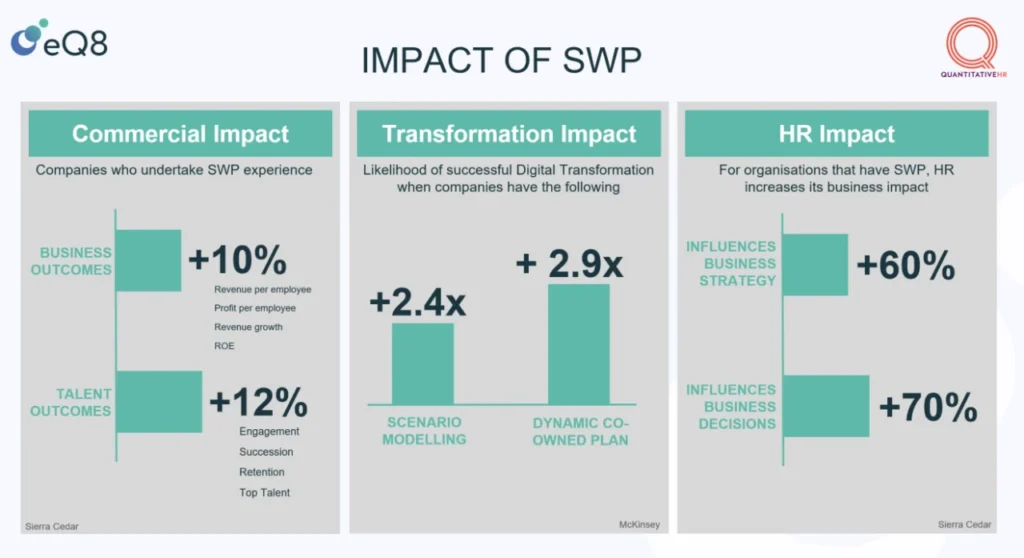
Image Source: myHRfuture
At large scale, strategic workforce planning cannot depend only on internal metrics. Headcount reports, attrition models, and hiring history are necessary, but they are incomplete. They describe internal movement. They do not describe market movement.
The labor market today changes faster than most annual planning cycles. Public data confirms that job openings and hiring activity can shift meaningfully within months. The U.S. Bureau of Labor Statistics’ Job Openings and Labor Turnover Survey regularly shows fluctuations in job openings across industries and regions year over year. Those shifts do not wait for internal planning reviews.
For CHROs and Strategy leaders, this creates a structural challenge. If workforce planning is disconnected from external job data, it will always lag. That lag turns into hiring surprises, budget strain, and delayed skill investments.
What this company recognized is that workforce intelligence is not a recruiting enhancement. It is infrastructure. When structured job data feeds directly into workforce analysis and hr forecasting, the planning conversation changes.
Instead of asking, “Can we hire this?” after a growth decision is made, leaders begin asking, “What does the market signal about this capability?” before committing capital.
This is where data infrastructure and AI readiness intersect. Organizations investing in AI, digital transformation, or new product lines need forward-looking visibility into talent supply and demand. Strategic workforce planning becomes part of enterprise risk management.
The implication is straightforward. Enterprises that treat job data as a strategic asset will anticipate market shifts earlier. Those that rely solely on internal data will continue adjusting after the fact.
For HR leaders operating at scale, the choice is no longer about whether to modernize workforce planning. It is about whether they are comfortable planning without market visibility.
Key Takeaways for CHROs and Strategy Leaders
After a year of operating with an external workforce intelligence layer, a few lessons became clear. None of them were theoretical. They were learned in real planning cycles, with real budget pressure behind them.
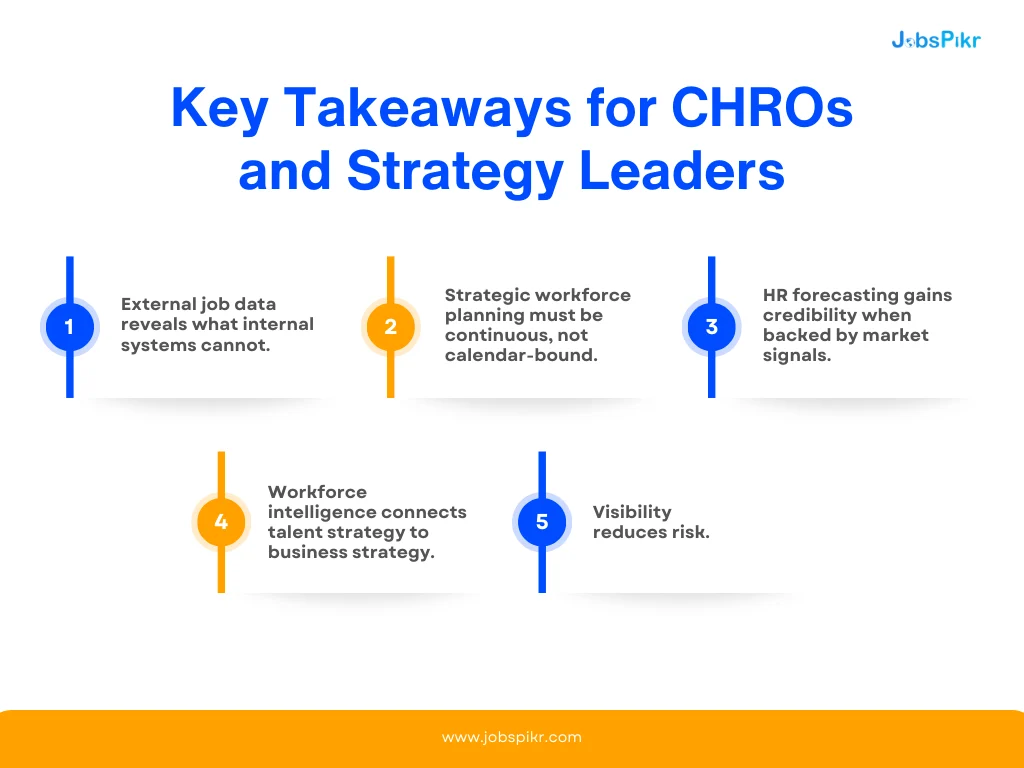
External job data reveals what internal systems cannot.
Internal workforce analysis shows attrition, mobility, and historical hiring velocity. It does not show how aggressively competitors are hiring for the same skills or how demand is shifting across regions. Structured job data adds that missing dimension. Without it, strategic workforce planning remains partially blind to external pressure.
Strategic workforce planning must be continuous, not calendar-bound.
An annual cycle is necessary for budgeting. It is not sufficient for anticipating talent shifts. The company’s shift to rolling reviews supported by workforce intelligence allowed them to adjust posture before hiring friction became visible in recruiting metrics.
HR forecasting gains credibility when backed by market signals.
Finance leaders are more likely to trust projections when they are grounded in observable labor-market movements. When workforce planning integrates external job data, forecasts move from opinion-based to evidence-backed. That credibility changes executive conversations.
Workforce intelligence connects talent strategy to business strategy.
Hiring plans are not isolated HR decisions. They are growth decisions. When workforce planning incorporates real-time demand signals, business leaders gain clarity on whether expansion timelines are realistic based on market conditions.
At enterprise scale, strategic workforce planning increasingly shapes overall talent acquisition strategy. When workforce intelligence informs which skills are tightening, which regions are saturating, and where competitors are investing, recruiting priorities shift accordingly. Talent acquisition becomes proactive rather than reactive, grounded in market signals instead of last-minute requisition pressure.
Visibility reduces risk.
The organizations most exposed to workforce surprises are often those with the most internal data. What reduces risk is not more internal reporting. It is the external context. Strategic workforce planning becomes stronger when it sees both sides: internal capacity and external demand.
For this Fortune 500 company, the shift was not dramatic. It was structural. And structural changes tend to last.
From Visibility to Control
This Fortune 500 company did not overhaul its workforce planning process overnight. It did not replace its HR systems or redesign its organizational structure. What it changed was the quality of visibility behind its decisions.
Before, strategic workforce planning relied heavily on internal signals. Those signals were accurate but incomplete. Market shifts were felt only after they started affecting hiring outcomes. By then, the response was reactive.
After embedding structured job data into its planning rhythm, the company gained something it did not previously have: early awareness. Workforce analysis became connected to real labor market movement. Hr forecasting was grounded in observable demand trends. Planning conversations shifted from explaining surprises to evaluating scenarios.
The difference was not cosmetic. It reduced friction across HR and Finance. It improved alignment with business growth plans. It strengthened confidence at the executive level.
Strategic workforce planning, when supported by workforce intelligence, stops being a static annual exercise. It becomes an ongoing capability. And at enterprise scale, that capability is what separates organizations that chase talent from those that anticipate it.
Build Market-Backed Workforce Plans
Discover how JobsPikr powers strategic workforce planning at enterprise scale.