- **TL;DR**
- Why “More Job Data” Is Not the Same as Better Workforce Intelligence
- The Hidden Problems with Raw Job Data Used for Workforce Planning
- Turn Job Market Data into Workforce Intelligence You Can Trust
- How Ethical and Compliant Job Data Collection Works at Scale
- Raw Job Data to Structured Talent Data: The Steps That Make Insights Reliable
- How JobsPikr Structures Job and Talent Data for Workforce Intelligence
- Turn Job Market Data into Workforce Intelligence You Can Trust
- Turning Structured Job Data into Actionable Workforce Intelligence
- Workforce Intelligence as a Strategic Capability, Not Just Analytics
- Why Trust Matters in Workforce Intelligence for Enterprise Decisions
- How Enterprises Use JobsPikr Workforce Intelligence in Practice
- Turn Job Market Data into Workforce Intelligence You Can Trust
- From Job Data to Decision-Ready Workforce Intelligence
- Turn Job Market Data into Workforce Intelligence You Can Trust
- FAQs
**TL;DR**
If you have ever tried using raw job postings for workforce planning, you already know the problem. It looks like “data,” but it behaves like chaos.
The same role shows up five different ways. Locations are written inconsistently. Staffing firms repost the same jobs. Titles are all over the place. Skills are messy. Some listings are outdated, some are duplicates, and many are missing the context you need to trust the insight.
So yes, you might have job market data. But that does not automatically give you workforce intelligence.
Workforce intelligence is what you get after the hard work is done. You collect job data responsibly. You clean it. You normalize roles, locations, companies, and seniority. You enrich it with skills and structure. Then you run an analysis that answers real questions, like:
- Which skills are becoming harder to hire for, and where?
- Are competitors speeding up hiring in certain functions?
- Are roles changing quietly, even when the titles stay the same?
- Which locations are turning into talent pressure zones?
That is the difference JobsPikr is built for. JobsPikr is not “more job data.” It is job data turned into something decision-ready, so people analytics and workforce planning teams can stop arguing about whether the data is reliable and start using it.
Why “More Job Data” Is Not the Same as Better Workforce Intelligence
When teams first start working with job market data, the instinct is simple: get more of it. More postings. More sources. More coverage across countries and industries. The assumption is that scale alone will reveal patterns.
In practice, the opposite usually happens.
More job data often means more confusion. The same role appears multiple times under slightly different titles. Staffing firms repost the same opening across platforms. Old listings sit in the dataset long after the role is closed. Locations are inconsistent. Skills are written differently by every employer. Before long, the dataset grows, but confidence in the insights shrinks.
This is the core reason why volume does not automatically translate into workforce intelligence.
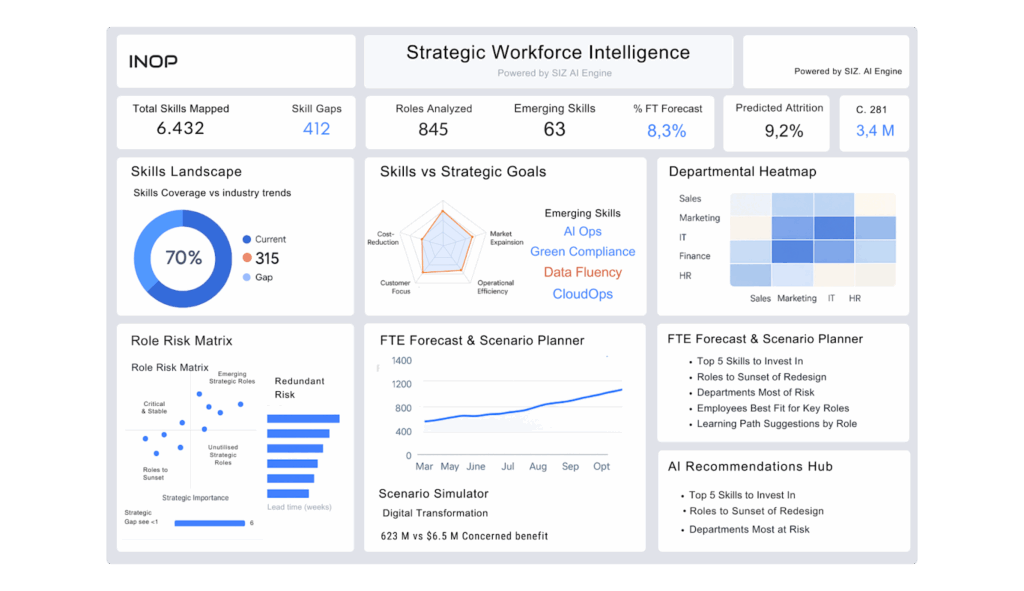
Image Source: INOP
Raw job data captures activity, not meaning
Job data records what companies choose to post. It does not explain intent, priority, or impact. A single role reposted ten times can look like aggressive hiring when it is actually a sourcing issue. A drop in postings can look like a slowdown when the hiring simply moved to referrals or internal mobility.
Workforce intelligence adds interpretation. It separates signal from noise and helps teams understand what the activity actually represents in the labor market. Without that layer, job market data can easily lead to overreactions or false conclusions.
Inconsistent job data breaks comparison and trend analysis
One of the biggest issues with raw job data is inconsistency. Titles, skills, seniority levels, and even locations are described differently across companies and regions. A “Lead Engineer” in one organization might be equivalent to a “Senior Engineer” in another. Some roles list detailed skill requirements, while others stay vague.
When teams try to compare hiring trends across competitors or markets, these inconsistencies distort the picture. Trend lines look volatile. Benchmarks feel unreliable. Leaders start questioning whether the data can be trusted at all.
Workforce intelligence depends on normalization. Without a consistent structure, analysis across time, companies, or geographies simply does not hold up.
More data increases bias and noise if controls are missing
Job postings reflect employer behavior, and that behavior is not neutral. Language choices, sourcing strategies, and posting habits introduce bias into the data. Certain roles are over-posted. Certain regions are underrepresented. Certain skills are emphasized even when they are not critical.
When more job data is added without bias controls or validation, these distortions become stronger. Instead of clarifying the labor market, the dataset amplifies existing blind spots.
Workforce intelligence requires deliberate checks to prevent this. Bias does not disappear at scale. It multiplies unless it is managed.
Why workforce intelligence starts with trust, not scale
Enterprises do not make high-stakes workforce decisions because a chart looks interesting. They act when they trust the underlying data. Trust comes from accuracy, consistency, transparency, and repeatability, not from sheer volume.
This is why workforce intelligence should be treated as a designed system, not a raw feed. Collection matters. Cleaning matters. Structure matters. And context matters.
JobsPikr is built around this idea. The goal is not to deliver “more job data,” but to deliver workforce intelligence that teams can rely on during planning cycles, strategy reviews, and executive discussions.
The Hidden Problems with Raw Job Data Used for Workforce Planning
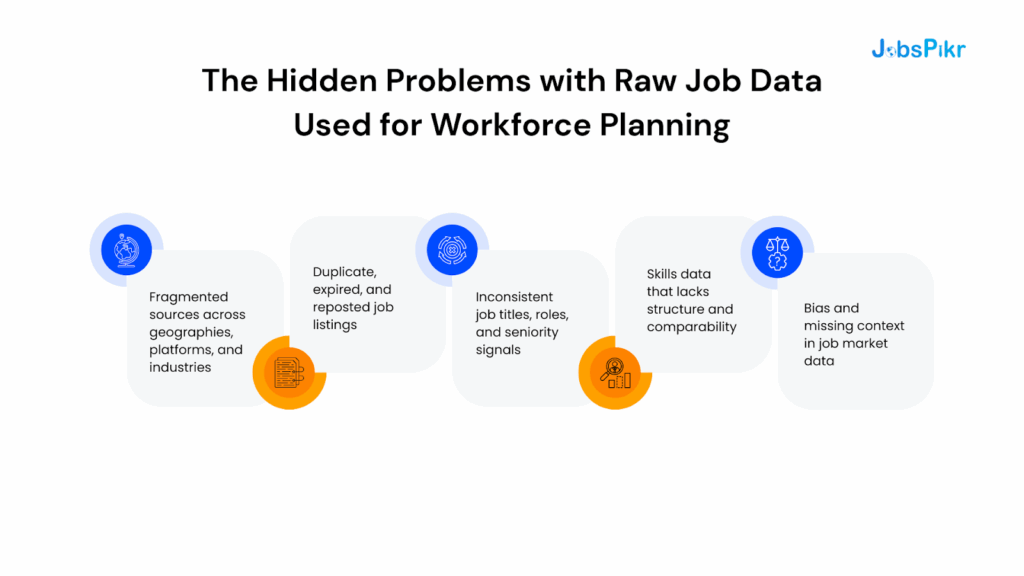
On paper, job data looks like an objective reflection of the labor market. In reality, it is one of the messiest data sources an enterprise will ever touch. The issues are not always obvious at first glance, but they surface quickly once teams try to use job market data for workforce planning or strategic analysis.
What makes this tricky is that none of these problems show up as clear errors. Dashboards still load. Charts still move. But the insights underneath are shaky.
Fragmented sources across geographies, platforms, and industries
Job data does not come from a single, clean source. It is scattered across company career pages, job boards, staffing platforms, and regional portals. Each source follows its own conventions. Some emphasize titles. Others focus on skills. Some are updated daily, others sporadically.
When data is pulled together without careful alignment, fragmentation becomes a silent issue. A hiring spike in one dataset might not appear in another. Certain regions look underrepresented simply because the sources covering them are weaker. Over time, this fragmentation makes it hard to answer even basic questions consistently.
For workforce planning teams, this creates uncertainty. Decisions start depending on which dataset someone happens to trust more.
Duplicate, expired, and reposted job listings
One of the biggest distortions in raw job data comes from duplication. The same role can appear multiple times because it was reposted, syndicated, or advertised by multiple staffing firms. Expired jobs often remain live in datasets long after hiring has stopped.
Without strong deduplication and freshness checks, hiring demand can look far higher than it actually is. This is especially risky when job data is used to estimate talent shortages or hiring velocity.
Workforce intelligence depends on understanding real demand, not inflated posting activity.
Inconsistent job titles, roles, and seniority signals
Job titles are not standardized, and employers are not consistent in how they describe roles. A “Growth Analyst” at one company may perform the same work as a “Marketing Data Analyst” at another. Seniority is implied differently across postings, sometimes through titles, sometimes through experience ranges, and sometimes not at all.
When teams analyze job data without normalizing these differences, they end up comparing unlike roles as if they were the same. This weakens skills analysis, demand forecasting, and role benchmarking.
Workforce planning requires clarity. Inconsistent role definitions undermine that clarity.
Skills data that lacks structure and comparability
Skills are often buried inside free-text job descriptions. Employers list them differently, group them inconsistently, or omit them altogether. Some postings are overly detailed, while others stay generic.
Raw skills data is difficult to analyze at scale without extraction, standardization, and validation. Without those steps, it becomes nearly impossible to track how skill demand is changing or which capabilities are becoming critical across roles.
This is where many talent data projects stall. The skills exist in the data, but they are not usable.
Bias and missing context in job market data
Job postings reflect how companies choose to present roles, not always how work is done. Language bias, aspirational requirements, and copy-paste descriptions introduce distortions. Certain skills may be listed as “must-haves” even when they are rarely used. Others may be omitted entirely.
If this context is ignored, workforce intelligence can drift away from reality. Planning decisions based on biased or incomplete signals can lead to over-hiring, under-investment in reskilling, or missed market shifts.
Why do these issues compound over time
None of these problems exist in isolation. Fragmentation amplifies duplication. Inconsistent titles weaken skills analysis. Bias grows as datasets scale without controls. Over time, teams lose confidence in their workforce analytics, even if the tools themselves are powerful.
This is why workforce intelligence cannot be an afterthought. The transformation from raw job data to reliable labor market insights has to be intentional from the start.
Turn Job Market Data into Workforce Intelligence You Can Trust
See how JobsPikr transforms raw job data into structured, decision-ready workforce intelligence for planning, hiring, and strategy.
How Ethical and Compliant Job Data Collection Works at Scale
Before job data ever turns into workforce intelligence, there is a basic question that needs answering. Where does this data come from, and can you trust how it was collected?
This part rarely gets attention, but it matters more than most teams realize. If the collection layer is shaky, everything built on top of it is at risk.
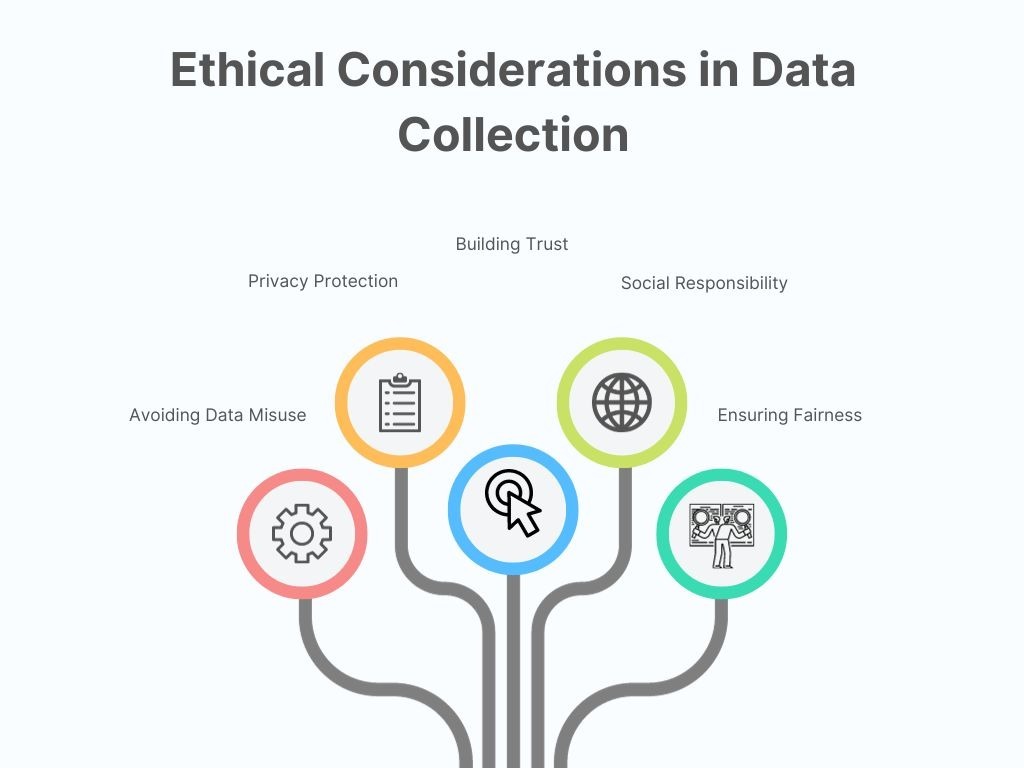
Image Source: PromptCloud
Where large-scale job market data actually comes from
Most enterprise job market data is pulled from a mix of public company career pages, job boards, and regional employment portals. Some roles appear directly from employers. Others come through staffing firms or aggregators.
Each source behaves differently. Some update postings daily. Some leave jobs live for months. Some reuse the same descriptions across roles. None of them follows a shared standard.
That means job data does not arrive clean. It has to be collected carefully, with an understanding of how each source behaves, or you end up mistaking platform behavior for hiring intent.
Why ethical collection is not just a legal checkbox
Ethical job data collection is not about scraping everything that is visible and hoping for the best. It involves respecting platform policies, collecting only what is necessary, and maintaining clear boundaries around how the data is used.
Enterprises care about this because risk does not stop at legal exposure. Questionable data practices damage trust internally. People analytics teams need to be able to explain where insights come from and why they are defensible.
Workforce intelligence that cannot be explained is not intelligence. It is noise with charts on top.
Compliance across regions is harder than it looks
Labor market data is global by nature, but compliance is local. Different regions have different expectations around data handling, retention, and transparency. What is acceptable in one market may raise concerns in another.
This is especially important when job data feeds into HR data systems or planning tools. Once insights cross internal boundaries, they need to hold up to scrutiny from legal, security, and leadership teams.
A compliant collection process reduces friction later. It allows workforce intelligence to move freely across the organization without constant revalidation.
Why trust starts before analytics even begin
Many teams focus on dashboards, models, and visualizations. Those things matter, but they are downstream. Trust is built much earlier, at the point of collection.
If leaders do not trust how the job data was sourced, they will not trust the labor market insights that follow. They will hedge decisions, delay action, or ignore the analysis entirely.
JobsPikr treats data collection as part of the intelligence layer, not a technical detail to hide. Responsible sourcing, transparency, and governance are what allow workforce intelligence to be used confidently in real planning conversations.
Raw Job Data to Structured Talent Data: The Steps That Make Insights Reliable
This is the part most people underestimate.
Teams think the “hard work” is the analysis. The dashboards. The forecasting. The workforce planning model.
But if the input is messy, your output is basically a confident guess. And job data, in its raw form, is messy by default. So the real work, the work that makes workforce intelligence trustworthy, happens in the middle. The unglamorous part is where you take job data and turn it into structured talent data that behaves like something you can analyze.
When this step is done well, labor market insights start to feel stable. Trends make sense. Comparisons across regions stop breaking. Stakeholders stop arguing about definitions and start discussing decisions.
Cleaning job data to remove noise and duplication
Cleaning is where you stop treating every job posting as equally valid.
Raw job data usually includes duplicates, reposts, syndicated listings, and stale roles that should have been removed weeks ago. If you skip cleaning, your job market data starts exaggerating demand, especially in high-volume roles and staffing-heavy categories.
Good cleaning does not just delete “bad rows.” It applies rules that protect the integrity of trend analysis over time. The goal is simple: when you look at hiring velocity or demand signals, you are seeing real market movement, not platform behavior.
Normalizing job titles, locations, and companies so the data becomes comparable
Normalization is what makes job data usable at an enterprise scale. Without it, every analysis becomes a one-off.
Two companies can post the same role using totally different titles. Two postings can point to the same location but write it differently. One company can appear under multiple brand names, subsidiaries, or spelling variations. If you do not resolve this, you end up comparing apples to a mixed fruit bowl and calling it a benchmark.
Title normalization for accurate role comparison
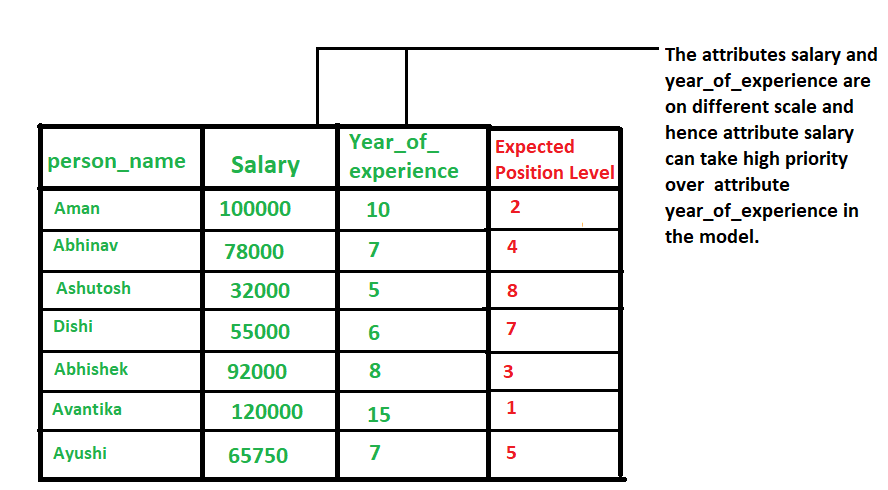
Image Source: Geeksforgeeks
Titles are a mess because employers do not write them for analytics. They write them for humans, sometimes even for branding.
Title normalization maps messy titles into consistent role families so “Sr Data Analyst,” “Data Analyst II,” and “Analytics Specialist” can be evaluated properly. This is how you get talent intelligence that holds up across competitors, regions, and time periods.
Location standardization for reliable geographic labor market insights
Geography is where raw data quietly breaks.
A posting might say “Bengaluru,” another says “Bangalore,” another says “Bangalore Urban,” and someone else uses a generic “India.” If you want workforce intelligence that supports location strategy, you need consistent location fields that roll up cleanly. City, metro, state, country. Same structure across the dataset.
Once locations are standardized, you can actually trust talent supply-demand mapping and geographic shifts in hiring patterns.
Company resolution for clean competitive hiring intelligence
Company names are not stable identifiers. Big enterprises have subsidiaries. Brands change. Parent companies own multiple entities. Job boards sometimes display employer names inconsistently.
Company resolution connects these variations, so your labor market data does not treat the same organization as five different employers. This matters a lot for competitive hiring intelligence, because small naming errors can completely distort competitor comparisons.
Enriching job data with skills, seniority, and role attributes
Cleaning and normalization get you consistency. Enrichment gives you meaning.
Most of the useful signals in job data are buried in text. Skills, tools, certifications, seniority cues, employment type, and remote versus onsite signals. This is where structured talent data begins to look like something you can use for skills gap analysis or workforce planning.
Enrichment also helps reduce ambiguity. A role title alone can be vague. But once you enrich the data with skill requirements and seniority signals, you can see the difference between two roles with the same title that actually belong to different job families in practice.
Turning job postings into analysis-ready labor market data
Once job data is cleaned, normalized, and enriched, it stops behaving like a pile of listings and starts behaving like a dataset.
This is the point where workforce intelligence becomes possible. You can track labor data insights over time without your trend lines getting wrecked by duplicates. You can compare regions without worrying that location formatting is driving the result. You can analyze skill demand trends without manually reading thousands of job descriptions.
In other words, this is where talent data becomes stable enough to support real decisions.
How JobsPikr Structures Job and Talent Data for Workforce Intelligence
Once you have cleaned, normalized, and enriched job data, you are still not “done.” You have something usable, sure, but workforce intelligence needs the data to behave the same way every time someone queries it.
That is what structuring is really about.
It is taking job data and talent data and locking it into a consistent shape so different teams can run analysis without constantly rewriting logic, redefining fields, or second-guessing the output. This is the step that makes workforce intelligence repeatable, not fragile.
Building consistent schemas so job data stays usable across markets
A lot of datasets fail because they are stitched together from multiple sources with inconsistent fields. One source has clean location fields, another does not. One source calls it “seniority,” another calls it “experience level,” and a third hides it inside the description. When you merge everything as-is, you end up with a dataset that technically exists but is painful to use.
JobsPikr approaches this differently. The goal is a consistent, analysis-ready schema where core fields behave the same way across industries and regions. That means standard definitions for role attributes like title, job family, location, company, seniority, skills, and posting timelines.
The result is simple but important. Workforce planning and people analytics teams can ask the same question across different markets and get answers that are comparable.
Creating historical depth so labor market insights are not just “right now”
A single snapshot of job market data is not workforce intelligence. It is a moment in time.
Enterprises need trend context. They need to know what is changing, how fast it is changing, and whether a shift is real or just temporary noise. That requires historical continuity.
JobsPikr structures labor market data to support time-based analysis, so you can track patterns like hiring velocity, role evolution, or skill demand trends over weeks and months without losing consistency. This is where labor market insights become useful for forecasting, not just reporting.
You are not stuck with “what is posted today.” You can understand what has been building up for a while.
Bias controls and data quality checks that keep insights defensible
This part matters if you ever have to defend the insight in front of leadership.
Raw job data carries distortions. Some companies repost aggressively. Some markets rely heavily on staffing firms. Some roles use inflated “nice-to-have” requirements that show up like real demand. If you do not account for that, you can end up treating posting habits as labor market reality.
JobsPikr positions itself as a trust layer by putting quality controls into the pipeline, not as an afterthought. The goal is not perfection; the real world is messy, but the goal is predictable quality. The kind that lets teams use workforce intelligence without attaching caveats every time they share a chart.
When the data is structured with controls, talent intelligence becomes something people can rely on, not something they argue about.
Why structure is the foundation of workforce intelligence, not a “data engineering detail.”
A lot of teams treat structure like plumbing. Necessary, but not strategic.
In workforce intelligence, structure is strategy. If the dataset is inconsistent, your insights will be inconsistent. If your fields mean different things across markets, your benchmarks will be misleading. If your history is unstable, your trend lines will be jumpy and untrustworthy.
Structured talent data is what makes workforce intelligence practical. It is what allows insights to flow into BI tools, HR analytics platforms, workforce planning models, and leadership reviews without falling apart.
Turn Job Market Data into Workforce Intelligence You Can Trust
See how JobsPikr transforms raw job data into structured, decision-ready workforce intelligence for planning, hiring, and strategy.
Turning Structured Job Data into Actionable Workforce Intelligence
This is the point where things finally start to click.
Once job data is cleaned, normalized, enriched, and structured, it stops feeling like an operational burden and starts behaving like intelligence. Not “interesting charts,” but answers to questions that workforce planning and people analytics teams actually get asked.
What changes here is not just the output. It is the confidence with which teams can use it.
Understanding skill demand trends without guessing
Skill demand is one of the most overused and misunderstood signals in talent discussions. Teams often rely on anecdotes or a handful of postings to decide which skills are “hot.”
Workforce intelligence looks at this differently. By analyzing structured job data across time, roles, and regions, you can see which skills are genuinely increasing in demand, which ones are stabilizing, and which ones are quietly fading out.
This matters for more than hiring. Learning and development teams use these signals to prioritize reskilling. Workforce planners use them to assess long-term capability risk. Without clean talent data underneath, skill trend analysis quickly turns into opinion.
Measuring hiring velocity instead of raw posting counts
Posting volume alone does not tell you how aggressively companies are hiring. Some roles stay open longer. Some get reposted repeatedly. Some are exploratory.
Workforce intelligence looks at hiring velocity. How quickly are they opened and closed? How often similar roles appear over time? Whether demand is accelerating or slowing down in specific job families.
This gives teams a better sense of market pressure. A steady increase in velocity often signals real competition for talent. A flat volume with rising velocity can indicate churn or difficulty filling roles.
These are the kinds of labor market insights that influence hiring strategy, not just reporting.
Tracking how roles evolve even when titles stay the same
Job titles change slowly. Work changes faster.
One of the most valuable aspects of workforce intelligence is seeing role evolution through skill requirements. A role may keep the same title for years while the underlying expectations shift significantly.
By analyzing changes in skills, tools, and responsibilities over time, structured job data reveals how roles are transforming in practice. This is especially important for digital, data, and hybrid roles where expectations evolve faster than org charts.
For workforce planning leaders, this insight helps prevent skills mismatch and outdated role definitions.
Mapping geographic talent shifts with real context
Location strategy is no longer just about cost. It is about access, competition, and sustainability.
Workforce intelligence uses structured labor market data to show where talent demand is rising faster than supply, where certain skills are clustering, and where competition is intensifying. This allows teams to make informed decisions about where to hire, where to expand, and where remote or hybrid strategies might make sense.
Without consistent location data and historical depth, these insights are unreliable. With them, they become practical inputs into expansion and workforce distribution decisions.
Identifying workforce risks before they show up internally
The biggest value of workforce intelligence is not explaining what already happened. It is spotting risk early.
Rising demand for scarce skills. Shrinking supply in key regions. Rapid role evolution without corresponding internal capability growth. These signals appear in job market data long before they show up in attrition or productivity metrics.
When talent data is structured and analyzed properly, enterprises can act earlier. Adjust hiring plans. Invest in reskilling. Rethink location strategies. That is the difference between reacting and planning.
Workforce Intelligence as a Strategic Capability, Not Just Analytics
This is where a lot of organizations get stuck.
They treat workforce intelligence as another reporting layer. Something that lives inside dashboards. Something that the people analytics team looks at once a quarter. Useful, maybe, but not central.
That mindset limits the value of the data.
When workforce intelligence is done right, it stops being “analytics” and starts becoming a strategic input. It shapes decisions that affect cost, growth, risk, and long-term competitiveness. It moves out of reports and into planning conversations.
How workforce planning changes when intelligence replaces intuition
Workforce planning often relies on a mix of historical headcount, internal ratios, and leadership intuition. That works until the market shifts faster than your internal data can keep up.
Workforce intelligence brings external reality into the picture. It shows how demand is changing outside your walls, not just what has already happened inside them. When planners can see hiring velocity, skill demand trends, and geographic pressure points in the broader labor market, forecasts become more grounded.
Instead of asking “what did we need last year,” teams can ask “what will be hard to hire next year, and why.”
Using talent data to guide skills and reskilling decisions
Reskilling conversations often start late. By the time a skill gap becomes visible internally, the market has already moved on.
Workforce intelligence helps teams see those shifts earlier. When structured job data shows certain skills appearing more frequently across roles, or new combinations becoming common, it signals where capability expectations are heading.
Learning and development teams can use these labor market insights to prioritize programs that align with real demand, not assumptions. Over time, this reduces the risk of investing in skills that look important internally but are losing relevance externally.
Making supply and demand visible for critical roles
Some roles are always hard to hire. Others become hard quietly.
Workforce intelligence makes this visible by mapping talent supply against demand across regions, industries, and seniority levels. Instead of relying on recruiter feedback alone, leaders can see whether hiring difficulty is a company-specific issue or a market-wide constraint.
This matters when decisions involve trade-offs. Should you open a new location? Expand remote hiring? Adjust role requirements? Workforce intelligence provides the context needed to make those calls deliberately.
Informing market entry and location strategy decisions
Location strategy is often framed around cost and availability. But labor market dynamics are rarely static.
Workforce intelligence shows how talent markets are evolving. Which regions are becoming crowded? Which are emerging quietly. Where competition is intensifying faster than supply.
For enterprises entering new markets or expanding existing ones, these insights reduce uncertainty. They help teams understand not just where talent exists today, but where pressure is building tomorrow.
Competitive hiring intelligence without guesswork
Organizations often want to know what competitors are doing, but internal data can only go so far.
Workforce intelligence uses job market data to reveal competitor hiring patterns, role priorities, and emerging focus areas. This is not about copying behavior. It is about understanding intent.
When competitors begin hiring aggressively for certain skills or roles, it often signals strategic shifts. Seeing those signals early gives enterprises more time to respond, whether that means adjusting hiring plans, accelerating internal development, or rethinking priorities.
Why workforce intelligence needs to be trusted to be strategic
None of this works if teams doubt the data.
Strategic decisions only happen when leaders trust the inputs. If workforce intelligence is seen as “directional” or “rough,” it gets sidelined. If it is consistent, transparent, and defensible, it becomes part of how decisions are made.
This is why workforce intelligence should be built as a capability, not a report. It needs the right data foundation, quality controls, and structure so it can be used confidently across planning, talent strategy, and leadership discussions.
Why Trust Matters in Workforce Intelligence for Enterprise Decisions
At some point, every workforce discussion reaches the same moment.
Someone looks at the numbers. Someone else asks where the data came from. A third person points out an edge case. Five minutes later, the conversation is no longer about what to do; it is about whether the insight can be trusted at all.
That is what breaks most workforce intelligence efforts. Not a lack of data. Lack of trust.
The cost of acting on unreliable labor market data
When workforce intelligence is shaky, teams hesitate. Hiring plans get padded. Expansion decisions get delayed. Reskilling initiatives lose urgency because no one is fully convinced the signal is real.
In some cases, teams act anyway, but they hedge. They run pilots instead of committing. They wait for internal confirmation that may arrive too late. Over time, this creates a gap between how fast the market moves and how fast the organization responds.
The cost here is not just inefficiency. It is a missed opportunity.
Why trust is different for enterprise workforce decisions
Enterprise workforce decisions are not small bets. They affect budgets, headcount, long-term capability, and leadership credibility. When insights feed into these conversations, they are expected to hold up under scrutiny.
That means people need to understand what the data represents, what it does not, and how consistent it is across time and markets. Black-box answers do not work here. Neither does “directional” data that changes meaning every quarter.
Workforce intelligence has to be explainable. If a leader asks why demand for a role looks higher in one region, the answer cannot be “that’s what the chart shows.” It has to be grounded in the data itself.
Accuracy, coverage, and transparency as non-negotiables
Trust in workforce intelligence usually comes down to three things.
Accuracy means the data reflects reality as closely as possible, not platform artifacts or posting noise. Coverage means insights are not skewed because certain regions, roles, or industries are underrepresented. Transparency means teams can trace insights back to their source and logic.
When any of these are missing, confidence drops. Teams stop relying on the intelligence and revert to intuition or anecdotal feedback.
How JobsPikr acts as the trust layer, not just a data provider
JobsPikr is positioned around this idea of trust. Not as a marketing claim, but as a design choice.
The focus is on making job data consistent, structured, and defensible before it ever becomes an insight. That includes how the data is collected, how it is cleaned, how roles and skills are defined, and how trends are calculated over time.
Because of this, workforce intelligence from JobsPikr can move across teams without losing credibility. People analytics teams can use it. Workforce planners can rely on it. Leaders can question it and still come away confident in the answer.
That is what a trust layer does. It reduces friction between data and decisions.
Why trusted workforce intelligence changes how organizations operate
When trust is high, behavior changes.
Teams stop debating definitions and start debating actions. Planning cycles get tighter. Decisions move faster because fewer caveats are needed. Workforce intelligence becomes part of how the organization thinks, not just something it references.
This is the difference between having labor market data and having workforce intelligence that influences outcomes.
How Enterprises Use JobsPikr Workforce Intelligence in Practice
Most companies don’t wake up and say, “Let’s build workforce intelligence.” What usually happens is more practical.
A workforce planning leader is trying to lock next quarter’s hiring plan. The business wants speed. Finance wants discipline. Talent acquisition says a few roles are already becoming painful to fill. People analytics gets asked a familiar question: “What’s happening in the market?”
If the only thing you have is raw job market data, that meeting becomes a debate. If you have workforce intelligence you trust, the meeting becomes a decision.
That is the difference.
It shows up when plans need a reality check, not when someone wants a dashboard
Workforce plans often look fine in isolation. Headcount targets, hiring timelines, and location plans can all seem reasonable until you compare them with what the market is doing.
This is where JobsPikr’s workforce intelligence gets used in a very simple way: as a reality check.
If your plan depends on hiring a hard-to-find skill set in a specific region, the question is not “can we try.” The question is “is that market tightening or loosening right now, and how does that change our odds?” When the data is structured and consistent, you can answer that without hand-waving.
And when you answer that clearly, the whole conversation shifts. Leaders stop talking in vague terms like “we’ll figure it out,” and start talking about trade-offs. Adjust the location. Adjust the skill mix. Increase lead time. Invest in reskilling. Or accept a slower ramp and plan for it.
It gets pulled into BI because leadership wants one version of the truth
In larger orgs, the quickest way for workforce intelligence to become “real” is when it lands inside the same BI environment everyone already trusts.
Not because BI is magical, but because leadership already uses it for revenue, pipeline, cost, and performance. Workforce intelligence becomes more actionable when it sits next to those metrics, not in a separate HR-only report.
Then it stops being “HR’s view of the market” and becomes “the market context we all plan with.”
People analytics teams use JobsPikr data here to make sure job data, labor market data, and talent intelligence are shaped consistently enough that business teams can query it without breaking definitions every time.
It helps TA stop arguing with hiring managers using gut feel
This is a common scene.
A hiring manager says, “This role should not take more than three weeks.” TA says, “It will take longer.” The manager pushes back because they’ve filled it quickly before. TA pushes back because the current pipeline looks thin.
Workforce intelligence helps make that conversation less personal and more factual.
Instead of a recruiter saying “the market is tough,” you can point to labor market insights that show hiring velocity changes, demand patterns, or increased competition in that skill cluster. It does not solve the hiring problem by itself. But it changes the tone of the discussion. It becomes easier to agree on what is happening, which is the first step to agreeing on what to do.
It supports skills conversations that usually get stuck at “we need to upskill”
Skills gap analysis is another area where teams overpromise and underdeliver.
Most organizations know they have skills gaps. The hard part is getting specific. Which skills, in which roles, in which locations, and how fast is the gap widening?
That is where structured talent data matters. JobsPikr’s workforce intelligence is used to spot patterns that are easy to miss internally, like a role family gradually shifting its “default” skill expectations, or a once-common skill becoming less relevant in new job descriptions.
Those are not abstract insights. They influence what L&D prioritizes, what job architectures get updated, and what hiring profiles get rewritten.
It becomes a shared reference point in leadership reviews
Here’s the honest truth: workforce intelligence becomes valuable when it reduces back-and-forth in leadership meetings.
When the data is messy, leaders lose patience quickly. They start treating market insights as “directional.” And once that label sticks, the insights stop influencing decisions.
When the data is dependable, the opposite happens. Workforce intelligence becomes something leaders ask for during planning cycles and business reviews because it adds context they cannot get from internal HR data alone.
That is what JobsPikr is aiming to be in practice: the trust layer that makes job data usable enough to show up in serious conversations, not just in analysis decks.
Turn Job Market Data into Workforce Intelligence You Can Trust
See how JobsPikr transforms raw job data into structured, decision-ready workforce intelligence for planning, hiring, and strategy.
From Job Data to Decision-Ready Workforce Intelligence
By the time teams reach this point, the shift is usually obvious.
They stop asking for “more data.” They start asking for clarity.
That is really what workforce intelligence is about. Not volume. Not coverage for the sake of it. But confidence. Confidence that when you look at the labor market, you are seeing something stable enough to base decisions on.
Raw job data does not give you that. It was never designed to.
Job postings are written for candidates, not analysts. They are shaped by employer habits, job board mechanics, and marketing language. Taken as-is, they are too noisy to guide serious workforce planning.
Workforce intelligence exists to fix that gap.
It takes job data, talent data, and labor market data and puts them through a process that removes distortion, adds structure, and preserves context. What comes out the other side is not just insight, but insight you can explain, defend, and reuse.
Why decision-ready workforce intelligence changes how teams operate
When workforce intelligence is reliable, teams behave differently.
People analytics stops acting as a translation layer for messy inputs. Workforce planning discussions move faster because fewer assumptions need to be debated. Talent leaders can commit to strategies without constantly qualifying the data behind them.
This is especially important in high-stakes situations. Market entry decisions. Large hiring ramps. Role redesign. Reskilling investments. These are not areas where “directional” insight is good enough.
Decision-ready workforce intelligence makes external labor market signals usable alongside internal HR data. It gives teams a shared reference point that reduces friction instead of adding to it.
Why JobsPikr focuses on transformation, not just access
JobsPikr is not positioned around access to job data alone. Plenty of teams can pull postings from somewhere.
The real value sits in the transformation layer. Ethical collection. Cleaning and validation. Normalization across roles, locations, and companies. Enrichment that turns text into structured talent data. Historical continuity that supports trend analysis. Quality controls that keep insights defensible.
That is what turns job market data into workforce intelligence instead of just another dataset.
For enterprises, this matters because workforce decisions are no longer isolated. They connect to growth plans, cost models, risk management, and long-term capability strategy. The data feeding those decisions has to be solid enough to carry that weight.
What “intelligence and trust” actually looks like in practice
Trust does not come from branding. It comes from consistency.
When the same workforce question is asked in two different quarters produces comparable answers.
When insights do not fall apart under follow-up questions. When leaders stop asking “can we rely on this?” and start asking “what should we do about this?”
That is when workforce intelligence is doing its job.
JobsPikr is built to support that outcome. Not as a reporting layer, but as an insights engine that helps enterprises move from raw job data to workforce intelligence they can use.
Turn Job Market Data into Workforce Intelligence You Can Trust
See how JobsPikr transforms raw job data into structured, decision-ready workforce intelligence for planning, hiring, and strategy.
FAQs
1) What is workforce intelligence? How is it different from job data?
Job data is the raw stuff: titles, descriptions, locations, dates, and company names. Workforce intelligence is what you get after you’ve cleaned up that mess and can trust what you’re seeing. The difference shows up the moment someone asks, “So what does this mean for us?” Job data describes. Workforce intelligence helps you decide.
2) Can I use raw job market data for workforce planning, or is that risky?
You can use it, but you’ll spend half your time arguing with the data. Raw job market data is full of duplicates, reposts, stale roles, and inconsistent titles and locations. It can still be useful as a directional signal, but it becomes planning-grade only after it’s been cleaned, normalized, and structured into consistent talent data.
3) What does JobsPikr do differently so the insights are reliable?
The difference is that JobsPikr is built around the transformation layer, not just the collection. It focuses on removing duplication and noise, standardizing roles and locations, and enriching postings with consistent attributes like skills and seniority. That structure is what makes labor market insights hold up when someone asks follow-up questions, compares regions, or looks at trends over time.
4) Is this only useful for HR and people analytics, or do other teams care?
Other teams care when hiring goals and business goals collide. Strategy teams care when they’re looking at new markets. Finance cares when hiring plans affect budgets and timelines. Business leaders care when a growth plan depends on hiring skills that are suddenly scarce. Workforce intelligence becomes shared context when it’s trusted, not a report that lives only inside HR.
5) How often should we refresh workforce intelligence?
If you refresh it once a year, it turns into a “study,” not an operating input. Most teams get value by reviewing it in the same rhythm as planning, usually monthly or quarterly, and then checking more frequently for the roles that are mission-critical. The point is not chasing daily noise; it’s building a clean trend view that stays consistent across time.