
- **TL;DR**
- Key HR Trends Shaping Global Workforce Strategies in 2025
- Aligning Global HR Strategies with Labor and Market Shifts
- The Role of Data Analytics in Global HR Decision-Making
- Navigating Multi-Country HR Compliance and Legal Frameworks
- Turn Global Workforce Insights into Better Decisions
- Best Practices for Building Resilient Global HR Frameworks
- Why Real-Time Labor Market Signals Matter More Than Annual HR Plans
- Elevate Your Global HR Strategy with Data-Driven Insights
- Turn Global Workforce Insights into Better Decisions
- FAQs
**TL;DR**
The way global companies manage people is changing in 2025. Hiring demand is uneven, skills gaps are growing, and workforce expectations differ by region. This article outlines the HR trends shaping global HR strategies today and explains how organizations are responding with smarter workforce planning and data-driven decisions.
As the world of work rapidly evolves, 2025 presents a pivotal moment for HR leaders across the globe to realign their strategies in response to new realities. The shift to hybrid and remote work models, rapid advancements in HR technologies, global economic volatility, and increasing focus on workforce well-being are redefining how enterprises approach human capital.
This article provides a comprehensive overview of the key HR trends influencing global HR strategies.. We explore how multinational organizations can adapt to labor market dynamics, use data-driven insights to strengthen decision-making, and establish resilient HR frameworks to address compliance, cultural, and productivity challenges across borders. Whether your organization operates in five countries or fifty, this guide serves as an essential resource to help you scale smartly and stay competitive.
Key HR Trends Shaping Global Workforce Strategies in 2025
Global workforce changes in 2025 aren’t happening in neat categories. Most HR teams are dealing with several shifts at once, technology changes layered on top of talent shortages, policy changes, and evolving employee expectations. The difference now is that these HR trends are directly influencing how global HR strategies are designed and executed.
Below are the trends that are having the most practical impact on global HR teams today.
Rise of AI and Automation in HR
AI-driven solutions are transforming recruitment, performance management, employee engagement, and learning & development. HR departments are leveraging AI-powered tools to automate candidate sourcing, screen resumes, and predict employee turnover.
According to Gartner during last year, 76% of HR leaders report that their organizations are already using or piloting AI tools in at least one HR function.
Hybrid and Distributed Work Models
The demand for workplace flexibility is here to stay. Remote and hybrid working models are being normalized across industries. This requires new frameworks for performance tracking, employee communication, and team collaboration across time zones.
Employee Well-being as a Core Metric
Burnout and disengagement remain a concern, especially among remote workers. Enterprises are integrating mental health, wellness programs, and digital support platforms as essential components of their HR offerings.
Skills-Based Hiring and Internal Mobility
More organizations are shifting from degree-based hiring to skills-first recruitment. Upskilling and internal mobility strategies are key to retaining top performers and closing critical skills gaps.
DEI and Global Inclusion Efforts
Global HR teams are implementing stronger Diversity, Equity, and Inclusion (DEI) policies to create equitable opportunities for employees from diverse backgrounds. Culturally sensitive DEI strategies that align with regional values and legal frameworks are being prioritized.
Aligning Global HR Strategies with Labor and Market Shifts

One of the biggest challenges for HR leaders in 2025 is that labor markets are no longer moving in predictable cycles. Demand rises quickly in one region, cools off just as fast in another, and skills shortages rarely show up where organizations expect them to. For global teams, this makes alignment between workforce plans and market reality harder and more important than ever.
Strong global HR strategies start with accepting that volatility is the norm. Instead of locking in plans once a year, HR teams are building models that can adjust as hiring demand, compensation benchmarks, and talent availability shift.
Local Talent Planning Is No Longer Optional
Global headcount targets mean very little without regional context. The same role can have vastly different hiring timelines, salary expectations, and talent supply depending on location.
In 2025, HR teams are investing more effort into understanding local labor markets before finalizing hiring plans. This includes tracking:
- How quickly roles are being filled in each region
- Which skills are becoming scarce or oversupplied
- Where competition for talent is intensifying
This kind of visibility allows HR leaders to adjust role locations, shift hiring budgets, or prioritize internal mobility instead of reacting after delays pile up.
Benefits and Compensation Are Becoming More Flexible
Standardized global compensation models are under pressure. Inflation, cost-of-living changes, and local labor regulations vary widely across regions, making uniform approaches difficult to sustain.
As a result, global HR strategies are moving toward adaptable benefits frameworks. Instead of offering identical packages everywhere, organizations define global principles and allow local teams to tailor execution. This helps maintain fairness while respecting regional expectations around healthcare, leave policies, and variable pay.
The goal isn’t complexity for its own sake. It’s relevance. Employees compare offers within their local market, not against global averages.
Workforce Agility Is a Competitive Advantage
In uncertain markets, the ability to redeploy talent quickly matters more than perfect forecasting.
HR teams are building agility by encouraging cross-functional skills, supporting short-term project assignments, and investing in internal mobility platforms. When demand shifts, this allows organizations to move people into priority roles instead of defaulting to external hiring.
For global organizations, agility also means thinking beyond borders. Short-term international assignments, regional hubs, and distributed teams help balance supply and demand when certain markets tighten.
Managing a Growing Contingent Workforce
Freelancers, contractors, and project-based workers are now a permanent part of many global workforce models.
This trend gives organizations flexibility, but it also introduces risk. Compliance, data access, and workforce visibility become harder when large portions of the workforce sit outside traditional employment structures.
In 2025, mature global HR strategies include clear policies for contingent labor—covering vendor management, data security, role classification, and integration with full-time teams. Without this structure, flexibility can quickly turn into fragmentation.
Aligning HR strategies with labor and market shifts isn’t about predicting every change. It’s about building systems that detect change early and give HR leaders room to respond. The organizations that do this well are the ones that treat workforce planning as an ongoing process, not a static exercise.
Global HR leaders need to develop frameworks that are not only scalable but sensitive to regional nuances to maintain compliance and employee satisfaction.
The Role of Data Analytics in Global HR Decision-Making
The integration of HR analytics into global workforce management has become a strategic priority. Data is no longer used just for tracking headcount or payroll—it drives predictive hiring, talent development, and retention strategies. This is why data analytics has become a core pillar of modern global HR strategies.
Predictive Workforce Planning
Traditional workforce reporting looks backward. It tells you how many people you hired, how many left, and where costs increased. Predictive workforce planning, on the other hand, helps HR teams anticipate problems before they affect the business.
In 2025, HR teams are using workforce data to:
- Identify roles with rising attrition risk
- Spot early signs of skills shortages
- Anticipate retirement waves or leadership gaps
- Plan hiring pipelines months ahead
This shift allows HR leaders to move from reactive hiring to proactive planning. Instead of scrambling when a role becomes hard to fill, teams can adjust sourcing strategies, open roles in new regions, or invest in internal upskilling early.
DEI Analytics
In 2025, diversity and inclusion efforts are increasingly measured, not just discussed.
Global HR teams are using analytics to track representation, promotion rates, pay equity, and retention across regions and demographics. This helps identify where outcomes fall short of intent—and where interventions are actually working.
For global organizations, this level of visibility matters. DEI challenges rarely look the same in every market, and aggregated global numbers can hide regional issues. Data allows HR leaders to address gaps with precision rather than broad, ineffective initiatives.
Engagement and Productivity Metrics
Hybrid work has changed how productivity and engagement are evaluated.
Instead of relying on presence or hours logged, HR teams are combining engagement signals, collaboration data, and performance outcomes to understand how work is getting done. Patterns such as excessive meetings, uneven workload distribution, or disengagement spikes in certain regions can signal deeper issues.
These insights help HR teams redesign workflows, adjust expectations, and prevent burnout—before it leads to attrition.
Location Intelligence for Expansion
One of the most practical uses of HR analytics in 2025 is location intelligence.
When organizations expand into new markets or reconsider existing footprints, workforce data plays a critical role. HR teams analyze:
- Talent availability by skill and role
- Compensation benchmarks
- Hiring velocity and competition
- Regulatory and employment constraints
This helps organizations avoid costly expansion mistakes and choose locations that support long-term workforce sustainability.
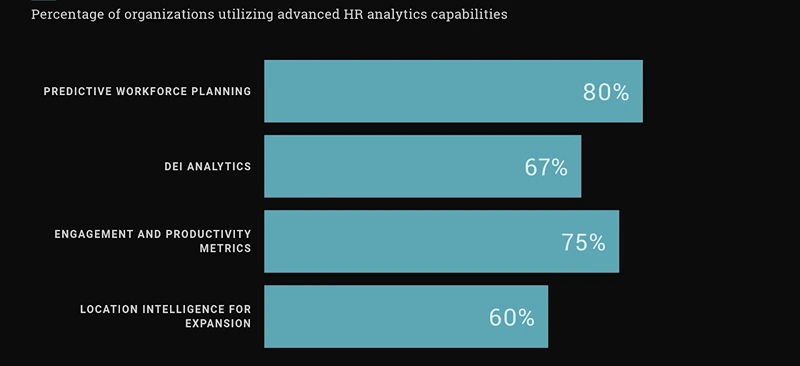
Organizations that invest in people analytics platforms are 5x more likely to make faster and more effective workforce decisions.
Navigating Multi-Country HR Compliance and Legal Frameworks
For global HR teams, compliance is one of those responsibilities that only gets attention when something goes wrong. In 2025, that approach is increasingly risky.
Labor laws are evolving quickly, data privacy expectations are tightening, and governments are paying closer attention to how organizations employ, classify, and pay workers across borders. As a result, compliance has become a central pillar of effective global HR strategies, not a back-office function.
Local Employment Laws
From working hours and holidays to termination clauses, every country has unique rules. Enterprises must stay current on labor law changes, especially in regions with evolving employment frameworks.
Data Privacy and Employee Records
With regulations like GDPR in Europe and data localization laws in countries like China and India, HR teams must maintain secure and compliant employee data management practices.
Global Payroll and Taxation
Multinational companies need accurate payroll processing and benefits administration across currencies and tax systems. Cloud-based payroll platforms and global PEO partners can help manage this complexity.
Cross-Border Mobility and Immigration
HR teams must support compliant employee relocation and visa sponsorship processes while ensuring fair treatment of international employees.
Compliance isn’t a checklist—it’s a living function that must evolve with policy shifts, global economic changes, and regional workforce developments.
Turn Global Workforce Insights into Better Decisions
Build stronger global HR startegies using real-time labor market data on hiring demand, skills, and regional workforce trends.
Best Practices for Building Resilient Global HR Frameworks
By 2025, most global organizations have learned the hard way that fragmented HR systems and rigid policies don’t scale. What works in a single market often breaks down when teams expand across regions with different labor laws, hiring dynamics, and cultural expectations.
Resilient global HR strategies aren’t built on control. They’re built on clarity, flexibility, and visibility into how the workforce is actually behaving.
Below are the practices global HR teams are relying on to stay effective in uncertain conditions.
Unify Technology and Talent Intelligence
Centralizing your global HR operations through an integrated HRIS or HCM platform is no longer optional. Modern HR stacks should include modules for payroll, benefits, compliance, and workforce analytics. Adding tools like JobsPikr can provide labor market intelligence, skill gap forecasts, and benchmarking insights to guide localized strategies with real-time data.
Localize Policies Without Fragmenting Culture
While maintaining a unified corporate identity, HR teams must adapt policies for cultural and legal diversity. This includes adjusting paid leave policies, holiday calendars, communication protocols, and DEI practices to reflect local norms. Leaders should promote a global company culture that respects regional variation.
Build an Agile Talent Supply Chain
Agility in global talent acquisition comes from cultivating internal mobility, reskilling initiatives, alumni networks, and partnerships with global staffing agencies. Enterprises that anticipate labor fluctuations and maintain active pipelines can fill roles faster and minimize business disruption.
Foster Cross-Border Collaboration and Learning
Virtual collaboration tools, internal job marketplaces, and global mentorship programs help employees build relationships across locations. This not only boosts engagement and innovation but also enhances cultural intelligence within global teams.
Conduct Regular Audits and Benchmarking
Routine audits of compliance readiness, compensation fairness, and performance outcomes help HR leaders identify gaps and risks early. Benchmarking HR KPIs such as retention, cost-per-hire, and engagement against industry standards keeps your strategy competitive.
Adopt Adaptive Governance Models
Instead of top-down enforcement, use a federated model that allows local HR managers to operate autonomously within defined global frameworks. This promotes accountability while allowing responsiveness to regional conditions.
These best practices empower organizations to manage complexity, adapt quickly to market changes, and ensure their people strategies remain globally consistent yet locally effective.
Why Real-Time Labor Market Signals Matter More Than Annual HR Plans
For years, global workforce planning followed a familiar rhythm. HR teams reviewed last year’s numbers, aligned with business forecasts, and locked in hiring plans for the next 12 months. In 2025, that approach is increasingly out of sync with reality.
The pace of change in labor markets has simply outgrown annual planning cycles. Hiring demand shifts faster. Skills become obsolete sooner. Regional conditions diverge instead of moving together. As a result, global HR startegies that rely heavily on fixed plans often struggle to keep up.
What’s replacing them is a more dynamic approach—one that uses real-time labor market signals to guide decisions as conditions change.
Annual Plans Break Down When Markets Move Asynchronously
One of the biggest challenges for global organizations is that labor markets no longer behave uniformly.
A role that’s easy to hire for in one country may be nearly impossible to fill in another. Salary benchmarks can rise sharply in one region while stabilizing elsewhere. Regulatory changes, layoffs, or investment shifts in a single market can quickly ripple into hiring outcomes.
When global HR startegies depend on annual assumptions, these regional differences get flattened. The result is delayed hiring, missed talent opportunities, or overspending in the wrong markets.
Real-time labor market data helps HR teams see these differences as they emerge, not after they’ve already caused disruption.
Labor Market Signals Reveal Problems Before They Show Up Internally
Internal HR data often reflects problems after they’ve already materialized—higher attrition, longer time-to-hire, or declining engagement.
External labor market signals provide earlier warnings. For example:
- A sudden rise in job postings for a specific skill may indicate growing competition
- Declining hiring activity in a region may signal cooling demand or structural change
- Shifts in role requirements can point to emerging skill adjacencies
By incorporating these signals into global HR startegies, HR teams gain time to respond. They can adjust sourcing locations, update role definitions, or accelerate upskilling before internal metrics start flashing red.
Skills Demand Changes Faster Than Job Titles
Job titles are slow to change. Skills are not.
In 2025, many organizations are discovering that the skills attached to familiar roles are evolving faster than their job architectures. A role that existed two years ago may now require a very different mix of capabilities.
Real-time labor market data helps HR teams track these changes as they happen. Instead of relying on outdated role definitions, global HR startegies can be grounded in current skill demand—by region, industry, and seniority level.
This makes workforce planning more accurate and learning investments more relevant.
Supporting Faster, More Confident HR Decisions
When HR leaders have access to up-to-date labor market insights, decisions become less speculative.
Questions like:
- Should this role be hired locally or remotely?
- Is this salary range still competitive in this market?
- Should we build this skill internally or hire externally?
become easier to answer with evidence instead of instinct.
This shift is one of the defining changes in global HR startegies for 2025. HR teams are no longer just executing plans—they are continuously recalibrating them based on what the market is doing right now.
From Static Strategy to Continuous Adjustment
The most effective global HR teams are treating strategy as a living system.
They still set long-term goals, but they allow short-term decisions to flex. Hiring plans are reviewed more frequently. Skill priorities are revisited as demand shifts. Location strategies evolve as markets tighten or open up.
Real-time labor market intelligence makes this possible. Without it, even well-intentioned global HR startegies risk lagging behind the workforce realities they’re meant to address.
Elevate Your Global HR Strategy with Data-Driven Insights
Global HR leaders in 2025 must go beyond compliance and talent management—they must architect dynamic, data-driven, and human-centered strategies that respond to continuous change. Whether it’s managing hybrid teams, navigating labor laws across borders, or leveraging analytics to shape workforce design, the role of global HR is more strategic than ever. Sign up with JobsPikr today to power your global HR decisions with real-time labor market data and insights built for cross-border workforce planning.
Turn Global Workforce Insights into Better Decisions
Build stronger global HR startegies using real-time labor market data on hiring demand, skills, and regional workforce trends.
FAQs
What are global HR strategies and why do they matter in 2025?
Global HR startegies define how organizations manage hiring, workforce planning, compliance, and employee experience across multiple countries. In 2025, they matter more than ever because labor markets are changing faster, skills shortages are uneven by region, and employee expectations vary widely across geographies. Without clear global HR startegies, companies struggle to scale, stay compliant, and compete for talent.
How are global HR strategies different from traditional HR planning?
Traditional HR planning relies on static forecasts and standardized policies. Modern global HR startegies are more flexible and data-driven. They adjust based on real-time labor market signals, regional hiring demand, and evolving HR trends such as skills-based hiring and hybrid work. This allows HR teams to respond faster when market conditions shift.
What HR trends are most influencing global HR strategies today?
Several HR trends are reshaping global HR startegies in 2025. These include AI-enabled hiring, skills-first workforce planning, hybrid and distributed work models, increased compliance complexity, and a stronger focus on employee well-being. Together, these trends are pushing HR teams to rethink how roles are designed, where talent is sourced, and how performance is measured globally.
How does labor market data support global HR strategies?
Labor market data helps global HR startegies stay aligned with reality. It shows where talent is available, which skills are becoming scarce, and how hiring competition differs by region. By combining internal HR data with external labor market insights, HR teams can make better decisions about hiring locations, compensation, and workforce planning.
How do global HR strategies balance global consistency with local needs?
Effective global HR startegies set clear global principles while allowing local flexibility. Core standards—such as ethics, compliance, and role frameworks—remain consistent, but execution adapts to regional labor laws, cultural norms, and market conditions. This balance helps organizations stay compliant without losing relevance in local markets.
What role does skills-based hiring play in global HR strategies?
Skills-based hiring is central to modern global HR startegies. Instead of relying on job titles or degrees, organizations focus on skills that transfer across roles and regions. This improves internal mobility, reduces hiring bottlenecks, and helps HR teams respond faster to changing skill demand driven by market and technology shifts.