


- Before You Read: Key Takeaways on Talent Intelligence and Recruiting Efficiency
- Why Most Recruiting Teams Hire Slowly And It Has Nothing to Do With Effort
- Workforce Planning Without Labor Market Data Is Just Guessing With a Spreadsheet.
- What Talent Intelligence Actually Means And What It Is Not
- The Three Intelligence Levers That Drive Recruiting Efficiency
- How Workforce Intelligence Shortens Every Stage of Your Hiring Funnel
- Industry Benchmarks: Time-to-Hire, Cost-per-Hire, and Recruiter Productivity by Sector
- See Talent Intelligence in Action: Global AI Hiring Signals from JobsPikr
- What a Modern Talent Intelligence Stack Looks Like and Where JobsPikr Fits
- How JobsPikr's Global Job Posting Data Powers Smarter Talent Acquisition
- Building a Data-Driven Recruiting Operation: Where to Start and What to Expect
- Recruiting Efficiency Is Not a Speed Problem, It Is an Intelligence Problem
- You Cannot Hire Faster With Data From Six Months Ago
- Frequently Asked Questions About Talent Intelligence and Recruiting Efficiency
Before You Read: Key Takeaways on Talent Intelligence and Recruiting Efficiency
Most recruiting teams are not slow because they lack effort. They are slow because they are making decisions without the right data. When you do not know where the best candidates are, what competitors are paying, or how fast a talent pool is shrinking, every hiring decision takes longer than it should, and recruiting efficiency takes the hit.
Key Takeaways
- Recruiting efficiency is not just about speed. It is about making sharper decisions at every stage of the hiring funnel, from sourcing through offer and close.
- Talent intelligence gives recruiting teams three critical advantages: real-time signals on where talent is available, benchmarks on how competitors are hiring, and live compensation data to make offers that land.
- Workforce intelligence platforms like JobsPikr turn raw job posting data from across the globe into structured insights that help teams source better, move faster, and spend less per hire.
- Traditional sourcing methods and annual labor market reports are too slow for today’s hiring environment. The teams winning on recruiting efficiency are the ones working with data that is current, not data that is six months old.
- Industry benchmarks on time-to-hire and cost-per-hire vary significantly by sector, and knowing where your numbers stand against the market is itself a competitive advantage.
The recruiting teams that consistently hire faster are not necessarily the ones with the biggest budgets or the most headcount. They are the ones making better-informed decisions, backed by real labor market intelligence and that is what recruiting efficiency actually looks like in practice.
Why Most Recruiting Teams Hire Slowly And It Has Nothing to Do With Effort
Picture this. A hiring manager submits a requsition for a senior data engineer. The recruiter posts it on LinkedIn, maybe Indeed, waits a few days, screens whoever applies, and starts chasing passive candidates through InMail. Two weeks in, the pipeline is thin. The hiring manager is asking for updates. The recruiter is doing everything right by the playbook and still falling behind.
This happens constantly, and the reason rarely gets named correctly.
It is not that the recruiter is slow. It is that the playbook itself is outdated. Posting and praying, volume sourcing, and gut-feel offer decisions were built for a labor market that no longer exists. Today, talent pools shift fast. A role that was easy to fill in Austin six months ago might now be fiercely competitive because three well-funded startups opened engineering hubs there. A compensation range that looked solid in Q1 might already be behind the market by Q3. None of that shows up in a job board dashboard.
What actually slows recruiting teams down is the gap between the decisions they need to make and the information they have when making them. Where should we source this role? What should we offer? Is this location the right one, or would we find stronger candidates faster somewhere else? These are not easy questions, and most teams are answering them based on instinct, past experience, or data that is already months old by the time it reaches them.
SHRM puts the average cost-per-hire in the US at around $4,700 and that number climbs sharply once you account for the productivity lost while a seat stays empty. For technical or senior roles, the real cost of a slow hire can reach well into five figures. That is not a sourcing problem. That is a decision-quality problem.
The teams that hire faster are not always the ones with the biggest budgets. More often, they are the ones who know things their competitors do not which markets are heating up, which talent pools are thinning, what the going rate actually is right now. That kind of knowledge does not come from a job board. It comes from talent intelligence, which is worth understanding properly before anything else.
Workforce Planning Without Labor Market Data Is Just Guessing With a Spreadsheet.
Give your workforce planning team the external market context they are missing right now.
What Talent Intelligence Actually Means And What It Is Not
The phrase gets used a lot in HR tech conversations, often interchangeably with “people analytics” or “recruitment data.” But talent intelligence is something more specific, and understanding the distinction matters if you are trying to build a recruiting operation that moves faster.
It Is Not Just Having Access to More Candidate Data
Most recruiting teams already have data. They have applicant tracking systems full of candidate histories, LinkedIn databases, job board analytics, and CRM pipelines. The problem is that most of this data tells you about the past. Who applied before. Who you reached out to six months ago. Which job posts got the most clicks last quarter.
Talent intelligence is not about having more of that. It is about having a different kind of data entirely data that tells you what is happening in the labor market right now, so you can make better decisions about what to do next.
The Difference Between Sourcing Data and Market Intelligence
Here is a practical way to think about it. Sourcing data tells you who is out there. Market intelligence tells you what the conditions are. Both matter, but they answer very different questions.
Sourcing data helps a recruiter build a list. Market intelligence helps a TA leader decide whether that list is worth building in the first place, or whether a different location, a different role title, or a different compensation range would yield better results faster. That strategic layer is what most recruiting operations are missing, and it is exactly what talent intelligence is designed to provide.
What Talent Intelligence Actually Looks Like in Practice
At its core, talent intelligence is the structured analysis of labor market signals job postings, hiring activity, compensation trends, talent flow patterns to inform recruiting decisions before they are made, not after they fail.
When a workforce intelligence platform is analyzing millions of job postings across geographies and industries in real time, it can tell you things like: hiring demand for machine learning engineers in Singapore has increased 34% in the last 90 days, or the median salary range for that role has shifted upward by roughly 12% since last year, or your three closest competitors have all opened reqs for the same profile in the same city in the last two weeks. That is not sourcing data. That is competitive intelligence and it changes how you approach the hire entirely.
Why This Distinction Matters for Recruiting Efficiency
When recruiting teams confuse access to candidates with access to market intelligence, they end up optimizing the wrong things. They focus on response rates and InMail volume when they should be questioning whether they are sourcing in the right place at all. They spend weeks building a pipeline for a role that the market cannot fill at the budget they have been given, and nobody catches it until the req has been open for two months.
Talent intelligence surfaces those problems early. It gives TA leaders the context they need to push back on unrealistic hiring plans, redirect sourcing efforts toward more productive markets, and walk into offer conversations knowing exactly what the market will and will not accept. That is how recruiting efficiency improves not by doing more of the same faster, but by making smarter decisions earlier.
The Three Intelligence Levers That Drive Recruiting Efficiency
If talent intelligence is the engine, these are the three things that make it run. Most workforce intelligence platforms offer some version of all three, but understanding what each one actually does and why it matters at each stage of hiring is what separates teams that use data strategically from teams that just have a subscription they barely touch.
Lever One: Real-Time Talent Availability Signals
This is the most underused intelligence layer in most recruiting operations, and arguably the most valuable.
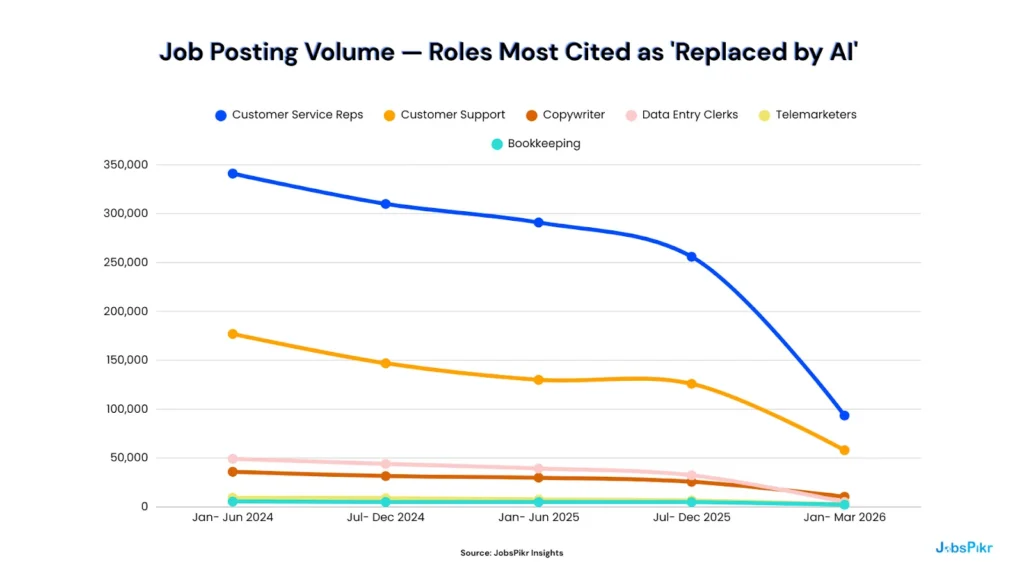
Talent availability signals tell you where the people you are looking for are, how many of them are actively in the market right now, and how quickly that pool is being absorbed by competing employers. This is not the same as running a LinkedIn search and counting profiles. A profile count tells you how many people exist with a certain skill set. A talent availability signal tells you how many of them are realistically reachable, in which markets, and at what velocity.
When a company like a large fintech firm suddenly lays off 400 engineers, that is a talent availability signal. When job postings for a specific role in a specific city drop by 30% over 60 days, that tells you hiring demand is cooling and your sourcing window may be getting more favorable. When postings spike, the opposite is true competition is heating up and your time-to-fill is likely to stretch unless you move fast. Real-time signals like these let recruiting teams act on market conditions rather than react to them after the fact.
JobsPikr tracks these signals across 100 million-plus job postings globally, giving TA teams a live read on talent availability by role, skill, location, and industry.
Lever Two: Competitive Hiring Benchmarks
Most TA leaders have a general sense of who their talent competitors are. But very few have a clear, current picture of exactly what those competitors are doing in the market right now which roles they are ramping up, which locations they are expanding into, how quickly they are moving from posting to fill, and what seniority levels they are targeting.
Competitive hiring benchmarks close that gap. When you can see that a direct competitor has opened 45 new engineering reqs in the last 30 days, all mid-to-senior level, all in markets where you are also hiring, that changes your sourcing strategy. You might move faster. You might adjust your outreach messaging. You might prioritize a market where competition is thinner. None of that is possible if you only find out what competitors are doing after candidates start mentioning it in interviews.
This is one of the more powerful applications of data-driven talent acquisition, turning publicly available hiring activity into structured competitive intelligence that your recruiting team can actually act on.
Lever Three: Market-Driven Compensation Data
Offers fail for a lot of reasons. But compensation mismatch is consistently one of the most common and most avoidable. According to a LinkedIn Talent Trends report, compensation remains one of the top reasons candidates decline offers or drop out of hiring processes late in the funnel.
The problem is not that companies are unwilling to pay competitively. It is that they often do not know what competitive means in real time. Salary bands get set annually. Comp benchmarks come from surveys that are already six to twelve months old by the time they are published. Meanwhile, the market moves continuously.
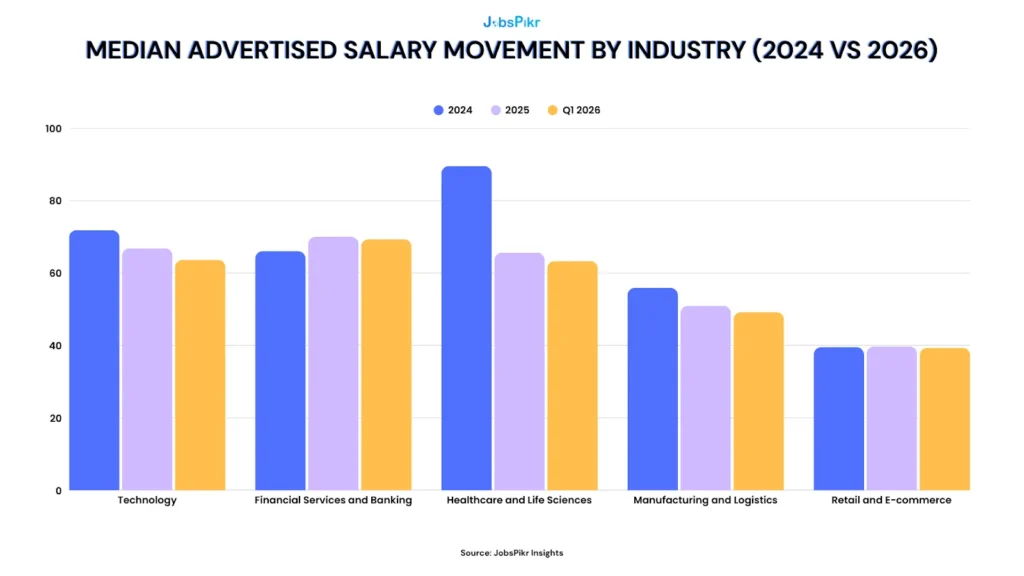
Market-driven compensation data pulls salary intelligence directly from live job postings, what employers are advertising for similar roles, in similar markets, right now. This gives TA leaders and Total Rewards teams a live reference point for offer decisions, rather than relying on data that may already be out of step with candidate expectations.
When these three levers work together, talent availability signals telling you where and when to source, competitive benchmarks telling you how to position your employer brand and pace your hiring, and live compensation data telling you what offers will land recruiting efficiency stops being a vague goal and starts being a measurable outcome.
How Workforce Intelligence Shortens Every Stage of Your Hiring Funnel
One of the most common misconceptions about talent intelligence is that it only helps at the sourcing stage. In reality, the impact of workforce intelligence spans the entire hiring funnel from the moment a requisition opens to the moment an offer is signed. Here is what that looks like at each stage.
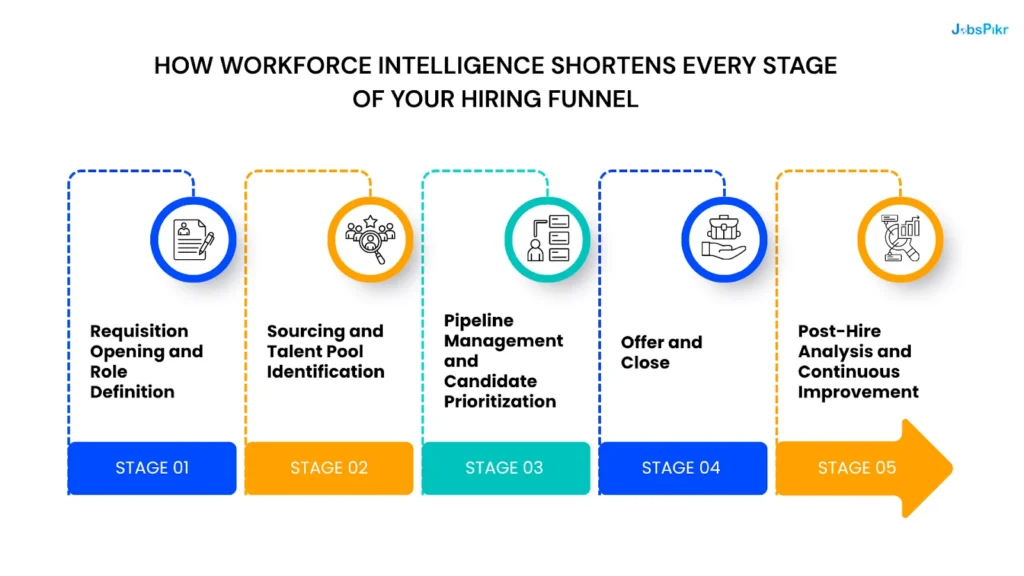
Stage One: Requisition Opening and Role Definition
Most hiring funnels have a problem that nobody talks about enough bad requisition design. A hiring manager writes a job description based on what they think the market looks like, sets a salary range based on what they paid the last person in the role, and hands it to recruiting with a two-week deadline. By the time the recruiter starts working it, the role is already misaligned with the market in at least one or two meaningful ways.
Workforce intelligence changes this at the very beginning. Before a requisition even gets posted, TA leaders can pull labor market insights on how similar roles are being defined by other employers right now, what skills are appearing most frequently, what seniority levels the market is producing, and what compensation ranges are showing up in live postings. That conversation between recruiting and the hiring manager becomes very different when it is grounded in current market data rather than internal assumptions.
This is one of the fastest ways to improve hiring efficiency not by speeding up the funnel, but by making sure the funnel is pointed in the right direction before it starts.
Stage Two: Sourcing and Talent Pool Identification
This is where most teams feel the pain most acutely, and where talent availability data has the most direct impact.
Instead of defaulting to the same sourcing channels and hoping for a strong response rate, recruiting teams with access to workforce intelligence can make deliberate decisions about where to focus. Which markets have the deepest talent pools for this role right now? Is hiring demand from competitors lower, giving you a wider sourcing window? Which skills within the role are readily available, and which are genuinely scarce and may need a different approach?
These are not hypothetical questions. They are answerable questions when you have access to real-time labor market insights. And answering them before you start sourcing rather than after two weeks of thin pipeline is what separates a 30-day fill from a 90-day one.
Stage Three: Pipeline Management and Candidate Prioritization
Once candidates are in the funnel, workforce intelligence helps recruiting teams move faster and make smarter prioritization calls.
When you know that the talent pool for a specific role is thinning because hiring activity in that space is increasing across the market you know you cannot afford to let strong candidates sit in review stages for a week waiting for hiring manager feedback. That context gives recruiting ops leaders real ammunition to push for faster internal SLAs, because the cost of moving slowly is no longer abstract. It is visible in the data.
Competitive hiring benchmarks also matter here. If you can see that competitors are actively ramping hiring for the same profile, you know your pipeline is not sitting still while you deliberate. The candidates you are evaluating are almost certainly in other processes simultaneously. That is a useful thing to know, and it changes how urgently you move.
Stage Four: Offer and Close
This is where compensation intelligence earns its keep most visibly.
According to NACE’s Job Outlook report, offer decline rates remain a persistent challenge across industries, with compensation misalignment consistently cited as a leading factor. When a candidate declines an offer, the cost is not just the lost hire. It is the weeks of pipeline work that preceded it, plus the additional time needed to restart or go deeper into a backup candidate pool.
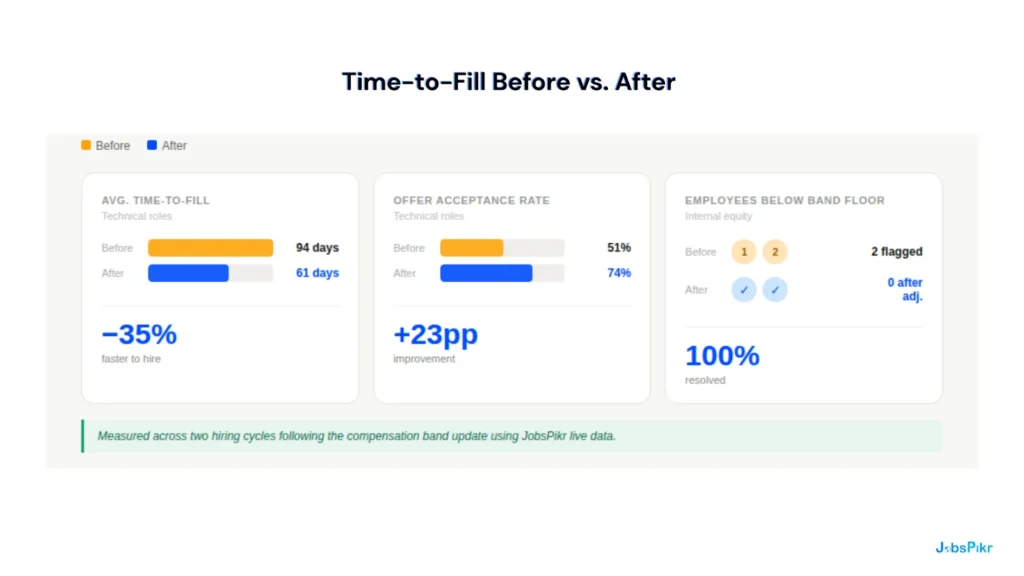
Market-driven compensation data gives recruiting teams and Total Rewards leaders a live benchmark to work from when constructing offers. Instead of anchoring to a salary band that was set 12 months ago, they can see what the market is paying for this role, in this location, right now. Offers get structured with current data behind them, which means fewer surprises at the finish line and stronger close rates.
Stage Five: Post-Hire Analysis and Continuous Improvement
Workforce intelligence does not stop being useful once the hire is made. The same labor market data that informed sourcing and offer decisions can feed into post-hire analysis helping recruiting ops teams understand whether time-to-fill trends are improving, whether certain markets are consistently harder than others, and whether compensation structures are keeping pace with the market over time.
This is what data-driven talent acquisition looks like at a mature level not just using intelligence to make individual hires faster but building an ongoing feedback loop that makes the entire recruiting operation sharper over time.
Industry Benchmarks: Time-to-Hire, Cost-per-Hire, and Recruiter Productivity by Sector
Numbers have a way of making abstract problems very concrete. When a talent acquisition leader tells a Chief Human Resources Officer that hiring is slow, the conversation stays vague. When they say the average time-to-hire for a software engineering role in their organization is 52 days against an industry benchmark of 35 days, the conversation becomes actionable. That is what benchmarks do they give teams a fixed reference point to measure against, and without them, recruiting efficiency improvements are hard to prioritize and even harder to justify to leadership.
Here is what the data shows across key hiring metrics.
Time-to-Hire: Where Most Organizations Are Losing Weeks
Time-to-hire measures the number of days between a candidate entering your pipeline and accepting an offer. It is one of the clearest indicators of recruiting efficiency, and most organizations are not performing as well as they think.
According to SHRM, the average time-to-hire across industries in the United States sits at around 44 days. But that average masks significant variation by sector and role type. Technology and engineering roles routinely run longer often between 50 and 60 days at large enterprises while high-volume roles in retail or logistics can close in under two weeks when sourcing pipelines are healthy.
The gap between best-in-class hiring teams and average ones is not usually explained by recruiter headcount or budget. It is almost always explained by how quickly decisions get made at each stage and decisions get made faster when teams have better information going into them.
Cost-per-Hire: The Metric That Gets Leadership’s Attention
Cost-per-hire captures all internal and external recruiting spend divided by the number of hires made in each period. It is the metric that tends to get Chief Human Resources Officers and procurement leaders most engaged, because it translates recruiting performance directly into financial terms.
As mentioned earlier, SHRM reports the average cost-per-hire in the United States at approximately $4,700. But again, the average obscures a wide range. For senior or highly specialized roles, the real cost including lost productivity while the seat sits empty, hiring manager time, and agency fees where applicable can climb to three or four times the role’s annual salary.
What drives cost-per-hire up most consistently is not advertising spend. It is time. Every additional week a job requisition stays open adds cost in recruiter hours, in hiring manager involvement, and in the compounding productivity loss of an unfilled seat. This is why improving recruiting efficiency has a direct and measurable return on investment that finance teams can get behind.
Recruiter Productivity: The Benchmarks Most Teams Do Not Track
Recruiter productivity is the least standardized of the three-core metrics, but it is arguably the most telling indicator of how well a talent acquisition operation is functioning.
Industry benchmarks suggest that a full-cycle recruiter handling professional roles can manage between 15 and 25 open job requisitions at a time effectively, depending on role complexity and sourcing difficulty. According to LinkedIn’s Global Talent Trends research, recruiting teams that use data and talent intelligence tools report significantly higher confidence in hiring decisions and faster pipeline progression compared to teams relying primarily on manual sourcing methods.
When recruiters spend most of their time on manual sourcing and administrative work rather than on high-value activities like candidate engagement and offer negotiation, productivity suffers and time-to-hire stretches. Workforce intelligence platforms address this directly by reducing the time spent figuring out where to look, and increasing the time spent on the work that moves candidates through the funnel.
Sector-by-Sector: How Benchmarks Vary Across Industries
Recruiting benchmarks are not one-size-fits-all, and applying the wrong benchmark to your industry can lead to misguided conclusions about your team’s performance.
Technology and software companies consistently report the longest time-to-hire figures, largely because the candidate pools for specialized engineering and product roles are genuinely shallow relative to demand. Healthcare and life sciences face similar challenges, particularly for clinical and research roles where credentialing requirements add screening time on top of standard hiring timelines.
Financial services organizations tend to benchmark closer to industry averages for most roles, but see significant stretching of timelines for compliance, risk, and quantitative finance profiles. Retail, logistics, and manufacturing particularly for high-volume hourly hiring operate on entirely different timelines, where time-to-hire measured in days rather than weeks is both achievable and expected.
Understanding which benchmark applies to your sector, your role mix, and your geographic markets is itself a form of talent intelligence. It stops talent acquisition leaders from benchmarking against the wrong number and gives recruiting operations teams a realistic and relevant target to optimize toward.
See Talent Intelligence in Action: Global AI Hiring Signals from JobsPikr
Reading about talent intelligence is one thing. Seeing what it looks like when applied to a real, fast-moving corner of the labor market is something else entirely.
The demo below shows JobsPikr’s Global AI Hiring Signals a live view of how artificial intelligence-related hiring is moving across geographies, industries, and role types in real time. It is a useful illustration of exactly the kind of workforce intelligence we have been talking about throughout this page, applied to one of the most competitive talent markets in the world right now.
What You Are Looking at in This Demo
Artificial intelligence hiring has become one of the most watched segments of the global labor market, and for good reason. Demand for artificial intelligence talent is volatile, geographically uneven, and moving faster than most traditional labor market reports can track. The same role that was in moderate demand six months ago may now be at the center of a bidding war between three well-funded competitors in the same city.
The JobsPikr Global AI Hiring Signals demo gives talent acquisition leaders a structured view of that activity not as a news story, but as actionable labor market data. You can see which regions are seeing the sharpest increases in artificial intelligence hiring demand, which role categories are growing fastest, and how hiring signals are shifting over time across industries.
Why This Matters Beyond Artificial Intelligence Hiring
Even if artificial intelligence roles are not your primary hiring focus right now, this demo is worth watching because it shows the mechanics of how talent intelligence works at scale and those mechanics apply equally to any role category, any industry, and any geography you are hiring in.
The same signals that track artificial intelligence hiring demand can be applied to financial services hiring in Singapore, healthcare talent availability in the midwest United States, or supply chain roles across Southeast Asia. The underlying capability is the same. What changes is the lens you point it at.
This is what a workforce intelligence platform does in practice it takes an enormous, constantly moving body of labor market data and surfaces the signals that are most relevant to the decisions your talent acquisition team needs to make right now.
What This Means for Your Recruiting Efficiency
For talent acquisition leaders watching this with their own hiring challenges in mind, the key takeaway is straightforward. The labor market is producing signals constantly signals about where talent is concentrating, where competition is intensifying, and where windows of opportunity are opening. The question is whether your recruiting operation has the intelligence infrastructure to read those signals and act on them before your competitors do.
The teams that are winning on recruiting efficiency right now are not doing it by working harder. They are doing it by seeing more and seeing it sooner.
What a Modern Talent Intelligence Stack Looks Like and Where JobsPikr Fits
There is a version of this conversation that goes sideways quickly. A talent acquisition leader sees a demo of a workforce intelligence platform, gets excited about the data, and goes back to their organization ready to pitch a new tool, only to realize they are not entirely sure how it fits with the seven other systems their recruiting team is already using. Sound familiar?
This section is meant to prevent that conversation from happening to you.
The Problem With How Most Recruiting Technology Stacks Are Built
Most talent acquisition technology stacks were not designed. They were assembled. An applicant tracking system got implemented first, then a candidate relationship management tool got added, then a sourcing platform, then a job advertising solution, then maybe a recruitment marketing tool. Each one solved a specific pain point at a specific moment in time, and the result is a collection of systems that mostly talk to each other imperfectly and produce data that lives in silos.
The missing layer in almost every stack built this way is market intelligence. The applicant tracking system tells you what is happening inside your pipeline. The candidate relationship management tool tells you about the candidates you have already engaged. The sourcing platform helps you find people. But none of these tools tells you what is happening outside your organization in the labor market, among your competitors, across the geographies and role categories you are hiring in.
That outside-in intelligence layer is what separating a reactive recruiting operation from a genuinely data-driven talent acquisition function.
The Four Layers of a Modern Talent Intelligence Stack
A well-built talent intelligence stack has four distinct layers, each serving a different function in the recruiting operation.
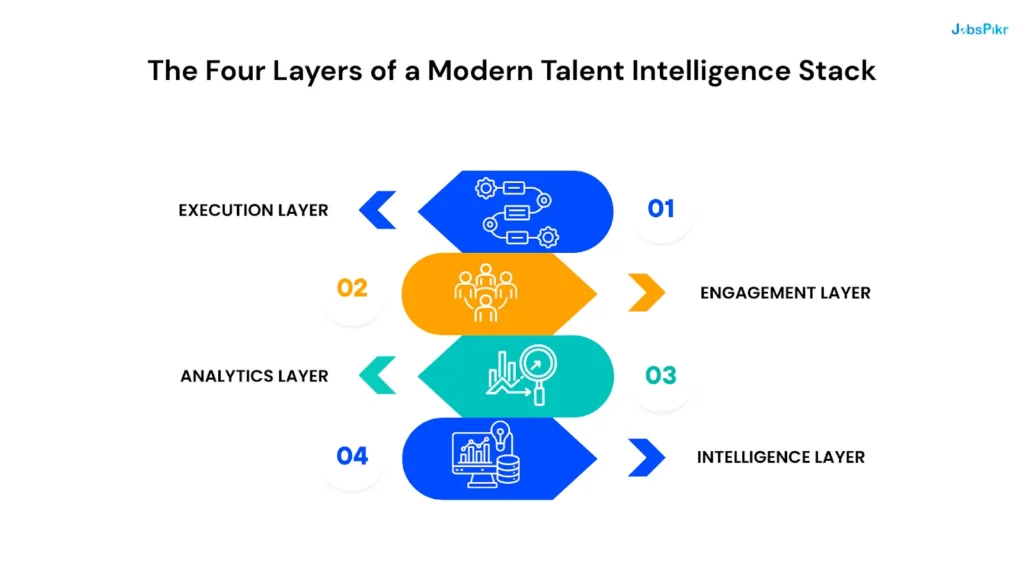
The first layer is the execution layer. This is where the day-to-day recruiting work happens the applicant tracking system, the candidate relationship management platform, the job distribution tools. These are the systems your recruiters live in. They are essential, but they are not intelligence systems. They are workflow systems.
The second layer is the engagement layer. This covers the tools that help talent acquisition teams build and maintain relationships with candidates’ recruitment marketing platforms, talent community tools, employer brand assets. Again, essential. But still internally focused.
The third layer is the analytics layer. This is where recruiting operations teams measure performance time-to-hire dashboards, pipeline conversion reporting, source-of-hire analysis. Most mature talent acquisition functions have something here, even if it is just a collection of spreadsheets and applicant tracking system reports. The problem is that this layer almost always looks backward. It tells you what happened. It does not tell you what is happening in the market right now.
The fourth layer and the one most stacks are missing is the intelligence layer. This is where workforce intelligence platforms like JobsPikr sit. The intelligence layer provides the external market context that makes every other layer more effective. It tells your execution layer where to focus sourcing. It informs your engagement layer about what messaging will resonate with candidates in a particular market. It gives your analytics layer an external benchmark to measure internal performance against. Without this layer, the rest of the stack is operating without a map.
Where JobsPikr Fits in the Stack
JobsPikr is not trying to replace your applicant tracking system or your sourcing platform. It sits in that fourth layer the intelligence layer and feeds structured labor market data into the decisions your recruiting team is making across all the other layers.
In practical terms, this means talent acquisition leaders can use JobsPikr to understand talent availability before a job requisition gets posted, monitor competitive hiring activity while a search is in progress, validate compensation ranges before an offer goes out, and benchmark recruiting performance against real market data after a hire is made. That intelligence flows into whatever tools your team is already using whether that is Workday, Greenhouse, Lever, or a custom analytics environment.
JobsPikr connects to existing human resources technology environments through application programming interfaces and structured data feeds, which means the intelligence does not sit in a separate dashboard that nobody checks. It becomes part of the workflow your team already operates in.
The Stack That Actually Drives Recruiting Efficiency
When all four layers are working together, the recruiting operation looks very different from the assembled-by-accident version most organizations are running today.
Job requisitions get opened with market context already built in. Sourcing decisions get made based on where talent is available, not where it was available last year. Offers get constructed using live compensation benchmarks rather than outdated salary bands. And recruiting performance gets measured against external market standards, not just internal targets that may have been set without any reference to what the market was doing.
That is what a modern talent intelligence stack delivers. And for talent acquisition leaders making the case to procurement and finance, it is worth framing it this way: the intelligence layer is not an additional cost. It is the layer that makes every other investment in your recruiting technology stack perform better.
How JobsPikr’s Global Job Posting Data Powers Smarter Talent Acquisition
At this point in the conversation, the natural question is: where does the data come from, and how does it turn into the kind of intelligence we have been describing throughout this page? That is worth answering directly, because the quality and structure of the underlying data is what determines whether a workforce intelligence platform delivers real recruiting value or just produces impressive-looking dashboards that nobody trusts.
The Data Foundation: What JobsPikr Actually Collects
JobsPikr aggregates and structures job posting data from across the global labor market over 100 million job postings tracked across geographies, industries, role categories, and seniority levels. Every time an employer posts a job opening, updates a salary range, changes a job title, or closes a role, that activity creates a signal. Individually, those signals are just hiring announcements. At the scale JobsPikr operates at, they become a continuously updated map of how the global labor market is moving.
The data covers job postings from over 50 countries, spanning North America, Europe, Asia Pacific, the Middle East, and Latin America. This matters for enterprise talent acquisition teams that are not hiring in a single market they are managing talent pipelines across multiple geographies simultaneously, and they need intelligence that reflects the full scope of where they are competing for talent.
From Raw Job Postings to Structured Intelligence
Raw job posting data on its own is not particularly useful for recruiting decisions. A job posting is an unstructured document it has a title, a description, a location, sometimes a salary range, and a collection of skills and requirements written in whatever language the hiring manager happened to use that day. Two companies hiring for essentially the same role might describe it in completely different terms. Without standardization, you cannot compare them meaningfully.
This is where JobsPikr’s data processing layer does the heavy lifting. Job titles get normalized across a standardized taxonomy so that a “machine learning engineer,” a “ML engineer,” and an “artificial intelligence software engineer” can be analyzed as variants of the same role category. Skills get extracted and mapped to a consistent skills framework. Salary ranges get structured into comparable formats across currencies and pay periods. Location data gets standardized across regional variations and naming conventions.
The result is a clean, structured dataset that talent acquisition teams and workforce planners can use to answer real questions not a raw feed of text that requires a data science team to interpret before it becomes useful.
Three Ways JobsPikr Data Directly Improves Recruiting Efficiency
Talent availability signals that tell you where to source:
When JobsPikr data shows that job postings for a specific role in a specific market have dropped significantly over the past 60 days while the talent pool in that area remains deep, that is a sourcing opportunity. Competition is cooling, which means your outreach is more likely to land. Conversely, when posting volume spikes, you know the sourcing window is tightening and speed becomes more important. These signals give talent acquisition teams a real-time read on market conditions before they commit sourcing resources.
Competitive hiring benchmarks that sharpen your strategy
Because JobsPikr tracks hiring activity across employers, talent acquisition leaders can see how competitor organizations are moving in the market which roles they are ramping, which locations they are expanding into, and at what seniority levels they are hiring. This is not anecdotal intelligence gathered from candidate conversations. It is structured, quantified hiring activity data that can inform sourcing strategy, employer brand positioning, and even workforce planning decisions about where to open new talent hubs.
Compensation data that closes more offers
JobsPikr extracts salary range data from job postings at scale, giving Total Rewards teams and talent acquisition leaders a live benchmark for what employers are advertising for similar roles in real time. This is meaningfully different from an annual compensation survey. It reflects what the market is doing today, not what it was doing when the survey was fielded six or twelve months ago. When offers get built on current market data, they land more often and the cost of late-stage candidate drop-off comes down with them.
The Intelligence Layer That Connects to Your Existing Workflow
One concern enterprise buyer consistently raise when evaluating workforce intelligence platforms is integration. Will the data get used, or will it sit in a separate tool that the recruiting team checks occasionally and eventually stops opening?
JobsPikr addresses this through flexible data delivery options. Talent acquisition teams can access intelligence through JobsPikr’s own analytics interface, but the data can also be delivered via application programming interface into existing human resources information systems, applicant tracking systems, business intelligence environments, or custom analytics dashboards. This means the market intelligence becomes part of the workflow your team already operates in, rather than an additional system competing for attention alongside everything else.
For enterprise organizations with dedicated people analytics or recruiting operations functions, JobsPikr’s structured datasets can feed directly into workforce planning models, headcount forecasting tools, and compensation benchmarking frameworks connecting labor market intelligence to the strategic decisions that sit above the day-to-day recruiting operation.
Why the Data Quality Difference Matters at Enterprise Scale
For a small team making a handful of hires a year, imprecise labor market data is an inconvenience. For an enterprise talent acquisition function managing hundreds of open job requisitions across multiple markets simultaneously, data quality is a strategic variable.
When compensation benchmarks are off, offers fail at scale. When talent availability signals are lagging the market by weeks or months, sourcing strategies get built on outdated assumptions. When competitive hiring intelligence is incomplete, talent acquisition leaders walk into workforce planning conversations without the external context they need to push back on unrealistic hiring timelines or justify budget requests.
JobsPikr’s data processing and normalization infrastructure is built specifically to address these risks at enterprise scale delivering structured, current, and globally consistent labor market intelligence that talent acquisition teams can act on with confidence.
Building a Data-Driven Recruiting Operation: Where to Start and What to Expect
There is a version of the “data-driven recruiting” conversation that stays permanently theoretical. Teams attend conferences, read the research, agree that workforce intelligence is the future, and then go back to doing exactly what they were doing before because nobody is quite sure where to begin. This section is meant to close that gap.
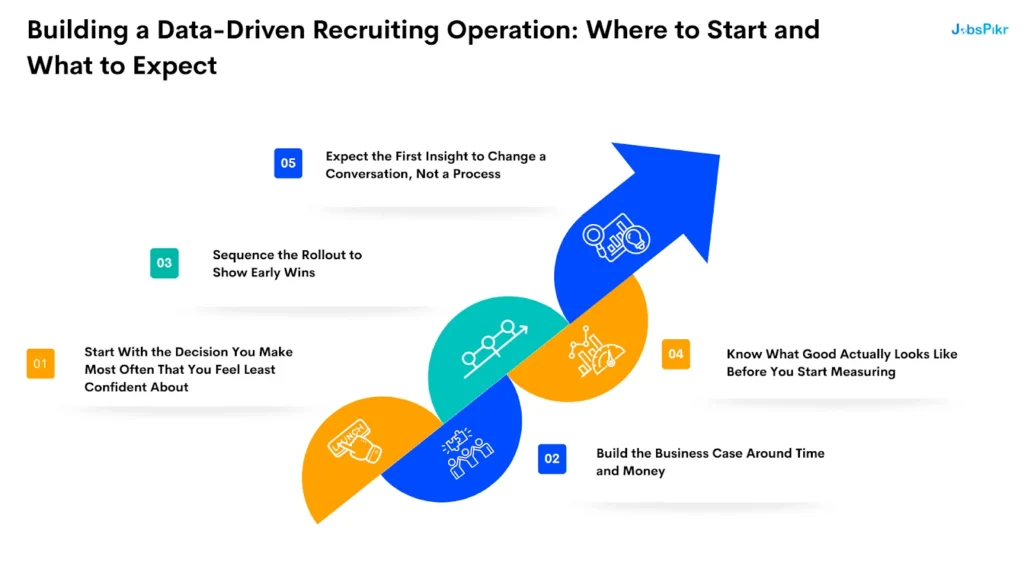
Start With the Decision You Make Most Often That You Feel Least Confident About
This is the most practical starting point for any talent acquisition leader trying to move their operation toward more intelligent recruiting, and it is more useful than trying to boil the ocean with a platform-wide transformation initiative.
Every recruiting team has a version of this decision. For some, it is compensation offers keep getting declined and nobody is entirely sure whether the salary bands are the problem or the candidates are outliers. For others, it is sourcing location the same markets keep getting used out of habit even though the pipelines are getting thinner and the time-to-hire keeps stretching. For others still, it is the conversation with the hiring manager at the start of a search, where the job requisition gets defined based on gut feel rather than any real understanding of what the market will produce.
Pick the decision that causes the most friction in your current operation. That is where workforce intelligence will deliver the fastest and most visible return, and it is the easiest way to build internal confidence in a data-driven approach before expanding it across the full recruiting function.
Build the Business Case Around Time and Money, Not Data
When talent acquisition leaders make the internal case for a workforce intelligence platform, the instinct is often to lead with the data the coverage, the refresh frequency, the normalization methodology. That conversation works well with recruiting operations leaders and people analytics teams. It does not work as well with Chief Human Resources Officers, Chief Financial Officers, and procurement leaders, who are thinking about return on investment and operational risk, not data infrastructure.
The business case that lands with senior leadership connects workforce intelligence directly to the metrics they already care about. Time-to-hire reduced by two weeks across 200 annual hires is not an abstract improvement it is a quantifiable productivity gain that finance can model. Offer acceptance rate improved by 15 percentage points because compensation data is current rather than 12 months old is not a recruiting metric it is a cost avoidance story. Cost-per-hire reduced because sourcing is more targeted and less reliant on expensive external agencies is a procurement conversation, not just a talent acquisition one.
Frame the investment in those terms, and the conversation with leadership becomes significantly easier.
Sequence the Rollout to Show Early Wins
One of the most common mistakes organizations make when implementing a workforce intelligence platform is trying to use it everywhere at once. They onboard the tool, run a training session, and expect the entire recruiting team to immediately change how they work. What usually happens instead is that adoption is patchy, early use cases are poorly defined, and the platform gets underutilized before it has had a chance to demonstrate value.
A more effective approach is to sequence the rollout around two or three high-visibility hiring initiatives where the intelligence will have the most immediate and measurable impact. A large engineering hiring push in a new market is a good candidate. A compensation benchmarking exercise ahead of an annual salary review is another. A competitive intelligence project tied to a workforce planning cycle is a third.
When the first wave of use cases produces visible results faster fills, stronger offer acceptance, better-informed workforce planning decisions adoption spreads organically because the recruiting team has seen the value firsthand rather than being told about it in a training session.
Know What Good Actually Looks Like Before You Start Measuring
Talent acquisition teams that move toward data-driven recruiting sometimes make the mistake of measuring everything immediately, before they have established what the baseline looks like or what improvement target, they are working toward.
Recruiting efficiency is best measured against a clear set of benchmarks ideally a combination of internal historical performance and external market standards for your industry and role mix. Before you start using workforce intelligence to improve time-to-hire, you need to know what your current time-to-hire is by role category and market, and what a realistic improvement target looks like given the talent availability conditions in those markets.
This is where the benchmarking capability of a workforce intelligence platform earns its value not just as a sourcing tool, but as a measurement framework. When you know what the market benchmark is for filling a senior product manager role in London, you have a meaningful external reference point for evaluating whether your 58-day average is a recruiting operations problem, a compensation problem, or simply a reflection of genuine market scarcity for that profile.
Without that external context, recruiting performance measurement tends to collapse into internal comparisons that tell you whether you are getting better or worse relative to your own past performance but not whether your past performance was ever competitive with the market in the first place.
Expect the First Insight to Change a Conversation, Not a Process
This is worth saying plainly because it sets realistic expectations for what workforce intelligence delivers in the short term versus the medium term.
In the first weeks of working with labor market data, the most common outcome is not a dramatic reduction in time-to-hire or a transformational shift in sourcing strategy. The most common outcome is a conversation that goes differently than it would have gone before.
A talent acquisition leader walks into a workforce planning discussion with data showing that the talent pool for a critical role category has shrunk by 30% in their primary hiring market over the last six months. That conversation with a Chief Human Resources Officer, a business unit leader, or a finance team goes very differently when it is grounded in labor market evidence rather than recruiter intuition. Timelines get reset. Budgets get adjusted. Expectations get calibrated to market reality rather than wishful thinking.
That shift from intuition-led conversations to evidence-led ones is where the real long-term value of workforce intelligence accumulates. The time-to-hire improvements and cost-per-hire reductions follow from better decisions made earlier in the process. And better decisions start with better information.
Recruiting Efficiency Is Not a Speed Problem, It Is an Intelligence Problem
The teams that consistently hire faster, spend less per hire, and close more offers are not doing anything dramatically different from everyone else at the surface level. They are still posting jobs, screening candidates, and extending offers. What is different is the quality of information behind every one of those steps.
Talent intelligence does not replace the judgment of a great recruiter or the instincts of an experienced talent acquisition leader. What it does is give that judgment something solid to stand on. When you know where talent is available right now, what your competitors are doing in the market this week, and what compensation ranges are landing versus falling flat every decision in the hiring funnel gets sharper. Sourcing gets more targeted. Pipelines fill faster. Offers land more often. And the cost of each hire comes down not because you cut corners, but because you stopped spending time and money in the wrong places.
The labor market is not going to slow down and wait for recruiting operations to catch up. Talent pools shift, compensation expectations move, and competitive hiring pressure builds faster than annual benchmarking cycles can track. The organizations that close the intelligence gap now are the ones that will have a measurable and compounding advantage in talent acquisition over the next several years.
JobsPikr exists to be that intelligence layer the data brain behind a modern talent acquisition strategy that is built on current market reality, not historical assumption.
You Cannot Hire Faster With Data From Six Months Ago
JobsPikr gives your talent acquisition team a live read on the market, so every sourcing decision, every offer, every hiring call is made with current intelligence behind it.
Frequently Asked Questions About Talent Intelligence and Recruiting Efficiency
What is recruiting efficiency?
Recruiting efficiency is a measure of how effectively a talent acquisition team converts resources time, budget, and recruiter effort into successful hires. But it is worth being precise about what that means in practice, because the definition matters for how you improve it.
A recruiting operation that fills roles quickly but at enormous cost is not efficient. Neither is one that spends conservatively but takes four months to close a senior hire while the business waits. True recruiting efficiency is about the quality of decisions made at every stage of the hiring funnel from how a job requisition gets defined, to where sourcing effort gets focused, to how offers get structured and closed. When those decisions are grounded in current labor market intelligence rather than historical assumptions or gut feel, the entire process moves faster and costs less. That is recruiting efficiency in its fullest sense.
How do you improve recruiting efficiency?
Improving recruiting efficiency starts with identifying where in your hiring funnel decisions are being made slowly, incorrectly, or without sufficient market context and then addressing the information gap that is causing the problem.
In practical terms, this means a few things. It means using real-time talent availability data to make sourcing decisions before committing resources to a market or channel that may not produce results. It means benchmarking your time-to-hire and cost-per-hire against external industry standards, not just internal historical performance, so you know whether your numbers reflect a genuine operations problem or simply a tight market for a specific role. It means building offers using current compensation data rather than salary bands that were set 12 months ago and may already be behind what candidates are seeing elsewhere. And it means giving your talent acquisition leadership team the external market context they need to have honest, evidence-led conversations with hiring managers about realistic timelines and budgets.
The single most consistent lever for improving recruiting efficiency across all of these dimensions is workforce intelligence structured, current labor market data that reduces the guesswork behind recruiting decisions and replaces it with evidence.
What is talent intelligence and how is it different from traditional recruiting data?
Talent intelligence is the structured analysis of labor market signals job posting activity, hiring demand trends, compensation movements, talent flow patterns to inform recruiting decisions before they are made. It is fundamentally different from the data most recruiting teams already have access to.
Traditional recruiting data is internally focused and backward-looking. It tells you what happened inside your own pipeline how many candidates applied, how long each stage took, which sources produced hires last quarter. Talent intelligence is externally focused and forward-looking. It tells you what is happening in the labor market right now, so your team can make better decisions about where to source, what to offer, and how to position your employer brand against what competitors are doing. The distinction matters because internal data can tell you that your pipeline is thin. Talent intelligence can tell you why, and what to do about it.
What is a workforce intelligence platform and does JobsPikr qualify?
A workforce intelligence platform is a system that collects, structures, and analyzes labor market data at scale to produce actionable insights for talent acquisition and workforce planning teams. The key word is actionable a platform that produces interesting data visualizations without connecting them to recruiting decisions is a reporting tool, not an intelligence platform.
JobsPikr qualifies in the fullest sense of that definition. It aggregates and normalizes over 100 million job postings globally, extracting structured signals on talent availability, competitive hiring activity, and compensation trends across geographies, industries, and role categories. That data connects directly to the decisions talent acquisition teams make every day where to source, how to benchmark performance, what offers to extend, and how to plan hiring capacity ahead of business demand. The intelligence is delivered through both an analytics interface and application programming interfaces that integrate into existing human resources technology stacks, which means it becomes part of the workflow rather than sitting alongside it.
How does talent intelligence reduce cost-per-hire?
Cost-per-hire goes up for a small number of consistent reasons sourcing in the wrong markets, losing candidates late in the funnel because of compensation misalignment, taking too long to fill roles and absorbing the productivity cost of an empty seat, and over-relying on external agencies when internal sourcing could have worked with better market guidance.
Talent intelligence addresses each of these directly. Real-time talent availability signals help sourcing teams focus effort where the return will be highest, reducing wasted spend on channels and markets that are unlikely to produce results. Current compensation benchmarking reduces late-stage offer failures, which are among the most expensive outcomes in any hiring process because they waste every investment made in the candidate up to that point. Faster, more informed decisions at each stage of the funnel reduce time-to-hire, which in turn reduces the compounding cost of an unfilled seat. According to SHRM, the average cost-per-hire in the United States sits at approximately $4,700 but for organizations using structured labor market intelligence to guide recruiting decisions, the levers to bring that number down meaningfully are well within reach