


- Types of B2B Data and Typical Use Cases
- How to Evaluate Coverage (Depth & Breadth)
- Start with a proof of concept.
- Freshness, Latency and Data Decay (How Recent is "Recent Enough"?)
- Compliance, Provenance and Vendor Trustworthiness
- Evaluating Enrichment Quality and Integration Readiness
- Why Real-Time Hiring Data is a Special B2B Signal (Use Cases & How to Use It)
- Vendor Shortlist & Procurement Checklist (Quick Decision Framework)
- Conclusion: Practical Next Steps for Buyers
- Start with a proof of concept.
- FAQs
Modern B2B data goes beyond contact lists. It includes structured information about organizations and their workforce, from firmographics to behavioral signals and real-time hiring patterns. That growth creates opportunities and challenges for RevOps and data teams evaluating dozens of vendors with varying data quality.
B2B data underpins revenue operations such as account identification, ideal-customer profiling, personalized outreach, market segmentation, pipeline forecasting, and signal engineering. buyers contend with a crowded vendor market, inconsistent freshness guarantees, and evolving regulations including GDPR, CCPA, and new state laws.
Procurement now requires knowing which data categories meet specific needs, how to evaluate vendor capabilities objectively, and which compliance rules apply. Vendors range from enterprise providers with broad firmographic databases to specialists offering real-time signals such as job posting streams that reveal employer intent before public announcements.
Types of B2B Data and Typical Use Cases
B2B data falls into distinct categories, each serving specific operational needs across revenue teams:
Firmographics: Foundation for Account Targeting
Firmographic data captures essential company attributes:
- Company size metrics (employee counts, revenue estimates)
- Industry classifications (NAICS, SIC codes)
- Geographic presence and headquarters locations
- Corporate hierarchies and subsidiary relationships
Use cases: ICP definition, territory planning, account tiering for resource allocation
Contact Data: Enabling Direct Outreach
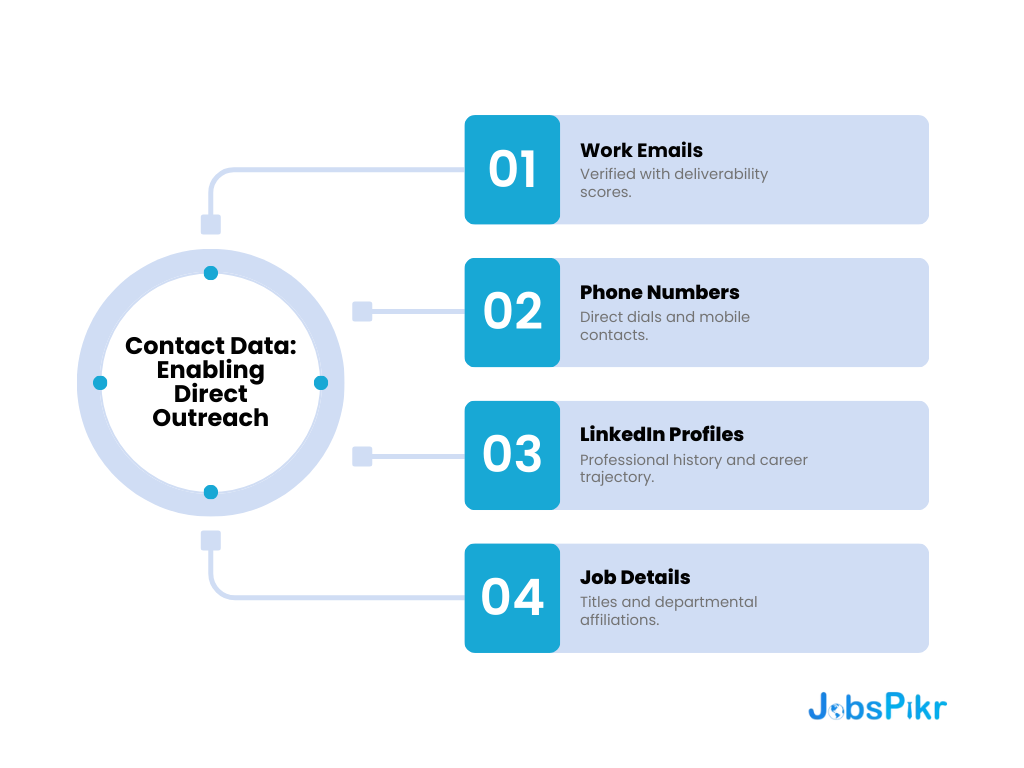
Professional contact information includes:
- Work email addresses with deliverability scores
- Direct dial and mobile phone numbers
- LinkedIn profiles and professional history
- Job titles and departmental affiliations
Use cases: SDR outreach, account mapping, and multi-threaded engagement
Technographics: Competitive Intelligence
Technology stack intelligence reveals:
- Installed software and platforms
- Contract renewal periods
- Usage intensity indicators
- Integration ecosystems
Use cases: Competitive displacement campaigns, product-led sales motions, partnership identification
Intent & Behavioral Signals: Prioritization at Scale
Digital activity patterns indicating buying interest:
- Search query patterns and keywords
- Content consumption (whitepapers, webinars)
- Website engagement metrics
- Competitor research activities
Use cases: Lead scoring models, ABM orchestration, campaign prioritization
Real-Time Hiring Data: Forward-Looking Intelligence
Job posting and workforce expansion signals:
- Hiring velocity (posting frequency over time)
- Role mix distribution across departments
- Skill requirements and technology adoption
Use cases: Top-of-funnel prioritization, investor signals, GTM planning, and workforce analytics.
For various use cases you’d need different freshness levels. Fraud detection and competitive intelligence require near-real-time updates, on the other hand, strategic planning can accept weekly or monthly refresh cycles.
How to Evaluate Coverage (Depth & Breadth)
Coverage evaluation requires systematic assessment across multiple dimensions:
Geographic and Market Reach
- Geographic coverage: Aim for 50+ countries for global operations, with regional depth in key markets
- Vertical specialization: Verify industry classification accuracy using NAICS/SIC codes
- Company size bands: Ensure coverage across your target segments (SMB, mid-market, enterprise)
- Source diversity: Look for multi-source approaches combining:
- Direct website crawls
- Job board integrations
- Social media monitoring
- Third-party partnerships
Historical Depth vs. Live Coverage
Historical archives enable:
- Back-testing of models
- Trend analysis over time
- Seasonal pattern recognition
- Change tracking
Live coverage provides:
- Near-term signals for immediate action
- Real-time competitive intelligence
- Fresh contact validation
- Current hiring trends
Platforms like JobsPikr offer both capabilities — multi-year archives plus real-time feeds with sub-day latency for priority sites.
Coverage Assessment Checklist
✓ Minimum 80% match rate against your target account list
✓ Coverage in 50+ countries for global operations
✓ Industry mapping to standard classification systems
✓ Source documentation explaining collection methods
✓ Historical data spanning 12+ months
✓ Sample datasets for pre-purchase validation
Start with a proof of concept.
Book a 30-minute session to see our coverage, freshness benchmarks, and enrichment quality on your actual use cases.
Freshness, Latency and Data Decay (How Recent is “Recent Enough”?)
Data freshness encompasses three critical metrics that determine information currency:
Key Freshness Metrics
Ingestion Latency
- Time from real-world event to database appearance
- Ranges from minutes (real-time) to days (batch processing)
- JobsPikr claims sub-day ingestion for priority sites
Update Frequency
- How often existing records refresh
- Daily updates standard for contact data
- Weekly/monthly for firmographics
Time-to-Reflect Changes
- Speed of capturing status changes (job filled, employee departed)
- Critical for maintaining data accuracy
Understanding Data Decay Patterns
| Data Type | Annual Decay Rate | Refresh Recommendation |
| Contact emails | 20-30% | Daily validation |
| Phone numbers | 15-20% | Weekly updates |
| Job titles | 15-25% | Quarterly refresh |
| Firmographics | 5-10% | Semi-annual updates |
| Company addresses | 3-5% | Annual validation |
Practical SLA Requirements
For enterprise deployments, demand:
- Webhook latency < 60 minutes
- API response times < 200ms
- 99.5% uptime guarantees
- Daily crawl commitments for priority accounts
For strategic modeling, ensure:
- Reliable historical archives with versioning
- Change tracking capabilities
- Point-in-time data recovery
Compliance, Provenance and Vendor Trustworthiness
Regulatory compliance has evolved from checkbox exercise to fundamental selection criterion:
Key Regulatory Requirements
GDPR (European Union)
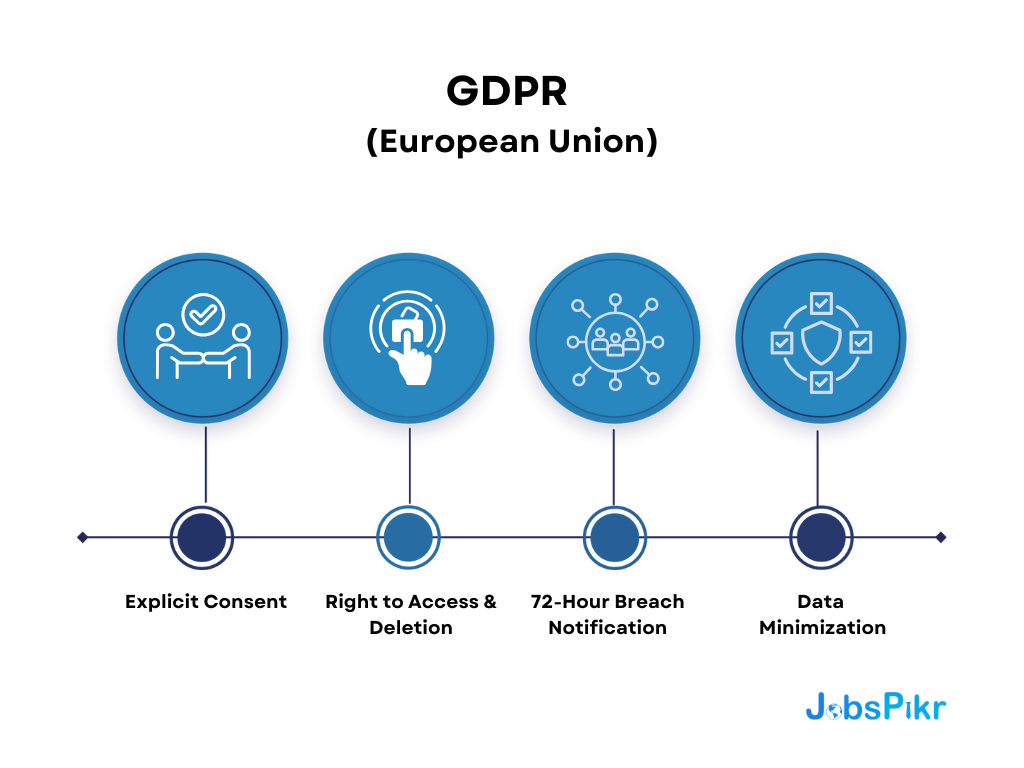
- Explicit consent for data processing
- Right to access and deletion
- 72-hour breach notification
- Data minimization principles
CCPA (California) & State Laws
- Consumer rights to opt-out
- Transparency in data selling
- Additional restrictions for employment data
- Sector-specific rules for recruitment information
Essential Documentation Requirements
Vendors must provide:
- Documented source lists — explaining data origins
- Crawl logs — showing collection timestamps and methods
- Deduplication rules — ensuring data consistency
- Retention policies — aligned with regulations
- Opt-out procedures — respecting individual preferences
- Data lineage — tracking from collection through delivery
Security & Contract Essentials
Required certifications:
- SOC 2 Type II or ISO 27001
- Encryption at rest and in transit
- Regular penetration testing
- Vulnerability management programs
Contract must-haves:
- Data Processing Addendum (DPA)
- Breach notification timelines
- Audit rights provisions
- Termination and deletion clauses
Evaluating Enrichment Quality and Integration Readiness
Quality enrichment transforms raw data into actionable intelligence:
Comprehensive Enrichment Standards
Essential enrichment fields:
- Canonicalized job titles (standardizing variations)
- Tokenized skills (extracting from descriptions)
- Geographic normalization (consistent location formats)
- Salary band mapping (role and location-based)
- Seniority inference (from title analysis)
- Confidence scores (reliability indicators)
- Remote/hybrid work tags
JobsPikr and similar platforms offer 40+ schema fields with confidence scoring for each data point.
POC Testing Framework
Run systematic quality tests:
- Deduplication analysis — measure duplicate record rates
- False positive detection — validate enrichment accuracy
- Skill extraction precision — verify against job descriptions
- API performance — test latency under load
- Webhook reliability — monitor over 7-day periods
Integration Architecture Requirements
| Integration Feature | Requirements | Why It Matters |
| Export Formats | CSV, JSON, Parquet | Flexibility for different systems |
| Cloud Storage | S3, GCS, Azure Blob | Scalable ingestion workflows |
| Webhooks | < 60 min latency | Real-time alerting |
| Rate Limits | 1000+ requests/minute | Production scalability |
| SDKs | Python, Node.js, Java | Faster development |
| Sandbox | Realistic test data | Risk-free testing |
Why Real-Time Hiring Data is a Special B2B Signal (Use Cases & How to Use It)
Real-time hiring data provides unique forward-looking intelligence unavailable in traditional B2B datasets:
Signal Definitions and Business Value
Hiring Velocity = job postings per time period
- Reveals growth trajectories and investment areas
- Precedes revenue impact by 6-12 months
Role Mix = distribution across functions
- Engineering hiring → product investment
- Sales expansion → GTM acceleration
- Customer success growth → retention focus
Skill Velocity = emerging capability requirements
- Technology adoption indicators
- Competitive positioning shifts
- Market maturity signals
Priority Use Cases for RevOps & Data Teams
1. Top-of-Funnel Account Prioritization
- Detect companies with hiring surges in relevant departments
- Tailor outreach to address growth challenges
- Example: Data engineering hiring → analytics platform needs
2. Equity & Coverage Signals
- Identify pre-funding hiring acceleration
- Spot expansion before announcements
- Track competitive hiring patterns
3. Product & GTM Planning
- Analyze competitor hiring for roadmap intelligence
- Identify market gaps from skill demands
- Inform partnership strategies
4. Workforce Planning & L&D
- Anticipate skill shortages
- Design training curricula
- Support internal mobility programs
Implementation Best Practices
Technical architecture:
- Use aggregation endpoints for company-level metrics
- Configure webhooks for threshold alerts
- Combine with firmographics to filter noise
- Implement decay functions for signal aging
Operational workflow:
- Set hiring velocity thresholds by industry
- Create alert routing to relevant teams
- Build dashboards for trend visualization
- Establish feedback loops for refinement
Vendor Shortlist & Procurement Checklist (Quick Decision Framework)
Evaluation Scorecard
| Criteria | Weight | Score (0-5) | Considerations |
| Coverage & Scope | 25% | ___ | Geographic reach, vertical depth, source mix |
| Data Freshness | 20% | ___ | Latency SLAs, update frequency, decay management |
| Enrichment Quality | 20% | ___ | Schema completeness, accuracy, confidence scoring |
| Compliance & Security | 15% | ___ | GDPR/CCPA, audit trails, certifications |
| Integration Ease | 10% | ___ | API quality, webhook reliability, documentation |
| Pricing Model | 5% | ___ | Transparency, scalability, contract flexibility |
| Support & Roadmap | 5% | ___ | Response times, innovation velocity, partnership approach |
Minimum passing score: 3.5 average across all criteria
Essential Contract Components
✓ SLA specifications with penalty clauses
✓ Data Processing Addendum (DPA)
✓ Security attestations and certifications
✓ Sample dataset provisions
✓ Termination and data deletion terms
✓ Pricing transparency and escalation caps
Decision Framework
- Vendor selection: Evaluate 2+ providers (enterprise + specialist)
- Parallel POCs: Run identical tests with success metrics
- Stakeholder involvement: Include technical, legal, and business teams
- Documentation: Record evaluation process for future reference
Conclusion: Practical Next Steps for Buyers
Managing Real-Time Data Effectively
Real-time hiring feeds and other B2B data sources provide competitive advantages but require proper implementation:
- Signal quality: Implement deduplication and firmographic filtering
- Noise reduction: Use statistical methods to identify outliers
- Feedback loops: Track conversion from alerts to opportunities
- Continuous improvement: Regular vendor performance reviews
Building Long-Term Capability
Success with B2B data extends beyond initial procurement:
- Establish clear ownership for data quality monitoring
- Build internal expertise in data engineering and analytics
- Create governance frameworks for data usage
- Plan for scalability as data volumes grow
Organizations that succeed with B2B data treat it as a strategic capability and invest continuously. procurement should balance coverage, freshness, and compliance while controlling cost and complexity. begin with focused proofs of concept, expand after demonstrated ROI, and use real-time hiring data for forward-looking signals traditional datasets miss.
Follow this guide’s structured approach — understand data types, evaluate vendors, and implement systems — so RevOps and data teams make decisions that produce measurable impact. treat vendor selection as the start of building data-driven revenue operations, not the end.
Start with a proof of concept.
Book a 30-minute session to see our coverage, freshness benchmarks, and enrichment quality on your actual use cases.
FAQs
What is b2b data?
Structured information about companies and the people who work for them, including firmographics (company size, industry, location), contact records, technology footprints, and behavioral signals such as job postings and content engagement.
What is b2b data enrichment?
Improving raw business records by adding, normalizing, and validating fields. Examples include canonicalizing job titles, appending firmographics, extracting skills, and assigning confidence scores so records are actionable.
What is b2b data scraping?
Automated tools or scripts that extract business information from public sources such as company websites, job boards, directories, and social profiles. Scraping produces raw records that require cleaning, deduplication, and legal review before use.
How to collect b2b data?
Combine multiple sources: internal CRM and sales notes, licensed vendor feeds, partner APIs, and public web scraping. Capture provenance metadata, run validation (dedupe and sample checks), and enforce privacy and opt-out rules before the data is put into production.
What is b2b data sharing?
The transfer or exchange of business records between organizations or platforms, for example leads, enrichment attributes, or audience segments. Sharing must follow contractual terms and privacy laws, including DPAs, opt-out mechanisms, and applicable regional regulations.