


- **TL;DR**
- The Business Analyst Role in the UK
- Make Smarter Talent Decisions with Real Job Market Data
- How Business Analysts Progress in Their Careers
- Salary Trends for Business Analysts
- Make Smarter Talent Decisions with Real Job Market Data
- Why Business Analyst Salary Growth Varies
- Business Analyst Job Demand in the UK
- Search Results for Business Analyst Salary
- Top skills in demand for Business Analysts
- Make Smarter Talent Decisions with Real Job Market Data
- Job Types for Business Analysts
- The UK and Business Analyst Jobs
- Industry-Wise Salary Differences for Business Analysts in the UK
- Key Takeaways From UK Business Analyst Salary Trends
- Make Smarter Talent Decisions with Real Job Market Data
- FAQs
**TL;DR**
Business Analysts remain one of the most in-demand data-driven roles in the UK. The business analyst salary landscape has evolved significantly since 2021, shaped by digital transformation, AI adoption, sector-specific demand, and regional hiring shifts beyond London. Entry-level salaries now start higher, mid-career compensation has widened, and experienced analysts who combine domain expertise with data, automation, or AI skills command premium pay. This guide breaks down business analyst salary UK trends, job profiles, skills, industries, locations, and what the next few years look like, using workforce intelligence principles aligned with how companies actually hire today.
This article delves into the key factors influencing Business Analyst salary in the UK, examining regional variations, industry demand, and the impact of experience and qualifications. Additionally, we will explore the typical responsibilities and skill sets required for a Business Analyst, providing a comprehensive overview of what it takes to succeed in this critical role. Whether you’re an aspiring Business Analyst or an experienced professional looking to stay informed about industry trends, this guide aims to equip you with valuable insights into the UK job market for Business Analysts in 2021.
While the UK may not be the first place that comes to one’s mind when you speak of job opportunities for Business Analysts, some of the top companies in the UK, working in the consultancy, financial, banking, oil and gas, and the IT industry hire thousands of analysts every year. This includes big names like Shell, Accenture, Capital One, American Express, Experian, and Barclays. All of these companies have offices at multiple locations in the UK, where they employ business analysis to help analyze data and boost business productivity.
Business Analysts in the UK bring skills like data modeling, project management, SQL, Business Intelligence, and Scrum to the table which help companies in tackling internal and partner-based issues using data, effectively.
The Business Analyst Role in the UK
In the UK job market, Business Analysts are often described as the link between business strategy and execution. They translate business needs into structured requirements that technology and operations teams can act on.
A typical Business Analyst in the UK is responsible for:
- Working with stakeholders to understand business challenges
- Gathering and documenting requirements
- Analysing data to identify inefficiencies or opportunities
- Supporting system implementations and process improvements
- Collaborating with product, engineering, and data teams
- Ensuring solutions align with business goals and compliance needs
Unlike purely technical roles, Business Analysts are valued for their ability to contextualise data and systems within real-world business constraints. This blend of analytical thinking, communication, and domain knowledge is a major reason why business analyst salary UK benchmarks remain competitive across industries.
Large enterprises, consultancies, and fast-growing technology companies continue to hire Business Analysts at scale, making the role one of the most resilient in the UK job market.
Make Smarter Talent Decisions with Real Job Market Data
Stop relying on assumptions. Use real-time job data to track business analyst salary trends, skills demand, and hiring patterns across the UK.
How Business Analysts Progress in Their Careers
Business analysis is often not a final destination, but a career foundation. In the UK, many professionals enter the workforce as Business Analysts and then branch out as they gain domain knowledge, technical exposure, and stakeholder confidence.
Early in their careers, most Business Analysts focus on core responsibilities such as requirements gathering, documentation, and process mapping. As they gain experience, progression becomes less about title changes and more about scope, influence, and specialisation.
A common progression path is into senior or lead Business Analyst roles, where professionals take ownership of larger initiatives, mentor junior analysts, and influence solution design rather than just documenting requirements. At this stage, salary growth is often driven by industry expertise and the ability to manage complexity across teams.
Another frequent path is a shift into product-focused roles, such as Product Analyst or Product Manager. Business Analysts with strong user understanding and data interpretation skills naturally transition into product environments, where compensation and decision-making authority tend to increase.
Some analysts move toward data and analytics roles, especially those who develop strong SQL, reporting, or business intelligence capabilities. This path appeals to professionals who enjoy working closely with data and often leads to higher earning potential over time.
Others progress into programme, delivery, or transformation roles, leveraging their cross-functional visibility to manage larger initiatives. These roles prioritise coordination, strategic planning, and stakeholder leadership rather than detailed analysis work.
Overall, career progression for Business Analysts in the UK is non-linear. Those who actively build domain expertise, expand their analytical skill set, and adapt to how organisations use data tend to unlock broader roles, greater influence, and stronger long-term salary growth.
Salary Trends for Business Analysts
As per the data at hand, Business Analyst salary start off around 25-30k pounds per year. This figure rises steadily till around 4-5 years of experience. The max salary at this level is close to 50k whereas the lower limit is around 40k.
The values after this follow irregular trajectories.

The minimum value keeps falling until it flattens out at around 6-10 years. The maximum salary falls after the 4-5 years mark but rises again from the 6-10 years to the 11-15 years. The maxima here is close to 55k pounds. After this, the salary figures fall again.
Make Smarter Talent Decisions with Real Job Market Data
Stop relying on assumptions. Use real-time job data to track business analyst salary trends, skills demand, and hiring patterns across the UK.
Why Business Analyst Salary Growth Varies
One consistent pattern in the UK market is that business analyst salary growth is not always linear. While early-career progression is relatively predictable, later-stage growth depends heavily on skill development and role evolution.
Business Analysts who remain focused solely on documentation and basic process work may experience slower salary growth. In contrast, those who expand into areas such as data analysis, automation, system integration, or strategic planning tend to see stronger compensation outcomes.
This explains why salary ranges widen at mid and senior levels rather than following a fixed ladder.
Business Analyst Job Demand in the UK
Business Analyst roles continue to appear consistently across UK job boards and company career pages.
Key demand indicators include:
- Tens of thousands of Business Analyst job postings each year
- Hiring activity from thousands of unique employers
- Strong demand across consulting, finance, technology, energy, retail, and the public sector
Large organisations often post multiple Business Analyst roles annually across different teams, reflecting the versatility of the role.
The breadth of job titles—such as Digital Business Analyst, Technical Business Analyst, Data Business Analyst, or Product Analyst—also highlights how business analysis has diversified across functions.
Search Results for Business Analyst Salary
The search results for the job position of business analysts produced almost 175k job positions in the current year in the UK. These jobs were posted by more than 13k companies on different job boards and job sites.

The companies in the top 5k list had posted requirements of around 31 business analysts in this year alone. The number of unique job titles stood at almost 25k and the unique skills keywords at 5000.
Top skills in demand for Business Analysts
Due to the varied industries in the UK that hire Business Analysts in the UK, from Finance to Fossil Fuels, the skills required are also varied. The ones at the top are skills that are common to multiple industries– basic skills that would be a must-have no matter which sector you want to work in as a Business Analyst.

Management, design, and business analysis have battled it out for the top position among skills asked for by companies for the post of a Business Analyst. There is no clear leader, although business analysis mostly stands at 3rd. These skills are necessary for Business Analysts to master no matter which company they work for. Understanding of Business requirements came at 4th position, followed by Project Management.
As more of a Business Analysts job moves to the processing and analysis of data– be it financial data or geopolitical data, data processing and visualization tools are also quickly becoming a must-have for many job positions. Although coding skills still fall under the “good to have section” for Business Analysts, their importance is fast-growing thanks to the growing push for automation in every sector.
Make Smarter Talent Decisions with Real Job Market Data
Stop relying on assumptions. Use real-time job data to track business analyst salary trends, skills demand, and hiring patterns across the UK.
Job Types for Business Analysts
In the UK, more than 3/4th of the jobs for Business Analysts are at the entry level. The rest are mostly mid-level whereas only 1-2% of the jobs are at the executive level. This is unlike the US and Canada where the majority of jobs are at mid-level. This can be due to two reasons:
- The Business Analytics job sector in the UK is at a rather nascent stage.
- Most employees move on to specialized roles after a few years of domain specific work experience.
The second option is most likely to be the real answer but we would need to evaluate more data to provide a conclusive reason.
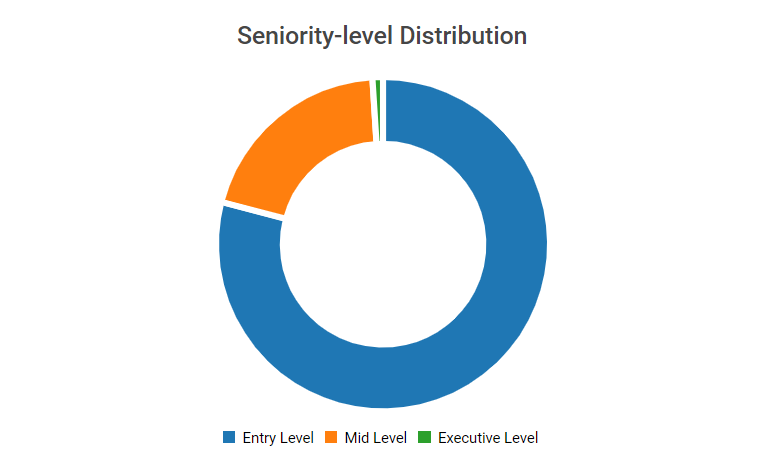
The negligible executive-level positions are in sync with the scenario in the US and Canada, as in all three countries Business Analysts are expected to take on Managerial or Leadership positions in the Business team after having crunched numbers for some years.
The UK and Business Analyst Jobs
Walking the thin line between businesses and their IT teams, Business Analysts helps companies from different sectors improve their bottom lines in the UK. They are tasked with using data to improve software, processes, products, workflows, and more.
As per some data, although the job concentration for business analysts is highest in the capital city of London, many job options for the particular position also exist in:
- Yorkshire
- Leeds
- Surrey
- Berkshire and
- Hertfordshire
As per this report published by the UK government, financial and related industries today employ almost 2.3 million people. The UK being a major hub for financial and fintech companies (companies that stand at the intersection of finance and technology), one can expect these industries to add hundreds of new positions for Business Analysts at different seniority levels in the coming years.
Industry-Wise Salary Differences for Business Analysts in the UK
While experience and skill set play a major role in determining business analyst salary, the industry you work in often has an equal, if not greater, impact on compensation. In the UK, Business Analysts are employed across a wide range of sectors, but not all industries value or use the role in the same way.
Some industries rely on Business Analysts for regulatory compliance and risk management, others for large-scale digital transformation, and some for product innovation or operational efficiency. These differences directly influence salary bands, job expectations, and long-term earning potential.
Below is a closer look at how business analyst salary UK trends vary by industry and why.
Business Analyst Salary in Finance and Banking
Finance, banking, and financial services consistently sit at the top end of the business analyst salary spectrum in the UK.
Business Analysts in this sector typically work on:
- Core banking systems
- Risk and compliance frameworks
- Regulatory reporting
- Payments, lending, and customer data platforms
The complexity of financial systems, combined with strict regulatory requirements, increases the value of experienced analysts who can navigate both business and compliance constraints.
As a result:
- Entry-level roles often start higher than the market average
- Mid-level analysts see faster salary growth
- Senior analysts with domain expertise command premium pay
Another factor pushing salaries upward is the cost of mistakes. In finance, poorly defined requirements or flawed data interpretation can lead to regulatory penalties or reputational damage. This makes skilled Business Analysts a critical investment rather than a support function.
Business Analyst Salary in Consulting and Professional Services
Consulting firms are among the largest employers of Business Analysts in the UK, and salary structures here reflect both demand and performance expectations.
Business Analysts in consulting typically:
- Work across multiple clients and industries
- Operate in fast-paced, high-pressure environments
- Are expected to deliver value quickly
Consulting salaries often sit in the upper-middle range of business analyst salary UK benchmarks, particularly at mid and senior levels. While base pay may sometimes appear similar to other industries, consulting roles often offer:
- Faster career progression
- Exposure to complex, high-impact projects
- Strong skill development opportunities
These factors make consulting a common pathway for analysts looking to accelerate their earning potential over time.
Business Analyst Salary in Technology and SaaS Companies
Technology-driven organisations, including SaaS providers, software firms, and digital-first businesses, have significantly reshaped the business analyst salary landscape.
In these environments, Business Analysts are often expected to:
- Work closely with product managers and engineers
- Analyse user behaviour and product data
- Support agile development and continuous delivery
Because these roles blend business analysis with product thinking and data interpretation, salaries tend to be competitive—especially for analysts who can operate in product-centric teams.
In many cases:
- Analysts with strong data and system knowledge earn more than their traditional counterparts
- Salary growth is tied closely to business performance and product success
This makes the tech sector particularly attractive for Business Analysts who enjoy working close to product development and innovation.
Business Analyst Salary in Energy, Utilities, and Infrastructure
The energy, utilities, and infrastructure sectors—including oil, gas, renewables, and public utilities—offer a different salary dynamic.
Business Analysts in these industries often focus on:
- Large-scale operational systems
- Asset management platforms
- Compliance, safety, and reporting frameworks
- Long-term infrastructure planning
While salary growth may be more stable and less volatile than in consulting or tech, business analyst salaries in this sector are generally solid, particularly for analysts with experience in complex enterprise systems.
These roles often appeal to professionals seeking:
- Long-term stability
- Clear career paths
- Deep domain specialisation
Business Analyst Salary in Retail and E-commerce
Retail and e-commerce companies employ Business Analysts to improve operational efficiency, customer experience, and supply chain performance.
Common focus areas include:
- Sales and demand forecasting
- Inventory and pricing analysis
- Customer behaviour insights
- Omnichannel performance tracking
Salaries in this sector vary widely. Analysts working in large retailers or data-driven e-commerce firms often earn above-average pay, while smaller organisations may offer more modest compensation.
That said, analysts with experience in:
- Digital analytics
- Marketplace data
- Pricing and assortment optimisation
tend to command higher business analyst salary levels within retail-focused roles.
Business Analyst Salary in the Public Sector
Public-sector organisations in the UK—including government departments, healthcare bodies, and local authorities—also hire Business Analysts, though with different priorities.
These roles typically focus on:
- Service delivery improvement
- System modernisation
- Policy-driven data analysis
- Process standardisation
Public-sector business analyst salary UK benchmarks are generally lower than those in private industry. However, these roles often offer:
- Greater job security
- Clear working hours
- Strong pension and benefits
For some professionals, these non-salary factors balance out the lower pay ceiling.
Business Analyst Salary in Emerging and Hybrid Industries
As industries increasingly overlap, such as fintech, healthtech, and regtech, new hybrid Business Analyst roles are emerging.
These positions often combine:
- Industry-specific knowledge
- Data and analytics expertise
- Regulatory awareness
Because talent in these niches is harder to find, salaries are often higher than traditional benchmarks. Analysts who position themselves at these intersections can significantly increase their earning potential.
Why Industry Choice Matters for Long-Term Salary Growth
Choosing the right industry early in your career can have a lasting impact on business analyst salary progression.
Industries that:
- Handle complex data
- Operate under regulation
- Invest heavily in digital transformation
tend to reward Business Analysts more generously over time.
This is why understanding industry-specific demand is just as important as tracking generic salary averages. Market intelligence platforms like JobsPikr help surface these differences by analysing real job postings, required skills, and compensation signals across sectors.
Key Takeaways From UK Business Analyst Salary Trends
Understanding the Business Analyst Salary trends in the UK for 2021 provides valuable insights for both aspiring and seasoned professionals in this field. The role of a Business Analyst is pivotal in bridging the gap between business goals and technological solutions, and the compensation reflects the critical nature of this position.
The Business Analyst Salary UK varies based on factors such as location, industry, experience, and educational background. By staying informed about these trends, professionals can make strategic career decisions and negotiate better compensation packages.
For those looking to stay ahead of the curve and gain access to the latest job market data, platforms like Jobspikr offer a comprehensive solution. Jobspikr provides real-time job data and trends, helping you make informed career choices. Sign up with the Jobspikr app today to explore the platform and take the first step towards optimizing your career as a Business Analyst.
Stay informed, stay competitive, and let Jobspikr guide your career path with precise and up-to-date job market insights.
Make Smarter Talent Decisions with Real Job Market Data
Stop relying on assumptions. Use real-time job data to track business analyst salary trends, skills demand, and hiring patterns across the UK.
FAQs
What is the average business analyst salary in the UK?
The average business analyst salary UK typically falls between £40,000 and £55,000 per year, depending on experience, industry, and location.
Does location affect business analyst salary?
Yes. London generally offers higher salaries, but strong opportunities also exist in cities like Manchester, Leeds, and Birmingham.
Which industries pay the highest business analyst salaries?
Finance, consulting, and technology sectors tend to offer higher business analyst salary levels due to complex business and data requirements.
Are technical skills required to earn a higher salary?
While coding is not mandatory, data analysis, SQL, and BI tool experience often lead to better salary outcomes.
How can I track current business analyst salary trends?
Using job market intelligence platforms that analyse live job postings provides the most accurate view of salary and skills demand.
Do Business Analysts usually move into management roles?
Some do, but many move into specialised roles in product, data, or transformation rather than traditional management.