

- **TL;DR**
- What Is Inflation and Why Does It Matter for Employment?
- Turn Inflation Signals into Workforce Strategy
- What is the Effect of Inflation on Unemployment?
- What is the Relationship between Inflation and Unemployment?
- What will happen when inflation and unemployment are positively correlated?
- Turn Inflation Signals into Workforce Strategy
- Does inflation cause unemployment?
- Inflation, Skills Demand, and Workforce Shifts
- Turn Inflation Signals into Workforce Strategy
- Globalization and the Inflation–Unemployment Disconnect
- Practical Implications for Employers and HR Leaders
- Inflation, Unemployment, and the Bigger Economic Picture
- Turn Inflation Signals into Workforce Strategy
- FAQs
**TL;DR**
Inflation and unemployment are deeply connected, but not in a simple cause-and-effect way. While economic theory often frames them as a trade-off, real-world data shows a far more complex relationship shaped by demand cycles, interest rates, productivity, global supply chains, and policy decisions. In today’s economy, inflation does not automatically reduce unemployment, nor does unemployment reliably control inflation. For HR leaders, workforce planners, and talent intelligence teams, understanding this relationship is critical for navigating hiring strategies during volatile economic conditions.
It is often said that inflation and unemployment are two sides of the same coin. But do these economic indicators move in tandem? In this blog post, we’ll explore the relationship between inflation and unemployment and ask whether – or how much – one affects the other. We’ll also look at strategies to reduce unemployment in an inflationary environment. Stay tuned.
What Is Inflation and Why Does It Matter for Employment?
Inflation refers to the sustained increase in the general price level of goods and services in an economy. When inflation rises, the purchasing power of money falls. In simple terms, the same salary buys fewer goods and services over time.
Inflation matters for employment because it influences:
- Business costs and profit margins
- Consumer spending behavior
- Wage negotiations and compensation planning
- Central bank policy decisions, especially interest rates
When inflation accelerates, businesses face higher input costs. Raw materials, energy, logistics, and wages often become more expensive. Some firms absorb these costs, while others pass them on to consumers. If costs rise faster than revenue, companies may freeze hiring, slow expansion, or reduce headcount.
However, inflation does not automatically destroy jobs. In some cases, rising prices reflect strong demand, which can support job creation. This dual nature is what makes the inflation and unemployment relationship so difficult to generalize.
Turn Inflation Signals into Workforce Strategy
Understand how inflation is reshaping hiring demand, skills, and workforce planning with live labor market insights.
What is the Effect of Inflation on Unemployment?
Source: Britannica
One common question is: “Does inflation cause unemployment?” The answer is not straightforward.
Inflation impacts unemployment in a cyclical manner; high inflation often correlates with higher unemployment rates. For example, a 10% inflation rate might result in a 1% increase in unemployment. Although inflation doesn’t always cause a direct increase in unemployment, significant fluctuations in inflation can influence unemployment levels. Historical cases, such as Russia and Hungary in the 1920s, illustrate that high inflation often accompanies higher unemployment rates.
However, this relationship between inflation and unemployment is not uniform across all countries. For instance, Australia and Turkey have experienced high unemployment without corresponding high inflation. Over time, a trend of higher inflation correlating with rising unemployment can be observed, suggesting that inflation does indeed affect unemployment rates.
What is the Relationship between Inflation and Unemployment?

Image Source: CourseSideKick
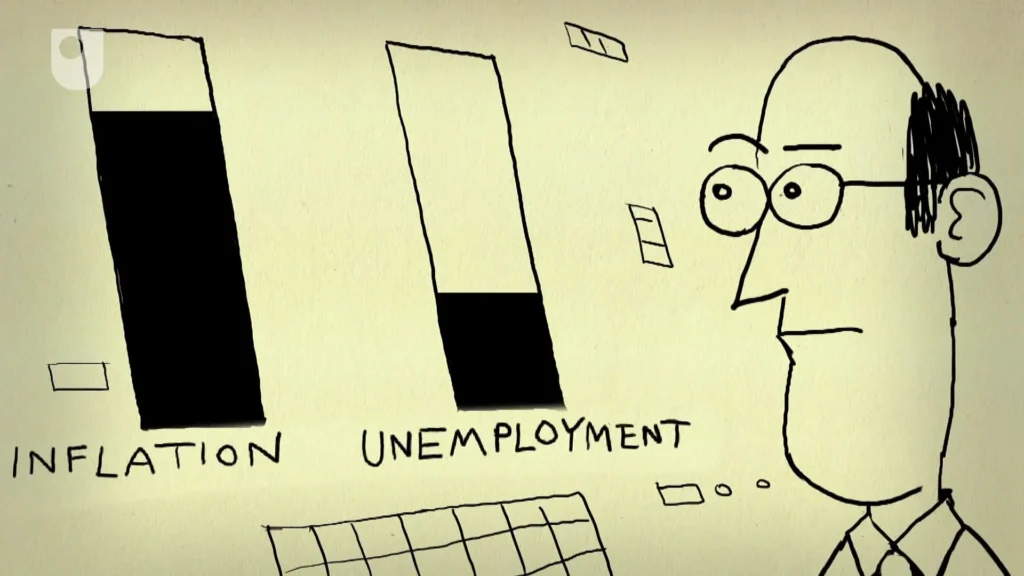
The United States does not exhibit a close link between inflation and unemployment. There does tend to be an inverse relationship between inflation and unemployment rates. When there is a high rate of inflation, this corresponds with lower levels of unemployment. However, when there are low inflation rates, this does correspond with high levels of unemployment.
It does seem that the relationship between inflation and unemployment is better explained when looking at the long run than in the short term. Looking at individual years can be noisy. For example, if there was a high level of inflation in one year, this does not mean that there will be an increase in the unemployment rate since the inflation rate often changes year to year. Therefore, looking at long-term trends does seem to be more accurate than just looking at individual years.
The relationship between inflation and unemployment does not help us understand what causes inflation rate or unemployment rate. However, there does seem to be a slight positive association between these two variables. This indicates that as inflation levels go up, this increases the unemployment rates, and as unemployment rates increase, this leads to a rise in the level of inflation.
What will happen when inflation and unemployment are positively correlated?
When inflation and unemployment are positively correlated, does this mean that high levels of employment lead to increased inflation rates? Or does low levels of employment lead to lower rates of inflation? What does the data indicate about the relationship between these two factors?
The evidence indicates that increased levels of unemployment do not lead to higher rates of inflation. If this were true, then increasing the number of people out of work would be a valid way to reduce prices in an economy. But does this mean that there is no link at all between these two variables?
When looking at whether or not there is a link between these two factors, it is necessary to look beyond correlation because correlation does not necessarily indicate causation.
Turn Inflation Signals into Workforce Strategy
Understand how inflation is reshaping hiring demand, skills, and workforce planning with live labor market insights.
Does inflation cause unemployment?
While it does show a positive statistical relationship with unemployment, does this mean that if the rate of inflation goes up, so does the unemployment rate?
This does not have to be true. Correlation does not give us enough information to conclude because there could be another variable influencing both of these factors. When we look at whether or not one factor causes another, we need to look for evidence of their casual relationship, and correlation is not enough to establish such a link.
An increase in aggregate demand can come from increases in both government spending, as seen here, and increases in private sector investment. Inflation does not happen because more money is being printed, so does this mean that if policymakers want lower levels of unemployment, they have no choice but to accept higher levels of inflation? This does not have to be true because money does not have to come from the central bank; it can come from foreign lenders. In order for inflationary pressures to rise, does this mean that we must reduce unemployment rates? No, because if we want employment levels to remain stable, then does this mean that pressure on prices will also stay the same?
No, this does not have to be true either. For example, if a country has a fixed exchange rate and an increase in spending does not lead to a corresponding increase in demand for domestic currency, does this cause any problems with maintaining low levels of inflation?
Yes, while there may be an increase in aggregate demand, does this mean that the only way to maintain low inflation levels is through an increase in unemployment? Well, now it does not because if the country does not have its own currency, does this mean that it does not need to adopt an independent monetary policy?
This does not need to set interest rates and is instead linked with another country’s interest rate. Therefore, this link means that prices may still increase, but inflation does remain lower than if they had their central bank. Therefore, it seems that many factors influence the relationship between inflation and unemployment, including the level of aggregate demand and whether current levels of economic growth place pressure on inflationary forces or act as a buffer against them.
Overall though, does having high levels of unemployment reduce inflation? The short answer is no. Many other influencing factors at work here make this an incredibly complex relationship.
Inflation, Skills Demand, and Workforce Shifts
One often overlooked aspect of inflation and unemployment is how inflation reshapes skills demand.
During inflationary periods, businesses focus on efficiency and cost control. This shift often leads to:
- Reduced demand for generalized roles
- Increased demand for specialized, revenue-driving skills
- Greater emphasis on productivity and automation
As a result, unemployment may rise in certain occupations while remaining low in others. This uneven impact creates the illusion of a weak labor market even when demand for specific skills remains strong.
For HR teams, this means traditional unemployment rates offer limited insight. Skills-level hiring data provides a clearer picture of labor demand during inflationary periods.
Geographic and Remote Hiring Adjustments
Inflation also reshapes where companies hire.
To manage cost pressures, organizations increasingly:
- Shift hiring to lower-cost regions
- Expand remote or distributed teams
- Rebalance location strategies based on wage inflation rather than availability alone
This means unemployment trends can vary sharply by region, even within the same country. Areas with higher living costs may experience slower hiring, while emerging talent hubs see continued demand.
Why Traditional Unemployment Metrics Miss the Real Story
Headline unemployment rates fail to capture these shifts.
They do not show:
- Which skills are becoming obsolete
- Which skills are gaining pricing power
- Where hiring demand is quietly moving
This is why inflation-driven workforce changes often feel confusing. Employers report talent shortages, while job seekers report difficulty finding work. Both can be true at the same time.
The real signal lies in skills-level hiring data, not aggregate employment numbers.
What This Means for Workforce Planning
For HR and talent leaders, inflation demands a different approach to planning.
Instead of forecasting headcount alone, organizations need to:
- Track skill demand in real time
- Identify roles that are becoming consolidation targets
- Understand which capabilities remain non-negotiable regardless of economic cycles
Inflation does not eliminate hiring. It forces prioritization. Companies that understand how skills demand shifts during inflationary periods are better positioned to protect productivity, control costs, and avoid reactionary workforce decisions.
In this context, workforce intelligence is no longer optional. It becomes the lens through which inflation’s true impact on employment can be understood and acted upon.
Turn Inflation Signals into Workforce Strategy
Understand how inflation is reshaping hiring demand, skills, and workforce planning with live labor market insights.
Globalization and the Inflation–Unemployment Disconnect
Global supply chains have fundamentally altered the inflation and unemployment relationship.
Companies can now:
- Source labor and materials internationally
- Shift production across regions
- Access global talent pools
This flexibility reduces the pressure to adjust domestic employment in response to inflation. For example, businesses may outsource functions instead of laying off workers locally or delay hiring in one region while expanding in another.
As globalization evolves, inflation becomes less tightly linked to domestic employment levels. Workforce strategies increasingly depend on global labor data rather than national averages.
Practical Implications for Employers and HR Leaders
Understanding inflation and unemployment is not just an academic exercise. It directly affects:
- Hiring plans
- Workforce budgets
- Retention strategies
- Talent availability forecasts
Inflation may increase wage pressure without increasing unemployment. Alternatively, unemployment may rise even when inflation stabilizes. Relying on outdated assumptions can lead to missed opportunities or unnecessary risk aversion.
Organizations that track live labor market data are better positioned to:
- Adjust hiring strategies by role and region
- Identify resilient skill clusters
- Plan workforce investments during economic uncertainty
Inflation, Unemployment, and the Bigger Economic Picture
Inflation is a measure of how much prices are rising in an economy. It’s measured by the general rise of goods and services caused by too many dollars chasing after a limited amount of products or labor. But does inflation cause unemployment? There seems to be some correlation between them with higher rates leading to greater levels of joblessness within the country.
However, plenty of other factors come into play, including interest rates and government spending habits that affect our employment rate. We recommend you consult your local economist for more information about this topic, and for insights on the labor market – sign up to JobsPikr!
Turn Inflation Signals into Workforce Strategy
Understand how inflation is reshaping hiring demand, skills, and workforce planning with live labor market insights.
FAQs
Does inflation always increase unemployment?
No. Inflation can occur alongside both rising and falling unemployment, depending on economic conditions and policy responses.
Can low unemployment cause inflation?
Low unemployment can contribute to wage pressure, which may influence inflation, but it is not the sole or guaranteed cause.
Why does inflation sometimes rise even when unemployment is high?
This often happens due to supply-side shocks, such as energy shortages or supply chain disruptions, rather than strong demand.
Are traditional economic models still useful for understanding inflation and unemployment?
They provide a foundation, but modern labor markets require real-time data and contextual analysis for accurate decision-making.
How can HR teams stay ahead during economic uncertainty?
By tracking live hiring signals, emerging skills, and compensation trends, HR teams can plan proactively instead of reacting to lagging indicators.