
- **TL;DR**
- What is dynamic workforce planning?
- How is dynamic workforce planning different from traditional workforce planning?
- What role does data play in dynamic workforce planning?
- What are the key components of a data-driven workforce planning strategy?
- Put real-time signals at the heart of your workforce strategy.
- How to build an agile workforce strategy using real-time job market analytics
- Benefits of dynamic workforce planning for HR and Ops leaders
- Real-world example: how real-time job signals drive workforce strategy
- Common challenges in dynamic workforce planning and how to overcome them
- The future of workforce planning is dynamic
- Plan with signals, not guesses
- Put real-time signals at the heart of your workforce strategy.
- FAQs
**TL;DR**
Dynamic workforce planning is like switching from a printed map to live GPS for talent decisions. Instead of relying on annual headcount guesses, you plan with real-time job signals, skills data, and short decision loops—so you can match the right skills to the right work before the market forces your hand.
- What it is: A live, data-driven way to plan staffing around current demand and skills—not last year’s org chart. You sense changes, decide fast, and adjust often.
- Why it matters: Markets shift quietly at first. Early signals (skills, locations, pay trends) let you move before hiring gets slow or expensive.
- How it works: Combine internal demand (pipeline, product, support) with external job market analytics (postings, skill trends, hiring velocity) and run weekly/biweekly reviews.
- What improves: Time from signal to action shrinks; internal mobility rises; hiring gets cleaner; unplanned costs drop because you act early, not late.
- Where JobsPikr fits: It’s the external signal layer—live postings, skills, and location insights you plug into hiring, redeployment, and upskilling decisions.
What is dynamic workforce planning?
Think of workforce planning like navigation. The old way was printing a map once a year and hoping the roads don’t change. Dynamic workforce planning is using live GPS. It watches what’s happening right now, demand shifts, skill trends, hiring signals and adjusts your route as you go.
Here’s a simple picture. Your product team ships a new feature. Support tickets spike in a new region. At the same time, you see competitors hiring “implementation specialists” with payments experience. Static plans wait for the next quarterly review. Dynamic planning reacts this week. You rebalance headcount, open a short-term contract role, and start an upskilling sprint for two existing CSMs. No drama. Just decisions made with live signals.
Dynamic planning isn’t about more meetings or bigger spreadsheets. It’s about combining three things you already have, but rarely put together in real time:
- Internal demand: pipeline, product roadmap, expansion plans.
- Internal supply: skills you have today, who can be reallocated, who can be trained.
- External signals: job market analytics, skill requirements, location pay, competitor hiring velocity.
Do this well and you stop arguing about “how many heads next year.” You start asking better questions: Which skills do we need next month? Where can we source them fastest? What should we train vs hire?
That’s the heart of dynamic workforce planning, a live view of work, skills, and talent so your team can move with the market, not behind it.
How is dynamic workforce planning different from traditional workforce planning?
Traditional workforce planning feels like an annual budget meeting: big assumptions, neat spreadsheets, and a plan that ages the moment the market shifts. It’s built for stability. The problem is, most teams don’t live in stable conditions anymore. Product priorities move. Sales cycles change. Competitors open roles you didn’t expect. A static plan can’t keep up.
Dynamic workforce planning flips that model. Instead of locking numbers for the year, you treat your plan like a living system. You sense changes in demand, skills, and location trends, then adjust hiring, redeployment, and training on a regular cadence. It’s not “set and forget.” It’s “sense and adapt.”
| Dimension | Traditional (Static) Workforce Planning | Dynamic (Live) Workforce Planning |
| Planning unit | Headcount tied to last year’s org chart | Work and skills mapped to near-term demand |
| Update cadence | Annual or quarterly refresh | Weekly or biweekly pulse based on live signals |
| Data inputs | Historical budgets and lagging HR reports | Real-time job postings, pipeline, roadmap, support volume |
| Decision trigger | Variance against plan after the fact | Threshold-based changes when demand or skill signals move |
| Capacity model | Fixed FTE allocations | Fluid mix of FTE, contractors, internal mobility, and short sprints |
| Skill strategy | Train after gaps become visible | Anticipatory upskilling aligned to market skill signals |
| Role design | One-size role descriptions | Modular tasks and time-boxed assignments you can reconfigure |
| Success metric | Adherence to the original plan | Time from signal to action and time to reallocate skills |
Static vs dynamic: what’s actually changing in your strategy?
In a static approach, headcount is the unit of planning. You ask, “How many people do we need?” In a dynamic approach, work and skills are the unit of planning. You ask, “What work is coming, what skills deliver it, and how do we deploy them quickly?” That shift sounds small, but it changes everything—from how you write job descriptions to how you schedule training and contractor capacity.
What does dynamic look like week to week?
You start by watching real signals: pipeline health, product roadmap shifts, support volume, and external job market analytics. When a spike shows up, say, rising demand for integrations—you rebalance tasks, spin up a short-term role, and line up targeted upskilling for the people closest to the work. Two weeks later, if the signal fades, you unwind those moves just as quickly. The point isn’t to hire faster. It’s to match skills to work without delay.
What improves when you switch?
Decision cycles get shorter because you’re not waiting for quarterly reviews to react. Hiring gets cleaner because you’re writing roles that mirror the market’s language and requirements right now, not last year’s org chart. Internal mobility finally works because you’re mapping skills you already have to work that’s arriving next. And budgets stop ballooning late in the year because you aren’t paying rush premiums to fix problems you could have seen earlier.
Traditional planning is a snapshot. Dynamic planning is a live feed. When you plan with a live feed, your teams move with the market—not behind it.
What role does data play in dynamic workforce planning?
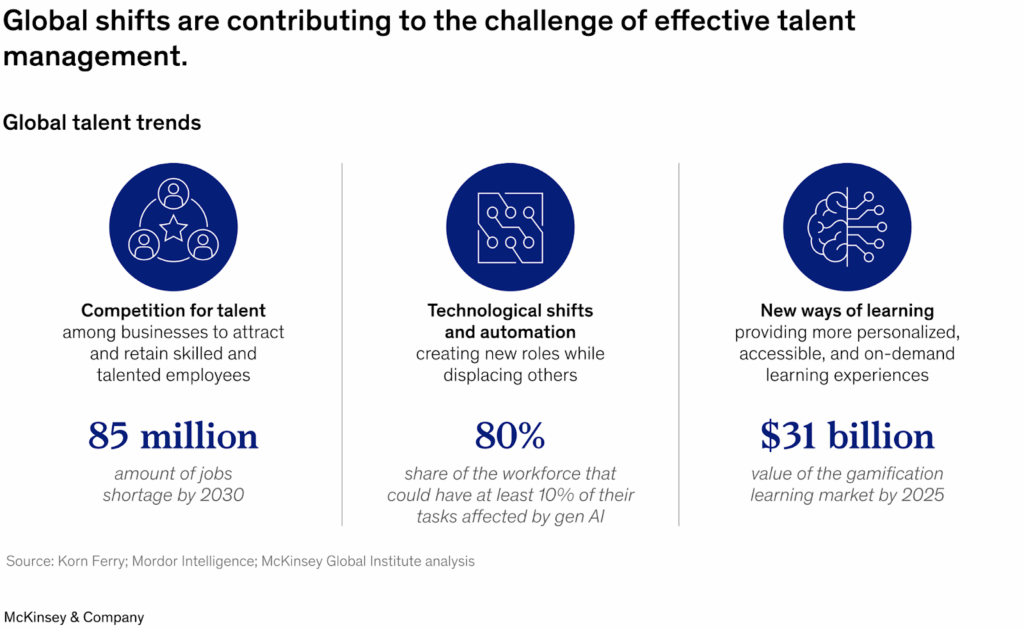
Image Source: McKinsey
The biggest difference between a team that plans and a team that stays ahead is data. Traditional planning leans on lagging information—last year’s hiring numbers, budget allocations, or talent reviews. Dynamic workforce planning leans on live signals that show what’s happening right now.
Data here doesn’t mean endless dashboards. It means specific, actionable signals that tell you how the market is moving:
- Internal signals like pipeline health, product timelines, and capacity gaps.
- External signals like job posting trends, skill demand shifts, competitor hiring patterns, and pay benchmarks.
When those two streams come together, you stop planning in isolation and start planning with context.
From gut feeling to evidence-based action
Let’s say your customer support tickets jump 25% in a new region. That’s an internal signal. A quick look at external data might show a spike in companies hiring for “regional onboarding specialists” in that same market. That’s your cue to react—not six months later when the team burns out, but now.
That’s why real-time job market analytics matter. They give HR and operations leaders the clarity to know what skills are heating up and where the pressure is building—before it becomes a crisis.
McKinsey research found that companies using real-time workforce data are nearly 2.5 times more likely to respond effectively to labor market shifts (McKinsey).
Dynamic workforce planning isn’t a technology trend. It’s a way to make smarter, faster moves when the ground shifts under your feet.
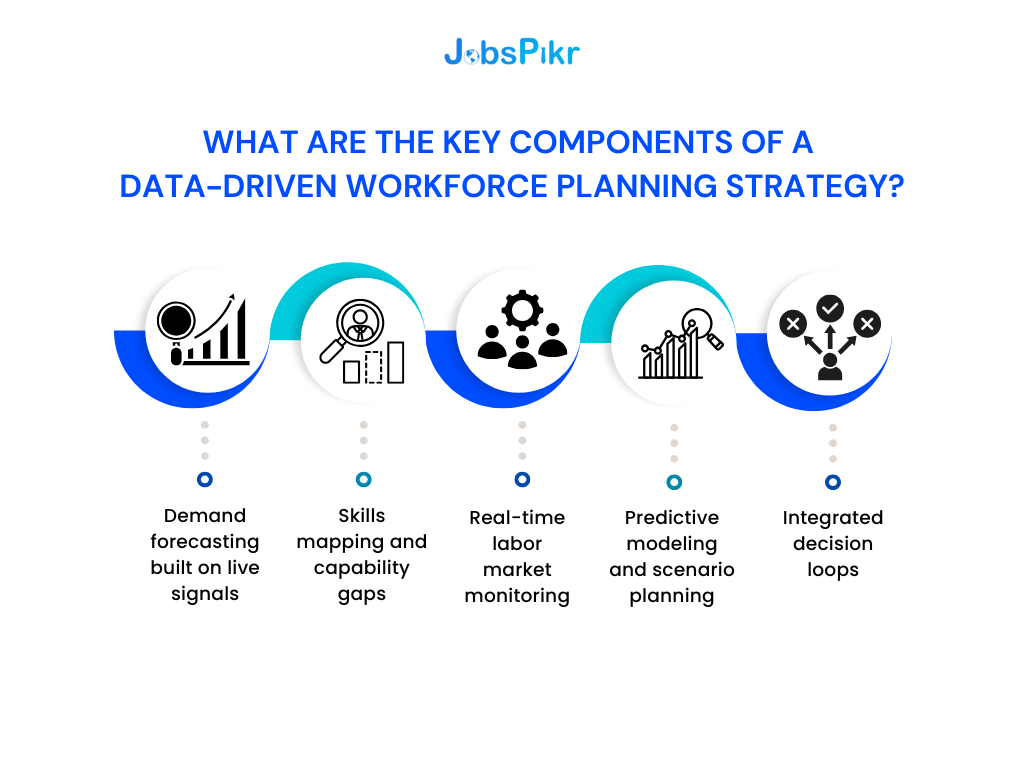
What are the key components of a data-driven workforce planning strategy?
Dynamic workforce planning isn’t just “being agile.” It’s a structured way to plan, act, and adapt using the right inputs at the right time. And at the center of it all is data—not as an afterthought, but as the foundation of every decision.
Here’s what separates teams that talk about agility from those that actually build a data-driven workforce strategy that holds up under pressure.
Demand forecasting built on live signals
Most workforce plans still anchor on revenue projections and headcount budgets. That’s a start, but it’s not enough. Real forecasting uses real-time job posting data, customer growth trends, and product timelines to predict what skills will be needed in the coming weeks or months.
For example, if postings for AI engineers or fulfillment specialists in your sector jump sharply, that’s a signal to adjust capacity before competitors snap up the talent.
Skills mapping and capability gaps
Knowing how many people you have tells you very little. Knowing what skills they hold tells you everything.
A strong dynamic strategy involves building and maintaining a skills inventory, not static resumes, but live skill profiles you can match against upcoming work. This is what allows teams to move people internally instead of always buying capacity through external hiring.
Real-time labor market monitoring
Markets shift fast. Skills that were hot six months ago may not be relevant today. A data-driven strategy tracks external job market analytics—demand velocity, location shifts, skill clusters—to know when to expand, pause, or upskill.
This isn’t about dashboards for the sake of dashboards. It’s about having one source of truth that tells you where the pressure points are forming.
Predictive modeling and scenario planning
The best teams don’t just react, they model.
They use market signals to build what-if scenarios: What if support volume doubles in Europe next quarter? What if cloud engineering roles become 40% more expensive in the US? What if talent pools dry up in key regions?
These scenarios let HR and operations leaders make informed trade-offs instead of scrambling when the market shifts.
Integrated decision loops
The real unlock happens when all these components—forecasting, skills data, labor market intelligence, and modeling—sit inside one decision loop. That means the same signals inform hiring, training, redeployment, and budget moves.
It’s how companies stop firefighting and start planning proactively.
Put real-time signals at the heart of your workforce strategy.
JobsPikr gives you job market data that moves at the same speed as the market itself, so you can plan, not chase.
How to build an agile workforce strategy using real-time job market analytics
A dynamic workforce strategy isn’t built in one big planning meeting. It’s built in small, repeatable loops—sensing what’s changing in the market, translating those signals into actions, and adjusting before the pressure shows up on the floor. That’s where real-time job market analytics come in. They’re not just numbers on a dashboard, they’re the early warning system that lets your teams stay ahead.
Below is a simple, practical framework to put this into action.
Step 1: Capture market signals early
Start by bringing in external signals, not just internal metrics. Job postings reveal emerging skills long before they show up in your own hiring plans.
For example:
- A sharp uptick in data engineering roles in your industry could indicate new tech adoption.
- A sudden surge in logistics coordinator postings might signal seasonal or regulatory shifts.
- Rising pay bands in a location might hint at tightening talent supply.
By tracking these shifts weekly or biweekly, you can see where demand is heating up and how that aligns (or collides) with your current team structure.
Step 2: Translate signals into action
Raw data doesn’t create agility—decisions do. The next step is turning those signals into specific workforce actions.
- If a skill starts trending up, decide whether to hire, train, or contract.
- If demand spikes in a region, explore redeploying internal talent before launching new requisitions.
- If pay levels climb, adjust your offer strategy or location mix early.
This step is where HR, operations, and business leaders need to work together—not in silos.
Step 3: Continuously adapt and measure
Dynamic workforce planning works only if it’s ongoing. Set short planning cycles—weekly signal reviews, monthly strategy adjustments, quarterly scenario recalibrations.
This keeps your plan alive, not locked away in a slide deck.
A Forrester study found that companies using external labor market data in their planning cycles are 1.8 times more likely to fill critical roles on time (Forrester). That kind of speed matters when your competitors are chasing the same talent pools.
Benefits of dynamic workforce planning for HR and Ops leaders
The real reason dynamic workforce planning matters is simple: you stop finding out too late. Too late to hire the right people, too late to adjust budgets, too late to avoid paying a premium for urgent fixes.
When you plan with live signals—not last year’s assumptions—you buy yourself time. And in workforce strategy, time is your leverage.
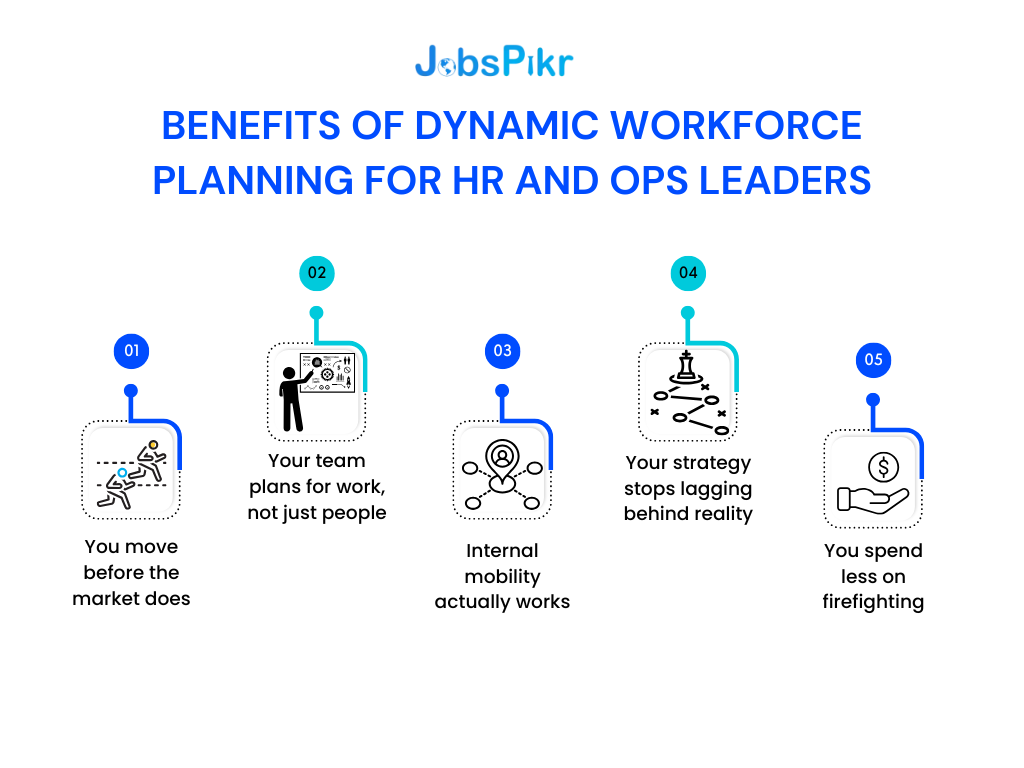
You move before the market does
Markets don’t give warnings. Demand for a skill heats up quietly, competitors start hiring, and suddenly, your recruiters can’t close roles. A dynamic planning loop helps you see the spike early and move while it’s still manageable. That can be the difference between hiring at market rate or paying 30% more three months later.
Your team plans for work, not just people
Most static plans fixate on headcount. Dynamic planning fixes on the work itself. When work shifts—new product, new region, new compliance requirement—you can reassign skills, open a short contract role, or trigger a training sprint. You’re not locked into the organization chart.
Internal mobility actually works
Here’s the quiet truth in a lot of companies: they hire externally for skills they already have internally—they just don’t know it. A live skills view changes that. You can redeploy people faster, fill gaps without waiting months for external hires, and keep good talent moving instead of leaving.
Your strategy stops lagging behind reality
Workforce plans often fail because they age badly. By the time the numbers hit the boardroom, they’re already stale. When planning becomes a continuous loop, your workforce strategy stays tied to what’s actually happening right now, not what happened a year ago.
You spend less on firefighting
Rushed hiring. Expedited relocations. Overpaying for scarce skills. These are all symptoms of slow planning. Dynamic planning cuts down on that burn by helping you make smaller, earlier moves instead of expensive, last-minute ones.
Real-world example: how real-time job signals drive workforce strategy
It’s one thing to talk about agility. It’s another to see what it looks like in practice. Real-time job signals give leaders something that static plans never can: a head start. Here’s a simple example that plays out in different industries every day.
The skills surge before the storm
A mid-size SaaS company starts seeing a quiet but steady increase in job postings for customer onboarding specialists in its sector. Competitors aren’t making loud announcements, but the signal is there in the data. At the same time, support tickets in a new region are climbing.
Traditional planning would catch this three to six months later, once the customer success team is stretched thin and customer churn starts creeping in. With a dynamic planning loop, the company reacts in weeks. They:
- Reassign two experienced CSMs with onboarding experience to the new region.
- Open a three-month contract role to cover immediate volume.
- Launch a short upskilling sprint for adjacent team members.
By the time competitors are rushing to hire, they’ve already stabilized the function.
A similar pattern in manufacturing
A global manufacturer spots a jump in postings for supply chain analysts in a specific logistics hub. Instead of waiting for bottlenecks to show up in their own operations, they move early—offering retention bonuses to keep critical talent, opening a small satellite recruiting push in that region, and adjusting workload across plants.
This kind of early action doesn’t just solve staffing issues—it protects production targets and saves costs.
Why this matters
The lesson isn’t about one job role. It’s about the power of signals. When you have visibility into where the market is moving, you can make quiet, early moves while everyone else is reacting loudly and late.
That’s the real advantage of dynamic workforce planning—you don’t win because you’re faster at firefighting. You win because the fire never starts in the first place.
Common challenges in dynamic workforce planning and how to overcome them
Shifting from static to dynamic workforce planning sounds good on paper. But in practice, it forces teams to change how they work. The hard part isn’t collecting data—it’s knowing how to use it, who owns it, and how fast you can turn signals into real decisions. These are the friction points most teams hit first.
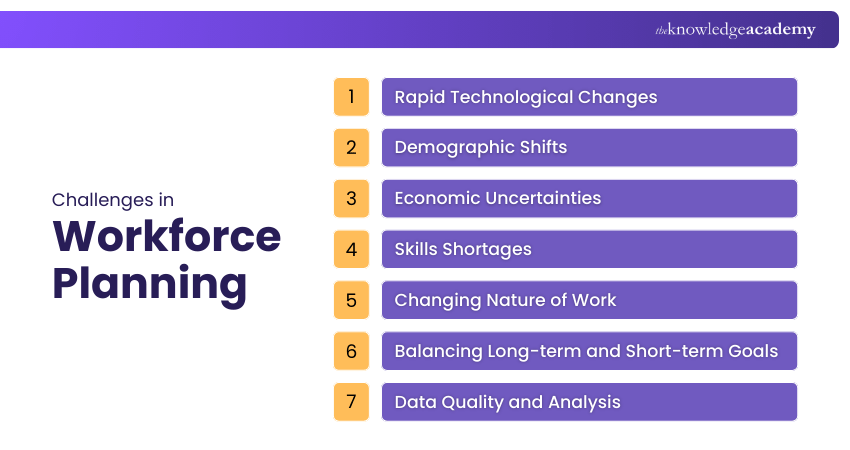
Image Source: theknowlegdeacademy
Data gaps and silos
Most companies have useful data scattered across systems: ATS reports, pipeline dashboards, training trackers, salary bands, and spreadsheets. What they don’t have is a clean, connected view of that information. Without it, signals show up late or get lost entirely.
The fix isn’t a massive tech overhaul. It’s starting small—centralizing job signal data and workforce inputs in one place. Once teams can see the same picture, decisions get faster.
Lagging decision cycles
A lot of companies still operate on quarterly planning rhythms. By the time a signal hits leadership, it’s already stale. Dynamic planning only works if decisions keep pace with the signals.
The shift here is cultural, not just operational. Set shorter planning loops—biweekly or monthly check-ins—so teams can make small course corrections instead of waiting for big emergencies.
Overcomplicating the model
A common mistake is trying to make dynamic planning too perfect too soon. Teams build elaborate dashboards, models, and processes, and then get stuck maintaining the machine instead of using it.
A better approach: pick two or three critical signals (for example, top roles by demand surge, location shifts, pay trends) and build decision habits around them. Complexity can come later—what matters first is speed and clarity.
Bridging strategy and execution
Even when signals are clear, they often die in the gap between planning and action. HR, Ops, and business units work on different clocks. Dynamic planning needs a shared language and fast lanes for decision-making—so that spotting a skill spike actually leads to reallocation, hiring, or upskilling in weeks, not quarters.
The future of workforce planning is dynamic
The companies winning the talent game over the next decade won’t be the ones with the biggest headcount or the longest annual plans. They’ll be the ones that move the fastest when the market moves. That’s what dynamic workforce planning unlocks—a way to plan that mirrors how the market actually behaves: fast, uneven, and unpredictable.
From planning cycles to planning loops
Traditional planning runs on long cycles: forecast, approve, execute, review. By the time the review happens, the reality has already changed. Dynamic planning breaks that cycle down into shorter loops—sense, decide, act, measure, repeat. Instead of asking “what happened?” every quarter, leaders can ask “what’s happening right now?” every week.
Skills as the new currency
Headcount is a blunt tool. Skills are precise. That’s why more forward-thinking teams are shifting from role-based to skills-based workforce strategies. Instead of planning “X number of engineers,” they plan for clusters of specific capabilities that can be shifted, expanded, or contracted as needed. This makes workforces more fluid and less dependent on rigid hiring cycles.
Market signals as a competitive advantage
Access to job signal data is no longer optional—it’s strategic. It’s how you see demand shifts before competitors do. It’s how you prepare your teams before the scramble begins. Whether it’s a spike in AI roles, a location pay shift, or an emerging skill gap, the edge goes to those who act early, not those who react loudly.
Human + data = better decisions
Dynamic planning isn’t about replacing judgment with algorithms. It’s about giving leaders better visibility so their judgment actually lands on time. Human decisions powered by live signals are faster, cleaner, and more aligned with what the market is doing.
The future isn’t static org charts. It’s living workforce strategies—built to bend, not break.
Plan with signals, not guesses
Dynamic workforce planning isn’t a buzzword. It’s a shift in how companies build and protect their advantage. Instead of reacting to talent shortages, hiring delays, or sudden skill gaps, teams that plan dynamically move before those problems surface.
The core idea is simple: stop treating workforce planning like an annual forecast. Treat it like a living system. One that listens, adapts, and keeps the business aligned with what’s happening right now—not what was true a year ago.
When external job signals are part of your planning loop, you don’t just keep up with the market. You get ahead of it. You match skills to work faster, keep hiring tight, and avoid the expensive scramble that comes from finding out too late.
HR and Ops leaders who build their strategy around live market intelligence are no longer guessing. They’re steering with a clear view of the road ahead.
Put real-time signals at the heart of your workforce strategy.
JobsPikr gives you job market data that moves at the same speed as the market itself, so you can plan, not chase.
FAQs
1. What is dynamic workforce planning?
Dynamic workforce planning is a way to plan staffing around live signals instead of fixed annual forecasts. It combines internal demand (product roadmap, pipeline, capacity) with external job market data (skills, postings, hiring velocity) so teams can adjust faster when market conditions shift.
2. What are the 5 R’s of workforce planning?
The 5 R’s are a common framework used to structure workforce strategy:
Right People – identifying who is needed.
Right Skills – ensuring those people have the right capabilities.
Right Place – deploying talent where the work happens.
Right Time – aligning hiring and deployment with demand.
Right Cost – optimizing spend without compromising execution.
3. What are the 4 steps in workforce planning?
Assess what work is coming, analyze your gaps, act through hire/train/redeploy, and review results so you can adjust quickly. Run that loop often, not once a year.
4. What are two types of workforce planning?
Strategic (longer-term direction and capabilities) and operational (near-term coverage and capacity). Most teams need both—strategy sets the guardrails, operations keeps pace week to week.
5. How often should a workforce plan be updated?
Treat it like a living doc. Do quick signal reviews weekly or biweekly, a deeper check monthly, and a heavier reset quarterly. If the market shifts sooner, you update sooner.
6. Where does JobsPikr fit in dynamic workforce planning?
It’s the outside-in view. JobsPikr supplies live job postings and skills signals, what roles are heating up, where pay is moving, which locations are active, so you can decide whether to hire, train, or redeploy before it gets expensive.