


- **TL;DR**
- Research proves hiring predicts corporate investment
- Building the JobsPikr signal: step-by-step data pipeline
- Curious how Fortune 500s track hiring signals?
- Where to hunt for alpha: three high-signal sectors
- Controlling for ghost jobs and false signals
- Making it work: equity and VC implementation strategies
- Curious how Fortune 500s track hiring signals?
- FAQs
**TL;DR**
Capital expenditure disclosures lag behind reality. By the time companies announce their $15 billion semiconductor fab or $80 billion cloud infrastructure plan, the investment thesis has already played out in the market. Smart investors need earlier signals. Job postings provide that edge. When Microsoft announced its record $80 billion capex plan for 2025, the hiring surge had already begun months earlier. Engineering roles for Azure infrastructure appeared across 12 planned regions before any public announcement. This trend appears across sectors. Job ads disclose investment intent ahead of earnings calls, SEC filings, or press releases.
Numerous academic studies show that growth in firm‑level job postings forecasts future operating performance and stock returns. Spikes in vacancies regularly precede favorable fundamental shifts.
Job postings offer scalable alternative data that reveals corporate strategy earlier than traditional sources. Unlike quarterly filings, hiring decisions happen in real time and signal forward-looking investment plans.
The signal works best when focused on specific role types. Engineering, facilities, and infrastructure positions near known sites provide the strongest predictive power.
Building an effective system requires combining posting velocity with function mix analysis and geographic proximity filters. Text analysis of job descriptions for terms like commissioning and tool install adds confirmation.
Controls for “ghost jobs” and seasonal hiring patterns prevent false positives. Multi-week persistence requirements and cross-validation with other alternative data sources improve signal quality.
Capital investment denotes funds set aside to acquire or grow long‑term assets. Contemporary examples include semiconductor fabs, data centers, manufacturing plants, and energy infrastructure. The scale has grown enormous. Individual semiconductor fabs now cost $10–20 billion each. Intel’s Arizona facilities are projected at $15 billion per location. Global semiconductor capex hit $148 billion in 2021, marking a 30 % year‑over‑year increase. These investments generate value by expanding capacity, boosting margins, and opening new growth avenues.
When TSMC announces its Arizona expansion, it signals years of future revenue potential. Traditional disclosure methods create information gaps. Companies announce capex decisions months or quarters after internal planning begins. Alternative data fills this gap. Job postings, building permits, and procurement data reveal investment intent before formal announcements. The reason is simple: every major capital project requires specialized human resources. Companies must hire before they build, install, or operate new assets.
Research proves hiring predicts corporate investment
Academic research strongly supports job postings as predictive signals. A 2019 study published in Management Science found that changes in job postings correlate positively with future performance changes.
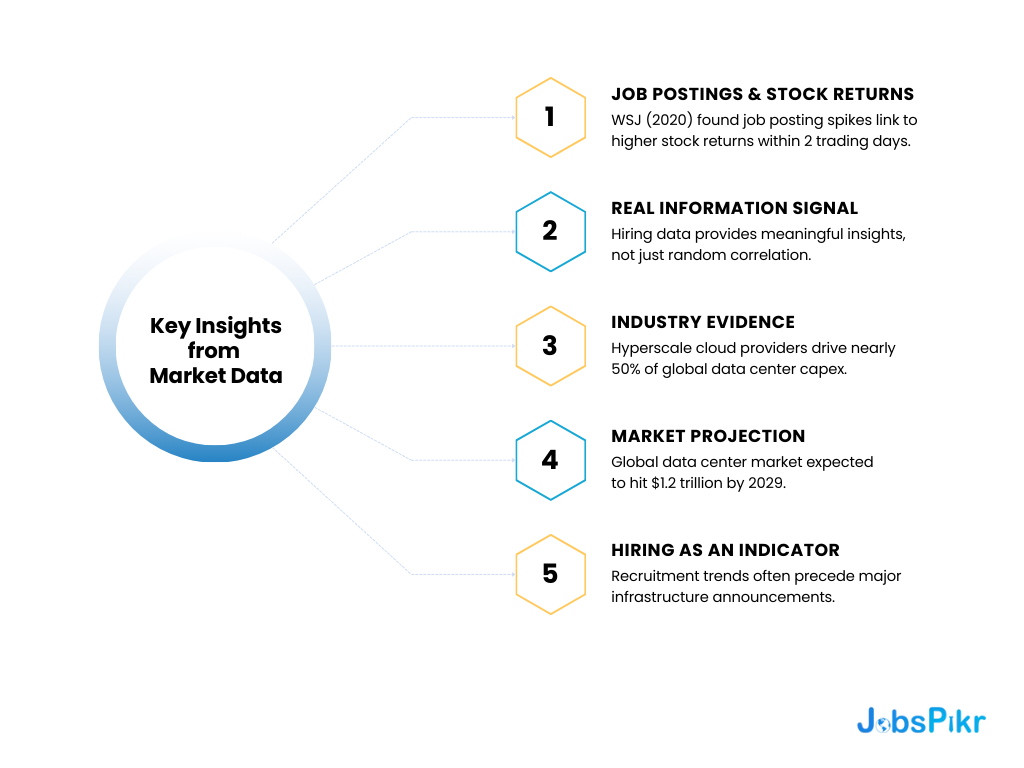
- The relationship strengthens when postings represent growth rather than replacement hiring. Investors react more positively to growth-oriented posting increases.
- Another study examining job postings and stock returns found that the job openings-to-employment ratio ranks among the strongest predictors of equity premiums. It outperforms over two dozen popular predictor variables.
- The predictive power extends to individual firms. Research shows that firms with currently low hiring rates earn higher subsequent returns than high-hiring firms. A 10 percentage point increase in hiring rate links to a 1.5 percentage point decrease in annual future returns.
Wall Street Journal coverage in 2020 highlighted how job posting increases correlate with higher stock returns in the two trading days following posting. The pattern reflects real information content rather than random correlation. Industry-specific evidence reinforces these findings. Hyperscale cloud providers now account for nearly half of global data center capex. This market is projected to reach $1.2 trillion by 2029. Their hiring patterns consistently precede major infrastructure announcements.
Like Microsoft’s $80 billion capex announcement followed months of accelerated hiring across Azure regions. Similar patterns appeared before Google’s data center expansions and Amazon’s warehouse automation initiatives. The signal works because hiring is forward‑looking; firms rarely add headcount without expecting higher capacity utilization and revenue growth.
Building the JobsPikr signal: step-by-step data pipeline
Building an effective hiring signal demands systematic data processing and feature engineering. The JobsPikr platform offers comprehensive job‑posting data across industries and regions.
1. Ingest and normalize
- Start by ingesting the JobsPikr feed and normalizing employer names.
- Deduplication removes redundant postings while preserving temporal patterns.
- Classification by function, seniority, and contract type enables targeted analysis.
2. Posting velocity tracks momentum changes
- Posting velocity measures week-over-week and month-over-month changes.
- Look for sustained increases over 4–8 week periods rather than single-week spikes.
- Persistence indicates genuine expansion rather than routine replacement.
3. Function mix analysis identifies growth signals
- Engineering, facilities, construction, environmental health and safety, procurement, and tooling positions signal capital deployment.
- Administrative or sales roles provide less predictive value.
4. Geographic clustering reveals site-specific expansion
- Filter postings within specific kilometer radius of known facilities, rumored locations, or areas with relevant zoning approvals.
- Proximity to utilities infrastructure or industrial zones strengthens the signal.
5. Requisition text analysis captures project-specific terms
- Key phrases like commissioning, tool install, fab, substation, hyperscale, and DC build indicate capital project involvement.
- Skills requirements for specialized equipment or processes provide additional confirmation.
6. Backtesting validates signal strength
- Event alignment connects posting patterns to announced capex decisions.
- Historical backtesting measures lead-lag relationships and establishes baseline signal strength across different industries and company sizes.
- Stratify results by industry since capex cycles vary significantly. Technology infrastructure follows different patterns than manufacturing or energy projects.
- Winsorize outliers and control for firm size and macro hiring trends.
- Evaluate signal performance using precision and recall metrics. False positives hurt as much as missed opportunities in investment applications.
7. Multiple data sources improve accuracy
- Stack job posting signals with other alternative data sources: building permits, procurement tenders, utility interconnect queues, and land acquisition data provide confirmation.
- Use hiring data as the “first ping” in a multi-signal system.
- Multi-week persistence requirements reduce noise from temporary posting increases. Require both posting velocity changes and supporting signals before generating investment alerts.
Curious how Fortune 500s track hiring signals?
Schedule a quick demo and see JobSpikr in action with real-time data from 30M+ job postings.
Where to hunt for alpha: three high-signal sectors
Semiconductor manufacturing shows clear hiring patterns
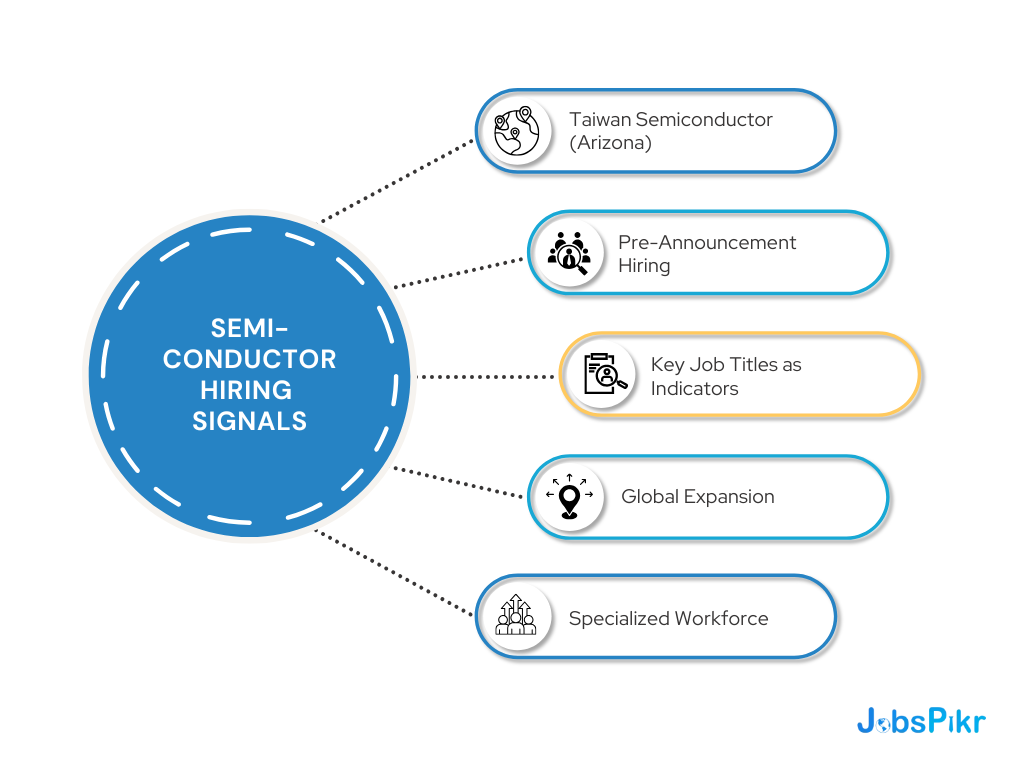
- Taiwan Semiconductor’s Arizona expansion employed 12,000 workers at peak construction.
- Sustained hiring of equipment technicians, process technicians, manufacturing specialists, and facilities gas chemical technicians preceded major timeline announcements.
- Key job titles that signal fab construction include process technician, tool install, and cleanroom facilities. These roles appear during specific construction phases and equipment installation periods.
- The pattern repeated across other semiconductor projects. Global industry expectations include 18 new fab construction projects starting in 2025. The pipeline includes 97 new high-volume facilities.
- Each project requires specialized construction protocols and extensive technical staffing.
Hyperscaler data centers follow predictable expansion cycles
Microsoft, Google, Meta, and Amazon collectively represent nearly half of global data center capex in 2025. Their infrastructure, power systems, and data center operations hiring waves align with reported capacity expansions. Data center construction requires 30–40 million work hours.
Projects demand specialized skills for managing power systems, cooling infrastructure, and network connectivity. Job postings for these roles typically appear months before construction announcements. Geographic filtering proves especially effective for data center projects. Postings clustered around new campus locations or areas with favorable power costs provide early expansion signals.
Energy transition projects create hiring multiplier effects
Software and AI platform companies demonstrate the pattern in infrastructure roles. Sustained engineering and solutions architect hiring often mirrors multi-year infrastructure commitments. Nvidia’s recent hiring patterns aligned with their data center and AI chip production scaling.
The signal extends beyond technology. Energy transition projects, logistics hubs, and advanced manufacturing show similar hiring-to-capex patterns. Construction, facilities, and maintenance roles consistently precede major project announcements.
India’s $4.2 billion energy transition capex allocation created hiring multiplier effects across green sectors. Renewable energy deployment generates approximately 40 jobs per megawatt over seven years locally. Job categories that signal energy investment include construction, facilities, and environmental health and safety roles. Watch for terms like commissioning, substation, and grid interconnect in descriptions.
Controlling for ghost jobs and false signals
- Up to 21% of job advertisements may be “ghost jobs” that don’t represent real hiring intent. Recent analysis found 27.4% of LinkedIn job listings are likely ghost postings.
- 40% of companies posted fake listings in 2024.
Why companies post ghost jobs
- Companies post ghost jobs for several reasons: to signal growth to investors, make current employees feel replaceable, build talent pipelines for future opportunities, or cast wider nets for exceptional candidates.
Detection methods filter false signals
- Job postings that remain continuously open or get repeatedly posted likely represent ghost positions.
- Vague descriptions with catchy titles but minimal detail indicate lower authenticity.
- Positions posted for more than 30 days carry higher ghost job probability. Cross-reference with company employment levels and recent announcements to validate genuine expansion signals.
Multi-signal confirmation requirements
- Require job posting increases plus supporting evidence from building permits, procurement activity, or regulatory filings before generating investment alerts.
- Persistence filters remove temporary spikes. Sustained posting velocity over 4–8 weeks provides stronger signal quality than single-week increases that might reflect routine replacement.
- Geographic validation adds another control layer. Hiring increases should cluster around logical expansion locations with appropriate infrastructure, zoning, or regulatory approvals.
- Industry-specific controls account for seasonal patterns. Construction and facilities roles show predictable cycles that don’t necessarily indicate major capex deployment.
Making it work: equity and VC implementation strategies
Equity analysts: building systematic watchlists
Equity analysts can build coverage watchlists with automated alerts for significant hiring pattern changes. Set thresholds at 2-sigma jumps in engineering and facilities postings near strategic geographic locations. Validate alerts against building permits and supplier discussions before incorporating into investment thesis or price targets.
Early hiring signals provide months of lead time before formal guidance updates. The method is especially effective for capital‑intensive sectors: semiconductors, data centers, energy infrastructure, and advanced manufacturing exhibit the strongest hiring‑to‑capex connections.
Private equity and VC: spotting strategic shifts
Private equity and venture capital teams can use hiring pattern analysis to spot product development commitments and infrastructure investments. This works for both portfolio companies and potential targets. Hiring mix shifts reveal strategic priorities.
Movement from dealmaker roles toward operational talent like data engineering, project management, and customer success indicates platform growth focus. Skill keyword analysis in job descriptions identifies technology bets and capability building. Requirements for specific tools, processes, or certifications signal strategic direction changes before public announcements.
Risk management through multiple confirmations
Risk management requires multiple confirmation signals. Hiring freezes, economic uncertainty, or company-specific challenges can disrupt normal hiring-to-capex relationships. Account for macro shocks that affect posting velocity across entire industries. Pandemic-related disruptions, supply chain constraints, or regulatory changes can create false signals without proper context.
JobsPikr platform advantages
The JobsPikr platform provides consistent, structured job posting data that scales across coverage universes. Real-time feeds enable systematic monitoring rather than manual tracking of individual company hiring pages. Investment teams supply their coverage universe. JobsPikr delivers the timestamped evidence and analytical framework. This combination creates a systematic edge in identifying capex deployment before traditional disclosure channels reveal the information. The alternative data advantage comes from timing rather than unique insights. Most capex announcements eventually become public. Months of advance notice provide substantial value in competitive investment markets.
Curious how Fortune 500s track hiring signals?
Schedule a quick demo and see JobSpikr in action with real-time data from 30M+ job postings.
FAQs
1. How far in advance do job postings predict capex announcements?
Typically 2–6 months. Microsoft’s $80 billion capex announcement followed months of Azure hiring increases. TSMC’s Arizona timeline updates came after sustained technician hiring. The lead time varies by industry and project complexity.
2. Which job titles give the strongest investment signals?
Engineering, facilities, construction, and process technician roles work best. Look for “tool install,” “commissioning,” “cleanroom facilities,” and “process technician” titles. Administrative and sales roles provide weaker signals since they don’t directly relate to capital projects.
3. How do you avoid false signals from ghost jobs?
Require 4–8 weeks of sustained posting increases, not single spikes.
Cross-check with building permits or supplier activity.
Avoid positions posted over 30 days or with vague descriptions.
Use geographic clustering near known facilities to validate real expansion.
4. What industries work best for this hiring-to-capex approach?
Capital-intensive sectors show the strongest patterns: semiconductors, data centers, energy infrastructure, and advanced manufacturing. Software companies with major infrastructure builds also show clear signals. Avoid service-heavy industries with minimal physical assets.
5. Do you need expensive tools to track hiring patterns effectively?
Manual tracking doesn’t scale across multiple companies. JobsPikr provides structured data feeds that enable systematic monitoring. Free job board scraping misses timing precision and normalization needed for investment signals. Consistent data processing is essential for reliable results.