


- The Great Hiring Slowdown: Numbers That Tell a Story
- Geographic Intelligence: Reading Between the Postings
- Starbucks’ hiring data tells the story of retail’s future.
- The Wage Compression Reality Check
- Role Mix Evolution: The Changing Face of Retail Jobs
- Internal Mobility: The Hidden Hiring Story
- What This Means for Retail Talent Strategy
- The Broader Retail Implications
- Looking Ahead: What to Watch
- The Strategic Value of Hiring Intelligence
- The Future of Retail Talent Intelligence
- Starbucks’ hiring data tells the story of retail’s future.
- FAQs
The job market in 2025 tells many stories, but few are as revealing as those hidden in the daily stream of corporate job postings. When a retail giant like Starbucks adjusts its hiring patterns, entire industries take notice.
The coffee chain’s job application trends offer a window into broader retail workforce dynamics. From wage compression to geographic expansion signals, every posting tells a story about where the company is heading.
The Great Hiring Slowdown: Numbers That Tell a Story
Starbucks experienced a dramatic shift in hiring velocity throughout early 2025. The numbers paint a picture of strategic recalibration rather than simple cost-cutting.
Job postings dropped from 42,000 in 2024 to just 2,500 in January 2025. That’s a 29% decline that caught many analysts off guard. But the real shock came in February when postings plummeted to just 1,100 – a staggering 56% month-over-month drop.
This wasn’t just market conditions at work. The company eliminated 1,100 corporate positions and closed several hundred vacant job postings as part of a major restructuring effort, affecting roughly 7% of its non-retail workforce.
The timing aligned with CEO Brian Niccol’s “Back to Starbucks” strategy, focusing on operational efficiency and customer experience over rapid expansion.
What the Numbers Actually Mean
The hiring slowdown reflects three key strategic shifts:
- Quality over quantity hiring: Moving from volume-based recruitment to selective, retention-focused hiring
- Internal mobility emphasis: Prioritizing existing partners for advancement opportunities
- Operational streamlining: Reducing complexity in both corporate structure and store operations
For retail HR teams watching these trends, the message is clear. The era of aggressive hiring to fill any available role is ending. Companies are demanding better hiring ROI.

Geographic Intelligence: Reading Between the Postings
Starbucks job postings reveal fascinating geographic expansion patterns that traditional market analysis might miss. The company’s hiring data shows where growth is actually happening, not just where it’s planned.
Texas and Southeast states emerged as primary expansion targets, with hiring managers specifically noting “great store economics” in these regions. This represents a shift from the West Coast saturation model that defined earlier growth phases.
Metro Market Saturation Signals
Established markets like Seattle, New York, and Los Angeles show different posting patterns entirely. Rather than new store hiring, these metros focus on:
- Renovation and remodel project managers
- Technology integration specialists
- Enhanced customer experience roles
The posting patterns reveal that mature markets are optimizing existing locations rather than expanding footprints.
Meanwhile, emerging markets show classic expansion hiring: store managers, assistant managers, and barista training coordinators. The geographic data from job postings provides real-time expansion intelligence that quarterly reports simply can’t match.
International Expansion Through Hiring Data
International posting patterns tell an even more ambitious story. India’s hiring surge aligns with plans for 1,000 stores by 2028 (up from 479 currently). China’s job postings suggest an aggressive push toward 9,000 total locations.
These international postings reveal something crucial: Starbucks isn’t just thinking about Starbucks jobs in the traditional sense. They’re building a global talent pipeline that extends far beyond typical usa jobs categories.
Starbucks’ hiring data tells the story of retail’s future.
Schedule a quick demo and see how real-time job posting intelligence powers smarter workforce planning and market strategy.
The Wage Compression Reality Check
Perhaps the most striking trend in Starbucks’ 2025 hiring data is wage compression across multiple role categories. Median salaries dropped from $49,222 in 2024 to $36,500 in 2025 – a 25.9% decline that reflects broader retail labor market conditions.
This compression wasn’t uniform across all positions:
Barista Roles: $15.23-15.55 per hour (relatively stable) Store Managers: $70,090 annually (minimal growth) District Managers: $108,250 (slight premium increase)
The Flat Raise Policy Impact
The company implemented 2% across-the-board increases for salaried staff, falling below the 2.7% inflation rate. This policy created ripple effects throughout the organization.
For retail HR professionals analyzing starbucks careers postings, this wage data provides crucial competitive intelligence. It shows how even premium employers are managing labor cost pressures.
The compression also reveals strategic workforce priorities. Higher-level management roles maintained competitive compensation while entry and mid-level positions saw stagnation.
Role Mix Evolution: The Changing Face of Retail Jobs
Starbucks’ job posting patterns reveal a fundamental shift in retail role architecture. The traditional barista-to-manager pipeline is evolving into something more sophisticated.
The Assistant Store Manager Expansion
One of the most significant changes involves Assistant Store Manager roles. Previously available in only 20% of locations, the position is expanding to “most stores” according to recent postings.
This expansion signals several strategic shifts:
- Span of control optimization: Reducing manager burnout through enhanced support
- Career pathway enhancement: Creating clearer advancement opportunities for baristas
- Operational complexity management: Adding leadership layers to handle increasing operational demands
Enhanced Hiring Process Evolution
District managers now screen barista candidates directly – a responsibility previously handled exclusively by store managers. This change appears in job descriptions and represents a significant operational shift.
The enhanced process includes:
- AI-powered screening systems tracking 9-12 month retention
- Behavioral assessment tools focused on customer service aptitude
- Multi-level interview processes for even entry-level positions
For companies analyzing retail hiring trends, these process changes indicate where the industry is heading. Volume hiring is being replaced by precision recruitment.
Technology vs. Human Resource Balance
Interestingly, Starbucks appears to be reversing previous automation strategies. Job postings increasingly emphasize adding more baristas rather than implementing labor-saving technology.
This “Green Apron” service approach being scaled nationwide prioritizes human interaction over efficiency automation. The posting patterns show roles that specifically focus on customer connection rather than transaction processing.
Internal Mobility: The Hidden Hiring Story
One of the most revealing aspects of Starbucks’ hiring patterns is what’s not posted externally. Internal mobility data shows that 60% of store managers started as baristas – a statistic that dramatically impacts external posting patterns.
The Partnership Culture Effect
Starbucks’ “partner” culture creates unique hiring dynamics. Many positions that might typically be posted externally are filled through internal advancement programs.
This creates posting patterns that look like:
- Fewer mid-level management external postings
- More entry-level barista positions
- Specialized training coordinator roles
- Leadership development program positions
For retail analysts, this internal mobility emphasis explains why certain role categories seem under-represented in external job boards despite organizational growth.
Training and Development Infrastructure
The company’s job postings increasingly include training and development specialist roles. These positions support the internal advancement pipeline and represent significant investment in workforce development.
Recent postings for training coordinators, learning experience designers, and partner development specialists indicate a company betting heavily on internal talent cultivation.
What This Means for Retail Talent Strategy
The patterns emerging from Starbucks hiring data offer crucial insights for retail HR teams and market analysts. The company’s approach represents a broader industry shift toward strategic workforce management.
Key Strategic Implications
Hiring Velocity vs. Quality: The dramatic posting reduction doesn’t indicate business decline – it shows strategic maturation. Companies are prioritizing retention and internal development over external recruitment.
Geographic Intelligence: Real-time posting data provides expansion insights that traditional market analysis misses. Hiring patterns predict market entry 6-12 months ahead of official announcements.
Wage Trend Forecasting: Compensation data from job postings offers immediate market intelligence. The wage compression observed at Starbucks likely indicates broader retail labor market trends.
Competitive Intelligence Applications
For market analysts and HR strategists, Starbucks’ posting patterns provide actionable competitive intelligence:
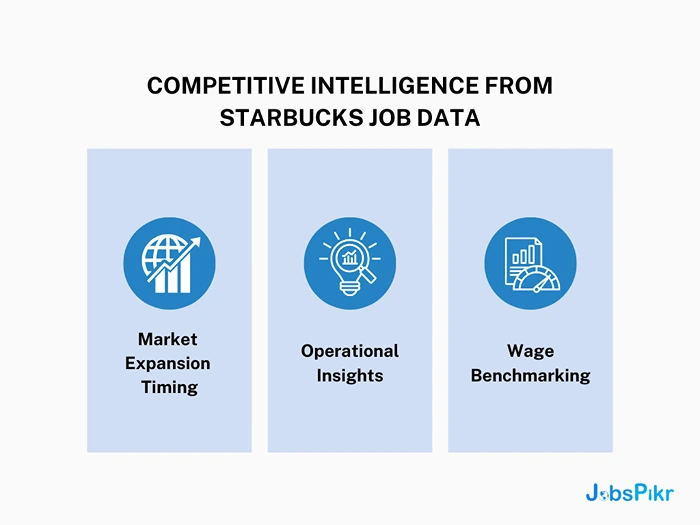
- Market expansion timing: Hiring surges in specific metros predict competitive market entry
- Operational model insights: Role mix changes indicate strategic operational shifts
- Wage benchmarking: Real-time compensation data enables competitive positioning
Near-Real-Time Market Intelligence
Traditional market analysis relies on quarterly reports and annual surveys. By the time this data becomes available, market conditions have often shifted dramatically.
Near-real-time job posting analysis offers a different approach. Daily posting data reveals strategic shifts as they happen, not months later.
Granular Data Insights
JobsPikr’s approach to tracking Starbucks job postings demonstrates the power of granular data analysis:
- Daily posting volume tracking: Immediate visibility into hiring velocity changes
- Geographic expansion mapping: Real-time identification of growth markets
- Role mix evolution analysis: Understanding strategic workforce composition changes
- Compensation trend identification: Market-rate intelligence updated continuously
Beyond Traditional Analytics
This granular approach reveals insights that traditional market analysis simply cannot capture:
- Seasonal hiring pattern variations: Understanding how external factors affect recruitment timing
- Strategic pivot indicators: Early warning signs of major operational changes
- Competitive positioning intelligence: Real-time understanding of competitor workforce strategies
The Broader Retail Implications
Starbucks’ hiring patterns likely forecast broader retail industry trends. The company’s size and market position make it an industry bellwether for workforce strategies.
Industry-Wide Trends
Several patterns observed in Starbucks data are appearing across retail:
- Hiring selectivity increase: Quality metrics prioritized over volume
- Internal mobility emphasis: Investment in existing workforce development
- Technology-human balance: Strategic decisions about automation vs. human interaction
- Geographic optimization: Data-driven expansion and contraction decisions
Future Workforce Models
The evolution of Starbucks’ hiring approach suggests several emerging retail workforce models:
- Hybrid Management Structures: More assistant manager roles creating flatter hierarchies
- Technology-Enhanced Recruitment: AI-powered screening becoming standard
- Partnership-Based Employment: Long-term career development replacing transactional hiring
Looking Ahead: What to Watch
As 2025 progresses, several key indicators will reveal whether Starbucks’ strategic hiring approach succeeds:
Performance Metrics to Monitor
- Retention rate improvements: Whether selective hiring improves workforce stability
- Internal advancement success: Effectiveness of enhanced mobility programs
- Customer satisfaction correlation: Impact of workforce changes on service quality
- Market expansion success: Whether data-driven geographic expansion delivers results
Competitive Response Patterns
Other retail chains will likely adopt similar approaches if Starbucks’ strategy proves successful. Key indicators include:
- Industry-wide hiring velocity changes: Competitors adopting quality-over-quantity approaches
- Investment in internal mobility programs: Enhanced career development initiatives
- Technology integration strategies: Balancing automation with human service elements
The Strategic Value of Hiring Intelligence
The Starbucks case study demonstrates how job posting analysis provides strategic intelligence that traditional market research cannot match. Real-time hiring data reveals strategic intentions, market expansion plans, and competitive positioning.
For retail HR teams and market analysts, this approach offers several critical advantages:
- Immediate Strategic Intelligence: Understanding competitive moves as they happen
- Market Expansion Forecasting: Predicting geographic growth 6-12 months ahead
- Compensation Benchmarking: Real-time wage and benefit trend analysis
- Operational Model Insights: Understanding how competitors structure their workforce
The granular nature of this data makes it invaluable for strategic planning and competitive analysis.
The Future of Retail Talent Intelligence
Starbucks’ 2025 hiring patterns reveal a retail industry in strategic transition. The shift from volume-based hiring to quality-focused recruitment represents a fundamental change in how companies approach talent acquisition.
The geographic expansion intelligence hidden in posting patterns provides unprecedented insight into market strategies. Wage compression trends offer early warning signals for broader labor market shifts.
Most importantly, the evolution of role mix and internal mobility programs suggests a retail workforce model focused on long-term partnership rather than transactional employment.
For retail HR teams and market analysts, the lesson is clear: job posting data provides strategic intelligence that traditional analysis simply cannot match. The companies that master this approach will have significant competitive advantages in understanding market dynamics and competitor strategies.
The future belongs to organizations that can extract strategic insights from operational data. In retail talent strategy, that future is already here.
Starbucks’ hiring data tells the story of retail’s future.
Schedule a quick demo and see how real-time job posting intelligence powers smarter workforce planning and market strategy.
FAQs
1. What’s new at Starbucks in 2025?
Starbucks is focusing less on mass hiring and more on selective recruitment, internal promotions, and expanding into new markets like India and China.
2. Is Starbucks in a hiring freeze?
Not a full freeze, but Starbucks has slowed hiring significantly. They are prioritizing quality roles and internal mobility instead of posting thousands of openings.
3. How many Starbucks are there in 2025?
Starbucks has over 38,000 stores worldwide, with plans to keep growing in markets like India and China.
4. Will layoffs continue in 2025?
Starbucks already cut some corporate jobs early in 2025. While large new layoffs haven’t been announced, the company is still restructuring.
5. Is Starbucks growing or declining?
Starbucks is still growing globally, especially in Asia, even though hiring in the U.S. has slowed.