


- Why Total Rewards Strategy Fails at Most Enterprises
- The Total-Rewards Revolution: Data-Driven Pay Strategy for Retention
- What "Total Rewards" Actually Means in 2026 And What Most Companies Miss
- Traditional Survey vs. Real-Time Job Posting Data: Why the Old Approach Is Losing Ground
- How to Read Total Rewards Intelligence from Job Postings
- A Step-by-Step Framework for Building a Data-Backed Total Rewards Strategy
- Pay Equity Is the Retention Risk Nobody Is Measuring Correctly
- What Good Total Rewards Intelligence Actually Looks Like in Practice
- The Shift Every Total Rewards Leader Needs to Make
- Stop Benchmarking on Last Year's Data
- Frequently Asked Questions
Why Total Rewards Strategy Fails at Most Enterprises
The Total-Rewards Revolution: Data-Driven Pay Strategy for Retention
Most retention problems get misdiagnosed as pay problems. But in 2025, employees are not just evaluating their salary, they are weighing the entire package: equity, bonuses, benefits, flexibility, and growth. And most companies are only benchmarking one piece of it.
This article is for Total Rewards Directors, VP Compensation, and HR Operations leads who want to move beyond salary surveys and build a compensation strategy grounded in real-time market data. Here is what we cover:
- Why total rewards benchmarking is broken at most enterprises and why annual surveys are a big part of the problem.
- What job posting metadata reveals equity grants, signing bonuses, benefits language, flexible work terms and how to use it at scale.
- A side-by-side comparison of the traditional survey approach versus a real-time job posting data approach.
- A step-by-step framework for building a data-backed total rewards strategy using live compensation intelligence.
- Why pay equity is a retention risk most companies are measuring the wrong way.
If your total rewards strategy is still built on last year’s survey data, this is the article that explains why that is costing you talent and what to do about it.
There is a pattern that plays out at enterprises more often than most compensation teams would like to admit.
A high performer hands in their notice. The exit interview is polite but vague. Someone in HR pulls up the salary benchmarking data, the numbers look broadly competitive, and the team concludes the person just got a better offer somewhere else.
The real reason, whether it was a benefits package that did not fit their life, an equity structure that never felt meaningful, or the sense that the company was not investing in their growth never makes it into the post-mortem.
This is the core problem with how most enterprises approach total rewards today. Salary gets the rigour. Everything else gets the leftover budget and a shrug.
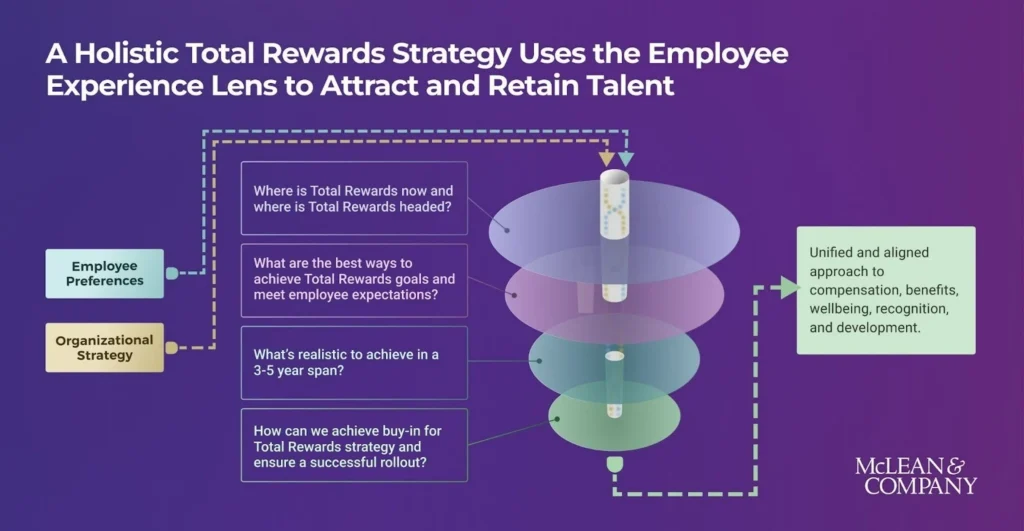
Image Source: PRNewswire
The benchmarking gap nobody talks about
The way this plays out in practice is pretty consistent. Compensation benchmarking gets a real process: annual survey data, percentile targets, band reviews. Benefits benchmarking, if it happens at all, is usually a conversation with a broker and a rough sense of what “feels competitive.” Equity gets reviewed when someone raises a red flag. Bonuses get modelled based on what the company did last year.
The result is a total rewards strategy where one pillar is data-driven and the rest are educated guesses.
And that gap is getting more expensive to ignore. According to i4cp’s 2026 Total Rewards Leader Board, today’s rewards portfolio spans pay, benefits, wellbeing, flexibility, recognition, and career opportunity and all of it shapes whether people stay or leave. Employees are not just comparing offer letters anymore. They are comparing entire packages, and they have more information than ever to do it.
The data problem underneath it all
Salary is relatively easy to benchmark because salary data is relatively easy to collect. You can pull from surveys, postings, and platforms and triangulate to a number that feels defensible.
But benchmarking the rest of the package what companies in your competitive set are offering on equity, how their benefits compare to yours, what signing bonuses look like for the roles you are hiring is genuinely difficult when your primary tool is an annual survey capturing whatever participants chose to report months ago.
WorldatWork’s review of 2025 total rewards trends put it plainly: pay equity and job architecture have moved from “nice-to-have” to “must-have,” and you cannot be transparent without defensible ranges, consistent levelling, and clean data.
Most enterprises do not have clean data across all five pillars of total rewards.
What needs to change
The companies winning the retention battle in 2026 are not simply outbidding the market on base salary. They are building packages that are harder to replicate because they reflect a deep understanding of what the market is offering across every dimension of total rewards, not just the salary line.
The starting point is not a better survey. It is better data. Real-time data that shows what companies are putting in front of candidates right now in job postings, in offers, in the language they use to compete for the same people you are trying to hire and keep.
What “Total Rewards” Actually Means in 2026 And What Most Companies Miss
Before we get into benchmarking and strategy, it is worth taking a moment to be precise about what total rewards covers. Because the term gets used loosely, and that looseness is part of why benchmarking it is so hard.
Total rewards are not just salary plus benefits. It is the entire value proposition an employer puts in front of a current or prospective employee, every financial and non-financial element that influences whether someone joins, stays, or leaves.
The five pillars, explained plainly
Most frameworks, including the widely cited WorldatWork model, break total rewards into five core components. Here is how they actually play out in practice:

Image Source: HackingHR
- Compensation is the foundation base salary, variable pay, bonuses, and equity. It is the most visible part of the package and the most benchmarked. It is also the part where, if you get it wrong, nothing else matters enough to compensate.
- Benefits cover health insurance, retirement plans, paid time off, parental leave, and wellness programs. According to PeopleKeep’s Employee Benefits Survey, 81% of employees say an employer’s benefits package is an important factor in whether they accept a job. It is not a secondary consideration for candidates. It is often a deciding one.
- Wellbeing and work-life balance sits somewhere most companies underestimate. This is flexible working, mental health support, remote work options, and protection against burnout. It is also the pillar that has moved the most in employee expectations over the past three years.
- Career development includes training, mentorship, internal mobility, and clear progression paths. This pillar is increasingly what separates companies with strong retention from those who lose people two or three years in, right when they are most valuable.
- Recognition is the most overlooked pillar and often the cheapest to get right. Structured acknowledgment of contribution, both formal and informal, has a measurable impact on whether people feel valued enough to stay.
Where the benchmarking breaks down
Here is the honest problem: most compensation teams have a rigorous process for pillar one and an informal, ad hoc approach to the other four.
Salary gets benchmarked against surveys, percentile targets, and job market data. Benefits get reviewed when the broker presents options. Equity gets looked at when someone raises a concern. Recognition programmes get evaluated on gut feel. Career development rarely gets benchmarked against the market at all.
The result is a total rewards strategy that is data-backed in one dimension and largely guesswork in four others.
A 2025 survey by Zerenglobal of 250 senior professionals found that 65% of employees report little to no clarity around how their compensation is determined. That is not just a communication problem it is a signal that most organisations have not built the internal infrastructure to manage and explain total rewards as a coherent whole.
And according to Ravio’s 2025 Compensation Trends Report, for 32% of companies, benefits are now the biggest challenge when attracting new hires and 27% say the same for retaining existing talent. Benefits, not salary, is where many companies are losing ground.
The signal hiding in plain sight
Here is what makes this particularly frustrating for comp teams who want to do better: the data to benchmark all five pillars exists. It is sitting inside job postings.
When companies advertise roles, they increasingly include far more than a salary range. They mention equity structures, signing bonuses, parental leave policies, learning stipends, flexible work terms, and wellness perks sometimes in detail, sometimes in passing, but consistently enough that at scale, it becomes a benchmark.
Parsed correctly, that metadata gives you a real-time picture of what the market is offering across every dimension of the total rewards package, not just the salary line. That is the shift that makes a total rewards intelligence platform different from a salary benchmarking tool. And it is the shift the rest of this article is built on.
Traditional Survey vs. Real-Time Job Posting Data: Why the Old Approach Is Losing Ground
If you have been in total rewards for any length of time, you know the traditional compensation benchmarking process well. You purchase a survey from a major provider, map your roles to their taxonomy, run your analysis, and walk into the comp review with a set of numbers that feel defensible. For decades, that process was the standard. It still is at many organisations.
The problem is not that traditional surveys are wrong. The problem is that they are slow and in a market where total rewards expectations are shifting faster than annual cycles can capture, slow is a real liability.
The core problem with traditional surveys
According to SalaryCube’s 2025 guide to compensation survey providers, most compensation surveys operate on annual or semi-annual cycles, which means the data can be 12 to 18 months old by the time you apply it. In a stable market, that lag is manageable. In a fast-moving one, it is the difference between a competitive offer and a declined one.
There is also a participation problem that does not get discussed enough. As Ravio’s analysis of salary survey reliability points out, because surveys rely on manual submissions, the data is often error-prone and sourced from legacy companies that rarely match your size, stage, or region making them a risky foundation for high-stakes compensation decisions.
Then there is the role-matching problem. When you are benchmarking an emerging or hybrid role think AI-adjacent positions, or a head of total rewards with analytics brief you are often forced to shoehorn the role into the closest available category in the survey’s taxonomy. The result is a benchmark that is technically populated but practically misleading.
And the cost is real. SalaryCube notes that annual costs for traditional compensation surveys range from $5,000 to $50,000 depending on scope before you factor in the internal time required to clean, map, and interpret the data.
What real-time job posting data changes
Job postings are a fundamentally different kind of signal. When a company publishes a role with a salary range, benefits callout, or equity mention, that information reflects a live decision made by someone with an actual budget and a hiring deadline. It is not self-reported. It is not lagged by a survey cycle. It is what that employer, in that market, for that specific role, is willing to put in front of candidates right now.
According to an analysis of 3.5 million job listings by INOP, more than 68% of job postings in 2025 included salary ranges, up from just 45% in 2023. That is a significant increase in usable signal and it is still growing, driven partly by pay transparency legislation spreading across US states and into Europe. More disclosed data in postings means better coverage, less reliance on self-reported survey inputs, and benchmarks that reflect the actual hiring market rather than a sample of HR leaders’ recollections.
Beyond salary ranges, modern job postings increasingly surface total rewards detail. Equity grant language, signing bonus mentions, flexible work terms, parental leave policies, learning stipends, this metadata exists at scale inside job posting data, and when parsed systematically, it gives you something no annual survey can: a real-time picture of what the market is offering across the full rewards package.
The side-by-side
Here is how the two approaches compare across the dimensions that matter most for total rewards benchmarking:
| Traditional Survey Approach | Real-Time Job Posting Data | |
| Data freshness | 12–18 months old at point of use | Updated continuously |
| Coverage | Salary-heavy; limited benefits detail | Salary, equity, bonuses, benefits language, perks |
| Role flexibility | Fixed taxonomy; poor fit for emerging roles | Captures actual job titles as posted |
| Geographic granularity | Broad regions; limited city-level detail | City, postcode, and micro-market level |
| Cost | $5,000–$50,000+ annually | Scales with API access |
| Refresh cadence | Annual or semi-annual | Continuous |
| Total rewards coverage | Primarily base pay and standard benefits | All five pillars, where disclosed |
The traditional approach has genuine strengths, particularly for governance, compliance, and executive pay where survey data still carries weight in board-level conversations. But as a primary tool for benchmarking total rewards in real time, it has structural limitations that no amount of supplementary analysis can fully fix.
The shift happening across enterprise comp teams right now is not a wholesale replacement of surveys, it is adding a live data layer that fills the gaps surveys leave behind. And for total rewards specifically, those gaps are significant.
How to Read Total Rewards Intelligence from Job Postings
Most comp teams look at job postings for one thing: the salary range. They pull the floor and ceiling, slot it against their internal band, and move on. That is useful, but it is also leaving most of the signal on the table.
A modern job posting, when it is well-written and compliant with pay transparency requirements, is actually a fairly dense document. It tells you what a company is willing to pay in cash. But it also tells you how they are thinking about equity, what they are dangling in terms of benefits, whether they are leading with flexibility, and sometimes even how they structure variable pay. Parsed at scale, that adds up to something much more powerful than a salary benchmark.
Here is what to look for across each layer.
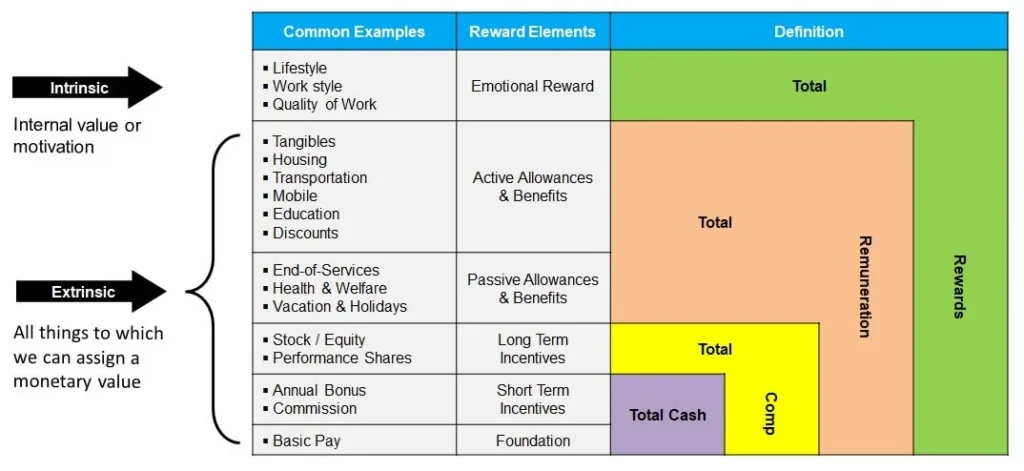
Image Source: pesync
Salary ranges: the floor, not the ceiling
The posted salary range is the starting point, not the endpoint. In markets with pay transparency laws and by end of 2025, 21 US states required salary ranges in job postings these ranges reflect genuine hiring intent, not aspirational numbers. The spread between the floor and ceiling also tells you something: a wide range often signals either seniority flexibility or uncertainty about what level of candidate they will attract. A tight range usually signals a well-scoped role with a clear internal band.
What you want from salary range data at scale is not a single midpoint number. You want the distribution where the 25th, 50th, and 75th percentiles sit across your competitive set, in your specific geography, for your specific role level. That is the difference between knowing a market exists around a number and knowing where you need to land to win.
Equity language: reading between the lines
Not every company spells out their equity structure in a job posting, but many drop enough language to be useful. RSU mentions, stock option references, vesting schedule hints, and phrases like “competitive equity package” or “meaningful ownership” are all signals that equity is part of the offer and increasingly, they indicate how prominently the company is leading with it.
At scale, you can start to see patterns. Which companies in your competitive set are leading with equity language? Which industries are using it more frequently than others? In sectors like tech and high-growth startups, equity is often doing more work than base salary in the total compensation story, and the posting language reflects that. For comp teams benchmarking against those environments, ignoring equity signals in posting data means ignoring a major portion of what the market is competing on.
Signing bonuses: the real-time demand signal
Signing bonus mentions in job postings are one of the most underused signals in total rewards benchmarking. When a company is actively advertising a signing bonus in the posting itself rather than negotiating it quietly at the offer stage, that is usually a sign of one of two things: high competition for that role, or a base salary that they know sits below market and needs bridging.
Either way, it is a useful data point. It tells you that the company knows the market has moved, even if their base salary bands have not caught up yet. Tracking signing bonus frequency and language across your competitive set gives you a leading indicator of where compensation pressure is building before it shows up in survey data.
Benefits callouts: what companies choose to advertise
The benefits a company chooses to highlight in a job posting are not random. Companies lead with what they believe differentiates, which makes the benefits mentioned in postings a reasonable proxy for what the market considers competitive.
Flexible work terms, mental health support, generous parental leave, learning stipends, four-day work weeks, wellness allowances. When these appear consistently across postings in your competitive set, they have effectively become table stakes. When they appear in only a minority of postings, they are still a differentiator. That distinction matters enormously for non-monetary benefits strategy.
According to Paycor’s 2025 HR Predictions survey of over 7,000 HR, finance, and IT professionals, flexibility is the number one reason employees stay at a company. If your competitors are advertising flexibility prominently and your postings are not, that is a gap in your employer brand and potentially in your retention rate.
Putting it all together with JobsPikr
This is exactly the kind of intelligence that JobsPikr is built to surface. Rather than reading individual job postings manually, JobsPikr processes them at scale, normalising role titles, salary ranges, location data, equity language, and benefits mentions into a consistent, queryable format.
The result is a live benchmark that covers far more than salary. It shows you what your competitive set is advertising across all the dimensions that drive total rewards decisions, and it updates in real time rather than on an annual survey cycle.
See exactly how it works below.
A Step-by-Step Framework for Building a Data-Backed Total Rewards Strategy
Most total rewards strategies do not fail because of a lack of intent. They fail because the process that builds them is disconnected from live market reality. The comp team runs their annual survey analysis, the benefits team reviews broker options, the equity team does a spot check, and somewhere in between, a “strategy” emerges that is just a collection of decisions made in separate rooms with different data at different times.
A genuinely data-backed total rewards strategy looks different. It starts with real-time job data, shared data foundation, works across all five pillars simultaneously, and has a built-in mechanism for staying current. Here is how to build one.
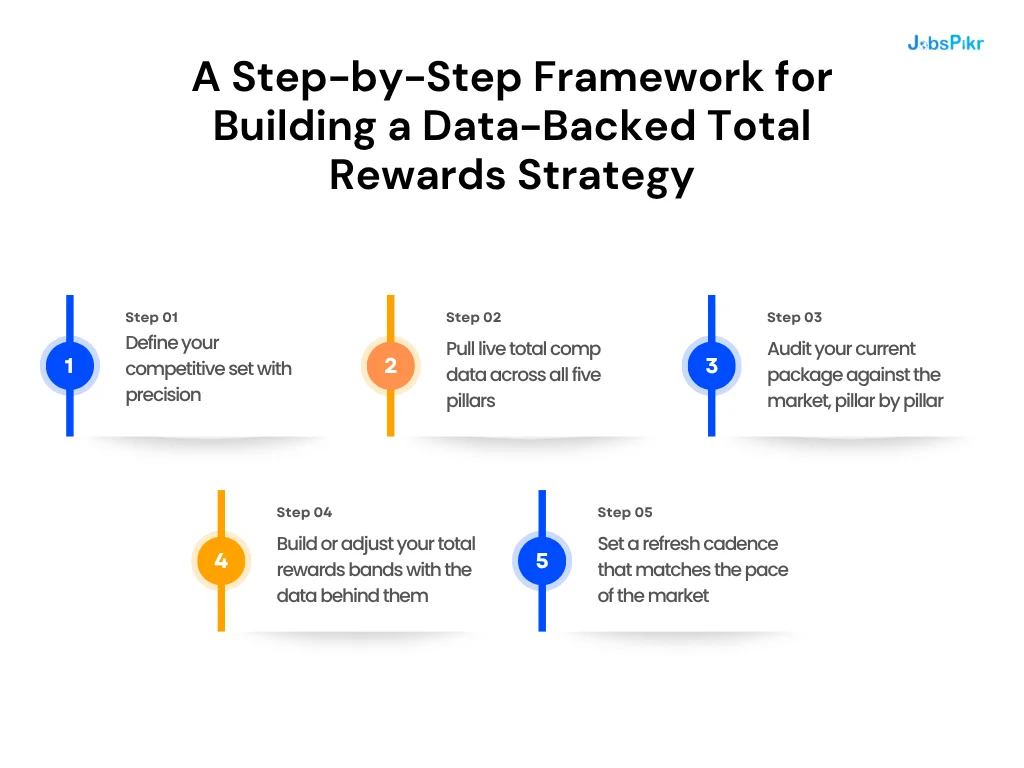
Step 1: Define your competitive set with precision
Before you pull a single data point, get clear on who you are competing with for talent. This sounds obvious but most organisations get it wrong in one of two ways either they benchmark against their industry peers when their real talent competition comes from outside the industry, or they use a national dataset when their hiring is concentrated in two or three specific cities.
Your competitive set for total rewards benchmarking should be defined by where your candidates are coming from and where they go when they leave not just by who operates in your sector. A financial services firm competing for data engineers is not benchmarking against other banks. They are benchmarking against every tech company, fintech, and analytics firm in the same metro area that is hiring for the same skills.
Get this definition right first. Everything downstream depends on it.
Step 2: Pull live total comp data across all five pillars
With your competitive set defined, the next step is to benchmark what that set is offering not just on salary, but across all five total rewards pillars. This is where live job posting data becomes the most useful tool available.
Pull salary ranges by role, level, and geography. Look for equity language and how frequently it appears in your competitive set’s postings. Note signing bonus mentions, benefits callouts, flexible work terms, and any non-standard perks that are appearing with enough consistency to suggest they have become market expectations rather than differentiators.
According to WorldatWork’s Total Rewards Leadership Priority Study, 36% of organisations identified benefits optimisation and expansion as their top 2025 goal above salary adjustments. That tells you where the market energy is right now. Your benchmark needs to reflect it.
Step 3: Audit your current package against the market, pillar by pillar
Now compare what you found externally against what you are currently offering internally and do it for each pillar separately, not as a blended average.
A blended “we are broadly competitive” assessment is almost always hiding a specific gap somewhere. You might be at the 75th percentile on base salary but well below market on equity for senior roles. Your health benefits might be strong, but your parental leave policy might be trailing your competitive set by two years. Your flexibility language in job postings might not reflect what your competitors are advertising.
The pillar-by-pillar audit is what surfaces those specific gaps and those gaps are what drive targeted fixes, which are far more cost-effective than across-the-board increases.
Mercer’s 2025 QuickPulse survey found that 82% of total rewards leaders are investing in analytics to strengthen decision-making. The investment is only useful if the analysis is specific enough to act on.
Step 4: Build or adjust your total rewards bands with the data behind them
Once you know where your gaps are, you can make deliberate choices about where to close them and where to hold. Not every gap needs to be fixed immediately or at full cost the key is that the decisions are intentional rather than reactive.
For salary bands, set ranges based on where your competitive set is landing by percentile, adjusted for your positioning strategy, whether you are targeting median, 65th percentile, or leading the market on specific high-priority roles. For equity, build a clear policy on grant frequency, size, and refresh timing that you can articulate to candidates. For benefits, identify the two or three things your competitive set is leading with and make a deliberate call on whether to match, exceed, or counterprogram with something different.
Document the rationale for each decision. When pay transparency requirements ask you to justify your ranges and increasingly, they will having a live data foundation makes that conversation far easier.
Step 5: Set a refresh cadence that matches the pace of the market
This is the step most organisations skip, and it is the most important one for maintaining competitive total rewards over time.
According to the INOP compensation benchmarking analysis of 3.5 million job listings, real-time benchmarking is where organisations are increasingly heading relying on live compensation data rather than annual surveys to set pay ranges, because salary transparency and fair pay practices are no longer optional. They are baseline expectations.
For most enterprise comp teams, an annual survey refresh made sense when the market moved slowly enough that 12-month-old data was still directionally accurate. That assumption no longer holds for most roles, and it does not hold for the kinds of specialised, high-demand positions that drive the most retention risk.
A practical cadence: run a full total rewards benchmark at least twice a year, with a lighter quarterly check on your highest-priority roles and markets. Build the trigger into your workflow rather than waiting for an exit interview to tell you the market has moved.
Pay Equity Is the Retention Risk Nobody Is Measuring Correctly
Pay equity conversations in most enterprises get funnelled into one of two places: legal compliance or DEI reporting. Both are important. But neither one captures the retention risk that comp teams should be losing sleep over.
The pay equity problem that drives turnover is not always the kind that shows up in a gender pay audit. More often, it is the quiet, structural kind, the kind that builds slowly over multiple hiring cycles and only becomes visible when someone you cannot afford to lose starts asking questions.
The compression problem hiding in your org chart
When companies compete aggressively for new hires, they tend to raise offers to win. That is the right move in a competitive talent market. The problem is what happens next the existing team does not get the same adjustment, and the gap between a new hire’s package and a tenured employee’s package starts to narrow or sometimes inverts entirely.
SalaryCube’s analysis of internal and external equity describes this clearly: aggressive hiring can create pay compression where new hires are paid close to or even more than more experienced employees in similar roles. The result is morale damage, retention risk, and a scramble to address pay disparities after the fact. This is not a hypothetical. It played out across tech in 2021 to 2023 and the aftershocks are still showing up in exit interviews.
According to NFP’s compensation trends analysis, sharp salary increases in recent years have left many organisations struggling with pay compression and internal inequalities both of which directly impact engagement and retention if left unaddressed. The same report notes that 70% of organisations planned pay equity adjustments in 2025, which is a signal of how widespread the problem became.
The equity and benefits dimension that people overlook
Most pay equity conversations stop at base salary. That is the wrong place to stop.
When a company brings in a senior new hire with a generous equity grant and a signing bonus, and the employees who have been building institutional knowledge for three years are sitting on a refresh schedule that has not moved in two cycles, that is a pay equity problem. It just does not show up in the traditional audit.
The same applies to benefits. If your parental leave policy improved significantly last year but only applies to employees hired after a certain date, you have an internal equity problem that your total rewards benchmark will never surface because benchmarks compare you to the external market, not to yourself.
Genuine pay equity analysis for total rewards requires looking inward as well as outward. It means asking: are our tenured employees being valued at the same rate as the market values them today, across all five pillars not just base salary?
What pay transparency legislation is changing
External pressure is accelerating the urgency here in ways that go beyond voluntary best practice.
By the end of 2025, 21 US states required salary ranges in job postings, with Minnesota and Illinois now also requiring benefits disclosures alongside salary information. In Europe, the EU Pay Transparency Directive is working its way into national legislation with a 2026 implementation horizon for many member states.
What this means in practice is that your employees can now see what you are offering new hires in your own job postings. When a tenured employee searches for their role on your careers page and sees a salary range that sits above what they are currently earning, that is an internal equity problem that just became externally visible. The legal landscape is not creating new pay equity risks so much as it is making existing ones impossible to ignore.
WorldatWork noted in their 2025 year-in-review that pay equity and job architecture moved from “nice-to-have” to “must-have” status, with the explicit point that you cannot be transparent without defensible ranges, consistent levelling, and clean data.
What fixing this looks like
Addressing pay equity across total rewards is not just about running an audit. It requires building the infrastructure to catch compression before it becomes turnover.
That means using the same live market data you use for external benchmarking to also check where your current employees sit relative to the market not just at hire, but on an ongoing basis. It means building equity refresh cycles that respond to market movement, not just tenure. And it means designing benefits policies that do not accidentally create two classes of employee based on when someone joined.
The companies that are getting this right are treating internal equity not as a compliance exercise but as a retention tool one that is most effective when applied proactively, before the exit conversation.
What Good Total Rewards Intelligence Actually Looks Like in Practice
There is a version of total rewards benchmarking that most enterprises are familiar with. It lives in a spreadsheet. It gets updated once a year when the survey results come in. It produces a set of numbers that feel defensible in a comp review meeting but bear little resemblance to what the market looked like last quarter, let alone what it looks like today.
Good total rewards intelligence does not work that way. Here is what it looks like when it is functioning well.
It is continuous, not cyclical
The most important shift in how enterprise comp teams are approaching total rewards in 2026 is the move from annual benchmarking to ongoing market monitoring. WTW’s January 2026 action guide for total rewards leaders is explicit about this: real-time pay data provides supplemental insights that traditional compensation surveys simply cannot capture, and the organisations that act on those insights have a meaningful advantage in both recruiting and retention.
This does not mean rebuilding your comp bands every month. It means having a live data feed that alerts you when the market has moved meaningfully on a specific role, geography, or pillar so your response is informed and timely rather than reactive and late.
It covers all five pillars, not just the salary line
A comp team that benchmarks salary rigorously but reviews benefits informally once a year is not doing total rewards intelligence. It is doing partial intelligence and calling it complete.
i4cp’s 2026 Total Rewards Leader Board is clear that the function has evolved well beyond salary and standard benefits and that the organisations succeeding in 2026 are those building reward systems that are dynamic, data-informed, and closely tied to how the business creates value. That requires data across all five pillars, updated often enough to be actionable.
It connects external benchmarking to internal reality
The most sophisticated comp teams are not just tracking what the external market is doing they are continuously checking where their own employees sit relative to that market. Not just at hire, but on an ongoing basis.
That means knowing which employees are drifting below the 50th percentile for their role as the market moves. It means identifying which teams have developed equity compression before someone raises it in a one-on-one. And it means having the data to make a proactive offer to someone who matters before they receive an outside offer that forces your hand.
Mercer’s research on AI in total rewards frames this well: the goal is not just using data to react to problems it is using it to surface risks before they become departures.
It informs decisions, not just reports
There is a version of compensation analytics that produces beautiful dashboards and quarterly reports that nobody acts on. Good total rewards intelligence is different. It is embedded into the decisions that matter offer approvals, comp band reviews, equity refresh cycles, benefits redesign conversations in a format that decision-makers can use without needing to interpret raw data themselves.
That is the practical test of whether your total rewards data infrastructure is working. Not whether it exists, but whether it is changing the decisions your team makes.
How JobsPikr fits into this picture
JobsPikr is built for exactly this kind of intelligence work. It tracks job postings at scale over 100 million, updated in real time and normalises the data across role titles, salary ranges, geographic markets, equity language, benefits mention, and more into a consistent, query able format.
For total rewards teams, that means a live benchmark that covers far more than salary. It tells you what your competitive set is advertising across all the dimensions that drive total rewards decisions, and it updates continuously rather than on an annual survey cycle. Whether you are building salary bands, reviewing benefits competitiveness, or checking whether your equity language is keeping pace with the market, the data you need is current, specific, and accessible via API.
That is what total rewards intelligence looks like when it is working, and it is what the organisations retaining their best people in 2026 are building toward.
The Shift Every Total Rewards Leader Needs to Make
The companies winning the retention battle in 2026 are not necessarily paying the most. They are paying the most intelligently with a clear, data-backed understanding of what their competitive set is offering across every dimension of total rewards, not just the salary line.
The tools to do this exist. The data is there. The gap between organisations that are retaining their best people and those that are losing them quietly to competitors often comes down to one thing: whether total rewards is treated as a live, ongoing function or an annual exercise that gets filed away until next year.
JobsPikr gives total rewards teams the live market intelligence to make it the former benchmarking salary, equity, benefits, and more against real job postings, in real time, at the scale that enterprise decisions require.
The market is not waiting for your next survey cycle. Neither are your best people.
Stop Benchmarking on Last Year’s Data
Your total rewards strategy is only as good as the market intelligence behind it.
Frequently Asked Questions
1. What is a total rewards strategy and why does it matter for retention?
A total rewards strategy is the complete framework an organisation uses to compensate and support its employees — covering base salary, variable pay, equity, benefits, wellbeing, career development, and recognition. It matters for retention because employees are not evaluating just their paycheck when they decide whether to stay. They are weighing the entire package against what they could get elsewhere. Companies that only benchmark and optimise salary while leaving the other pillars to guesswork are regularly losing people to competitors who have built a more complete and compelling offer — often without necessarily paying more in base salary.
2. How is total rewards benchmarking different from salary benchmarking?
Salary benchmarking compares your base pay structure against the external market for specific roles and geographies. Total rewards benchmarking does the same thing, but across all five pillars — including benefits, equity, bonuses, and non-monetary elements. The difference matters because salary alone increasingly does not determine whether candidates accept offers or whether employees stay. A company that is at the 75th percentile on base salary but below market on parental leave, equity refresh, or flexibility will still lose talent to competitors who have a better overall package. Total rewards benchmarking gives you the full picture rather than one dimension of it.
3. What data sources are most useful for compensation benchmarking in 2025?
The most useful compensation benchmarking data in 2025 combines traditional survey sources with real-time job posting data. Traditional surveys — from providers like Mercer, WTW, and Radford — offer credibility and broad coverage, but they are typically 12 to 18 months old by the time you use them. Real-time job posting data fills the gap by showing what companies are actually advertising right now, across salary ranges, benefits language, equity mentions, and bonus structures. The strongest benchmarking approaches use both, with live posting data providing the current market signal and survey data providing historical context and governance-level credibility.
4. How does pay transparency legislation affect total rewards strategy?
Pay transparency legislation is changing total rewards strategy in two important ways. First, it is making external benchmarking more valuable — as more companies are required to disclose salary ranges in job postings, the quality and coverage of live benchmarking data improves. Second, it is creating new internal equity risks. When employees can see the salary ranges you are advertising for their own role, compensation gaps that were previously invisible become visible. Organisations that have not proactively addressed internal equity across all five total rewards pillars — not just base salary — will increasingly find those gaps surfacing in retention conversations rather than being caught and corrected in advance.
5. How often should an enterprise review and update its total rewards strategy?
For most roles and markets, an annual review cycle is no longer sufficient. The better approach is a tiered refresh cadence: a full total rewards benchmark at least twice a year, a lighter quarterly check on high-priority roles and geographies, and a continuous monitoring layer for fast-moving markets where salary and benefits expectations can shift meaningfully in a matter of months. The specific cadence should be driven by the pace of change in your talent market — roles in high-demand areas like technology, data, and AI require more frequent updates than stable, lower-competition functions. The key is building the refresh trigger into your workflow rather than waiting for an exit interview to tell you the market has moved.