- The Quick Take on HR Demand Forecasting
- The Downside of Not Using HR Demand Forecasting
- HR Demand Forecasting - Why It’s Absolutely Crucial for Businesses
- Your Competitors Are Already Building Tomorrow's Workforce
- HR Demand Forecasting vs. HR Supply Forecasting: Understanding the Difference
- The HR Forecasting Toolkit Based on Practical Models
- Your Competitors Are Already Building Tomorrow's Workforce
- Which HR Demand Forecasting Model Should You Use? A Quick Comparison
- Building Proactive HR: From Theory to Gritty Reality
- How HR Demand Forecasting Works Across Industries
- Facing the Real-World Hurdles
- Your Competitors Are Already Building Tomorrow's Workforce
- The Payoff: Why Proactive HR Demand Forecasting Wins
- Build the Workforce Before You Need It
- Your Competitors Are Already Building Tomorrow's Workforce
- Frequently Asked Questions
The Quick Take on HR Demand Forecasting
Reactive HR is expensive. Every last-minute hire, surprise skills gap, and overstaffed quarter is a planning failure not a market problem.
HR demand forecasting fixes this by connecting your business strategy directly to talent decisions: how many people you’ll need, in which roles, with which skills, and by when.
This article covers the five forecasting models that actually work, how to implement them inside a real HR stack, and how to measure the ROI once you do.
Look around your HR department. Is it constantly putting out fires? Scrambling to fill sudden vacancies? Wrestling with unexpected skills gaps? Reacting to budget cuts with panicked restructuring? If this sounds familiar, you’re stuck in the costly, exhausting cycle of reactive HR. It’s a treadmill leading nowhere fast: burnout for your team, frustration for employees, and strategic irrelevance for your function. The escape hatch lies in HR demand forecasting.
Not the dusty sales projections of old, but a dynamic, data-informed approach applied ruthlessly to human capital. Let’s look at the need to transform HR into a strategic workforce planning system.
HR demand forecasting is the discipline that makes this shift possible and this guide breaks down exactly how to do it.
The Downside of Not Using HR Demand Forecasting
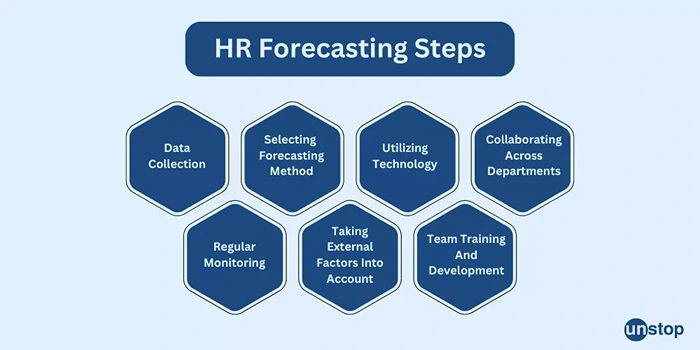
Image Source: Unstop
To look at HR demand forecasting as an advantage, we need to understand the true cost of reactivity –
- The Talent Tax: Needing someone now means paying top dollar in a seller’s market. You compete with everyone else who failed to plan, inflating salaries and recruitment fees. Remember that niche data scientist role you filled last quarter? Bet you paid 30% over budget because you were desperate.
- Skills Gap Whiplash: That new AI initiative the board greenlit? Great! Except HR only finds out after the project stalls because no one internally has the ML Ops skills. Cue expensive contractors or delayed timelines – both hit the bottom line.
- The Boom-Bust Rollercoaster: Overstaffed during the Q1 slump? That’s pure profit leakage. Understaffed during the Q4 holiday rush? Hello, overtime burnout, plummeting service quality, and lost customers. It’s inefficiency baked into your operating model.
- The Human Toll: Employees aren’t cogs. Constant chaos – unpredictable workloads, reactive (not developmental) feedback, uncertainty about their future – breeds disengagement and flight risk. The best people leave first.
- Strategic Irrelevance: When HR is perpetually firefighting, it can’t sit at the strategy table. You become the ambulance service, not the city planner. Your value proposition shrinks to “cost center.”
The verdict is to stop reactive HR operations and begin HR demand forecasting as a process.
HR Demand Forecasting – Why It’s Absolutely Crucial for Businesses
Demand forecasting essentially means predicting future needs. In HR terms, demand forecasting focuses on workforce demand. Looking at skills needed, the number of people, from which locations, and the time by which they need to be integrated in the organization to execute the business strategy.
The time for all of this to happen is a disciplined process that requires answering some hard questions –
- Looking at the Hard Problems: Answering the following can help understand the right talent needed for the hiring process –
- What really drives our headcount?
- What are our sales targets?
- What are the project pipelines?
- Do we need to launch a new product to the market?
- Are we aiming for a tech disruption product?
- Look at the Data: Look at the historical headcount of your organization, the turnover trends, and understand why people really leave the company. Look at productivity metrics, project plans, to see what tech skills are needed, financial forecasts, and gather all the data you can.
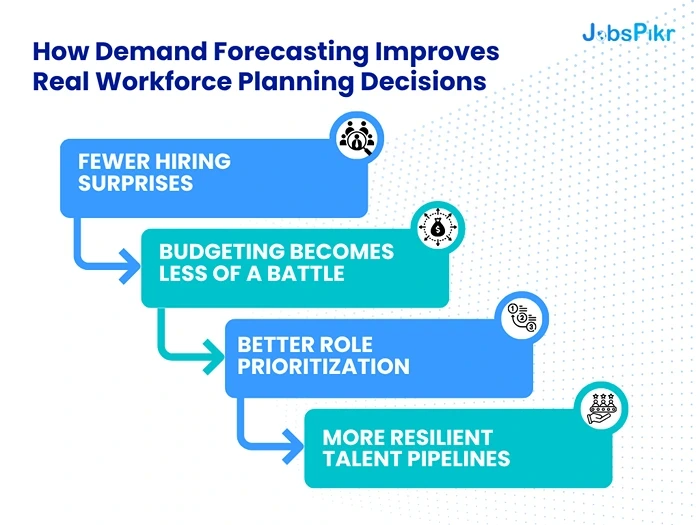
Image Source: Demand Forecasting Solutions
- Pick your Platform: Choose HR demand forecasting models that fit your problem, not the trendiest tech. (More on this below).
Your Competitors Are Already Building Tomorrow’s Workforce
Don’t let reactive hiring slow you down. JobsPikr gives your HR team the market intelligence to stay ahead.
HR Demand Forecasting vs. HR Supply Forecasting: Understanding the Difference
These two terms are frequently used interchangeably, but they shouldn’t be. They describe opposite sides of the same workforce planning equation, and confusing them leads to an incomplete strategy.
HR demand forecasting answers the question: what talent will the business need? It looks forward to your strategy growth targets, new product lines, market expansion, technology adoption, and translates those business plans into specific headcount, role, skill, and location requirements at a future point in time.
HR supply forecasting answers the question: What talent will we have available? It looks at your current workforce and projects forward based on expected attrition, retirements, promotions, and internal mobility to estimate what your talent inventory will look like at that same future point.
The gap between the two is your workforce planning problem and it’s the number that drives every downstream HR decision:
- If demand exceeds projected supply → you need to hire, upskill, or both
- If supply exceeds projected demand → you need to plan for redeployment, restructuring, or natural attrition management
- If the gap is in specific skills rather than headcount → you need targeted L&D, not recruitment
Most organizations focus heavily on demand forecasting and underinvest in supply analysis. The result is accurate predictions of what they need combined with poor visibility into what they already have, which means they keep hiring externally for capabilities that already exist internally, just unmapped.
A complete HR demand forecasting process runs both analyses in parallel, compares them at the role and skill level, and uses the gap as the input to workforce planning decisions.
The HR Forecasting Toolkit Based on Practical Models
Effective HR demand forecasting requires a tailored mix of strategies and tools that help teams understand and predict demand.
1. The Old Reliable: Time Series Analysis
- What it does: Spots patterns in your own historical HR data (headcount churn, seasonal hiring spikes). Assumes the past offers clues to the near future.
- HR Reality Check: Best for stable environments or short-term ops (“We need 15% more warehouse staff every November”). Useless for strategic shifts. Remember Blockbuster?
- Tools: Simple moving averages, Exponential Smoothing (weights recent data heavier), ARIMA (handles complex trends/seasonality – needs stats savvy).
- Our Take: A solid starting point, but dangerously myopic if used alone. Don’t drive using only the rearview mirror.
2. The Strategic Workhorse: Causal/Econometric Models
- What it does: Connects the dots. How does this business driver (sales volume, new store openings, production targets) cause demand for that role or skill? Uses regression analysis to quantify it.
- HR Reality Check: Gold for medium-term planning. “If sales hit $X, we’ll need Y additional sales engineers by Q3.” Requires good driver data (often the hard part).
- Tools: Use tools like JobsPikr that provide multivariate geographic analysis to understand how skills vary per location.
- Our Take: This is where HR teams can stay one step ahead of the recruitment drive and look at what’s needed before the requests start piling up.
3. Expert Insights from the Human Perspective
- What it does: While new tools and tech are amazing, it does not overpower or replace human insight. People in the field with experience will have strategic insights and the know-how to prioritize and review new initiatives.
- HR Reality Check: The Delphi Method (structured expert surveys) is great for predicting demand for emerging skills (e.g., quantum computing ethics specialists). Scenario planning (“What if a recession hits? What if our main competitor folds?”) builds resilience.
- Tools: Structured workshops, expert panels, and scenario narratives can help brainstorm new requirements.
- Our Take: Essential for long-term strategy. Combats the “we’ve always done it this way” blindness. But manage biases ruthlessly – optimistic sales VPs will always over-hype demand!
4. The Early Warning System: Leading Indicators
- What it does: Finds external/internal signals that precede workforce changes. Rising competitor job posts in your niche? Economic index dipping? Internal project milestones hit?
- HR Reality Check: Provides crucial lead time. “Tech job postings in Austin just spiked 20% – expect hiring competition there soon.”
- Tools: Market data feeds like JobsPikr, economic reports, and internal project trackers.
5. The Heavy Hitter – AI/ML Models
- What it does: Finds hidden patterns in massive datasets. Predicts individual flight risk, models complex “what-ifs,” and forecasts hyper-specific future skill needs.
- HR Reality Check: Powerful but demanding. Needs pristine data, significant tech investment, and data science expertise. Avoid “black box” models – you need to explain predictions.
- Tools: Machine learning algorithms (e.g., for attrition prediction), workforce simulation platforms, or JobsPikr’s skill and talent determination platform.
- Our Take: Exciting potential, but don’t start here. Master the fundamentals first. Use AI to augment human judgment, not replace it. Ethics matter – predictive firing is a dystopian path.
Your Competitors Are Already Building Tomorrow’s Workforce
Don’t let reactive hiring slow you down. JobsPikr gives your HR team the market intelligence to stay ahead.
Which HR Demand Forecasting Model Should You Use? A Quick Comparison
No single model works for every organization. Here’s how to match the right approach to your situation:
| Model | Best For | Time Horizon | Data Required | Complexity | Ideal For |
|---|---|---|---|---|---|
| Time Series Analysis | Seasonal hiring, stable roles | 0–6 months | Historical headcount, attrition data | Low | SMBs, high-volume hiring |
| Causal / Econometric | Linking revenue to headcount | 6–18 months | Business driver data, financial forecasts | Medium | Mid-market, sales-driven orgs |
| Expert Judgment (Delphi) | Emerging skills, new markets | 1–5 years | Structured expert input | Low-Medium | Strategic planning teams |
| Leading Indicators | Early warning, market shifts | 3–12 months | External job market data, economic signals | Medium | Competitive talent markets |
| AI / ML Models | Complex multi-variable forecasting | Any horizon | Large, clean datasets | High | Enterprise HR teams |
Most organizations don’t pick one model; they layer two or three. A common starting combination is causal modeling for medium-term headcount planning, leading indicators for early market signals, and expert judgment for long-horizon skills forecasting. AI/ML works best as a layer on top once the foundational models are producing reliable outputs.
Building Proactive HR: From Theory to Gritty Reality
Implementing HR demand forecasting can require more than a plug-and-play approach; often, it’s a cultural shift. Here’s how to make sure it sticks –
- Anchor to Strategy: HR forecasts must be derived from the business plan. What markets, products, and technologies are prioritized? Partner fiercely with Finance and Ops. If strategy is vague, demand forecasting is a fantasy.
- Data is the Foundation (Sweat the Small Stuff): Integrate systems. Break down silos. Cleanse data religiously. Track skills inventories, not just job titles. Garbage data guarantees garbage forecasts.
- Skills Are the New Currency: Forecast capabilities, not just headcount. What skills does Strategy X actually require in 18 months? Map your current inventory. Identify critical gaps now. This reshapes everything.
- Weave Forecasting into HR’s DNA:
- Talent Acquisition: Forecast needs 12+ months out. Build pipelines before the req opens. Target universities strategically. Ditch reactive job board spamming.
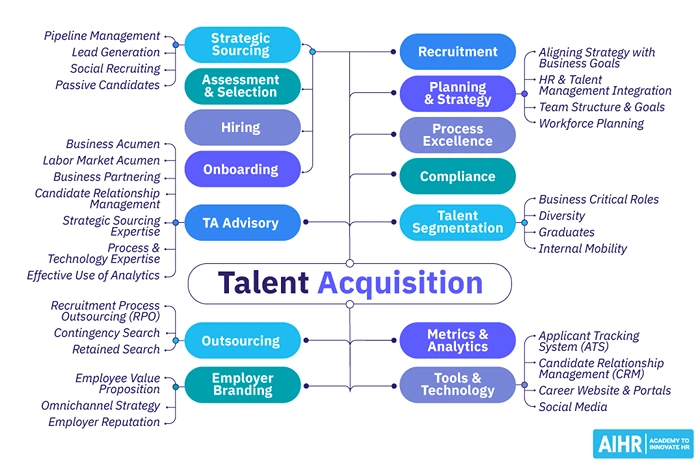
Image Source: AIHR
- L&D: Identify future skill gaps. Train proactively for roles you will need, not just current deficiencies. Make development strategic, not remedial.
- Succession Planning: Gaps in leadership roles and critical roles must be predicted and planned for. Successors within the organization must be identified so that when the time arises, there aren’t any panic promotions.
- Workforce Planning: Models of optimal staffing across projects and locations based on forecasted demand have to be created. Contingent labor has to be used strategically and not as a last-minute save.
- Retention: Use ethical predictive models (transparency is key!) to ID flight risks early. Why are they really considering leaving? Fix it preemptively.
- Plan for Multiple Futures (Because One is Fantasy): Develop 3-5 plausible scenarios. What if growth is 5%? 15%? What if that new regulation passes? Build flexible workforce plans with clear trigger points. Agility is survival.
- Communicate Relentlessly (Especially the Uncertainty): Share forecasts and their assumptions with leaders. Be transparent about confidence levels. Review quarterly – what changed? Why was the forecast off? Learn and adapt.
How HR Demand Forecasting Works Across Industries
The mechanics of HR demand forecasting stay consistent across sectors but the inputs, time horizons, and critical variables shift significantly by industry. Here’s what it looks like in practice:
Retail and E-Commerce
Retail demand forecasting is heavily driven by seasonal patterns and sales volume projections. A retailer planning for peak holiday season needs to begin HR demand forecasting in Q2 identifying how many warehouse, logistics, and customer service roles are needed by November, sourcing and onboarding ahead of the crunch, and planning for the wind-down equally carefully to avoid overstaffing in Q1.
The leading indicator that matters most here is sales forecast data from commercial teams. A projected 20% revenue increase in Q4 should automatically trigger a workforce demand calculation not a reactive hiring sprint in October when it’s too late to hire and train effectively.
Technology and Software
In tech, HR demand forecasting is less about volume and more about skills precision. A company planning a major AI product launch 18 months out needs to forecast not just headcount but specific capability clusters ML engineers, data infrastructure specialists, AI safety roles and assess whether those skills can be developed internally or must be sourced externally.
The challenge unique to tech is skills half-life. With technical skills becoming outdated in under 2.5 years, HR demand forecasting in this sector must run on shorter update cycles than in other industries. Quarterly reviews of the skills forecast not annual, are the standard for high-performing tech HR teams.
Healthcare
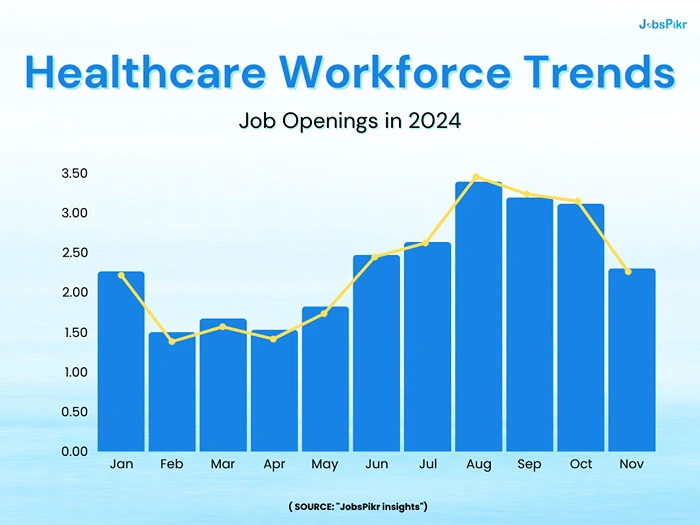
Healthcare organizations face some of the most complex HR demand forecasting challenges of any sector. Regulatory requirements dictate minimum staffing ratios, licensing and credentialing add 3–6 months to effective time-to-productivity for clinical hires, and demographic shifts are simultaneously increasing patient demand while aging out a significant portion of the clinical workforce.
The most critical input for healthcare HR demand forecasting is population data understanding the demographic trajectory of the communities served, which drives patient volume projections, which drive staffing requirements. Organizations that integrate public health data into their HR demand forecasting consistently outperform those using only internal historical data for anticipating clinical workforce needs.
Facing the Real-World Hurdles
The shift to HR demand forecasting is hard and requires some careful maneuvering –
- Breaking Data Silos – Silos have to broken and cross-functional data sharing must be mandated. It’s your means to ensuring the right adoption of the function through and through.
- HR Needs New Muscles: Upskilling is non-negotiable. Basic data literacy is table stakes. Hire or develop analytical talent within HR.
- “But We’ve Always…” Culture: Combat inertia by showcasing quick wins. Prove the ROI of one accurate forecast. Involve skeptical managers early.
- Tech Costs: Use existing tools before moving on to more sophisticated ones that require AI integration and a complete overhaul of existing processes. Look at the ROI of the new tool to ensure it won’t go to waste.
Your Competitors Are Already Building Tomorrow’s Workforce
Don’t let reactive hiring slow you down. JobsPikr gives your HR team the market intelligence to stay ahead.
The Payoff: Why Proactive HR Demand Forecasting Wins
Effective HR demand forecasting isn’t just feel-good; it’s a financial and strategic imperative:
- Slash Talent Costs: Proactive hiring = lower salaries, reduced agency fees, faster fills. Pipelining is cheaper than poaching.
- Eradicate Surprise Skills Gaps: Train before the project starts. Protect revenue and innovation momentum.
- Optimize Every Dollar: Right-size staffing. Eliminate bench waste and burnout-fueled overtime.
- Boost Engagement & Retention: Employees see a path. Workloads are manageable. Development is meaningful. Trust increases.
- Become Strategic Partners: HR with foresight gets a seat at the big table. You enable strategy, don’t just clean up after it.
- Build Unshakeable Resilience: Scenario-tested organizations weather storms. You adapt faster than competitors stuck in catch-up mode.
Build the Workforce Before You Need It
HR demand forecasting requires investment in data, skills, technology, and cultural change. But the alternative – endless, costly cycle of reactivity – is a far riskier path. Stop fighting yesterday’s fires. Start building tomorrow’s workforce, today.
Try JobsPikr today for your workforce planning needs.
Your Competitors Are Already Building Tomorrow’s Workforce
Don’t let reactive hiring slow you down. JobsPikr gives your HR team the market intelligence to stay ahead.
Frequently Asked Questions
What is HR demand forecasting?
HR demand forecasting is basically the process of figuring out how many people a company will need to hire — and what kind of talent will be required — as it moves forward. It’s a way for businesses to stay prepared instead of scrambling to fill roles last minute.
This kind of planning helps a company avoid having too few people during a busy season or ending up with a bloated team when things slow down. Forecasting usually considers things like how the business is expected to grow, employee turnover, seasonal demand, and any big changes like new product launches or expansions.
How to do HR forecasting?
There’s no strict formula for this, but the idea is to link staffing needs to what the business is trying to do in the near future.
Here’s what it often involves:
- First, HR and leadership sit down to understand what’s coming — maybe new markets, new products, or just a push for more growth.
- Then, they look at who’s currently on the team, including what roles are likely to stay stable, and which departments might be at risk of understaffing.
- From there, they estimate what kinds of roles and how many people will be needed to support that future growth.
- It’s really about asking the right questions: Are there enough people to support this plan? Do we need to hire, train, or shift roles internally?
Some teams use forecasting tools or workforce planning software, but even a solid spreadsheet and access to good internal data can work well if used carefully.
How to calculate HR demand?
A common way to approach this is by looking at the workload that’s expected — for instance, how much work is coming in, and how much each person can realistically handle.
Let’s say a company expects sales to jump 25% next quarter. If each sales rep brings in about $100K in revenue per quarter, you can roughly calculate how many more reps might be needed to meet that target.
In other cases, companies use:
- Ratios from past performance
- Input from department leads
- Turnover data to anticipate backfills
It’s not about getting it perfect, but about being prepared with realistic estimates.
What are the factors influencing HR demand forecasting?
Plenty of variables can influence how hiring needs play out, both inside and outside the business.
Internally, you’re looking at things like:
- Where the business is headed
- How much budget is available
- Whether any technology is being added that might automate or shift responsibilities
- Who’s leaving, retiring, or being promoted
Externally, the labor market has a huge influence. If it’s hard to find skilled people in your industry or location, your approach to hiring might need to change.