
- **TL;DR**
- Why AI in the Workforce Is a Turning Point
- How AI Is Disrupting Traditional Workforce Planning
- Why Workforce Intelligence Is the Missing Piece in AI-Driven Planning
- How Smart Companies Are Using AI to Make Workforce Planning More Agile
- The Future of AI and Automation in the Workforce
- How to Reskill Your Workforce in the Age of AI
- Companies Getting Workforce Planning Right
- The Role of Data Providers Like JobsPikr in Enabling Smarter Planning
- Planning Today for a Smarter, AI-Ready Tomorrow
- FAQs
**TL;DR**
AI moved from slide decks to payroll reality faster than most HR teams expected. Some companies expected AI to eliminate entire job titles, but that’s not exactly what’s happening. Instead, it’s picking off tasks, bit by bit, across roles. A recruiter might still handle interviews, but AI screens the resumes. An analyst still presents insights, but software is pulling the numbers. Meanwhile, those old-school annual headcount plans? They’re starting to feel clunky. The companies adjusting well aren’t just adding new tools, they’re rethinking how all the moving parts fit together. They’re using real-time labor data, skill signals from inside their organization, and automation trends to guide decisions that used to be mostly instinct. That’s what we mean by workforce intelligence: seeing where skills are rising, where gaps are forming, and where reskilling beats rehiring.
If you lead talent, you don’t need to predict every AI breakthrough. You need to know which parts of your workforce are exposed, which skills can be grown in-house, and when the external market gives you a faster option. In this article, we break down how forward-leaning organizations are using AI in the workforce to guide investments, how to reskill your workforce in the age of AI without blowing budgets, and what reliable data partners, JobsPikr included, bring to the table when markets move faster than planning cycles.
Why AI in the Workforce Is a Turning Point
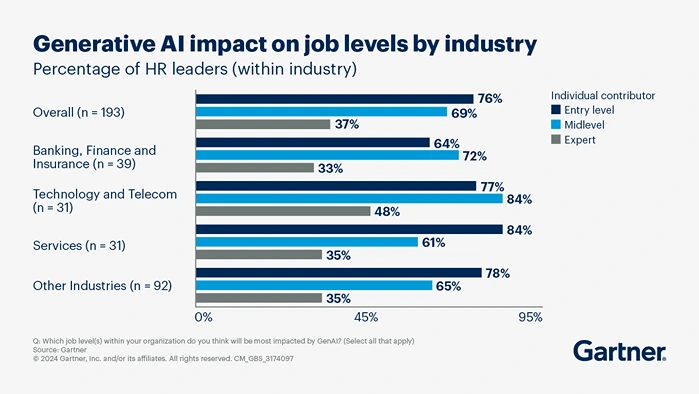
Image Source: Gartner
Walk into any HR meeting these days and chances are, someone’s bringing up AI. Not in a vague “someday” way, but as a real factor shaping today’s workforce decisions. Maybe it’s a tool to automate part of the hiring process. Maybe it’s being used to track internal skills more efficiently. Either way, it’s here, and it’s moving fast.
A lot of people assume AI is just about cutting jobs, but that’s not exactly right. What’s happening is more subtle. In many places, the work is just shifting. One day you’re doing a task, the next, a tool does part of it for you. It doesn’t always make headlines, but it adds up. Small tasks get shifted to software. Job roles get tweaked. Team structures adjust. Over time, those changes add up. A recent study from McKinsey found that up to 30% of work hours in the U.S. could be automated by 2030. Not entire jobs, just bits and pieces of them. But that’s enough to make the old way of planning for talent feel outdated.
Think about traditional workforce planning. You’d map out headcount targets, outline hiring needs, maybe even forecast a few skill gaps for the year ahead. That approach made sense when change was slower. But today, with AI evolving monthly and markets shifting weekly, you can’t afford to lock yourself into a static plan.
That’s where workforce intelligence helps. It lets you see what’s going on—not just in your own teams, but across the market too. You start spotting patterns you’d probably miss otherwise. Who’s learning what? Where are skills fading out? What jobs are starting to shift, even if the title stays the same?
The smartest companies aren’t waiting to react. They’re watching patterns early. They’re asking: Which parts of our operations could be automated next? Where are we at risk of losing human expertise? Can we build the skills we need, instead of buying them?
It’s not about chasing the latest tool. It’s about seeing further ahead and adjusting before the wave hits.
How AI Is Disrupting Traditional Workforce Planning
AI has quietly reshaped the foundations of workforce planning. It’s not just changing who companies hire—it’s changing what work looks like, and that shift is forcing businesses to rethink long-standing planning models. The old way of planning—where you base everything on fixed roles and once-a-year forecasts—it’s not holding up anymore. Things are just moving too fast, especially with AI changing the way teams work every few months.
So what exactly is breaking down? And what should people in charge of workforce planning be watching for?

Static Job Models Don’t Match a Fluid Reality
Most workforce plans still revolve around job titles—specific roles, with defined responsibilities. But AI doesn’t operate within those boundaries. Instead of replacing whole jobs, it carves off tasks. A marketing manager might lose the manual part of reporting to automation. A financial analyst might rely on AI to prep data, freeing them to focus on insight.
On paper, the role hasn’t changed. But in reality? It’s a different job. And that throws things off—especially if your planning tools aren’t picking up on what’s happening. Most of them don’t. They’re stuck looking at titles, not the work underneath.
The Traditional Forecasting Approach Falls Short
Workforce planning has long relied on historical data and long-term headcount projections. But AI development moves too quickly for that kind of lag. A tool you didn’t even know existed last quarter could suddenly replace part of your customer support workflow.
When that happens, the old model of planning—mapping roles once a year, reacting slowly—becomes risky. Teams either overhire or miss critical reskilling opportunities. And worse, they don’t see the shifts coming until it’s too late to adapt smoothly.
Work Is Evolving Faster Than Job Titles Can Keep Up
Job architecture doesn’t evolve overnight. Most companies don’t update job descriptions regularly. But AI is moving at a pace that forces teams to rethink roles on the fly. The same “project manager” might now need prompt engineering skills or tools like ChatGPT embedded in their daily workflow.
This means workforce planning has to zoom in—not just on jobs, but on tasks and skills. You need to know what’s changing underneath the surface of your organization chart, not just what the boxes say.
Companies Need Real-Time Visibility to Adapt
That’s where workforce intelligence comes in. You can’t just go off gut feeling or what your organization looked like a year ago. You need to see—clearly—how jobs are shifting in other companies, which skills are starting to fade out, and where automation is creeping in.
If you’ve got that view, you can make better calls. Maybe you retrain someone instead of hiring new. Maybe you change how a team works instead of growing it. But without that kind of insight, you’re guessing. And guessing’s risky.
Why Workforce Intelligence Is the Missing Piece in AI-Driven Planning
Most companies know change is coming. What they’re not always sure of is where it’s coming from—or how fast. That’s where the trouble starts.
Teams feel the effects of AI in bits and pieces. A process gets quicker. A report runs itself. An entire task just disappears. But the planning around it? Still slow. Still based on models that assume the next five years will look something like the last five. That’s a risky bet these days.
This is where workforce intelligence comes into play. Not as a buzzword or another HR tool—but as a way to make better calls, earlier.
You Can’t Plan for Tomorrow Using Yesterday’s View
By the time many companies notice a shift—say, a certain role is drying up or a skill is falling out of use—they’re already behind. They end up reacting. That’s costly, and it creates stress for everyone involved.
With workforce intelligence, the goal is to see the shift before it lands in your inbox. You’re not relying on gut feel or outdated benchmarks. You’re looking at actual trends—inside your organization, across your industry, and even globally.
It’s More Than Data; It’s Timing
Most businesses aren’t short on information. What they lack is timing. They see talent trends after the fact. But by then, the best candidates have moved, the market’s changed, and your team is playing catch-up.
Real workforce intelligence brings together hiring data, skills insights, and signals from automation trends before they hit your organization. It lets you ask smarter questions. Do we train up? Do we hire? Do we wait?
You Don’t Always Need to Hire; You Need to Know When Not To
One of the biggest mistakes leaders make right now is thinking every shift requires a hire. Sometimes, the better move is to reassign. Or train. Or even pause.
If you know a task is on its way to being automated, why bring in someone just to do it manually for six months? Workforce intelligence lets you see those patterns. It doesn’t tell you what to do—but it gives you the information you need to avoid a misstep.
It’s Not Just Tools. It’s the Story Behind the Work
Every company has dashboards. Tools. Spreadsheets. But most of them look backwards.
Workforce intelligence, when done right, gives you more than numbers. It helps you understand how jobs are changing. What’s driving that change? And what your business should do about it—before you’re scrambling.
How Smart Companies Are Using AI to Make Workforce Planning More Agile
If you ask most companies what workforce planning looks like, you’ll hear the usual stuff: headcount goals, hiring timelines, maybe a skills forecast tossed in from last year. That old model? It just doesn’t work anymore—not for companies that are actually trying to keep up.
The ones making headway with AI aren’t just looking to shave minutes off a task or cut a few roles. They’re using it to rethink how the work gets done in the first place. They’re rethinking how they structure work altogether. Not overnight. Not all at once. But in small, deliberate ways that make their planning more flexible—and a lot smarter.

They Start Small, Then Scale Up
One pattern you’ll see? These companies don’t try to “transform” everything in one go. Instead, they pick a team, or a process, and run experiments. Maybe it’s using AI to review incoming resumes, or to analyze internal skill data before opening a new role. The results help them see what works—and what doesn’t—before scaling it up across departments.
This kind of approach lowers the risk. You’re not betting the whole organization on one system. You’re learning as you go, and planning gets sharper with each iteration.
They Focus on Skills, Not Just Roles
Another shift: smart companies don’t just look at job titles. They dig into the actual work people are doing. If automation affects a task within a role—say, generating reports—they want to know that. It tells them what skills might no longer be needed, and which ones are now more valuable.
Over time, this mindset helps them build talent strategies around real capabilities, not assumptions based on old job descriptions.
They Blend External and Internal Data
You can’t plan in a vacuum. That’s why the best organizations use a mix of outside labor data and internal signals. Maybe they pull data from job boards or market trends. Maybe they analyze what tools employees are adopting on their own. Either way, they don’t rely on guesswork.
But data alone isn’t the game-changer—it’s what they actually do with it. The smart teams fold that info into their planning early on, so they’re ahead of the curve. They’re not scrambling when things shift; they’ve already started adjusting before it turns into a problem.
They Don’t Wait for a Crisis to Reskill
A lot of companies only think about reskilling when something breaks. A team falls behind, a tool rolls out, and no one knows how to use it, or they lose people they can’t replace fast enough.
Smarter teams plan. They treat reskilling as part of the long-term workforce strategy, not an emergency fix. When AI takes over a task, it already has people learning the next one.
They Use AI as a Lens, Not Just a Tool
This might sound subtle, but it matters: the companies getting the most from AI aren’t just plugging it into workflows. They’re using it to see their workforce differently. To spot gaps earlier. To rethink what their teams could look like if they planned more deliberately.
It’s not about chasing the latest tech. It’s about seeing what’s possible—and building around that.
The Future of AI and Automation in the Workforce
One thing’s clear lately—work keeps changing. And now that AI’s part of the mix, it’s not slowing down. If anything, it’s picking up speed. But the big shifts aren’t happening the way some headlines predicted. It’s not a clean swap of humans for machines. It’s messier—and more interesting—than that.
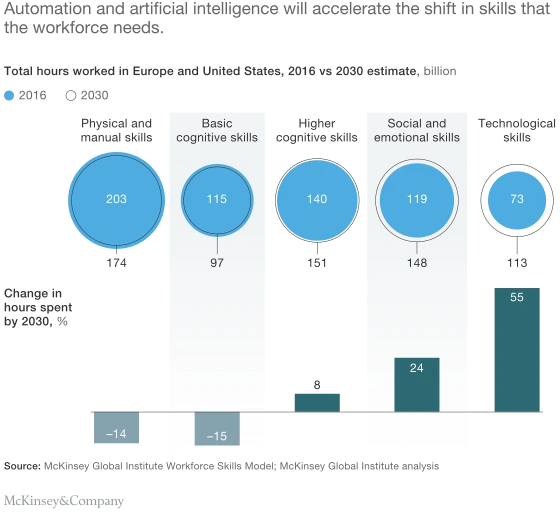
Image Source: McKinsey&Company
AI Isn’t Replacing Jobs. It’s Rewriting Them.
People talk a lot about AI wiping out jobs, but that’s not really what’s happening—at least not most of the time. What you’re seeing is certain tasks getting handed off to software. The title might not change, but the work doesn’t look quite the same. A few small things drop off, maybe something new gets added. It’s not a huge shift all at once—it just kind of builds, slowly, until the role isn’t what it used to be.
Take marketing, for example. Generating ideas still requires creativity. But AI can now write the first draft of a campaign, pull in data from five platforms, and test variations—all before a human even touches it. That doesn’t mean the marketer is out of a job. It means their job just shifted. They’re directing the tools, not doing all the heavy lifting.
Workforces Will Get Smaller in Some Places—and Bigger in Others
As automation grows, it’s easy to assume every team will shrink. But that’s not the full picture. Some departments might slim down, yes. But others will grow—especially those focused on strategy, oversight, and creativity. The tools still need guidance. The systems still need fixing. The insights still need explaining.
What’s changing is the balance. Companies will need fewer people doing repetitive tasks and more people who can learn fast, pivot often, and work alongside technology—not in spite of it.
Reskilling Won’t Be Optional Anymore
In a world where tools evolve faster than training manuals, the idea of reskilling once every few years just won’t cut it. The best companies will treat learning as part of the job. Not something you do after work shifts—but something built into the rhythm of it.
We’re already seeing signs of this. Internal mobility programs are getting stronger. L&D budgets are rising. People aren’t expected to be experts in everything—but they are expected to keep learning.
The Workforce of the Future Won’t Be Static
Here’s a reality few planners like to admit: the organization charts we build today probably won’t hold up five years from now. Titles will change. Teams will shift. Some roles won’t even exist yet.
That’s not a failure in planning. It’s a sign of agility. Companies that build flexible structures—and give their people room to grow into them—will have an edge. The workforce of the future won’t be rigid. It’ll be responsive.
How to Reskill Your Workforce in the Age of AI
Reskilling used to be something you planned every few years. These days, you can’t go more than a few months without thinking about what your team needs to learn next. It’s not just about picking up new tools anymore—AI is changing the baseline. What counted as “up to speed” six months ago might not cut it now.
So the question is: how do you help people keep up without constantly playing catch-up?
You can’t just roll out one big training program and call it done. That kind of fixed, one-time approach doesn’t hold up. What works better is building a culture where people are learning all the time—bit by bit, in ways that actually fit the job.
Start with What You Already Have
Before companies rush to hire for “AI talent,” it’s worth stepping back. Most teams have skills sitting untapped. People who’ve been curious about automation, playing with tools on their own, or building efficiencies into workflows quietly—those folks are your early adopters.
The best reskilling plans don’t start with external hires. They start by mapping the skills inside the company, then asking: what can we build on?
Make Learning Part of the Work, Not an Extra Task
One reason upskilling efforts stall? They feel like homework. People are asked to take courses on top of their jobs, usually disconnected from what they’re actually doing day-to-day.
Companies that do this well make learning part of the workflow. A designer picks up a new prototyping tool on a live project. A sales rep experiments with an AI assistant during a campaign. The learning sticks because it’s happening in real time—not in some abstract training module.
Focus on Capabilities, Not Credentials
AI doesn’t care what school someone went to. It responds to how people use it. And smart teams have picked up on that. They’re moving away from checking boxes and toward building capabilities—things like prompt design, cross-functional collaboration, or just knowing which tool to reach for and when.
The result? People who may not have the “right background” on paper turn out to be the ones pushing the work forward.
Reskilling Isn’t a One-Time Project. It’s Culture.
This part matters. You can’t launch a reskilling initiative, run it for a quarter, and call it done. The companies that see real change build learning into the culture. Leaders model it. Teams reward it. Mistakes are part of the process, not something to hide.
AI won’t stop evolving. Your team’s ability to evolve with it depends on whether they feel safe enough—and supported enough—to keep learning.
Companies Getting Workforce Planning Right
Image Source: Estuate
Not every company using AI gets it right. Some roll out flashy tools and expect the workforce to magically adjust. But others? It’s not always the big names making noise. Some of the most interesting changes are happening quietly—inside companies that are just watching closely, trying things out, and adjusting as they go.
Here’s what a few of them are doing differently.
A Financial Services Firm Rebuilt Its Roles from the Inside Out
One midsize finance company—not a household name—realized its analysts were spending hours each week preparing reports that could easily be automated. Instead of cutting those roles, the company shifted the focus.
They introduced simple automation tools to handle the repetitive work. Then, they retrained the analysts to spend more time interpreting data and advising clients directly. They didn’t reduce headcount. They repositioned it. The result? Happier clients and better retention—because the team’s work became more valuable, not less.
A Retail Giant Used External Data to Rethink Its Talent Strategy
Another example comes from a global retailer. Facing talent shortages in logistics, they used labor market data to spot growing automation trends in warehouse roles. Instead of just competing on salaries, they began to retrain internal staff from other parts of the business—folks with strong process skills but little technical experience.
By doing this, they filled open roles faster and reduced turnover. They also discovered that internal hires were more adaptable to the tech changes happening on the floor. The lesson? Sometimes the answer isn’t outside your walls—it’s just in a different department.
A Startup Focused on Skills, Not Job Titles
A growing tech startup noticed its teams were overlapping in strange ways. Engineers were doing support tasks. Designers were managing operations. It wasn’t efficient, but it was born from necessity.
Instead of correcting it with stricter job roles, the founders leaned in. They mapped out what people were actually good at—skills, not titles—and reorganized work based on capability clusters. When they later introduced AI tools, those teams were already used to adapting. The structure flexed easily.
That flexibility is now one of their biggest strengths.
These aren’t huge transformations. They’re steady moves made by companies that paid attention to what was changing—and used that awareness to get ahead, one decision at a time. They didn’t throw out everything they knew about workforce planning. They just stopped pretending the old rules still applied.
The Role of Data Providers Like JobsPikr in Enabling Smarter Planning
Even the best planning frameworks fall short without good data. You can have the right strategy, the right people in the room, and still miss the mark if you’re flying blind. That’s where external data providers come in—not to replace internal insights, but to give them sharper edges.
Take JobsPikr. It gives you a look at hiring patterns and job trends you probably wouldn’t catch just by looking at your organization. Maybe there’s a skill heating up in your space, or a shift in how other companies are filling certain roles. Seeing that early can change how you plan—and how fast you move.
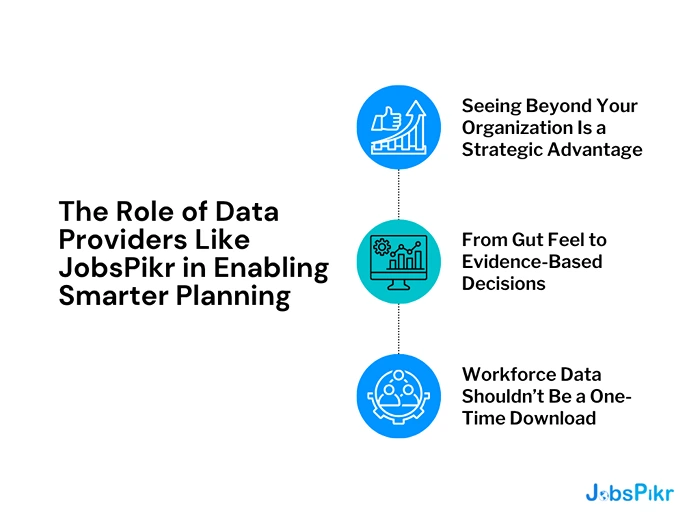
Seeing Beyond Your Organization Is a Strategic Advantage
Internal HR systems are great at showing you what’s happening in your company—but they don’t tell you much about the market outside. That’s where tools like JobsPikr earn their keep. They help you see which roles are growing (or shrinking) across regions and sectors. They show how fast demand for certain skills is rising. You get a sense of how others are handling the same changes. That kind of outside view makes a difference. It’s not just about keeping up—it gives you a chance to stay a step ahead.
From Gut Feel to Evidence-Based Decisions
A lot of workforce planning still happens based on gut. That’s not always a bad thing—there’s experience in those instincts. But when the market moves this fast, gut alone isn’t enough.
With workforce intelligence platforms powered by real-time job market data, you can back up those instincts with evidence. You can show why you’re shifting headcount. Why you’re investing in one skill over another. Why are you choosing to reskill instead of hiring externally?
It makes your planning sharper—and your conversations with leadership easier.
Workforce Data Shouldn’t Be a One-Time Download
Another thing that sets smart data providers apart? It’s not just about access—it’s about timing. JobsPikr delivers continuously updated job data, so you’re not stuck using last quarter’s trends to make this quarter’s decisions.
That matters when you’re trying to keep up with how fast AI is changing the nature of work. You don’t want to act on insights that are already stale.
JobsPikr isn’t trying to predict the future of work on its own. But it does give you the visibility to plan for it with more accuracy—and less guesswork. And in this landscape, that edge can make all the difference.
Planning Today for a Smarter, AI-Ready Tomorrow
There’s no getting around it—AI is changing the workforce in ways that are still unfolding. Some shifts are obvious. Others are happening more quietly, in small decisions, subtle adjustments, and everyday tools. But together, they’re adding up to something big.
Funny enough, it’s not always the companies with the newest tools or the biggest spend that handle this shift the best. They’re the ones that stay curious. Those who adapt early. That looks past job titles and into the real work being done. And most importantly, they build systems that let them keep learning—even when the path ahead isn’t perfectly clear.
That’s where smart workforce planning fits in. Not as a fixed plan, but as a living, flexible strategy that responds to what’s happening. And behind that strategy? Reliable, real-time data. Internal signals, yes—but also outside context. Trends. Market shifts. Emerging skills.
Tools like JobsPikr don’t give you all the answers. But they do help you ask better questions—and that’s usually where the smart decisions start.
Sure, AI moves fast. But that doesn’t mean your planning has to be in reaction mode all the time. If you’ve got a clear view of what’s changing—and you’re open to letting go of old ways of doing things—you can stay ahead of it. Maybe even steer the direction a bit.
Sign up today!
FAQs
1. What does “AI in the workforce” actually mean in practice?
Honestly, it’s not as dramatic as some people make it sound. You don’t see entire teams getting replaced overnight. It’s more like… parts of the job start shifting. Maybe a tool picks up the admin work or handles something repetitive. Before you know it, the job changes—bit by bit. Still needs people. Just different work than before.
2. How is workforce planning different in the age of AI?
It’s quicker. Or at least, it has to be. You used to plan for the year and feel okay about it. Now? Tools get better mid-quarter. Skills shift faster. If you’re not checking in regularly and adjusting your plan, you’re probably already behind. The playbook has to flex more than it used to.
3. What is workforce intelligence, and why should I care?
It’s like having a better rearview and a wider windshield. Instead of just looking at internal HR data, you’re also watching what’s happening in the market—trends, hiring shifts, new roles showing up. Helps you make calls based on what’s actually happening, not just what you think might be.
4. How can companies reskill their workforce without burning out employees?
Keep it close to the work. If you tack learning on like an afterthought, people get overwhelmed. But if they pick up skills while working—on real projects—it’s more natural. Less pressure. You’re not asking them to do two jobs. You’re helping them do one better.
5. How does JobsPikr help with AI-era workforce planning?
It gives you a peek outside your bubble. You can track which roles are heating up, which ones are cooling off, and how skill demand is shifting in your field. That kind of info helps you adjust before things get urgent. It’s not flashy—it’s useful.