
- **TL;DR**
- The AI Layoff Wave in 2025
- Turn AI Layoffs into Workforce Wins
- Why These Layoffs Are Different
- How AI Layoffs Reshape Labor Market Trends
- Reskilling in the Age of AI
- The Real Workforce Planning Challenge: Redeployment
- How Labor Market Data Can Guide Your Workforce Planning Strategy
- AI Jobs Are Changing, Not Disappearing
- AI Layoffs and the Rise of Skills-Based Organizations
- The Cost of Getting AI Layoffs Wrong
- From Regular Jobs to AI Jobs: Where the Shift Is Happening
- 2025 Is the Year Workforce Planning Gets Real
- Turn AI Layoffs into Workforce Wins
**TL;DR**
AI layoffs in 2025 aren’t just about headcount reduction — they’re about structural shifts in the workforce. More than 180,000 tech roles have already been cut globally as companies pivot from traditional functions to AI-first operations.
But the real story isn’t job loss. It’s job transition. Entire layers of design, QA, coordination, content, and support work are being automated. In their place, new AI-aligned roles are emerging — in AI operations, model validation, prompt engineering, governance, and orchestration.
Companies that treat this wave as a hiring crisis will stay stuck in reactive layoffs and costly rehires. Those that treat it as a workforce redesign moment will use data, reskilling, and redeployment to come out stronger.
- Reskilling is no longer optional — it’s the shortest bridge between displacement and redeployment.
- Redeployment isn’t about finding a role; it’s about strategic skill adjacency mapping.
- Labor market intelligence gives HR and policy teams a 6–12 month head start on skill shifts
AI isn’t making work disappear. It’s rebalancing the workforce. The winners will be the organizations that plan for the shift instead of reacting to it.
AI layoffs have become one of the most defining workforce stories of 2025. Headlines focus on numbers—thousands of jobs cut, teams dissolved, entire functions restructured—but those figures only tell part of the story. What’s unfolding is not a temporary contraction in employment. It’s a rebalancing of labor driven by automation, AI maturity, and changing business priorities.
Unlike previous tech downturns, AI layoffs are not primarily about cost control or economic slowdown. Many of the companies announcing layoffs are profitable, growing, and actively hiring. The difference is what they are hiring for. Traditional roles that once formed the backbone of digital teams are being phased out, while AI-centric roles are expanding rapidly.
This is why workforce planning has moved from a background HR function to a board-level priority. When AI changes the structure of work itself, organizations can no longer rely on static org charts or annual hiring plans. They must rethink how skills flow through the organization, how talent is redeployed, and how future roles are anticipated before layoffs happen.
In 2025, AI layoffs are less about job loss and more about organizational redesign. And how companies respond will determine whether they fall behind—or emerge stronger.
The AI Layoff Wave in 2025
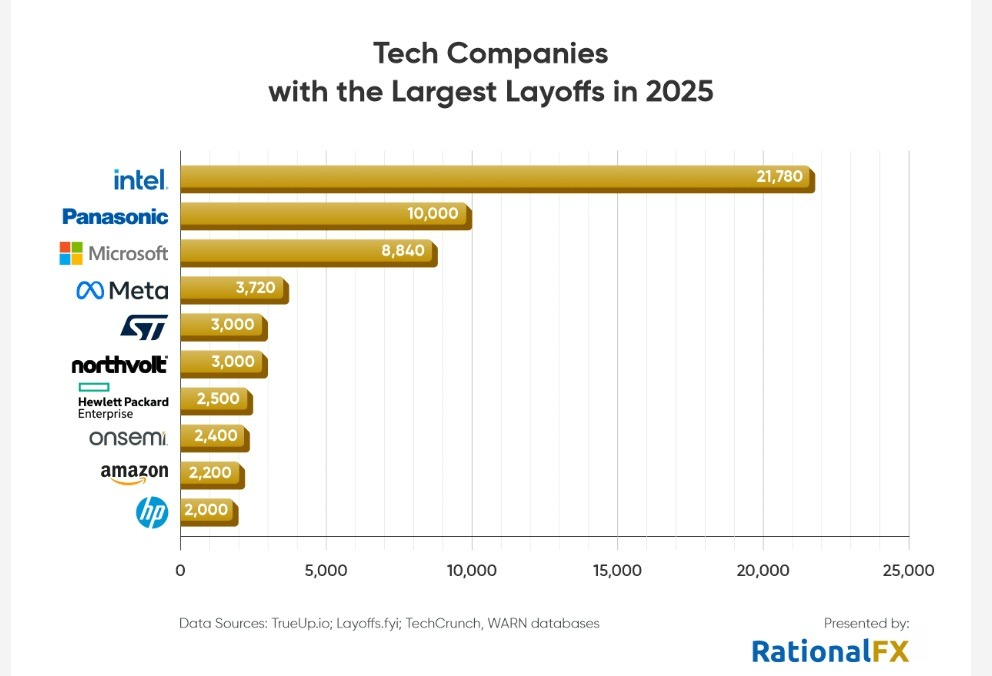
Image Source: PeopleMatters
AI layoffs aren’t just another round of cost-cutting. They’re a signal that workforce structures are fundamentally shifting. What started as a quiet internal restructuring at a few big tech firms in late 2024 has turned into a full-blown labor market story in 2025.
According to Gulf News, more than 180,000 tech roles have been cut globally as of October 1, 2025 — making it one of the largest single-year waves of tech layoffs in recent history (source). A significant share of these cuts has been directly or indirectly tied to AI restructuring efforts.
Accenture confirmed thousands of job cuts as part of its global pivot to AI-first operations (source). Meanwhile, Google recently cut over 100 design roles as it shifted resources toward AI development and automation (source).
This time, it’s not about economic slowdown or a funding winter. It’s about companies rebalancing their human capital around AI. Entire middle layers — design, operational coordination, legacy support functions — are being consolidated or automated. In many organizations, AI isn’t just augmenting tasks; it’s replacing them outright.
When workforce structures change at this scale, the ripple effects reach far beyond immediate job losses. Hiring pipelines are disrupted. Skills that were core two years ago lose their value overnight. And suddenly, HR and policy teams aren’t just firefighting layoffs — they’re rebuilding workforce strategies from scratch.
Turn AI Layoffs into Workforce Wins
Build a future-ready talent strategy using real-time labor market data.
Why These Layoffs Are Different
Tech layoffs aren’t new. We’ve seen hiring freezes, post-pandemic corrections, and even dot-com era overhauls. But 2025 is playing out differently — because this wave isn’t triggered by a market crash or financial tightening. It’s being driven by technology itself.
Companies aren’t trimming headcount to survive; they’re restructuring to automate. A design team replaced by generative AI models, a customer support layer replaced by AI agents, a testing function automated by ML pipelines — these are not temporary cuts. They represent a permanent shift in how work gets done.
What makes this moment sharper is where the cuts are happening. Historically, downturns hit early-career or contract roles the hardest. This time, many affected employees sit in mid-career and operational functions, product design, QA, project management, support, documentation, or data operations. These were once seen as safe, essential roles. Now, they’re becoming the first layer of functions that AI systems can absorb.
At companies like Accenture and Google, the narrative wasn’t “retrenchment” but “AI transition.” Those words matter. They signal that these roles aren’t expected to come back in the same form. Instead, they’ll be replaced, redesigned, or redistributed into fewer, more technical or hybrid positions.
This also means the labor market impact will be uneven. Some roles will vanish quickly. Others will shrink in number but grow in complexity. And entirely new roles — in AI governance, AI operations, model supervision, compliance, and human-in-the-loop review — will rise to fill the gap.
For workforce planners and HR leaders, this creates a strategic problem. Traditional layoff recovery strategies — wait, rehire, or backfill — don’t apply here. You can’t rehire into a role that no longer exists. You have to rethink the workforce architecture itself.
How AI Layoffs Reshape Labor Market Trends
When thousands of roles are eliminated in a short span, the market doesn’t just absorb that shock; it reshapes around it. What’s happening in 2025 isn’t just a wave of layoffs. It’s a rebalancing act between skills that are fading and skills that are suddenly in demand.
Look at major job boards and market signals. You’ll see the pattern clearly: while roles in design, operations, and routine QA have shrunk, there’s a parallel surge in listings for AI operations, data engineering, and compliance functions. Companies aren’t pulling back on hiring entirely. They’re reallocating their budgets from traditional roles to AI-first roles.
A clear example is in product teams. Where a product design org may have once needed ten designers, today it might keep three — supported by AI tools that handle wireframes, user flows, and asset generation. Those budget lines are now being redirected to AI model trainers, prompt engineers, and data quality analysts.
And this isn’t limited to big tech. Banks, insurers, logistics players, retail giants — even governments — are making similar moves. AI is eating away at the middle layers of workflows, forcing workforce structures to flatten and technical competencies to rise.
The Bureau of Labor Statistics and private job signal aggregators have noted that AI and ML-related job postings increased by nearly 21% year-on-year through Q3 2025, even as total tech postings declined (source). That divergence — fewer total jobs, but more AI-heavy jobs — is exactly what makes this wave different.
1. Skills That Are Being Phased Out
The first roles to feel the squeeze are repetitive, operational, or documentation-heavy. Product QA testers, tech writers, front-end designers, process coordinators — jobs that rely on structured, predictable tasks. These functions are the easiest for AI to automate or augment at scale.
Many teams are discovering that one AI-powered workflow can do the work of multiple human operators, especially in areas like support, monitoring, and standardized content production. And once these functions are automated, they rarely come back.
2. Skills That Are in High Demand
At the same time, there’s an entirely new class of in-demand roles emerging. Instead of traditional “developer vs. non-developer” categories, the line is blurring into hybrid roles:
- AI Operations and Automation Engineering — managing and optimizing AI workflows.
- Prompt Engineering & Model Governance — tuning models and ensuring compliance.
- AI Infrastructure & Security — ensuring data safety and model integrity.
- Human-in-the-loop Quality Roles — ensuring AI outputs meet accuracy, fairness, and regulatory standards.
These are roles built for a workforce that doesn’t just use AI — it controls and shapes it.
This shift is why simply looking at the layoff numbers doesn’t tell the full story. Jobs aren’t disappearing uniformly; they’re evolving unevenly. And for workforce planners, that unevenness is where the strategic opportunities lie.
Reskilling in the Age of AI
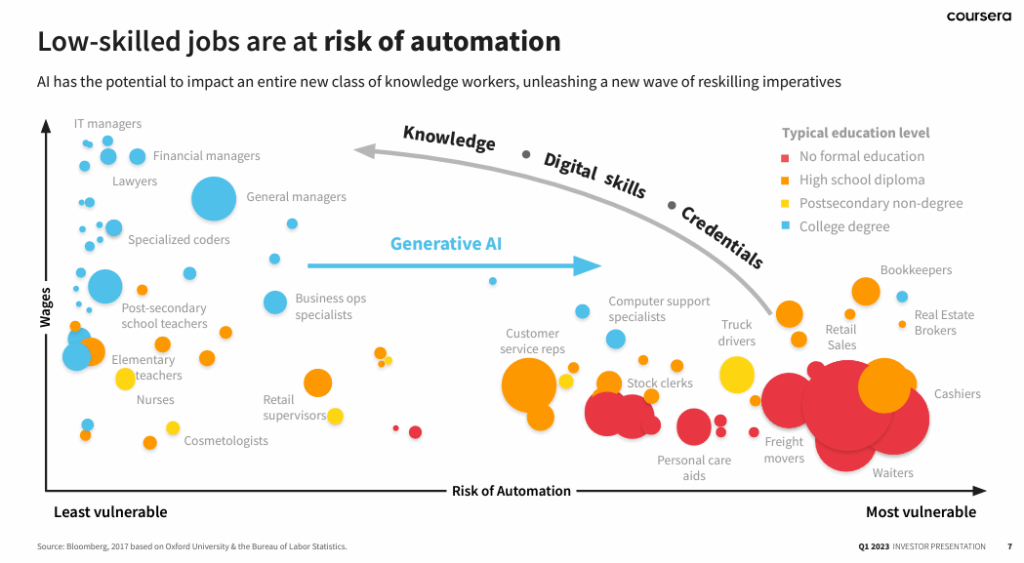
Image Source: constellationr
When layoffs are driven by automation rather than economics, the logical response can’t just be severance and hiring freezes. It has to be reskilling at scale. 2025 is making it painfully clear: companies that treat reskilling as a “nice-to-have” are losing workforce agility, while those that build structured reskilling pipelines are retaining and redeploying talent faster.
AI-driven layoffs expose a simple truth — the gap isn’t just about headcount, it’s about skill mismatches. A QA tester may no longer be needed in their old function, but that same person can be trained to manage AI testing pipelines, prompt evaluation, or workflow auditing. The workforce isn’t becoming obsolete; the roles are shifting.
Globally, companies like IBM, Accenture, and Tata Consultancy Services have already announced structured reskilling programs alongside their AI transitions. Accenture’s layoffs, for instance, were accompanied by a global upskilling initiative for 80,000 employees aimed at moving them into AI and automation-aligned roles (source).
This approach is less about saving jobs in their old form and more about accelerating redeployment into emerging functions. That’s a crucial distinction. It acknowledges that traditional functions may disappear but recognizes the human capital behind them still holds value.
HR Ops: From Reactive to Proactive Workforce Planning
For HR Ops and workforce planners, this is a pivotal moment. Historically, many organizations have reacted to skill gaps — responding after layoffs, hiring freezes, or attrition spikes. But the AI wave demands a different stance: anticipating which roles are at risk and building reskilling pathways before the shock hits.
That means:
- Mapping job families likely to be impacted by AI tools.
- Identifying adjacent skills that employees can be trained in.
- Partnering with learning platforms and internal academies for rapid skill sprints.
- Using labor market data to predict which skills will be in demand 6–12 months ahead.
This isn’t about saving every job — it’s about shortening the distance between displacement and redeployment.
The companies that master this shift will reduce churn, avoid talent shortages, and build a workforce that can flex as fast as technology evolves. Those that don’t will be stuck in a cycle of layoffs and rehires — expensive, disruptive, and unsustainable.
The Real Workforce Planning Challenge: Redeployment
Layoffs get the headlines. Redeployment decides the long game. When roles disappear due to AI, companies are left with a hard question: do they let experienced talent walk out the door, or do they move them into new roles fast enough to matter?
Redeployment isn’t just about “finding a new role internally.” It’s about strategic repositioning of skills. In 2025, the organizations making the cleanest transitions are the ones treating redeployment as an operating muscle, not an HR afterthought.
Here’s what that looks like in practice.
- A technical writer whose function has been automated moves into AI output quality assurance.
- A project coordinator is trained in prompt operations and joins the AI workflow team.
- A QA engineer becomes an automation testing specialist.
None of these redeployments happens by accident. They require clear skill adjacency mapping — knowing which at-risk roles can shift into which new functions with minimal friction.
Accenture, for example, emphasized redeployment for many impacted employees as part of its AI restructuring strategy, citing internal mobility as a way to reduce external hiring costs and keep domain expertise in-house (source). This is becoming a defining strategy among large employers trying to balance efficiency with stability.
The challenge is speed. Market demand for AI-aligned roles is growing faster than most companies can retrain or reassign. A lag of even a few quarters can leave skilled workers out of the system and force companies to rehire externally at a higher cost for the same capabilities they let go.
Redeployment also creates a more resilient workforce architecture. Instead of constantly reacting to external shocks, companies build internal mobility pathways that can absorb technological shifts without destabilizing teams.
For policy analysts and HR Ops teams, this means workforce planning isn’t just forecasting headcount anymore. It’s forecasting skill flow — understanding how talent moves inside the organization when entire role families disappear.
How Labor Market Data Can Guide Your Workforce Planning Strategy
Most companies don’t fail at workforce planning because they lack people. They fail because they’re flying blind on market signals. In a year like 2025, where AI layoffs are reshaping job families faster than traditional planning cycles can keep up, relying on static internal data isn’t enough.
This is where real-time labor market data becomes a strategic asset. By tracking job postings, skill requirements, and hiring velocity across industries, companies can identify which skills are rising, which are declining, and where the redeployment opportunities actually are.
For example, if internal data shows a surplus of QA testers, but job market signals show a spike in demand for AI testing and prompt evaluation roles, HR Ops teams can map those employees to targeted reskilling programs. This isn’t guesswork — it’s data-backed workforce design.
Labor market signals also reveal how fast skills are moving. If postings for AI Ops roles grow by 20% in a quarter, that’s not a trend to debate in the next annual planning cycle — it’s a signal to act now.
- Rising skills highlight where to invest in reskilling and hiring.
- Declining skills flag where to prepare for role transitions.
- Emerging skills expose blind spots that could become future hiring bottlenecks.
This kind of signal-based planning is already being adopted by global employers. Instead of just reacting to layoffs, they’re using external market data to preempt them — building internal pipelines before demand peaks.
Workforce planning powered by external data isn’t a luxury anymore. It’s a competitive advantage. Companies that can align internal workforce movement with external hiring signals will redeploy faster, reduce talent acquisition costs, and maintain operational continuity even as roles change.
AI Jobs Are Changing, Not Disappearing

Image Source: BBC
It’s easy to look at layoff numbers and assume the future of work is shrinking. But that’s not what the data says. AI isn’t making work disappear — it’s changing the shape of work.
The 180,000 job cuts this year (source) are real. But at the same time, postings for AI-adjacent roles — AI operations, prompt engineering, MLOps, and governance — have surged across industries. What’s happening is a redistribution of labor, not a vacuum.
The future workforce won’t be divided into “AI vs. humans.” It will be built around human-AI collaboration, where people move higher up the value chain while automation takes over repeatable work. This means fewer heads in support or operations but more roles in oversight, orchestration, and optimization.
Forward-looking organizations are already restructuring around this idea. They’re:
- Designing leaner, more technical teams instead of large layered org charts.
- Investing in reskilling before layoffs rather than after.
- Using labor market analytics to plan role transitions instead of relying on static org structures.
- Building cross-functional roles where technical fluency and strategic thinking overlap.
This is why workforce planning in 2025 isn’t about preventing change — it’s about getting ahead of it. Companies that cling to legacy structures will keep fighting wave after wave of displacement. Those who anticipate skill shifts will grow stronger with each cycle.
AI jobs are here. But they don’t look like the ones we’ve known. That’s the challenge — and the opportunity — for every workforce leader right now.
AI Layoffs and the Rise of Skills-Based Organizations
One of the most significant trends emerging from AI layoffs is the move away from job titles toward skills-based workforce planning.
Traditional workforce models assume stable roles with fixed responsibilities. AI breaks that assumption. When tasks are automated rapidly, job titles lose relevance faster than skills.
Skills-based organizations:
- Hire and redeploy based on capabilities, not titles
- Maintain dynamic skill inventories
- Adapt roles as technology evolves
AI layoffs accelerate this transition. Organizations that cling to rigid job architectures will struggle to adapt, while skills-first organizations will redeploy talent more fluidly.
The Cost of Getting AI Layoffs Wrong
Poorly managed AI layoffs create long-term damage:
- Loss of institutional knowledge
- Increased rehiring costs
- Declining employee trust
- Slower AI adoption due to skill gaps
In contrast, organizations that integrate AI layoffs into workforce planning reduce disruption and preserve momentum. The difference lies not in whether layoffs occur, but in how strategically they are handled.
From Regular Jobs to AI Jobs: Where the Shift Is Happening
Layoff numbers tell you the scale of disruption. Job transitions tell you the shape of the future. One of the clearest patterns emerging from 2025 is that many roles aren’t disappearing — they’re being recast into AI-aligned versions of themselves.
These transitions aren’t just happening at the fringes of tech. They’re cutting through core business functions. Below are a few of the clearest and fastest-moving shifts happening across industries:
| Traditional Role | AI-Shifted Role | What Changed |
| QA Tester | AI Testing & Model Validation Specialist | Manual testing tasks replaced by automated pipelines; workers now manage AI testing and edge-case coverage. |
| Product Designer | AI Workflow Designer | Wireframing, layout, and asset creation handled by AI tools; humans focus on system logic and UX strategy. |
| Content Writer | AI Prompt Engineer / Content Curator | Drafting automated by language models; humans refine prompts, tone, and fact accuracy. |
| Project Coordinator | AI Ops Workflow Manager | Status tracking automated; coordinators now manage multi-agent orchestration and data flows. |
| Customer Support Representative | AI Supervisor / Escalation Specialist | L1 issues handled by AI; reps manage exception handling and customer sentiment analytics. |
| Tech Writer / Documentation Lead | AI Knowledge Base Curator | Documentation generated by AI; humans ensure structure, clarity, and compliance. |
| Data Entry Operator | Data Labeling & Quality Assurance Specialist | Repetitive entry eliminated; workers maintain labeling accuracy and dataset integrity. |
These shifts are significant for two reasons:
- The job titles may change — but the people don’t have to. Many of these transitions can be achieved through targeted, time-bound reskilling.
- They reveal which capabilities are rising in value. Pattern recognition, model supervision, orchestration, and prompt design are replacing manual execution.
One of the most telling trends in recent job postings is the rise of hybrid AI roles. For instance, listings for “AI Prompt Engineer” roles grew by more than 27% between January and September 2025, while postings for content writers and editors dropped across major job boards (source).
The same trend is visible in customer support, operations, and documentation-heavy functions. Every time AI takes over a repetitive layer, a more strategic layer gets created above it — and companies that invest in mapping those shifts early can redeploy instead of replace.
2025 Is the Year Workforce Planning Gets Real
Every decade has its workforce reset moment. For 2025, AI layoffs are a reset. Unlike the cyclical downturns of the past, this wave isn’t temporary. It’s structural. Roles that vanish now won’t return in the same form. Entire job families are being reshaped, and the speed of that change is outpacing traditional HR playbooks.
Organizations that approach this like a standard headcount reduction will be stuck in a loop of layoffs, panic hiring, and skills gaps. Those who treat it like a workforce redesign moment will come out ahead. That means combining three things deliberately:
- Reskilling as a core strategy, not a PR exercise.
- Redeployment with data-backed role mapping, not ad-hoc placement.
- Labor market intelligence as a real planning tool, not an afterthought.
The companies that act on these three pillars will find that AI isn’t just a cost-cutting lever — it’s a workforce multiplier. But to get there, they’ll need to treat workforce planning with the same urgency and sophistication they bring to product roadmaps or revenue forecasts.
2025 is not the year to wait and see. It’s the year to restructure with intention.
Turn AI Layoffs into Workforce Wins
Build a future-ready talent strategy using real-time labor market data.
FAQs:
1) Are companies laying off because of AI?
Short answer: yes, but it’s mostly restructuring. Firms are cutting layers that AI can handle (routine QA, first-line support, some design/documentation work) and moving budget to AI-first roles. 2025 has already seen 180,000+ tech job cuts globally, with many tied to AI-led reorganizations (source). Think fewer heads in repeatable tasks, more heads in AI ops, model quality, and governance.
2) Will AI replace 50% of jobs?
No. That headline is built for clicks. What’s far more likely: AI automates a chunk of tasks inside many jobs. Roles change; people shift. Expect a lot of job redesign and redeployment, not a 50% wipeout. The smart move for HR Ops is to map task automation to new role shapes and reskill into them.
3) Who will lose jobs because of AI?
The early impact hits predictable, rules-based work. Examples: manual QA, data entry, tier-1 support, heavy documentation, basic coordination. Those roles shrink fastest. But they don’t have to vanish from your org. With short, targeted training, many of these employees move into AI testing, prompt ops, data quality, and workflow orchestration.
4) What jobs will be eliminated by AI by 2030?
Jobs built on repetition are most at risk: routine data entry, transcription, basic customer service, low-complexity testing, admin scheduling. Some titles will disappear; many will reappear as hybrids—humans supervising, auditing, or improving AI outputs rather than doing the original manual work.
5) Which jobs will AI not replace?
Anything that leans on judgment, context, trust, or creativity has staying power. Think: product strategy, senior engineering, compliance and risk, complex healthcare, legal advisory, enterprise sales/consulting, change leadership. AI can draft, summarize, or monitor. It can’t own nuance, accountability, or relationships. Those are human—and they’ll only get more valuable.