
- Talent Scarcity in 2026: What You Need to Know
- The Global Talent Scarcity Crisis in 2026 Is Not What You Think
- Good Hiring Decisions Start With Better Workforce Intelligence.
- Roles Nobody Can Fill: 2026 Talent Scarcity by Job Category
- Where in the World Is Talent Disappearing Fastest?
- Why These Shortages Are Structural, Not Cyclical
- What Talent Scarcity Is Actually Costing Your Business
- How to Beat Talent Scarcity: What Smart TA Leaders Are Doing in 2026
- How JobsPikr's Workforce Intelligence Helps You Anticipate Talent Shortages
- The Talent Market Is Not Waiting and Neither Should You
- Turn Talent Scarcity Into a Strategic Advantage.
- Frequently Asked Questions
Talent Scarcity in 2026: What You Need to Know
Talent scarcity in 2026 is not a hiring trend; it is a structural reality that is reshaping how enterprise organizations compete for people. According to ManpowerGroup’s 2026 Global Talent Shortage Survey, 72% of employers globally are reporting difficulty filling open roles. The hardest-hit categories right now are AI and machine learning, healthcare, skilled trades, and cybersecurity, and the root causes go much deeper than a temporary labor market blip. Demographic shifts, chronic underinvestment in reskilling, and a labor market that is moving faster than traditional hiring playbooks can keep up with have all converged at once.
Key Takeaways
- Talent scarcity in 2026 is structural, not cyclical; the skills the global economy needs are not being produced fast enough by educational pipelines or reskilling programs, and that gap is widening every quarter.
- The shortage is not limited to one industry or one region. AI and tech, healthcare, skilled trades, and cybersecurity are all under severe pressure simultaneously, which means competing for the same shrinking pool of candidates across functions.
- Geography matters more than ever right now. Some cities and regions are becoming genuine talent deserts while others are emerging as unexpected hiring hubs, and knowing the difference before your competitors do is a significant strategic advantage.
- Real-time workforce intelligence is no longer optional for enterprise TA teams. Organizations that rely on annual labor market surveys to make hiring decisions are already operating with outdated information in a market that is moving faster than those surveys can track.
The Global Talent Scarcity Crisis in 2026 Is Not What You Think
There is a version of this conversation that gets told a lot. Companies say they cannot find people. Job seekers say they cannot find jobs. And somewhere in the middle, recruiters are quietly burning out trying to bridge a gap that keeps getting wider.
But here is the thing: this is not a story about people not wanting to work. It is a story about a fundamental mismatch between the skills the global economy needs right now and the skills that exist in the labor market. That distinction matters enormously for how you approach hiring strategy, because the solution to a volume problem looks very different from the solution to a skills problem.
ManpowerGroup’s 2026 Talent Shortage Survey, which spans more than 39,000 employers across 41 countries, found that 72% of employers are reporting difficulty hiring, a figure that has remained stubbornly high despite modest global economic shifts. The number is down slightly from 74% the previous year, but that is not the relief it might appear to be. What has changed is not that talent has suddenly become more available; it is that hiring demand in some sectors has cooled marginally, creating the illusion of improvement while the underlying structural problem remains firmly in place.
What makes this especially frustrating for hiring teams is that this is not a volume issue. Many roles attract high applicant numbers, but very few candidates meet the required skill level. When your job posting pulls in 300 applications, and none of them are genuinely qualified, the problem is not your employer brand or your job description. The problem is labor availability, and that is a much harder thing to fix with traditional recruiting tactics.
For the first time ever, AI skills have surpassed all other categories to become the most difficult for employers to find globally, with AI Model and Application Development and AI Literacy now leading the global ranking of hard-to-fill skills. That shift alone tells you a great deal about where the labor market is heading. The economy has pivoted toward AI-driven work faster than educational institutions, corporate reskilling programs, or immigration pathways can realistically keep up with.
Researchers describe what is happening right now as a “Double Whammy” effect. The World Economic Forum has found that nearly 44% of core skills will shift by 2027, meaning the workforce is quite literally outrunning the education system. At the same time, approximately 10,000 baby boomers are retiring every day, taking decades of institutional knowledge and hard-won experience with them. When you put those two forces together, accelerating skill change at one end and accelerating workforce exit at the other, you get exactly the kind of structural talent scarcity that no single hiring campaign is going to solve.
For talent acquisition directors and workforce planning teams, the takeaway from all of this is uncomfortable but important. The organizations that are going to win the talent competition in 2026 are not necessarily the ones with the biggest recruiting budgets. They are the ones with the clearest, most current picture of where talent exists, where it is disappearing, and where it is beginning to emerge, and who are using that intelligence to act before the shortage becomes a crisis.
Good Hiring Decisions Start With Better Workforce Intelligence.
See how enterprise TA teams are using JobsPikr to turn real-time labor market data into a talent strategy that actually works.
Roles Nobody Can Fill: 2026 Talent Scarcity by Job Category
Not every corner of the labor market is hurting equally. Talent scarcity in 2026 is concentrated in specific role categories where demand has accelerated faster than supply could ever reasonably follow. If you are a TA leader trying to prioritize where to focus your workforce intelligence efforts, these are the categories that deserve your immediate attention.
AI and Machine Learning Engineers
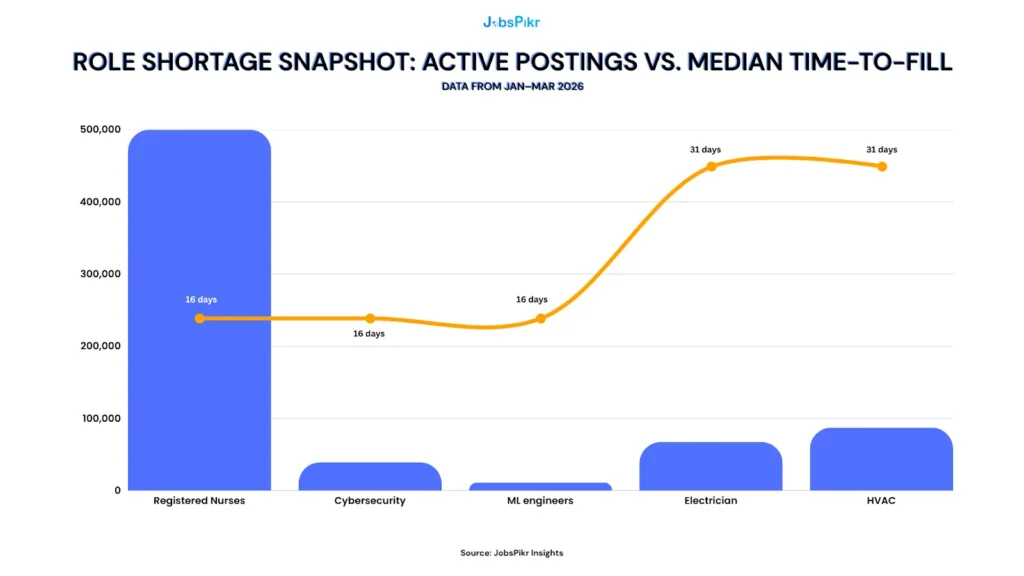
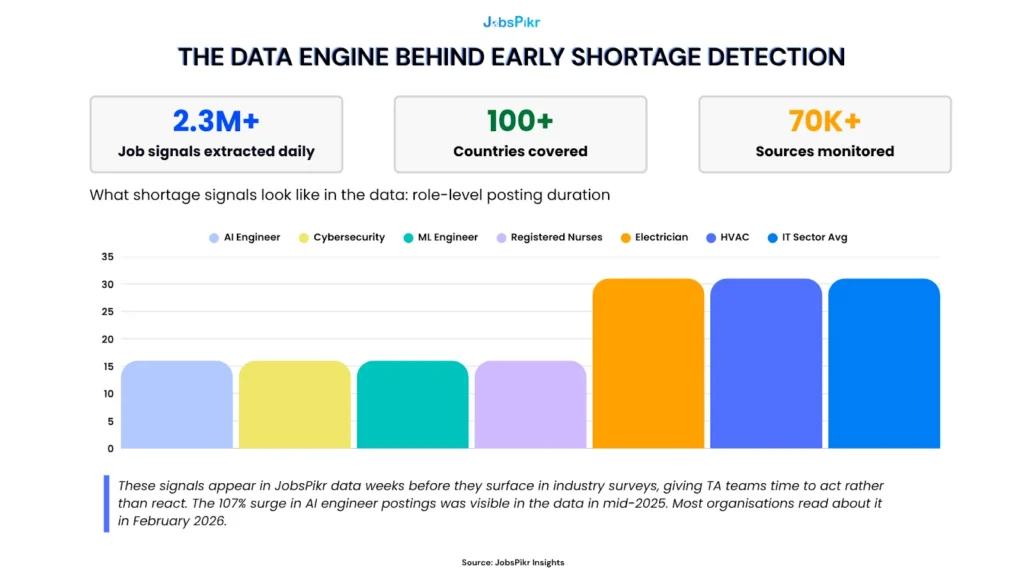
This is the sharpest pressure point in the entire global labor market right now. According to ManpowerGroup’s 2026 Talent Shortage Survey, AI skills have claimed the top spot globally for hiring difficulty for the first time in the survey’s history. The demand is real, and it is accelerating fast. According to JobsPikr data, there were 11,300 active ML engineer job postings in the January to March 2026 period alone, with a median posting duration of just 16 days. That short posting window might sound like a good thing, but it is actually a warning signal. It means these roles are being filled extremely quickly, often because companies are throwing compensation and speed at the problem rather than hiring strategically.
According to data from Second Talent, AI talent demand currently exceeds supply by a ratio of 3.2 to 1 globally, with over 1.6 million open positions and only 518,000 qualified candidates available worldwide. AI roles also command salaries that are 67% higher than traditional software positions, which tells you how desperate the competition has become. For enterprise TA teams, this is not a role category where you can afford to wait for candidates to come to you.
Cybersecurity Professionals
Cybersecurity is another category where the gap between demand and supply has reached a genuinely alarming level. According to the ISC2 Cybersecurity Workforce Study, the global cybersecurity workforce gap has hit 4.8 million unfilled positions, a figure that has grown by 19% year over year. The cybersecurity workforce would need to increase by 87% just to satisfy current demand. That is not a hiring challenge. That is a structural crisis.
JobsPikr data from January to March 2026 shows 39,100 active cybersecurity job postings, with a median posting duration of 16 days, identical to ML engineers. And much like AI roles, organizations with significant cybersecurity staffing shortages face data breach costs that are on average $1.76 million higher than their well-staffed counterparts. The financial consequence of not filling these roles is not abstract; it shows up directly on the balance sheet.
Registered Nurses and Healthcare Workers
Healthcare is where talent scarcity collides most visibly with human consequence. JobsPikr data captured 500,000 active registered nurse job postings in the January to March 2026 period, by far the largest volume of any role category tracked. The median posting duration of 16 days reflects how urgently these roles need to be filled, and how quickly organizations are moving to close them when they can.
The World Health Organization projects a global shortage of 11 million healthcare workers by 2030, and 2026 is very much part of that trajectory. The American College of Physicians predicts a shortage of 85,000 physicians by 2036, and the National Center for Health Workforce Analysis projects shortages across 30 out of 35 physician specialties by 2038. Nursing is no different. The 2022 National Nursing Workforce Survey predicted that more than one quarter of nurses will leave or retire by 2027, a retirement wave that is already well underway.
For TA leaders in healthcare, the volume of open roles is not the problem. The problem is the pipeline. There simply are not enough qualified professionals entering the field fast enough to replace the ones leaving it.
Skilled Trades: Electricians and HVAC Technicians
Skilled trades are perhaps the most underappreciated talent shortage story of 2026. These are not glamorous headlines, but the numbers are stark. JobsPikr data from January to March 2026 shows 67,400 active electrician postings and 87,400 active HVAC technician postings, both with a median posting duration of 31 days, nearly double that of tech and healthcare roles. That longer posting duration is a direct reflection of how thin the qualified candidate pool has become in these trades.
According to the Associated Builders and Contractors, the US construction industry needs to attract approximately 349,000 net new workers in 2026 beyond normal hiring levels just to keep pace with demand. The National Association of Home Builders has quantified the economic impact of this skilled labor shortage at $10.8 billion per year, accounting for delayed construction timelines, higher carrying costs, and an estimated 19,000 homes that are not being built annually as a direct result. These are not soft consequences. They ripple directly into housing affordability, infrastructure delivery, and broader economic productivity.
Decades of cultural emphasis on four-year college degrees systematically steered young people away from the trades, and the bill for that is now coming due all at once.
Where in the World Is Talent Disappearing Fastest?
Talent scarcity does not hit every geography the same way. Some cities are drowning in job postings with nowhere near enough qualified candidates to fill them. Others are quietly emerging as new hiring hubs that smart TA leaders are already tapping into. Understanding the geographic dimension of the labor shortage is not a nice-to-have for enterprise hiring teams, it is table stakes for any workforce planning conversation happening in 2026.
The Cities Where Hiring Pressure Is Intensifying
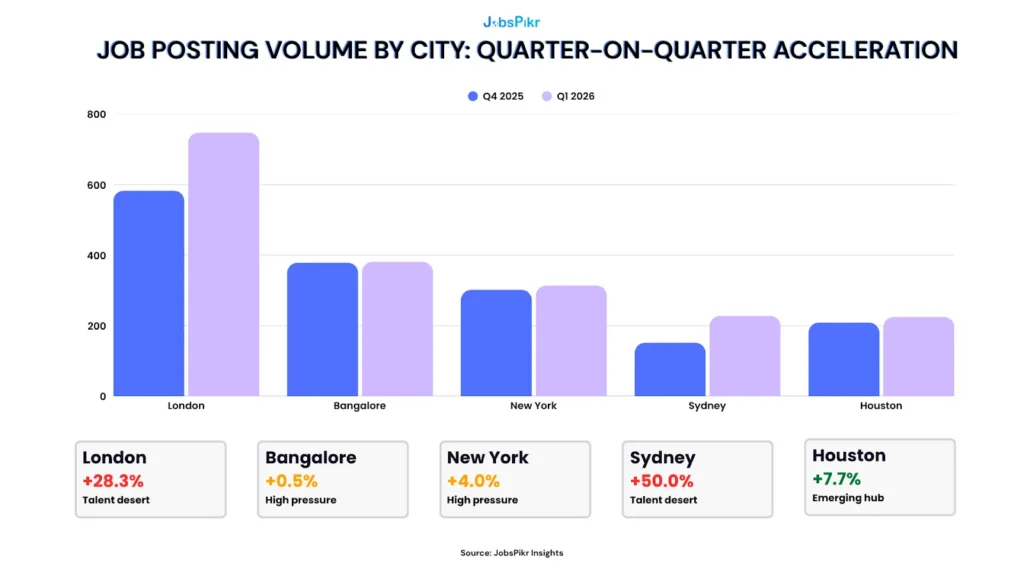
JobsPikr data tells a revealing story when you look at job posting volumes across major global metros and compare the last two quarters. Between October and December 2025, London recorded 583,000 job postings. By January to March 2026, that number had climbed to 748,000, a jump of 165,000 postings in a single quarter. New York followed a similar pattern, moving from 302,000 postings in Q4 2025 to 314,000 in Q1 2026. Sydney showed perhaps the most dramatic acceleration of all, leaping from 152,000 postings in Q4 2025 to 228,000 in Q1 2026, a 50% increase in just three months. Houston also grew, moving from 209,000 to 225,000 postings over the same period.
What these numbers tell you is not just that hiring activity is increasing in these cities. They tell you that demand is outpacing supply at an accelerating rate. When posting volumes surge this sharply in a short window, it almost always means organizations are struggling to fill roles and reposting them, a classic signal of a talent desert forming beneath the surface of an otherwise busy job market.
London: Europe’s Most Pressured Hiring Market
London’s posting volume is the highest of any city in the JobsPikr dataset, and it is not hard to understand why. According to ManpowerGroup’s 2026 Talent Shortage Survey, 73% of UK employers report significant hiring difficulty above the global average of 72%. The concentration of financial services, technology, and professional services firms in London creates a particularly intense competition for AI-literate, technically skilled professionals. The city has long been a global talent magnet, but the inflow of international talent that once helped balance demand has become less predictable in the post-Brexit environment. For TA teams hiring in London, the message from the data is clear: reactive hiring will not work here. You need to be building pipelines well before roles open.
Bangalore: Asia’s Talent Hub Under Pressure
Bangalore is the most interesting data point in the JobsPikr geographic breakdown. With 381,000 postings in Q1 2026, up marginally from 379,000 in Q4 2025, it is the second busiest hiring market in the dataset. But what makes Bangalore distinctive is its dual role in the global talent story. It is simultaneously one of the world’s most important technology talent supply hubs and one of its most competitive hiring markets. ManpowerGroup’s 2026 survey data shows that India reports an 82% employer hiring difficulty rate, one of the highest of any major economy globally. Global enterprises that have historically treated India as an easy talent sourcing destination are discovering that the market has matured significantly. Competition for senior engineering, data science, and AI talent in Bangalore is now fierce, with local and global companies all competing in the same candidate pool.
Emerging Hubs Worth Watching
Not every city in the data is a stress signal. Some of the posting growth patterns in the JobsPikr data point toward cities that are becoming genuine emerging hiring hubs, places where talent supply is growing alongside demand rather than lagging it. Houston’s steady growth across both quarters, for example, reflects the intersection of energy sector transformation, data center expansion, and infrastructure investment that is drawing both employers and workers to the region. Sydney’s dramatic posting surge, while partly a signal of demand pressure, also reflects Australia’s growing attractiveness to internationally mobile talent, particularly in healthcare and technology, as remote and hybrid work models make geographic relocation a more viable option for candidates.
ManpowerGroup’s data also flags some interesting geographic contrasts at the country level. Germany reports an 83% employer hiring difficulty rate, the highest of any major economy surveyed, driven by an aging population, strict credentialing requirements, and historically low immigration relative to labor demand. France sits at 74%. Meanwhile, China reports just 48% hiring difficulty, making it the least constrained major labor market globally. That contrast matters for global enterprises making decisions about where to build or expand teams. The geographic arbitrage opportunity is real, but it requires current, granular data to act on not broad regional assumptions.
What the Geographic Data Is Really Telling TA Leaders
The pattern that emerges from looking at city-level posting data is not simply “some places are busier than others.” It is that the gap between where talent is needed and where qualified talent exists is widening in specific, identifiable ways. London, New York, and Sydney are showing the classic markers of talent deserts, high and accelerating posting volumes in markets where candidate supply is constrained by cost of living, visa complexity, or simply a finite pool of people with the right skills. Bangalore is a reminder that even markets historically considered talent-rich are now competitive in ways that require a more sophisticated sourcing approach.
For enterprise TA teams and workforce planning leaders, the geographic intelligence embedded in real-time job posting data is one of the most underutilized strategic assets available. Knowing which cities are heating up three to six months before your competitors act on that information is the difference between building a proactive talent pipeline and scrambling to fill roles in a market that has already moved against you.
Why These Shortages Are Structural, Not Cyclical
Here is something worth saying plainly: the talent shortages showing up in hiring data right now are not going to correct themselves when the economy shifts or when the next generation of graduates enters the workforce. That is the kind of thinking that leads organizations to underinvest in workforce intelligence and overpay for talent reactively when the pressure finally becomes impossible to ignore.
The causes of what we are seeing in 2026 are structural. They have been building for years across multiple dimensions simultaneously and understanding them is the first step toward building a hiring strategy that addresses the problem rather than just reacting to the symptoms.
The Demographic Wave Nobody Can Stop
The single most unavoidable driver of talent scarcity right now is demographics. Approximately 10,000 baby boomers are retiring every day in the United States alone, and this is not a trend that peaks and reverses. It is a sustained, multi-year exodus of experienced professionals from the workforce, taking with them decades of institutional knowledge, technical expertise, and leadership capability that cannot simply be replaced by posting a job opening.
The healthcare sector makes this most visible. The US population aged 65 and older stood at 58 million in 2022 and is projected to reach 82 million by 2050, according to the National Center for Health Workforce Analysis. That means the demand side of the healthcare labor equation is expanding rapidly at the same moment that experienced clinicians and administrators are exiting the workforce through retirement. The same dynamic is playing out in skilled trades, where the median age of a US construction worker is 42.5 years and approximately one in five electricians is already over the age of 55. The retirement clock is ticking loudly in these industries, and the incoming pipeline of younger workers is nowhere near large enough to compensate.
For TA leaders, this demographic reality has a direct strategic implication. A significant portion of your future hiring need is not being driven by business growth. It is being driven by replacement and replacement hiring at this scale requires a fundamentally different approach to talent pipelining than most organizations currently have in place.
Skills Are Evolving Faster Than Training Systems Can Follow
The second structural driver is the pace of skill change, and it is genuinely unprecedented. The World Economic Forum has found that nearly 44% of core skills will shift by 2027 meaning that nearly half of what qualifies someone as competent in their role today will look meaningfully different in less than two years. No educational system, corporate training program, or professional certification body moves at that speed.
The result is what talent researchers are increasingly calling a permanent skills mismatch. The organizations succeeding in this market are those that hire for capability and learning potential rather than just CV fit, because the specific technical skills they need today may not be the ones they need in 18 months. That is a fundamentally different hiring philosophy from what most enterprise TA functions were built around, and shifting toward it requires both a change in how roles are defined and much better real-time intelligence about which skills are emerging in the market.
This is particularly acute in AI and cybersecurity, where the skill requirements themselves are evolving almost month to month. An AI engineer role posted in early 2025 looks meaningfully different from one posted in early 2026, and the gap between what employers need and what the candidate pool can offer widens every time the technology takes another step forward.
Decades of Underinvestment in Vocational Training
Alongside the pace of technological change sits a more slow-burning structural problem, decades of systematic underinvestment in vocational and technical education. In many countries, the cultural and policy emphasis on four-year university degrees as the primary pathway to a good career effectively defunded the trade school pipeline over a generation. The consequences of that are showing up in full force in 2026.
The skilled labor shortage in the home building sector alone carries an aggregate economic impact of $10.8 billion per year, according to the National Association of Home Builders, not because the work does not exist, but because there are not enough qualified people to do it. You cannot build an electrician or a plumber in six months. These are skills that take years of apprenticeship and hands-on experience to develop, which means the investment decisions made, or not made, in vocational education a decade ago are directly shaping what the available talent pool looks like today. Reversing that takes time that most hiring teams do not have.
Remote Work Has Permanently Redistributed Talent
The normalization of remote and hybrid work following the pandemic has added another layer of complexity to an already difficult talent picture. On the surface, remote work should help solve talent scarcity; if you can hire from anywhere, the pool gets larger. In practice, what has happened is more complicated.
Remote work has made high-demand talent more mobile, which means the most sought-after professionals now have genuinely global options when evaluating opportunities. That has intensified competition for top talent rather than relieving it, particularly in AI, data science, and cybersecurity, where the best candidates can effectively name their terms. It has also created new geographic dynamics where some regions are seeing talent drain as mobile workers relocate to lower cost-of-living areas, even while their employers remain in high-cost metros.
Data from the 2026 Global Talent Barometer shows that 64% of workers said they would stay with their current employer rather than risk a move, a phenomenon researchers are calling “job hugging.” While that sounds like good news for retention, it has a significant downside for hiring teams. When workers stop moving between employers, the pool of active candidates shrinks dramatically. Passive candidates become the primary talent universe and reaching them effectively requires a level of market intelligence and proactive outreach that most TA functions are not yet equipped to deliver at scale.
The Compounding Effect
What makes all of this particularly challenging is that these structural drivers do not operate in isolation. They compound each other. An aging workforce exits while skill requirements accelerate. Underinvestment in vocational training reduces pipeline supply at exactly the moment demand for trade skills is surging. Remote work expands the geographic scope of competition while candidate mobility declines. Each force on its own would be manageable. All of them together, hitting simultaneously, is what produces the kind of sustained, broad-based talent scarcity that 72% of global employers are now reporting.
Understanding this compounding dynamic is important because it changes what a good hiring strategy looks like. Incremental improvements to job posting copy or employer branding are not going to move the needle in a structural shortage. What is required is a fundamentally more intelligent, more proactive, and more data-driven approach to where and how talent acquisition teams deploy their time and resources.
What Talent Scarcity Is Actually Costing Your Business
Talent shortages have a way of feeling abstract until someone puts a number on them. The conversation in most leadership teams tends to stay at the level of “hiring is hard right now”, which is true, but it dramatically undersells the actual business consequence of operating with unfilled roles, extended time-to-hire, and a recruiting function that is perpetually in reactive mode.
The cost of talent scarcity is not just a recruiting problem. It shows up in revenue, in product delivery timelines, in customer experience, in security exposure, and in the compounding cost of losing good people because the organization could not move fast enough to replace those who left. For TA directors and VP-level leaders making the case for better workforce intelligence investment internally, these are the numbers that matter.
The Time-to-Hire Problem Is Worse Than Your ATS Is Telling You
Most organizations track time-to-hire as an internal metric, the number of days between a role being approved and an offer being accepted. What that metric does not capture is the invisible time that passes before a role is even formally opened, when a manager already knows they have a gap, but the requisition has not been raised yet. By the time a job posting goes live, the shortage has already been costing you for weeks or months.
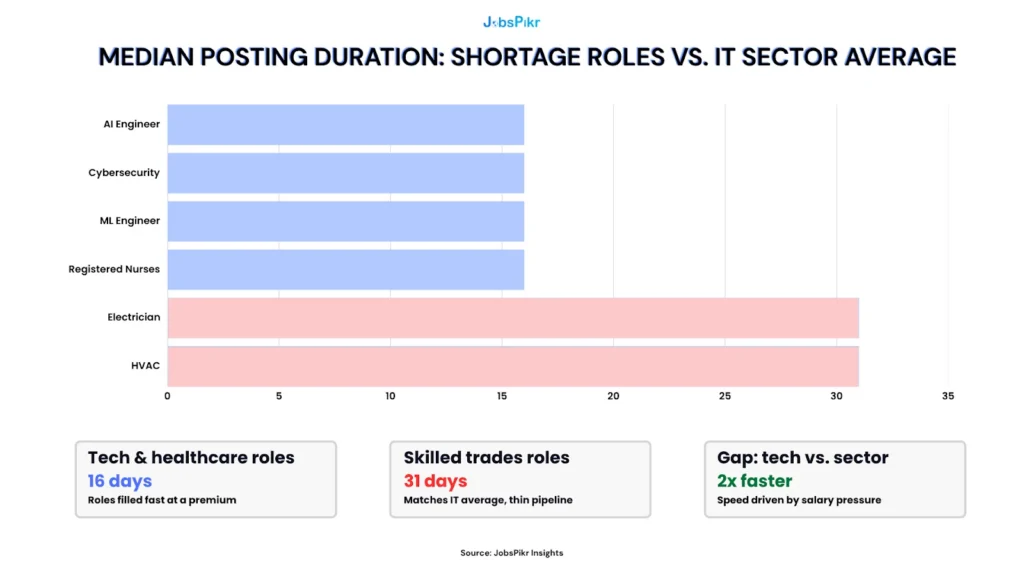
JobsPikr data from January to March 2026 shows that median posting durations for AI engineers, ML engineers, and cybersecurity professionals all sit at 16 days. On the surface, that sounds relatively fast. But it needs to be read in context. According to data from Second Talent, the average time to fill a technical role is 66 days, 50% longer than non-technical positions. The 16-day posting duration for these roles reflects how aggressively companies are moving once a posting goes live, not how easy the hire is. In many cases, roles are being filled at speed precisely because organizations are compromising on candidate quality or paying significant salary premiums to close quickly.
What is particularly telling in the JobsPikr data is the contrast between tech roles and trade roles. While AI engineers, ML engineers, cybersecurity professionals, and registered nurses all show a 16-day median posting duration, electricians and HVAC technicians sit at 31 days, double the duration. That gap reflects a candidate pool that is even thinner relative to demand in the trades, where you cannot accelerate hiring by simply offering more money to a larger remote talent pool. The candidate either has the certification and hands-on experience or they do not.
Across the broader IT sector, the overall median posting duration sits at 31 days according to JobsPikr data, meaning the average tech role takes twice as long to fill as the most in-demand AI and cybersecurity specializations. That contrast is worth sitting with. The roles that are hardest to fill are being closed fastest, which tells you that companies are prioritizing speed over process in shortage categories and that carries its own costs in terms of mis-hires, onboarding failures, and early attrition.
Demand Is Accelerating Faster Than Supply Can Follow
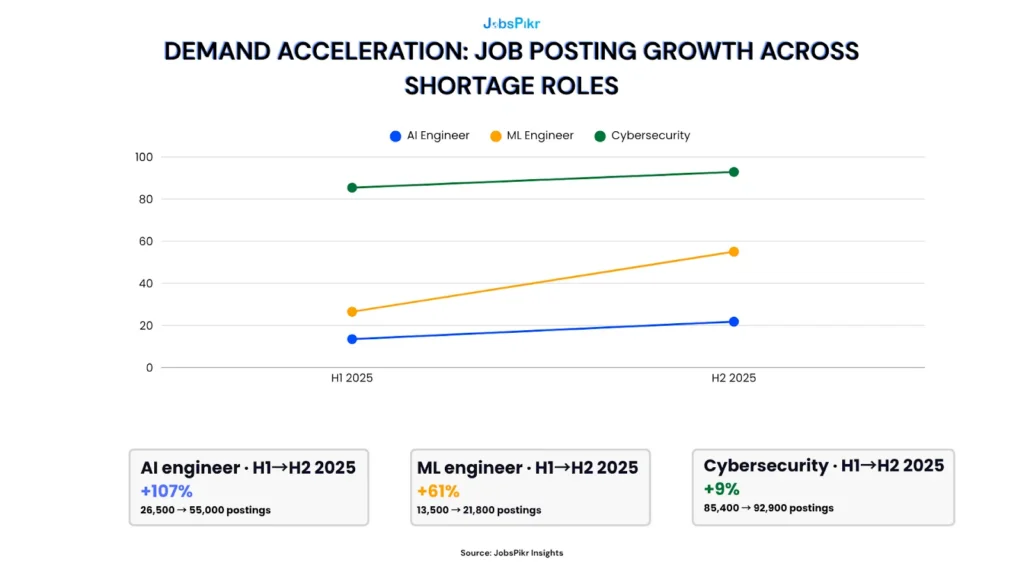
Perhaps the most important signal in the JobsPikr dataset is the trajectory of posting volumes over the past 12 months, because it shows not just where the shortage is today, but where it is heading.
For AI engineers, JobsPikr recorded 26,500 job postings in the first half of 2025. By the second half of the same year, that number had jumped to 55,000, a 107% increase in six months. That is not gradual growth. That is, demand doubled within a single year while the supply of qualified AI engineers grew at a fraction of that pace. For ML engineers, the trajectory is similarly steep, 13,500 postings in the first half of 2025 rising to 21,800 in the second half, an increase of 61% in six months.
Cybersecurity shows a different but equally concerning pattern. Postings moved from 85,400 in the first half of 2025 to 92,900 in the second half, a more measured 9% increase, but one that sits on top of an already enormous baseline of unfilled demand. With 4.8 million cybersecurity positions unfilled globally according to ISC2, even modest growth in posting volume represents a significant widening of an already critical gap.
For workforce planning teams, these trajectory numbers are arguably more important than the point-in-time totals. A role category where posting volume is doubling every six months is a category where your hiring strategy from 12 months ago is already obsolete. The organizations that are going to be in the best position in late 2026 and into 2027 are those that spotted these acceleration curves early and adjusted their sourcing and pipelining strategies accordingly, not those that are reading the data after the shortage has fully materialized.
The Financial Consequences Are Not Soft Numbers
Beyond the operational frustration of slow hiring, talent scarcity carries hard financial consequences that tend to be underreported in most internal workforce discussions.
Organizations with significant cybersecurity staffing shortages face data breach costs that are on average $1.76 million higher than their well-staffed counterparts, according to ISC2 research. That is not a theoretical risk, it is a quantified financial exposure that sits directly on the balance sheet of every enterprise that is running understaffed security teams because it cannot find qualified candidates fast enough. Organizations with a high level of skills shortages incur an average of $5.22 million in breach costs, a staggering $1.57 million more than organizations with low or no skills shortages.
In the skilled trades, the National Association of Home Builders has calculated that the housing industry labor shortage costs the economy $10.8 billion per year, with approximately 19,000 homes going unbuilt annually as a direct result of not having enough qualified workers. And in the technology sector, IDC has projected that the global IT talent shortage will cost organizations worldwide $5.5 trillion in losses in 2026, a number so large it is difficult to fully absorb, but one that reflects the compounding cost of delayed product development, missed innovation cycles, and lost competitive advantage.
These are not recruiting metrics. They are business performance metrics. And they make the case, clearly and in financial terms, for why investing in real-time workforce intelligence is not a cost center decision. It is a risk management decision.
The Hidden Cost of Reactive Hiring
There is one more cost that rarely makes it into the formal analysis but deserves attention: the cost of hiring reactively in a shortage market. When roles stay open too long, the pressure to fill them builds until organizations start making compromises on candidate quality, on compensation discipline, on onboarding thoroughness. Those compromises have downstream consequences in the form of early attrition, performance gaps, and the need to rehire sooner than planned.
Replacing an employee can cost anywhere from half to twice their annual salary, once you factor in recruiting, onboarding, and lost productivity. In shortage role categories where salaries are already elevated, AI engineers, cybersecurity specialists, and senior nurses, the replacement cost can run well into six figures per hire. Every mis-hire driven by time pressure in a shortage market is not just a recruiting failure. It is a significant, measurable financial event.
The organizations that break this cycle are not the ones that hire faster under pressure. They are the ones that build enough forward visibility into the labor market that they are never truly surprised by a shortage, because they saw it coming months in advance and built the pipeline before the vacancy appeared.
See How Leading TA Teams Are Using Workforce Intelligence to Stay Ahead
The short demo below shows how talent acquisition teams are using JobsPikr’s real-time labor market data to anticipate shortage curves, identify emerging hiring hubs, and build proactive sourcing strategies before the competition catches up.
How to Beat Talent Scarcity: What Smart TA Leaders Are Doing in 2026
Knowing where the shortages are is only half the battle. The other half is deciding what to do about it, and the gap between organizations that are navigating talent scarcity well and those that are struggling is not primarily a budget gap or a brand gap. It is a strategy gap.
The TA leaders who are winning right now have made a fundamental shift in how they think about recruiting. They have moved from a model built around vacancy management, open a role, post a job, review applications, make a hire, to one built around continuous talent market engagement. That shift sounds simple, but it requires a very different operating model, a different relationship with data, and a different definition of what recruiting success looks like.
Here is what that looks like in practice.
Stop Hiring for Today’s Vacancy and Start Pipelining for Tomorrow’s Need
The single most impactful change a TA team can make in a shortage market is to decouple talent identification from open requisitions. In a market where AI engineer posting volumes doubled in six months and registered nurse postings numbered in the hundreds of thousands, waiting for a vacancy to appear before you start looking for candidates means you are already behind every organization that started building relationships with that talent pool three months ago.
Proactive talent pipelining means identifying the role categories and seniority levels where your organization will have predictable future needs based on growth plans, retirement patterns, and historical attrition data, and beginning to build relationships with qualified candidates before those roles are formally open. It means your recruiters are having conversations, attending events, and nurturing passive candidate relationships continuously, not just when a hiring manager submits a requisition.
According to ManpowerGroup’s 2026 Talent Shortage Survey, 91% of employers are already deploying a mix of strategies to address structural scarcity, with upskilling and reskilling leading the list at 27%, followed by schedule flexibility at 20% and location flexibility at 18%. The organizations that are combining these retention strategies with proactive external pipelining are the ones building genuine competitive advantage in shortage categories.
For this to work at scale, you need two things. You need recruiters with enough capacity to engage talent they are not actively hiring right now, which means getting ruthless about where recruiter time is spent. And you need real-time labor market data that tells you which role categories and geographies are heating up fast enough to warrant pipeline investment today, rather than in six months when everyone else has caught up.
Rethink Your Geographic Sourcing Strategy
The geographic data in the JobsPikr dataset points to something that many enterprise TA teams are still underutilizing: the fact that talent is not evenly distributed, and the gap between high-pressure markets and emerging talent hubs represents a genuine sourcing opportunity for organizations willing to look beyond their default geographies.
London, New York, and Sydney are posting enormous job volumes and facing intensifying competition for the same candidate pools. Germany is reporting an 83% employer hiring difficulty rate, the highest of any major economy. These are markets where the cost of talent is high, the competition is fierce, and the supply is fundamentally constrained. Continuing to source exclusively from these markets while ignoring emerging hubs is leaving significant talent opportunity on the table.
The smarter approach is to use real-time job posting data to identify regions where qualified talent is available, but employer competition has not yet caught up. These are the markets where your sourcing dollar goes further, where time-to-hire is shorter, and where candidates are more likely to be genuinely engaged rather than fielding five competing offers simultaneously. Remote and hybrid work models have made this kind of geographic arbitrage more viable than it has ever been, but acting on it requires current, granular data about where talent exists, not broad assumptions about which cities have good universities or tech scenes.
ManpowerGroup’s data shows that China reports just 48% employer hiring difficulty, the lowest of any major economy globally. Meanwhile, secondary tech hubs across Southeast Asia, Eastern Europe, and Latin America are producing growing pools of qualified engineering and data science talent that many Western enterprises have been slow to engage systematically. The organizations building sourcing infrastructure in these markets now will have a significant advantage as competition in traditional hubs continues to intensify.
Hire for Potential, Not Just for Credentials
One of the most important tactical shifts in shortage markets is moving away from credential-based hiring toward capability-based hiring. When the candidate pool for a specific role is structurally constrained, holding out for a candidate who checks every box on the job description is a luxury the market no longer supports in most shortage categories.
The organizations succeeding in this environment are those hiring for capability and learning potential rather than CV fit, building internal development pathways that bring candidates with adjacent skills up to full role competency faster than the external market can supply fully formed hires. This is particularly relevant in cybersecurity, where ISC2 identifies AI and machine learning as the number one skill need for 2026, a skill set that very few candidates already have in combination with deep security expertise, but that can be developed in professionals who have the foundational security knowledge already in place.
Skills-based hiring is not a compromise on quality. Done well, it is a higher-quality hiring approach because it forces a clearer articulation of what the role requires versus what has historically been listed on job descriptions out of habit. Skills-based hiring increased to 81% among employers in 2024 and continues to grow in 2026 as organizations recognize that the traditional credential filter is excluding qualified candidates in exactly the role categories where they can least afford to miss someone good.
Build Internal Mobility Into Your Talent Strategy
One of the most underutilized levers in a shortage market is the talent that already exists inside the organization. Internal mobility, moving people across roles, teams, and geographies, reduces external hiring dependency in shortage categories while simultaneously improving retention by giving high-potential employees visible growth paths.
This is not just a retention strategy. It is a supply chain strategy. When external hiring in shortage categories is slow, expensive, and uncertain, the ability to identify internal candidates with adjacent skills and develop them into shortage roles is a genuine competitive advantage. It requires better internal talent data than most organizations currently have, a clear picture of skills, experiences, and aspirations across the existing workforce, but the investment in that visibility pays dividends across both hiring efficiency and retention.
ManpowerGroup’s data shows that around one third of organizations are now prioritizing upskilling existing employees as a direct response to the reality that ready-made external talent simply is not available at scale in shortage categories. The organizations doing this most effectively are combining internal skills data with external market intelligence to identify which internal talent investments will have the highest return, focusing development resources on the roles where external hiring is most constrained and most expensive.
Make Workforce Intelligence a Standing Capability, not a One-Off Exercise
Perhaps the most important strategic shift of all is treating labor market intelligence as a continuous operational capability rather than something you commission when a shortage has already become a crisis. The JobsPikr data showing AI engineer postings doubling in six months is valuable information, but it is most valuable to the organization that was watching that trajectory in real time and adjusting their sourcing strategy at month three, not the one reading about it in an industry report at month eight.
Real-time job posting data, when analyzed at scale across roles, geographies, and industries, gives TA teams something that no amount of recruiter intuition can replicate, an early warning system for where talent shortages are forming, which geographies are heating up, which role categories are about to become significantly harder to fill, and where the best sourcing opportunities exist before the competition has identified them.
That kind of forward visibility is what separates workforce planning from workforce reacting. And in a labor market where 72% of employers are already struggling to hire and the structural drivers show no sign of reversing, the difference between those two operating modes is increasingly the difference between organizations that scale and those that stall.
How JobsPikr’s Workforce Intelligence Helps You Anticipate Talent Shortages
There is a meaningful difference between knowing that a talent shortage exists and knowing that one is forming three to six months before it fully materializes. The first piece of information is useful for explaining why last quarter’s hiring targets were missed. The second piece of information is what allows you to do something about it before the damage is done.
That forward visibility is exactly what workforce intelligence from JobsPikr is built to deliver and it is what separates talent acquisition teams that are genuinely proactive from those that are simply faster at being reactive.
The Scale of the Data Makes the Difference
Most labor market datasets are built from surveys, periodic reports, or aggregated job board samples. They are useful for understanding broad trends, but they update slowly, cover limited geographies, and rarely have the granularity to tell you what is happening at the role level in a specific city in a specific industry right now.
JobsPikr operates at a fundamentally different scale. The platform extracts 1 million job signals daily from over 70,000 sources across more than 100 countries. That is not a sample of the labor market. That is the labor market, structured and made actionable in real time. When posting volumes for AI engineers double in six months as the JobsPikr data showed happening between the first and second half of 2025 that signal appears in the data as it happens, not six months later when it shows up in an industry survey.
For enterprise TA teams and workforce planning leaders, that difference in data freshness is not a minor technical detail. It is the entire strategic advantage. The organizations that spotted the AI engineer demand surge in mid-2025 and started building pipelines immediately were in a fundamentally better position by Q1 2026 than those that read about the shortage in a February report and started reacting in March. JobsPikr’s data coverage across 100+ countries and 70,000+ sources means that geographic signals emerging hiring hubs, regional demand spikes, talent desert indicators surface with the same speed and granularity as role-level signals.
From Raw Data to Actionable Shortage Intelligence
Raw job posting volume alone does not tell you everything you need to know. A spike in postings could mean demand is growing, or it could mean roles are sitting unfilled and being reposted repeatedly, which is a stronger signal of talent scarcity. Understanding the difference requires structured analysis of posting duration, posting frequency, geographic concentration, and skill requirement patterns across time.
This is where JobsPikr’s talent intelligence layer adds the most value for TA teams. Rather than handing you a data dump of millions of job postings and leaving you to make sense of it, the platform structures that data into signals that are directly relevant to workforce planning decisions. Which role categories are showing the longest posting durations in your key hiring markets? Where are posting volumes growing fastest relative to historical baselines? Which skills are appearing with increasing frequency in job descriptions for roles you hire regularly, signaling that the market’s definition of that role is shifting and your sourcing criteria may need to adjust?
The JobsPikr data points in this article give you a taste of what that intelligence looks like in practice. The 107% jump in AI engineer postings between the first and second half of 2025. The contrast between a 16-day median posting duration for cybersecurity roles and a 31-day duration for electricians and HVAC technicians. The 50% quarter-on-quarter posting surge in Sydney. These are not data points for a slide deck. They are early warning signals that, when acted on with the right sourcing strategy, translate directly into reduced time-to-hire, lower cost-per-hire, and a talent pipeline that is ready when the business needs it rather than six weeks after.
Helping TA Teams Reduce Time-to-Hire and Acquisition Costs
The enterprise ROI case for workforce intelligence comes down to a straightforward logic chain. When you can see a shortage forming early, you can start building candidate relationships before the competition does. When you have relationships already in place, your time-to-hire drops significantly because you are not starting from zero when a requisition opens. When your time-to-hire drops, your cost-per-hire follows, because you are spending less on urgent sourcing, agency fees, and the compensation premiums that come with making offers under time pressure in a hot market.
According to ManpowerGroup’s 2026 Talent Shortage Survey, the largest companies, those with 1,000 to 4,999 employees, report the highest shortage rate at 75%, eleven points higher than the smallest firms. That finding is counterintuitive until you consider that large enterprises typically have the most complex hiring processes, the most organizational layers between a talent signal and a hiring decision, and the greatest exposure to the compounding costs of unfilled roles across multiple functions simultaneously. For these organizations in particular, the investment in real-time workforce intelligence is not a discretionary line item, it is a direct offset against the financial exposure that comes with operating at scale in a shortage market.
JobsPikr helps TA teams at this scale to move from broad labor market awareness to precise, actionable sourcing decisions. Instead of knowing generally that cybersecurity talent is scarce, you can see exactly which cities have the highest posting volumes relative to candidate availability, which skills within cybersecurity are showing the steepest demand growth, and which alternative geographies offer viable sourcing options before your primary markets become fully saturated. That precision is what turns workforce intelligence from an interesting data exercise into a genuine driver of recruiting efficiency and cost reduction.
Anticipating Shortage Curves Before They Become Hiring Crises
The most powerful use case for JobsPikr’s talent intelligence is not explaining the shortage you are currently experiencing. It is seeing the next one coming far enough in advance to do something about it.
The data patterns that predict a shortage are identifiable before the shortage fully materializes. Posting volumes begin rising in a role category before candidate supply has responded. Median posting durations start creeping up as the pool thins. Geographic concentration of postings shifts as organizations start looking beyond their primary hiring markets for candidates. Salary ranges in job postings begin moving upward as employers compete more aggressively for a shrinking pool. Each of these signals appears in structured job posting data weeks or months before the shortage becomes the kind of crisis that ends up in leadership conversations and board reports.
JobsPikr surfaces these signals continuously across 1 million daily job data points, giving workforce planning teams the forward visibility to make pipeline investments, geographic sourcing decisions, and internal mobility moves ahead of the curve rather than behind it. For talent acquisition directors and VP-level TA leaders managing hiring at enterprise scale, that early warning capability is the difference between a workforce plan that holds up under market pressure and one that unravels the moment a key role category becomes competitive.
The talent market in 2026 is not going to get meaningfully easier on its own. The structural drivers are too deep and too entrenched for that. But the organizations that combine smart hiring strategy with real-time workforce intelligence are not waiting for the market to get easier. They are building the visibility and the pipelines to compete effectively regardless of market conditions and they are doing it now, while others are still reacting to the shortage data from last quarter.
The Talent Market Is Not Waiting and Neither Should You
Talent scarcity in 2026 is not a storm you can wait out. The demographic shifts driving it are irreversible. The skills gaps widening it are structural. The geographic mismatches complicating it are deepening quarter over quarter. And the job posting data makes one thing abundantly clear, in the role categories that matter most to enterprise growth, demand is accelerating far faster than supply is responding.
The organizations that will come out ahead are not necessarily the ones with the deepest pockets or the strongest employer brand. They are the ones that stopped treating workforce intelligence as a reporting exercise and started treating it as a strategic capability. They are building pipelines before vacancies open, sourcing from geographies before competition arrives, and making hiring decisions based on where the labor market is heading, not where it was six months ago.
The data exists to do all of this. The question is whether your talent acquisition function has access to it in real time, at the scale and granularity that moves the needle on hiring outcomes. That is precisely the problem JobsPikr is built to solve, turning 2.3 million daily job signals from 100+ countries into the kind of forward-looking workforce intelligence that helps TA teams anticipate shortage curves, not just react to them.
The shortage is real. The tools to navigate it are available. The only variable left is how quickly your organization decides to act.
Turn Talent Scarcity Into a Strategic Advantage.
JobsPikr gives your workforce planning team the forward visibility to hire smarter, faster, and ahead of the market.
Frequently Asked Questions
1. What is talent scarcity and why is it getting worse in 2026?
Talent scarcity refers to the growing gap between the skills and professionals that employers need and the qualified candidates available in the labor market. It is different from a general labor shortage you can have high unemployment and still have acute talent scarcity in specific role categories, which is exactly what is happening in AI, cybersecurity, healthcare, and skilled trades right now. The reason it is getting worse in 2026 comes down to a combination of structural forces hitting simultaneously. An aging workforce is exiting faster than new entrants can replace it. Skill requirements are evolving faster than educational and training systems can keep up with. And decades of underinvestment in vocational and technical education have left critical pipeline gaps in trades and technical roles that cannot be closed quickly. ManpowerGroup’s 2026 Talent Shortage Survey found that 72% of employers globally are struggling to fill open roles and the structural drivers behind that number are not reversing anytime soon.
2. Which industries are facing the most severe hiring shortages right now?
The four industries under the most acute pressure in 2026 are technology and AI, healthcare, cybersecurity, and skilled trades. In technology, AI talent demand currently exceeds supply by a ratio of 3.2 to 1 globally, with AI engineer job postings more than doubling in the second half of 2025 alone according to JobsPikr data. In healthcare, JobsPikr tracked 500,000 active registered nurse postings in just the first quarter of 2026, against a backdrop of a projected global shortage of 11 million healthcare workers by 2030 according to the WHO. In cybersecurity, the global workforce gap has reached 4.8 million unfilled positions according to ISC2, with the workforce needing to grow by 87% just to meet current demand. And in skilled trades, the US construction industry alone needs to attract approximately 349,000 net new workers in 2026 beyond normal hiring levels, with electrician and HVAC postings showing median durations of 31 days in the JobsPikr dataset, double that of tech roles.
3. What is the difference between a talent shortage and a skills gap?
These two terms are often used interchangeably but they describe different problems with different solutions. A talent shortage is a headcount problem, there are simply not enough people available in the labor market to fill the number of open roles that exist. A skills gap is a capability problem, there may be enough people available, but they do not have the specific skills the role requires. In practice, most of what employers are experiencing in 2026 is a combination of both. Globally, more than seven in ten organizations report that many roles attract high applicant numbers but very few candidates meet the required skill level, which is a skills gap sitting inside a talent shortage. Understanding which problem, you are facing in each role category matters enormously for strategy. A headcount shortage calls for geographic sourcing expansion and proactive pipelining. A skills gap calls for adjacent hiring, internal reskilling, and a shift toward capability-based assessment rather than credential-based screening.
4. How can talent intelligence help reduce time-to-hire during a hiring shortage?
The core logic is straightforward. Time-to-hire is longest when recruiting starts from scratch now a vacancy opens. Talent intelligence reduces time-to-hire by giving TA teams the forward visibility to start building candidate relationships before roles are formally open, so that when a requisition does appear, the pipeline already exists rather than needing to be built under time pressure. Real-time job posting data, like the signals JobsPikr extracts from 2.3 million daily job postings across 100+ countries, allows workforce planning teams to see which role categories are showing accelerating demand, which geographies are becoming more competitive, and which skills are emerging as critical requirements, all early enough to act on rather than simply react to. In shortage categories where the average time to fill a technical role is already 66 days according to industry data, the difference between having a warm pipeline and starting cold can represent weeks of lost productivity, missed project timelines, and significant additional cost per hire.
5. How do I build a proactive hiring strategy in a talent-scarce labor market?
Building a proactive hiring strategy in a shortage market starts with accepting that the traditional vacancy-driven recruiting model is not designed for the conditions that exist in 2026. The shift required is from reactive hiring, filling roles as they open, to continuous talent market engagement that runs independently of whether a specific requisition is active. In practice, this means several things working together. It means using real-time labor market data to identify which role categories and geographies are heating up before your competitors do and investing in pipeline building in those areas ahead of demand. It means broadening your geographic sourcing strategy to engage talent in emerging hubs rather than competing exclusively in saturated markets. It means shifting toward skills-based and potential-based hiring criteria in shortage categories where the fully credentialed candidate pool is structurally constrained. And it means treating internal mobility as a genuine supply chain strategy rather than an afterthought. With 91% of employers already deploying mixed strategies to address structural scarcity according to ManpowerGroup, the baseline has shifted — proactive workforce intelligence is no longer a competitive advantage reserved for the most sophisticated TA functions. It is becoming the minimum standard for effective hiring in a shortage market.