
- Core Signal Categories:
- Sourcing Data: Build vs. Buy vs. Partner
- Compliance & Risk: Crawl Polite, Contract Smart
- See how JobsPikr can power your talent intelligence.
- Reference Architecture: Crawling to Clean Signals
- Pipeline Patterns That Reduce Maintenance
- Governance You Can Operate
- SLIs/SLOs/SLAs for Talent Data
- Operating the Pipeline: Observability & Cost Control
- Example Walkthrough: Adding a New Data Source in 48 Hours
- The Business Case: Benefits of Data-Driven Decision Making
- Raw Data to Strategic Talent Intelligence
- See how JobsPikr can power your talent intelligence.
- FAQs
**TL;DR**
Building a resilient data pipeline that turns raw crawls and API feeds into clean, governed talent intelligence signals requires streamlining three critical dimensions: coverage (breadth of entities), freshness (latency & recency), and compliance (privacy/ToS/residency).
With this guide, you’ll learn to achieve comprehensive talent intelligence—unifying internal HRIS/ATS data with external labor market signals like skills, roles, and company attributes—without the maintenance overhead that typically derails these initiatives.The benefits of data-driven decision making in talent intelligence are substantial: 25% improvement in hire quality, reduced time-to-hire, and credible workforce planning scenarios. Whether you’re evaluating build-vs-buy decisions or optimizing existing pipelines, this technical deep-dive shows how to operationalize talent data at scale.
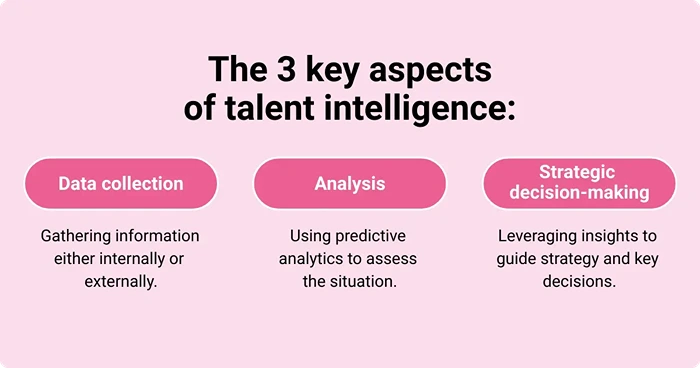
For technical teams, talent intelligence means creating a unified data layer that combines internal people data (HRIS, ATS, performance systems) with external labor market signals. This means building contextual intelligence around:
Core Signal Categories:
- People signals: Skills vectors, seniority progression, mobility likelihood, compensation bands
- Company signals: Headcount trends, hiring velocity, tech stack adoption, funding stage indicators
- Market signals: Location talent hotspots, skills supply/demand ratios, competitive intelligence
The business use cases span strategic hiring (identifying skill gaps), workforce planning (predicting attrition risks), skills adjacency analysis (internal mobility recommendations), and DEI analytics (representation tracking across levels and functions).
Benefits of data-driven decision making in this context deliver measurable outcomes:
- Faster req prioritization: Data-driven hiring managers reduce time-to-shortlist by 40%
- Better pipeline quality: Improved candidate-role matching increases offer acceptance rates
- Lower sourcing spend: Predictive analytics reduce dependency on external recruiting agencies
- Enhanced internal mobility: Skills-based recommendations improve retention and career development
The market reality involves a complex ecosystem spanning data collectors (web crawlers, API aggregators), enrichers (skills extraction, company mapping), and full talent intelligence platforms. Expect licensing overlaps, opaque data provenance, and the need for careful vendor due diligence.
Sourcing Data: Build vs. Buy vs. Partner
The fundamental question facing every talent intelligence initiative is how to acquire data at the scale and quality your business demands. There are three primary acquisition modes, each with distinct trade-offs that impact everything from time-to-market to long-term operational costs.
- Direct crawling and scraping remains the most flexible approach, giving you access to public web sources like LinkedIn profiles, company career pages, job boards, and industry news sites. This path offers maximum control over data collection timing and scope, plus unique access to sources that competitors might miss. However, it comes with significant challenges around anti-bot measures, IP management complexity, and navigating legal gray areas around terms of service compliance.
- Official APIs and partnership agreements provide a middle ground, offering structured data through ATS/HRIS integrations, professional network partnerships, and government labor statistics APIs. The advantages are compelling: pre-structured data formats, clear licensing terms, and often higher refresh rates than what you could achieve through scraping. The trade-offs include rate limiting constraints, vendor dependency risks, and limited customization options that may not align perfectly with your use cases.
- Licensed datasets from specialized providers offer the fastest path to comprehensive coverage through company graphs, talent profiles, and market intelligence feeds. These solutions excel in speed-to-value and compliance clarity, with vendors handling the complex legal and technical challenges of data acquisition. The primary concerns center on vendor lock-in, data standardization gaps between providers, and ongoing costs that can scale unpredictably with usage.
When evaluating these approaches, the decision often comes down to where you’re willing to accept complexity versus where you need maximum control. The decision framework becomes clearer when you consider your specific context. Choose direct crawling when you’re targeting unique data sources unavailable through partnerships, operating in atypical geographic markets, or need cost leverage at massive scale.
Partner APIs make sense when speed to value matters more than customization, when you’re facing difficult anti-bot surfaces, or when contractual clarity is essential for compliance requirements. Licensed datasets work best when immediate coverage trumps long-term cost considerations or when internal technical capacity is limited.
Source: workhuman.com
Compliance & Risk: Crawl Polite, Contract Smart
Understanding the legal landscape for data acquisition isn’t just about avoiding lawsuits—it’s about building sustainable operations that can scale without constant legal fire-drills. The regulatory environment has evolved significantly, creating both clearer guidelines and new complexities that technical teams need to navigate.
In the United States, the Ninth Circuit’s ruling in hiQ Labs v. LinkedIn established that scraping publicly available data doesn’t automatically violate the Computer Fraud and Abuse Act. This was a watershed moment that provided important clarity for the industry. However, this ruling doesn’t provide carte blanche for unlimited data collection. Courts continue to evaluate cases based on intent, scale, and business impact, with user agreement breaches, copyright violations, and state-level regulations still carrying significant risks.
The European and global context introduces additional complexity through GDPR and CCPA requirements. These regulations impose strict obligations around personal data handling: purpose limitation means you can only use data for explicitly stated purposes, transparency requires clear disclosure of collection and use practices, minimization demands collecting only necessary data, and data subject rights create ongoing operational obligations for access, correction, and deletion requests.
Operational excellence in compliance starts with technical controls that respect the ecosystem you’re operating in. This means honoring robots.txt preferences, maintaining reasonable request rates (typically 1-5 requests per second), using descriptive user-agent identifiers that allow site owners to contact you, and distributing requests across IP addresses and timing patterns to avoid overwhelming target servers.
Beyond technical measures, governance controls create the foundation for sustainable operations. Maintaining do-not-crawl lists honors explicit opt-out requests, implementing data retention policies ensures automatic expiration based on data type and jurisdiction, comprehensive audit logging provides complete request/response tracking for compliance verification, and streamlined DSR workflows enable efficient data subject request processing.
Vendor relationships require particular attention to chain of custody documentation, subprocessor and data residency mapping, indemnification clauses for compliance violations, and regular compliance audits and certifications that ensure your partners maintain the standards your business requires.
See how JobsPikr can power your talent intelligence.
Schedule a quick demo and we’ll show you how structured job data makes workforce analytics, planning, and sourcing easier, without the hassle.
Reference Architecture: Crawling to Clean Signals
Flowchart
A[Sources: Public Web, Partner APIs, Licensed Feeds] –> B[Crawlers/Connectors]
B –> C[Ingestion: Queue + Schema Registry]
C –> D[Bronze: Raw, Immutable]
D –> E[Validation: Contracts + PII Classifier]
E –> F[Transform: Parse/Normalize/Deduplicate]
F –> G[Entity Resolution: Person/Company/Job]
G –> H[Skills Extraction & Taxonomy Mapping]
H –> I[Silver: Clean Records + Lineage]
I –> J[Gold: Signals for Coverage/Freshness/Compliance]
J –> K[Serving: Graph DB, Feature Store, Warehouse]
K –> L[APIs & Apps: Search, Insights, TI Dashboards]
E –> M[Observability: SLIs/SLOs, Alerts]
E –> N[Policy Engine: Consent/Retention/Residency]
Core Components
Acquisition Layer:
- Multi-protocol crawlers with proxy rotation and anti-bot resilience
- Partner API connectors with rate limiting and credential management
- Batch ingestion for licensed dataset dumps with validation checkpoints
Ingestion & Staging:
- Message bus (Kafka/Pulsar) for high-throughput, ordered processing
- Schema registry enforcing data contracts from source registration
- Bronze zone: immutable raw data with complete audit trails
Processing Pipeline:
- Parsing engines robust to HTML layout changes and format variations
- Entity resolution using graph-aided matching for person/company/job disambiguation
- Skills extraction via NER + embeddings with taxonomy normalization
- Change data capture for incremental processing and “as-of” historical views
Governance Layer:
- Data contracts defining schema, semantics, quality thresholds, and SLAs
- Column-level lineage tracking from source through all transformations
- Policy engine enforcing retention, consent, and data residency requirements
- PII classification and automated masking for sensitive attributes
Serving & Access:
- Feature stores for real-time model serving and analytics
- Graph databases optimizing for relationship queries (skills, companies, people)
- Data warehouse marts for BI and reporting with pre-aggregated insights
- API gateway with SLA monitoring and access controls
Pipeline Patterns That Reduce Maintenance
The difference between a data pipeline that becomes a maintenance burden and one that scales gracefully lies in the architectural patterns you choose from day one. These proven approaches have emerged from teams who’ve learned the hard way that shortcuts in pipeline design compound into operational nightmares.
Contract-first ingestion treats data schemas like API specifications—comprehensive, versioned, and enforced. Before you extract a single record, define the complete contract including schema structure, quality thresholds, update cadence, and SLA commitments. This might feel like overhead initially, but it prevents the data quality emergencies that derail so many projects. When schema changes happen (and they always do), treating them as code review requirements with proper impact analysis saves countless hours of debugging downstream pipeline failures.
The Bronze/Silver/Gold medallion architecture has become the standard approach because it solves the reproducibility problem that plagues most data operations. Bronze stores immutable raw data with complete provenance—this becomes your source of truth that never changes. Silver contains parsed, normalized, and deduplicated records with entity resolution applied—this is where most of your business logic lives. Gold provides business-ready signals with taxonomy mapping and complete lineage—this is what your applications and analysts actually consume. This separation allows you to iterate on business logic without losing the ability to reprocess historical data when requirements change.
Entity resolution deserves particular attention because it’s where most talent intelligence pipelines break down under scale. The key is combining deterministic rules for clear matches (exact email domains for company resolution, full name plus company plus location for person deduplication) with ML features for edge cases (fuzzy string similarity, geographic proximity, semantic embeddings). The mistake most teams make is trying to solve everything with ML—deterministic rules handle 80% of cases efficiently, leaving your models to focus on the genuinely ambiguous scenarios.
Skills normalization becomes critical as soon as you have multiple data sources claiming to describe the same capabilities with different terminology. Map extracted skills to stable taxonomies like O*NET or ESCO rather than trying to maintain your own skill vocabulary. The extraction pipeline should handle synonym collapse (“JS” becomes “JavaScript”), semantic matching to taxonomy concepts, and assignment of stable identifiers that survive changes in your extraction logic.
Governance implemented as code means policy enforcement travels with your pipeline deployments rather than being maintained as external configuration that can drift out of sync. Automatic policy evaluation at read/write boundaries, jurisdiction-aware masking rules, and purpose-based access controls become part of your standard pipeline infrastructure rather than bolt-on compliance theater.

Source: nubela.co
Governance You Can Operate
Data Contracts as Code
Treat data contracts like API specifications—versioned, reviewed, and enforced:
Contract Elements:
- Schema definition with required/optional fields
- Semantic documentation (what each field means)
- Quality thresholds (completeness, accuracy, timeliness)
- Ownership and escalation contacts
- SLA commitments (freshness, availability, support response)
Change Management:
- All contract changes require code review
- Breaking changes trigger consumer impact analysis
- Backward compatibility periods for deprecations
- Automated testing validates contract compliance
Lineage & Cataloging
Surface column-level lineage from crawler through entity resolution to final signals:
Automatic Tagging:
- PII classification on ingestion
- Data residency requirements by source geography
- Business criticality based on downstream usage
- Retention policies by data type and jurisdiction
Access Control Patterns
Role-Based Access:
- Data engineers: full pipeline access for operations
- Data scientists: analysis access with automatic PII masking
- Product managers: aggregated metrics and dashboards only
- Business users: self-service analytics with governed datasets
Purpose-Based Access:
- Hiring use cases: candidate profiles with skills and experience
- Workforce planning: aggregated demographics and skills trends
- DEI analysis: representation data with individual anonymization
- Research: anonymized datasets with statistical privacy guarantees
SLIs/SLOs/SLAs for Talent Data
Service Level Indicators (SLIs)
Coverage Metrics:
- Entity Coverage: % of target companies/profiles/jobs present in system
- Geographic Coverage: % of key markets with representative data
- Skills Coverage: % of job postings with extracted/normalized skills
Freshness Metrics:
- Source Freshness: 95th percentile age of records by source tier
- Pipeline Latency: End-to-end time from source change to signal publish
- Update Frequency: % of entities updated within expected cadence
Quality Metrics:
- Parsing Accuracy: Manual validation pass rate on stratified samples
- Entity Resolution: Join consistency across person/company linkages
- Skills Accuracy: Taxonomy mapping precision on human-labeled test sets
Operating the Pipeline: Observability & Cost Control
Production talent intelligence systems require operational excellence that goes beyond basic monitoring—you need observability frameworks that provide insight into data quality, business impact, and cost efficiency simultaneously.
Freshness monitoring needs to account for the reality that different data sources have vastly different business criticality and natural update cadences. Tier 1 sources like major job boards might require 48-hour freshness with critical alerting, while Tier 2 sources like company blog posts can tolerate weekly updates with warning-level notifications. The key insight is that your monitoring should reflect business value rather than treating all data sources equally.
Data quality alerts go beyond simple volume checking to include schema drift detection that validates against your data contracts, volume anomaly detection using seasonal baselines that account for natural fluctuations (hiring typically spikes in January and September), and null value spike identification that catches parsing failures before they impact downstream applications. Duplicate rate monitoring across entity resolution stages helps identify when your matching logic needs tuning.
Cost management becomes essential as talent intelligence systems scale because the expense structure includes both obvious costs (compute, storage) and hidden costs (proxy services, API rate limits, manual data quality work). Crawling cost controls should include monthly proxy budget management with automatic scaling limits, source prioritization based on business value scoring, delta crawling that processes only changed content, and geographic request routing through cost-optimal proxy locations.
Infrastructure optimization opportunities include spot instance usage for non-critical processing (70-80% cost reduction), automatic storage tiering that archives bronze data after retention periods, dynamic compute right-sizing based on processing queue depth, and cache optimization that reduces redundant API calls and processing.
On-call operations require a different approach than typical software systems because data quality issues often present as gradual degradation rather than binary failures. Alert design should follow principles of actionability (every alert includes specific runbook references), clear scoping (ownership and escalation paths), contextualization (business impact and affected user segments), and noise management (error budgets that prevent alert fatigue).
The incident response playbook needs to account for the unique characteristics of data pipeline failures: immediate response focuses on pipeline health dashboards and affected stage identification, investigation involves error log review and data contract validation, and resolution includes fix validation in staging environments plus backfill decisions based on SLA requirements. Post-incident reviews should update contracts and SLOs to prevent similar issues rather than just fixing the immediate problem.
Example Walkthrough: Adding a New Data Source in 48 Hours
Day 0: Contract Definition & Governance Review
Governance Checklist:
- Legal review of terms of service and robots.txt
- PII classification and data residency requirements
- Retention policy aligned with business purpose
- Data lineage registration in catalog
Day 1: Implementation & Bronze Integration
Connector Development:
- Crawler Configuration: Respectful rate limiting (2 req/sec)
- Anti-Bot Resilience: Residential proxy rotation, user-agent diversity
- Error Handling: Exponential backoff, circuit breaker patterns
- Schema Validation: Contract compliance checks on ingestion
Day 2: Processing Pipeline & Signal Publishing
Parsing & Normalization:
- HTML extraction with job-board-specific selectors
- Salary parsing with currency normalization
- Location geocoding and standardization
- Posted date parsing with timezone handling
Entity Resolution:
- Company name matching against existing entity graph
- Job title normalization using role taxonomy
- Duplicate detection across existing job sources
- Skills extraction from job description text
Exit Criteria Validation:
- Coverage sample ≥80% target within 24 hours
- Freshness SLO achieved in shadow mode (6-hour updates)
- Data quality validation >90% pass rate
- Compliance checklist complete (PII handling, retention, consent)
- Monitoring dashboards updated with source-specific metrics
- SLA catalog registration with committed service levels
Decision Examples
When to Build:
- Unique data sources unavailable through partnerships
- Proprietary data processing requirements
- Scale economics favor internal development (>10M records/month)
- Long-term strategic differentiation depends on data advantage
When to Partner:
- Established API relationships with quality SLAs
- Compliance complexity outweighs development benefits
- Speed to market critical for competitive positioning
- Technical expertise available for integration but not crawler development
When to Buy:
- Time-to-value is the primary constraint
- Data requirements align with vendor strengths
- Internal technical capacity limited
- Total cost of ownership favors managed service
Current market providers specialize across the value chain: data collectors focus on broad coverage and refresh rates, enrichment providers add skills extraction and company matching, while full talent intelligence platforms provide end-to-end solutions with built-in analytics.
The Business Case: Benefits of Data-Driven Decision Making
Quantified Hiring Improvements
Faster Time-to-Shortlist: Data-driven hiring reduces candidate screening time by 35-40% through:
- Predictive scoring models ranking candidates by fit likelihood
- Automated skill matching against role requirements
- Historical performance patterns informing sourcing strategy
- Market intelligence guiding compensation and timing decisions
Improved Quality-of-Hire: Organizations with mature talent intelligence report 25% improvement in hire quality metrics:
- 90-day retention: Better role-candidate matching increases early retention
- Performance ratings: Skills-based selection correlates with job performance
- Time-to-productivity: Accurate skills assessment reduces onboarding time
- Internal referrals: Data insights improve employee referral program targeting
Reduced External Recruiting Spend:
- Agency dependency: Internal talent intelligence reduces external recruiting spend by 30-45%
- Sourcing efficiency: Higher candidate response rates through personalized outreach
- Pipeline optimization: Conversion rate improvements across hiring funnel stages
- Market timing: Competitive intelligence improves offer success rates
Workforce Planning ROI
Credible Scenario Modeling:
- Skills gap analysis with 18-month forward visibility
- Attrition risk prediction enabling proactive retention
- Internal mobility recommendations reducing backfill costs
- Compensation benchmarking ensuring competitive positioning
Strategic Workforce Decisions:
- Geographic expansion planning based on talent availability
- Skills transformation roadmaps aligned with market trends
- Diversity & inclusion goal tracking with actionable insights
- Organizational design optimization using role adjacency analysis
Product Management Metrics
Conversion Rate Improvements:
- API usage patterns show 3x higher adoption for data-driven features
- User engagement increases 60% with personalized talent recommendations
- Platform retention improves when insights drive successful hiring outcomes
Engineering SLO Achievement:
- 99.5% API uptime supporting real-time recruiting workflows
- <200ms p95 response times enabling responsive user experiences
- Data freshness SLOs ensuring competitive intelligence accuracy
- Quality metrics maintaining user trust in platform recommendations
The benefits of data-driven decision making compound over time as organizations develop competencies in talent analytics, creating sustainable competitive advantages in strategic talent acquisition and workforce planning.
Raw Data to Strategic Talent Intelligence
The journey from crawling raw data to delivering clean, governed talent intelligence signals is a strategic differentiator. By building pipelines around coverage, freshness, and compliance, organizations can transform fragmented data into actionable insights that directly impact hiring velocity, workforce planning, and long-term competitiveness.
For business as a whole, it means realizing the true benefits of data-driven decision making, faster time-to-hire, higher quality of hire, reduced external spend, and credible scenario modeling for the future of work. Organizations that master this discipline position themselves to outpace competitors not only in recruiting but also in strategic workforce transformation. Now is the time to evaluate your data sourcing strategy.
Whether you’re building, buying, or partnering, the frameworks and patterns outlined here give you the blueprint to scale with confidence. The teams that succeed will be the ones who treat data pipelines not as an afterthought, but as the backbone of smarter, faster talent decisions.
See how JobsPikr can power your talent intelligence.
Schedule a quick demo and we’ll show you how structured job data makes workforce analytics, planning, and sourcing easier, without the hassle.
FAQs
1. What is the meaning of data sourcing?
Data sourcing means finding and collecting information from different places so it can be used for analysis. In hiring and workforce planning, this could be gathering job postings, resumes, or employee records and turning them into useful insights.
2. What do you mean by data source?
A data source is simply where the data comes from. It could be a website, an API, a government report, or even your company’s HR system. Each source adds a piece of the bigger picture.
3. What are the four types of data sources?
The main types of data sources are:
Information you collect directly (like job postings or surveys).
Data from experiments or tests.
Transactional data, like HR or payroll records.
Data you buy or get from third-party providers.
4. What are the two ways of sourcing for data?
You can either:
Collect it yourself from the original source (like crawling websites or using your own systems).
Use data from others, such as buying datasets or connecting to APIs.
5. How can we source data?
Data can be sourced by crawling websites, connecting to APIs, buying licensed datasets, or pulling from your internal systems. Which method you choose depends on how quickly you need the data and how accurate or compliant it needs to be.