
- **TL;DR**
- What is Demand Analysis?
- Stay Ahead of Market Demand
- What Is Gap Analysis?
- Demand Analysis vs. Gap Analysis: Core Differences You Should Know
- Why Demand Analysis Alone Is Not Enough
- Why Gap Analysis Without Demand Context Falls Short
- How to Leverage Both Demand & Gap Analysis for Better Decision-Making?
- Real-World Applications of Demand and Gap Analysis in Business
- Stay Ahead of Market Demand
- Step-by-Step Guide to Conducting Demand and Gap Analysis
- Demand Analysis in the Age of Real-Time Labor Market Data
- Common Mistakes Businesses Make (and How to Avoid Them)
- Real-World Case Study: Demand and Gap Analysis in Global E-Learning
- Making Demand and Gap Analysis Work Together
- Stay Ahead of Market Demand
- FAQs
**TL;DR**
Demand analysis helps businesses understand what the market, customers, or workforce will need next. Gap analysis helps them understand where they fall short today.
In 2025, high-performing organizations don’t treat these as separate exercises. They combine demand analysis and gap analysis to drive smarter workforce planning, product strategy, market expansion, and investment decisions. This guide explains the differences, shows how to use both together, and highlights how modern data platforms like JobsPikr enable more accurate, real-time analysis.
In the modern-day context, understanding the business dynamics becomes crucial if a company is keen on remaining competitive, and such a task requires setting aside the right resources. Two of the significant methods that most of the firms tend to use are the heart of gap and the heart of demand analysis.
While both are critical for business growth, they have different objectives and bring different benefits. The purpose of this article is to investigate the differences and uses of demand analysis and gap analysis and assist business strategy managers, HR and workforce planners, top management, and investors with the knowledge required to make practical business decisions.
What is Demand Analysis?
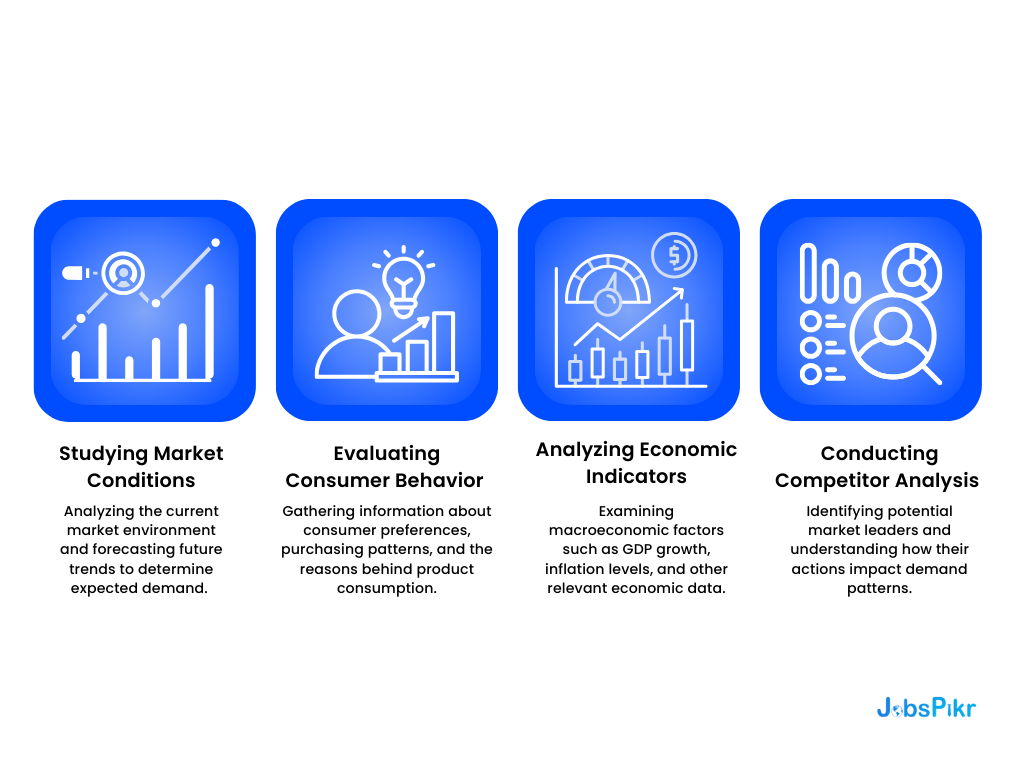
Demand analysis is determining and assessing the desire for the particular goods, services, or workforce in the target market or industry. It includes studying market conditions, consumer tastes, and other relevant factors that determine demand for such goods. The insights gathered from demand analysis assist firms in meeting the most likely demand for goods in the market.
At its core, demand analysis answers one critical question: What will customers, markets, or employers need, now and in the near future?
In 2025, demand analysis extends well beyond traditional sales forecasting. It now includes workforce demand, skill demand, regional hiring demand, and even emerging job role demand.
Key Elements of Demand Analysis
1. Market and Industry Trends
Demand analysis starts by identifying broader shifts—technological adoption, regulatory changes, consumer expectations, or hiring momentum across industries.
For example:
- Growth in AI-related roles across enterprise hiring
- Increased demand for green energy skills
- Expansion of remote-first and hybrid work models
These trends help organizations anticipate where demand is heading, not just where it currently sits.
2. Customer and User Behavior
Modern demand analysis relies on behavior data—what people search for, buy, apply for, or engage with. In workforce contexts, this includes:
- Job posting volumes
- Role frequency by geography
- Skill requirements appearing in hiring data
3. Economic and Macro Indicators
Economic signals like interest rates, inflation, funding cycles, and regional growth influence demand across products and talent markets. Demand analysis connects these macro signals to actionable forecasts.
4. Competitive and Market Signals
Understanding what competitors are launching, hiring for, or expanding into provides early indicators of where demand will rise next.
Stay Ahead of Market Demand
Use real-time hiring and labor market intelligence to identify opportunity gaps early and execute with clarity.
What Is Gap Analysis?
Gap analysis focuses on identifying the difference between current performance and desired outcomes. It answers a different, but equally important, question: Where are we falling short today, and what needs to change?
Unlike demand analysis, gap analysis is primarily internal. It evaluates systems, processes, skills, resources, and results against predefined goals.
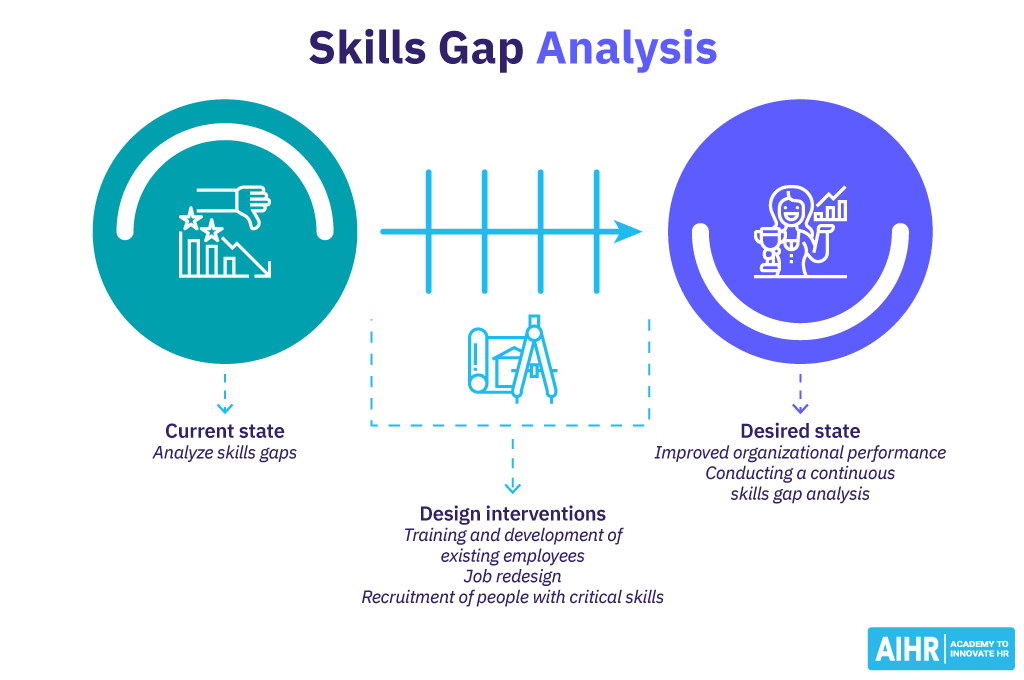
Image Source: AIHR
Core Components of Gap Analysis
1. Current State Assessment
This involves mapping existing capabilities:
- Current workforce skills
- Operational efficiency
- Product coverage
- Technology maturity
Without a clear view of the current state, improvement efforts remain fragmented.
2. Target State Definition
Organizations must define what success looks like:
- Revenue goals
- Market expansion targets
- Workforce readiness benchmarks
- Customer experience standards
The clarity of this step determines the usefulness of the analysis.
3. Performance Measurement
KPIs, benchmarks, and comparative metrics are used to quantify the gap. These can include:
- Time-to-hire
- Cost efficiency
- Market share
- Skill coverage ratios
4. Actionable Recommendations
A good gap analysis doesn’t stop at identifying problems; it prioritizes actions such as hiring, reskilling, process changes, or investment shifts.
Demand Analysis vs. Gap Analysis: Core Differences You Should Know
While demand analysis and gap analysis are complementary, they differ significantly in purpose and approach. Here are the primary distinctions:
| Aspect | Demand Analysis | Gap Analysis |
| Purpose | Understand market needs and demand trends. | Identify gaps between current and desired states. |
| Focus | External market factors and consumer behavior. | Internal performance and resource allocation. |
| Outcome | Align offerings with market demand. | Optimize operations to achieve strategic goals. |
| Tools and Techniques | Market research, surveys, and trend analysis. | SWOT analysis, KPI evaluation, and benchmarking. |
Why Demand Analysis Alone Is Not Enough
Organizations often fall into the trap of relying heavily on demand analysis while neglecting internal readiness.
For example:
- A company identifies rising demand for cloud engineers but doesn’t assess whether its current workforce or hiring pipeline can support that demand.
- A retailer sees strong regional demand signals but ignores supply chain or operational gaps that prevent expansion.
Demand analysis highlights opportunities—but without gap analysis, those opportunities remain unrealized.
Why Gap Analysis Without Demand Context Falls Short
Similarly, gap analysis without demand insights can lead to misaligned investments:
- Upskilling teams in areas that are declining in relevance
- Expanding into markets with limited future growth
- Optimizing processes for products customers no longer want
Without understanding what the market actually needs, internal optimization becomes inefficient.
How to Leverage Both Demand & Gap Analysis for Better Decision-Making?
Gap analysis and demand analysis focused together enables an in-depth understanding as to the market, positioning as well as the operational strengths and weaknesses of the organization. Let’s examine how:
- Strategic Workforce Planning
- Analysis of demand helps in determining what skills and talent will be required within the organization based on the emerging trends in the market that relates to education and workforce.
- Gap analysis helps the organization in identifying the skill gaps and the inefficiencies which are present in the current workforce.
- Combined, all of these insights assist in coming up with solutions regarding recruiting and upskilling the employees.
- Product Development
- Analysis of demand aids the organization in identifying the consumer’s wants and needs that are not being catered to or are being unnecessarily catered to.
- Gap analysis helps the organization in recognizing products and resources that can be used to suffice these wishes and requirements.
- This creates great insight into how products need to be made or modified to meet consumer requirements.
- Operational Optimization
- Analysis of demand assists in predicting the market demand for the products and thereby determining the resources needed to meet that demand.
- Gap analysis determines whether there is waste or misallocation in the resources within the organization.
- All of these analyses together ensure that resources are utilized in the best possible fashion increasing efficiency within the organization with maximum cost efficiency.
Real-World Applications of Demand and Gap Analysis in Business
There are various industries and operations in which the demand and gap analyses can also be applicable in practice. These approaches are able to deliver practical guidance to firms on meeting market requirements, improving workforce deployment, and optimizing business planning. This section delves into hands-on applications that demonstrate the relevance of such analytical methods to be employed jointly.
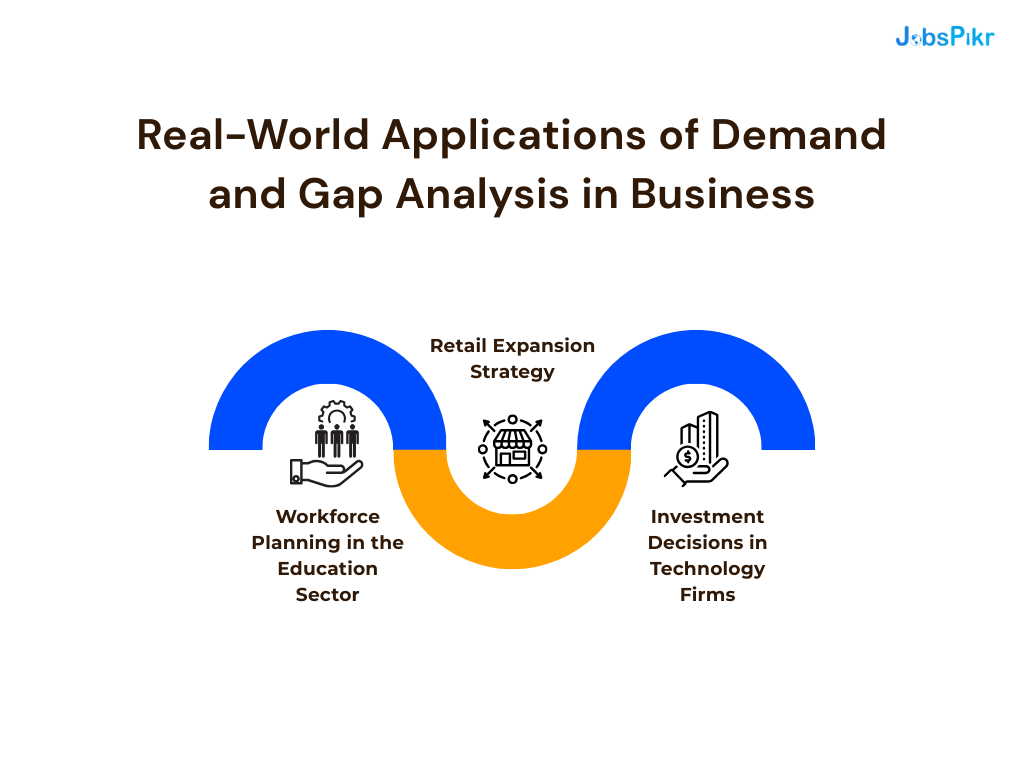
1. Workforce Planning in the Education Sector
Demand and gap analyses can easily assist in forecasting programs for educational institutes as well as labor market needs. For example, the future educational needs can be established by examining the gaps in the present syllabuses against the anticipated requirements of new industries, such as in demand for new technology skills.
2. Retail Expansion Strategy
For retail firms, demand analysis provides the opportunity of gaining insight into the most favorable markets likely to yield higher growth and understanding of consumer preferences. While gap analysis, however, helps in knowing whether the organization is ready for the penetration of the particular market by examining supply chain, inventory and even recruiting efforts.
3. Investment Decisions in Technology Firms
Investors can take advantage of demand analysis to assess the possible market that can be covered by Tools and Techniques for Effective Analysis
Stay Ahead of Market Demand
Use real-time hiring and labor market intelligence to identify opportunity gaps early and execute with clarity.
Step-by-Step Guide to Conducting Demand and Gap Analysis
Conducting demand and gap analysis involves a systematic approach to uncover insights and align business strategies with goals. This section provides a step-by-step guide to help organizations effectively implement these analyses, ensuring they address market needs and operational inefficiencies. By following these steps, businesses can drive growth and make data-driven decisions with confidence.
- Define Objectives: Clearly outline what the analysis aims to achieve, whether it’s understanding market demand or bridging performance gaps.
- Gather Data: Collect relevant data using surveys, interviews, and internal reports.
- Analyze Data: Use analytical tools to derive insights and identify trends or discrepancies.
- Develop Action Plans: Create actionable strategies based on analysis results.
- Monitor Progress: Continuously track performance and refine strategies as needed.
Demand Analysis in the Age of Real-Time Labor Market Data
In 2025, demand analysis has shifted from static reports to continuous, real-time intelligence. Traditional surveys and annual market reports are no longer sufficient for fast-moving talent markets.
Modern demand analysis now relies on:
- Daily job posting volumes
- Skill frequency changes across industries
- Location-specific hiring demand
- Employer expansion signals
Workforce demand can now be tracked almost as dynamically as consumer demand, allowing organizations to react faster to emerging needs.
This shift has made demand analysis more precise, but also more complex—requiring advanced data infrastructure and reliable data sources.
Common Mistakes Businesses Make (and How to Avoid Them)
Even data-driven organizations often fail to unlock the full value of demand analysis and gap analysis—not because the tools are flawed, but because of how they’re applied. Below are the most frequent mistakes businesses make, along with clear guidance on how to avoid them.
1. Treating Demand Analysis as a One-Time Exercise
One of the most common errors is approaching demand analysis as a static, annual task—often conducted during budgeting or strategic planning cycles and then forgotten.
In 2025, market and workforce demand changes far faster than annual reports can capture. Skills that were in high demand six months ago may already be saturating, while new roles emerge unexpectedly due to regulatory shifts, AI adoption, or economic changes.
How to avoid it:
Move from periodic demand analysis to continuous demand monitoring. Updating demand insights regularly—monthly or quarterly—allows teams to spot early signals and adapt before competitors do. Demand analysis should be treated as a living process, not a presentation deck.
2. Running Gap Analysis Without Measurable Benchmarks
Gap analysis often becomes vague when organizations fail to define what they are measuring against. Statements like “we lack enough talent” or “our processes aren’t mature” provide little value without clear benchmarks.
Without measurable targets—such as role coverage ratios, time-to-hire thresholds, productivity metrics, or revenue per employee—gap analysis turns subjective and difficult to action.
How to avoid it:
Define quantifiable targets before assessing gaps. Every identified gap should be tied to a metric, a timeline, and a desired state. Clear benchmarks make prioritization easier and allow leadership to track real progress over time.
3. Ignoring Geographic and Role-Specific Nuances
Another major pitfall is analyzing demand and gaps at too high a level. Aggregated insights—like “software engineers are in high demand”—sound useful but often hide critical differences across locations, seniority levels, and specializations.
For example, demand for backend engineers in one region may be declining while demand for AI engineers in another is accelerating. Treating these as a single trend leads to misaligned hiring and misplaced investments.
How to avoid it:
Break down both demand analysis and gap analysis by geography, role type, skill level, and industry context. Granular insights enable far more accurate workforce planning and prevent one-size-fits-all decisions that rarely work in practice.
4. Overreacting to Short-Term Spikes Without Context
Short-term demand surges—whether in hiring, sales, or product interest—can be misleading when viewed in isolation. Many organizations rush to scale teams or expand offerings based on temporary demand spikes driven by seasonal cycles, funding announcements, or short-lived trends.
This often results in overhiring, underutilized resources, or costly restructuring when demand normalizes.
How to avoid it:
Always evaluate demand patterns in context. Compare short-term spikes against long-term trends, historical seasonality, and broader market indicators. Pair demand analysis with gap analysis to test whether scaling decisions are sustainable—not just reactive.
5. Failing to Align Insights With Execution Ownership
Perhaps the most damaging mistake is allowing insights to remain disconnected from execution. Demand and gap analyses are frequently shared across teams, but responsibility for acting on them remains unclear.
When insights don’t have a clear owner—whether in HR, strategy, operations, or leadership—they rarely translate into change.
How to avoid it:
Assign clear ownership to every major insight. Each identified demand opportunity or performance gap should have an accountable team, defined actions, deadlines, and success metrics. Insight without ownership leads to inaction; ownership turns insight into execution.
Why Avoiding These Mistakes Matters
Demand analysis and gap analysis are powerful—but only when applied with discipline and intent. Avoiding these common mistakes ensures that analysis directly informs strategy, hiring, investment, and operational decisions.
When done right, organizations stop reacting to change and start anticipating it. That shift—from insight to impact—is what separates high-growth businesses from the rest in 2025.
Real-World Case Study: Demand and Gap Analysis in Global E-Learning
Challenge: The platform experienced declining user engagement despite a growing market for online education.
Approach:
- Conducted demand analysis to identify trending topics and preferred content formats.
- Performed gap analysis to uncover deficiencies in content offerings and platform usability.
Outcome:
- Launched new courses tailored to market demand, resulting in a 40% increase in enrollments.
- Enhanced platform features, reducing user drop-off rates by 25%.
Making Demand and Gap Analysis Work Together
Demand analysis and gap analysis are indispensable tools for driving business growth and optimizing resource allocation. While demand analysis focuses on understanding external market trends, gap analysis evaluates internal performance to identify areas of improvement. By integrating these methodologies, organizations can make informed decisions, enhance workforce planning, and achieve strategic objectives. For business strategy managers, HR and workforce planners, corporate executives, and investors, leveraging demand and gap analyses is essential for maintaining a competitive edge.
Sign-up on JobsPikr and take the first step towards smarter decision-making by incorporating these powerful tools into your strategic processes.
Stay Ahead of Market Demand
Use real-time hiring and labor market intelligence to identify opportunity gaps early and execute with clarity.
FAQs
What is the main difference between demand analysis and gap analysis?
Demand analysis and gap analysis differ primarily in orientation and purpose. Demand analysis looks outward and forward, helping organizations understand what the market, customers, or workforce will need in the future. It focuses on trends such as skill demand, role creation, product interest, or regional market growth.
Gap analysis, in contrast, looks inward. It evaluates how prepared the organization currently is to meet those future needs. By comparing existing capabilities, resources, and performance against defined goals, gap analysis highlights what is missing or underdeveloped.
Used together, demand analysis identifies where to go, while gap analysis determines what stands in the way of getting there. Neither is effective on its own in long-term strategic planning.
When should an organization conduct a gap analysis?
Gap analysis should be conducted after demand trends are clearly understood, not in isolation. Running gap analysis without a demand context often leads to optimizing areas that may no longer be strategically relevant.
In practice, organizations should perform gap analysis:
– During strategic planning cycles
– Before entering new markets or launching new products
– When scaling teams or restructuring operations
– After identifying major shifts in market or workforce demand
Because internal conditions and external demands both evolve, gap analysis should also be revisited periodically, rather than treated as a one-time diagnostic.
How often should demand analysis be updated in 2025?
In fast-moving markets, demand analysis should be updated continuously or at least quarterly. Annual updates are no longer sufficient, especially in industries affected by technology shifts, regulatory change, or volatile labor markets.
Regular updates allow organizations to:
– Detect emerging trends early
– Validate whether previous assumptions remain accurate
– Adjust hiring, pricing, or expansion plans in real time
The frequency of updates should increase in highly competitive or innovation-driven sectors, where demand patterns can shift rapidly.
What types of data improve the accuracy of demand analysis?
Accurate demand analysis depends on granular, real-time, and multi-source data. In 2025, this typically includes:
– Job posting and hiring trend data
– Role and skill frequency analysis
– Geographic demand signals
– Industry-specific growth indicators
– Competitive market activity
Relying solely on surveys or historical reports often produces lagging insights. Combining real-time market data with internal performance metrics leads to more reliable forecasts and better strategic alignment.
Can automation and data platforms improve gap analysis outcomes?
Yes. Automation significantly improves both the speed and consistency of gap analysis. Modern data platforms reduce manual effort, eliminate fragmented reporting, and offer standardized metrics across teams.
Automated dashboards make it easier to track evolving gaps over time, measure progress against benchmarks, and connect insights directly to operational decisions. This helps organizations move from reactive assessments to proactive gap management—especially at scale.
How do investors and leadership teams use demand and gap analysis together?
Leadership teams use demand analysis to validate growth opportunities and future relevance, while gap analysis helps assess execution readiness. Together, these analyses answer two critical questions: Is the opportunity real? and Can the organization deliver on it?
Investors apply the same logic when evaluating companies. Strong demand signals without execution capability increase risk, while strong execution with weak demand limits upside. Organizations that can clearly articulate both demand insights and gap-closure plans are seen as more resilient and investable.