- How Predictive Hiring Changes Workforce Planning
- What Predictive Hiring Actually Means
- The Planning Problem: Why Reactive Hiring Keeps Failing
- Types of Hiring Models: Reactive, AI-Driven, and Predictive Hiring Compared
- Shift from Reactive Hiring to Predictive Planning
- What Predictive Hiring Really Means (Without the AI Hype)
- The Data Behind Predictive Hiring Models: The Signals You Actually Need
- Make Workforce Planning Less Reactive
- How Predictive Hiring Spots Role Emergence and Decline (Before It Becomes Obvious)
- Building a Predictive Hiring Framework: From Signals to Decisions
- Make Workforce Planning Less Reactive
- Why Most Predictive Hiring Efforts Fail: The Data Infrastructure Gap
- Where JobsPikr Fits in a Predictive Hiring Stack
- Make Workforce Planning Less Reactive
- What Predictive Hiring Looks Like Inside a Real Planning Cycle
- Planning for Roles That Don’t Fully Exist Yet
- Make Workforce Planning Less Reactive
- FAQs
How Predictive Hiring Changes Workforce Planning
If you plan to hire based only on open roles and last year’s headcount, you are already behind.
The market does not wait for your budget cycle. Skills shift quietly. Titles stretch. New role variations show up in competitor postings months before they show up in yours. By the time you approve a new requisition, demand may have already changed.
Predictive hiring is not about fancy dashboards. It is about watching the market closely enough to see what is forming early. Instead of relying only on internal HR data, predictive hiring models use job data analytics to track role growth, skill changes, and hiring velocity across industries. That allows teams to forecast demand before it becomes urgent.
Many organizations say they are using AI in hiring. Most AI hiring models focus on screening resumes faster. That improves speed. It does not improve planning. Predictive hiring shifts the focus upstream, toward role forecasting and long-term workforce design.
The difference is simple. Reactive hiring fills gaps. Predictive hiring reduces the number of gaps you create in the first place.
What Predictive Hiring Actually Means
Predictive hiring is not a new tool. It is a shift in timing.
Most hiring decisions are reactive. A team grows. A role opens. Hiring becomes difficult. Compensation feels off. Skills seem misaligned. Then the organization responds.
Predictive hiring tries to pull that response earlier.
It looks at what is happening in the broader labor market before a requisition becomes urgent. If certain roles are steadily increasing across competitors, if specific skills are quietly becoming standard, or if hiring activity is picking up in new locations, those are not isolated events. They are signals. Predictive hiring pays attention to them.
The goal is not to predict exact headcount numbers two years out. It is to reduce friction later by noticing change sooner.
When done properly, predictive hiring influences how roles are defined, how skills are prioritized, and how workforce plans are structured. It helps teams avoid opening roles based on outdated assumptions. It helps them decide whether to build capability internally or compete externally. It gives context before the pressure builds.
Reactive hiring fills vacancies. Predictive hiring reduces the number of surprises that create them.
The Planning Problem: Why Reactive Hiring Keeps Failing
Walk into most workforce planning meetings, and you will hear the same language.
- “How many roles are open?”
- “What is our attrition rate?”
- “What is the approved headcount?”
All of those are internal numbers. And they matter. But they are lagging signals.
By the time a role shows up as “hard to hire,” the market has already shifted. Demand may have spiked months earlier. Competitors may have redefined the skill mix. Compensation expectations may have moved quietly in certain locations. Internal dashboards do not capture that movement early enough.
The result is predictable. Teams approve roles based on last year’s structure. Six months later, hiring managers complain that the profiles coming in do not match what the business now needs. Recruiters struggle to find candidates with new skill combinations that were never part of the original job design. Finance sees rising hiring costs and assumes it is a sourcing problem. It is often a planning problem.
The scale of change is not small. The World Economic Forum’s Future of Jobs Report 2025 notes that 44% of workers’ core skills are expected to change within the next five years. At the same time, nearly 60% of employers expect to transform their business due to AI and digital adoption. That means role definitions are not drifting slowly. They are being reshaped by technology, automation, and new operating models.
When skill expectations shift that quickly, static headcount planning becomes fragile.
The challenge becomes even sharper in fast-moving sectors. McKinsey’s recent research on generative AI adoption shows that organizations are rapidly redesigning roles around automation and augmentation, particularly in tech, operations, and knowledge work functions. When demand accelerates for certain skill clusters, companies that react late end up paying more or settling for compromises.
Reactive hiring models fail for three structural reasons.
Hiring Is Triggered by Vacancies, Not Market Signals
In most organizations, action starts when something breaks. A resignation lands. A new project gets approved. A revenue target forces expansion. Only then does a requisition open.
This approach makes hiring reactive by design. The system responds to visible gaps instead of anticipating where pressure is building. By the time a role is approved, competitors may already be hiring for the evolved version of that same position.
Internal Data Dominates the Planning Conversation
Workforce plans often lean heavily on internal metrics. Promotion rates, past hiring velocity, attrition patterns, and team ratios are important. They show how your organization behaves.
What they do not show is how the market is shifting outside your walls.
Internal data explains history. It rarely signals emergence. It does not reveal new role combinations forming in adjacent industries. It does not show whether competitors are accelerating hiring for a skill cluster you have barely noticed yet.
Without external job data analytics, planning becomes inward-looking.
Roles Are Treated as Stable When They Are Not
Traditional workforce planning assumes job families are fixed categories. A data analyst is a data analyst. A marketing manager is a marketing manager.
Roles stretch and split constantly. A data analyst gradually absorbs automation and machine learning skills. A marketing manager suddenly owns experimentation frameworks and growth analytics. A cybersecurity function fractures into cloud security, application security, and identity governance.
If role evolution is not tracked externally, organizations end up hiring for outdated versions of jobs. And by the time that the mismatch becomes visible, it is expensive to correct.
When these changes are not tracked externally, organizations end up hiring for outdated versions of roles.
This is where predictive hiring starts to matter. Not because AI is fashionable, but because the planning timeline has to move upstream. If skill requirements are shifting before requisitions are opened, your workforce intelligence needs to shift as well.
The real question is no longer “How many people do we need?”
It is “What shape will our roles take next, and when will that shift happen?”
That is a different planning problem. And it requires a different kind of signal.
Types of Hiring Models: Reactive, AI-Driven, and Predictive Hiring Compared
When people say they want “predictive hiring,” they usually mean one of four things. And if you do not separate them, you end up fixing the wrong problem.
Most hiring models are not bad. They are just built for different conditions. The trouble is the labor market stopped behaving like a stable environment, but hiring operations still run as if it does.
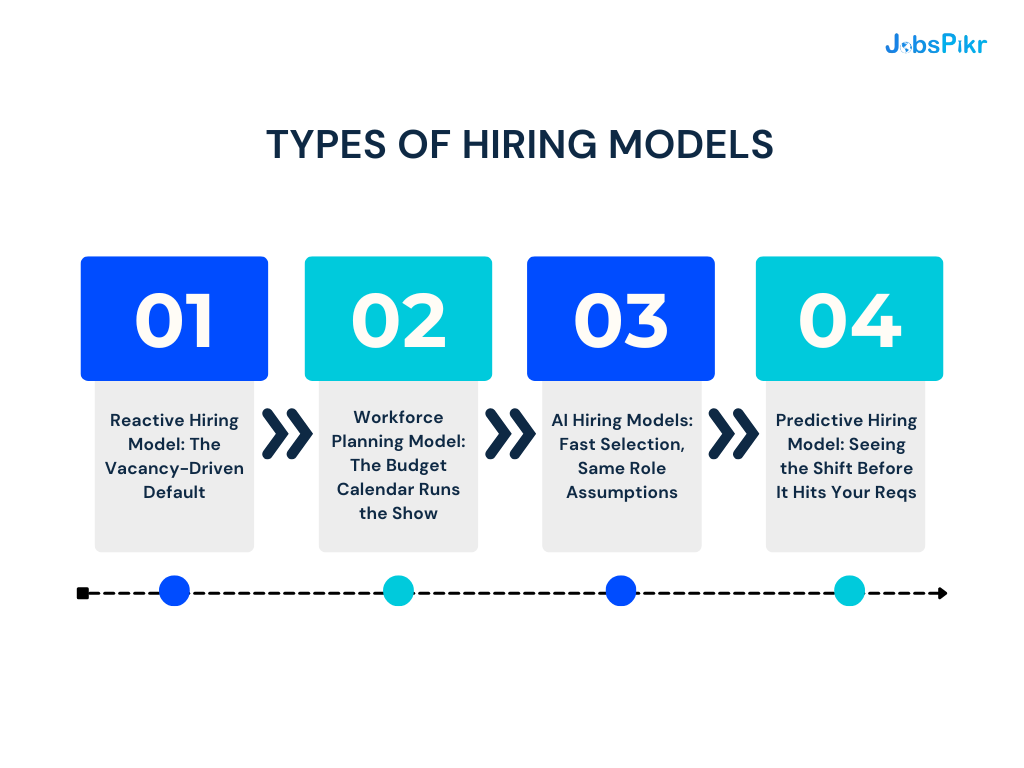
Reactive Hiring Model: The Vacancy-Driven Default
This is the model almost everyone starts with.
Someone leaves, the team feels the gap, a requisition gets opened. If you are lucky, you fill it quickly. If you are not, it sits open and turns into a “hard-to-hire” role.
Reactive hiring is not dumb. It is just late by design. You only respond after the pain shows up.
In a steady market, that is manageable. In a market where skills and titles keep shifting, reactive hiring turns into a loop of catch-up.
Workforce Planning Model: The Budget Calendar Runs the Show
This is what organizations call “strategic hiring.” Headcount is planned. Budgets are approved. Targets are set by quarter.
It sounds better than reactive hiring, and in many ways it is. The problem is what it uses as input.
Most planning models are still inward-looking. They use last year’s hiring patterns, internal capacity assumptions, and what the business thinks it will ship. That is useful, but it is incomplete.
If your competitors start hiring aggressively for a new role variant, or if a skill suddenly becomes table stakes across your industry, your plan does not automatically update. It waits for the next planning cycle. By then, the market has moved.
AI Hiring Models: Fast Selection, Same Role Assumptions
This is where the phrase ai hiring models gets messy.
A lot of AI in hiring today is focused on screening and process efficiency. Resume parsing, ranking, matching, interview scheduling, and chatbot workflows. That can absolutely improve time-to-hire.
But notice what it does not do.
It does not tell you whether you are hiring for the right role in the first place.
Most AI hiring is downstream. It assumes your job description is accurate and your role design is still relevant. It helps you pick faster from the candidates you already decided to look for.
That is a real benefit. It is just not predictive hiring.
Predictive Hiring Model: Seeing the Shift Before It Hits Your Reqs
Predictive hiring starts earlier, before the req exists.
It uses job data analytics and external hiring signals to answer questions that internal dashboards usually cannot answer in time.
- Are companies in your sector suddenly posting more of a certain role family?
- Are job descriptions adding a new skill pattern consistently, not as a one-off?
- Are certain roles spreading from one location to five, indicating demand expansion?
- Are some roles declining quietly, even if your internal org chart has not changed yet?
That is role forecasting in a practical sense. It is not fortune-telling. It is pattern recognition using signals that update continuously.
This is where predictive analytics matters, because it helps you plan with external reality, not internal assumptions.
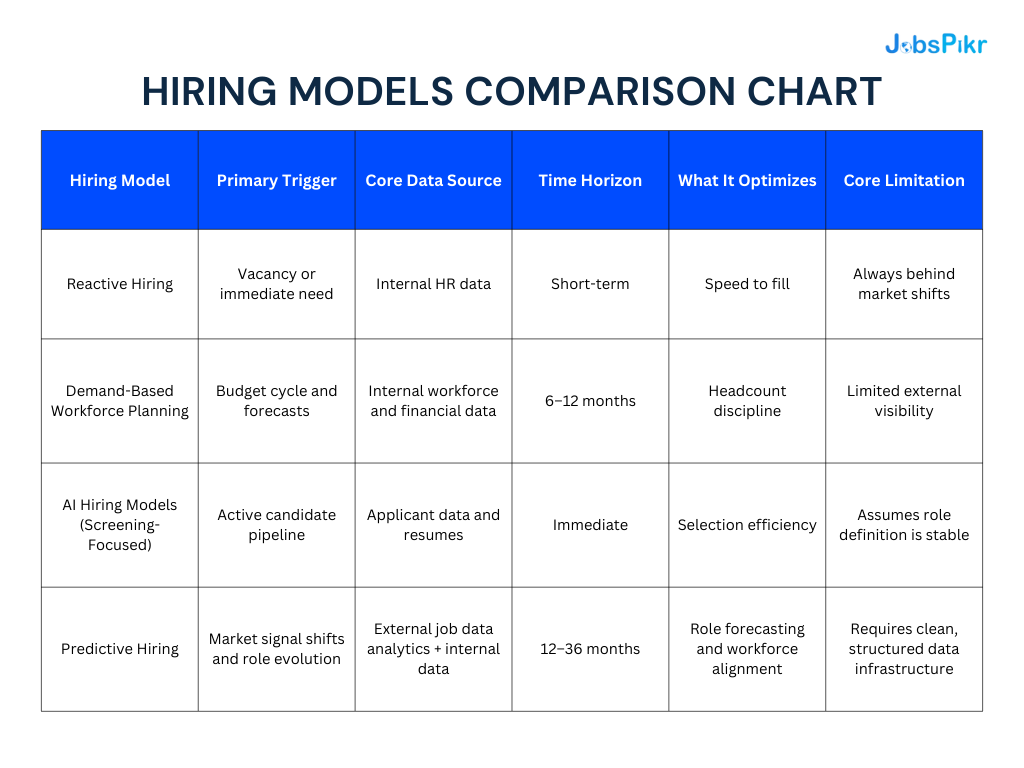
The progression is clear.
- Reactive hiring responds to events.
- Demand-based planning projects internally.
- AI hiring models automate selection.
- Predictive hiring integrates external signals into strategic workforce design.
The difference is not technological sophistication. It is where in the timeline you intervene.
If you intervene at selection, you improve efficiency. If you intervene in forecasting, you improve alignment.
That distinction is what makes predictive hiring a planning discipline rather than a feature.
Shift from Reactive Hiring to Predictive Planning
Anticipate talent shortages, benchmark demand trends, and reduce hiring surprises with data-backed workforce insights.
What Predictive Hiring Really Means (Without the AI Hype)
Predictive hiring is not a chatbot. It is not resume ranking software. It is not a flashy dashboard with trend lines.
At its core, predictive hiring is about reducing uncertainty in workforce planning.
Most talent decisions are made under time pressure. A team needs to scale. A product roadmap changes. A new market opens. Hiring leaders make their best call based on what they know internally. Sometimes they are right. Sometimes they are six months late.
Predictive hiring changes the starting point.
Instead of asking, “How many people do we need?” it asks, “What is happening in the market that will change what this role looks like?”
That shift sounds subtle, but it completely reframes talent strategy.
From Headcount Forecasting to Role Forecasting
Traditional planning focuses on headcount. Ten engineers. Five analysts. Three regional managers.
Predictive hiring focuses on role composition. What kind of engineer? Which skill mix? What adjacency patterns are forming? Is the analyst role absorbing automation skills? Is the regional manager role expanding into data ownership?
When you look at external job data analytics across industries, patterns emerge before they become mainstream.
For example, a role that previously emphasized reporting might start consistently listing data engineering skills. A marketing role might begin requiring experimentation frameworks or product analytics exposure. If you track this evolution at scale, you can see role drift early.
That is role forecasting in practice. It is not about guessing the future. It is about spotting directional shifts.
From Automation to Anticipation
A lot of conversation around AI in hiring revolves around automation. Faster shortlisting. Bias reduction. Candidate matching.
All of that sits downstream.
Predictive hiring sits upstream. It uses predictive analytics to anticipate demand curves, skill concentration shifts, and hiring velocity changes before they become visible in your own requisitions.
There is a difference between improving selection efficiency and improving planning accuracy.
Selection efficiency saves time. Planning accuracy saves strategy.
When organizations confuse the two, they believe they have modernized hiring because they use AI tools. In reality, they have only optimized one step in the funnel.
The Practical Signals Behind Predictive Hiring
So what actually powers predictive hiring models?
It is not abstract intelligence. It is signal aggregation.
Consistent increases in postings for a specific role family across competitors.
Repeated addition of certain skills to job descriptions over time.
Expansion of a role from one geography to multiple markets.
Compression in hiring velocity for certain titles, indicating saturation.
When these signals are structured and normalized, predictive analytics can model momentum. That momentum becomes an early indicator.
This is why clean, role-level job data matters. If titles are inconsistent or skills are not extracted properly, the signal breaks. Predictive hiring depends less on fancy algorithms and more on disciplined data infrastructure.
That is the part most organizations underestimate.
Why This Matters Now
The labor market is no longer slow-moving. Digital transformation, AI adoption, and automation are compressing skill cycles.
If almost half of core skills are expected to change within a five-year window, planning based purely on internal history becomes fragile. The shelf life of a static job description is shrinking.
Predictive hiring does not eliminate uncertainty. It narrows it.
It gives HR analytics leaders and talent strategy heads earlier visibility into where role demand is bending. That earlier visibility is what creates optionality. You can reskill sooner. You can redesign roles gradually. You can adjust the location strategy before compensation spikes.
The alternative is to wait for friction.
And friction is always more expensive than foresight.
The Data Behind Predictive Hiring Models: The Signals You Actually Need
Here’s what usually happens when a team tries predictive hiring for the first time.
They pull job postings. They built a trend chart. They see a spike. Someone says, “Looks like demand is up.” Everyone nods. Then three months later, nothing changes in hiring outcomes, and the whole effort gets labeled as “interesting but not actionable.”
That failure is not because predictive hiring does not work. It fails because the team collected “data” without collecting usable signals.
Predictive hiring works when your inputs answer planning questions. Not when they merely produce charts.
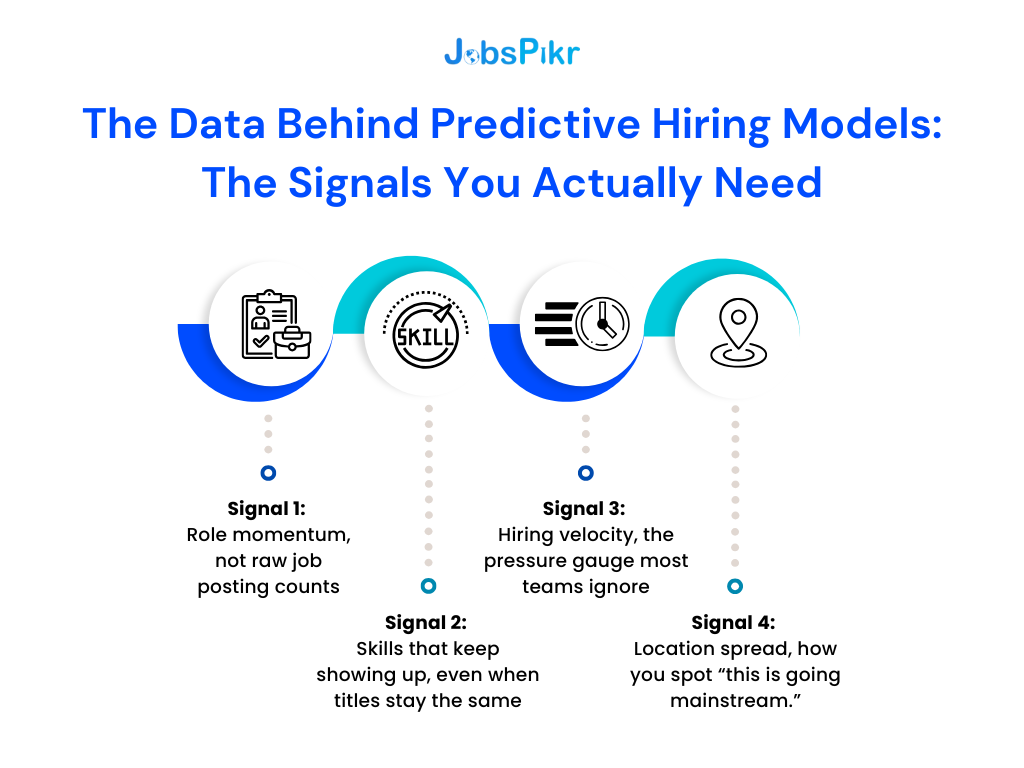
Signal 1: Role momentum, not raw posting counts
A posting count is just a number. Role momentum is a pattern.
If “Data Engineer” postings rise 20% in isolation, it could be noise. If the rise shows up across multiple competitors, across multiple weeks, and within a consistent role cluster, it becomes a signal. That is when role forecasting gets real.
The catch is normalization. Titles are messy on purpose. “Platform Data Engineer,” “Analytics Engineer,” and “Data Engineer II” often describe overlapping work. If those live in different buckets, your trend lines lie.
If you want predictive hiring models that hold up in front of a CFO or a Head of Talent, you need clean role groupings before you ever touch predictive analytics.
Signal 2: Skills that keep showing up, even when titles stay the same
Roles rarely change their name first. They change their content first.
A role can look stable on paper, but job descriptions will start drifting. A familiar title begins picking up new skill requirements, and suddenly, the “same role” is harder to hire for. Hiring managers call it a sourcing problem. It is actually role drift.
Skill evolution signals are about repetition. One employer adding “GenAI tooling” to a JD is not a trend. Twenty employers doing it repeatedly over a quarter starts looking like a new baseline.
This is where job data analytics earns its keep: you can track which skills are becoming common, which ones are fading, and which combinations are emerging. That is what predictive hiring is supposed to see early.
Signal 3: Hiring velocity, the pressure gauge most teams ignore
Volume tells you scale. Velocity tells you urgency.
When a role’s posting activity accelerates quickly across competitors, the market is signaling priority. That often shows up before compensation changes and before recruiters start complaining that “candidates are not available.”
Velocity is also one of the easiest signals to misread if you do not maintain history. You need consistent snapshots, not one-time scraping. Otherwise, you confuse a temporary burst with a real demand curve.
This is also where many AI hiring models mislead teams. They optimize shortlisting once the role exists. Velocity tells you whether the role is about to become painful to fill.
Signal 4: Location spread, how you spot “this is going mainstream.”
A role moving from one hub to many hubs usually means adoption is spreading.
You will see it when a title that used to be concentrated in one market starts appearing across secondary cities, or when the same skill cluster shows up in new regions. That diffusion is a quiet signal that the capability is becoming standard, not niche.
If your planning is still anchored to old talent hubs, you will overpay in saturated markets and under-hire in places where supply is forming.
Location signals also matter because they reveal how competitors are thinking about cost, remote feasibility, and talent access. That is strategic input for predictive hiring, not just recruiting ops.
Quick “signal checklist” you can use internally
| Signal type | What it helps you forecast | What makes it reliable |
| Role momentum | Which roles are gaining demand | Normalized titles, consistent role clusters |
| Skill evolution | How roles are changing inside the same title | Repeated skill shifts across many employers |
| Hiring velocity | Which roles are about to become expensive or slow | Time-series history, not one-time pulls |
| Location spread | Which capabilities are moving from niche to standard | Standardized geo-mapping and market coverage |
Where predictive hiring breaks in practice
This is the part most teams learn the hard way.
If your job data is messy, predictive analytics will still output confidence. It will just be confident about the wrong thing. Duplicate postings, inconsistent titles, and missing history create fake spikes and fake declines. That is why “AI in hiring” can look impressive and still fail to change planning decisions.
Predictive hiring needs structure before it needs sophistication.
Make Workforce Planning Less Reactive
Learn how predictive hiring and talent intelligence can reduce hiring surprises.
How Predictive Hiring Spots Role Emergence and Decline (Before It Becomes Obvious)
New roles do not appear overnight.
They leak into the market quietly.
First, you see an unusual job title at one company. Then two. Then you notice the same skill combination being added to a familiar role. A quarter later, the title stabilizes. A year later, it is standard.
By the time most organizations formally add that role to their job architecture, competitors have already hired for it.
That is where predictive hiring earns its place.
Role Emergence: What It Looks Like in the Data
Emerging roles rarely start with volume. They start with pattern consistency.
You might see a niche title appear across multiple employers in a short window. The posting counts are small, but the repetition is not random. The skill cluster inside those postings is also consistent.
For example, a traditional analytics role might begin incorporating automation tooling, data pipeline ownership, and experimentation frameworks. At first, it looks like a one-off hybrid. Over time, it becomes its own category.
If you are running predictive analytics on structured job data, you can detect clustering before it reaches scale.
This is what role forecasting actually means in practice. It is not speculation. It is pattern tracking across employers and time.
Most internal workforce systems cannot see this because they only reflect roles that already exist in your organization.
Role Drift: The Silent Reshaping of Existing Jobs
Not every shift creates a new title. Often, the more important change is role drift.
A role that used to emphasize coordination slowly absorbs technical ownership. A customer support function starts requiring data fluency. A compliance role adds cybersecurity requirements.
Nothing dramatic happens at first. The title stays the same. The headcount plan stays the same.
But candidate expectations change. Hiring difficulty increases. Compensation benchmarks creep up.
Predictive hiring models that track skill evolution across time can see this drift happening externally. When the same new requirement shows up across many employers, that is no longer experimentation. It is a transition.
Without that visibility, organizations blame recruiters for “harder hiring conditions,” when the real issue is that the role itself has changed shape.
Role Saturation and Decline: The Signals Most Teams Miss
Emergence is only half the story. Predictive hiring is also about spotting when demand is flattening or declining.
Decline rarely looks dramatic. It shows up as slower posting growth, reduced hiring velocity, or consolidation of titles back into broader categories.
If a specialized role stops expanding geographically, or if postings cluster back into a smaller number of employers, that can signal maturation or saturation.
Why does that matter?
Because workforce planning should not only ask what to add. It should also ask what to stabilize, merge, or reskill.
If you see early signs of decline in a role category across the market, you have time to retrain internal talent before the shift becomes disruptive.
This is where predictive hiring connects directly to reskilling strategy. You are not reacting to layoffs or budget cuts. You are responding to market direction.
The Practical Advantage of Early Visibility
The biggest advantage of predictive hiring is not accuracy. It is timing.
If you see role emergence early, you can pilot small hires instead of large corrective waves.
If you see role drift early, you can update job descriptions before recruiters struggle.
If you see saturation early, you can redirect learning investments instead of hiring into declining demand.
That timing difference changes budget conversations, hiring velocity targets, and long-term workforce design.
AI hiring models that only operate at the screening stage will never surface these structural shifts. They operate after the role has already been defined.
Predictive hiring operates at the moment the role itself is changing.
And that upstream visibility is what makes it strategic.
Building a Predictive Hiring Framework: From Signals to Decisions
At some point, every HR analytics leader asks the same question:
“Okay, we have the signals. Now what?”
Because here is the truth. Watching trends is interesting. Acting on them is harder.
Predictive hiring only becomes useful when it changes how you plan roles, not just how you report on them.
Below is a practical framework that moves predictive hiring from insight to execution.

Step 1: Define Your Core Role Clusters
Before running predictive analytics, you need stable role groupings.
Not job titles. Role clusters.
If your data treats “Senior Data Engineer,” “Analytics Engineer,” and “Platform Engineer” as unrelated roles, your forecasting will fragment. You need a normalized architecture that maps similar roles into consistent families.
This does two things:
It prevents false spikes caused by inconsistent naming.
It allows you to track role evolution even when titles shift slightly.
Without this structure, predictive hiring models will show movement where none exists, and hide movement where it matters.
Step 2: Establish Baseline Momentum
You cannot forecast without understanding direction.
For each role cluster, track:
Sustained posting growth across competitors
Changes in hiring velocity
Geographic spread patterns
The keyword is sustained. One-month spikes are noise. Repeated directional movement over multiple cycles is a signal.
This baseline becomes your reference point. From here, you can begin scenario modeling.
Step 3: Layer Skill Evolution on Top of Role Growth
This is where predictive hiring becomes more than volume tracking.
Look inside the role.
- Are new skills appearing repeatedly?
- Are legacy skills declining in frequency?
- Are hybrid combinations emerging?
This layer answers a more strategic question: even if headcount remains stable, is the capability mix changing?
Many organizations miss this. They forecast the number of roles but ignore capability composition. That leads to underestimating hiring difficulty and compensation pressure.
Skill evolution signals turn role forecasting into capability forecasting.
Step 4: Model Forward Scenarios
Now you move from observation to projection.
If growth continues at current momentum, what does demand look like in 12–24 months?
If velocity accelerates, what hiring friction should you expect?
If diffusion spreads to new markets, how should the location strategy adapt?
This is where predictive analytics supports decision-making. You are not predicting exact numbers. You are stress-testing workforce assumptions against external signals.
For example:
If a role cluster is growing externally but your internal hiring plan is flat, that gap deserves scrutiny.
If a role’s skill mix is evolving externally but your job descriptions are static, your hiring difficulty will likely rise.
Predictive hiring surfaces those misalignments before they show up in time-to-fill metrics.
Step 5: Connect Forecasts to Talent Strategy Levers
Forecasting without action is reporting.
A predictive hiring framework should directly inform:
- Headcount planning adjustments
- Reskilling and L&D investment
- Compensation benchmarking
- Location expansion decisions
- Role redesign conversations
This is where many AI hiring efforts stall. They stop at insight generation.
Predictive hiring works when the output feeds directly into workforce planning cycles, not as a side dashboard.
Make Workforce Planning Less Reactive
Learn how predictive hiring and talent intelligence can reduce hiring surprises.
A Simple Operational Flow
| Stage | What Happens | Why It Matters |
| Role normalization | Standardize titles into clusters | Prevent distorted trend analysis |
| Signal tracking | Monitor growth, velocity, skill drift | Identify directional change |
| Predictive modeling | Project momentum forward | Stress-test workforce assumptions |
| Strategic alignment | Adjust planning, reskilling, budgets | Reduce hiring lag and cost surprises |
The important thing to understand is this:
Predictive hiring is not about replacing workforce planning. It upgrades it.
It adds an external signal layer to internal projections. That external layer is what makes the difference between reacting to hiring pain and preparing for it.
And this is where data infrastructure becomes decisive.
If your job data is inconsistent, outdated, or incomplete, the framework collapses. If it is structured and clean, predictive hiring becomes repeatable rather than experimental.
Why Most Predictive Hiring Efforts Fail: The Data Infrastructure Gap
Most predictive hiring initiatives do not fail because the models are weak. They fail because the data underneath them is unreliable.
It usually starts with enthusiasm. Someone says, “Let’s build predictive hiring capability.” A dataset is pulled. A few dashboards get built. Early trends look promising.
Then inconsistencies show up.
Titles do not match across sources. Duplicate postings inflate volume. Skills are extracted unevenly. Historical snapshots are incomplete. Suddenly, the same role looks like it is rising and falling at the same time, depending on how you slice it.
Confidence drops. The initiative gets labeled as exploratory. It quietly fades.
This pattern is common because predictive hiring depends less on algorithms and more on disciplined job data analytics.
Fragmented Data Creates False Signals
If your external job data comes from multiple feeds without normalization, you are not analyzing demand. You are analyzing noise.
One source may list “AI Engineer.” Another may list “Machine Learning Engineer.” A third may use “Applied AI Specialist.” Without consistent role mapping, you cannot track true momentum.
The result is false emergence. Or worse, hidden emergence.
Predictive analytics amplifies these inconsistencies. The model looks mathematically sound, but the input layer is unstable.
Inconsistent Skill Extraction Breaks Role Forecasting
Skill evolution is one of the strongest signals in predictive hiring.
But if skills are pulled inconsistently, the signal disappears.
For example, “Python,” “Python scripting,” and “Python programming” might be treated as separate entities. Cloud platforms may be named differently. Emerging tools may not be captured at all.
When skill normalization is weak, it becomes impossible to measure drift accurately. And if you cannot measure drift, you cannot forecast capability shifts.
Role forecasting then collapses into volume forecasting, which is far less strategic.
Lack of Historical Continuity Distorts Velocity
Hiring velocity and acceleration only make sense over time.
If your dataset lacks consistent historical snapshots, you cannot separate seasonal spikes from structural change. A two-week surge might look like explosive growth. A temporary dip might look like a decline.
Predictive hiring models need stable time-series data. Without it, scenario modeling becomes guesswork dressed as insight.
Internal-Only Data Creates Blind Spots
Some organizations attempt predictive hiring using only internal data.
They model attrition. They project promotions. They analyze internal skill inventories.
All of that is useful, but it does not tell you what competitors are building. It does not show new role variants forming externally. It does not reveal where demand is heating up geographically.
Predictive hiring requires an external signal layer.
Without external job market visibility, you are forecasting from inside a closed system.
The Real Constraint: Structured, Clean Job Data
This is where many teams underestimate the challenge.
Predictive hiring is not limited by AI capability. The quality of job data analytics limits it.
You need:
- Consistent role normalization
- Reliable skill extraction
- Clean company resolution
- Standardized geography
- Historical continuity
Without those elements, predictive analytics produces elegant but fragile outputs.
With them, predictive hiring becomes defensible.
And this is exactly why data infrastructure matters more than the modeling layer.
When the foundation is strong, predictive hiring shifts from experimental to operational. When it is weak, the initiative stalls before it influences real workforce decisions.
Where JobsPikr Fits in a Predictive Hiring Stack
If you decide to build a predictive hiring capability, you quickly run into a structural issue. Your internal systems know your employees. They do not know the market.
- Your ATS tells you who applied.
- Your HRIS tells you who joined or left.
- Your planning sheets tell you what you approved.
None of them tell you what competitors are building, which roles are accelerating externally, or how skill expectations are shifting across industries.
That gap is where predictive hiring either gets serious or quietly dies.
The Talent Intelligence Layer
This is where talent intelligence fits.
Talent intelligence is not about collecting resumes. It is about observing the labor market in a structured way. It tracks role demand, skill movement, hiring velocity, and geographic diffusion across companies and industries.
Without that external layer, predictive hiring becomes internal forecasting dressed up as innovation.
When talent intelligence is wired correctly, it becomes a continuous feed into workforce planning. You are no longer asking, “What did we hire last year?” You are asking, “What is forming outside right now?”
That shift changes the quality of planning conversations.
Structured Role-Level Signals
Predictive hiring depends heavily on clean role clusters.
If titles are inconsistent or loosely mapped, every trend analysis becomes suspect. You need titles resolved into consistent role families so that when you see growth, you trust it.
JobsPikr provides structured, role-level hiring signals instead of raw job postings. That matters because it removes the cleaning burden from the HR analytics team.
Instead of spending cycles reconciling messy titles, teams can focus on interpreting demand patterns.
Skill Evolution Tracking
Most role change does not show up as a new title. It shows up as a new skill requirement inside an existing role.
If you cannot track how skills are appearing, stabilizing, or fading across the market, your role in forecasting is shallow.
JobsPikr tracks skill evolution across industries in a normalized way. That makes it possible to detect capability drift early. And that early detection is often what separates controlled reskilling from last-minute hiring pressure.
Historical Continuity
Predictive analytics only works if history is stable.
If you do not have consistent snapshots across time, you cannot measure velocity or diffusion accurately. You end up reacting to spikes that are not real.
JobsPikr maintains historical job data continuity, which allows HR analytics leaders to compare like-for-like across months and quarters. That continuity is what turns trend watching into planning input.
To be clear, JobsPikr does not replace internal systems.
Internal data explains your workforce reality.
Talent intelligence explains market movement.
Predictive hiring lives at the intersection of both.
When the external signal layer is structured and reliable, predictive hiring stops being an experiment and becomes part of the workforce planning cycle.
Make Workforce Planning Less Reactive
Learn how predictive hiring and talent intelligence can reduce hiring surprises.
What Predictive Hiring Looks Like Inside a Real Planning Cycle
Here’s a cleaner way to explain the impact without repeating the “benefits list” rhythm.
Picture a normal quarterly workforce planning cycle. Most companies run it like a budgeting exercise with a hiring wrapper. Predictive hiring changes what shows up on the table, and when.
Week 1: The “Market Read” Before Headcount Discussions
Instead of starting with internal reqs and attrition, the cycle starts with a short market scan.
Not a giant report. A focused readout that answers a few uncomfortable questions:
- Are we about to hire into a role that is heating up everywhere?
- Are competitors redefining the skill mix for roles we consider stable?
- Are certain role families shifting to new locations or becoming more remote-friendly?
This is where talent intelligence becomes practical. It keeps the conversation from starting in an internal bubble.
Week 2: Role Redesign Happens Before the Requisition Opens
In reactive hiring, role redesign happens after pain. Predictive hiring pulls it forward.
If job data analytics shows that a role’s skill baseline is changing across the market, teams do not wait for hiring managers to complain about “bad candidates.” They update the role definition early.
This is small but important. A job description refresh is cheap in January. It is expensive in June when the role has been open for 90 days, and every stakeholder is frustrated.
Predictive hiring is often just this: fixing the role before you start hiring for the wrong version of it.
Week 3: Hiring Plans Become Scenario-Based, Not Single-Track
Most plans assume one path: “We will hire X people at Y cost.”
Predictive hiring introduces scenarios without turning it into a consulting exercise.
- If the velocity is rising for a role cluster, you plan for a tighter market.
- If diffusion is spreading to new locations, you consider alternate talent pools.
- If skill drift is accelerating, you decide what to build internally vs. buy externally.
The plan becomes less fragile because it has options built in.
Week 4: Execution Gets a Different Set of Priorities
This is where you feel the shift operationally.
Recruiting does not just receive a list of requisitions. They receive a priority map:
- Which roles are likely to become harder next quarter.
- Which roles need updated skill criteria now.
- Which locations are worth testing before competitors flood them?
That changes sequencing. It changes how teams allocate recruiter time. It changes which roles get leadership attention early.
And it prevents the common situation where everything is “urgent” because planning did not spot pressure in time.
What Changes Long-Term (The Quiet Outcome)
The outcome is not that hiring becomes magically easy.
The outcome is that fewer things surprise you.
Roles stop sitting open because the market moved faster than your job design.
Hiring spikes stop derailing budgets because demand acceleration was visible earlier.
Reskilling stops being a panic reaction because skill trends were tracked before they hit your reqs.
Predictive hiring does not replace planning. It makes planning less blind.
Planning for Roles That Don’t Fully Exist Yet
The hardest roles to hire are not always the rarest ones.
They are the ones that changed quietly while no one was looking.
By the time a hiring manager says, “We’re not getting the right profiles,” the role has usually drifted. By the time compensation feels inflated, demand has already accelerated. By the time the organization decides to redesign the role, competitors may have been hiring for that version for months.
This is the gap predictive hiring is meant to close.
It is not about guessing the future. It is about watching the present more closely than most companies do.
When you layer talent intelligence onto workforce planning, you stop treating roles as fixed objects. You start treating them as moving targets shaped by technology, automation, and competitive pressure.
That shift changes the way planning feels.
Instead of defending headcount based only on internal growth assumptions, HR analytics leaders can anchor decisions in observable market signals. Instead of reacting to hiring friction, teams can update role definitions before friction builds. Instead of chasing emerging capabilities late, organizations can build or hire into them gradually.
Predictive hiring is ultimately a timing advantage.
If nearly half of core skills are expected to change over a five-year window, the cost of planning in isolation keeps rising. The companies that integrate external job data analytics into their planning cycles will not eliminate uncertainty. But they will reduce avoidable surprises.
And in workforce strategy, fewer surprises compound into a measurable advantage.
Predictive hiring is not about replacing recruiters. It is not about replacing workforce planners. It is about giving both a clearer view of what is forming outside the organization before it becomes expensive inside it.
That is what makes it strategic.
Make Workforce Planning Less Reactive
Learn how predictive hiring and talent intelligence can reduce hiring surprises.
FAQs
1. What is predictive hiring in simple terms?
It’s planning hiring the way you plan inventory. You don’t wait for stock to hit zero and then panic. You watch early signals and move sooner. In hiring, those signals are things like which roles competitors are posting more often, what skills keep showing up inside those postings, and how fast demand is moving.
2. How is predictive hiring different from AI hiring models?
Most AI hiring is used after the role is already decided. It helps shortlist faster, rank candidates, schedule interviews, that sort of thing. Predictive hiring sits earlier. It is about the role itself. Are we hiring for the right version of this job, or are we about to open a req for something the market has already moved past?
3. What data do you actually need for predictive hiring?
Clean job data. That’s the boring answer, but it’s the true one. If titles are all over the place, skills are extracted inconsistently, and you don’t have history, the model will “predict” nonsense with a straight face. You also want internal context, like attrition and org plans, but external signals are what stop you from planning in a bubble.
4. Can predictive hiring support role forecasting across industries?
Yes. And cross-industry is often where the early clues show up first. Skills usually spread sideways before they spread everywhere. You might see a capability become standard in one sector, then show up as a “nice to have” in another, and then become mandatory. Watching that progression helps you avoid being late.
5. Is predictive hiring only for large enterprises?
No. Big companies feel the impact because they hire at scale, but smaller teams get hurt too, especially in competitive roles. If you have ever said, “This role used to be easy to hire for,” that’s the moment predictive hiring starts paying for itself.