

- **TL;DR**
- Why HR Tech Is Entering a New Era
- Put talent intelligence into motion
- The Rise of AI-Powered HR Tech Platforms
- Workforce Intelligence Is Becoming the Strategic Core
- Skills-First Hiring and Internal Mobility Platforms
- Pay Transparency and Compensation Intelligence Tools
- HR Tech Trends Shaping Employee Experience in 2025
- Compliance, Data Privacy, and Responsible AI in 2025 HR Tech
- The Road Ahead: What to Expect Beyond 2025
- Put talent intelligence into motion
- FAQs
**TL;DR**
HR tech is stepping out of the “software upgrades” lane and into the “strategy engine” lane. Budgets are as follows: the global HR technology market was $37.66Bn in 2023 and is projected to reach $81.84Bn by 2032 at ~9.2% CAGR (Fortune Business Insights).
What’s different in 2025? Two things. First, AI in HR isn’t just automating forms anymore, it’s guiding decisions: Gartner reports HR leaders expect GenAI to impact 37% of the workforce in the next 2–5 years. Second, workforce intelligence is moving from “nice to have” to “operating system.” Skills-first hiring and labor-market signals are reshaping job design, internal mobility, and pay—LinkedIn’s research shows large-scale shifts toward skills-based practices and a growing share of roles changing due to AI.
If you’re evaluating HR tech in 2025, look for platforms that combine talent intelligence (external market + skills data) with workforce intelligence (your internal reality). That mix helps you hire faster, design roles around skills, set pay with confidence, and stay compliant as rules tighten (see the EU AI Act timeline now phasing in).
Why HR Tech Is Entering a New Era
HR tech has always evolved, but 2025 feels different. What used to be a slow, predictable curve of digitization is turning into a steep climb. Tools that once existed to make processes faster now sit at the heart of how organizations make decisions.
The market is backing this shift. According to Fortune Business Insights, the global HR technology market was valued at $37.66 billion in 2023 and is expected to grow to $81.84 billion by 2032, at a CAGR of 9.2%. Those numbers tell you something: HR isn’t just a support function anymore. It’s becoming a data-driven, tech-first growth engine.
The acceleration comes from three forces working together.
First, AI and automation are reshaping how hiring and workforce planning happen.
Second, regulations and new standards (like the EU AI Act) are pushing companies to build responsible, auditable HR systems.
And third, labor markets are moving faster than most org charts can keep up with—forcing CHROs to rethink how they track skills, pay, and talent availability.
What is HR Tech and Why It’s More Than Just Software
When people say “HR tech,” they often think of payroll platforms or ATS systems. But in 2025, it’s a different story. HR tech is the full ecosystem that powers how companies find, manage, and retain talent. It includes:
- Talent intelligence platforms that bring in real-time job market signals.
- Workforce intelligence layers that connect internal data with external demand.
- Predictive tools that don’t just tell you what happened but what’s about to happen.
It’s no longer about digitizing paperwork; it’s about steering workforce strategy.
Put talent intelligence into motion
JobsPikr turns market signals into actionable workforce intelligence so your hiring, pay, and mobility decisions are grounded in reality, not lagging spreadsheets.
The Rise of AI-Powered HR Tech Platforms

Image Source: Josh Bersin
Five years ago, “HR tech” often meant clunky ATS dashboards, shared drives full of PDFs, and spreadsheets trying to keep up with headcount. Today, AI has turned that world upside down. Recruitment, onboarding, performance management, and workforce planning are being rebuilt on top of intelligent systems that learn, recommend, and predict.
This isn’t just a vision for the future, it’s already in motion. According to Gartner, 37% of the global workforce is expected to be impacted by GenAI over the next 2–5 years. HR isn’t immune to that. Tools are getting smarter, moving beyond automating tasks like candidate screening or onboarding workflows. They’re making real-time recommendations on where to hire, which skills are emerging fastest, and how to optimize workforce plans.
Think of AI in HR tech less like a fancy add-on and more like the new engine under the hood. Where older systems could only store data, modern AI platforms can interpret and act on it.
AI in HR Tech: From Task Automation to Decision Intelligence
There’s a big difference between automating a form and forecasting a skill shortage before it happens. Modern AI tools do the latter. They help CHROs and HR Ops teams see shifts in the labor market before they hit their own talent pipelines.
For example, AI-powered talent intelligence platforms can analyze external job postings, internal mobility data, and compensation benchmarks together. Instead of just telling you “engineering roles are taking longer to fill,” they can surface why—maybe cloud security demand spiked in your region or salary expectations shifted by 12%.
This shift, from admin automation to decision intelligence, is what separates yesterday’s HR software from tomorrow’s strategic infrastructure.
Workforce Intelligence Is Becoming the Strategic Core
Here’s the big shift that’s not getting enough airtime: workforce intelligence is quietly becoming the operating layer for modern HR. It’s what turns scattered HR tech tools into a connected strategy.
Workforce intelligence is about using external labor market signals and internal workforce data together to make smarter, faster decisions. Instead of relying on static reports or outdated surveys, companies are now mapping live job demand, skill shifts, and pay trends directly against their internal teams. This gives CHROs and HR Ops a live dashboard of where they’re strong, where they’re weak, and where the market’s moving.
Why is this happening now? Because the market itself is moving faster than internal planning cycles. According to LinkedIn’s Future of Work Report, more than 50% of global companies say skills gaps are growing faster than they can fill them. You can’t solve that with annual reviews and old headcount plans. You need live signals.
This is exactly why talent intelligence platforms are surging. They don’t just store workforce data—they contextualize it against the market in real time.
Talent Intelligence Platforms as the New Operating System for HR
Think of it like this: five years ago, most HR teams operated with a lag. They’d analyze what happened last quarter, draft a plan, and execute months later. Now, they’re expected to act in the moment. Talent intelligence platforms bring three crucial capabilities together:
- Real-time visibility into skills demand and availability
- Pay and compensation signals across markets
- Forecasting models that help teams plan for talent shifts before they happen
This isn’t just a “nice to have” anymore. In 2025, it’s the foundation of competitive talent strategy.
Skills-First Hiring and Internal Mobility Platforms
Skills are finally taking center stage. Not because it’s trendy, but because role requirements are shifting faster than job architecture can keep up. Teams that move to skills-first hiring and build real internal mobility paths will fill roles faster, retain niche talent longer, and stay ahead of market shifts.
What is “skills-first hiring” and why does it matter in 2025?

Image Source: Testgorilla
Skills-first hiring means evaluating candidates primarily on capabilities, not credentials. It’s moving from statements to practice. LinkedIn’s 2025 analysis shows the share of paid job posts without a degree requirement rose 16% since 2020, signaling a real change in how employers scope talent. LinkedIn
Zoom out, and the “why now?” becomes obvious: the World Economic Forum estimates six in ten workers will need training by 2027 due to shifting skills demand. That’s not a nice-to-have; it’s a survival metric for modern orgs. World Economic Forum
How do skills taxonomies replace traditional job descriptions?
Classic JDs lock you into titles and time-in-role. A skills taxonomy maps capabilities → roles → learning paths so you can:
- Identify adjacent skills (who can pivot into a role with minimal upskilling).
- Align L&D to real job demand (not just generic courses).
- Update compensation logic to reflect market-priced skills, not just titles.
Gartner’s recent HR research underscores the urgency: 41% of HR leaders say their workforce lacks required skills, and 62% see uncertainty around future skills as a significant risk. Taxonomies help replace guesswork with a living map of what you need—and when. Gartner
Which stats prove skills-based hiring is more than talk?
Signals are mixed, and honesty helps you plan. Harvard Business School and Burning Glass tracking show that while many companies announce degree resets, sustained changes in hiring behavior are uneven. Translation: you’ll get ahead by operationalizing skills (taxonomy, assessments, mobility paths) rather than waiting for the market to finish shifting.
How do internal mobility platforms turn potential into pipeline?
Internal mobility connects skills data to real moves, temporary stints, project marketplaces, and progression frameworks. Yet only about one-third of organizations have formal internal mobility programs, and confidence among employees to navigate moves is low. That’s a gap you can exploit with the right platform and data. LinkedIn
When you pair internal profiles with external labor-market signals (what JobsPikr provides), you can spotlight which teams are at risk, where demand is spiking, and which learning paths unlock the most leverage.
Pay Transparency and Compensation Intelligence Tools
Over the last two years, pay transparency has gone from a hot topic to a compliance reality. And in 2025, it’s colliding head-on with workforce intelligence. Companies can no longer afford to make compensation decisions based on last year’s survey data—they need live market signals and structured compensation intelligence.
Why is pay transparency becoming a non-negotiable in 2025?

Image Source: LinkedIn
Pay transparency isn’t just about publishing salary bands anymore. It’s becoming a legal requirement in many markets. As of early 2025, over 20 U.S. states have adopted some form of pay transparency legislation, and the EU Pay Transparency Directive is rolling out in stages through 2026.
These rules are forcing organizations to clean up internal pay structures, track external benchmarks, and communicate salaries with more precision. It’s no longer enough to know “what we paid last year”—teams need to know what the market is paying right now.
How is compensation intelligence shaping HR strategy?
Compensation intelligence uses live job market data to map pay by role, skill, and location. Instead of relying on outdated salary surveys, companies tap into real-time job postings and labor market feeds to benchmark against competitors. This allows HR teams to set salaries that are competitive today—not six months ago.
According to Mercer, companies that adopt structured pay transparency strategies see up to 30% improvement in candidate pipeline quality. Why? Because clarity builds trust—and trust attracts better talent.
How do HR tech platforms turn pay data into action?
Modern HR tech platforms are embedding compensation intelligence directly into workforce planning workflows. That means:
- Managers can see market pay ranges while creating requisitions.
- Comp teams can adjust salary bands dynamically as the market shifts.
- CHROs can spot pay equity gaps before they turn into compliance problems.
This combination of pay transparency + live data isn’t a future trend anymore—it’s a 2025 reality.
HR Tech Trends Shaping Employee Experience in 2025
Employee experience used to mean perks, surveys, and a nice intranet. In 2025, hr tech turns it into something sharper: a living system that adapts to each person, in real time, using both internal signals and labor-market context. Why the urgency? Because engagement is still fragile. Gallup’s latest report shows only 23% of employees are engaged, and companies with highly engaged teams see up to 21% higher profitability—that’s not a vibe; that’s a balance sheet outcome (Gallup, 2024). Executives feel the pressure too: 83% now rank employee experience as a top priority, with growing investment in AI-led EX platforms (Deloitte Human Capital Trends, 2024).
How is hr tech reshaping employee experience in 2025?
The big shift is from process to pattern. Instead of running annual cycles and hoping for the best, modern platforms track day-to-day signals—skill growth, workload friction, mobility interest—and surface what needs attention now. Pair that with workforce intelligence (what’s changing in your teams) and talent intelligence (what the market is demanding), and you get an EX engine that can actually steer outcomes: faster development paths, cleaner handoffs, fewer “quiet” exits.
Why is personalization the new core of employee experience platforms?
Because generic programs miss the moment. If AI can recommend the next movie, it can recommend the next skill, project, or mentor. Personalization in hr tech 2025 means your people see learning that matches the role they want, pay guidance that matches the market they’re in, and internal moves that match the skills they already have. It feels fair. It feels timely. And it reduces the distance between “I’m thinking of leaving” and “I can grow here.”
Which data signals actually move the needle on retention?
Three buckets: skills, mobility, and energy. Skills data shows what’s gaining value outside your walls; mobility data shows whether people can move inside your walls; energy signals (engagement pulses, sentiment, workload markers) show whether they have the fuel to keep going. When your hr tech platform connects those dots—and your managers can act on them—you stop running engagement programs and start running a talent system.
Compliance, Data Privacy, and Responsible AI in 2025 HR Tech
Powerful tools need grown-up guardrails. That’s the headline for hr tech in 2025. AI is touching hiring, promotion, pay, and performance—areas full of sensitive data and real consequences for people. So the question isn’t “Do we use AI?” It’s “Can we explain it, audit it, and defend it when someone asks how a decision was made?”
Why is regulatory pressure changing how HR teams buy and use tech in 2025?
Because the rules are catching up to the tools. Across the EU and the US, new frameworks expect HR systems to be explainable, documented, and human-supervised—especially for hiring and evaluation. In practice, that means fewer black boxes, more audit trails, and a clear story for how models are trained, tested, and monitored.
What does “responsible AI” actually look like inside an HR platform?
It looks boring in the best way: versioned models, bias checks before and after deployment, approval workflows, and readable reason codes for every automated recommendation. If your screening model suggests “not a fit,” your team should see which signals drove that call—and how a human can override it.
How should HR leaders think about privacy and data minimization now?
Start with purpose. Collect only what you truly need, keep it for only as long as you need it, and make it portable if employees request their data. Map data flows (who touches what, when, and why), tag sensitive attributes, and keep vendor access on a tight lease with role-based permissions and short-lived tokens.
Which governance habits prevent surprises during audits or disputes?
Three simple ones:
- Prove it: Keep logs of model inputs, outputs, and overrides. Store the “why” next to the “what.”
- Test it: Run regular bias and drift tests. If your talent pool changes, your model should prove it still behaves.
- Own it: Assign a real owner for each automated decision flow. If everything is “shared,” nothing is accountable.
How do talent intelligence and workforce intelligence platforms stay compliant without slowing down?
By baking governance into the daily workflow. Bias tests run on a schedule, reason codes display by default, and human review is part of the process—not an afterthought. Done right, workforce intelligence gets faster because you trust the signals you’re acting on.
The Road Ahead: What to Expect Beyond 2025
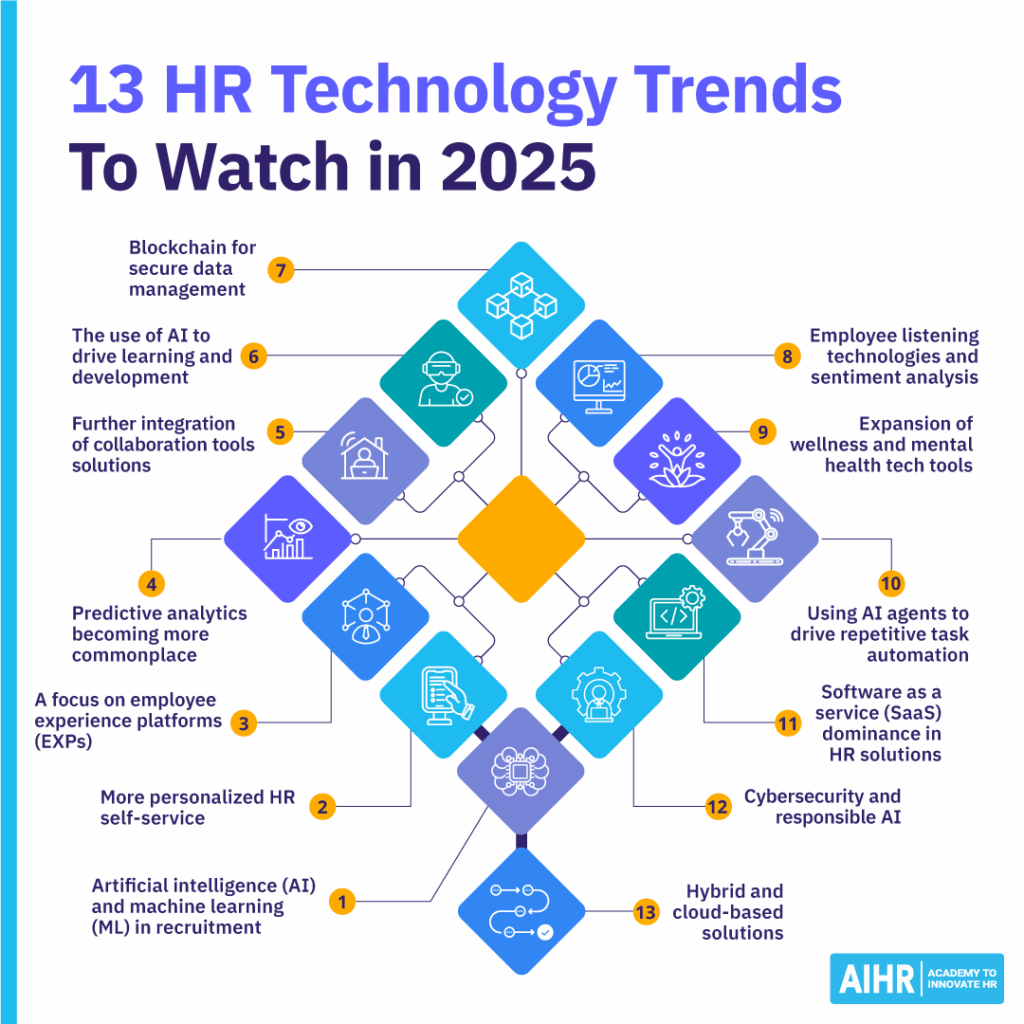
Image Source: AIHR
The curve isn’t flattening. If 2024–2025 felt like “catch-up,” the next stretch is about compounding—stacking small, durable wins in hr tech until they add up to a different operating model. Less tool sprawl. More connected signals. Fewer quarterly fire drills.
What will actually converge in hr tech after 2025?
Three layers will behave like one system: talent intelligence (market and skills signals), workforce intelligence (your internal truth), and execution platforms (ATS, LMS, performance, comp). Instead of pushing data between islands, you’ll see a shared spine—skills, pay, and role architecture—so planning, hiring, development, and compensation run off the same map. The payoff is practical: faster requisitions, cleaner mobility paths, and fewer mismatches between job design and reality.
How should CHROs shape a 24-month roadmap without boiling the ocean?
Think in seasons, not years.
- Season 1: Stabilize the data spine. Standardize skills, roles, and location logic across tools. Map where each source of truth lives.
- Season 2: Turn signals into actions. Embed market pay ranges in requisitions, surface adjacent skills inside career paths, and wire L&D to actual demand.
- Season 3: Add guardrails. Bias testing on a schedule, reason codes by default, human override in the flow—not in a separate committee.
This rhythm keeps you shipping value every quarter while your hr tech stack gets smarter under the hood.
Which capabilities will separate leaders?
Not fancy features—feedback loops. Leaders will close the loop between market shifts and internal moves faster than everyone else. That means:
- Skills taxonomies that update with market demand (and adjust learning paths automatically).
- Compensation intelligence wired into headcount plans, not parked in slides.
- Mobility marketplaces that treat projects, gigs, and promotions as one talent graph.
- Governance that’s visible: bias checks, versioned models, and audit trails in plain language.
Where does JobsPikr fit in this future?
Right at the seam between outside signals and inside decisions. JobsPikr brings real-time job market data—skills, roles, pay, location trends—into the places your team already works. So your recruiters see what the market wants, your comp team prices roles with current ranges, and your employees get growth paths that reflect what’s truly in demand.
Put talent intelligence into motion
JobsPikr turns market signals into actionable workforce intelligence so your hiring, pay, and mobility decisions are grounded in reality, not lagging spreadsheets.
FAQs
1. What is HR Tech?
It’s the toolkit HR uses to run the people side of the business—hiring, pay, performance, learning, internal moves, the works. In 2025, hr tech isn’t just an ATS and payroll anymore. It’s a connected stack that blends talent intelligence (live market data on skills and pay) with workforce intelligence (your internal skills, roles, and mobility). The result: fewer guesses, faster decisions, and a clearer path for people to grow.
2. What is the future of HR Tech?
Fewer separate tools, more shared signals. The future is a single backbone where recruiting, compensation, learning, and performance speak the same language—skills. Platforms will pull in real-time market shifts (what’s paying where, which skills are spiking) and push those signals into everyday workflows. For leaders, that means headcount plans tied to reality. For employees, it means personalized learning and visible, fair mobility.
3. Can HR be replaced by AI?
No. AI can process patterns at scale; it can’t build trust. Think of AI as the co-pilot: it flags pay drift, highlights rising skills, and spots flight-risk signals early. HR still handles judgment, context, and conversations. The winning formula is simple—let AI do the heavy lifting, let humans make the calls.
4. What are the top HR tech trends in 2025?
A few shifts you’ll actually feel:
AI decision support replacing manual reports with forecasts you can act on.
Skills-first talent strategy making job titles less important than capabilities.
Compensation intelligence + pay transparency grounding offers in live market data.
Personalized employee experience—learning, projects, and mobility tailored to each person.
Responsible AI and compliance by design—explainable models, bias checks, human oversight.
Together, these trends move hr tech from admin software to a strategy engine.
5. How is AI used in HR tech?
Quietly, in the background—everywhere. It reads market signals to forecast skill demand, recommends adjacent skills for faster hiring, prices roles to current ranges, and nudges managers when retention risks rise. None of that replaces people. It gives HR the clarity to step in sooner with the right action—better offers, smarter learning paths, or a timely internal move.