
- The 3 Upskilling Calls You Need to Make Now (TL;DR)
- The Skill-Gap Isn’t “Coming.” It’s Already Costing You.
- What a Skill-Gap Heatmap Actually Shows (And Why Skills Matrices Fall Short)
- Move From Skill-Gap Insights to Skills-Based Hiring Execution
- Mapping Internal Skills Against External Workforce Trends
- Identifying Roles at Risk of Obsolescence Before It Hits Productivity
- Prioritizing Upskilling Based on Market Intelligence, Not Guesswork
- Building a 12–24 Month Upskilling Forecast Using Live Market Signals
- Why External Talent Intelligence Is the Missing Layer in Most Skill-Gap Strategies
- From Skill-Gap to Competitive Advantage: What to Do Next
- Turning the Skill-Gap into a Strategic Edge
- See Where Your Skill-Gap Is Widening Before It Hurts Delivery
- FAQs: Skill-Gap, Upskilling Forecast, and Workforce Intelligence
The 3 Upskilling Calls You Need to Make Now (TL;DR)
Most companies don’t have an “upskilling problem.” They have a prioritization problem. Too many skills, too many roles, not enough budget, and no external reality check.
A skill-gap heatmap fixes that by combining two views:
- what your workforce can do today (your internal skills inventory), and
- what the market is demanding next (external job-posting and labor market signals).
When you build it properly, skill gap analysis stops becoming a laundry list of courses and starts forcing sharper calls:
- Which role families are quietly drifting into danger — harder to fill, tougher to retain, and increasingly misaligned with what the business now needs.
- Which skills are clearly gaining momentum in the market, so your upskilling forecast follows external demand signals, not internal assumptions.
- Where to focus training vs hiring vs redesign so L&D investment maps to productivity and execution outcomes
This article shows how to build a skill-gap heatmap using external workforce trends, how to prioritize upskilling based on demand velocity and workforce availability, and how JobsPikr turns raw job data into the signal layer that makes those calls earlier.
The Skill-Gap Isn’t “Coming.” It’s Already Costing You.
If you lead L&D or workforce transformation, you’ve seen this movie.
A team gets headcount. You hire. You run onboarding. You even roll out training.
And then… delivery still slows down.
That’s the skill-gap. Not as a theory. As a daily tax on execution.
It shows up in boring, expensive ways:
- projects slip because the team can’t work fast enough without outside help
- managers keep “borrowing” the same few experts across teams
- new hires take longer to become useful because the real skill requirements changed while you were still hiring
The market is also telling you this isn’t a small issue.
The World Economic Forum’s Future of Jobs Report (2023) says employers expect 44% of workers’ skills to be disrupted within five years. That means nearly half your workforce will need some kind of upskilling just to stay effective.
A recent ManpowerGroup Talent Shortage survey indicates that about 74% of employers globally report difficulty finding the skilled workers they need. That’s a substantial indicator that the skill-gap isn’t limited to one region or industry — it’s a persistent constraint on hiring and execution.
For an even more locally relevant stat, reporting from India shows that 80% of employers in India are struggling to find skilled talent, and this trend has held steady or grown the past few years.
Put those together and you get the real problem:
You can’t hire your way out of the skill-gap.
And you can’t train your way out of it if you don’t know what’s changing.
Most upskilling plans break because they’re built using weak inputs:
- internal surveys that reflect confidence, not capability
- manager opinions that vary by team
- competency frameworks that get refreshed once a year
Meanwhile, external demand changes every quarter. Sometimes faster.
So the skill-gap keeps moving. Your plan stays still.
This is the moment where a lot of L&D teams get stuck. Because “upskill people” is not a strategy. It’s a request.
What you actually need is clarity on two things:
- which role families are getting harder to staff and harder to keep stable
- which skills are gaining demand in the market, so your upskilling forecast has a real foundation
That’s exactly what the next section is about. A skill gap heatmap is not another dashboard for reporting. It’s a way to turn external labor market signals into a ranked upskilling plan.
What a Skill-Gap Heatmap Actually Shows (And Why Skills Matrices Fall Short)
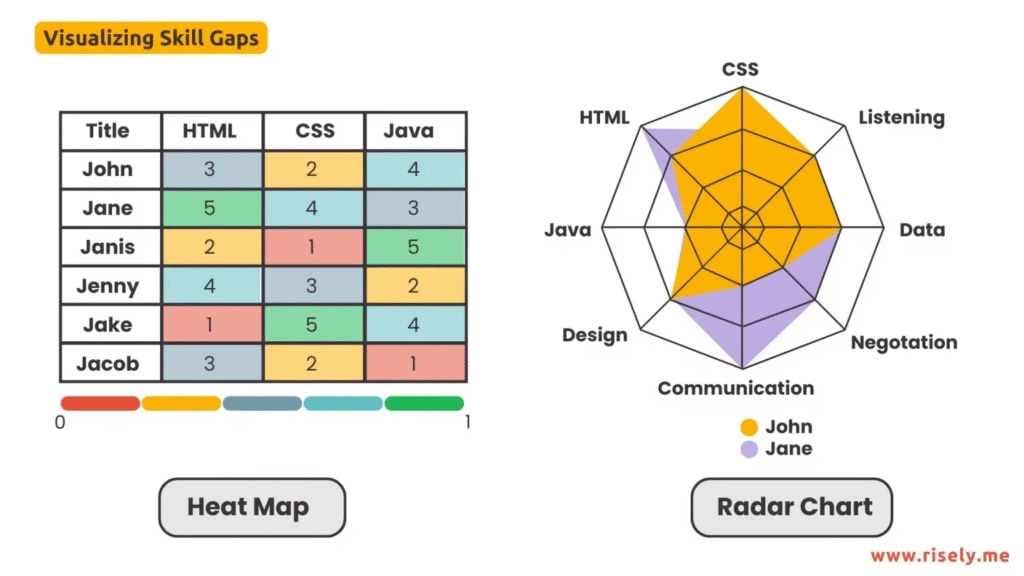
Image Source: Risely
Why a skills matrix looks “complete” but still fails in practice
Most organizations already have a skills matrix.
It’s usually a spreadsheet. Rows of employees, columns of skills, and some kind of rating. It feels organized, so it’s easy to assume you’re covered.
But a skills matrix mostly reflects what your workforce says it can do, or what managers believe is true today. It rarely captures how fast the role itself is changing in the market. That’s why teams keep getting surprised even when the spreadsheet looks healthy.
What a skill gap heatmap adds that your internal view can’t
A skill gap heatmap overlays two realities:
First, your internal capability distribution, meaning what skills exist today, how deep they are, and how they’re spread across role families.
Second, external demand signals, meaning what the labor market is asking for in job postings, how requirements are shifting, and what’s becoming table stakes.
When you combine these, you stop asking, “Do we have this skill?” and you start asking, “Are we keeping up with how this role is evolving?” That’s the entire value of the heatmap.
A simple example of how the skill-gap hides in plain sight
Let’s say you have a strong analytics team.
Internally, you see SQL, Python, reporting, and basic cloud exposure across a good chunk of the team. It looks fine.
But then you look externally. Comparable roles are now written around modern data stacks, orchestration, lakehouse patterns, and specific platforms. Expectations shift quietly, and your internal capability doesn’t shift at the same speed.
That’s how the skill-gap grows without anyone noticing until delivery slows down or hiring starts failing.
How the “heat” works in a skill gap heatmap
The heatmap is useful because it forces ranking.
Hot zones tend to show up where external demand is rising quickly, workforce availability is tightening, and your internal capability is thin or concentrated in a few people.
Cold zones show up where demand is flattening, hiring difficulty is easing, or you already have surplus depth.
This contrast matters because it pulls you out of opinion-led planning. It replaces “we think we should train this” with “this is where our capability exposure is widening.”
What this changes for upskilling forecast and budget decisions
Most upskilling programs fail because they’re spread too thin. Everyone gets trained on something, but the business still doesn’t feel the impact.
A skill gap heatmap helps you avoid that. It makes your skill gap analysis actionable by pushing you toward a small set of high-impact decisions. It also gives your upskilling forecast something most L&D plans lack: an external reality check.
Why external labor market signals are the difference-maker
Without external signals, your heatmap is basically internal reporting with nicer visuals.
With external job data and market movement, it becomes workforce intelligence. You can see where your role families are drifting away from market expectations and where talent shortage pressure is building.
Move From Skill-Gap Insights to Skills-Based Hiring Execution
Connect your skill-gap analysis to real-time market data and make faster, evidence-backed workforce decisions.
Mapping Internal Skills Against External Workforce Trends
This is where most skill gap analysis efforts collapse.
Not because the idea is wrong. But because the inputs are messy.
If you want a skill-gap heatmap that actually guides your upskilling forecast, you need to align two very different data sources:
- your internal skill inventory
- external labor market signals
And those two rarely speak the same language.

Step 1: Clean Your Internal Skill Inventory (Before You Compare Anything)
Most internal skill datasets are inconsistent.
Titles vary across teams. Skill names differ by department. One team logs “ML,” another logs “Machine Learning,” and a third just writes “AI.” You cannot map this against market data unless you normalize it.
Start by standardizing three things:
First, role families. Group roles into logical clusters that reflect how work is structured, not just how HR codes it. For example, combine variants of data engineer, analytics engineer, and platform engineer under a broader data infrastructure family if that’s how capability flows.
Second, skill taxonomy. Collapse similar skill names into unified categories. You don’t need 500 micro-skills to run skill gap analysis. You need a clear, comparable skill layer.
Third, proficiency bands. Instead of vague ratings, define what depth actually means. Foundational. Applied. Advanced. Expert. Without depth clarity, your heatmap will overstate coverage.
This step is not glamorous. But if you skip it, your skill-gap heatmap becomes noise.
Step 2: Capture External Demand Trends in a Structured Way
Now you bring in the external layer.
This is where most L&D teams don’t have infrastructure.
External workforce trends show up in job postings first. They reveal:
- new skills being added to role descriptions
- tools becoming mandatory instead of optional
- role scope expanding (for example, analytics roles now requiring engineering skills)
- geographic demand clusters
- salary shifts tied to scarcity
The key is not just counting postings. It’s tracking skill velocity.
Skill velocity means how quickly a skill’s presence in job descriptions is rising relative to its historical baseline. A skill mentioned in 10% of postings last year and 28% this year is not just “popular.” It’s accelerating.
That acceleration is what should influence your upskilling forecast.
Without this external layer, you’re planning in isolation.
With it, you’re benchmarking your internal capability against market movement.
Step 3: Overlay Internal Capability with External Demand
This is where the actual skill gap heatmap is built.
For each role family, you compare:
- internal skill penetration (how many employees have it, at what depth)
- external demand intensity (how frequently it appears in relevant job postings)
- demand growth rate (is it flat, rising, or declining?)
- workforce availability signals (is the market tight or stable?)
When internal depth is low and external demand is rising fast, you get a red zone. That’s a widening skill-gap.
When internal depth is high and external demand is flat or declining, you may have a reskilling opportunity or a future redundancy risk.
This is where conversations change.
Instead of asking, “Should we train more people in cloud?”
You ask, “Cloud-native architecture demand is rising 30% year-over-year in comparable roles, but only 18% of our engineers have applied-level capability. Do we upskill or adjust hiring?”
That’s a strategic discussion, not a training discussion.
Step 4: Turn This into an Upskilling Forecast
Once you see the exposure clearly, your upskilling forecast becomes structured.
You can model:
- How many employees need to move from the foundational to the applied level
- How long capability lift typically takes
- Whether internal training can close the gap in time
- Whether hiring externally is more realistic, given the talent shortage conditions
This is where most organizations finally see the real constraint.
It’s not that they don’t want to upskill. It’s that they don’t know which 3–5 capability gaps matter most over the next 12–24 months.
That’s what this mapping exercise solves.
If your current workforce planning relies only on HRIS data and annual competency reviews, you’re missing the external signal layer that makes the skill-gap measurable in real time.
This is exactly where JobsPikr fits.
JobsPikr aggregates structured job data across industries and geographies, allowing you to track emerging skills, shifting role requirements, and workforce availability trends at scale. Instead of manually scanning postings, you get normalized, comparable labor market signals that plug directly into your skill gap analysis.
If you want to see how this looks in practice, we can walk through a sample skill gap heatmap built using live job data for your industry.
Identifying Roles at Risk of Obsolescence Before It Hits Productivity
Not every skill-gap is about a shortage.
Some are about drift.
Roles don’t disappear overnight. They slowly change shape. Responsibilities shift. New tools become mandatory. Automation absorbs parts of the workflow. And by the time the organization reacts, the role has already outgrown its original definition.
This is where many companies get blindsided.
They keep investing in hiring for yesterday’s version of the role while the market has already moved on.
The Market Is Already Signaling Structural Shifts
The World Economic Forum’s Future of Jobs Report (2023) estimates that 23% of jobs are expected to change due to industry transformation over five years, with both job growth and decline happening simultaneously.
That doesn’t mean entire professions vanish. It means tasks within roles evolve faster than job titles.
At the same time, the U.S. Bureau of Labor Statistics regularly shows uneven occupational outlooks. For example, data-related and technology-enabled roles are projected to grow significantly over the next decade, while certain administrative and routine roles face stagnation or decline.
For L&D and HR strategy leaders, the implication is simple:
- If you only track hiring volume, you miss transformation.
- If you only track internal skill coverage, you miss external evolution.
How Obsolescence Risk Shows Up in a Skill Gap Heatmap
A role doesn’t flash “obsolete.” The warning signs are subtler.
First, you’ll see declining demand signals in the external market. Posting volumes flatten or drop. Required skills narrow rather than expand.
Second, you’ll notice adjacent roles absorbing its responsibilities. For example, automation tools may reduce manual reporting work, while analytics engineers take over what used to be pure business analyst responsibilities.
Third, salary premiums shift. Scarcity premiums migrate toward hybrid or advanced roles, not legacy skill sets.
When you overlay these signals onto your internal workforce data, patterns emerge.
You may find that a large percentage of your workforce sits in roles where external demand is plateauing or where required skills are evolving beyond current capability depth.
That’s not an immediate crisis. But it is a strategic warning.
The Hidden Cost of Ignoring Role Drift
Most organizations wait for one of three triggers before acting:
- Hiring difficulty becomes severe.
- Attrition spikes in high-performing teams.
- Automation initiatives suddenly expose capability gaps.
By then, you are reacting.
Proactive skill gap analysis flips this dynamic. Instead of asking, “Why are we struggling to hire?” you ask, “Is this role definition still aligned with where the market is moving?”
That’s a more uncomfortable question. But it’s also more strategic.
If a role family is trending toward automation or structural decline, your options are clearer:
- You redesign the role.
- You reskill the talent into adjacent growth areas.
- Or you rebalance hiring strategy before exposure grows.
Turning Obsolescence Signals into Actionable Planning
A forward-looking upskilling forecast doesn’t just identify where you’re short. It identifies where you’re long.
Surplus capability in declining skill areas is just as risky as a shortage in emerging ones.
When your skill gap heatmap highlights declining demand combined with high internal concentration, it gives you a runway. You can begin structured reskilling while productivity is still stable.
That is a far better outcome than forced transitions after disruption.
And this is where external talent intelligence becomes critical.
Without external workforce trends, you are relying on internal performance metrics to tell you something has changed. But performance metrics lag. Labor market signals lead.
Prioritizing Upskilling Based on Market Intelligence, Not Guesswork
This is where most organizations stall.
You’ve run the skill gap analysis. You’ve identified exposure. You’ve seen which role families are heating up and which are drifting.
Now comes the uncomfortable part: you cannot fix everything.
Budgets are finite. Learning capacity is finite. Manager attention is finite.
So the real question becomes: which skill-gaps actually deserve investment first?
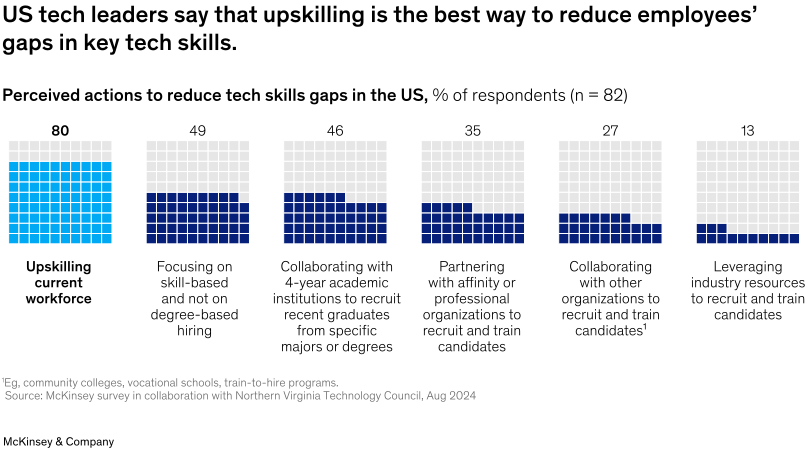
Image Source: McKinsey
Not All Skill-Gaps Carry the Same Risk
Some gaps are inconvenient. Others threaten execution.
If a niche tool appears in a handful of external postings, that’s not necessarily a red flag. But if core skills in a critical role family are accelerating in demand while your internal depth is thin, that’s operational risk.
A practical way to rank gaps is to score them across three dimensions:
- First, business criticality. Does this role family directly impact revenue, product delivery, compliance, or strategic transformation initiatives?
- Second, external demand intensity and growth. Is this skill rising across comparable companies? Is the demand curve steep or flat?
- Third, workforce availability. Is the talent market tight for this skill? Are time-to-fill and compensation premiums increasing?
When all three move in the same direction, you have a priority zone.
That’s where upskilling should focus.
When Hiring Is Not a Realistic Option
Many organizations default to hiring when a skill-gap appears.
But this only works when workforce availability supports it.
If 74% of employers globally report difficulty finding skilled talent, as recent ManpowerGroup data shows, simply adding headcount is not always viable.
When the market is tight and compensation is inflating, internal upskilling becomes strategically smarter than external hiring. Not because it’s cheaper in every case, but because it gives you control over capability timing.
A skill gap heatmap helps you see this clearly. If external scarcity is high and internal adjacent capability exists, reskilling may be faster than competing in an overheated hiring market.
Avoiding the “Train Everyone” Trap
One of the most common mistakes in upskilling strategy is spreading effort too widely.
Broad programs feel inclusive, but they dilute impact. Everyone learns something. Few become meaningfully better at what the business actually needs.
Market-informed prioritization forces sharper choices.
For example, instead of launching a generic AI literacy program across the entire company, your skill gap analysis might show that specific engineering and data roles require deeper applied capability in automation tooling or machine learning deployment.
That is a different investment decision.
It shifts training from awareness to capability lift.
Connecting Upskilling to Time Horizons
A strong upskilling forecast does not just say “we need more of this skill.”
It answers:
- How many people need to move from foundational to applied level within 12 months?
- Can internal learning pathways close that gap before demand accelerates further?
- What happens if we delay by one year?
This forward view is what turns L&D from reactive support into strategic workforce planning.
It also gives you something leaders respect: a clear line between skill-gap exposure and business risk.
Where JobsPikr Fits in This Decision Layer
Most internal systems show you what you have. They do not show you what the market is demanding next.
JobsPikr’s structured job data provides that missing layer. You can track emerging skills across industries, monitor demand shifts by geography, and benchmark role evolution against your own definitions.
Instead of arguing over which capability “feels important,” you anchor the decision in workforce trends.
That changes the tone of the conversation. It moves from subjective to defensible.
In the next section, we’ll look at how to build a 12–24 month upskilling forecast using continuous labor market signals instead of static annual planning cycles.
Building a 12–24 Month Upskilling Forecast Using Live Market Signals
Annual training plans don’t fail because they’re badly designed.
They fail because they assume stability.
But the skill-gap doesn’t move once a year. It moves every quarter.
If you’re serious about building a defensible upskilling forecast, you need to shift from calendar-based planning to signal-based planning.
That means continuously tracking external workforce trends and adjusting your capability roadmap accordingly.
Step 1: Track Skill Velocity, Not Just Skill Presence
Most companies ask: “Is this skill in demand?”
A better question is: “How fast is demand growing?”
If a skill appears in 15% of relevant job postings today and 28% next year, that acceleration matters more than its absolute number.
Skill velocity tells you which capabilities are becoming baseline expectations.
When you track velocity across role families, you start seeing patterns like:
- Hybrid roles expanding in scope
- AI and automation tools moving from “nice-to-have” to “required”
- Cloud, security, and compliance requirements being layered into traditional roles
These shifts shape your upskilling forecast far more than static skill counts.
Step 2: Model Internal Readiness Against Market Timelines
Once you identify rising skills, the next question is timing.
How long does it realistically take to move an employee from foundational to applied capability?
Six months? Twelve? Eighteen?
Now compare that against external demand growth.
If market demand for a skill is accelerating faster than your internal capability lift cycle, you have exposure.
If your learning velocity can keep pace, you’re stable.
This comparison transforms skill gap analysis into workforce planning logic.
Step 3: Prioritize by Role Family Exposure
Your upskilling forecast should not treat all roles equally.
Instead, categorize role families into:
- Stable roles: Demand steady, internal depth sufficient
- Acceleration roles: Demand rising, internal depth moderate
- Exposure roles: Demand rising fast, internal depth low
- Declining roles: Demand flattening or shifting
Here’s how that looks in a simplified model:
| Role Family | External Demand Growth | Internal Skill Depth | Workforce Availability | Risk Level | Upskilling Action Priority |
| Data Engineering | High | Moderate | Tight | High Exposure | Immediate capability lift |
| Cybersecurity | High | Low | Very Tight | Critical Exposure | Aggressive upskilling + selective hiring |
| Traditional Reporting | Flat | High | Stable | Low / Drift Risk | Gradual reskilling toward analytics engineering |
| ERP Administration | Declining | High | Moderate | Obsolescence Risk | Role redesign & cross-skilling |
This kind of table turns a vague skill-gap conversation into a board-level planning tool.
It makes trade-offs visible.
Step 4: Move from Static Planning to Rolling Forecast
A 12–24 month upskilling forecast should be updated quarterly, not annually.
External labor market signals act as early indicators. They often shift before internal performance metrics do.
For example:
If you see a sharp increase in postings requiring AI-augmented workflows in your industry, that is a signal that capability expectations are rising.
If workforce availability tightens for certain technical skills across multiple regions, hiring costs will follow.
Waiting until your hiring pipeline slows is too late.
Continuous external monitoring allows you to rebalance training investment before the skill-gap widens materially.
Turning Forecasting into Strategy
When you connect skill velocity, internal readiness, and workforce availability, you gain three strategic levers:
- You decide where to invest in deep capability lift.
- You decide where to redesign roles.
- You decide where hiring remains realistic.
That is what separates generic upskilling programs from transformation-driven workforce strategy.
And this is exactly where an external workforce intelligence layer matters.
JobsPikr aggregates and structures job data across industries and geographies, enabling you to monitor emerging skills, demand acceleration, and regional workforce availability in near real time. Instead of relying on lagging indicators, your upskilling forecast is built on forward-looking signals.
Why External Talent Intelligence Is the Missing Layer in Most Skill-Gap Strategies
Most organizations already track something.
- They track headcount.
- They track training hours.
- They track performance ratings.
- Some even track internal skill certifications.
And yet the skill-gap keeps widening.
The reason is simple.
All of those systems look inward.
They tell you what you have done. They rarely tell you what the market is demanding next.
Internal Data Tells You the Past. Market Data Tells You the Direction.
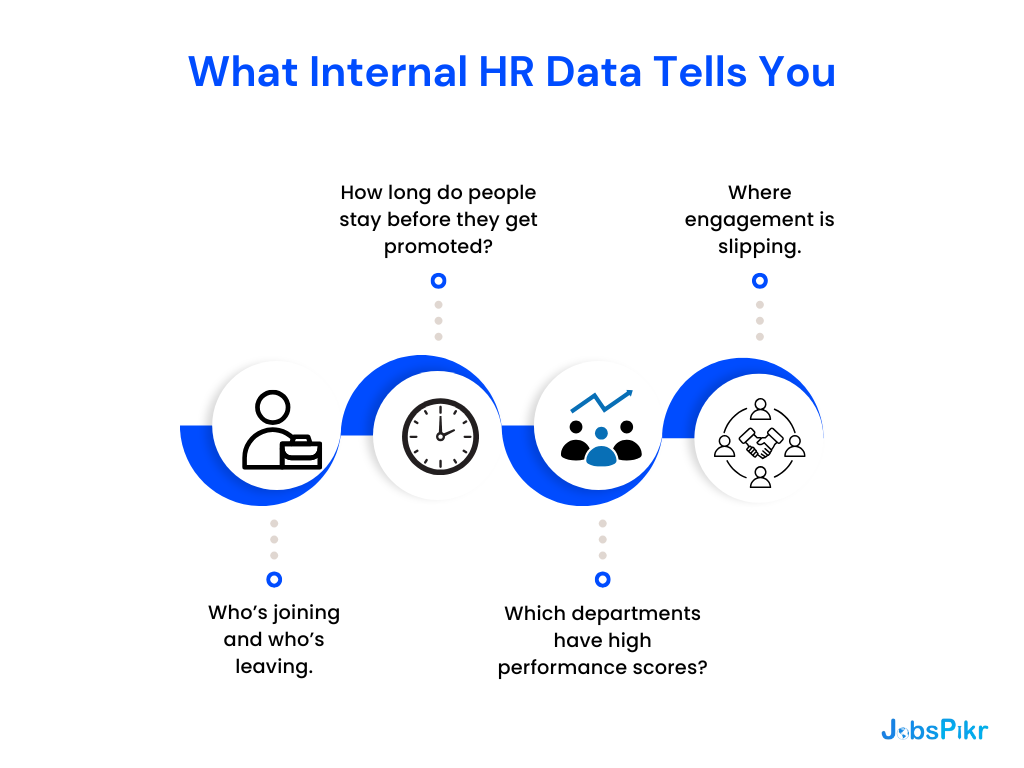
HRIS systems are built for compliance, payroll, and reporting. Learning systems track course completion. Performance systems track output against defined goals.
None of them are designed to monitor shifting workforce trends.
But job postings across your industry are constantly rewriting role expectations in public.
They reveal:
- new tools becoming mandatory
- adjacent skills merging into hybrid roles
- shifting seniority expectations
- geography-based demand spikes
- salary pressure tied to scarcity
If you are not ingesting those signals, your skill gap analysis is blind to external pressure.
That’s how companies end up surprised.
They discover a capability gap only after hiring fails or attrition increases.
The Real Risk Is Strategic Misalignment
A skill-gap is not just about shortage.
It’s about misalignment between internal capability and market evolution.
You may have deep expertise in legacy processes while competitors are building automation layers. You may invest in broad digital literacy while the market demands applied AI workflow capability.
Without external benchmarking, you are optimizing in isolation.
And isolation is dangerous in fast-moving sectors.
The World Economic Forum has repeatedly highlighted that technology adoption is reshaping work structures at speed, with analytical thinking, AI literacy, and technology skills rising in priority for employers globally.
Those shifts are visible in job data before they are visible in performance reviews.
That’s why external talent intelligence functions as an early-warning system.
Turning Raw Job Data into Workforce Intelligence
Collecting job postings manually does not scale.
You need structured, normalized data that allows you to compare:
- role definitions across competitors
- skill frequency trends over time
- demand growth by geography
- workforce availability patterns
- emerging skill clusters within industries
This is where JobsPikr becomes strategic.
JobsPikr aggregates and standardizes job data across markets, transforming unstructured postings into structured workforce intelligence. That structured layer enables you to:
- detect accelerating skills early
- benchmark your role definitions against industry norms
- track regional talent shortage patterns
- build a defensible skill gap heatmap
- support a rolling upskilling forecast
Instead of reacting to hiring friction, you anticipate it.
Instead of debating which training matters, you show where exposure is growing.
From Reactive L&D to Strategic Workforce Planning
When external signals are layered into your workforce planning, three things change.
First, skill gap analysis becomes forward-looking instead of diagnostic.
Second, upskilling investments become tied to market movement rather than internal opinion.
Third, workforce strategy discussions move from “training budget” to “capability risk management.”
That shift is subtle but powerful.
Because once leadership sees the skill-gap as measurable exposure tied to workforce trends and talent shortage signals, the conversation becomes strategic.
Not educational. Not theoretical. Operational.
From Skill-Gap to Competitive Advantage: What to Do Next
At this point, the pattern should be clear.
The skill-gap is not just a training issue.
It’s not just a hiring issue either.
It’s a visibility issue.
When you cannot see how your internal capability compares to external demand, you default to reactive decisions. You hire when projects stall. You train when leaders complain. You redesign roles after productivity drops.
That cycle is expensive.
The alternative is not complexity. It’s clarity.

Step 1: Stop Treating the Skill-Gap as a One-Time Audit
Many organizations run a large skill gap analysis once every year or two. It becomes a presentation deck. Then it fades.
But the market doesn’t move annually.
Workforce trends shift quarter by quarter. New technologies layer into roles quietly. Hiring expectations change before internal frameworks are updated.
If you want your upskilling forecast to stay relevant, you need a continuous signal layer, not a periodic review.
Step 2: Identify Your Top Three Exposure Zones
You don’t need a perfect heatmap to start. You need focus.
Look at your role families and ask:
- Which ones directly support growth initiatives?
- Which ones are already hard to hire?
- Which ones show rising external demand for skills we don’t have at depth?
If three role clusters consistently show widening exposure, that’s your starting point.
A focused response beats a broad training campaign every time.
Step 3: Align Upskilling with Business Milestones
Upskilling works when it’s tied to execution.
If your product roadmap depends on automation capability within 18 months, your upskilling forecast should map to that timeline.
If expansion into new markets requires compliance or analytics capability lift, those skills move up the priority stack.
When L&D is anchored to external workforce trends and internal strategic milestones, it becomes an investment lever, not a support function.
Step 4: Build the External Intelligence Layer
This is where many teams hesitate.
They know they need better visibility. But they lack the infrastructure to track labor market signals at scale.
Manual monitoring is not sustainable. Random benchmarking exercises are not enough.
You need structured job data that shows:
- evolving role definitions
- accelerating skill clusters
- regional talent shortage patterns
- comparative demand across competitors
That is the foundation of a reliable skill gap heatmap.
JobsPikr was built to provide exactly this layer. By transforming raw job postings into structured, comparable labor market intelligence, it allows organizations to benchmark internal skills against real market movement.
The result is simple but powerful:
- Your upskilling forecast stops being opinion-led.
- Your skill gap analysis becomes defensible.
- Your workforce planning becomes forward-looking.
The Real Outcome
Companies that treat the skill-gap as an early signal, not a late symptom, gain leverage.
- They reskill before hiring pressure spikes.
- They redesign roles before productivity drops.
- They allocate learning budgets where capability exposure is highest.
In a market where workforce availability is tightening and skills are evolving faster than org charts, that foresight is not optional.
It’s competitive advantage.
Turning the Skill-Gap into a Strategic Edge
The skill-gap will not close on its own. It will either widen quietly or be managed deliberately.
Organizations that treat it as a reactive training issue will continue to chase demand after it has already shifted. They will hire in overheated markets, retrain too broadly, and redesign roles only after performance slows down.
Organizations that treat it as a measurable exposure gain leverage.
A skill gap heatmap gives you that leverage. It forces clarity on where capability is thinning, where external demand is accelerating, and where workforce availability is tightening. It moves the conversation from “What should we train?” to “Where are we exposed over the next 12–24 months?”
That shift matters.
Because once your upskilling forecast is anchored to workforce trends instead of internal assumptions, budget allocation becomes rational. Role redesign becomes proactive. Hiring becomes strategic rather than desperate.
The skill-gap is not just a talent problem. It is a signal problem.
When you layer structured labor market intelligence into your workforce planning, you stop reacting to symptoms and start managing capability risk in advance.
And in a market where skills are evolving faster than job titles, that foresight is what separates stable organizations from those constantly playing catch-up.
See Where Your Skill-Gap Is Widening Before It Hurts Delivery
Turn external job market signals into a live skill gap heatmap and a defensible upskilling forecast for your industry.
FAQs: Skill-Gap, Upskilling Forecast, and Workforce Intelligence
1. What is a skill-gap and why is it becoming a bigger issue in 2025–2026?
A skill-gap is the difference between what your teams can do today and what the business will need them to do next. The reason it feels worse in 2025–2026 is that roles are changing faster than internal frameworks can keep up. The World Economic Forum has said employers expect 44% of workers’ skills to be disrupted within five years, which is basically a warning that “steady-state capability” is no longer a safe assumption.
In practical terms, this is why you see teams hiring and still struggling. The job gets redefined while you’re still hiring for the older version of it.
2. How is a skill gap heatmap different from a traditional skills matrix?
A skills matrix is an internal snapshot. It tells you what skills you think you have and where you think they sit.
A skill gap heatmap is a comparison tool. It puts your internal view next to what the market is asking for right now. That’s the part most matrices miss. The market changes job requirements quietly, posting by posting, until suddenly your “strong team” is missing key capability depth.
The heatmap makes that drift obvious. It’s less about labeling people and more about spotting where capability risk is building.
3. What should an effective skill gap analysis include?
If your skill gap analysis ends with “here are 60 skills we should train,” it’s not doing its job.
A useful one has three things:
You standardize your internal skills so you’re not comparing messy labels. You bring in external demand signals so you’re not planning in a bubble. Then you rank the gaps so leaders can make trade-offs.
The goal is not to prove you have gaps. Every company has gaps. The goal is to prove which gaps will hurt execution first.
4. How do you build a reliable upskilling forecast?
A reliable upskilling forecast is less about predicting the future perfectly and more about avoiding obvious surprises.
You track which skills are picking up speed in external demand, then check how thin your internal capability is in those areas. After that, you look at timing. If it takes 9–12 months to lift capability and the market has already shifted, you’re late.
That’s why the best upskilling forecasts are rolling. They get revisited quarterly, not once a year. If you treat it like a yearly plan, you’ll keep funding the wrong things.
5. How can external talent intelligence reduce talent shortage risk?
Because it gives you earlier warnings than your hiring pipeline.
Talent shortage usually shows up late. Recruiters struggle, offers get rejected, time-to-fill spikes, and then leaders panic. External talent intelligence lets you see the pattern before it hits your funnel. You can spot rising demand, tightening workforce availability, and shifting role requirements while you still have time to reskill internally or redesign the role.
That’s the difference between “we can’t hire this” and “we saw this coming and built capability ahead of it.”