- Building a Workforce Plan That Anticipates Hiring Needs
- What External Job Data Sees Before Internal Workforce Data Does
- How Workforce Planners Use Job Data to Predict Hiring Needs
- From Hiring Signals to Strategic Workforce Plans
- Job Data Is Not the Same as Workforce Intelligence
- How Workforce Plans Change When Market Signals Are Built In
- Turn market signals into a workforce plan you can rely on
- From Reactive Hiring to Predictive Hiring
- What Workforce Teams Often Get Wrong About Job Data
- Turn market signals into a workforce plan you can rely on
- Why Workforce Intelligence Matters for Long-Term Planning
- Job Data Is the Input. Workforce Intelligence Is the Outcome.
- Turn market signals into a workforce plan you can rely on
- FAQs
Building a Workforce Plan That Anticipates Hiring Needs
Most workforce plans do not fail at the planning stage. They fail during execution. Roles that seemed easy to hire suddenly are not. Skills that were not even discussed become urgent. Hiring costs jump, timelines slip, and teams are forced to react.
The reason is simple. Internal workforce data only shows what has already happened inside the company. It does not show how the job market is changing right now. By the time internal reports highlight a gap, other companies have already started hiring for those roles.
External job data shows these shifts earlier. It reflects what companies are actively trying to hire, where demand is increasing, and which skills are becoming harder to find. When this data is analyzed properly, it helps workforce planning teams forecast hiring needs instead of discovering them late.
The real value is not the job data itself. The value comes from turning that data into workforce intelligence that can shape a more realistic workforce plan.
What External Job Data Sees Before Internal Workforce Data Does
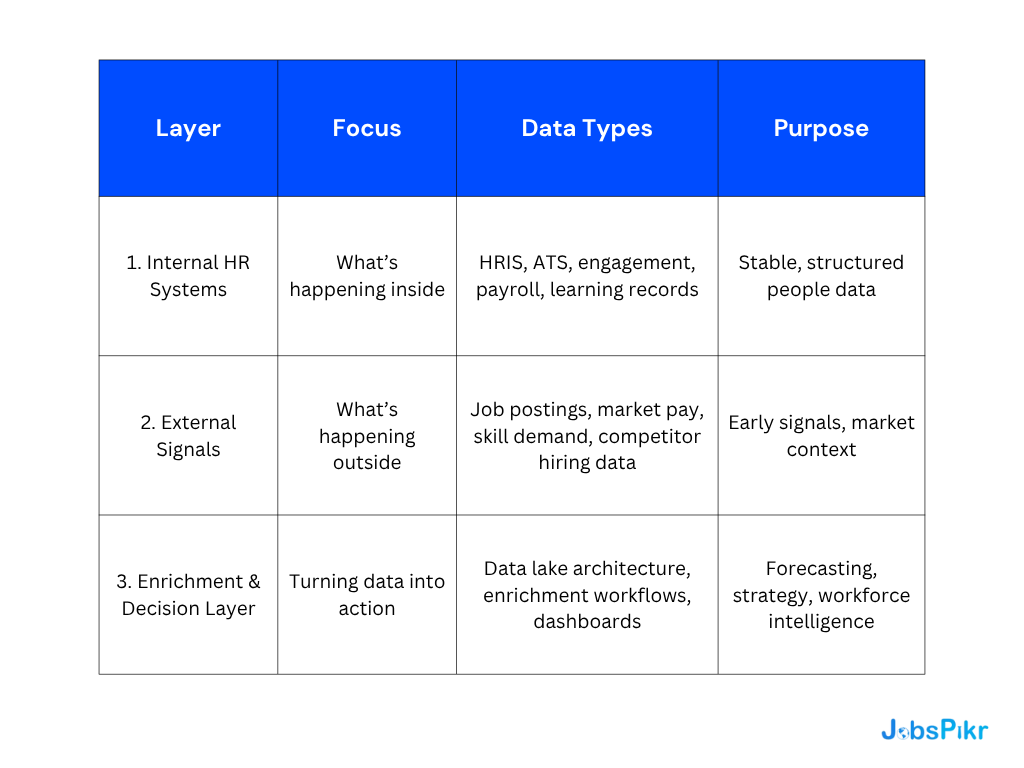
External job data is useful not because it is more detailed, but because it shows movement earlier. It reflects decisions companies are making before those decisions show up as missed targets, delayed hires, or budget overruns. This difference in timing is what makes job data valuable for workforce planning.
Internal data moves only after something breaks
Internal workforce data updates when an event has already happened. A role stays open longer than expected. Hiring targets are missed. Attrition spikes in a team. These are important signals, but they arrive late in the process.
By the time internal reports flag a problem, the market conditions that caused it are already in place. Workforce planning teams are reacting to outcomes, not seeing pressure build.
The market signals appear earlier than the gap
Hiring demand shows up in the market before it shows up in headcount or attrition numbers. Companies do not post jobs on impulse. Roles are approved, budgets are cleared, and skill requirements are agreed on well before a job appears publicly.
When multiple companies start posting for similar roles within a short window, that is not coincidence. It is demand forming. Internal workforce data has no way to capture this stage.
Recruiters feel it first, but plans rarely change
Recruiters usually notice the shift before anyone else. Roles take longer to close. Candidate expectations change. Skills that were common last year are suddenly harder to find.
These signals are real, but they are informal. Without data to back them up, they are often dismissed as temporary or anecdotal. Workforce plans stay the same until the problem becomes impossible to ignore.
Job data turns market noise into something usable
External job data shows what roles are being hired for right now, where hiring activity is increasing, and which skills are starting to repeat across companies and locations.
On its own, a single posting does not matter. Patterns do. Frequency does. Spread does. When the same roles and skills appear again and again across the market, that is not noise. That is a signal.
This is what internal workforce data cannot show. It does not capture intent. It captures results.
When workforce planners look at external job data this way, they are no longer guessing whether the market is changing. They can see it happening.
How Workforce Planners Use Job Data to Predict Hiring Needs
Once workforce teams start looking outside their own data, the question changes. It is no longer “what happened last quarter,” but “what is starting to happen now.” This is where job data becomes practical, not theoretical.
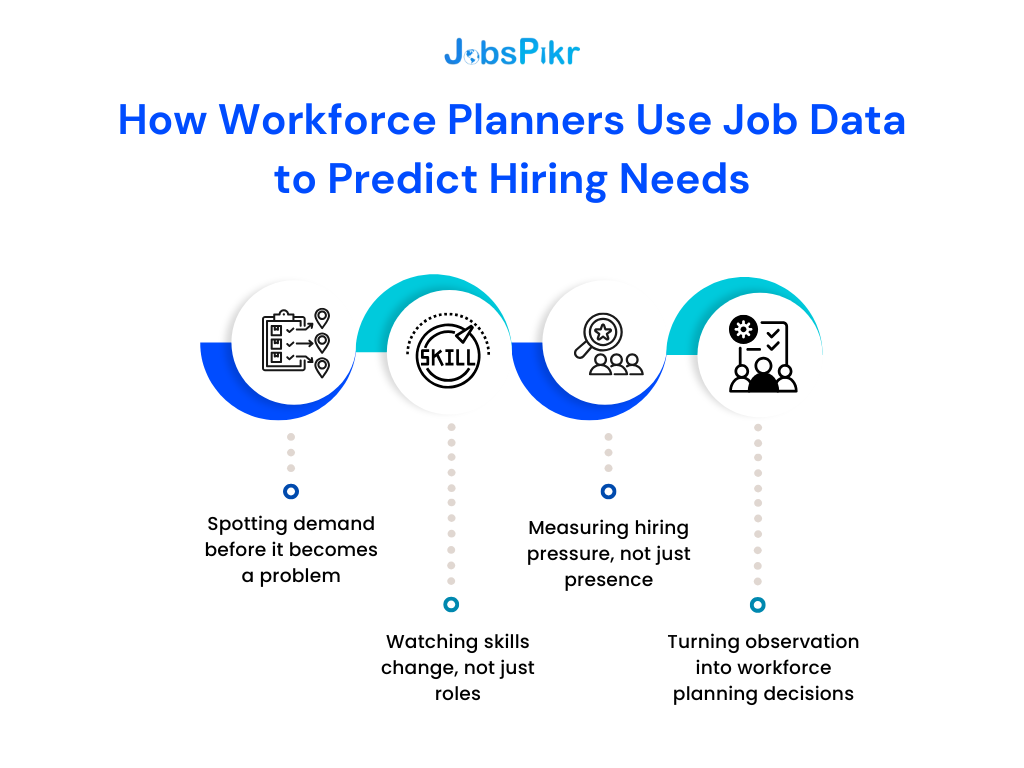
Spotting demand before it becomes a problem
Workforce planners do not wait for a role to become hard to hire internally. They watch for early signs in the market. When the same role starts appearing more frequently across companies, that is usually the first hint. It does not mean an immediate hiring spike, but it does suggest that demand is building.
Seeing this early gives planners time. Time to flag a role as higher risk. Time to talk to recruiting about pipeline readiness. Time to pressure-test whether current hiring targets are still realistic.
Watching skills change, not just roles
Roles often look stable on paper while the skills inside them change quietly. A job title might stay the same, but the requirements inside the description start shifting. New tools appear. Old ones disappear. Experience expectations creep up.
Job data makes these shifts visible. When certain skills start showing up repeatedly across postings, planners can see where the market is heading. This helps them anticipate gaps that internal skills inventories have not caught yet.
Instead of reacting when teams say, “we cannot find this skill anymore,” workforce planning can adjust earlier, either by planning new hires, reskilling programs, or location changes.
Measuring hiring pressure, not just presence
One job posting does not say much. Hiring pressure shows up through patterns. How often the role is posted. How long it stays open. How widely it is posted across regions or job boards.
Workforce planners use these signals to judge intensity. A role that is posted once in a niche market is different from a role that is being hired across multiple locations by many companies at the same time. The second scenario usually means competition will increase quickly.
This helps planners prioritize. Not every role deserves the same level of attention. Job data helps separate background noise from roles that are likely to cause hiring delays later.
Turning observation into workforce planning decisions
The goal is not to monitor the market endlessly. The goal is to feed these signals back into the workforce plan. Roles get reclassified as higher risk. Hiring timelines are adjusted. Budgets are revisited before pressure peaks.
This is how job forecasting becomes useful. It is not about predicting exact numbers. It is about reducing surprise. Workforce planning becomes less about explaining why things went wrong and more about adjusting early enough to keep plans realistic.
From Hiring Signals to Strategic Workforce Plans
Spot talent risk early, benchmark supply-demand shifts, and align headcount planning with live market intelligence.
Job Data Is Not the Same as Workforce Intelligence
At this point, many workforce teams feel they are doing the right thing. They look at job postings. They scan competitor career pages. They hear updates from recruiting. And yet, planning outcomes do not improve much.
The problem is not intent. It is the gap between seeing job data and being able to use it.
Raw job data is messy. Titles are inconsistent. Skills are listed differently for the same role. Some postings stay live for months. Others disappear and reappear. If you look at this data one posting at a time, it is easy to draw the wrong conclusions or give up entirely.
| Raw Job Data | Workforce Intelligence |
| Individual job postings viewed in isolation | Market-wide hiring patterns analyzed over time |
| Inconsistent titles and skill descriptions | Normalized roles and standardized skills |
| Easy to misread or dismiss as noisy | Structured signals that show real demand shifts |
| Focuses on what is posted | Focuses on what demand is forming |
| Hard to connect to planning decisions | Directly informs workforce plans and risk assessment |
| Useful for observation | Useful for prediction and action |
This is where most teams get stuck.
Workforce intelligence starts where raw job data stops. Instead of looking at individual postings, it looks at patterns over time. It normalizes roles so that “Senior Data Analyst,” “Lead Data Analyst,” and “Analytics Specialist” are treated as part of the same demand signal. It groups skills so that small wording differences do not hide larger trends.
It also adds context. A rise in postings means something very different depending on the industry, location, company size, and time period. Without that context, job data looks noisy. With it, hiring demand becomes easier to interpret.
This is the shift JobsPikr enables. Not access to job postings, but the ability to translate hiring activity into signals that workforce planning teams can use. Signals that show whether demand is temporary or sustained. Signals that show whether a skill is emerging or already saturated. Signals that can be tracked over time, not just observed once.
When workforce planners work with workforce intelligence instead of raw job data, conversations change. Plans are debated using market evidence, not gut feel. Risks are flagged earlier. Assumptions are challenged before they become problems.
The difference matters because workforce planning is not about being perfectly right. It is about being less surprised. Job data is the input. Workforce intelligence is what turns that input into something planning teams can act on.
How Workforce Plans Change When Market Signals Are Built In
Once external market signals are part of workforce planning, the plan itself starts to look different. Not more complex. More realistic.
Plans built only on internal data tend to assume stability. Hiring volumes are spread evenly. Timelines feel predictable. Risk is discussed, but rarely quantified. The plan works as long as the market behaves the way it did last year.
When market signals are added, assumptions get tested earlier.
Roles are no longer treated as equal. Some are flagged as low risk because market supply is stable. Others are marked as fragile because demand is rising outside faster than internal hiring capacity. This changes how teams prioritize attention and budget, even before hiring starts.
Timelines also shift. Instead of assuming standard time-to-hire across roles, planners adjust expectations based on what is happening in the market. Roles facing heavy competition get longer runways. Backup options are discussed sooner, not after targets are missed.
Location strategy becomes more deliberate. Market data shows where hiring is concentrated and where it is not. Workforce plans that include these signals are less likely to default to the same few locations without questioning whether those markets are already saturated.
Perhaps the biggest change is how plans are reviewed. Conversations move away from defending last year’s numbers and toward discussing risk. When questions come from finance or leadership, planners can point to market behavior, not just internal history.
This does not make workforce plans perfect. Markets still change. But it reduces blind spots. Instead of being surprised by hiring pressure, teams see it coming and adjust while there is still room to act.
Turn market signals into a workforce plan you can rely on
See how workforce intelligence helps planning teams spot hiring risk early and adjust before execution breaks down.
From Reactive Hiring to Predictive Hiring
Most organizations say they plan. In practice, hiring still reacts to pressure.
| Reactive Hiring | Predictive Hiring |
| Hiring starts when a role becomes urgent | Hiring starts before pressure builds |
| Decisions made under time and budget stress | Decisions made with time to evaluate options |
| Compensation and profiles adjusted late | Profiles and expectations set earlier |
| Recruiters and hiring managers flag problems | Workforce planners flag risks in advance |
| Trade-offs are rushed | Trade-offs are discussed deliberately |
| Workforce plan explains misses after the fact | Workforce plan anticipates where misses may happen |
A role takes too long to close, so more recruiters are added. Compensation is adjusted after candidates start dropping out. New skills are approved only after teams complain they cannot deliver without them. These are all responses to problems that are already visible.
Predictive hiring changes the timing.
When workforce planning includes market signals, teams stop waiting for roles to break before acting. They can see which roles are likely to tighten months in advance and treat them differently from the start. That might mean opening those roles earlier, planning a larger pipeline, or approving alternate profiles before hiring managers feel the pain.
This also changes how trade-offs are made.
In reactive hiring, decisions are rushed. Teams choose between speed and quality under pressure. In predictive hiring, those trade-offs are discussed earlier, when there is still room to decide. Workforce planners can ask whether a role should be hired in a different location, whether adjacent skills can work, or whether internal mobility is a better option.
Another shift is confidence. Predictive hiring does not rely on instinct alone. When planners can point to sustained market demand or rising skill scarcity, recommendations carry more weight. Conversations with finance and leadership become grounded in evidence instead of urgency.
This is especially important for roles that do not look critical until it is too late. Emerging roles, hybrid roles, and skills that cut across functions often get missed in traditional planning. Market signals surface these patterns earlier, before they turn into hiring bottlenecks.
Predictive hiring does not eliminate uncertainty. It reduces surprise. Workforce plans stop being static documents and start acting more like living models that adjust as the market changes.
What Workforce Teams Often Get Wrong About Job Data
By this stage, most workforce planning teams agree that external signals matter. Where things go off track is in how job data is interpreted and used. A few common assumptions quietly limit its value.
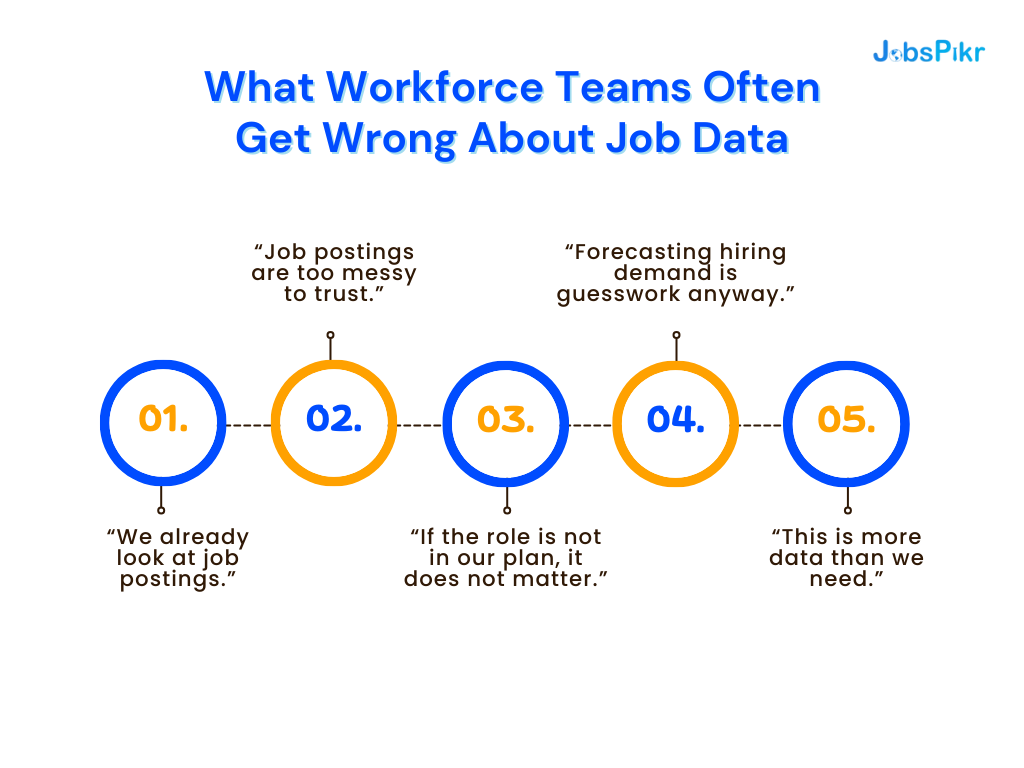
“We already look at job postings.”
Looking at postings occasionally is not the same as using job data. Skimming a few competitor roles or checking a job board when a role feels hard does not create a usable signal. It creates impressions.
Job data only becomes useful when it is tracked consistently and over time. Without that history, it is impossible to tell whether demand is new, seasonal, or already cooling off. One snapshot rarely tells the full story.
“Job postings are too messy to trust.”
They are messy. That is not the problem.
The mistake is assuming messiness makes the data unusable. Titles vary. Skills are written differently. Some postings stay open longer than they should. This is exactly why raw job data needs structure. When roles and skills are normalized, patterns emerge quickly.
Ignoring job data because it is imperfect usually means relying on internal data that is already outdated.
“If the role is not in our plan, it does not matter.”
This is one of the most expensive assumptions.
New roles and hybrid roles often show up in the market long before they appear in internal planning documents. When teams ignore them because they are “not approved yet,” they miss early signals of where work is heading.
By the time these roles are officially added to the workforce plan, competitors may already be hiring at scale.
“Forecasting hiring demand is guesswork anyway.”
Forecasting exact numbers is hard. That does not mean forecasting direction is useless.
Workforce planning does not need perfect predictions. It needs early warnings. Job data does not tell you exactly how many people you will hire. It tells you where pressure is building, which roles are becoming risky, and where assumptions deserve a second look.
Teams that dismiss forecasting entirely usually end up reacting late and explaining why.
“This is more data than we need.”
More data is not the goal. Better signals are.
When job data is turned into workforce intelligence, planners do not spend time digging through noise. They spend time deciding what to do differently. That is the point. Less surprise. Fewer last-minute changes. A workforce plan that reflects the market it operates in.
Turn market signals into a workforce plan you can rely on
See how workforce intelligence helps planning teams spot hiring risk early and adjust before execution breaks down.
Why Workforce Intelligence Matters for Long-Term Planning
Short-term hiring pressure is easy to see once it arrives. Long-term risk is not. This is where many workforce plans struggle.
Most planning processes are still built to answer near-term questions.
- How many people do we need this year?
- Which roles are approved?
- What budget can we support?
Those questions matter, but they do not explain how work itself is changing over time.
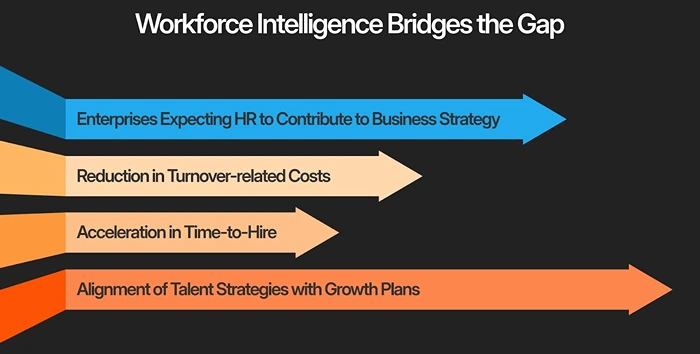
Workforce intelligence helps with that shift in horizon.
When job data is tracked consistently across months and years, patterns start to hold. Certain roles expand across industries, not just within one company. Skills move from niche to expected. Locations gain or lose relevance as hiring concentrates or spreads. These changes do not show up in a single planning cycle, but they shape future workforce needs.
This matters for decisions that cannot be reversed quickly.
Location strategy is one example. Opening or closing hiring markets is not a quarterly adjustment. Workforce intelligence shows whether demand is growing in a region or already saturated before those commitments are made.
Skills strategy is another. Reskilling programs, build-versus-buy decisions, and automation investments all depend on understanding where talent supply and demand are heading. Internal skills data shows what exists today. Workforce intelligence shows where the market is pulling tomorrow.
It also changes how planning teams work with leadership.
Long-term workforce decisions are easier to support when they are grounded in external reality, not just internal projections. Market signals provide a shared reference point. They help align workforce planning with business strategy, technology roadmaps, and financial planning.
This is especially important as organizations think about analytics and automation. Models are only as useful as the data feeding them. Workforce intelligence creates a stronger foundation for forecasting, scenario planning, and future-looking decisions, without turning planning into a black box.
Job Data Is the Input. Workforce Intelligence Is the Outcome.
Workforce planning does not fail because teams lack effort or intent. It fails because plans are built using signals that arrive too late to be useful.
Internal data will always matter. Headcount, attrition, and internal mobility explain what has already happened and what is possible today. But they do not explain how the labor market is changing outside the organization, or where hiring pressure is forming next.
External job data fills that gap, but only when it is used correctly. On its own, it is just activity. When it is structured, normalized, and tracked over time, it becomes workforce intelligence. That intelligence helps planning teams see demand earlier, question assumptions sooner, and adjust before hiring gaps turn into emergencies.
This is the shift workforce planning teams are making. From static plans to living models. From reacting to shortages to anticipating them. From explaining surprises to reducing them.
Job data is the input. Workforce intelligence is what turns that input into a workforce plan that holds up when the market does not stay still.
Turn market signals into a workforce plan you can rely on
See how workforce intelligence helps planning teams spot hiring risk early and adjust before execution breaks down.
FAQs
How does external job data improve a workforce plan?
It helps teams see hiring pressure forming outside the company before it turns into missed targets or delayed roles.
What role does job forecast play in workforce planning?
It helps planners spot which roles are likely to get harder to hire, so the plan can be adjusted earlier.
Can job data really predict hiring needs?
It does not give exact numbers. It shows where demand is picking up, which is usually enough to plan.
What is the difference between job data and workforce intelligence?
Job data shows activity. Workforce intelligence makes that activity usable for planning.
Who should use job data when building a workforce plan?
Teams responsible for workforce planning, hiring strategy, or long-term talent decisions.