


- **TL;DR**
- How Sourcing Strategies Impact the Recruitment Process?
- See Strategic Sourcing Powered by Real-Time Talent Intelligence
- Best Practices for an Effective Strategic Sourcing Process
- How Technology is Transforming Sourcing Strategies?
- Skills-Based Sourcing in 2026
- See Strategic Sourcing Powered by Real-Time Talent Intelligence
- Global and Remote Talent Sourcing
- Measuring ROI of Sourcing Strategies
- How JobsPikr’s Data Solutions Enhance Sourcing Efficiency?
- Building a Future-Ready Strategic Sourcing Process
- See Strategic Sourcing Powered by Real-Time Talent Intelligence
- FAQs
**TL;DR**
Modern talent acquisition is no longer reactive. The most successful companies build a structured strategic sourcing process supported by data, automation, and real-time labor market intelligence. Strong sourcing strategies help organizations reduce time-to-hire, lower cost-per-hire, engage passive candidates, and improve long-term retention.
This guide breaks down how to design high-impact sourcing strategies, apply best practices in a strategic sourcing process, leverage AI and workforce analytics, and use real-time labor market intelligence platforms like JobsPikr to stay ahead of hiring competition.
Talent sourcing and recruitment in today’s world require data driven sourcing strategies to constantly compete in the hunt for talented individuals. Developing a carefully thought out strategic sourcing process enables a business to effectively search for, engage, and hire the ideal candidates while controlling expenses and improving efficiencies in recruitment.
Talent willing to consider other career options is passive by nature. That means in order for companies to attract the very best talent, business owners need to actively engage with top employees rather than wait for them to apply. Moreover, McKinsey has shown that technology-enabled sourcing strategies reduce time taken to hire by 35%, as well as decrease cost-per-hire by 25%.
This article examines sourcing strategies, their impact in the recruitment cycle, best practices in the strategic sourcing process, the impact of technology-enabled sourcing, and how JobsPikr’s cloud-based data solutions for sourcing enhance efficiency.
How Sourcing Strategies Impact the Recruitment Process?
Contrary to traditional perspectives, recruitment today is much more active in nature, as companies now need to continuously improve their sourcing strategies to attract the best employees. The recruitment landscape has changed from the posting of a job advertisement to using a variety of options. Strategic sourcing process deepens the talent pool of organizations and enables them to capture the best available talent before competitors do. Adopting precise sourcing strategies boosts the hiring efficiency while reducing costs and improving the workforce quality.

What are Sourcing Strategies?
Sourcing strategies describe the detailed steps that recruiters and human resource managers undertake to attain desirable candidates for their organizations. Proactive measures taken to fill positions within an organization include but are not limited to advertising on job boards, social media, company website, and brand-related events.
Why Are Sourcing Strategies Important in Recruitment?
A strong competitive advantage for a business that operates in a high talent market is achieved with the implementation of clearly defined strategies. By implementing sourcing strategies, organizations are guaranteed to have access to skilled talents in different industries.
According to a survey by LinkedIn Talent Solutions, businesses that implement structured human resources (HR) sourcing plans claim that they spend 35% less time hiring and receive 40% better quality of employees. In addition, proactive employers are able to engage with passive candidates as much as 60% more than those who only rely on advertising a position.
Besides, passive candidates are often top performers in their organizations because they appreciate the way they have been recruited which increases the likelihood of retention. When recruiters focus on business objectives, they achieve greater value for money and better-managed workforce requirements.
The effectiveness of HR sourcing strategies affects the success of a company’s recruitment in the following ways:
- Outreach to passive candidates and niche job seekers increases the candidate pool.
- The most qualified candidates who are guaranteed to add value to the business are the only ones in the pipeline.
- Targeted outreach makes it possible to streamline the recruitment process which makes it faster.
- Branding the company makes it more desirable among job applicants.
- Improved targeting of potential candidates reduces the cost-per-hire.
A Gartner workforce study reported that 30% of companies that implemented structured sourcing strategies claimed greater success in hiring while 45% had better retention rates.
See Strategic Sourcing Powered by Real-Time Talent Intelligence
Discover how JobsPikr helps you map skills demand, track hiring competition, and reduce time-to-hire with data-backed precision..
Best Practices for an Effective Strategic Sourcing Process
Within contemporary recruitment, strategic sourcing processes stand as a cornerstone feature that helps companies form a pool of candidates who could fill their long-term skill gaps. In contrast to hiring in response to a vacancy, companies are able to forecast their hiring needs, maintain a friendly rapport with ideal candidates, and expedite their hiring processes through strategic sourcing.
A Gartner workforce report cited by Oxford shows that companies with a defined-strategic sourcing process achieve strategic sourcing 50% stronger hiring and 25% lower cost-per-hire. Following best practices also helps organizations guarantee results from their efforts.
What is the Strategic Sourcing Process?
A strategic sourcing process is defined as a procedure that HR personnel and recruiters develop and implement to search for, contact, and obtain the best candidate for a given position. It incorporates determining the most important and most needed workforce requirements, establishing a defined set of targets, and applying an analyzed approach to recruitment.
Best Practices for an Effective Strategic Sourcing Process
- Define Workforce Needs and Hiring Goals
- Examine business goals to qualify and quantify hiring needs in terms of skills.
- Develop workforce modeling forecasts to project for future requirements.
- Use Multi-Channel Talend Sourcing
- Maximize the use of job sites, LinkedIn, employee networking, and various referral sources.
- Proactively contact and engage passive candidates via social media and talent community forums.
- Incorporate Data-Driven Sourcing Decisions
- Utilize AI-driven analysis to pinpoint exceptional candidates.
- Analyzing industry requisition practices and pay rates should be done for proper sourcing optimization.
- Enhance Candidate Experience with Personalization
- Deploy outreach campaigns geared toward the unique interests of candidates.
- Improve engagement through enhanced job and career advancement clarity.
- Implement a Candidate Relationship Management (CRM) System
- Create a repository of already vetted candidates for potential hiring in the future.
- Cultivate relationships with selected candidates over an extended period of time to facilitate hiring processes.
A Forrester talent acquisition report revealed that companies employing strategic sourcing methods had a 40% reduction in time-to-fill and 25% decrease in cost-per-hire.
How Technology is Transforming Sourcing Strategies?
The explosion of recruitment marketing technology, especially HR software and AI-powered recruitment tools, has dramatically altered the ways organizations source and contact potential candidates. Business data analytics, automation, and artificial intelligence enable organizations to optimize the strategic sourcing process in a more rapid, precise, and economical manner.
A Deloitte HR Technology survey found that 80% of organizations using AI-powered sourcing tools reported a 35% increase in candidate quality and a 28% reduction in hiring time. These numbers highlight the importance of integrating technology-driven sourcing strategies into the recruitment process to stay ahead in today’s competitive hiring market.
The Role of Effective Technology In Strategic Sourcing
Recruiters can enhance their sourcing methods with the use of strategic sourcing software and HR sourcing platforms, where AI, automation, and big data analytics also play a role.

Top Technology-Driven Sourcing Strategies for Better Hiring
- AI-Powered Candidate Matching
- Uses machine learning algorithms to match candidates based on skills, experience, and job fit.
- Reduces sourcing time by 35% by identifying top-qualified applicants faster.
- Predictive Hiring Analytics
- Forecasts candidate availability, hiring demand, and skill shortages.
- Improves sourcing efficiency by enabling data-driven recruitment decisions.
- Automated Resume Screening
- Speeds up the process of analyzing candidate profiles and job applications.
- Eliminates manual resume filtering, reducing hiring bias.
- Data-Driven Market Intelligence
- Tracks global workforce trends, hiring patterns, and salary benchmarks.
- Helps businesses align compensation strategies with market standards.
- Chatbots and AI Assistants for Candidate Engagement
- Automates candidate communication, improving response times and engagement rates.
- Ensures 24/7 candidate interaction, enhancing the recruitment experience.
The Statista HR Report finds that 63% of businesses believe using AI-powered sourcing tools improves the hiring process and quality of candidates for the position.
Skills-Based Sourcing in 2026
By 2026, skills-based hiring is no longer an emerging trend — it is becoming the default foundation of effective sourcing strategies.
Organizations are shifting away from rigid degree requirements and job titles toward validated skills, demonstrated capabilities, and adjacent competencies. This shift is largely driven by rapid technology adoption, shorter skill life cycles, and the growing gap between traditional qualifications and real-world job demands.
In practical terms, this means the strategic sourcing process now starts with skills mapping, not job descriptions.
What’s Changing in 2026?
- From Job Titles to Skill Clusters
Instead of searching for “Senior Data Analyst,” recruiters break roles into required skills such as SQL, data visualization, statistical modeling, and stakeholder communication. This widens the talent pool and improves match accuracy. - Transferable Skill Targeting
Companies are identifying adjacent talent pools. For example, cybersecurity analysts may transition into cloud security roles with minimal upskilling. Strong sourcing strategies now account for skill adjacency rather than exact job history. - Micro-Credentials and Certifications Matter More
Short-form certifications, project portfolios, and verified skill badges are gaining weight in candidate evaluation. The strategic sourcing process increasingly integrates skills validation signals into screening criteria. - Data-Driven Skills Intelligence
Real-time labor market data helps recruiters understand which skills are rising, which are declining, and where supply shortages exist. This enables sourcing strategies that are forward-looking rather than reactive.
Why Skills-Based Sourcing Strengthens the Strategic Sourcing Process
A skills-first approach:
- Expands the accessible talent pool
- Reduces unnecessary qualification barriers
- Improves diversity outcomes
- Increases hiring agility
- Shortens time-to-fill in high-demand roles
Most importantly, skills-based sourcing aligns recruitment with business capability needs — not just hiring volume.
In 2026, organizations that embed skills intelligence into their strategic sourcing process will build more adaptable, future-ready workforces.
See Strategic Sourcing Powered by Real-Time Talent Intelligence
Discover how JobsPikr helps you map skills demand, track hiring competition, and reduce time-to-hire with data-backed precision..
Global and Remote Talent Sourcing
In 2026, the question is no longer “Can we hire remotely?” It’s “Why are we still limiting ourselves geographically?”
The most competitive organizations have stopped viewing location as a constraint. Instead, geography has become a strategic lever inside their sourcing strategies. Access to talent is now global by default — and companies that fail to adapt their strategic sourcing process risk competing for the same shrinking local pools as everyone else.
What has changed is not just remote work policy — it’s talent economics.
In high-demand domains like AI, advanced analytics, cloud infrastructure, and cybersecurity, local supply often cannot meet hiring velocity. When sourcing remains geographically restricted, time-to-fill increases, compensation inflates, and hiring quality may decline under pressure. Expanding the talent lens globally reshapes that equation.
But global sourcing is not about simply posting remote jobs.
A mature strategic sourcing process begins with labor market intelligence. Before entering a new geography, companies must understand:
- Skill density in that region
- Competitive hiring activity
- Compensation benchmarks
- Talent churn rates
- Regulatory complexity
Without this data, global sourcing becomes risky. With it, it becomes strategic.
For example, certain regions may show rising concentrations of cloud engineers due to local tech investments or university pipelines. Others may have high demand but low supply, driving compensation volatility. Strong sourcing strategies evaluate these signals before building pipelines.
There is also a cost-discipline dimension. Global hiring is not about chasing lower wages — it’s about optimizing value. Real-time market data allows companies to align compensation fairly while maintaining margin control. This intelligence strengthens the strategic sourcing process by making global expansion predictable rather than reactive.
However, distributed hiring introduces new performance variables. Cultural alignment, time-zone coordination, collaboration infrastructure, and compliance frameworks all influence long-term success. Organizations that embed these considerations early into their sourcing strategies avoid downstream operational friction.
The real shift in 2026 is strategic mindset. Global sourcing is no longer an emergency response to talent shortages — it is an integrated component of workforce planning.
Forward-looking companies now treat geographic talent mapping the same way they treat skills mapping. They continuously analyze where emerging talent hubs are forming, where hiring competition is accelerating, and where skill surpluses may exist. This insight feeds directly into their strategic sourcing process.
The result is a more resilient talent model.
Instead of competing for a limited local supply, companies build distributed pipelines. Instead of reacting to shortages, they anticipate them. Instead of overpaying under pressure, they align compensation with real market signals.
Global and remote hiring are not temporary shifts. They are structural evolutions in how sourcing strategies operate. And in 2026, the organizations that win are those that know not only who to hire — but where to look, backed by data.
Measuring ROI of Sourcing Strategies
For years, sourcing was treated as an activity — not a performance engine. Recruiters reached out, pipelines were built, and hires were made. But leadership often struggled to answer a simple question:
Are our sourcing strategies actually delivering measurable business value?
In 2026, that question is no longer optional.
As talent acquisition becomes more data-driven, the strategic sourcing process must demonstrate ROI with the same rigor as marketing, sales, or operations. Sourcing is no longer judged by effort — it is judged by outcomes.
Moving Beyond Vanity Metrics
Many teams still rely on surface-level indicators such as number of profiles sourced or outreach messages sent. These activity metrics do not reflect impact.
A mature strategic sourcing process instead tracks metrics that connect directly to business performance:
- Time-to-source: How long does it take to build a qualified shortlist?
- Cost-per-qualified-candidate: What is the real cost of generating viable talent?
- Pipeline conversion rate: How many sourced candidates move through each hiring stage?
- Offer acceptance rate: Are sourcing strategies attracting aligned candidates?
- Retention of sourced hires: Do proactively sourced candidates stay longer?
These indicators reveal whether sourcing strategies are improving workforce quality or simply increasing volume.
The Financial Lens on Sourcing
When sourcing is optimized, financial impact becomes visible.
A reduced time-to-fill lowers productivity loss. Better candidate matching decreases turnover costs. More accurate salary benchmarking prevents overpayment. Stronger engagement improves acceptance rates and reduces renegotiation cycles.
A well-executed strategic sourcing process directly influences:
- Revenue continuity
- Workforce stability
- Hiring predictability
- Budget efficiency
This is why sourcing ROI must be measured holistically — not just at the hiring stage, but across the employee lifecycle.
The Role of Talent Intelligence in ROI Measurement
ROI measurement becomes significantly more accurate when sourcing strategies are supported by labor market intelligence.
For example:
- If market data shows a rising skill shortage, proactive sourcing may prevent inflated compensation later.
- If competitor hiring activity spikes, early pipeline building reduces hiring lag.
- If certain regions show strong skill density, shifting sourcing focus may lower cost-per-hire.
These insights strengthen the strategic sourcing process by linking external market signals with internal hiring performance.
Why ROI Tracking Strengthens the Strategic Sourcing Process
When sourcing is measurable, it becomes strategic.
Teams can compare channels, refine outreach models, reallocate budgets, and continuously optimize performance. Leadership gains visibility into hiring efficiency. Recruitment shifts from reactive fulfillment to proactive workforce investment.
In 2026, the most advanced organizations treat sourcing strategies as growth levers. They measure them, refine them, and tie them directly to business KPIs.
Because ultimately, a strategic sourcing process is not successful simply because it fills roles — it is successful when it delivers measurable, sustainable workforce advantage.
How JobsPikr’s Data Solutions Enhance Sourcing Efficiency?
Today’s recruitment processes thrive on big data and AI. It becomes increasingly important to have actionable insights of the labor market when formulating sourcing strategies. JobsPikr’s data solutions provide recruiting and procurement professionals with accurate and timely job market forecasts, data, and information, thereby improving strategic sourcing.
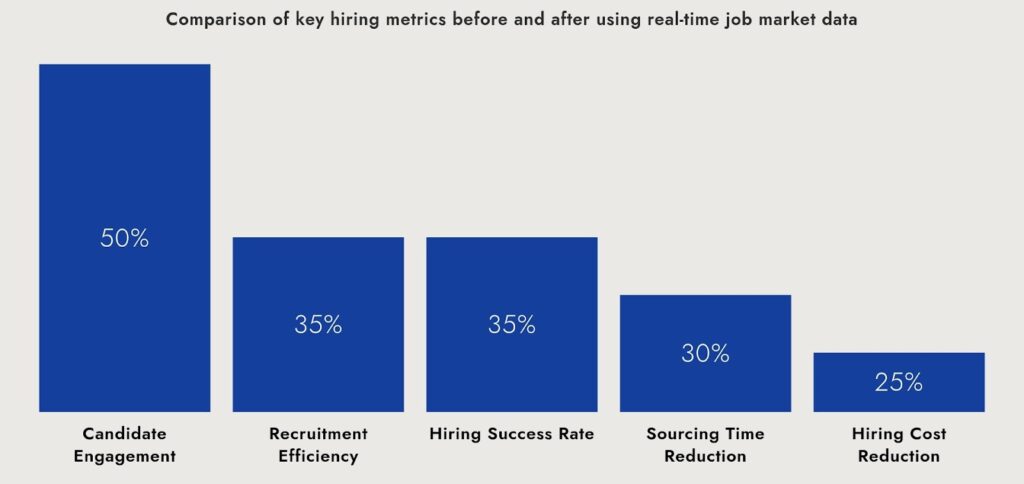
Organizations can improve their candidate targeting, job market trend analysis, and salary benchmarking with the competitive intelligence augmented by JobsPikr’s AI-powered data insights. A particular report released by Statista workforce trends has shown that businesses utilizing real-time workforce analytics experience a 50% increase in candidate engagement and a 35% improvement in recruitment success rates.
Why Choose JobsPikr for Strategic Sourcing?
Real-time job market insights and sourcing intelligence offered by JobsPikr help recruiters and procurement professionals enhance their hiring processes.
Key Features of JobsPikr’s Sourcing Solutions:
- Real-Time Job Market Data
- Tracks hiring trends, in-demand job roles, and competitive recruitment strategies.
- Helps recruiters identify top talent pools for efficient hiring.
- AI-Powered Talent Intelligence
- Uses machine learning algorithms to analyze job data across industries.
- Provides predictive analytics for workforce planning.
- Comprehensive Salary Benchmarking
- Compares industry salaries, benefits, and compensation trends.
- Ensures businesses remain competitive in their salary offerings.
- Competitive Hiring Insights
- Monitors competitor hiring strategies and recruitment patterns.
- Helps businesses stay ahead by refining their sourcing strategies.
Business Impact of Using JobsPikr for Sourcing Strategies
- 30% reduction in sourcing time, leading to faster talent acquisition.
- 25% decrease in hiring costs through targeted recruitment campaigns.
- 40% improvement in candidate-job matching accuracy due to AI-driven insights.
According to a LinkedIn Workforce Report, firms that utilize real time sourcing intelligence are able to increase engagement with potential applicants by 50% and improve recruitment efficiency.
Building a Future-Ready Strategic Sourcing Process
A strategic sourcing process is essential for businesses looking to optimize talent acquisition, enhance recruitment efficiency, and gain a competitive edge. By leveraging technology-driven sourcing strategies, organizations can reduce time-to-hire, improve sourcing accuracy, and lower recruitment costs.
With AI-driven talent intelligence, businesses can integrate real-time hiring insights and predictive workforce analytics into their recruitment strategies. JobsPikr’s data solutions provide recruiters and procurement teams with accurate, data-driven sourcing intelligence to make informed hiring decisions.
For companies looking to enhance their sourcing strategies with market intelligence, JobsPikr offers the best AI-powered talent acquisition solutions. Sign up on JobsPikr today to access data-driven sourcing insights and optimize your recruitment strategies!
See Strategic Sourcing Powered by Real-Time Talent Intelligence
Discover how JobsPikr helps you map skills demand, track hiring competition, and reduce time-to-hire with data-backed precision..
FAQs
What is the difference between sourcing strategies and recruitment?
Recruitment typically begins when a vacancy opens. Sourcing strategies are proactive methods used to identify and engage talent before roles become urgent. A strategic sourcing process supports recruitment by building long-term pipelines.
Why is a strategic sourcing process important?
A structured strategic sourcing process improves hiring speed, reduces costs, enhances candidate quality, and aligns hiring with workforce planning goals.
How can data improve sourcing strategies?
Labor market data reveals skill demand, salary benchmarks, and geographic talent availability. Data-driven sourcing strategies allow recruiters to target the right candidates efficiently.
How do you measure the success of sourcing strategies?
Key metrics include time-to-source, cost-per-qualified-candidate, pipeline conversion rate, offer acceptance rate, and retention of sourced hires.
What are common challenges in implementing a strategic sourcing process?
Challenges include lack of data integration, limited workforce forecasting, inconsistent outreach, and inadequate measurement frameworks.
How does JobsPikr support sourcing strategies?
JobsPikr provides real-time job postings intelligence, salary benchmarks, and hiring trend insights that strengthen the strategic sourcing process and improve hiring precision.