
- **TL;DR**
- See JobsPikr in action
- 5 Tech-Driven Hiring Trends Reshaping Talent Acquisition in 2025
- Hiring Trends Reshaping Talent Acquisition
- Talent Intelligence Platforms: The New Nerve Center for Strategic Hiring
- See JobsPikr in action
- From Job Descriptions to Capability-Based Role Design
- From Job Descriptions to Capability-Based Role Design (Reflecting 2025 Hiring Trends)
- Diagnosing Hiring Bottlenecks Using Job-Market Data (A Critical Part of Today’s Tech Hiring Trends)
- See JobsPikr in action
- Making Sense of 2025’s Most Important Hiring Trends
- FAQs
**TL;DR**
Hiring in 2025 looks very different from just a few years ago. Teams are relying more on real-time data, skills-based evaluations, streamlined digital workflows, and tools that support remote recruiting. AI, automation, VR assessments, and labor-market analytics have quietly become part of everyday recruiting operations. This guide explains the major hiring trends shaping talent acquisition today and how companies can use them to build stronger, more predictable hiring pipelines.
Recruitment has always adapted to the job market, but the pace of change over the past two years has been unusually fast. Companies are dealing with shifting skill demands, wider talent pools, new expectations from job seekers, and more pressure to make hiring decisions backed by data rather than instinct.
At the same time, job seekers themselves are behaving differently.
Many job-seekers today (in the US)— around 76% — choose to submit their applications directly through the company’s career websites. Given the rapid pace at which technology affects both our work habits and recruitment processes, it is vitally important that organizations recognize these transitions and modify their strategies accordingly. In this article, we will explore some of the top tech-driven insights shaping today’s hiring trends.
See JobsPikr in action
Use up-to-date labor-market insights to plan smarter, hire faster, and stay aligned with today’s hiring trends.
5 Tech-Driven Hiring Trends Reshaping Talent Acquisition in 2025
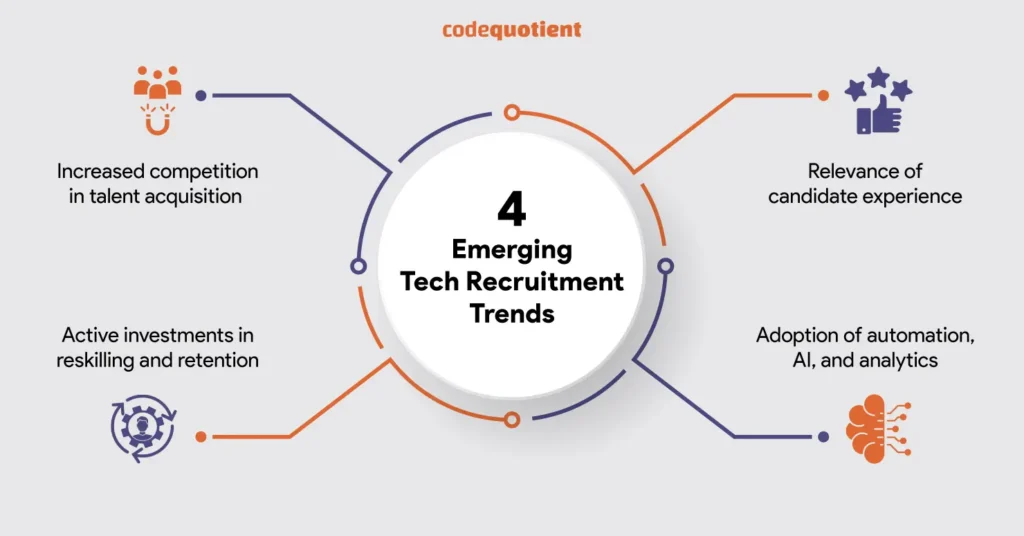
#1 AI and Machine Learning
The fusion of AI and machine learning in recruitment methodologies heralds a paradigm shift in talent acquisition strategies. Implementation of these technologies yields several advantages including:
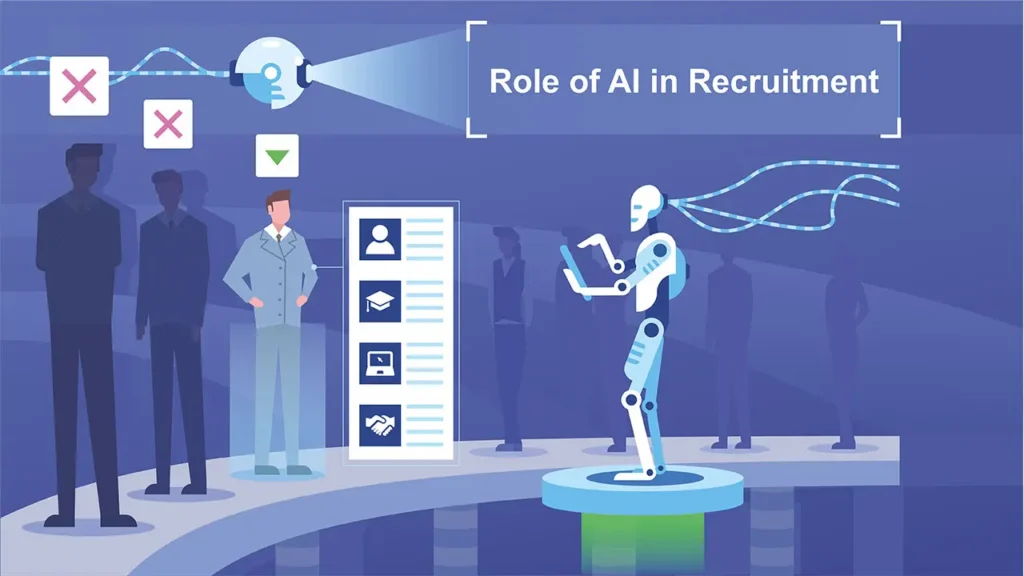
Image Source: AI in Recruitment
- Automated Candidature Sourcing – Utilization of AI algorithms facilitate exploration of extensive databanks, efficiently identifying suitable candidates and thereby extending outreach and minimizing time-to-hire ratios.
- Improved Candidates-Vacancies Synergy – Advanced machine learning models meticulously evaluate résumés and position descriptions, accurately aligning candidates possessing requisite abilities and expertise with corresponding roles.
- Mitigation of Unconscious Bias – AI-based solutions focus primarily on competencies and credentials instead of demographic details, thus diminishing inherent prejudices during selection phases.
- Prognostication Through Predictive Analytics – Leveraging machine learning techniques enables anticipatory assessment of successful candidacy traits, culminating in well-judged hires.
By capitalizing upon such attributes, AI and machine learning emerge as indispensable components of contemporary recruitment procedures, fostering efficacious and equitable personnel acquisitions.
How employers benefit
Companies using AI in practical ways report shorter hiring cycles, better-qualified shortlists, and more time for recruiters to focus on interviewing and relationship-building rather than administrative tasks.
AI has become a productivity layer, not a replacement for human judgment, but a tool that strengthens it.
#2 Virtual Reality and Gamification: Enhancing the Candidate Experience
Virtual reality and gamified tools are no longer experimental. In 2025, more companies are using simulations to give candidates a realistic preview of the job and to understand how they would approach everyday tasks.
Practical uses companies rely on today
Role-specific simulations
For customer support, operations, warehouses, and technical roles, simulations let candidates work through scenarios that mirror real working conditions.
Virtual workplace tours
VR gives candidates an idea of what it’s like to be part of the organization, especially when the physical office isn’t accessible.
Skill-based mini-games
Structured, game-based tasks help evaluate cognitive skills such as decision-making, attention to detail, or task prioritization.
The real advantage
These tools help remove guesswork. Instead of judging someone solely on their resume or an interview, employers get insights into how candidates think, solve problems, and adapt in practical scenarios.
For candidates, the experience is more engaging and gives them a clearer sense of whether the job is right for them.
#3 Utilizing Big Data and Predictive Analytics for Smarter Hiring Decisions
Harnessing the prowess of expansive datasets and prognosticating approaches is one of the most important tech hiring trends in 2025. JobsPikr innovatively enhances enterprises’ decision-making capacities pertinent to staffing assignments.
Accessible resources encompass exhaustive labor market statistics, empowering management entities to strategically plan team structures intelligently. Salient perquisites comprise:
- Competitive Compensation Estimation – Comprehending prevalent wage scales for specified positions and sectors ensures attractively remunerative packages while respecting financial restrictions.
- Skill Distribution Assessment – Determining potential talent clusters coupled with appraising skill dissemination across multiple locales helps refine recruitment policies advantageously.
- Performance Metrics Evaluation – Quantitative analysis of past vacancy postings assists in forecasting forthcoming demand patterns, resulting in enhanced resource utilization and workforce organization.
- Market Dynamics Monitoring – Real-time comprehension of sector-oriented fluctuations concerning occupational expectations, emergent abilities, and prominent functions permits firms to maintain relevance and swiftly adjust tactics according to shifting surroundings.
Why this matters now
Recruiting has become too complex to rely only on intuition. Data brings clarity to compensation, role definition, talent availability, and expected hiring challenges — all of which help teams budget better and close roles faster.
#4 The Rise of Remote Hiring and Video Interviews
Technological breakthroughs propel the surge in teleworking arrangements, dramatically transforming recruitment protocols. Organizations widely embrace video-conferenced meetings as conventional practice attributable to ease, economic viability, and capacity to extend talent searches irrespective of spatial boundaries.
Additional factors contributing towards increased acceptance involve:
- Sophisticated videoconferencing apparatus furnishing elaborate functionalities approximating face-to-face dialogues.
- AI-enhanced interactive platforms supporting automated scheduling and evaluations.
- Corporate ambition to exploit worldwide manpower resources unfettered by geographical separation.
- Imperatives mandating flexible recruitment mechanisms commensurate with escalating distant working populaces.
Accordingly, videoconference sessions constitute fundamental facets of contemporary hiring blueprints owing to manifold benefits derived therefrom.
#5 Diversity and Inclusion: Tech-Enabled Strategies to Broaden Talent Pools
As diversity assumes paramountcy, companies resort to innovative technologies to disrupt antiquated conventions, championing impartiality throughout all levels of employability judgment.
Integration of AI-backed instruments facilitates neutrality by gauging meritoriousness predicated solely on competence parameters.
Moreover, anonymous resume screening eliminates preconceived impressions rooted in ethnicity, sex, or age variables. Furthermore, algorithmic job matching expedients expand opportunities accessible to underprivileged cohorts, establishing inclusivity at the forefront of personnel procurement schemes.
Digital networks and socio-media channels function synergistically as lucrative avenues for unearthing diversified international talents, solidifying inclusive philosophies ingrained within progressive recruitment policies.
Hiring Trends Reshaping Talent Acquisition
As technology continues to evolve, the landscape of talent acquisition is undergoing significant changes. Companies are increasingly leveraging data-driven insights and advanced technologies to stay ahead in the competitive job market. Here, we explore the key hiring trends reshaping talent acquisition today.
Emphasis on Skills Over Degrees
One of the most notable tech hiring trends is the shift from traditional degree-based hiring to a skills-first approach. Employers are prioritizing candidates with specific skill sets that align with job requirements, often valuing practical experience and demonstrated abilities over formal education. This trend is particularly evident in the tech industry, where coding bootcamps and online courses are becoming viable alternatives to traditional degrees.
Remote and Hybrid Work Models
The pandemic has accelerated the adoption of remote and hybrid work models, transforming recruitment trends. Companies are now more open to hiring talent from different geographical locations, offering flexible work arrangements to attract top talent. This shift not only broadens the talent pool but also enhances work-life balance and employee satisfaction.
Diversity and Inclusion Initiatives
In response to growing awareness and advocacy for diversity and inclusion, organizations are implementing targeted initiatives to create more equitable workplaces. These efforts include unbiased recruitment practices, diversity training programs, and the establishment of employee resource groups. Leveraging AI and machine learning tools to eliminate biases in the hiring process is a key aspect of this tech hiring trend.
Data-Driven Recruitment
The use of data analytics in recruitment is revolutionizing how companies identify and attract candidates. By analyzing data from various sources, such as social media, job boards, and internal databases, employers can gain insights into candidate behavior, preferences, and hiring trends. This data-driven approach enables more accurate matching of candidates to job openings, improving the efficiency and effectiveness of the hiring process.
Focus on Candidate Experience
Enhancing the candidate experience is becoming a crucial part of recruitment trends. Companies are investing in technologies like AI-powered chatbots, automated scheduling tools, and personalized communication platforms to streamline the recruitment process and provide a seamless experience for candidates. A positive candidate experience not only boosts the company’s reputation but also increases the likelihood of attracting and retaining top talent.
These job trends are transforming talent acquisition, making it more dynamic and responsive to the evolving needs of the job market. By staying abreast of these hiring trends and integrating advanced technologies into their recruitment strategies, companies can navigate the complexities of modern talent acquisition and secure the best candidates for their organizations.
Talent Intelligence Platforms: The New Nerve Center for Strategic Hiring
Five years ago, recruitment data mostly meant spreadsheets, ATS exports, and manual benchmarking. In 2025, hiring teams operate very differently. Many organizations now rely on talent intelligence platforms to guide everything from role design to location strategy to compensation planning.
What changed is not just the availability of data, but the expectation that hiring decisions should be backed by real evidence rather than gut instinct.
What talent intelligence platforms actually offer today
Instead of isolated dashboards, companies now use integrated systems — including solutions like JobsPikr — that combine:
- Market-wide job posting activity
- Competitive hiring trends
- Salary benchmarks
- Skill demand shifts
- Geographic talent availability
- Emerging job titles and role patterns
This data builds a more realistic foundation for decision-making.
How companies use this in practical ways
Planning headcount for the next quarter
Instead of picking numbers based on budget cycles alone, talent leaders now ask:
Is this position even feasible to hire right now? What does the market suggest?
Choosing where to build new teams
A company may compare two cities — say, Austin vs Denver — and realize that Denver has more available mid-level data engineers at lower median salary ranges.
Understanding whether a job description is aligned with market expectations
If a role consistently underperforms in applicant volume, labor-market data often reveals the issue:
- Title mismatch
- Salary out of sync
- Rare combination of skills
- Higher-than-average competition in that week/month
Why this matters in 2025
The hiring landscape changes too fast to rely on assumptions. Talent intelligence platforms help organizations design roles, timelines, and compensation around what is actually happening in the market — not what they hope is happening.
This shift is one of the most significant upgrades in modern talent acquisition.
See JobsPikr in action
Use up-to-date labor-market insights to plan smarter, hire faster, and stay aligned with today’s hiring trends.
From Job Descriptions to Capability-Based Role Design
Traditional job descriptions are one of the last outdated artifacts in recruitment. They tend to be long, inflated, generic, and often written by teams far removed from the actual work.
In 2025, more companies are shifting to capability-based role design, a more accurate way of defining what a role truly requires.
Why job descriptions are being rethought
Most organizations discovered the same problems:
- Duties change faster than job postings do.
- Skill lists swell into unrealistic “wishlists.”
- Essential skills are buried under generic bullet points.
- Titles don’t always match what the market understands.
Candidates feel this disconnect too, leading to confusion and lower-quality applications.
What capability-based role design looks like
Instead of listing tasks, capability-based hiring breaks a role into:
- Core capabilities (e.g., “ability to analyze structured and unstructured data”)
- Supporting skills
- Expected outcomes
- Key decisions the role influences
- Collaborations and cross-functional points
This provides hiring teams with a clearer picture of what needs to be accomplished — and it helps candidates understand whether they can realistically perform the job.
How companies use market data to refine roles
Labor-market insights help teams identify:
- Which skills are emerging
- Which skills are oversaturated and easily sourced
- Whether a role’s skill expectations are out of sync with the market
- If the title aligns with current industry practices
Example: A company looking for a “Marketing Data Scientist” found almost no matching profiles in the market. Using market data, they realized the role was actually two jobs: a Marketing Analyst and a Machine Learning Specialist. Splitting it led to faster hires and clearer expectations.
Why does this add real business value?
Capability-based design reduces bad hires, supports internal mobility, and ensures teams don’t chase hybrid roles the market can’t provide.
From Job Descriptions to Capability-Based Role Design (Reflecting 2025 Hiring Trends)
One of the most meaningful hiring trends in 2025 has nothing to do with AI or automation. It’s the quiet shift from traditional job descriptions to capability-based role design — a more accurate way of defining what a role truly requires.
For decades, job descriptions grew bloated, inconsistent, and often unrealistic. Companies listed everything they could possibly want, not what the job actually needed. This made hiring slower and often excluded strong candidates whose skills didn’t align perfectly with the old template.
Why job descriptions are being reconsidered
Capability-based role design is gaining traction for a simple reason: it reflects how real work happens today. Roles evolve rapidly, and one of the major tech hiring trends is acknowledging that skills and outcomes matter more than exhaustive task lists.
Teams are replacing rigid descriptions with clearer frameworks that define:
- Core capabilities
- Supporting skills
- Expected outcomes
- Decision ownership
- Cross-functional interactions
This creates alignment between hiring managers, recruiters, and candidates.
How companies use market insights to reshape roles
Labor-market intelligence helps employers check whether their expectations match what the market can realistically provide. Data often reveals:
- When a role is misaligned with industry norms
- When requested skills rarely appear together
- When a job title is outdated
- When the market uses different language for the same function
Example:
A company trying to hire a “Marketing Data Scientist” found almost no matching applicants. Market data revealed the job combined two different skill clusters. Splitting it into “Marketing Analyst” and “Machine Learning Specialist” aligned better with actual hiring trends, instantly improving applicant flow.
Why this matters in 2025
Capability-based hiring leads to clearer expectations, more accurate job postings, and stronger long-term fit. It also helps businesses avoid chasing roles the market can’t supply — a problem that continues to grow as skill requirements evolve.
Diagnosing Hiring Bottlenecks Using Job-Market Data (A Critical Part of Today’s Tech Hiring Trends)
A major frustration for hiring teams is not knowing why a role isn’t performing. It’s one of the most common — and costly — challenges shaping modern tech hiring trends.
In 2025, data helps teams diagnose these issues early and make adjustments before hiring stalls. Rather than guessing, recruitment teams use job-market intelligence the way a clinician uses diagnostic tests: as a way to understand the root cause quickly and objectively.
The most common bottlenecks — revealed by market data
1. Compensation out of sync with the market
If similar roles in the same city offer higher salary ranges, application volume drops dramatically.
Hiring data often confirms this instantly.
2. Rare combinations of skills
Some job descriptions ask for capabilities that rarely appear in a single candidate — a growing theme in current hiring trends.
Example: DevOps + UX Design + Product Management in one role.
3. Title mismatch
If the title doesn’t match market norms, qualified candidates simply don’t find it.
Job-market data often shows what titles are currently trending.
4. Intense hiring competition in that week or month
If dozens of companies are hiring the same role simultaneously, application rates fall.
Teams use this signal to adjust timelines or sourcing strategies.
5. Flexibility constraints
One of the strongest tech hiring trends is the expectation of remote or hybrid options.
If 80% of similar postings offer flexibility, an on-site-only role struggles immediately.
How companies adjust based on insights
Instead of rewriting the job post blindly, teams now use data to decide whether to:
- Update the salary range
- Adjust the title
- Reduce unnecessary requirements
- Split the role into two specialized positions
- Expand sourcing regions
- Add flexibility
Why this is becoming standard practice
Diagnosing hiring bottlenecks using real-time data makes hiring faster, more predictable, and more defensible when reporting to leadership. It also reflects a broader shift in hiring trends: evidence-based recruitment is becoming the norm, not the exception.
See JobsPikr in action
Use up-to-date labor-market insights to plan smarter, hire faster, and stay aligned with today’s hiring trends.
Making Sense of 2025’s Most Important Hiring Trends
Hiring trends within the burgeoning tech sphere portend profound modifications, fueled predominantly by advancing technology and transitioning employee ecosystems. Consequently, the adoption of cutting-edge recruitment modalities promises marked improvements spanning sourcing, valuation, and maintenance of skilled workforce segments.
Adopting tech-inclined recruitment initiatives signifies optimization of procedural efficiency combined with securing a competitive edge amidst dynamic markets characterized by heightened volatility and accelerated evolution.
Therefore, astute organizations shall persistently strive toward versatile adaptation, judicious utilization of informational assets, and stringent emphasis on candidate satisfaction to prosper within this ever-evolving backdrop of personnel acquisition.
Staying ahead of the rapidly evolving tech hiring trends is essential for businesses looking to remain competitive in today’s market. By leveraging real-time data and insights, companies can make informed decisions that align with current hiring trends. To gain a deeper understanding of these hiring trends and optimize your talent acquisition strategies, sign up with JobsPikr today for access to comprehensive, real-time job data and insights.
FAQs
How are hiring trends in 2025 different from previous years?
Hiring in 2025 is far more data-driven. Companies rely on market intelligence, skill-demand insights, and capability-based role design instead of traditional JDs and intuition. Remote models, skills-first evaluations, and structured talent intelligence workflows have also become standard.
Why is labor-market data important for recruitment teams?
Labor-market data helps recruiters understand salary expectations, competition levels, skill availability, and realistic hiring timelines. It reduces guesswork and prevents hiring delays caused by poorly defined roles or misaligned compensation.
What is capability-based role design, and why is it becoming popular?
Capability-based role design focuses on defining core skills, outcomes, and decision scope instead of long task lists. It aligns better with today’s fast-changing work environment and avoids the role inflation that often slows hiring.
How does workforce intelligence help close skill gaps?
Workforce intelligence tools compare internal skill levels with real-time external demand, helping companies spot emerging skill gaps early. This allows them to plan training, redesign roles, or adjust hiring strategies before the gap becomes costly.
Are AI tools replacing recruiters in 2025?
No. AI supports routine work like screening, summarizing resumes, or drafting communication, but recruiters still drive interviews, judgment calls, and hiring decisions. The trend is augmentation, not replacement.