


- The Short Version: What the Talent Availability Index Tells You About the Global Hiring Market Right Now
- What Is the Talent Availability Index?
- Turn Talent Availability Intelligence Into a Competitive Advantage
- How the Talent Availability Index Is Built: Methodology
- Global Rankings: Where Talent Is Plentiful and Where It Is Running Out
- The Talent Market Is Moving Faster Than Your Annual Planning Cycle
- Quarter-Over-Quarter Trends: Where Talent Availability Is Improving, Plateauing, or Getting Worse
- Workforce Planning Implications: What the TAI Should Change About How You Hire
- The Talent Market Is Moving Faster Than Your Annual Planning Cycle
- How Enterprise HR and TA Teams Can Operationalize the TAI in Annual Talent Planning
- The Talent Availability Index: What It Means for Your Next Planning Cycle
- The Talent Market Is Moving Faster Than Your Annual Planning Cycle
- Frequently Asked Questions
The Short Version: What the Talent Availability Index Tells You About the Global Hiring Market Right Now
If you are a workforce planner or talent strategy lead, here is the honest reality: the global talent market is not tight everywhere, and it is not loose everywhere either. The imbalance is highly specific by role, by region, and it is shifting faster than most annual planning cycles can track. The Talent Availability Index (TAI) is a framework for mapping exactly that using real-time hiring data to score talent supply against active demand across geographies and functions, so enterprise teams can stop guessing and start planning with a real signal.
Here is what the global snapshot shows:
- Demand is outpacing supply in AI, cybersecurity, and cloud infrastructure across North America and Western Europe, and the gap is widening.
- Parts of Southeast Asia and Eastern Europe have more talent than active demand can absorb, making them underleveraged markets for remote and offshore hiring.
- Availability scores are deteriorating fastest in the roles that are hardest to backfill: senior data engineers, ML specialists, and security architects.
- Geography is doing more work than most hiring teams give it credit for the same role title can sit at opposite ends of the availability spectrum depending on where you are hiring.
Workforce planning built on broad market assumptions is leaving real efficiency on the table. The TAI gives enterprise HR and TA teams the precision to act on what the hiring data is actually saying before the shortage becomes a headcount crisis.
What Is the Talent Availability Index?
There is no shortage of hiring data in the world. What is a shortage of is hiring data that tells you something useful before you are already in trouble.
Most enterprise HR and talent teams are working with a familiar set of tools: annual workforce surveys, labor market reports, and compensation benchmarks that were accurate sometime last year. These are not bad inputs. They just were not built for a labor market where the talent availability picture for a cloud security engineer in Austin and one in Warsaw can look completely different and shift meaningfully within a single quarter.
That is the gap the Talent Availability Index addresses.
The TAI is a workforce intelligence scoring methodology that measures talent supply against active hiring demand across roles and regions. When built on a real-time global hiring data platform like JobsPikr, it becomes a continuously updated signal rather than a periodic snapshot, telling you not just where talent is scarce, but by how much, in which markets, and whether the situation is getting better or worse.
The WEF Future of Jobs Report 2025 found that employers expect 39% of workers’ core skills to change by 2030, and in a market moving that fast, a workforce plan built on last year’s availability assumptions is not a slightly imperfect plan. It is a plan built on a market that no longer exists.
What follows is a global snapshot of what the TAI is currently showing, by region, by role, and by the trends that matter most for enterprise talent planning heading into the next cycle.
Turn Talent Availability Intelligence Into a Competitive Advantage
See how enterprise teams are using JobsPikr’s hiring data to make smarter, faster workforce decisions.
How the Talent Availability Index Is Built: Methodology
Before you can trust a number, you need to understand where it comes from. That is especially true in workforce planning, where the wrong signal at the wrong time can send an entire headcount strategy in the wrong direction. So here is exactly how the Talent Availability Index works and why job posting data is the right foundation for it.
Why Job Posting Data Is the Right Starting Point
Most talent intelligence frameworks are built on lagging indicators, survey responses, unemployment figures, and census data. These are useful for understanding where the market has been. They are much less useful for understanding where it is going.
Job posting data is different. When an employer opens a requisition and publishes it, that is a live, real-time signal of demand. It is not what someone remembered reporting in a survey last quarter. It is an active hiring decision being made right now, with a budget attached to it. When you aggregate those signals across millions of postings by role, by region, by seniority level, by required skills, you get a picture of hiring demand that is weeks and sometimes months ahead of what any traditional labor market report can show you.
This is the core data input behind the TAI. JobsPikr continuously tracks and structures job postings from across the web, normalizing role titles, location data, seniority signals, and skill requirements into a consistent, queryable format. That normalized data is what makes it possible to compare demand for a senior data engineer in Bangalore against one in Berlin, with enough consistency to produce a meaningful score rather than an apples-to-oranges comparison.
How Supply and Demand Are Scored
The TAI score for any given role-region combination is essentially a ratio, but one with a few important layers underneath it.
On the demand side, the index looks at active job posting volume for a defined role category in a defined geography, how that volume has changed over the past one to three quarters, and how competitive the posting environment is. One of the clearest proxies for that competitiveness is median posting duration, how long a role stays open before it is closed or filled. When roles are closing quickly, supply is absorbing demand. When they sit open for weeks, the market is telling you something important: there are not enough qualified candidates to go around.
On the supply side, the index draws on signals including historical fill rates for similar roles in the same market and skill availability indicators derived from the requirements employers are actively listing. The resulting score sits on a scale where a high TAI reflects a market where supply is comfortably meeting demand, and a low TAI reflects a market where demand has outrun supply, posting volumes are high, roles are staying open longer, and the competition for a thin candidate pool is pushing both time-to-hire and acquisition costs upward.
What the Data Actually Shows: Three Roles, Five Regions
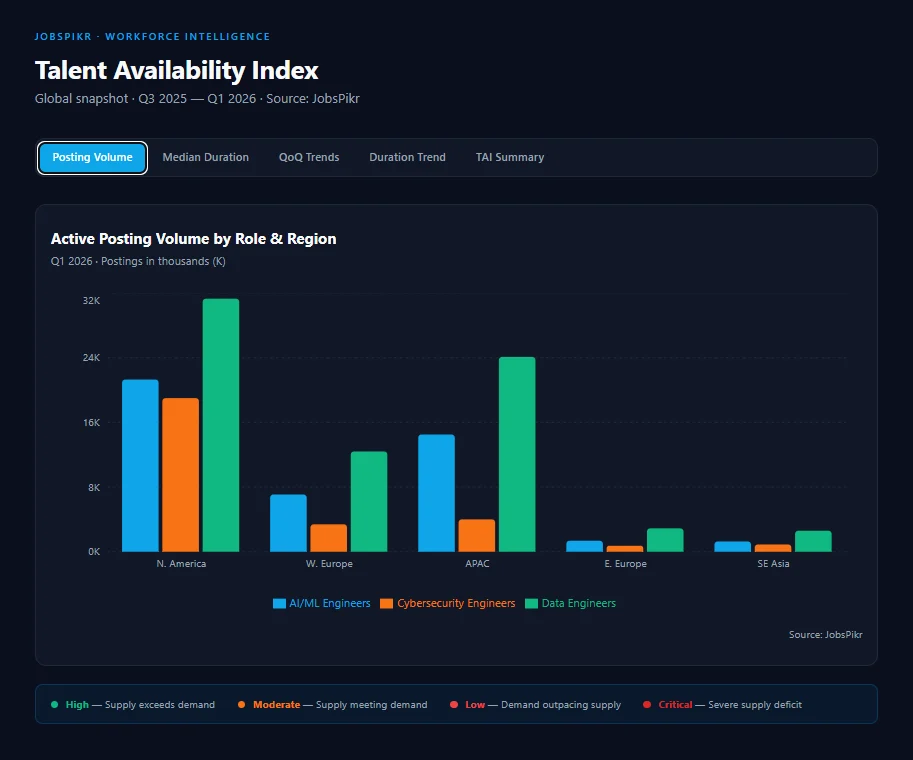
The numbers below are drawn from JobsPikr’s job posting data across three high-demand role categories: AI/ML Engineers, Cybersecurity Engineers, and Data Engineers tracked across five global regions from Q3 2025 through Q1 2026. Two metrics are tracked for each: total active postings, which reflects the demand side, and median posting duration, which reflects how quickly that demand is being absorbed by available supply.
AI / ML Engineers
North America tells the most complex story in this dataset. Active postings peaked at 25.1K in Q3 2025 before dropping to 19.6K in Q4, a decline that tracks closely with the wave of AI-related hiring pauses and layoffs that characterized the back half of 2025. What is notable, however, is that median posting duration held steady at 61 days across both quarters, meaning the roles that were posted were still sitting open for a long time. Demand softened, but supply did not meaningfully improve. By Q1 2026, postings had recovered to 21.3K, and median duration had dropped sharply to 31 days, suggesting the market is beginning to rebalance, but North America remains a high-pressure environment for this role. New York, San Francisco, and Seattle consistently anchor demand across all three quarters. (Source: JobsPikr)
Western Europe shows a different pattern. Postings nearly doubled from 4.7K in Q3 2025 to 8.1K in Q4, before settling at 7.08K in Q1 2026, a sign that demand is growing but beginning to find a more stable level. Median posting duration has been falling consistently, from 22 days in Q3 and Q4 down to 17 days in Q1 2026, with London, Paris, and Manchester leading hiring activity. Roles are being filled faster even as volume stays elevated, which points to a market where supply is growing but still under pressure. (Source: JobsPikr)
APAC tells a story of sustained and growing demand. Postings climbed from 10.3K in Q3 2025 to 14.7K in Q4 and held at 14.5K into Q1 2026, with Bangalore, Hyderabad, and Pune consistently dominating volume. Median posting duration dropped from 60 days in Q3 to 31 days by Q1 2026, a meaningful improvement, but still long enough to indicate that demand in this market is running well ahead of available supply. (Source: JobsPikr)
Eastern Europe is a much smaller market by volume, but the trend line is worth watching. Postings have grown steadily from 1.05K in Q3 2025 to 1.36K in Q1 2026, and median posting duration, while volatile, jumping from 14 days in Q3 to 50 days in Q4 before settling at 22 days in Q1, suggests a market that is still finding its equilibrium. Warsaw, Krakow, and Bucharest lead activity here. (Source: JobsPikr)
Southeast Asia stands out as the clearest high-supply signal in the dataset. Postings have held relatively stable across the three quarters, ranging from 993 to 1.34K, but median posting duration has collapsed from 7 days in Q3 2025 to just 2 days in Q1 2026. Roles in Kuala Lumpur, Manila, and surrounding markets are being absorbed almost immediately, which is exactly what a strong talent availability score looks like in practice. For enterprise teams exploring remote or offshore hiring strategies, this is a signal worth taking seriously. (Source: JobsPikr)
Cybersecurity Engineers
North America follows a pattern similar to AI/ML, with a Q3 peak of 26.4K postings dropping to 17.5K in Q4, before recovering to 19K in Q1 2026. What is different here is the median posting duration in Q1: just 14 days, down from 61 days in Q3. Washington, Atlanta, and Austin lead hiring. That sharp drop in duration alongside a recovering posting volume suggests demand is stabilizing, and supply may be improving slightly, but with nearly 19K active roles open simultaneously, this remains one of the tightest markets in the dataset. (Source: JobsPikr)
Western Europe shows consistent growth in both postings and speed of absorption. Volume has risen from 2.82K in Q3 2025 to 3.39K in Q1 2026, while median posting duration has fallen from 14 days to just 4 days. London and Munich anchor demand, with Paris entering the top three by Q1. Roles are being filled quickly, but the consistent growth in posting volume suggests that demand is not slowing down either. (Source: JobsPikr)
APAC shows steady, unrelenting demand growth, from 3.62K in Q3 2025 to 4K in Q1 2026, with median posting duration falling from 60 days to 31 days. Bangalore, Hyderabad, and Pune dominate, with Mumbai a consistent presence. The long median duration, even after improvement, tells you this market has a real supply gap that is narrowing but far from closed. (Source: JobsPikr)
Southeast Asia is a notable outlier for cybersecurity. Unlike AI/ML, where Southeast Asia shows very fast absorption, cybersecurity postings here carry a median duration that has actually been falling from 61 days in Q3 2025 to 16 days in Q1 2026, alongside growing posting volumes, from 641 to 897. That combination of rising demand and faster absorption suggests this market is developing its cybersecurity talent base, but is not yet at the surplus levels seen for AI/ML roles. (Source: JobsPikr)
Data Engineers
Data Engineering is the highest-volume role category in this dataset across every region, which reflects just how foundational this function has become for organizations investing in AI and analytics infrastructure.
North America peaks at 41.4K postings in Q3 2025 before declining to 31.3K by Q1 2026, the steepest volume drop of any role in this dataset. Median posting duration has also fallen sharply, from 61 days in Q3 to 22 days in Q1, with New York, Atlanta, and Dallas leading demand. The combination of falling volume and faster absorption could suggest either improving supply or a cooling of demand worth monitoring closely over the next two quarters. (Source: JobsPikr)
Western Europe shows remarkable stability. Postings ranged between 11.1K and 16.1K across the three quarters, with London, Paris, and Manchester consistently topping the list, and median posting duration holding remarkably steady at 14 to 15 days throughout. This is one of the more balanced supply-demand pictures in the dataset demand is real, but supply appears to be keeping a reasonable pace. (Source: JobsPikr)
APAC continues to show both the highest volume and the longest median durations outside North America. Postings peaked at 26.1K in Q4 2025 before settling at 24.1K in Q1 2026, with median duration improving from 60 days to 31 days. Bangalore remains the clear epicenter of demand. The volume here is significant. APAC accounts for more active Data Engineering postings than Western Europe and Eastern Europe combined, and the long median durations confirm that supply is still struggling to keep pace. (Source: JobsPikr)
Southeast Asia tells the clearest surplus story of all three role categories. Postings have grown steadily from 2K to 2.6K across the three quarters, while median posting duration has held at just 4 to 7 days throughout. Kuala Lumpur, Manila, and Taguig City lead activity. Roles are being filled almost as fast as they are posted, which is a strong indicator of healthy and potentially underleveraged talent availability in this region. (Source: JobsPikr)
What the Data Is Telling You
Across all three role categories, a few patterns emerge clearly. North America and APAC carry the highest posting volumes and historically the longest median durations, the clearest indicators of sustained supply-demand imbalance. Western Europe is a growing demand market where supply appears to be developing in parallel. Eastern Europe is small by volume but growing, with posting duration volatility that suggests a market still maturing. And Southeast Asia, particularly for AI/ML and Data Engineering, is showing the fastest absorption rates in the dataset, making it the most underleveraged talent market for enterprise teams that have not yet built remote or offshore hiring pipelines into their workforce strategy.
That is what the TAI methodology is designed to surface: not just where demand is high, but where the gap between demand and available supply is widest and where it is not.
Want to explore this data for your specific roles and regions? The JobsPikr demo below shows how the platform surfaces these signals for enterprise workforce planning teams.
Global Rankings: Where Talent Is Plentiful and Where It Is Running Out
The data from the previous section gives you a detailed look at three specific roles. But the TAI is designed to work across a much broader landscape, covering regions and functions that together give enterprise workforce planners a global read on where hiring is straightforward and where it is going to cost you more time, money, and pipeline effort than you have probably budgeted for.
This section summarizes the global rankings picture: which regions and role categories sit at the high end of the availability index, which sit at the low end, and what that distribution means for how you approach talent strategy heading into the rest of 2026.
The Regions With the Strongest Talent Availability
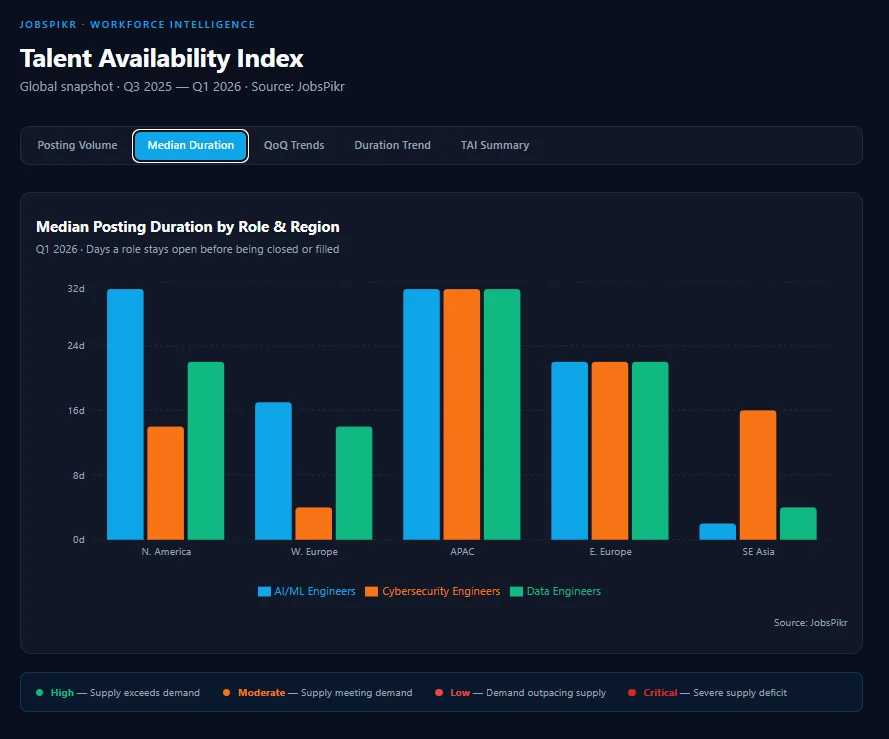
Southeast Asia consistently emerges as the highest-availability region across the role categories tracked in the TAI. The median posting durations in markets like Kuala Lumpur, Manila, and Ho Chi Minh City are the shortest in the dataset, in some cases just two to four days, which means qualified candidates are available and actively engaging with open roles at a pace that no other region comes close to matching right now.
This is not a new development, but it is one that enterprise teams are still underutilizing. The talent base in Southeast Asia has matured considerably over the past five years, particularly in data engineering and software development functions, and the gap between the quality of available talent and the awareness of that availability among Western enterprise hiring teams remains wide. For organizations that have not yet built structured remote or offshore hiring pipelines into this region, the TAI data suggests the opportunity cost of that gap is growing.
Eastern Europe is the second strongest availability story in the global rankings, particularly for technical roles. Markets like Warsaw, Krakow, Bucharest, and Wroclaw show relatively fast posting absorption across data engineering and cybersecurity functions, and the talent pool here carries a profile that enterprise teams tend to value highly: strong technical foundations, European time zone alignment, and increasing familiarity with enterprise-grade tooling and compliance environments. Posting volumes are lower than in Southeast Asia or APAC, but the supply-demand balance is favorable, and the trend line shows steady growth in both supply and demand, which suggests this region will become more competitive over the next several quarters.
The Regions Where Supply Is Under the Most Pressure
North America sits at the low end of the availability index for every role category in this dataset. Posting volumes are the highest of any region. North America accounts for the majority of active postings across AI/ML, cybersecurity, and data engineering, and median posting durations, even after recent improvement, remain among the longest. The market is deep in absolute terms, but demand is so consistently elevated that supply has never fully caught up. For enterprise teams headquartered in the US or Canada, this is not a surprising finding, but the TAI data puts a specific shape on what most talent leaders already sense: the North American market for technical talent is structurally undersupplied relative to how much demand is being generated, and that gap is not closing quickly.
APAC, specifically the India cluster of Bangalore, Hyderabad, and Pune, presents a more nuanced picture. Raw posting volumes are the second highest in the dataset, and the talent pool is genuinely large. But median posting durations in this region have historically been the longest outside North America, which tells you that volume alone does not equal availability. Demand in these markets has grown faster than the specialized talent supply can keep pace with, particularly at the senior and mid-level for roles requiring production-grade AI or cloud security experience. The Q1 2026 data shows some improvement; median durations are falling, but APAC remains a high-pressure market for the roles that matter most to enterprise technology teams.
The Role Categories Facing the Steepest Supply Deficits
Across regions, three role categories consistently show the widest gap between active demand and available supply.
Cybersecurity Engineers face the most structurally constrained supply picture of any role in this dataset. Demand is growing in every region tracked, North America, Western Europe, APAC, and Southeast Asia all showed posting volume increases between Q3 2025 and Q1 2026, while the global cybersecurity talent shortage shows no sign of meaningful resolution. The ISC2 2024 Cybersecurity Workforce Study estimated the global cybersecurity workforce gap at 4.8 million professionals, and the posting data in the TAI reflects that structural deficit clearly. Roles are staying open longer in the markets with the highest demand, and the regions with faster absorption, Western Europe and Southeast Asia, are absorbing a much smaller volume of postings than North America needs to fill.
AI and Machine Learning Engineers sit in a similar position. The demand signal across North America and APAC is strong and recovering after the Q4 2025 dip, and the skill requirements attached to these roles particularly production deployment experience, fine-tuning, and retrieval-augmented generation pipelines, narrow the qualified candidate pool significantly relative to the broader pool of people who carry an AI or ML job title. Senior candidates with genuine production experience remain genuinely scarce in every major market, and the TAI reflects that scarcity in both posting duration and volume trends.
Data Engineers are the highest-volume category in the dataset, which makes the supply deficit here worth paying particular attention to. When the most in-demand role by raw posting count is also showing median durations of 22 to 61 days in its largest markets, that is a signal that the pipeline of qualified data engineering talent is not keeping pace with how fast organizations are building out their data infrastructure. This is a role where workforce planners consistently underestimate lead times, assuming the market is more accessible than it is, and the TAI data suggests that assumption is costing teams more than they realize.
Where the Index Points for Talent Strategy
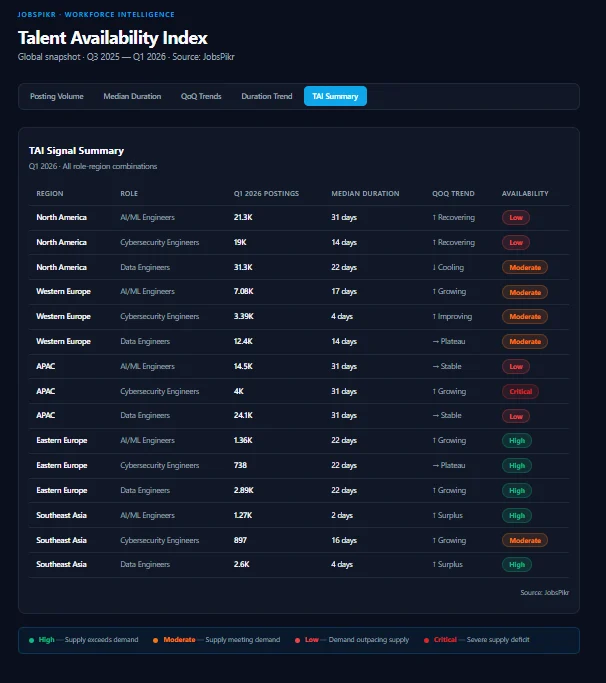
The global rankings picture that emerges from the TAI is not one of uniform scarcity or uniform surplus. It is a map with real variation, variation that creates genuine strategic options for enterprise teams willing to act on it.
The markets with the strongest availability scores, Southeast Asia and Eastern Europe, are not yet saturated by enterprise demand. That window will not stay open indefinitely. The markets with the weakest availability scores, North America and parts of APAC, are not going to resolve quickly, and planning timelines need to reflect that reality.
The next section looks at how these scores are moving over time, which regions are improving, which are plateauing, and which are deteriorating in ways that should be changing workforce plans right now.
The Talent Market Is Moving Faster Than Your Annual Planning Cycle
Find out how enterprise HR and TA teams are using JobsPikr’s hiring data to get ahead of supply constraints before they become headcount emergencies.
Quarter-Over-Quarter Trends: Where Talent Availability Is Improving, Plateauing, or Getting Worse
A single snapshot of talent availability is useful. A trend line is what changes a workforce plan.
Knowing that North America has a tight supply of cybersecurity engineers is helpful context. Knowing that the situation has been deteriorating for three consecutive quarters or alternatively, that it is beginning to show early signs of relief, is the kind of signal that should be changing pipeline lead times, sourcing strategies, and headcount timelines in your next planning cycle. That is what the quarter-over-quarter TAI trend data is designed to show.
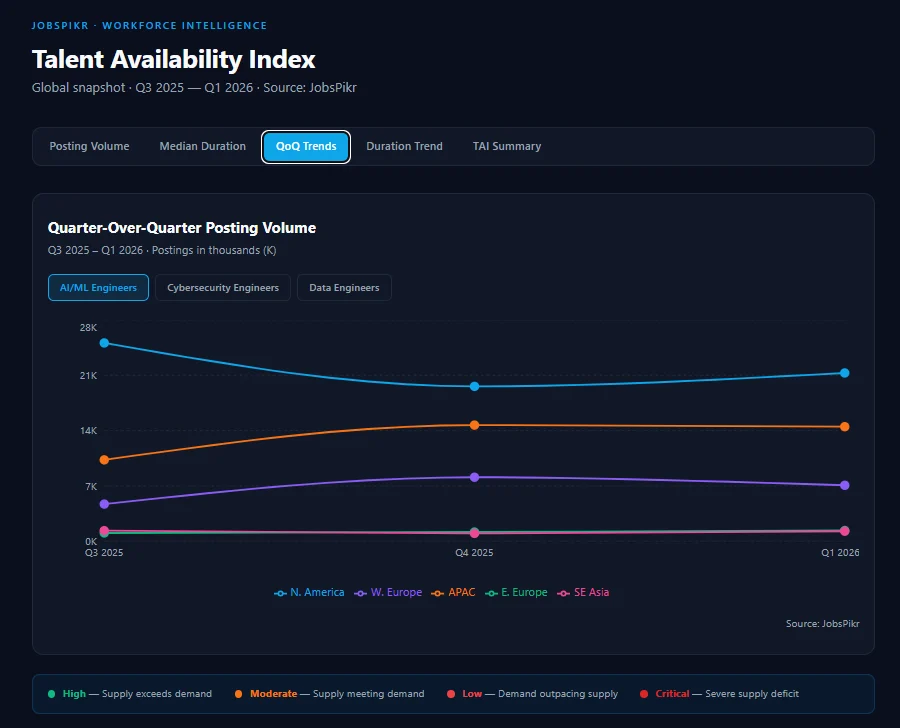
Here is what the Q3 2025 through Q1 2026 data is telling us across the three role categories and five regions tracked in this index.
Where Availability Is Improving
The clearest improvement story in the dataset is North America for AI/ML Engineers. After a significant demand contraction in Q4 2025, postings dropped from 25.1K to 19.6K, likely tied to the wave of AI-related hiring pauses that characterized that period. Q1 2026 has brought a partial recovery to 21.3K postings alongside a sharp drop in median posting duration from 61 days to 31 days. That combination of recovering demand and faster absorption is a meaningful positive signal. It does not mean the North American AI/ML market has become easy to hire in; it has not, but the trend line is moving in the right direction for the first time in several quarters.
Western Europe is another improving story, particularly for cybersecurity. Posting volumes have grown consistently from 2.82K in Q3 2025 to 3.39K in Q1 2026, while median posting duration has collapsed from 14 days to just 4 days. That is a market where supply is developing in parallel with demand, roles are being filled faster, even as more of them open. For enterprise teams with European hiring mandates, Western Europe is becoming a meaningfully more accessible market for cybersecurity talent than it was twelve months ago.
Southeast Asia shows improvement across all three role categories, but the AI/ML trend is the most striking. Median posting duration has fallen from 7 days in Q3 2025 to just 2 days in Q1 2026, while posting volumes have remained relatively stable. That trajectory points to a talent pool that is growing faster than local demand, which is precisely the kind of surplus condition that enterprise remote hiring strategies are designed to tap into.
Where Availability Is Plateauing
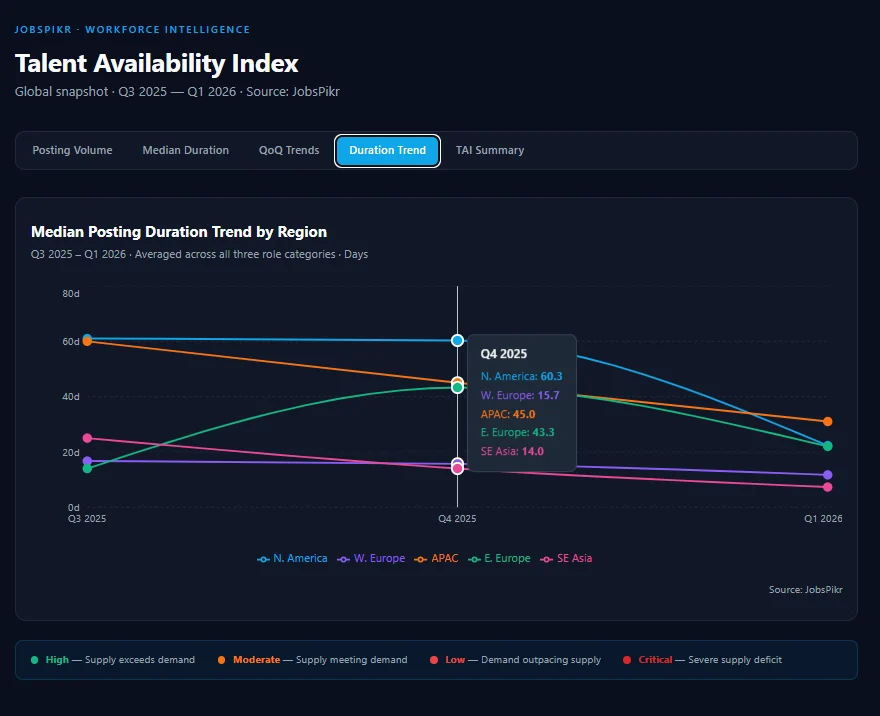
Western Europe for Data Engineers is the clearest plateau in the dataset. Posting volumes have moved between 11.1K and 16.1K across the three quarters, with no consistent directional trend, and median posting duration has held almost perfectly steady at 14 to 15 days throughout. This is not a deteriorating market, but it is not improving either. Supply and demand appear to have found a relatively stable equilibrium, which means enterprise teams hiring data engineers in London, Paris, and Manchester can plan with reasonable confidence around current timelines but should not expect conditions to get materially easier or harder in the near term.
Eastern Europe for AI/ML shows a similar plateau dynamic, though with more volatility underneath it. Posting volumes have grown modestly from 1.05K to 1.36K, but median posting duration has swung from 14 days in Q3 to 50 days in Q4 before settling at 22 days in Q1 2026. The net trend is neither clearly improving nor clearly deteriorating. This is a market in the process of finding its level, and the Q2 2026 data will be important for determining which direction it ultimately breaks.
Where Availability Is Deteriorating
APAC for cybersecurity is the most concerning deterioration trend in this dataset. Posting volumes have grown every single quarter from 3.62K in Q3 2025 to 4K in Q1 2026 while median posting duration, despite some improvement, remains at 31 days as of Q1 2026. Demand is consistently outpacing supply growth, and the trend line shows no sign of reversal. For enterprise teams running technology operations out of Bangalore, Hyderabad, or Pune, this is a market that is getting harder to hire in, not easier, and pipeline lead times should be adjusted accordingly.
North America for Data Engineers tells a more ambiguous but potentially concerning story. Posting volumes have fallen from 41.4K in Q3 2025 to 31.3K in Q1 2026, the steepest volume decline of any role-region combination in the dataset, while median posting duration has also improved from 61 to 22 days. On the surface, faster absorption looks positive. But a 24% drop in posting volume alongside faster fill times could indicate that organizations are pulling back on data engineering headcount plans rather than successfully filling roles at the pace. This is a trend worth watching closely over the next two quarters before drawing strong conclusions.
Southeast Asia for cybersecurity is the one deterioration signal in an otherwise strong availability region. Posting volumes have grown from 641 in Q3 2025 to 897 in Q1 2026, a 40% increase, while median posting duration has fallen from 61 days to 16 days. At first read, faster absorption sounds positive. But a 40% demand surge in three quarters in a market that previously showed very long posting durations suggests that demand is growing faster than the available talent pool has been tested before. If posting volumes continue at this pace, Southeast Asia’s cybersecurity availability advantage could erode faster than most workforce plans currently account for.
What the Trend Lines Mean for Your Planning Cycle
The quarter-over-quarter picture reinforces a point that is easy to miss when you are working from annual benchmarks: the talent availability landscape is not static, and the direction of movement matters as much as the current position.
A market that is improving gives you options you can extend your sourcing reach into it with confidence that conditions will support your timeline. A plateauing market gives you predictability; you can plan around current conditions without expecting them to change dramatically. A market that is deteriorating gives you a warning that your current pipeline assumptions are probably already behind reality, and the longer you wait to adjust them, the more expensive the correction becomes.
The TAI trend data is designed to give enterprise workforce planning teams exactly that read not just where the market stands, but which way it is moving and how fast.
Workforce Planning Implications: What the TAI Should Change About How You Hire
Data without a decision attached to it is just interesting reading. The TAI trend lines and regional rankings covered in the previous sections only matter if they change something concrete about how your organization plans, sources, and budgets for talent. This section is about that translation.
There are three workforce planning decisions that the TAI data speaks to most directly: where to build talent pipelines, where to explore remote or offshore hiring, and where to extend your planning lead times before the market forces you to.
Where to Build Talent Pipelines and How Far in Advance
The single most expensive mistake in talent pipeline planning is treating all markets as equally accessible and building your lead times accordingly. The TAI data make clear that they are not.
North America and APAC, the two regions with the highest posting volumes and the longest median posting durations across AI/ML, cybersecurity, and data engineering, are markets where a reactive hiring approach is consistently going to cost you. When a senior ML engineer role in New York or Bangalore carries a median posting duration of 31 to 61 days, even in an improving market, that is a signal that your pipeline needs to be running well before a headcount need becomes urgent. Organizations that open requisitions in these markets in response to a business need are already behind the curve. The ones that are winning the talent competition here are the ones that have built continuous sourcing pipelines, maintaining active relationships with qualified candidates before roles are formally opened, not after.
For cybersecurity specifically, the pipeline argument is even stronger. With the global cybersecurity workforce gap estimated at 4.8 million professionals according to the ISC2 2024 Cybersecurity Workforce Study, and with APAC posting volumes growing every quarter while median durations remain elevated, the idea that you can open a cybersecurity requisition and fill it on a standard recruiting timeline is increasingly a planning fiction. Enterprise teams that are serious about building cybersecurity capacity need to be thinking in terms of talent communities, university partnerships, and certification pipeline programs not just active sourcing when a seat opens up.
Where Remote and Offshore Hiring Makes Strategic Sense Right Now
The TAI data identifies two regions where talent availability is strong, demand is growing but not yet saturated, and the supply signal suggests that enterprise teams have a genuine window to build cost-effective remote or offshore hiring pipelines before that window narrows.
Southeast Asia is the clearest opportunity in the current dataset. Median posting durations of two to four days for AI/ML and data engineering roles in Kuala Lumpur, Manila, and surrounding markets tell you that qualified candidates are available and actively engaging with open roles at a pace that no high-pressure Western market comes close to matching. The talent base here has matured considerably, particularly in data engineering and software development functions, and the cost profile relative to North American or Western European equivalents remains significantly more favorable. For enterprise teams that have not yet built structured remote hiring pipelines into Southeast Asia, the TAI data suggests the opportunity cost of that gap is real and growing.
Eastern Europe is the second opportunity the data points to, particularly for cybersecurity and data engineering. Markets like Warsaw, Krakow, and Bucharest show favorable supply-demand balances, European time zone alignment that reduces the coordination friction of remote working arrangements, and a talent pool that is increasingly comfortable operating in enterprise environments with complex compliance and security requirements. Posting volumes here are smaller than in Southeast Asia, but the quality signal measured through how quickly roles are being absorbed relative to how many are being posted is strong.
The practical implication for workforce planning teams is straightforward but requires some organizational will to act on. If your current sourcing strategy is concentrated in North America and Western Europe for technical roles, you are paying a premium in both time and acquisition cost that the TAI data suggests is not necessary for every role in your portfolio. A structured review of which roles genuinely require geographic proximity and which can be filled effectively through remote or offshore arrangements informed by regional availability scores is one of the highest-ROI exercises a workforce planning team can run right now.
Where to Extend Your Planning Lead Times Before the Market Forces You To
The deteriorating trend lines identified in the previous section have a direct implication for headcount planning timelines that most annual planning cycles have not yet adjusted for.
APAC cybersecurity is the clearest example. With posting volumes growing every quarter and median durations still at 31 days as of Q1 2026, enterprise teams that are planning to hire cybersecurity engineers in Bangalore or Hyderabad on a standard 60 to 90-day recruiting timeline are almost certainly going to miss their targets. The market is tightening, not loosening, and planning timelines need to reflect that reality before the next headcount cycle is locked.
The same logic applies to AI/ML hiring in North America, even with the Q1 2026 improvement signal. A median posting duration of 31 days reflects that the midpoint of all roles in this category are taking longer than that to fill. For senior roles with specific production experience requirements, the realistic timeline is longer still. If your workforce plan assumes AI/ML headcount can be added on a standard quarterly cadence, the TAI data suggests that assumption needs revisiting.
How to Use the TAI to Reduce Time-to-Hire and Lower Acquisition Costs
The ROI case for acting on TAI intelligence is not complicated. Time-to-hire and cost-per-hire are both direct functions of supply-demand imbalance; the tighter the market, the longer roles stay open and the more it costs to fill them. Every week, a technical role sits open carries a real productivity and opportunity cost that compounds across a large headcount plan.
The teams that use availability intelligence most effectively are doing three things that most enterprise talent functions are not yet doing consistently. They are building sourcing pipelines in high-availability markets before demand is urgent, rather than turning to those markets only when their primary markets have failed them. They are adjusting offer timelines and approval processes to move faster in low-availability markets, recognizing that in a competitive candidate pool, a slow internal process is often the reason an offer is lost rather than anything about the compensation or the role itself. And they are using regional availability data to have more informed conversations with business leaders about realistic hiring timelines, replacing optimistic assumptions with data-backed projections that prevent the downstream friction of missed headcount targets.
The TAI is not a guarantee that any of these conversations will be easy. But it gives workforce planning teams the data to have them with confidence, and that is usually what it takes to move an organization from reactive hiring to genuine talent forecasting.
The Talent Market Is Moving Faster Than Your Annual Planning Cycle
Find out how enterprise HR and TA teams are using JobsPikr’s hiring data to get ahead of supply constraints before they become headcount emergencies.
How Enterprise HR and TA Teams Can Operationalize the TAI in Annual Talent Planning
Understanding the Talent Availability Index is one thing. Building it into the way your organization actually makes talent decisions is another. This section is about the second part, specifically how Chief People Officers, HR analytics teams, talent acquisition leads, and workforce planning professionals can take the TAI from an interesting framework to a functional input in their annual planning and headcount budgeting process.
Start With the Roles Where Bad Assumptions Are Most Expensive
Not every role in your headcount plan carries the same risk if your availability assumptions turn out to be wrong. A customer service manager’s role in a market with a strong supply is forgiving if your timeline slips by a few weeks; the cost is manageable. A senior ML engineer role in a supply-constrained market is not forgiving at all. When that role sits open longer than planned, it delays product roadmaps, increases pressure on existing team members, and compounds into a much higher organizational cost than the recruiting budget line item suggests.
The most practical way to operationalize the TAI in annual planning is to start by identifying the roles in your headcount plan where availability risk is highest the intersections of high demand, constrained supply, and high business criticality, and building your planning assumptions around those roles first. Use availability scores to separate your headcount plan into tiers: roles where standard recruiting timelines are reasonable, roles where extended lead times are necessary, and roles where the supply situation is constrained enough that alternative strategies like remote hiring, upskilling internal candidates, or talent community investment need to be part of the plan from day one.
This tiering exercise does not require a complete overhaul of your planning process. It requires adding one question to the headcount approval conversation that most organizations are not currently asking: what does the availability picture actually look like for this role in this market right now, and does our timeline reflect that reality?
Build Availability Intelligence Into Headcount Budgeting
One of the most consistent gaps between workforce planning intent and workforce planning outcomes is the disconnect between headcount budgets and realistic hiring timelines. A budget gets approved for a role in Q2, the recruiting process starts in Q2, and the expectation is that the role will be filled and productive by Q3. In a high-availability market, that sequence is reasonable. In a low-availability market, it is a setup for a missed target that nobody in the planning process flagged because nobody looked at the availability data before the budget was locked.
The fix is to make availability scoring a standard input in the headcount budgeting process, not an afterthought that gets consulted when a role is already open and running behind. Before a headcount request is approved, the relevant availability score for that role and region should be visible to the people making the approval decision. If the TAI score for senior cybersecurity engineers in your primary hiring market is low and deteriorating, that information should be on the table when the budget conversation happens, not six months later when your TA team is explaining why the role is still open.
In practice, this means building a simple availability check into your headcount request template. The role title, the target market, and the planned start date go in, and the availability score and median posting duration for that role-region combination come back as a data point that informs the timeline discussion. It is a small process change that prevents a much larger and more expensive downstream problem.
Use the TAI to Make the Case for Proactive Talent Investment
One of the perennial challenges for HR and TA leaders is making the business case for proactive talent investment, building pipelines, developing talent communities, and investing in employer brand in specific markets, before there is an urgent hiring need to justify the spend. The typical organizational response to these proposals is to ask for evidence that the investment will pay off, and without availability data, that evidence is hard to produce in a form that resonates with finance and business leaders.
The TAI changes that conversation. When you can show a CFO or a business unit leader that the median posting duration for the role category they are planning to hire from has been sitting at 31 to 61 days in their target market for three consecutive quarters, and that the trend line is not improving, the case for investing in a proactive talent pipeline before the need becomes urgent stops being a soft HR argument and starts being a straightforward risk management conversation. You are not asking for a budget to do something speculative. You are asking for a budget to avoid a known, quantifiable delay in hiring that will cost the business more than the pipeline investment would.
That shift in framing, from talent investment as HR overhead to talent investment as hiring risk mitigation, is one of the most practically valuable things availability intelligence enables for senior HR leaders who are trying to move their organizations toward more strategic workforce planning.
How Compensation and Benefits Teams Can Use Availability Data
Talent availability intelligence is not just for recruiting and workforce planning functions. Compensation and benefits teams have a direct use case for TAI data that is often overlooked in how these tools get positioned.
When a role carries a low availability score in a specific market, that score is not just a recruiting problem; it is a compensation signal. Constrained supply relative to demand puts upward pressure on offered salaries, and compensation bands that were set when the market was more balanced are likely to be out of step with what it actually takes to attract candidates in a tight availability environment. Using availability scores as a trigger for compensation band reviews, specifically flagging low-TAI roles for a market data refresh before the next hiring cycle, gives compensation teams a more precise, more timely signal than an annual benchmarking process alone can provide.
This is particularly relevant for the role categories showing the most consistent supply pressure in the current dataset. Cybersecurity engineers in North America and APAC, senior ML engineers in high-demand metros, and data engineers in markets where posting volumes remain elevated are all role categories where compensation bands set on annual survey data are at genuine risk of being behind the market by the time they are applied to an active offer.
Turning TAI Into a Continuous Intelligence Function, Not a One-Time Report
The final and most important point about operationalizing the TAI is that its value compounds over time. A single snapshot of availability scores is useful for a specific planning cycle. A continuously updated feed of availability intelligence tracked quarter over quarter, by role and region, integrated into the workflows where talent decisions are actually made, is what transforms workforce planning from a periodic exercise into a genuine organizational capability.
This is where the infrastructure question becomes practical. Building and maintaining a TAI-grade availability intelligence function requires access to real-time job posting data at scale, the analytical capability to normalize and score that data consistently across geographies and role categories, and the workflow integration to surface the right signals to the right people at the right point in their decision-making process. For most enterprise HR and talent teams, building that infrastructure from scratch is neither practical nor the best use of resources.
This is precisely the use case that JobsPikr’s data platform is built for. Rather than periodic snapshots, JobsPikr provides continuously updated job posting intelligence, normalized, queryable, and structured in a way that supports the kind of availability scoring the TAI methodology requires. Enterprise teams can access regional posting volumes, median duration trends, skill demand signals, and quarter-over-quarter movement across the roles and markets that matter most to their workforce plan without building the data infrastructure themselves.
The result is a workforce planning function that is working with the same quality of market intelligence that the best-resourced talent organizations in the world use and applying it to the specific roles, regions, and planning decisions that determine whether your headcount plan delivers or falls short.
The Talent Availability Index: What It Means for Your Next Planning Cycle
The global talent market is not uniformly tight, and it is not uniformly accessible. It is a patchwork of surpluses and deficits that shifts quarter over quarter, and the enterprise teams that are winning the talent competition right now are the ones that can see that patchwork clearly enough to act on it before their competitors do.
The TAI data covered in this piece points to a few things that should be sitting on every workforce planning leader’s radar heading into the second half of 2026. North America and APAC remain structurally undersupplied for the technical roles that matter most, and that is not resolving quickly. Southeast Asia and Eastern Europe represent genuine availability advantages that most enterprise hiring strategies are still underutilizing. And the quarter-over-quarter trend lines, particularly for cybersecurity in APAC and AI/ML in North America, are moving fast enough that planning assumptions built even two quarters ago may already be out of step with the market.
The value of availability intelligence is not that it makes hiring easy. It is that it replaces guesswork with a signal and gives workforce planning teams the data to have harder, more honest conversations about timelines, pipelines, and sourcing strategies before the cost of getting those things wrong shows up in missed headcount targets and delayed business plans.
That is what the TAI is built to support. And it is the kind of intelligence that JobsPikr’s hiring data platform is designed to make continuously available not just at the point of an annual report, but at every point in the planning cycle where a talent decision is being made.
The Talent Market Is Moving Faster Than Your Annual Planning Cycle
Find out how enterprise HR and TA teams are using JobsPikr’s hiring data to get ahead of supply constraints before they become headcount emergencies.
Frequently Asked Questions
1. What is the Talent Availability Index, and how is it different from a standard labor market report?
The Talent Availability Index is a workforce intelligence scoring methodology that measures talent supply against active hiring demand by role and region, using real-time job posting data as its core input. The difference between the TAI and a standard labor market report comes down to granularity and cadence. A typical labor market report tells you that demand for a broad skill category is rising nationally or globally, which is useful context but rarely useful enough to change a specific hiring decision. The TAI scores availability at the role level and the regional level, updated continuously rather than annually, which means it reflects what the market looks like right now rather than what it looked like when a survey was conducted six to nine months ago. For enterprise workforce planning teams, that difference between a lagging snapshot and a live signal is the difference between planning around the market as it is and planning around the market as it was.
2. How should enterprise workforce planning teams use TAI data in their annual headcount planning cycle?
The most practical entry point is to use availability scores to tier your headcount plan by hiring risk. Roles in low-availability markets where demand is high, median posting durations are long, and the trend line is deteriorating need longer lead times, proactive pipeline investment, and realistic timeline expectations built into the budget conversation before headcount is approved. Roles in high-availability markets can be planned on more standard timelines. The key shift the TAI enables is moving the availability conversation to the front of the headcount approval process rather than the back so that planning assumptions reflect actual market conditions before budgets are locked, not after roles have been open for two quarters and the gap between expectation and reality has already become expensive.
3. Which regions currently offer the strongest talent availability for technical roles according to the TAI data?
Based on the Q3 2025 through Q1 2026 data tracked in this index, Southeast Asia, particularly Kuala Lumpur, Manila, and surrounding markets, shows the strongest availability signal for AI/ML and data engineering roles, with median posting durations as low as two to four days, indicating that qualified candidates are actively available and engaging with open roles at a pace no other region matches. Eastern Europe, specifically Warsaw, Krakow, and Bucharest, is the second strong availability story, particularly for cybersecurity and data engineering functions. Both regions remain underleveraged by enterprise hiring teams relative to what the availability data suggests they can support, which means organizations that build structured remote or offshore hiring pipelines into these markets now are likely to find conditions more favorable than those who wait until demand from other enterprise teams has caught up with the supply advantage.
4. What does deteriorating talent availability mean for time-to-hire and acquisition costs?
When a TAI score deteriorates, meaning demand is growing faster than supply in a specific role-region combination, the practical consequences show up in two places almost immediately: time-to-hire stretches and cost-per-hire climbs. Roles stay open longer because the qualified candidate pool is thinner relative to how many organizations are competing for it. Candidates in constrained markets run parallel processes and accept faster offers, which means a slow internal approval process becomes a direct cause of offer losses that get misattributed to compensation or culture. And the longer a critical technical role sits open, the more the downstream productivity cost compounds, delayed projects, increased pressure on existing team members, and a growing gap between planned and actual headcount that affects business outcomes well beyond the recruiting function. The TAI gives workforce planning teams the signal to see these dynamics developing before they become visible in recruiting metrics, which is where the real planning value sits.
5. How does JobsPikr’s hiring data platform support the kind of talent availability intelligence the TAI requires?
Building a TAI-grade availability intelligence function from scratch requires three things: access to real-time job posting data at scale across geographies and role categories, the analytical infrastructure to normalize and score that data consistently, and the workflow integration to surface the right signals at the right point in talent decision-making. JobsPikr provides the data foundation that makes all three possible. The platform continuously tracks and structures job postings from across the web, normalizing role titles, location data, seniority signals, and skill requirements into a consistent, queryable format, so that enterprise HR analytics and workforce planning teams can access regional posting volumes, median duration trends, skill demand signals, and quarter-over-quarter movement for the roles and markets that matter most to their specific workforce plan. Rather than building and maintaining that infrastructure internally, enterprise teams can access it through JobsPikr and spend their analytical bandwidth on the decisions the data informs rather than the data itself.