

- What the 2026 Job Market Index Is Really Telling Hiring Teams
- What the 2026 Job Market Index Is Actually Measuring
- Your Talent Strategy Deserves Better Than Guesswork
- Competitive Hiring Intensity by Industry: Where the Real Pressure Is
- The Roles Everyone Is Fighting Over at the Same Time
- Enterprise vs. SMB: How Company Size Changes the Hiring Competition
- What Rising Hiring Competition Means for Your Offer Strategy and Time-to-Hire
- Employer Brand in a Competitive Job Market: Why Your EVP Now Has a Shelf Life
- How TA Teams Can Use Job Market Competitiveness Data to Hire Smarter
- The Hiring Edge Goes to Whoever Acts First
- The Competitive Hiring Data Your TA Team Has Been Missing
- Frequently Asked Questions
What the 2026 Job Market Index Is Really Telling Hiring Teams
If you have been feeling like hiring has gotten harder even though the economy looks stable, you are not imagining it. The job market in 2026 is deeply competitive beneath the surface, and the reasons are more specific and more actionable than most macro headlines suggest.
Key Takeaways
- Healthcare, Retail, and Technology posted a combined 6.22 million job openings in Q1 2026 alone, making these three sectors the most active hiring battlegrounds right now.
- Cross-sector talent competition is the defining feature of this market. Roles like Sales Manager, Software Developer, and Marketing Manager are being posted simultaneously by tech firms, banks, retailers, and construction companies, meaning your competition for the same candidate is wider than your industry peer set.
- Advertised salaries for Computer and Information Systems Managers jumped from $154K to $167K between Q1 2025 and Q1 2026, a clear signal that compensation pressure in high-demand roles is accelerating fast.
- Enterprise hiring teams face structurally slower processes than SMBs, which creates a real disadvantage in fast-moving talent pools where the best candidates are off the market quickly.
- TA teams that use real-time job market competitiveness data are better positioned to calibrate sourcing budgets, allocate recruiters, and build pipelines before shortage pressure peaks, not after.
Understanding where competitive hiring pressure is highest, and acting on that intelligence early, is the difference between a talent strategy that holds up under market conditions and one that unravels when a key role category heats up. This article breaks that down, sector by sector, with real Q1 2026 data.
What the 2026 Job Market Index Is Actually Measuring
Here is something worth saying upfront. The headline unemployment rate tells you almost nothing useful about how hard it actually is to hire right now.
A low unemployment number gets read as good economic news, and in a broad sense, it is. But for a talent acquisition director trying to fill a Software Developer role that is being posted simultaneously by a fintech firm, a hospital system, and a logistics company, the unemployment rate is basically irrelevant. What matters is the competitive hiring pressure in your specific talent pool, in your specific geography, at this specific moment.
That is what the job market index is really about. And it is a much more granular, much more actionable picture than the macro numbers most people default to.
What the Numbers Actually Show
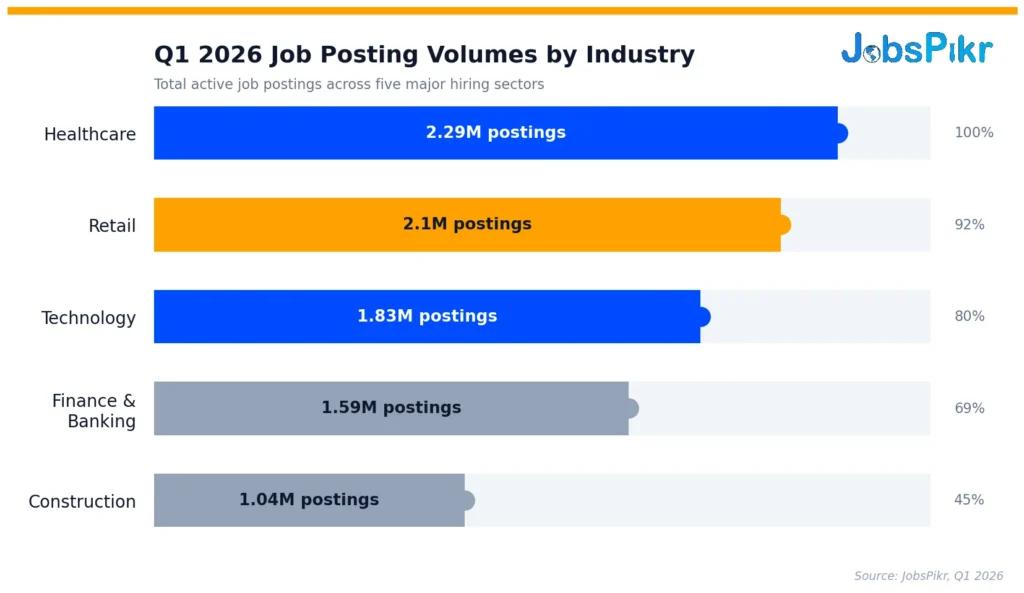
What we are seeing in Q1 2026 is a labor market that looks healthy on the surface but is intensely competitive underneath it. Healthcare alone generated 2.29 million postings in the first quarter of this year. Retail came in at 2.1 million. Technology crossed 1.83 million. These are not numbers that suggest a sluggish economy. They suggest an economy where demand for talent is running well ahead of available supply, and where competition between employers is getting sharper, not softer.
And the pressure is not evenly distributed. Some role categories are being competed for across five, six, sometimes seven different industries at the same time. Some geographies are heating up faster than others. Some company sizes are structurally better positioned to win in fast-moving talent pools than others. None of that nuance shows up in a single unemployment figure.
Why Cross-Sector Competition Changes Everything
What makes this moment genuinely different from previous tight labor markets is the cross-sector dimension of the competition. In past cycles, industries largely competed for talent within their own lanes. Tech hired from tech. Healthcare hired from healthcare. That is no longer how it works.
The same roles are now appearing across multiple industries simultaneously, and employers who are used to competing only against companies that look like them are suddenly in a much wider, much less predictable talent race. A Sales Manager candidate is not just choosing between two retail companies. They are weighing offers from a technology firm, a construction company, a bank, and a retailer, all at once. That changes the sourcing calculus entirely.
For TA teams still building strategies based on their own industry norms, that cross-sector pressure is something they are often underestimating until it shows up in their offer rejection rates and time-to-hire numbers.
What the Job Market Index Is Actually Measuring
The job market index, properly understood, is not a single number. It is a multi-dimensional picture. It captures where hiring demand is concentrated, how fast posting volumes are growing relative to candidate availability, which roles are being competed for across industry lines, and how all of that translates into real pressure on sourcing strategy, offer positioning, and recruiter capacity.
The sections that follow break that picture down, industry by industry and role by role, using real Q1 2026 job posting data from JobsPikr. If you are a TA leader, an HR business partner, or a compensation analyst trying to figure out where your hiring strategy needs to adjust, this is the data that matters.
Your Talent Strategy Deserves Better Than Guesswork
In a market where hiring competition crosses industry lines and compensation benchmarks shift quarter to quarter, the TA teams that win are the ones working from real intelligence, not assumptions.
Competitive Hiring Intensity by Industry: Where the Real Pressure Is
Let’s be honest about something. When most TA teams talk about “the market being competitive,” they usually mean their market. Their industry, their role type, their usual candidate pool. What the Q1 2026 job posting data from JobsPikr shows is that competitive hiring is not evenly distributed, and understanding exactly where the pressure is highest is the first step toward deploying your sourcing resources where they will make a difference.
Here is how the five major industries stack up on hiring intensity this quarter.
Healthcare: The Highest Volume, The Least Slack
With 2.29 million job postings in Q1 2026, healthcare is the single most active hiring market in the dataset. That volume alone is striking, but what makes healthcare’s competitive hiring intensity particularly severe is the structural nature of the shortage behind it. This is not demand created by business expansion. It is demand driven by an aging population, a retiring clinical workforce, and a training pipeline that simply cannot produce qualified professionals fast enough to keep pace.
The roles driving this volume, Registered Nurses, Licensed Practical Nurses, Medical Assistants, Physical Therapists, and Personal Care Aides, are not roles where you can hire adjacent talent and upskill quickly. Credentialing requirements mean the candidate pool is definitionally finite, and every healthcare employer in the country is fishing in the same pond. For TA teams in this sector, the job market index reading is as high as it gets. Sourcing strategies built around inbound applications are not going to cut it here.
Retail: High Volume, But a Different Kind of Competition
Retail posted 2.1 million openings in Q1 2026, making it the second most active sector by raw volume. But the nature of retail’s hiring competition is meaningfully different from healthcare’s. Retail is dealing with a high-churn, high-volume problem rather than a deep skills scarcity problem. The roles at the top of retail’s hiring list, Retail Salespersons, Cashiers, Stockers, Customer Service Representatives, are roles with relatively low barriers to entry but extremely high turnover rates.
That distinction matters for how you interpret the competitive hiring pressure here. In retail, the competition is less about finding candidates who have rare skills and more about winning the attention and commitment of candidates who have many options at a similar compensation level. Employer brand, schedule flexibility, and speed of hire are the competitive levers that move the needle in this sector more than sourcing sophistication does. The sheer volume of postings also tells you that a significant portion of these roles are being reposted repeatedly, which is a signal of retention failure as much as it is a signal of hiring demand.
Technology: Smaller Volume, Much Sharper Competition
Technology’s 1.83 million postings in Q1 2026 look modest compared to healthcare and retail, but raw volume is not the right lens here. The competitive hiring intensity in tech is driven by skill specificity, not headcount demand. The roles on tech’s top hiring list, Software Developers, Computer and Information Systems Managers, IT Project Managers, Database Architects, are roles where the gap between a qualified candidate and an unqualified one is enormous, and where the number of truly qualified candidates available at any given moment is far smaller than the posting volume suggests.
The salary data makes this concrete. Computer and Information Systems Managers saw advertised salaries jump from $154,000 in Q1 2025 to $167,000 in Q1 2026, an increase of roughly 8.4% in a single year. Software Developer salaries moved slightly in the other direction, from $103,000 to $99,600, which is worth watching. That modest decline could reflect a slight softening in entry-level demand as AI tools begin absorbing some junior development work, or it could reflect a temporary market correction. Either way, the directional movement in advertised salaries is one of the clearest signals of where competitive pressure is intensifying versus where it is beginning to plateau.
For TA teams in tech, the competitive job market reality is that you are not just competing against other tech companies. You are competing against every industry that needs technical talent, which at this point is essentially every industry.
Finance and Banking: Quiet Competition, High Stakes
Finance and banking’s 1.59 million postings in Q1 2026 make it the fourth most active sector by volume, but its competitive hiring dynamics are arguably the most underappreciated of any industry on this list. Finance sits at a unique intersection in the talent demand analysis picture because it competes for two very different talent pools simultaneously.
On one side, it needs traditional financial professionals, Loan Officers, Financial Analysts, Personal Financial Advisors, and Tellers. On the other side, it increasingly needs the same technical talent that tech companies are chasing, Software Developers and Computer and Information Systems Managers both appear in finance’s top ten hiring roles for Q1 2026. That dual competition means finance employers are simultaneously navigating a relatively stable traditional talent market and an extremely hot technical talent market, often within the same hiring team.
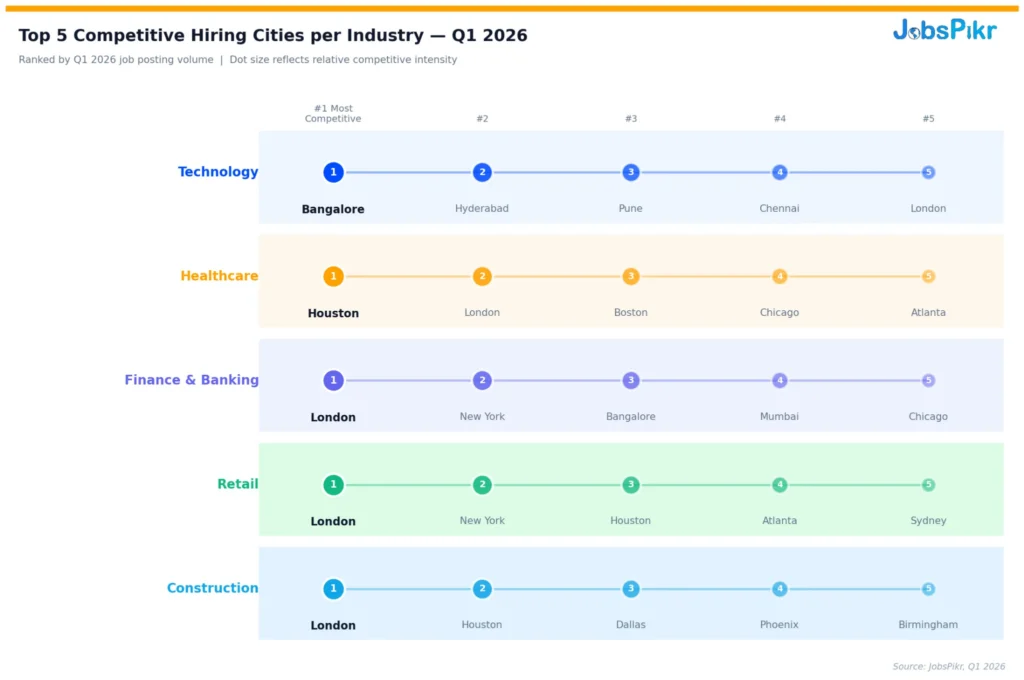
The geographic concentration of finance hiring adds another layer of complexity. London, New York, Bangalore, Mumbai, and Chicago are the top five cities for finance hiring competition in Q1 2026 according to JobsPikr data. Three of those five cities also appear in the top hiring markets for technology. That geographic overlap means the same candidate pool is being approached by employers from two of the most aggressive hiring sectors simultaneously, in the same cities.
Construction: Lower Volume, Longer Struggle
Construction’s 1.04 million postings in Q1 2026 are the lowest of the five sectors in this dataset, but do not mistake lower volume for lower pressure. Construction’s hiring challenge is arguably the most structurally entrenched of any industry here. The roles that dominate construction hiring, Construction Managers, Civil Engineers, Carpenters, Cost Estimators, Heavy Truck Drivers, require years of hands-on experience and in many cases specific certifications that take time to earn. You cannot accelerate the supply of a qualified Carpenter the way you might accelerate the supply of a customer service representative.
What makes construction’s competitive hiring picture particularly interesting is the presence of Sales Managers and Marketing Managers in its top ten hiring roles. These are roles that construction firms are competing for directly against tech, retail, and finance companies, often with less employer brand recognition and compensation competitiveness than those sectors can offer. That cross-sector disadvantage is something construction TA teams need to account for explicitly in their sourcing and offer strategy.
How These Five Industries Compare at a Glance
When you line up Q1 2026 posting volumes across all five sectors, the picture that emerges is not just about which industry is hiring the most. It is about which industries are creating the most pressure on specific shared talent pools. Healthcare and retail are generating enormous volume. Tech and finance are generating fierce competition for high-skill roles. Construction is fighting a slower, deeper structural battle.
The industries in the middle of all of this, the ones facing genuine cross-sector talent competition, are the ones that need the most sophisticated approach to competitive hiring intelligence. And as the next section shows, the roles caught in the crossfire of multiple industries competing simultaneously are where the real sourcing complexity lives.
The Roles Everyone Is Fighting Over at the Same Time
Here is where the competitive job market picture gets genuinely complicated for TA teams.
When you look at hiring data industry by industry, each sector’s challenges seem somewhat self-contained. Healthcare is short on nurses. Tech is short on developers. Finance needs analysts. But when you look across all five industries simultaneously, a different and more disruptive pattern emerges. A significant number of roles are not sitting neatly inside one industry’s talent pool. They are being actively recruited across three, four, and five industries at the same time. And that cross-sector collision is creating some of the sharpest hiring competition in the entire job market right now.
This is what talent demand analysis misses when it stays within industry silos. The real pressure points are not always the most technically specialized roles. Sometimes they are the operational and commercial roles that every industry needs to function, and that nobody has a structural advantage in attracting.
The Roles Caught in the Cross-Industry Crossfire
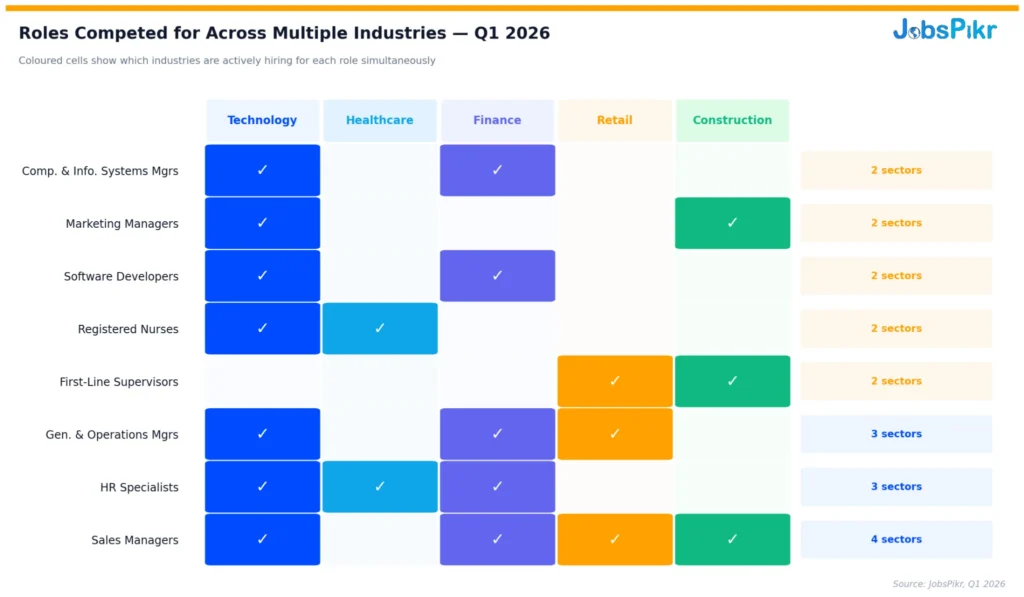
Looking at Q1 2026 job posting data from JobsPikr across technology, healthcare, finance, retail, and construction, three roles stand out as appearing in the top hiring lists of the highest number of industries simultaneously.
Sales Managers appear in the top ten hiring roles for technology, finance, retail, and construction. That is four out of five industries in this dataset competing for the same candidate profile at the same time. A Sales Manager candidate in Q1 2026 is not choosing between two employers in the same sector. They are weighing opportunities from a software company, a bank, a retail chain, and a construction firm, all of whom are making their pitch simultaneously. The advertised salary data reflects the pressure this creates. JobsPikr data shows median advertised salaries for Sales Managers moved from $72,500 in Q1 2025 to $70,300 in Q1 2026, a modest decline that likely reflects employers pulling back slightly on advertised ranges while relying more heavily on variable compensation and commission structures to stay competitive without inflating base salary benchmarks.
Software Developers appear in the top hiring lists for both technology and finance, and their presence in finance deserves particular attention. Banks and financial services firms have been building out their own engineering capabilities for years now, and in Q1 2026 they are competing directly and aggressively with technology companies for the same developer talent. The advertised salary movement here is telling. Median posted salaries for Software Developers declined slightly from $103,000 in Q1 2025 to $99,600 in Q1 2026. That dip is worth watching closely. It may reflect the early stages of AI-assisted development beginning to soften demand for certain developer profiles, or it may simply reflect a temporary correction after several years of sharp salary growth in this category. Either way, it signals that the compensation arms race for developers may be entering a more nuanced phase.
Marketing Managers appear in the top hiring lists for technology and construction, which is a pairing that tells its own story. The fact that construction firms are competing for the same Marketing Manager profiles as technology companies speaks to how much the commercial function in traditional industries has evolved. Construction companies are increasingly investing in digital marketing, content, and brand capability, which means their Marketing Manager requirements now overlap significantly with what a tech firm is looking for. With median advertised salaries moving from $84,700 in Q1 2025 to $83,400 in Q1 2026, the compensation picture here is relatively stable, but the competitive dynamics are anything but.
Computer and Information Systems Managers appear at the top of hiring lists for both technology and finance, and this is the role where the salary data tells the most dramatic story in the entire dataset. Median advertised salaries for this role jumped from $154,000 in Q1 2025 to $167,000 in Q1 2026, an increase of roughly $13,000 in twelve months. That kind of movement in advertised compensation is a direct reflection of how intensely two of the highest-paying industries in the economy are competing for the same leadership-level technical talent. For TA teams in either sector, this is a role where offer strategy needs to be recalibrated frequently, because the market is moving fast enough that a compensation benchmark from six months ago may already be meaningfully out of date.
Registered Nurses appearing in the top hiring lists for both healthcare and technology might seem surprising at first glance. But it reflects the growing presence of clinical informatics, health tech, and digital health roles within technology companies, where nursing credentials combined with technical aptitude create an extremely rare and sought-after profile. This cross-sector demand adds another layer of pressure on an already strained nursing talent pool, and it means healthcare TA teams are no longer only competing against other hospital systems. They are also competing against technology employers who can often offer more flexible working conditions, higher base salaries, and stronger remote work options.
What Cross-Sector Competition Actually Means for Your Sourcing Strategy
The practical implication of cross-sector talent competition is straightforward but uncomfortable for most TA teams to sit with. Your sourcing strategy cannot be built solely around your industry’s norms, because the candidates you are trying to reach are being approached by employers from completely different sectors, often with different value propositions, different compensation structures, and different working models.
A Sales Manager candidate evaluating your offer is not just benchmarking against your competitors in the same industry. They are benchmarking against what a technology firm is offering them, and technology firms tend to have stronger employer brand recognition, more flexible working arrangements, and equity upside that traditional industries struggle to match. If your offer strategy is calibrated only against your direct industry competitors, you are likely losing candidates to cross-sector competitors without ever fully understanding why.
The same logic applies to sourcing channels. If Software Developers are being recruited simultaneously by technology companies and financial services firms, and both are fishing in the same LinkedIn pools and attending the same developer conferences, the cost of candidate acquisition in those channels is going to reflect that shared demand. TA teams that diversify their sourcing into channels where cross-sector competition has not yet arrived will consistently find better quality candidates at lower cost per hire.
This is exactly the kind of role-level, cross-industry competitive intelligence that job market index data is built to surface. Knowing which of your target roles are also being actively recruited by four other industries is not a nice-to-have insight. It is foundational to building a sourcing strategy that is calibrated to the actual competitive environment you are operating in, rather than the one you assume you are operating in.
Enterprise vs. SMB: How Company Size Changes the Hiring Competition
Not every employer enters a competitive job market on equal footing. Two companies can be recruiting for the exact same role, in the same city, at the same salary range, and have completely different hiring outcomes based almost entirely on their size and the organizational complexity that comes with it. Understanding how enterprise and SMB hiring dynamics differ is not just an academic exercise. It has direct implications for how you structure your recruiting process, how quickly you need to move when a strong candidate enters your pipeline, and how realistically you can expect to compete in the talent pools that matter most to your business.
The picture that emerges from looking at company size alongside competitive hiring data is one that should make large enterprise TA teams genuinely uncomfortable, and one that should help SMB hiring managers understand both their advantages and their very real limitations.
The Enterprise Hiring Paradox
Here is the paradox that plays out in enterprise hiring repeatedly. Large organizations typically have the biggest recruiting budgets, the most established employer brands, the most sophisticated HR technology stacks, and the largest TA teams. On paper, they should be winning the talent competition decisively. In practice, they are often losing it to smaller, faster-moving organizations, not because of brand or compensation, but because of process.
According to SHRM research, the average time to fill a role across all organization sizes sits at approximately 44 days. But those average masks an important split. Enterprise organizations, those with over 1,000 employees, consistently report time-to-fill figures that run significantly longer than their smaller counterparts, driven by multi-stage approval processes, structured interview loops, compensation band approvals that require multiple sign-offs, and internal compliance requirements that add friction at every step of the hiring funnel.
In a talent market where the most competitive roles are moving fast, that process overhead is not a minor inconvenience. It is a structural disadvantage. A strong Software Developer or a highly qualified Computer and Information Systems Manager is typically evaluating multiple opportunities simultaneously. Research from Glassdoor suggests that the best candidates are off the market within 10 days of beginning an active job search. Enterprise hiring processes that take four to six weeks just to get to an offer stage are not competing for the same candidates as employers who can move from first interview to offer in seven to ten days. They are competing for whoever is left.
Where Large Employers Do Have a Genuine Advantage
That said, enterprise hiring is not without its strengths in a competitive job market, and being honest about where those strengths lie is important for calibrating strategy rather than simply criticizing process.
Large employers tend to have more established talent pipelines, stronger university recruiting relationships, and more resources to invest in employer brand at scale. For roles where the candidate evaluation process is genuinely complex, senior leadership positions, highly specialized technical roles, and roles requiring security clearances or professional licensing, a thorough multi-stage process is often appropriate and candidates expect it. Enterprise employers also tend to offer more structured career development, stronger benefits packages, and greater job security, factors that matter significantly to certain candidate segments, particularly those with families or those earlier in their careers who value stability over speed.
According to LinkedIn’s 2024 Talent Trends report, 61% of candidates say that career growth opportunities are the primary factor in their decision to join a new employer, ahead of compensation. Enterprise organizations that communicate career pathing clearly and early in the hiring process can convert that structural advantage into a genuine differentiator, particularly against smaller employers who may offer speed but less visible long-term opportunity.
The challenge is that most enterprise TA teams are not packaging and communicating these advantages consistently or early enough in the candidate experience. By the time the offer arrives, the narrative about growth and stability has often been drowned out by the friction of a slow, impersonal process.
How SMBs Compete and Where They Hit Their Ceiling
Smaller and mid-market employers, those with under 200 employees and those in the 200 to 1,000 range respectively, operate with a very different set of constraints and advantages in a competitive hiring environment.
The most significant advantage smaller employers have is speed and decision-making agility. A hiring manager at a 50-person company can typically meet a candidate on Tuesday, decide by Thursday, and extend an offer on Friday. That kind of turnaround is not just faster than enterprise hiring. It is a fundamentally different candidate experience, one that signals decisiveness, organizational efficiency, and genuine interest in a way that a six-week enterprise process simply cannot replicate regardless of how polished the employer brand is.
SMBs also tend to offer candidates more visible impact and broader scope of responsibility, which is a compelling proposition for mid-career professionals who feel constrained by the narrow role definitions that large organizations often impose. For the right candidate profile, the opportunity to own a function rather than be one contributor within it is worth a meaningful compensation trade-off.
Where smaller employers hit their ceiling is in role categories that require compensation above a certain threshold, in geographies where cost of living makes it difficult to compete on base salary, and in technical specializations where candidates have global options and can effectively name their terms. A 200-person company competing for a Computer and Information Systems Manager in London or New York against both enterprise tech firms and financial services companies is fighting a compensation battle it is structurally unlikely to win on salary alone. In those situations, the non-compensation elements of the offer, equity, flexibility, culture, scope, and mission, need to do significantly more of the heavy lifting than most SMB TA teams are currently asking them to do.
The Mid-Market Squeeze
The most difficult position in a competitive job market is arguably the mid-market, companies in the 200 to 1,000 employee range. These organizations are often too large to move with genuine startup agility but not large enough to compete with enterprise compensation, brand recognition, or benefits breadth.
Mid-market employers are frequently caught in a no-man’s-land where they are too structured to be fast and too small to be dominant. They face the process overhead of a larger organization without the brand equity to make candidates patient about a slow hiring experience. According to Korn Ferry research, mid-market companies report the highest rates of offer rejection relative to offers extended, precisely because candidates at this stage of their search are often evaluating them simultaneously against both larger and smaller employers and finding them less compelling in both directions.
The mid-market employers that navigate this most successfully tend to be those that have made a deliberate choice about which competitive dimension they want to win on and have built their entire hiring process around it. If speed is the differentiator, every stage of the process is ruthlessly streamlined. If culture and mission are the differentiators, those elements are embedded in every candidate touchpoint from the first outreach message to the offer call, not just the final interview.
What This Means for Competitive Hiring Strategy Across Company Sizes
The takeaway from looking at enterprise versus SMB hiring dynamics in a competitive job market is not that one model is better than the other. It is that each model has specific, identifiable vulnerabilities that are predictable enough to plan around if you have the right data.
Enterprise TA teams need to audit their process honestly and identify exactly where the friction is adding days to their time-to-fill without adding proportional quality to the hire. In most cases, the biggest gains come not from overhauling the entire process but from eliminating the approval and scheduling delays that sit between stages rather than within them.
SMB and mid-market TA teams need to be more deliberate about which role categories they can realistically compete in at the compensation level the market demands, and more creative about how they position the non-compensation elements of their offer in roles where salary is not their strongest card.
Both need the same thing to do this well. A clear, current, role-level picture of what the competitive hiring environment looks like in the markets where they are recruiting, so that strategy is built on real market conditions rather than assumptions that may have been accurate six months ago but are not accurate today.
What Rising Hiring Competition Means for Your Offer Strategy and Time-to-Hire
At some point, competitive hiring stops being an abstract market condition and starts showing up in very specific, very measurable ways inside your own recruiting function. Offer rejection rates creep up. Roles that used to close in three weeks are now taking six. Candidates who seemed engaged go quiet after the final interview. Hiring managers start asking why the process is taking so long, and recruiters start feeling the pressure of a pipeline that is moving slower than the business needs it to.
These are not random occurrences. They are predictable symptoms of a competitive job market that has shifted faster than the hiring strategy designed to navigate it. And the good news is that because the symptoms are predictable, so are the remedies, if you are working with the right data.
What the Salary Data Is Telling You About Offer Positioning
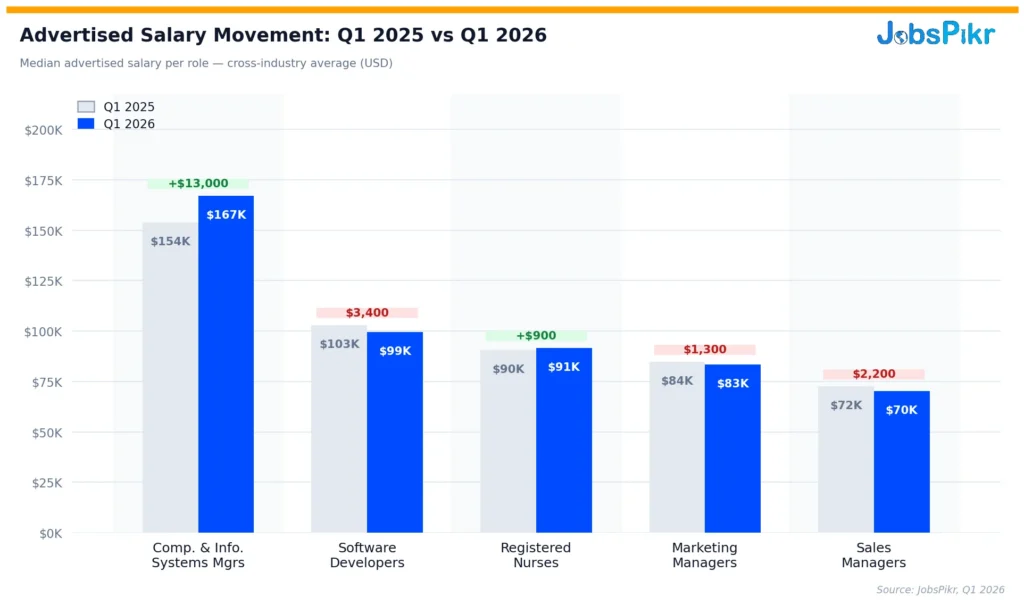
The Q1 2025 to Q1 2026 advertised salary movement in JobsPikr’s dataset tells a story that every compensation analyst and TA leader should be paying close attention to right now, because it is not a uniform story. Different roles are moving in very different directions, and treating them all the same way in your offer strategy is one of the most common and most costly mistakes in a competitive hiring environment.
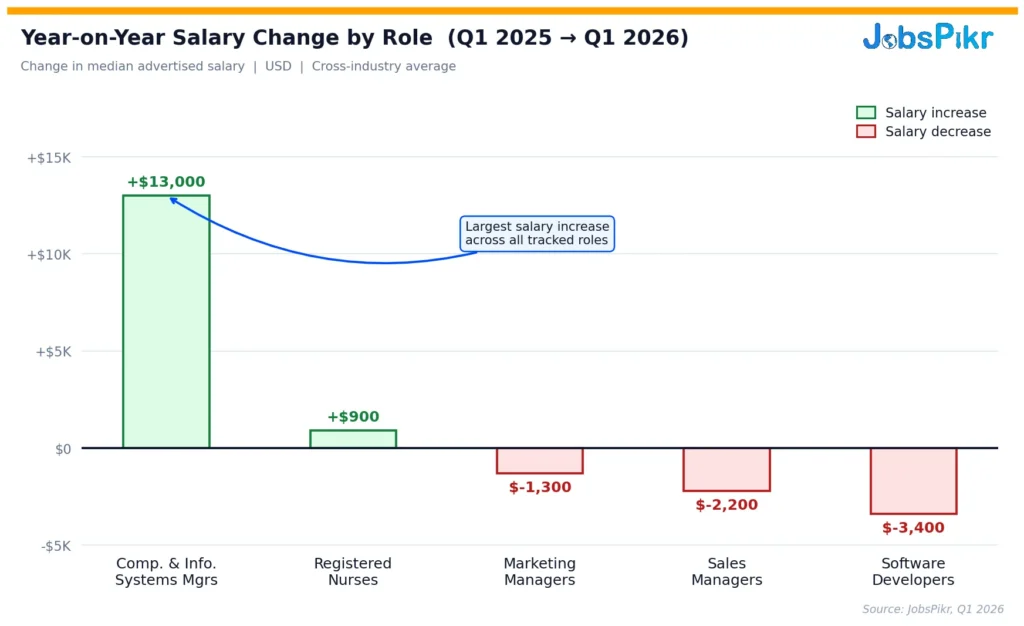
Computer and Information Systems Managers saw the sharpest upward movement in the dataset, with median advertised salaries rising from $154,000 to $167,000 between Q1 2025 and Q1 2026. That is an 8.4% increase in twelve months, in a role that is already at the high end of the compensation spectrum. For TA teams still benchmarking this role against salary data from mid-2024 or earlier, that gap between your internal benchmark and the current market rate is not just a number on a spreadsheet. It is the reason your offers are being declined.
Registered Nurses showed a more modest but meaningful upward movement, from $90,600 to $91,500 over the same period. In a role category with 2.29 million postings and a structurally constrained candidate pool, even a relatively small increase in advertised salary reflects sustained demand pressure that is unlikely to ease in the near term. For healthcare TA teams, the implication is not necessarily that you need to dramatically increase offer amounts, but that you need to be moving closer to the top of your compensation band consistently rather than anchoring to midpoints.
The more interesting signals come from the roles where advertised salaries have declined slightly. Software Developers moved from $103,000 to $99,600. Sales Managers moved from $72,500 to $70,300. Marketing Managers moved from $84,700 to $83,400. Across all three, the decline is modest, in the range of two to three percent, but the directional movement is worth examining carefully before drawing conclusions.
For Software Developers, the decline may partly reflect the early impact of AI-assisted development tools beginning to shift the demand curve for certain developer profiles, particularly at the junior and mid-level end of the market. For Sales Managers and Marketing Managers, it more likely reflects employers pulling back on advertised base salaries while shifting more compensation weight into variable pay, bonuses, and commission structures that do not show up in posted salary ranges. If that is what is happening, and the broader compensation data from sources like Mercer and Korn Ferry suggests it is a growing trend in commercial roles, then TA teams hiring for these positions need to be having more explicit conversations about total compensation earlier in the process, because candidates who are benchmarking against advertised salaries alone may be systematically underestimating what the role actually pays.
Time-to-Hire Pressure Is Not Distributed Evenly
One of the most important things the job market index data reveals is that time-to-hire pressure is not a uniform problem across all role categories. It is concentrated in specific places, and understanding exactly where it is worst allows TA teams to make much smarter decisions about where to invest process improvement effort.
According to SHRM’s most recent hiring benchmarks, the average time to fill across all roles and organization sizes sits at approximately 44 days. But that average is doing a lot of work to conceal the variance underneath it. Technical roles in high-demand categories consistently run longer, with data from LinkedIn’s Talent Solutions research suggesting that specialized technology and healthcare roles take between 50 and 60 days to fill on average, while high-volume commercial roles in retail and entry-level finance can close significantly faster when sourcing pipelines are healthy.
The implication for TA leaders is that a single time-to-hire target across all role categories is not a useful management tool in a competitive market. A 44-day average that combines a 25-day retail hire with a 65-day senior engineering hire is not telling you anything actionable about either. What you need is role-level time-to-hire benchmarks that reflect the actual competitive dynamics of each talent pool, so that you can identify where you are genuinely underperforming relative to the market and where your current pace is actually reasonable given the supply constraints involved.
Where the Biggest Process Delays Are Actually Coming From
Here is something most post-hire analyses eventually surface but rarely get acted on systematically. The biggest contributor to extended time-to-hire in most organizations is not the sourcing phase or the interview phase. It is the time that sits between phases. The days between a recruiter identifying a strong candidate and a hiring manager reviewing their profile. The gap between a final interview and a debrief conversation. The lag between a verbal offer and a written offer going out.
These inter-stage delays are often invisible in ATS reporting because they do not show up as active process steps. They show up as calendar days that accumulate quietly until someone looks at the total time-to-fill number and wonders where the weeks went. In a competitive hiring environment where strong candidates in technical and commercial roles are evaluating multiple opportunities simultaneously, those invisible delays are frequently the difference between a successful hire and an offer that arrives three days after the candidate accepted something else.
Research from the Harvard Business Review found that interview processes lasting more than four weeks cause candidates to lose interest at significantly higher rates, with candidate engagement declining sharply after the three-week mark regardless of their initial enthusiasm for the role. In a market where Computer and Information Systems Managers are commanding $167,000 in advertised salaries and where cross-sector competition means those candidates have options across multiple industries, a four-week process that could have been three weeks is not a minor inefficiency. It is a meaningful competitive disadvantage.
Recruiter Capacity Is the Constraint Nobody Wants to Talk About
Rising competitive hiring intensity has a direct impact on recruiter workload that often gets overlooked in strategic discussions about talent acquisition. When the market gets more competitive, the activities that actually move the needle, proactive outreach, relationship building with passive candidates, detailed candidate preparation before interviews, thoughtful offer conversations, all require more time per hire, not less. But in most TA functions, recruiter headcount has not kept pace with the increased complexity of the competitive environment.
According to SHRM benchmarking data, the average recruiter manages between 15 and 20 open requisitions at any given time in a well-resourced TA function. In organizations that are understaffed relative to hiring volume, that number frequently climbs above 30. At that load, recruiters are forced into a purely reactive operating mode, processing applications and scheduling interviews rather than doing the proactive sourcing and candidate relationship work that competitive markets actually require.
The practical consequence is that recruiter capacity becomes a hidden bottleneck in the hiring funnel. Roles stay open longer not because qualified candidates do not exist, but because the TA team does not have the bandwidth to find them proactively and engage them effectively. In sectors like technology and healthcare where passive candidates make up a disproportionately large share of the available talent pool, that capacity constraint is particularly damaging to hiring outcomes.
For TA leaders making the internal business case for additional recruiter headcount or for tools that improve sourcing efficiency, the job market competitiveness data is one of the most powerful arguments available. A market where posting volumes are running at 1.83 million in tech and 2.29 million in healthcare, and where cross-sector competition means your recruiters are effectively competing against every industry simultaneously, is not a market where a TA function built for a less competitive environment is going to perform at the level the business needs.
Turning Competitive Pressure Into a More Decisive Hiring Process
The organizations that consistently outperform in competitive hiring environments are not necessarily the ones with the most sophisticated technology or the largest sourcing budgets. They are the ones that have built decisiveness into their hiring process as a structural feature rather than leaving it to individual hiring managers.
Decisiveness in hiring means shortlisting faster, scheduling interviews with fewer delays, running structured debriefs immediately after final interviews rather than days later, and being ready to extend offers within 24 to 48 hours of a final interview when a strong candidate is identified. It means giving hiring managers clear market data about what competitive offers look like in real time, so that compensation conversations do not stall at the approval stage because someone is benchmarking against outdated figures.
It also means having a clear internal escalation path for high-priority roles in high-competition categories, so that a senior technical hire does not get stuck waiting for a standard approval process designed for a volume retail hire. Not all roles need the same level of process urgency, but in a competitive job market, the roles that do need it need it badly enough that the cost of getting it wrong is substantial.
This kind of process decisiveness does not happen by accident. It is built on a foundation of current, accurate intelligence about what the market looks like right now, which roles are under the most competitive pressure, where advertised compensation is moving, and how quickly candidates in specific talent pools are being taken off the market by competing employers. That intelligence is what allows a TA team to move with confidence rather than caution, and confidence in the offer process is one of the most underrated competitive advantages in a tight talent market.
Employer Brand in a Competitive Job Market: Why Your EVP Now Has a Shelf Life
There is a version of employer branding that a lot of organizations are still operating on. It involves a careers page that was last updated two years ago, a set of values statements that were workshopped in an offsite and have not been revisited since, and an employee value proposition that was built around what candidates wanted before the market looked anything like it does today. In a less competitive hiring environment, that approach was survivable. In the job market of 2026, it is actively costing you candidates.
The relationship between employer brand and competitive hiring has changed in a fundamental way over the last few years, and understanding exactly how it has changed is important for TA leaders, employer brand managers, and HR business partners who are trying to figure out why their talent attraction efforts are not performing the way they used to.
Your EVP Is Competing Against More Industries Than It Was Built For
The cross-sector competition data from Section 3 has a direct implication for employer brand that does not get discussed enough. When a Sales Manager candidate is evaluating opportunities from a technology firm, a bank, a retailer, and a construction company simultaneously, they are not just comparing compensation packages. They are comparing the entire experience of what it feels like to work for each of those organizations, based on whatever signals are available to them before they have even had a first conversation.
That means your employer brand is being benchmarked not just against your direct industry competitors but against every sector competing for the same talent. And different sectors have very different baseline expectations when it comes to things like workplace flexibility, career development visibility, technology and tooling quality, and the general sophistication of the candidate experience. Technology companies have set a high bar across most of these dimensions, and candidates who are evaluating your offer alongside a tech employer’s offer are using that bar as a reference point whether you want them to or not.
For organizations in construction, finance, and healthcare, this cross-sector brand comparison is one of the most underappreciated challenges in their talent attraction strategy. A construction company competing for a Marketing Manager against a technology firm is not just fighting a compensation battle. It is fighting a perception battle about what day-to-day work life looks like, how modern the tools and processes are, how much autonomy employees actually have, and how clearly the career path is defined. If those perceptions are not being actively shaped by your employer brand content, they are being shaped by assumptions, and assumptions about traditional industries rarely favor them in a comparison against tech.
Reposting Rates Are a Brand Signal, Not Just a Hiring Metric
One of the most underused indicators of employer brand health in job posting data is the reposting rate. When a role is posted, filled quickly, and not seen again for a reasonable period, that is a signal of a healthy hire. When the same role keeps reappearing in the job market every 60 to 90 days, it is telling a different story entirely.
High reposting rates can mean one of two things. Either the role is genuinely hard to fill because the candidate pool is constrained, which is a sourcing problem. Or the role keeps becoming vacant because people keep leaving it, which is a retention problem rooted in the employee experience. Both of these have employer brand implications, but the second one is significantly more damaging and significantly more visible to candidates than most employers realize.
Candidates research companies before applying, and a role that appears repeatedly in job searches over a short period is a red flag that registers even when candidates cannot articulate exactly why. Platforms like Glassdoor and LinkedIn make it easier than ever for candidates to cross-reference what a company says about itself with what current and former employees say about the actual experience of working there. In a competitive job market where candidates have options, any signal of instability or poor employee experience is enough to shift a borderline decision toward a competitor.
For TA leaders and employer brand managers, reposting rate data is one of the most honest early warning signals available. It surfaces the gap between what your EVP promises and what the actual employee experience delivers, and it surfaces it in a way that is visible to the external market, not just internally. The organizations that monitor this data proactively and use it to diagnose retention issues before they compound into brand damage are the ones that maintain a genuine hiring advantage in competitive markets.
Speed Is Now Part of Your Employer Brand
This is something that does not appear in most employer brand frameworks but probably should. In a competitive job market, the speed and quality of your hiring process is itself a brand signal. Candidates draw direct inferences about what it is like to work for an organization based on how that organization treats them during the hiring process. A slow, disorganized, or impersonal candidate experience does not just cost you that specific hire. It shapes how that candidate talks about your organization to their network, what they write in a Glassdoor review, and whether they would consider applying again in the future.
Research from IBM’s Smarter Workforce Institute found that candidates who have a positive hiring experience are 38% more likely to accept a job offer, and that the quality of the hiring experience has a measurable impact on new hire performance and early retention even after someone joins. In other words, the hiring process is not just a means of identifying the right person. It is the first real chapter of the employee experience, and candidates are reading it carefully.
In practice, this means that the decisiveness and responsiveness discussed in Section 5 are not just operational efficiency goals. They are brand investments. Every time a candidate moves through your process quickly, feels genuinely respected and informed at each stage, and receives a clear and well-structured offer, you are building brand equity with that person regardless of whether they ultimately join. And in a competitive job market where today’s declined candidate may be tomorrow’s referral source or reapplicant, that equity compounds over time.
What a Competitive Market Demands From Your EVP Specifically
The employee value proposition that works in a competitive job market is not necessarily the most elaborate one or the one with the most benefits line items. It is the one that is most honest, most specific, and most clearly differentiated from what competing employers are offering in the same talent pools.
Generic EVP language, phrases like “we are a family,” “we value innovation,” or “we invest in our people,” has become so ubiquitous across industries that it functions as noise rather than signal for most candidates. In a market where a Sales Manager candidate is reading five different employer value propositions from five different industries in the same week, the organizations that cut through are the ones that can articulate specifically and credibly what is different about the experience of working for them.
That specificity requires knowing your audience at the role level, not just the company level. What a Software Developer values in an employer is meaningfully different from what a Registered Nurse values, even if both are evaluating your organization at the same time. And what a candidate in Bangalore prioritizes is meaningfully different from what a candidate in London or Houston is weighing, because the local market context, the cost of living, the alternative opportunities available, and the cultural expectations around work all shape how your EVP lands.
According to LinkedIn’s 2024 Talent Trends research, companies with a strong employer brand see a 50% reduction in cost per hire and a 28% reduction in turnover. Those are not marginal gains. In a market where the cost of a mis-hire in a shortage role category can run well into six figures, the ROI on EVP investment is one of the clearest financial cases in the entire talent acquisition budget.
The Competitive Job Market Has Made Employer Brand a Real-Time Capability
Perhaps the most important shift in how leading organizations are thinking about employer brand in 2026 is the move from treating it as a periodic campaign to treating it as a real-time capability. In a market that is moving as fast as the current one, an EVP refresh that happens every two to three years is not keeping pace with how quickly candidate expectations and competitive dynamics are evolving.
The organizations doing this most effectively are the ones that have connected their employer brand strategy to their labor market intelligence. They are monitoring what competing employers are saying in their job postings, how compensation and benefit messaging is evolving across their talent pools, which working model promises are becoming table stakes versus differentiators, and how candidate sentiment about their own brand is shifting on public platforms. They are using that intelligence to make small, continuous adjustments to how they position themselves rather than waiting for a formal EVP project to tell them that the market has moved.
This is where job posting data becomes an unexpected but powerful employer brand tool. The language that employers use in job postings, the benefits they highlight, the working arrangements they advertise, the career development language they lead with, is one of the most direct windows available into how your competitors are positioning themselves to the same candidates you are trying to attract. Monitoring that language systematically across industries and geographies gives employer brand teams an intelligence advantage that most are not currently exploiting.
In a competitive job market where your EVP is being benchmarked against employers from five different industries simultaneously, that kind of real-time competitive intelligence is not a luxury. It is the foundation of a brand strategy that can actually keep up with the market it is trying to win.
How TA Teams Can Use Job Market Competitiveness Data to Hire Smarter
Everything covered in the previous six sections, the industry-level hiring intensity, the cross-sector role competition, the enterprise versus SMB dynamics, the offer strategy implications, the employer brand pressures, all of it points to the same underlying conclusion. The TA teams that are going to consistently outperform in this market are not the ones that work harder within their existing model. They are the ones that have fundamentally better intelligence about the market they are operating in, and they are using that intelligence to make decisions that their competitors are still making on instinct.
This section is about what that looks like in practice. Specifically, how job market competitiveness data from JobsPikr translates into three of the most consequential decisions a TA team makes: where to allocate sourcing budget, how to deploy recruiter capacity, and how to position offers in a market where compensation benchmarks are moving at different speeds in different role categories.
Sourcing Budget Allocation: Stop Spreading Evenly, Start Targeting Precisely
The default approach to sourcing budget allocation in most enterprise TA functions is essentially proportional. More open roles in a category means more budget directed toward that category. It sounds logical, but in a competitive job market it is actually a fairly blunt instrument, because posting volume alone does not tell you where your sourcing dollar is going to generate the most return.
The Q1 2026 data from JobsPikr illustrates this clearly. Healthcare generated 2.29 million job postings, the highest volume of any sector in the dataset. Technology generated 1.83 million. On a proportional budget model, healthcare gets the most sourcing investment, and technology gets the second most. But if you layer in the cross-sector competition data from Section 3, the geographic concentration data, and the salary movement signals, a more nuanced picture emerges.
Technology roles in cities like Bangalore, Hyderabad, Pune, Chennai, and London are being competed for by employers across multiple industries simultaneously. The cost of candidate acquisition in those markets through mainstream channels like LinkedIn and major job boards reflects that shared demand pressure. Sourcing budget directed toward those saturated channels in those saturated geographies is going to generate a lower return per dollar than budget directed toward emerging sourcing channels or geographies where cross-sector competition has not yet arrived.
For healthcare TA teams hiring in Boston, Chicago, and Atlanta, the picture is similar. These are cities where healthcare posting volumes are high and where employer competition for clinical talent is intense enough that standard job board investment is table stakes rather than a differentiator. The organizations finding genuine sourcing efficiency gains in these markets are the ones that have identified where qualified candidates exist before the competition has found them, which requires a level of geographic and channel-level intelligence that goes well beyond knowing which cities have the most postings.
The practical implication for sourcing budget decisions is straightforward. High posting volume in a market is not a reason to invest more in that market through the same channels everyone else is using. It is a reason to look harder for the channels, geographies, and candidate communities where competition has not yet fully arrived. That kind of precision sourcing is not possible without current, granular job market data at the role and geography level.
Recruiter Allocation: Match Capacity to Competitive Complexity, Not Just Requisition Count
The standard model for allocating recruiter capacity is requisition-based. Each recruiter carries a certain number of open roles, and headcount decisions are made based on total requisition volume relative to that capacity benchmark. In a less competitive market, that model works reasonably well. In the market that the Q1 2026 data describes, it systematically under-resources the roles that need the most attention and over-processes the ones that need the least.
Consider the difference between a retail hiring push for Stockers and Order Fillers in London or New York and a technology search for a Computer and Information Systems Manager in the same cities. Both might count as one requisition in a capacity model. But the technology search requires proactive outreach to a passive candidate pool, competitive intelligence about what other employers are offering, a nuanced multi-stakeholder interview process, and a compensation conversation that needs to be calibrated against a market where salaries moved from $154,000 to $167,000 in twelve months. The retail hire, while not without its challenges, operates in a fundamentally different competitive environment that requires a different kind of recruiter effort.
Allocating recruiter capacity based on requisition count alone means that the Computer and Information Systems Manager search is getting the same bandwidth as the retail volume hire, which almost certainly means it is getting less bandwidth than it actually needs. The result is extended time-to-fill in exactly the role categories where extended time-to-fill is most costly.
A smarter allocation model uses competitive intensity data to weight requisitions by the actual recruiter effort they require, not just by headcount. Roles in high-competition categories, in geographically saturated markets, with cross-sector competition from multiple industries, get more recruiter time and more proactive sourcing investment. Roles in lower-competition categories with healthy inbound pipelines get less. That reallocation does not necessarily require more recruiter headcount. It requires better intelligence about where current capacity is being under-deployed relative to where the market demands it.
Offer Positioning: Use Market Data to Lead With Confidence, Not Caution
The offer conversation is where competitive hiring intelligence pays its most immediate and most measurable dividend. And it is also where the gap between organizations that have current market data and those that do not shows up most visibly in hiring outcomes.
The salary movement data from JobsPikr makes the stakes concrete. A TA team that is benchmarking Computer and Information Systems Manager offers against figures from early 2025 is going into offer conversations with a $13,000 gap between their anchor and the current market rate, before the negotiation has even started. In a role where cross-sector competition means the candidate is also fielding offers from financial services firms that are equally aware of the current market rate, that gap is not just a negotiating disadvantage. It is a credibility problem. Candidates who have done their own market research, and most senior candidates have, will notice the discrepancy, and it will shape their perception of how seriously the organization values the role.
The reverse is equally important. For roles where advertised salaries have declined modestly, Software Developers, Sales Managers, and Marketing Managers all showed slight downward movement between Q1 2025 and Q1 2026, a TA team armed with current market data can make offers with confidence at the right level without over-indexing on compensation that the market no longer demands. In high-volume hiring scenarios, the cumulative saving from not inflating offers in categories where the market has softened slightly is not trivial.
Beyond base salary, the geographic data adds another dimension to offer positioning strategy. Finance and banking hiring in London and New York carries a very different compensation expectation than the same role in Bangalore or Mumbai, and technology hiring in Bangalore is now competitive enough that the historical assumption of significant cost arbitrage relative to Western markets needs to be revisited carefully. The top five cities for finance hiring competition in Q1 2026, London, New York, Bangalore, Mumbai, and Chicago, represent three meaningfully different cost and competition environments, and offer strategy needs to reflect those differences at the city level rather than applying a single global or regional benchmark.
Using Geographic Competitive Intelligence to Get Ahead of the Market
The city-level hiring data from JobsPikr is one of the most immediately actionable outputs available to TA teams trying to calibrate sourcing strategy in real time. Knowing that technology hiring competition is concentrated in Bangalore, Hyderabad, Pune, Chennai, and London in Q1 2026 is useful context. But the more valuable question is what that concentration tells you about where to look next.
When posting volumes in a specific city reach the levels seen in Bangalore for technology or London for finance, the candidate acquisition cost in those markets rises, the time-to-hire extends, and the probability of losing a strong candidate to a competing offer increases. The TA teams that are consistently ahead of this curve are the ones that use current geographic concentration data not just to understand where competition is highest today, but to identify adjacent markets where qualified talent exists before employer competition has fully arrived.
For technology hiring, cities like Pune and Chennai are showing high posting volumes in Q1 2026, but the competitive intensity in those markets has not yet reached the saturation levels of Bangalore. For healthcare hiring, Atlanta appears in the top five competitive cities, but secondary markets in the surrounding region may offer viable sourcing alternatives for certain role categories where remote or hybrid work makes geographic flexibility possible. These are the kinds of geographic arbitrage opportunities that are visible in real-time job posting data but invisible in periodic labor market surveys.
Putting It All Together: What a Data-Driven TA Operating Model Actually Looks Like
The shift from a reactive to a proactive talent acquisition operating model is something most TA leaders talk about but relatively few have fully operationalized. The reason is not usually lack of intention. It is lack of the right data infrastructure to make proactive decisions confidently and consistently.
What the JobsPikr dataset makes possible is a TA operating model where sourcing budget decisions, recruiter allocation, offer positioning, and employer brand investment are all calibrated against current market reality rather than historical benchmarks or industry intuition. Where a spike in posting volume for a cross-sector role in a key geography triggers a sourcing response before the shortage becomes a crisis. Where a shift in advertised salary levels for a critical role category is reflected in offer benchmarks within weeks rather than quarters. Where geographic concentration data informs a diversified sourcing strategy that reduces cost per hire by finding talent before the competition does.
This is not a theoretical future state. It is what leading enterprise TA functions are building right now, using real-time labor market intelligence as the foundation for decisions that used to be made on gut feel, anecdote, and lag-indicator data.
The video below shows how talent acquisition teams are using JobsPikr’s competitive hiring intelligence to build exactly this kind of data-driven sourcing and offer strategy in practice.
See how TA teams are turning real-time job market competitiveness data into faster hires, sharper offer positioning, and a sourcing strategy that stays ahead of the market.
The Hiring Edge Goes to Whoever Acts First
The data from Q1 2026 makes one thing clear. The job market is not waiting for hiring strategies to catch up with it. Healthcare is posting 2.29 million openings. Technology is fighting cross-sector competition for the same technical talent that finance, construction, and retail are all chasing simultaneously. Advertised salaries for critical roles like Computer and Information Systems Managers are climbing fast enough that a benchmark from twelve months ago is already meaningfully out of date.
None of this is going to resolve itself on its own. The competitive pressures described in this article are structural, not cyclical. They are being driven by sustained demand across industries, role categories that no longer fit neatly inside single-sector talent pools, and a candidate landscape that is more informed, more selective, and more likely to be fielding competing offers than at any point in recent memory.
The TA teams that come out ahead in this environment are not necessarily the ones with the biggest budgets or the loudest employer brand. They are the ones that have the clearest, most current picture of where competitive hiring pressure is building before it peaks. They are sourcing in geographies that have not yet reached saturation. They are benchmarking offers against what the market looks like today rather than what it looked like last year. They are allocating recruiter capacity to the roles that need it most, not just the roles that have the most requisitions.
That kind of precision is not possible on instinct alone. It requires real-time job market competitiveness data at the role level, the geography level, and the industry level, all at once. That is exactly what JobsPikr is built to deliver.
The competitive advantage in hiring right now belongs to whoever moves first on the right intelligence. The question is whether your TA function has access to it.
The Competitive Hiring Data Your TA Team Has Been Missing
Get a look at how JobsPikr’s real-time competitive hiring intelligence helps enterprise TA teams source smarter, offer faster, and stay ahead of the market.
Frequently Asked Questions
1. What is a job market index and why does it matter for talent acquisition teams?
A job market index is a measure of hiring activity, demand concentration, and competitive pressure across role categories, industries, and geographies at a given point in time. Unlike broad economic indicators like the unemployment rate, a job market index gives talent acquisition teams a granular view of where hiring competition is actually intensifying, which talent pools are under the most pressure, and how quickly specific role categories are moving. For TA leaders and HR business partners, it matters because it turns labor market conditions from background context into actionable intelligence. Knowing that healthcare posted 2.29 million openings in Q1 2026 while technology crossed 1.83 million is not just an interesting data point. It is the starting point for decisions about where to allocate sourcing budget, how to position offers, and where recruiter capacity needs to be concentrated to keep time-to-hire competitive.
2. Which industries are facing the most competitive hiring conditions in 2026?
Based on Q1 2026 job posting data from JobsPikr, healthcare, retail, and technology are generating the highest hiring volumes, with healthcare leading at 2.29 million postings, retail at 2.1 million, and technology at 1.83 million. But raw volume is only part of the competitive hiring picture. Technology and finance are dealing with acute skill scarcity in high-demand role categories, where the gap between posting volume and qualified candidate availability is significant. Construction is facing a slower but deeply structural shortage driven by decades of underinvestment in vocational training. The most complex competitive dynamic sits at the intersection of these industries, where cross-sector role competition means employers are no longer just competing within their own talent lanes but against every sector that needs the same commercial, technical, and operational profiles simultaneously.
3. What is cross-sector talent competition and how does it affect my hiring strategy?
Cross-sector talent competition occurs when the same role appears in the active hiring lists of multiple industries at the same time, meaning candidates for that role are receiving approaches from employers across completely different sectors simultaneously. In Q1 2026, roles like Sales Manager, Software Developer, Marketing Manager, and Computer and Information Systems Manager all appear in the top hiring lists of between two and four industries at once. For a TA team that has built its sourcing strategy, compensation benchmarking, and employer brand positioning entirely around its own industry’s norms, cross-sector competition is a blind spot that shows up in offer rejection rates and candidate drop-off before its cause is properly understood. Addressing it requires a sourcing approach that accounts for the full competitive landscape a candidate is navigating, not just the slice of it that sits within your sector.
4. How can real-time job posting data improve offer strategy and reduce time-to-hire?
Real-time job posting data gives TA teams two things that are critical for offer strategy and time-to-hire reduction. First, it provides current advertised salary benchmarks at the role and geography level, so compensation decisions are based on where the market is today rather than where it was when your last benchmarking exercise was completed. The difference matters significantly in fast-moving categories. Computer and Information Systems Manager salaries moved from $154,000 to $167,000 between Q1 2025 and Q1 2026, and a team benchmarking against last year’s figures is going into offer conversations with a structural disadvantage before the negotiation has even started. Second, it provides competitive intensity signals, posting volumes, reposting rates, and geographic concentration data, that allow TA teams to identify where time-to-hire pressure is building early enough to respond proactively rather than reactively. When you can see a shortage forming three to six months before it fully materializes, you can build the candidate pipeline before the vacancy appears rather than scrambling to fill it after the fact.
5. How does JobsPikr help talent acquisition teams navigate a competitive job market?
JobsPikr gives talent acquisition teams real-time access to job market competitiveness data at a scale and granularity that periodic labor market surveys and industry reports cannot match. The platform processes job posting data daily across more than 70,000 sources and over 100 countries, which means the signals it surfaces, posting volume trends, salary movement, geographic concentration, cross-sector role competition, reflect current market conditions rather than conditions from the previous quarter. For enterprise TA teams, that data translates directly into more precise sourcing budget allocation, recruiter capacity decisions that are weighted by competitive complexity rather than just requisition count, and offer positioning that is calibrated to where the market actually is. For employer brand and compensation teams, it provides a continuous window into how competing employers across industries are positioning their roles, so EVP and compensation strategy can be adjusted in response to real competitive shifts rather than waiting for an annual benchmarking cycle to surface a gap that has already cost the organization candidates.