- **TL;DR**
- What Is Workforce Intelligence in HR?
- Turn workforce data into decisions you can trust
- Why Traditional HR Analytics Is No Longer Enough
- How Workforce Intelligence Expands the Scope of HR Analytics
- Why Job Data Is the Backbone of Workforce Intelligence
- Why job data needs to be trusted to be useful
- Turn workforce data into decisions you can trust
- How Workforce Intelligence Uses Labor Market Insights to Reduce Guesswork
- How Workforce Intelligence Uses Labor Market Insights to Reduce Guesswork
- Turn workforce data into decisions you can trust
- Workforce Intelligence vs Workforce Analytics: Where Most Teams Get Confused
- Real HR Problems Workforce Intelligence Actually Solves
- Why Trust and Data Quality Matter More in Workforce Intelligence Than HR Analytics
- Turn workforce data into decisions you can trust
- What to Look for in an HR Analytics Platform (If You Care About the Future)
- How JobsPikr Turns Job Data Into Workforce Intelligence
- Why Workforce Intelligence Is Becoming the Future of HR Analytics
- Turn workforce data into decisions you can trust
- FAQs
**TL;DR**
Most HR analytics still looks inward. It tells you how many people you hired, who left, and how long roles stayed open. What it does not tell you is why those numbers are changing, or what the market is doing while you are reviewing last quarter’s reports.
Workforce intelligence fills that gap. It brings in job data and labor market insights to show how roles are evolving, which skills are getting harder to hire, and where demand is heating up or slowing down. When HR teams see these signals early, they can plan their hiring, skills, and locations with far more confidence. That shift, from internal reporting to market-aware insight, is what defines the future of HR analytics.
What Is Workforce Intelligence in HR?
Most teams already have HR analytics. They can pull attrition, headcount, time-to-fill, internal mobility, offer drop-offs. The problem is not the dashboard. The problem is the moment someone asks the next question:
“So what should we do about it?”
That is where workforce intelligence comes in. It is not a prettier version of HR analytics. It is the layer that explains what your internal numbers cannot, because it brings in what is happening outside your four walls, using job data and labor market insights.
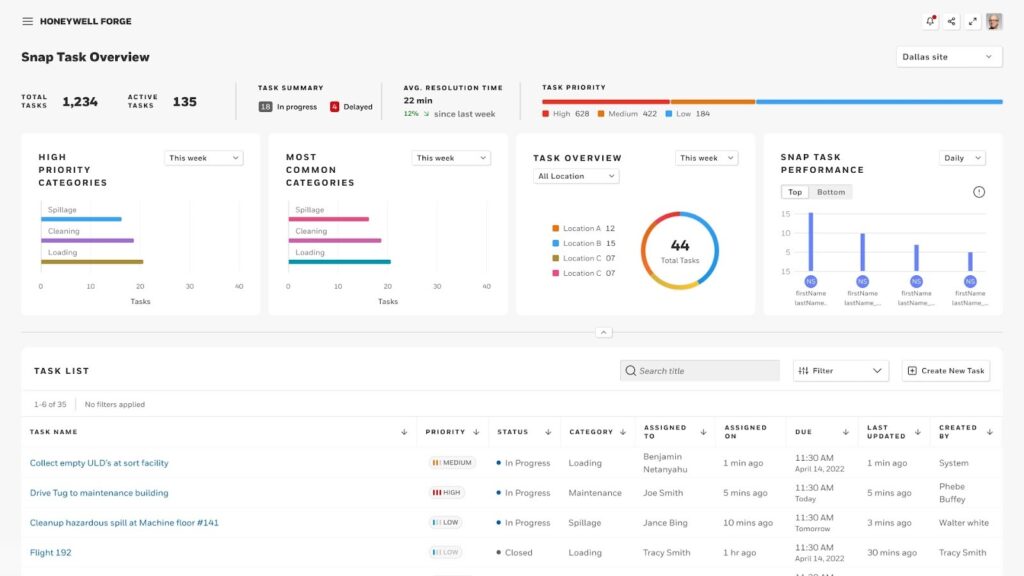
Image Source: Honeywell
Workforce intelligence is HR analytics with market context
HR analytics tells you your time-to-fill for data engineers jumped from 45 days to 70. Workforce intelligence helps you answer whether that jump is because your process got slower, or because the market moved.
It answers the questions HR teams keep getting asked
Leaders rarely ask HR for “more metrics.” They ask for clarity.
They want to know:
- Are we losing people because we have a problem, or because competitors are hiring aggressively in the same city?
- Are we struggling to hire because our JD is outdated, or because the skill mix the market wants has shifted?
- Is a role hard to fill everywhere, or only for us?
Workforce intelligence is built to answer these kinds of questions using workforce analytics plus external signals from job data.
Where workforce intelligence fits between workforce analytics and talent strategy
Workforce analytics is a measurement. Talent strategy is choices. Workforce intelligence is what connects the two.
If workforce analytics says, “offer acceptance is down,” talent strategy needs to decide whether to change comp, change role scope, change location, or change the pipeline mix. Workforce intelligence supports that decision by showing what the market is paying for similar roles, how competitors are framing the same jobs, and where demand is rising or cooling.
This is why job data matters so much
Job postings are not perfect, but they are one of the few large-scale, near-real-time signals of employer demand. When you look at job data across companies, roles, and locations, patterns show up fast: skills getting added to job descriptions, roles getting renamed, hiring shifting to new metros, and sudden spikes in demand for certain profiles.
Those patterns are what turn HR data into talent intelligence you can actually use.
Workforce intelligence is about reducing wrong assumptions
Here’s a very common trap in HR analytics: treating every change as an internal issue.
Example: when HR analytics misleads without labor market insights
Time-to-fill increases. The default diagnosis is usually “pipeline problem” or “interview process problem.” But if labor market insights show that hiring demand for that role doubled in your region over the last 60 days, your process might be fine. The market is simply tighter. The right action might be comp correction, location expansion, or adjusting the role requirements, not “fix the recruiters.”
Workforce intelligence exists to prevent that kind of expensive misread. It keeps HR analytics grounded in what the labor market is doing right now, using job data as a reality check.
Turn workforce data into decisions you can trust
See how real job data and labor market insights can strengthen your HR analytics and workforce planning.
Why Traditional HR Analytics Is No Longer Enough
For a long time, HR analytics did exactly what it was expected to do. It helped teams bring structure to people data. Headcount reports replaced gut feel. Attrition trends replaced anecdotes. Hiring metrics gave leaders something concrete to review in quarterly meetings.
The problem is not that HR analytics is wrong. The problem is that the world it was designed for no longer exists.
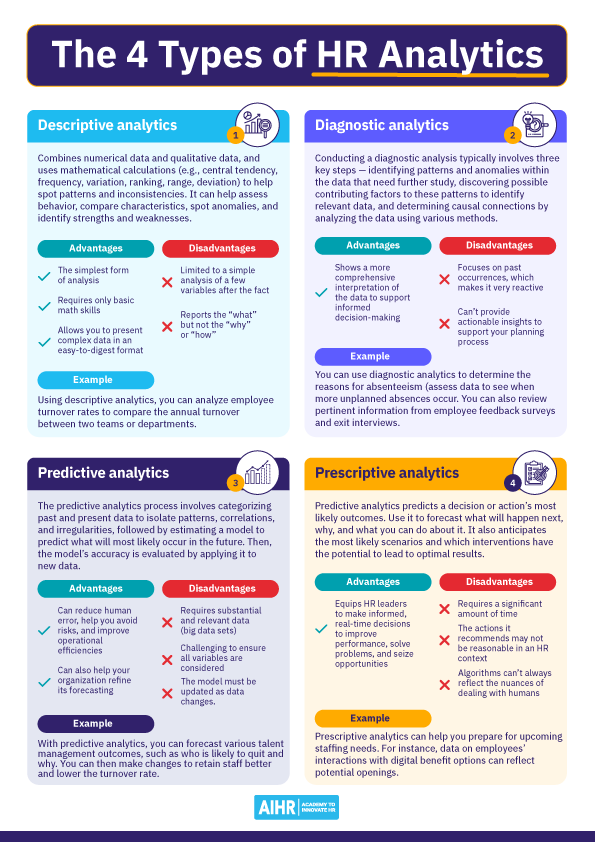
Image Source: AIHR
HR analytics explains the past, not the present
Most HR dashboards are built on internal systems. HRIS, ATS, performance tools, engagement surveys. All of this data is valuable, but it arrives late. By the time a trend shows up clearly, the market has already moved.
Attrition spikes only after people have accepted other offers. Time-to-fill increases only after roles have been open for weeks. Skills gaps become visible only when teams start missing delivery goals. Traditional HR analytics reacts to outcomes. It does not surface early signals.
This is why HR teams often feel like they are constantly explaining bad news instead of preventing it.
Internal HR data creates blind spots by design
Internal HR data shows you what your workforce looks like today. It does not show you what your workforce is competing against.
You might see that a critical role has low applicant volume. What you do not see, without workforce intelligence, is that three competitors just opened large hiring programs for the same role in the same location. You might notice declining offer acceptance. What you cannot see is whether compensation expectations for that role have shifted across the market.
When numbers lack context, decisions rely on assumptions
In the absence of labor market insights, HR teams fill the gap with assumptions. Recruiters assume sourcing needs to work harder. Hiring managers assume candidates are less committed. Leaders assume brand issues. Sometimes those assumptions are correct. Often, they are not.
This is where traditional HR analytics starts to break down. It provides numbers without enough context to explain them.
Workforce analytics alone cannot predict what comes next
Workforce analytics is excellent at describing patterns inside the organization. It can segment attrition by role, track diversity by level, and analyze internal mobility. What it cannot do on its own is tell you what the external labor market will look like three or six months from now.
Job data and labor market insights change faster than internal data. New skills appear in job descriptions before they show up in resumes. Role titles evolve before they appear in org charts. Hiring demand shifts across regions before HR budgets catch up.
Without those external signals, HR analytics becomes reactive by default.
The cost of relying only on backward-looking HR analytics
When HR teams operate only on internal data, they tend to respond late and overcorrect. Hiring plans get revised after talent shortages hit. Skills programs are launched after roles become hard to staff. Location strategies change only after attrition spikes.
Workforce intelligence exists because the cost of being late has gone up. Talent markets move faster than internal reporting cycles. The future of HR analytics depends on seeing change earlier, using job data and labor market insights as leading indicators, not post-mortems.
How Workforce Intelligence Expands the Scope of HR Analytics
Here’s a blunt truth most HR teams run into sooner or later: HR analytics is great at describing your company, and surprisingly bad at explaining your situation.
You can know your attrition is up, your time-to-fill is getting worse, and your offer acceptance is slipping. But the second a business leader asks, “Is this us, or is this the market?” a lot of HR analytics teams end up doing the same thing: scrambling. Someone pulls a few LinkedIn screenshots. Someone checks a couple of competitor career pages. Someone guesses.
Workforce intelligence is what makes that scramble unnecessary.
It moves HR analytics from “internal reporting” to “market-aware insight”
Traditional HR analytics lives inside your systems. HRIS, ATS, engagement tools. It is clean, structured, and… inward-looking. That is not a flaw, it is just what the data is.
Workforce intelligence expands the scope by bringing in external signals, mainly job data and labor market insights, so HR teams can place internal trends in context.
It gives you a baseline that is not “last quarter.”
A big reason HR analytics gets misread is that the only baseline teams use is historical internal performance. Last month. Last quarter. Last year.
But the labor market does not care about your last quarter. If demand for a role spikes across your industry, your hiring metrics will change even if your process stays the same. Workforce intelligence gives you a baseline that is external: what the market is doing right now.
Workforce analytics measures. Workforce intelligence explains.
Workforce analytics is a measurement. It helps you quantify what is happening.
Workforce intelligence is interpretation. It helps you understand what those numbers mean and what to do next.
Example: time-to-fill without context is a trap
If your time-to-fill for data engineers rises, HR analytics will show the increase. But it cannot tell you whether:
- the role got harder because competitors are hiring aggressively,
- the skill profile changed in the market,
- location demand shifted, or
- your job description is not aligned with what candidates expect.
Workforce intelligence helps answer those questions because it connects HR data to job data and labor market insights.
It changes the kind of questions HR can answer
When you only have internal HR data, you mostly answer questions that start with:
- “How many…”
- “How long…”
- “What percentage…”
Once you add job data and workforce analytics signals from the market, HR can answer questions that leaders actually care about:
- “Are we losing people because we have a retention issue or because the market is paying more?”
- “Is this role hard to hire everywhere or just for us?”
- “Are our skill requirements realistic for this location?”
- “What roles are emerging in our space that we are not even planning for yet?”
That is the real expansion. Not more charts. Better answers.
Why this matters for the future of HR analytics
The expectation on HR has changed. HR is being asked to advise on workforce planning, skills strategy, and talent risk, not just report metrics.
And that work requires external context. Without it, HR analytics stays stuck in hindsight. With it, HR teams can spot pressure points earlier and make decisions with fewer assumptions. That is why workforce intelligence is not a nice add-on. It is becoming the core of what modern HR analytics needs to be.
Why Job Data Is the Backbone of Workforce Intelligence
If workforce intelligence had to stand on one data source, it would be job data. Not because job postings are perfect, but because they are one of the few signals that show what employers want before those decisions turn into hires, attrition, or budget changes.
This is where most HR analytics falls short. Internal HR data tells you what has already happened. Job data shows what is about to happen in the market.
Job postings are early signals, not just vacancies
Most people think of job postings as simple hiring ads. In reality, they are structured signals of demand. Every posting carries information about skills, experience levels, role scope, seniority, location, and urgency.
When you look at one posting, it does not tell you much. When you look at thousands or millions of postings over time, patterns become obvious.
You start seeing roles evolve. Titles change. Skill requirements expand or narrow. Experience expectations creep up. Entire job families emerge or fade. All of this happens in job data well before HR teams see the impact internally.
This is why job data is foundational to workforce intelligence. It captures intent, not outcomes.
What job data reveals that HR data cannot
Internal HR data is constrained by your organization’s structure. Job data is not. That difference matters.
Skills shift before they show up internally
A common frustration for HR teams is being “late” to skills trends. By the time a skill shows up as a gap internally, the market has already moved on.
Job data surfaces these shifts earlier. When new tools, frameworks, or certifications start appearing consistently across job postings, it signals changing expectations. Workforce intelligence uses these signals to flag skills that are becoming table stakes, not nice-to-haves.
Role definitions change quietly
Roles rarely change through formal announcements. They change quietly, one job description at a time.
Job data shows when roles start absorbing new responsibilities, when two roles begin to overlap, or when a single role splits into multiple specializations. HR analytics inside the organization often lags this reality because org structures and titles change slowly.
Location pressure becomes visible
Hiring challenges are often location-specific, but internal data does not always make that obvious. Job data, combined with labor market insights, shows where demand is concentrating and where supply is thinning out.
This is how workforce intelligence helps HR teams understand whether a hiring slowdown is a sourcing issue, a location issue, or a market-wide constraint.
Job data turns workforce analytics into talent intelligence
On its own, workforce analytics tells you what is happening inside your company. When you layer in job data, those same metrics become talent intelligence.
Time-to-fill stops being just a number and starts reflecting market competitiveness. Attrition becomes easier to interpret when you see how aggressively similar roles are being hired elsewhere. Compensation discussions become more grounded when job data shows how roles are positioned across the market.
This is the shift workforce intelligence enables. HR analytics becomes less about defending metrics and more about explaining reality.
Why job data needs to be trusted to be useful
Job data only works if it is clean, current, and comprehensive. Stale postings, duplicate roles, inconsistent titles, and poor location data can distort insights quickly.
This is where many workforce analytics efforts fail. Teams pull a sample of job postings, run one-off analyses, and draw big conclusions. Workforce intelligence requires job data that is structured, normalized, and refreshed continuously, so trends are real and not artifacts of messy inputs.
Without that foundation, job data becomes noise. With it, it becomes the backbone of workforce intelligence.
Turn workforce data into decisions you can trust
See how real job data and labor market insights can strengthen your HR analytics and workforce planning.
How Workforce Intelligence Uses Labor Market Insights to Reduce Guesswork
One of the hardest parts of workforce planning is knowing whether you are reacting to a real signal or just noise. Hiring feels slower. Candidates are pushing back on compensation. Certain skills are suddenly hard to find. Without context, every one of these situations turns into a debate driven by opinion.
Labor market insights are what remove a large part of that guesswork.
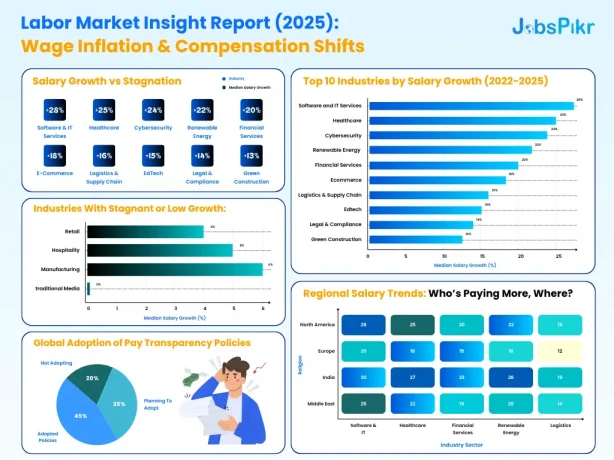
Labor market insights show pressure before it turns into problems
Internal HR data shows impact after the fact. Labor market insights show pressure building up.
When hiring demand for a role starts increasing across an industry, job data reflects it almost immediately. More postings appear. Roles stay open longer. Skill requirements tighten. Location concentration increases. These shifts happen weeks or months before most organizations feel the effect in their own hiring funnel.
Workforce intelligence uses these early signals to help HR teams understand what is coming, not just what has already gone wrong.
Understanding supply and demand, not just vacancies
A common mistake is to treat job volume as the only indicator of market activity. Labor market insights go deeper than counting postings.
They help answer questions like:
- Are more companies competing for the same talent pool, or are new talent pools opening up?
- Is demand rising evenly, or only in specific locations?
- Are employers widening role definitions because supply is tight, or narrowing them to reduce competition?
These details matter. A market with rising demand but stable supply requires different actions than a market where supply is shrinking fast.
Why location-based labor market insights matter so much
Labor markets are not uniform. What looks like a hiring crisis at a global level can be a location-specific issue.
Workforce intelligence breaks labor market insights down by region, city, and sometimes even metro clusters. This makes it easier to see whether a role is difficult to hire everywhere or only in certain locations.
That distinction changes decisions. HR teams might expand hiring to adjacent markets, adjust remote work policies, or rethink where future teams should be based. Without labor market insights, those decisions are often made too late or based on anecdotal input.
Turning labor market insights into clearer decisions
The real value of labor market insights is not prediction for prediction’s sake. It is decision clarity.
When HR leaders can point to external labor data insights, conversations change. Hiring delays are no longer framed as performance issues without evidence. Compensation discussions are grounded in market movement, not assumptions. Skills planning is based on observed demand trends, not just internal capability reviews.
This is what workforce intelligence does well. It reduces uncertainty by showing what the labor market is actually doing, using job data and workforce analytics together. Fewer surprises, fewer reactive moves, and better-aligned decisions.
How Workforce Intelligence Uses Labor Market Insights to Reduce Guesswork
One of the hardest parts of workforce planning is knowing whether you are reacting to a real signal or just noise. Hiring feels slower. Candidates are pushing back on compensation. Certain skills are suddenly hard to find. Without context, every one of these situations turns into a debate driven by opinion.
Labor market insights are what remove a large part of that guesswork.
Labor market insights show pressure before it turns into problems
Internal HR data shows impact after the fact. Labor market insights show pressure building up.
When hiring demand for a role starts increasing across an industry, job data reflects it almost immediately. More postings appear. Roles stay open longer. Skill requirements tighten. Location concentration increases. These shifts happen weeks or months before most organizations feel the effect in their own hiring funnel.
Workforce intelligence uses these early signals to help HR teams understand what is coming, not just what has already gone wrong.
Understanding supply and demand, not just vacancies
A common mistake is to treat job volume as the only indicator of market activity. Labor market insights go deeper than counting postings.
They help answer questions like:
- Are more companies competing for the same talent pool, or are new talent pools opening up?
- Is demand rising evenly, or only in specific locations?
- Are employers widening role definitions because supply is tight, or narrowing them to reduce competition?
These details matter. A market with rising demand but stable supply requires different actions than a market where supply is shrinking fast.
Why location-based labor market insights matter so much
Labor markets are not uniform. What looks like a hiring crisis at a global level can be a location-specific issue.
Workforce intelligence breaks labor market insights down by region, city, and sometimes even metro clusters. This makes it easier to see whether a role is difficult to hire everywhere or only in certain locations.
That distinction changes decisions. HR teams might expand hiring to adjacent markets, adjust remote work policies, or rethink where future teams should be based. Without labor market insights, those decisions are often made too late or based on anecdotal input.
Turning labor market insights into clearer decisions
The real value of labor market insights is not prediction for prediction’s sake. It is decision clarity.
When HR leaders can point to external labor data insights, conversations change. Hiring delays are no longer framed as performance issues without evidence. Compensation discussions are grounded in market movement, not assumptions. Skills planning is based on observed demand trends, not just internal capability reviews.
This is what workforce intelligence does well. It reduces uncertainty by showing what the labor market is actually doing, using job data and workforce analytics together. Fewer surprises, fewer reactive moves, and better-aligned decisions.
Turn workforce data into decisions you can trust
See how real job data and labor market insights can strengthen your HR analytics and workforce planning.
Workforce Intelligence vs Workforce Analytics: Where Most Teams Get Confused
The terms workforce analytics and workforce intelligence are often used interchangeably. On paper, they sound similar. In practice, they solve very different problems. This confusion is one of the main reasons HR teams feel stuck, even after investing heavily in analytics tools.
Workforce Intelligence vs Workforce Analytics
| Aspect | Workforce Analytics | Workforce Intelligence |
| Primary focus | Measuring internal workforce metrics | Interpreting workforce data in market context |
| Core question answered | What is happening inside the organization? | Why is it happening and what should we do next? |
| Data sources | HRIS, ATS, performance systems, surveys | HR data plus job data and labor market insights |
| Time orientation | Mostly backward-looking | Current and forward-looking |
| Typical outputs | Dashboards, reports, ratios | Contextual insights, scenarios, decision signals |
| Role in decision-making | Supports reporting and reviews | Supports planning and strategic choices |
| Risk when used alone | Misreading market-driven changes as internal issues | Lower risk due to external validation |
| Value to leadership | Visibility into workforce performance | Confidence in workforce-related decisions |
Workforce analytics focuses on measurement
Workforce analytics is about quantifying what is happening inside the organization. It looks at headcount trends, attrition rates, internal mobility, hiring velocity, diversity ratios, and performance outcomes. These metrics are essential. They bring structure and consistency to HR decision-making.
But workforce analytics stops at measurement. It tells you what changed and where it changed. It rarely explains why it changed or what external forces might be influencing it.
This is why workforce analytics often ends up being reviewed in hindsight. The insights are accurate, but they arrive after the impact is already visible.
Workforce intelligence focuses on interpretation
Workforce intelligence builds on workforce analytics by adding interpretation and context. It brings in external job data and labor market insights so HR teams can understand whether internal trends are unique to their organization or part of a broader market shift.
Instead of asking whether attrition went up, workforce intelligence asks whether competitors increased hiring for the same roles in the same locations. Instead of noting longer hiring cycles, it looks at whether demand for those skills is rising across the market or whether role expectations have changed.
This difference matters because HR decisions are rarely made in isolation. They are made in response to market pressure, even if that pressure is not immediately visible in internal systems.
Why analytics without intelligence leads to wrong conclusions
When teams rely only on workforce analytics, they often misdiagnose the problem. A drop in offer acceptance might be blamed on recruiter performance. A spike in attrition might be treated as an engagement issue. A hiring slowdown might be seen as a process bottleneck.
In some cases, those conclusions are correct. In many cases, they are not.
Without workforce intelligence, HR teams lack the external reference point needed to validate their assumptions. Labor market insights act as that reference. They help separate internal issues from market-driven ones, reducing the risk of overcorrecting in the wrong direction.
Workforce intelligence closes the decision gap
The simplest way to think about the difference is this: workforce analytics tells you what is happening. Workforce intelligence helps you decide what to do about it.
As the future of HR analytics shifts toward strategic workforce planning and talent risk management, this distinction becomes more important. HR leaders are expected to advise the business, not just report metrics. Workforce intelligence is what makes that advisory role possible.
Real HR Problems Workforce Intelligence Actually Solves
Most HR teams do not wake up thinking about categories like workforce intelligence or workforce analytics. They wake up thinking about very practical problems. Roles that are suddenly hard to hire. Skills that no longer match what teams need. Leaders asking for answers that HR analytics alone cannot confidently provide.
This is where workforce intelligence earns its place. Not as a concept, but as a way to solve problems that keep repeating across organizations.
Workforce planning when demand keeps shifting

Image Source: Scalex
Workforce planning often breaks down because it assumes stability. Headcount plans are built months in advance, based on last year’s numbers and internal forecasts. Meanwhile, the labor market moves much faster.
Workforce intelligence brings job data and labor market insights into planning conversations. It shows whether demand for certain roles is rising or slowing across the market, not just inside your company. That context helps HR teams pressure-test hiring plans before they are locked in.
For example, if job data shows a sharp increase in hiring for a specific role across your industry, workforce intelligence can flag potential hiring risk early. HR leaders can then adjust timelines, budgets, or location strategies before shortages show up internally.
Skills planning that reflects reality, not assumptions
Skills planning is one of the areas where HR analytics struggles the most. Internal data shows current skills. It rarely shows where the market is headed.
Workforce intelligence uses job data to track how skill requirements are changing across roles and industries. When certain skills start appearing more frequently in job postings, it signals that expectations are shifting. When older skills fade from postings, it suggests declining relevance.
This helps HR teams make better decisions about reskilling, hiring versus training, and long-term capability building. Instead of reacting after skills gaps hurt delivery, teams can plan earlier using labor market insights as a guide.
Talent intelligence for competitive hiring decisions
Hiring rarely happens in isolation. Candidates compare offers. Recruiters compete for attention. Companies unknowingly target the same talent pools.
Workforce intelligence turns workforce analytics into talent intelligence by showing how competitors are hiring. Job data reveals which roles competitors are prioritizing, where they are hiring from, and how they frame similar positions.
This does not mean copying competitors. It means understanding the competitive landscape so hiring decisions are informed, not blind. HR teams can see when a role is becoming crowded, when demand is easing, or when a market is becoming saturated.
Location strategy beyond guesswork
Location decisions are often made based on history or leadership preference. Workforce intelligence adds evidence.
Labor market insights show where talent supply is strong, where demand is intensifying, and where competition is lower. This helps HR teams evaluate whether to expand into new locations, enable remote hiring, or rebalance existing workforce distribution.
Instead of reacting to attrition spikes in a specific city, workforce intelligence helps teams see location pressure building ahead of time. That visibility leads to smarter, earlier decisions.
Why these problems are hard to solve with HR analytics alone
HR analytics is not broken. It is just incomplete on its own.
Internal data explains outcomes after they happen. Workforce intelligence explains conditions while they are forming. When HR teams combine workforce analytics with job data and labor market insights, recurring problems become easier to diagnose and harder to misinterpret.
This is why workforce intelligence is increasingly viewed as the future of HR analytics. It helps HR move from reacting to problems to anticipating them.
Why Trust and Data Quality Matter More in Workforce Intelligence Than HR Analytics
When workforce intelligence works well, it feels obvious. The insights line up with what hiring teams are experiencing on the ground. Decisions feel easier to defend. Conversations with leadership feel calmer and more grounded.
When it does not work, the opposite happens. Numbers conflict with intuition. Different teams quote different “market views.” Confidence drops fast. Almost every time, the root cause is the same: poor data quality.
Workforce intelligence amplifies bad data faster than HR analytics
HR analytics usually relies on a limited number of internal systems. The data is imperfect, but it is at least consistent. Workforce intelligence, on the other hand, pulls from much larger and messier sources, especially job data.
If that data is incomplete, stale, or poorly normalized, the conclusions can drift quickly. A few duplicate postings can inflate demand. Old roles can distort trend lines. Inconsistent titles can make emerging skills look bigger or smaller than they really are.
Because workforce intelligence is used for planning and prediction, bad data does more damage here than it does in traditional HR analytics.
Why job data quality is the hardest problem to get right
Job data looks simple until you work with it at scale. Titles vary wildly. Locations are written inconsistently. The same role appears across multiple job boards. Some postings stay live long after hiring is done. Others change quietly without any timestamp.
Without careful handling, these issues introduce noise that looks like insight.
Common job data problems that distort workforce insights
Inconsistent titles make it hard to track role evolution accurately. Duplicate postings exaggerate hiring demand. Missing or vague location data breaks regional analysis. Stale jobs create the illusion of ongoing demand when the role has already been filled.
Workforce intelligence depends on solving these issues systematically, not manually or occasionally.
Trust matters because HR decisions are high-impact
HR leaders use workforce intelligence to influence decisions about hiring plans, budgets, skills investment, and location strategy. These are not low-risk calls.
If leaders do not trust the data behind the insights, they will fall back on instinct. When that happens, workforce intelligence becomes an expensive reporting layer instead of a decision support system.
Trust comes from transparency. HR teams need to know where the data comes from, how often it is refreshed, and how it has been cleaned and structured. Without that clarity, even accurate insights get questioned.
Why structured, normalized data changes the conversation
Clean data does not just improve accuracy. It improves credibility.
When job titles are standardized, locations are mapped consistently, and postings are deduplicated and refreshed, trends become easier to explain. Patterns hold up under scrutiny. Leaders ask better questions instead of challenging the numbers.
This is where workforce intelligence separates itself from ad-hoc market research. It is not about pulling a few examples to support a point. It is about building a reliable view of the labor market that HR teams can return to again and again.
Trust is what turns workforce analytics into real intelligence
Workforce analytics can survive with imperfect data because it is descriptive. Workforce intelligence cannot. It is interpretive.
As HR analytics moves toward more strategic, forward-looking use cases, trust in data quality becomes non-negotiable. Workforce intelligence only delivers value when HR teams are confident that the signals they see reflect the market, not artifacts of messy inputs.
Turn workforce data into decisions you can trust
See how real job data and labor market insights can strengthen your HR analytics and workforce planning.
What to Look for in an HR Analytics Platform (If You Care About the Future)
Most HR analytics platforms promise visibility. Fewer actually help HR teams make better decisions. As workforce intelligence becomes more important, the criteria for evaluating an HR analytics platform need to change as well.
This section is not about feature checklists. It is about what actually matters when HR analytics is expected to support workforce planning, talent strategy, and long-term decisions.
It should go beyond internal HR data
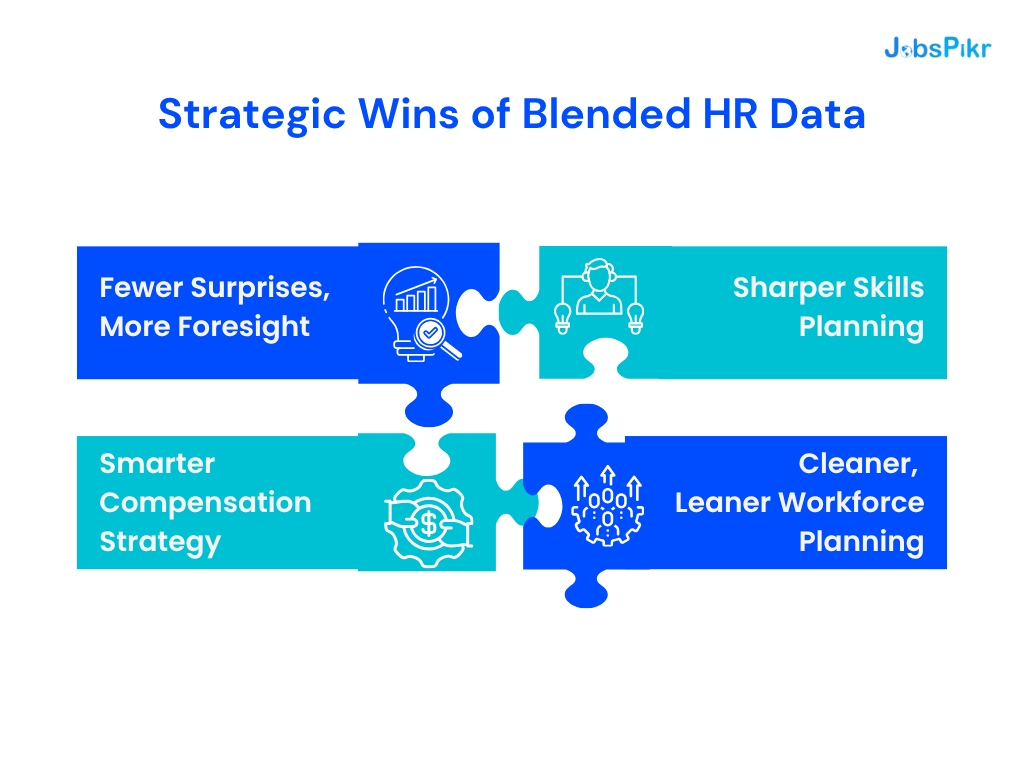
An HR analytics platform that only looks inward is already limited.
Internal HR data is necessary, but it is not sufficient. Platforms that matter going forward are able to connect HR data with external context, especially job data and labor market insights. Without that, HR analytics stays descriptive. It tells you what happened, but not whether it was inevitable, avoidable, or about to repeat.
If a platform cannot place your workforce metrics next to what the market is doing, it will struggle to support strategic decisions.
External data needs to be structured, not bolted on
Many platforms claim to support labor market insights by pulling in a few external sources. The problem is how that data is handled.
Job data is messy by nature. Titles vary. Locations are inconsistent. The same role appears multiple times across job boards. An HR analytics platform needs to normalize, deduplicate, and continuously refresh this data before it can be trusted.
If external data feels like an add-on rather than a core part of the platform, insights will be shallow and inconsistent.
Insights should explain patterns, not just visualize them
Dashboards are easy to build. Interpretation is not.
A strong HR analytics platform helps users understand why a trend exists, not just that it exists. When attrition rises, the platform should help HR explore whether that change aligns with labor market pressure, competitor hiring activity, or shifts in role demand.
If users are constantly exporting charts to explain them in slides, the platform is doing only half the job.
The platform should support forward-looking questions
HR analytics platforms are often optimized for reporting cycles. Monthly reviews. Quarterly dashboards. Annual summaries.
Workforce intelligence requires a different orientation. HR teams need to ask forward-looking questions. Where are skills becoming scarce? Which roles are likely to get harder to hire next quarter? Which locations are seeing rising competition?
An HR analytics platform built for the future supports exploration and scenario thinking, not just static reporting.
Transparency builds trust in the insights
HR leaders will only act on insights they trust.
That trust comes from transparency. Users should be able to understand where the data comes from, how often it is updated, and how metrics are calculated. Black-box scores without explanation create hesitation, especially when decisions affect hiring plans or budgets.
Platforms that surface methodology clearly tend to be used more confidently and more consistently.
It should fit how HR teams work
Finally, the best HR analytics platform is one that fits into real workflows.
HR teams collaborate with recruiters, finance partners, and business leaders. Insights need to be easy to share, easy to explain, and easy to revisit. Platforms that require heavy interpretation or constant analyst support struggle to scale across teams.
As HR analytics evolves toward workforce intelligence, platforms need to support clarity, context, and conversation, not just reporting.
How JobsPikr Turns Job Data Into Workforce Intelligence
Job data is everywhere, but usable workforce intelligence is not. The difference lies in what happens between raw postings and the insights HR teams actually rely on. This is the gap JobsPikr is designed to address.
JobsPikr does not position job data as a side input to HR analytics. It treats job data as a primary signal and builds structure, consistency, and context around it so HR teams can trust what they are seeing.
From raw job postings to reliable workforce signals
Raw job postings are noisy. Titles are inconsistent, locations are vague, and the same role can appear multiple times across different job boards. On their own, these postings are difficult to analyze and even harder to compare over time.
JobsPikr focuses on cleaning and structuring this data before any analysis happens. Job titles are normalized so similar roles can be grouped accurately. Locations are standardized to support meaningful regional analysis. Duplicate and stale postings are removed so demand signals reflect reality, not clutter.
This groundwork is what allows job data to function as a dependable input for workforce analytics and talent intelligence.
Making job data usable for HR analytics teams
HR teams are not trying to study job postings for their own sake. They are trying to answer practical questions. Which roles are becoming harder to hire? Which skills are showing up more often in the market? Where is competition increasing?
JobsPikr organizes job data in a way that aligns with how HR teams think. Roles can be analyzed by function, seniority, skill mix, and location. Trends can be tracked over time, not just viewed as snapshots. This turns job data into something HR analytics teams can actually work with, without needing manual cleanup or one-off research.
Connecting job data with workforce and talent decisions
The value of workforce intelligence comes from connection, not volume. JobsPikr helps HR teams link job data insights to real decisions around hiring, skills planning, and workforce strategy.
For example, if HR analytics shows increasing time-to-fill for a role, JobsPikr data can show whether market demand for that role is rising, whether competitors are expanding hiring in the same locations, or whether required skills have shifted. That context changes the response. Instead of guessing, teams can adjust role definitions, sourcing strategies, or location plans with evidence.
This is where job data becomes talent intelligence rather than just market information.
Built for trust, not just coverage
Workforce intelligence only works if HR teams trust the data behind it. JobsPikr emphasizes data freshness, consistency, and transparency so insights hold up in leadership discussions.
HR teams can see how data is sourced, how often it is refreshed, and how roles and skills are categorized. This transparency reduces skepticism and increases adoption. Insights stop being debated and start being used.
JobsPikr as an insights engine, not just a data source
At a surface level, JobsPikr provides access to large volumes of job data. At a deeper level, it acts as an insights engine that translates that data into workforce intelligence HR teams can rely on.
By turning raw job postings into structured, contextual signals, JobsPikr helps HR analytics evolve beyond reporting. It supports the shift toward market-aware decision-making, which is what the future of HR analytics increasingly demands.
Why Workforce Intelligence Is Becoming the Future of HR Analytics
HR analytics has done its job. It brought structure to people data and replaced intuition with measurement. But the expectations placed on HR have changed. Leaders no longer want reports that explain what already happened. They want insight that helps them avoid problems before they show up in the numbers.
That shift is why workforce intelligence is gaining ground.
Workforce intelligence changes the role of HR analytics from a reporting layer to a decision layer. By combining internal HR data with job data and labor market insights, it gives HR teams a clearer view of the forces shaping their workforce. Hiring difficulty, skill gaps, attrition pressure, and location challenges stop being surprises and start looking like signals.
This matters even more as talent markets move faster and roles evolve more quickly. Internal data alone cannot keep up with these changes. Job data shows demand as it forms. Labor market insights reveal pressure before it becomes visible internally. When HR teams use these signals together, planning becomes more grounded and less reactive.
The future of HR analytics is not about more dashboards or more metrics. It is about better judgment. Workforce intelligence supports that shift by adding context, reducing blind spots, and helping HR leaders explain not just what is happening, but why it is happening and what to do next.
As organizations rethink how they plan talent, skills, and growth, workforce intelligence is no longer an optional add-on. It is becoming the foundation for HR analytics that the business can trust and act on.
Turn workforce data into decisions you can trust
See how real job data and labor market insights can strengthen your HR analytics and workforce planning.
FAQs
1. What is workforce intelligence in HR analytics?
Workforce intelligence is what you use when HR analytics alone stops being enough. HR analytics tells you what happened inside your company. Workforce intelligence adds the outside view, using job data and labor market insights, so you can understand what is changing in the talent market and how that affects your hiring, skills, and planning. It is less about reporting and more about making the numbers usable for decisions.
2. How is workforce intelligence different from workforce analytics?
Workforce analytics is the “scorecard.” It measures things like attrition, time-to-fill, headcount growth, internal mobility, and hiring efficiency. Workforce intelligence is what helps you interpret the scorecard. It brings in job data and labor market insights to explain whether a change is happening because of internal issues, external market pressure, or both. Without that context, teams often end up guessing.
3. Why is job data important for modern HR analytics?
Because job data shows what employers want before those shifts hit your internal metrics. When companies start changing skill requirements, expanding into new locations, or hiring aggressively for certain roles, it shows up in job postings first. HR analytics usually sees the impact later, through longer hiring cycles, rising comp pressure, or higher attrition. Job data gives HR a way to spot those market moves early, instead of reacting after the fact.
4. How do labor market insights improve workforce planning?
Workforce planning falls apart when it is based on assumptions. Labor market insights help replace assumptions with evidence. They can show whether a role is getting more competitive in a specific location, whether supply is shrinking, or whether demand is shifting toward a different skill mix. That makes it easier to decide if you should change the hiring plan, adjust the role scope, expand locations, or invest in reskilling.
5. Is workforce intelligence only useful for large enterprises?
No. Bigger companies may have more complex workforce planning, but smaller teams feel market pressure just as quickly. If you are growing, one wrong assumption about talent availability can slow you down for months. Workforce intelligence helps any company understand what they are competing against, where hiring will be hardest, and which skills are starting to matter more. It is useful whenever hiring and skills decisions carry real business risk.