

- **TL;DR**
- What’s Actually Happening: The 2025 Snapshot
- Volkswagen’s Restructuring and What It Means for Germany Layoffs
- Beyond VW: The Supplier Shakeout
- How China’s EV Pressure Deepens Germany Layoffs
- The Cost Stack: Energy and Labor
- EV Demand Whiplash and Partial Rebound
- The AI Effect: Cuts Here, Growth There
- Stay Ahead With Live Labor Market Intelligence
- What the Data Says Right Now: Real-Time Signals
- Geography: Who Is Hiring Where
- Skills: What’s Shrinking, What’s Rising
- Inside an EV Team in 2025: What Work Actually Looks Like Now
- The Talent Paradox: Disruptive Change and Demographics
- Why This Industrial Recession Is Unlike Anything Germany Has Faced Before
- What Leaders Should Do Amid Rising Germany Layoffs
- For People Analytics Teams
- Stay Ahead With Live Labor Market Intelligence
- What to Keep an Eye On in 2026
- Germany 2026–2028 — Three Scenarios That Could Define the Next Wave of Germany Layoffs
- Germany’s Industrial Shift and The Opportunities Beyond Germany Layoffs
- Stay Ahead With Live Labor Market Intelligence
- FAQs
**TL;DR**
Massive job cuts ahead: Over 35% of German businesses plan staff reductions, with 3 million unemployed for first time in decade
Volkswagen’s historic restructuring: 35,000 job cuts by 2030 (25% of workforce) after avoiding plant closures through union deal
Automotive sector collapse: Industry job postings down 34% year-over-year, with assembly roles falling 58%
AI acceleration: 27% of German companies expect AI-driven layoffs in next 5 years, cutting 8% of headcount on average
Major players cutting deep: Audi eliminating 7,500 jobs, Bosch cutting 1,100, Continental reducing 7,150 globally
China competition intensifies: Chinese EVs gaining 25% European market share despite 37.6% EU tariffs
Skills transformation underway: Battery/software engineering jobs up 156% while traditional ICE roles plummet 78%
The shift in Germany’s industrial sector is anything but smooth, and the scale of Germany layoffs reflects how deep the disruption has become. With advancing germany layoffs in 1 in 3 companies, nearing 3 million people are unemployed for the first time in a decade. The country is showcasing the only stagnant growth in G7 for the past two years. With all of this, it is clear Germany has a lot to unpack. Moreover, the automotive industry, which has always been central to the German industry, is undergoing a harsh restructuring due to the expensive domestic production, lackluster EV adoption, and ever-growing competition from China.
The Volkswagen cuts sit at the center of the broader germany layoffs wave that is reshaping the country’s industrial base, but met with intense backlash due to the planned changes. Although the drastic closure threats VW proposed were followed up with a deal from IG Metall to not close plants in exchange for a revised 35,000 employee reduction plan by 2030 which included heavy cuts to production and spending. VW’s competitors, Audi and Bosch, are also reeling from the restructuring, marking a critical moment for the automotive layoffs trend across the sector.
Traditional workforce restructuring is being turned upside down with the fireworks of AI. The ifo Institute has predicted that 27.1% of German companies foresee job losses due to AI in the next 5 years. Affected companies expect a reduction of 8% in headcount, with a concentration in the industrial sector, with only tech services witnessing growth. Under these conditions, leadership teams require swift, reproducible signals to distinguish between news and real changes in operations, such as which businesses are actively hiring, which positions are being phased out, where pay scales are stagnating, and shifts in geography.
This article explores how the Volkswagen cuts fit into the broader pattern of Germany layoffs in 2025 and what the latest JobsPikr data reveals about hiring, skills, and geographic shifts across the industrial economy.
What’s Actually Happening: The 2025 Snapshot
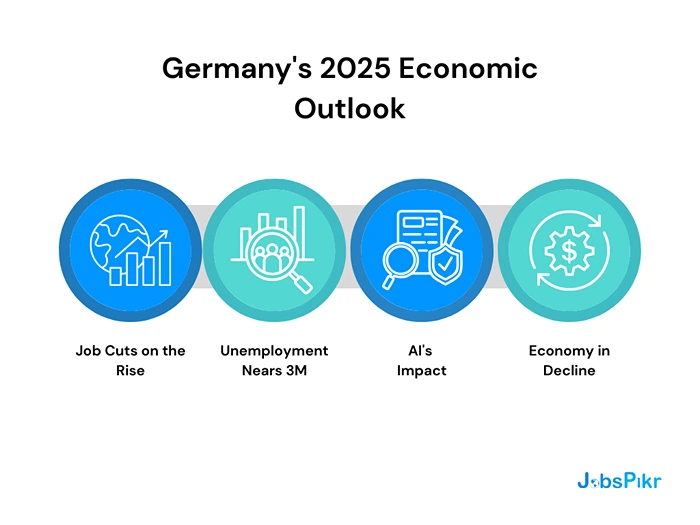
- Forecast job cuts: Forecast job cuts illustrate the magnitude of germany layoffs, with more than 35% of German businesses are expecting to reduce staff. Specifically, the industrial and construction sectors are the most pessimistic. Within the industrial sector, only 14% of firms expect to expand their workforce, while 44% plan to reduce it. Services appear to be relatively more upbeat, with only 21% anticipating cuts.
- Jobless count: The number of unemployed persons has been inching towards the 3.0 million mark. In July, seasonally adjusted numbers rose to 2.97 million, the highest it’s been in roughly a decade. This in itself poses a headline risk, which influences prevailing sentiment and affects policy discussions on layoffs 2025.
- AI expectations: AI-driven restructuring is now a direct contributor to germany layoffs, with 27.1% anticipate the effect of AI on workforce reduction over the next five years, with the average affected company reducing headcount by 8%. The most affected are industry (37.3%) and trade, roughly 30%. In construction, most firms expect a minimal impact. There are expectations of net job increases in IT/information services exceeding 10%.
- The macro backdrop: An unprecedented economic crisis is looming in Germany as it is set to enter its third consecutive year of recession, an occurrence unfathomable in the post-war period. Manufacturing production saw a decline of 4.5% in the previous year, and a 0.5% shrinkage in GDP is anticipated in 2025.
Volkswagen’s Restructuring and What It Means for Germany Layoffs
The Scare (September–October 2024)
VW is considering plant closures for the first time in 87 years due to plummeting profits, stark competition from China, and high domestic operating costs. Works council leaders mentioned closing “at least three” plants, and reports indicated a drastic reduction in wages alongside a massive downsizing of around 40,000 jobs. These VW layoffs reflect deeper issues affecting the sector.
The company cancelled its job security agreement made in 1994, which marked an end to a period of cooperation between labor and management. Labor reacted with unprecedented mobilization, with 100,000 workers undertaking warning strikes in December 2024 as part of extended negotiations.
The Deal (December 20, 2024)
VW and IG Metall reached an arrangement that prevented the immediate shutdown of the plants and avoided enforced layoffs, but agreed to:
- Reduction of 35,000 jobs by 2030 (more than one in four positions)
- Achieve an annual savings of €15 billion
- Reduction of ~700,000 units in capacity
- Dresden car production ceases in 2025; Osnabrück ceases production in 2027; Wolfsburg reduces four production lines to two and consolidates.
The Economics Behind It
The cost of labor in Germany’s automobile sector at €59–€62 is the highest in the world. It is also significantly higher than France’s €47, Italy’s €33, and Spain’s €29. VW’s German plants are consistently 25-50% over their planned spending, and while some energy costs have improved since their 2022 highs, they are still 158% higher than the US and four times what China pays.
From the last 18 months of German automotive job advertisements, the speed of change is evident. Within the automotive sector, OEMs, and Tier-1 supplier’s, the total postings fell 34% year on year. “Assembly/Production Operator” roles saw a reduction of 58% while “Battery Systems/Power Electronics/Software” positions saw a rise of 127%.
Beyond VW: The Supplier Shakeout

- Audi: Plans to cut 7,500 jobs in Germany by 2029 (which is 8% of the global workforce) and aims to achieve €1 billion in savings by focusing on admin and development positions.
- Bosch: Looking through the lens of the shift from control units to semiconductors, an estimated 1,100 jobs will be slashed at Reutlingen by 2029, following 2023’s 8,000 to 10,000 employee reductions.
- Continental/Schaeffler: Reduction programs continue to be executed at companies across Germany and the rest of Europe as suppliers adapt to new system architectures and volumes.
These supplier cuts feed directly into the expanding germany layoffs trend in the automotive sector, with electronics and semiconductor-adjacent manufacturing emerging as bright spots.
How China’s EV Pressure Deepens Germany Layoffs
China’s foothold in the EV segment continues to grow and has become a defining external force behind recent germany layoffs, particularly in legacy manufacturing roles. Transport & Environment projected that China will produce 1 out of 4 EVs sold in Europe in 2024. Even with countervailing duties from the EU that reach up to 37.6%, Chinese brands seem relentless, coming to market with products, subsidizing sales, and outcompeting locally. For example, we’ve seen BYD with 252% sales growth in Europe and a 55% decline in Tesla registries in Germany in July 2025. The price difference is of importance. Chinese brands often sideswipe their European competition with significantly lower prices, which boosts sales. Several experts estimate the competition from BYD will price their EVs at 32,000. To circumvent tariffs while still capitalizing on lower costs, Chinese companies are looking to invest in manufacturing plants within the EU. One example is BYD in Hungary.
The Cost Stack: Energy and Labor
- Energy: In 2022, Germany averaged €78.5/MWh wholesale electricity which was competitive compared to other countries, but industrial users still consider it expensive. Germany remains one of the costliest countries in Europe, with electricity priced about one and a half times cheaper than the US and China.
- Labor: Germany ranks first in the automotive sector, paying €59-€62/hour, which sustains the trend of relocating businesses or automating them due to high labor costs. Germany remains one of the countries in Europe with the highest hourly labor costs.
These costs are the reasons behind the phrase, “we are not competitive enough.” Addressing the complexity of regulations alongside wages, energy, and compliance costs are the mismatch sparking the losses. For Volkswagen, its €15 billion target savings translates to addressing this cost competitive problem.
EV Demand Whiplash and Partial Rebound
- 2024 slump: After pausing incentives, BEV adoption was down by 27%, causing a drop to 13.5% market share. This was a problem for those plants tuned to deeper EV concentration.
- 2025 rebound signs: Record EV sales in the first half of 2025 capturing 248,726 units and a 17.7% market share. This indicates fleet cycles and model introductions are stabilizing demand, though still termed as a rebound and not boom.
The AI Effect: Cuts Here, Growth There
According to the ifo survey, diagnostic AI reductions will impact around one-fourth of firms (most prominent in trade and industry) while gains are anticipated in the IT/information services sectors net some gains.
The divergence comes from the impact on tasks:
- Declining roles: Routine operations, administrative tasks, legacy quality control now account for a growing slice of germany layoffs tied to AI adoption.
- Rising roles: Data engineering, MLOps, embedded intelligence, software-defined vehicle development, power electronics.
Practical signals to track:
- AUTOSAR+functional safety+HV battery showcases upward pressure in posted compensation.
- Expansion in firmware and software roles, battery safety, and safety systems.
- Decline in routine operations in legacy product lines.
Stay Ahead With Live Labor Market Intelligence
JobsPikr gives you early-warning signals on hiring freezes, skill shortages, and geo shifts.
What the Data Says Right Now: Real-Time Signals
Current job advertisement data showcases a clear picture of Germany layoffs trends:
- Automotive OEM activity: Net open requisitions fell by 42% over 6 months, with the steepest declines from the VW Group—down 67% since October 2024.
- Skills transformation: BMS, power electronics, and embedded software skyrocketed by 156% while legacy ICE powertrain roles plummeted 78% year on year.
- Geographic shifts: Eastern Europe sees a 34% increase in postings by German companies, while Spain and Portugal gain 28% as a cheaper alternative.
- Salary benchmarks: The position of a battery systems engineer in Germany earns a median salary of €78,000, a figure that is up 18% year-over-year. In contrast, traditional mechanical engineers have been experiencing a real wage decline of 8%.
In the automotive, industrial machinery, and construction sectors, there is a 28% decline in postings compared to a 43% increase in tech and green-tech postings. Employers have been shifting towards more junior positions to cut costs, resulting in a 15% decrease in median seniority requirements.
Geography: Who Is Hiring Where
Production and engineering positions may be impacted by relocations rather than reductions. For specialized automotive engineering, observe Lower Saxony, Bavaria, and Baden-Württemberg. For EV clusters, Saxony is a prime location. In the EU, Hungary, Poland, Czechia, and parts of Iberia offer attractive pricing, better logistics, and beneficial incentives.
These regions are experiencing a 45% increase in positions related to the supplying of the automotive chain to Germany.
Skills: What’s Shrinking, What’s Rising
- Shrinking: Legacy assembly roles associated with ICE (Internal Combustion Engine) platforms, positions that are more administrative but automatable.
- Rising: All battery engineering (cells, packs and thermal), power electronics, embedded vehicle software, adjacent semiconductor manufacturing, charging infrastructure with grid integration.
If you track the skill shifts annually among German OEMs and Tier 1s, you can connect them to salary bands to identify emerging premiums and quantify the shifts.
(See our 2025 global job market trends for more insights on skill demand shifts)
Inside an EV Team in 2025: What Work Actually Looks Like Now
If you want to understand why germany layoffs are accelerating in some roles while salaries explode in others, spend one day inside a modern EV engineering team. The contrast with the old automotive world is immediate. The legacy floors feel slow and understaffed. The EV and software corridors feel like a different company altogether. Battery engineers cluster around thermal modeling simulations. Firmware developers review live code commits. Power electronics specialists pore over inverter efficiency curves. Everything moves fast because everything depends on software, data, and electrical architecture.
This is the real reason hiring has fractured into two labor markets. Ten years ago, a German OEM built its teams around mechanical engineers, component suppliers, and step-by-step validation cycles. In 2025, the center of gravity is completely reversed. Every EV program begins with a battery systems engineer, a BMS architect, a power electronics designer, and a functional safety lead. These roles define the product roadmap. Body panels and interior trims come later.
Hiring pressures reflect this shift. A BMS engineer can receive three competing offers before lunch. Power electronics talent is so scarce that companies are now recruiting from aerospace and semiconductor clusters. Firmware engineers with experience in CAN, AUTOSAR, and over-the-air diagnostics earn 25 to 40 percent more than they did in 2023. These premiums tell you exactly why Germany layoffs in legacy roles coexist with aggressive hiring for EV talent. It is not a contradiction. It is a structural reset.
Workflows have transformed at the same pace. Old automotive cycles were built on documentation, gates, and supplier dependencies. EV teams now operate like tech squads. Weekly sprints replace quarterly checkpoints. Continuous integration pipelines feed live battery data into shared dashboards. A thermal engineer might work side by side with a machine learning engineer on predictive cooling algorithms. Five years ago, a setup like this would have sounded unrealistic. In 2025, it is standard practice.
This is the part of the transition that rarely makes headlines. The layoffs are visible. The rebuild is not. Germany is cutting roles that no longer fit the product strategy and replacing them with capabilities it never had to scale before. The result is a workforce caught between two eras. One era is winding down. The other has barely begun and already cannot hire fast enough.
The Talent Paradox: Disruptive Change and Demographics
The skill shortage that Germany faces is happening at the same time as widespread germany layoffs, creating a rare situation of simultaneous oversupply and undersupply, illustrated throughout history. The country is projected to face a shortage of skilled workers by 768,000 by the year 2028, an increase from the 487,000 projected in 2024. This scenario will result in the need to provide 288,000 immigrants a year until 2040 just to stabilize the workforce.
The most critical skill within the workforce will see a sharp decline in the available human resources—depreciation in legacy roles brings an increase in the demand for battery, software, and semiconductor skills in the workforce. This, in turn, accelerates aggressive redeployment and reskilling agendas in workforce-shifting roles as a result of coexisting higher unemployment.
Skills Adjacency Insight: Evaluations indicate strong prospects for reskilling that cross traditional occupational boundaries. The power electronics field offers battery management systems a 78% skill overlap. Mechanical engineers specializing in internal combustion engines have the ability to switch to thermal systems and possess a 65% adjacency. Traditional assembly production quality engineers have 71% overlap in battery production quality control functions.
This is why the 2025 crisis is not cyclical. It is structural. Germany is not waiting for demand to return. It is rebuilding its industrial identity in real time, under pressure, and with global competitors accelerating around it.
Why This Industrial Recession Is Unlike Anything Germany Has Faced Before
Every recession leaves fingerprints. But the downturn behind the 2025 Germany layoffs wave does not resemble anything in recent history. Germany has weathered financial shocks, oil crises, and eurozone instability. None of those episodes reshaped the very architecture of its industrial economy. This one is doing exactly that.
The first difference shaping the scale of germany layoffs is the collapse of the long-standing industrial formula that powered Germany for decades: premium manufacturing, high labor skills, strong exports, and tight supplier networks. That formula worked as long as German automakers led the world in engine technology. In 2025, engine technology is no longer the center of gravity. The shift to electric drivetrains neutralized one of Germany’s strongest competitive advantages. Battery chemistry, software-defined components, and semiconductor integration now define the product. These are areas where German industry is not only catching up, but doing so under cost structures that give global competitors an enormous edge.
The second difference is the force of foreign competition. Past recessions hit global markets broadly. This time China is accelerating through the downturn. Chinese EV makers are building at scale, moving faster than German OEMs, and offering models that remain cheaper even after 37 percent EU tariffs. Analysts estimate that BYD’s European pricing strategy undercuts comparable German vehicles by thousands of euros. This is not a temporary pricing war. It is a structural cost gap. And it is a major engine behind germany layoffs in the traditional automotive supply chain.
The third distinction is the convergence of multiple pressures at the same time. Germany faces an aging workforce, record job vacancies in emerging tech roles, soaring energy costs, and aggressive automation across industrial operations. Companies are not just trimming excess roles. They are redesigning workflows, replacing administrative functions with AI, and relocating production to markets with lower input costs. In previous recessions, jobs paused. In this one, job categories disappear.
The final difference is that this downturn exposes a timeline problem. Germany must replace hundreds of thousands of mechanical and production roles with high-voltage, software, and semiconductor talent, but the training pipeline moves slower than the market shift. The talent deficit is widening at the exact moment layoffs surge in legacy teams. That tension did not exist in previous industrial cycles. It defines this one.
This is why the 2025 crisis is not cyclical. It is structural. Germany is not waiting for demand to return. It is rebuilding its industrial identity in real time, under pressure, and with global competitors accelerating around it.
| Dimension | Past German Recessions | 2025 Industrial Crisis (Driving Germany Layoffs) |
|---|---|---|
| Primary trigger | External financial shocks or global demand slowdown | Structural transformation driven by EV shift, software adoption, and cost pressure |
| Industry foundations | Strong engine technology and export-led manufacturing | Competitive edge eroded as electric drivetrains and battery systems replace ICE leadership |
| Role of technology | Automation adoption was gradual and limited | AI and software remove entire categories of administrative and operational roles |
| Labor impact | Temporary hiring freezes and short-term cuts | Permanent elimination of legacy roles, rapid expansion in battery and software roles |
| Cost environment | Manageable labor and energy costs compared to peers | Highest industrial labor costs in Europe and energy costs still above global competitors |
| Global competition | Other Western markets struggled in parallel, less asymmetry | Chinese EV makers accelerating during the downturn and undercutting prices even with tariffs |
| Recovery pattern | Jobs typically returned when demand stabilized | Many roles being cut will not return because the underlying work no longer exists |
| Talent pipeline | Skills aligned closely with industrial needs | Massive mismatch between shrinking mechanical roles and rising high-voltage, software, and semiconductor demands |
| Geographic pressure | Production stayed largely domestic | Increased relocation to Eastern Europe, Mexico, and Asia due to cost advantages |
| Speed of change | Gradual, multi-year adjustments | Rapid structural shift compressing a decade of transformation into 24 to 36 months |
What Leaders Should Do Amid Rising Germany Layoffs
For CHRO and Talent Acquisition
Benchmark real-time geography and salary splits to competitor offers. Build at-risk supply watchlists for opportunistic hiring. Create dynamic compensation models that respond to declining and emerging skill categories.
For People Analytics Teams
Combine external attrition signals with internal demand to identify external supply. Create real-time role-risk scenarios tied directly to germany layoffs patterns and external supply signals. Analyze expired job data to track and identify genuine skill shortages.
For Strategy and Corporate Development
Analyze competitor hiring and track them to infer product roadmaps 6-12 months before earnings calls. Track supply chain hiring health as a canary in the coal mine for quality, delivery, or financial risks.
Stay Ahead With Live Labor Market Intelligence
JobsPikr gives you early-warning signals on hiring freezes, skill shortages, and geo shifts.
What to Keep an Eye On in 2026
- VW execution: Does posting trajectory in Germany decelerate as reductions pay in Mexico and CEE compensates hires?
- EV share path: Is it possible to sustain the H1 rebound in EV registrations through the winter build out period?
- Tariff endgame: EV penetration from China remains resilient even with EU duties; production within the EU could speed up hiring on the EU-side.
- Macro growth: Germany continues to be stuck in stagnation as per the advisory council, and any surprise growth will impact layoff targeting.
Germany 2026–2028 — Three Scenarios That Could Define the Next Wave of Germany Layoffs
Germany’s industrial landscape is shifting faster than companies, policymakers, or even workers can adjust. The decisions made over the next 24 to 36 months will shape not only the future of the automotive sector, but the scale and direction of germany layoffs across all major industries. Based on current JobsPikr signals, hiring data, and cost trajectories, three scenarios stand out as the most plausible paths.
Scenario 1: The Reset Takes Hold (Best-Case Stabilization)
In this trajectory, Germany absorbs most of the shock by 2026. EV demand continues its recovery, battery supply chains localize in Europe, and software integration problems finally stabilize. Production lines begin to run at predictable capacity, reducing the pressure on large-scale cuts.
Germany would still see layoffs in aging ICE divisions and administrative roles, but not at the pace seen in 2024 and 2025. Software, battery, and semiconductor hiring begins to offset losses. Companies like VW and BMW shift more engineering clusters back to domestic operations as talent pipelines improve. The labor market would not return to its peak, but the worst turbulence would be behind it.
Scenario 2: Prolonged Structural Strain (Most Likely)
This scenario assumes the trends fueling germany layoffs continue in their current direction. Energy costs remain high, Chinese EV competition accelerates, and AI adoption removes operational roles faster than companies can reskill workers. German OEMs continue to shrink their domestic footprint while expanding in Eastern Europe and Mexico. Local suppliers that depend on legacy components face consolidation or collapse.
New hiring continues, but heavily concentrated in battery systems, power electronics, and embedded software. The country faces a dual market: layoffs in legacy sectors and talent shortages everywhere else. The imbalance becomes the defining feature of the workforce through 2028.
This is the path the data most strongly supports.
Scenario 3: The Hard Landing (Severe Industrial Contraction)
This is the scenario Germany wants to avoid, but it cannot be ignored. If EV demand falters again, if Chinese pricing pressure deepens, or if OEMs fail to execute their software strategies, the country could face a sharper decline. Under this path, capacity cuts accelerate, multiple plants downsize simultaneously, and small suppliers disappear at a pace not seen since the early 2000s.
In this case, germany layoffs could reach levels that push the unemployment rate far above the three million threshold. Talent shortages would remain, but companies would solve them by shifting engineering centers to lower-cost countries rather than fixing domestic pipelines.
This scenario is the least likely, but it becomes plausible if demand softens or execution issues persist.
What This Means Right Now
These scenarios are not predictions. They are forks in the road, and Germany is already walking between them. The hiring signals from 2025 tell us that the old industrial model will not return. What happens next depends on EV adoption, software readiness, cost competitiveness, and the speed of reskilling. For companies navigating this period, the challenge is staying on the right trajectory long before economic data reveals the trend.
Germany’s Industrial Shift and The Opportunities Beyond Germany Layoffs
The change in industry sectors in Germany is a massive shift in real time, and the scale of germany layoffs reveals just how quickly old roles are disappearing while new ones emerge. As the older jobs in manufacturing sectors start to wither away and unemployment rates increase, an economy that relies on electric vehicles, software, and green tech is beginning to take shape. With the volatile nature of the market, leadership requires a shift from plain guesswork to fact-based strategies.
With JobsPikr, you get a direct line to these changes. Understanding and analyzing the changes in the workforce, hiring, and the evolving needs of skills gets us the right, data-based insights. Make the right calls using our insights, from the historic Volkswagen restructuring to the burgeoning battery tech industry. Explore more insights on global labor market shifts in our JobsPikr Blog from EV hiring trends to AI-driven workforce changes.
Stay Ahead With Live Labor Market Intelligence
JobsPikr gives you early-warning signals on hiring freezes, skill shortages, and geo shifts.
FAQs
1. Are there layoffs in Germany?
Yes. A significant number of German businesses are projected to make workforce cuts in the automotive, industrial, and construction sectors. Volkswagen, for instance, plans to reduce 35,000 jobs by 2030.
2. Is Germany facing a job crisis?
Yes. The country sits on the verge of hitting 3 million unemployed people for the first time in 10 years. At the same time, Germany is entering the third year of economic stagnation. Aggressive labor costs, shrinking output in manufacturing, AI-driven automation of jobs, and overseas competition, especially from Chinese producers of electric vehicles, are worsening the problem.
3. What explains the high unemployment rate of Germany?
The unwelcome spike is a result of a combination of industrial restructuring, underperforming exports, the high domestic demand, and the expensive cost of production. The automotive industry’s adoption of electric vehicles, the switch from internal combustion engines, and the automation of jobs due to AI have resulted in a surge of layoffs in manufacturing and support roles.
4. Which professions are in shortage in Germany?
Germany has gaps in specialized and skilled professions including battery engineering, power electronics, embedded software development, and roles in green technology. These professions are vital for the nation’s electric vehicle and renewable energy shift, even as older manufacturing jobs shrink.
5. Will layoffs continue in 2025?
Yes. Considering existing plans for restructuring, cuts in workforce will probably persist until the end of 2025, focusing on older manufacturing and industrial jobs. On the other hand, Information Technology, green technology, and advanced manufacturing are expected to create some new positions, albeit not enough to fully offset the overall decline.