


- **TL;DR**
- Why Does Global Workforce Data Matter More Than Ever?
- Build Your Next Workforce Plan on Actual Market Intelligence
- What Do We Mean by “Global Coverage, Local Depth”?
- How Do Companies Use Workforce Data Across 70+ Global Markets?
- What Makes JobsPikr’s Workforce Data Infrastructure AI-Ready?
- Which Workforce Trends Can You Spot Only With Global Market Coverage?
- How Does JobsPikr Ensure Data Accuracy Across 70+ Markets?
- Build Your Next Workforce Plan on Actual Market Intelligence
- What Strategic Advantages Do Companies Get from Global Workforce Intelligence?
- Real-World Examples: How Organizations Use Global Workforce Data
- What Should Leaders Look for in a Global Workforce Data Partner?
- Ready To Unlock Workforce Intelligence Across 70+ Markets?
- Build Your Next Workforce Plan on Actual Market Intelligence
- FAQs:
**TL;DR**
Most companies have pockets of good HR reporting, but their view of talent is usually local, fragmented, and late. When you stitch together workforce data across 70+ markets, you stop guessing where skills are moving, which regions are heating up, and how competitors are shaping demand.
Global job data does something internal systems cannot. It shows how roles, skills, and compensation are evolving in the open market, country by country, city by city. Used well, it becomes a live map of the global workforce, not just a rear-view mirror of who you already employ.
This article breaks down what “global coverage, local depth” really means in practice. We will look at how JobsPikr standardizes job data across 70+ markets, why localization matters as much as coverage, and how CXOs, HR transformation leaders, and strategy consultants can plug this into their workforce planning and AI initiatives.
If you are trying to benchmark talent supply, plan new hubs, or train internal AI tools on real-world workforce data, think of this as your field guide. By the end, you should have a clear picture of how global workforce data can move you from static reports to a live, market-aligned talent strategy.
Why Does Global Workforce Data Matter More Than Ever?
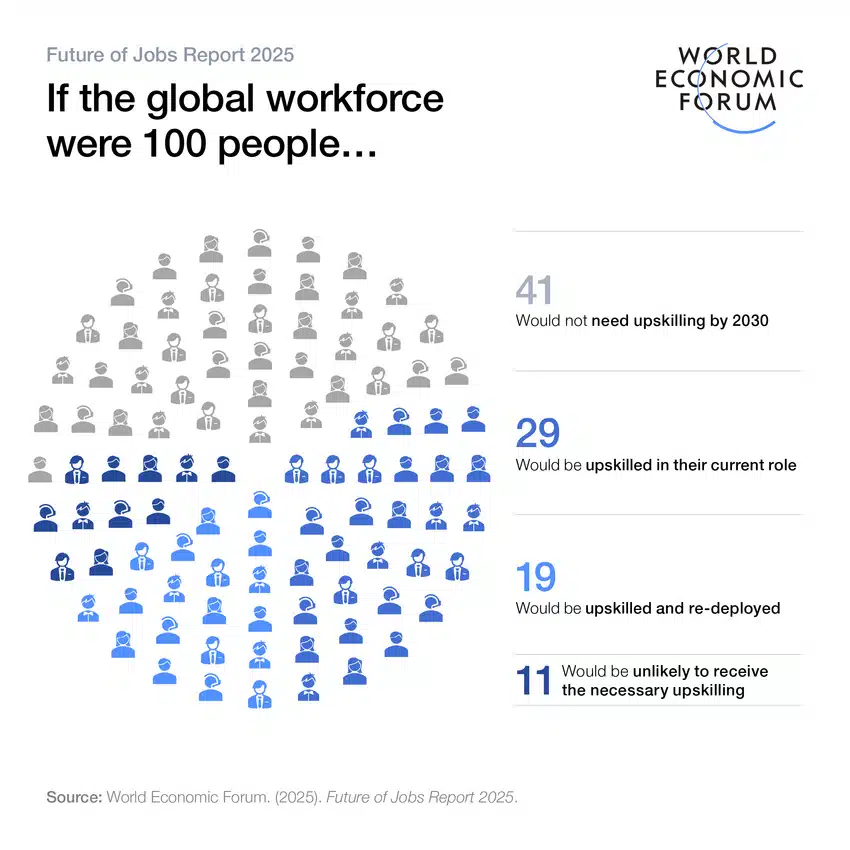
Image Source: WEF
Most organizations still look at talent through a narrow lens. They track headcount, attrition, offer-acceptance, some internal mobility, and call it a workforce dashboard. Useful, but almost entirely local. It tells you what is happening inside your walls, not how the market around you is shifting.
Global workforce data changes that frame. Instead of debating why one country’s attrition is higher than another, you can see that certain roles in that region are exploding in demand externally. ManpowerGroup’s research shows that nearly four in five employers globally report difficulty finding the skilled talent they need, more than double the challenge they reported in 2015. When the market is that tight, it is not enough to know your internal ratios. You need to see, in real time, where skills are getting scarce, where demand is overheating, and where alternative markets are quietly opening up.
Workforce data as a strategic early-warning system
The other big shift is time. Internal HR reports are often monthly or quarterly. By the time you see a spike in resignations for a critical role, the external market has already moved. Employers in the World Economic Forum’s Future of Jobs Report estimate that 44 percent of workers’ skills will be disrupted in the next five years. That kind of disruption does not show up first in your HRIS. It shows up in job data: new titles, fresh skill clusters in JD text, different combinations of experience and tools.
Global job data acts like an early-warning system for your people strategy. You can see when a role that was once “nice to have” suddenly becomes a hot market demand in specific regions. You can spot when certain skills get embedded into job descriptions at scale, long before your internal competency models catch up. If your competitors in three markets start hiring “AI talent partners” or “skills architects,” and your requisitions still say “HR generalist,” that is a signal, not noise.
The link between market coverage and better workforce decisions
This is where market coverage and data depth intersect. If your view of workforce data is limited to a few countries or a handful of job boards, you will misread the trend. A spike in one metro might look dramatic until you see that, across 70+ markets, demand is actually shifting to a different region altogether.
With broad global job data coverage, you can ask better questions. Where are new hubs for cloud engineering emerging outside the usual suspects? Which markets are quietly becoming strong for finance + analytics talent? Where are mid-level roles flattening and specialist roles branching out? When that global view is paired with local depth – city-level, skill-level, and even level-band detail – it becomes possible to decide things like:
- Whether to open a new delivery hub in a market with rising talent supply and moderate salary benchmarks, instead of chasing the same overheated metros as everyone else.
This is not just a cost decision; it is a resilience decision, because you are not over-exposed to a single labor market. - When to reframe your internal job architecture to reflect how roles are actually being defined externally.
That might mean splitting one generic “data analyst” role into distinct analytics, visualization, and machine learning pathways because the market is already moving that way.
Global workforce data gives CXOs and HR transformation leaders something they rarely get from internal systems alone: a high-confidence way to say, “We are ahead, on par, or falling behind the market,” and to prove it with real numbers.
Build Your Next Workforce Plan on Actual Market Intelligence
Compare roles, skills, and hiring patterns across real global data, not assumptions.
What Do We Mean by “Global Coverage, Local Depth”?
How global coverage creates a complete workforce picture
When people talk about “global workforce data,” it often sounds bigger than it actually is. Many datasets claim global reach but rely heavily on a few English-speaking markets, a handful of job boards, or only publicly posted roles. True global coverage means something very different. It means capturing workforce data from structured job sources across 70+ markets, normalizing them, and stitching them into one coherent view so that a job posted in São Paulo, Warsaw, Singapore, or Toronto sits on the same analytical footing.
This matters because talent markets are no longer linear. They do not expand country by country. They expand by skill clusters, regional hubs, and employer demand. You might see skills like cloud security rise sharply in Bengaluru six months before Berlin, or a surge in supply chain analytics roles in Mexico City before it spreads across North America. Without broad coverage, leaders end up guessing whether these movements are isolated signals or part of a larger pattern.
How local depth gives meaning to global signals
Coverage on its own is not enough. You can have millions of job postings and still miss the real story if the data is shallow. Local depth is what turns coverage into intelligence. It includes city-level and metro-level mapping, location normalization, standardized job titles, extracted skills, experience bands, and industry tags.
Two markets can look similar from far away. Both may show rising demand for cybersecurity roles. But with local depth, you might discover that one market is hiring senior specialists while another is leaning heavily on entry-level analysts. Or that one region emphasizes compliance-heavy skills, while another leans toward cloud-native security. This is the nuance that shapes workforce planning, reskilling investments, compensation decisions, and hub strategy.
Local depth also helps avoid false equivalence. A “data engineer” in Chicago may require a completely different tech stack than a “data engineer” in Manila. Skill extraction and normalization reveal those differences so your internal job architecture does not flatten them into one generic profile.
Why both matter for CXOs and HR transformation leaders
Leaders planning for the next three years are no longer asking, “Where should we hire next?” They’re asking:
- Are our roles aligned to how the world defines them today?
- Are we overexposed to talent-scarce markets where competition drives up hiring difficulty?
- Are we seeing early signals of skill shifts that will change our workforce mix?
Global coverage gives you the breadth to benchmark. Local depth gives you the precision to act. Together, they allow you to balance what is happening across the world with what is happening in a specific region, city, or team.
This is the foundation for market-aware workforce planning, which is quickly becoming the new standard for talent intelligence teams, large consultancies, and HR leaders building AI-enabled people strategies.
How Do Companies Use Workforce Data Across 70+ Global Markets?
When an organization operates across multiple regions, even simple questions become tangled. Which markets have a rising talent supply? Which roles are becoming harder to hire? Which locations are quietly becoming high-cost due to demand spikes? Internal reports can’t answer these because they only reflect the talent you already employ, not the broader ecosystem shaping your next quarter or next year.
With global workforce data, leaders get a unified view of how roles evolve, how skills shift, and how markets behave. A strategy consultant advising a retail client can quickly see which markets have a strong supply of analytics talent. A CHRO planning next year’s hiring budget can understand where compensation pressure is building. A transformation leader redesigning job families can validate that emerging titles are not just hype but part of a wider global trend.
How market coverage strengthens expansion decisions
When your workforce data spans 70+ markets, expansion planning becomes a data exercise instead of an intuition exercise. You can compare talent supply, demand intensity, skill frequency, and hiring velocity across locations side by side.
This helps teams:
- Select new tech or analytics hubs based on actual availability rather than brand perception.
- Validate whether a market known anecdotally for engineering talent still holds that advantage today.
- Identify regions where competition is low but skill depth is high, creating more sustainable hiring pipelines.
A large number of companies still base expansion decisions on limited market research and internal cost models. Global job data gives them a live, skill-based understanding of workforce feasibility—something static reports rarely provide.
How workforce data enhances compensation and mobility planning
Compensation conversations often rely on outdated or incomplete benchmarks. With real-time job data, organizations can observe how competitors describe experience levels, requested skill combinations, or seniority bands across markets.
This helps HR teams adjust salary bands, title ladders, and internal mobility pathways to match how the market is shaping these roles. For example:
If senior data engineering roles in EMEA now embed cloud-native tooling across most postings, it’s a sign your compensation structure should reflect that elevated expectation. If entry-level analytics roles in Southeast Asia emphasize SQL and visualization tools more than Python, it tells you how to design local development pathways.
Global visibility prevents the common trap of building workforce plans around outdated assumptions.
How organizations use global signals for hiring velocity and role prioritization
When job postings from specific regions show consistent spikes for certain roles, it’s an early indicator of where competition is heading. This is useful for organizations trying to manage hiring velocity, especially in fields like cybersecurity, cloud engineering, risk, and AI-driven roles.
Companies can compare hiring intensity across multiple markets and decide:
- Where they should accelerate sourcing before the market becomes too competitive.
- Which roles require deeper proactive pipelines.
- Which markets might soon introduce hiring delays due to growing demand.
This kind of forward visibility is difficult to achieve with local-only data.
What Makes JobsPikr’s Workforce Data Infrastructure AI-Ready?

Most organizations want to use AI for workforce planning, but the real bottleneck isn’t the model, it’s the data. AI models need structured, standardized, and consistently labeled inputs. The challenge is that global job data is naturally messy. Titles vary wildly, skill names evolve faster than competency models, and locations follow no predictable template.
JobsPikr’s infrastructure is built to solve that. Every posting that enters the system is parsed, normalized, deduplicated, and enriched so that AI systems can consume it without friction. A “Sr. SDE,” a “Software Craftsman,” and a “Backend Engineer III” all map to a unified taxonomy. Skills mentioned in free text are extracted and standardized so the model understands “TensorFlow,” “TF,” and “Google TensorFlow” as the same capability.
The result is a dataset that behaves like a single, coherent workforce language, one that AI can actually learn from.
How normalization accelerates decision-making for HR and strategy teams
Without normalization, global workforce datasets become noisy very quickly. Leaders spend more time cleaning the data than interpreting it. JobsPikr automates that grunt work. Titles, skills, industries, locations, and job levels are standardized across 70+ markets.
That matters because decision-makers don’t need dashboards full of raw data. They need fast clarity:
- Are AI roles exploding globally or only in specific markets.
- Which regions are redefining job families through new title patterns.
- Which functions are embedding new skills ahead of others?
Clean data accelerates these insights. Strategy teams can run pattern recognition across markets. HR can build accurate skill gap models. AI tools can detect relationships between job clusters. A consistent data foundation makes every downstream analysis stronger.
How localization improves AI outputs for role design and skill modeling
Localization, the ability to understand job data within its regional context, is critical when building AI models for talent intelligence. Skill expectations differ by country, even when the job title looks the same. Salary brackets shift. Experience expectations vary. Entire job families exist in one region and not in another.
JobsPikr captures that nuance. Instead of flattening global roles into a single blueprint, the dataset preserves local variations so AI models learn the true shape of the global workforce. This prevents a common AI issue: models trained on only a few markets tend to generalize poorly, leading to misclassified roles, inaccurate skill maps, or misleading recommendations.
With localized depth, AI models can differentiate between:
- A cybersecurity role shaped by regulatory trends in Europe.
- A cloud engineering role influenced by hyperscaler adoption in APAC.
- A data analytics role designed around retail ecosystems in LATAM.
This level of granularity is what makes the data usable for next-generation talent intelligence systems.
Why AI readiness is becoming a requirement, not a differentiator
Organizations everywhere are racing to build internal AI copilots for HR, reporting assistants for workforce planning, and automated tools for job architecture. These systems cannot run on inconsistent or incomplete data. They need clean pipelines, broad market visibility, and continuous updates.
JobsPikr’s workforce data is refreshed constantly across 70+ markets, giving models a living feed of skills, roles, and hiring movement. That input becomes the foundation for AI use cases like:
- Automated role comparison across regions
- Skill adjacency modeling
- Market-based job architecture redesign
- Predictive hiring difficulty scoring
- Compensation intelligence powered by real-time demand
The future of workforce strategy will be AI-driven, but only if the data feeding those models is globally rich and locally precise.
Which Workforce Trends Can You Spot Only With Global Market Coverage?
Skill trends rarely emerge everywhere at the same time. They show up in pockets—one city, one industry, one hiring wave and then spread outward. Global market visibility lets you catch these signals early instead of reacting months later.
For example, the rise of AI-heavy job families didn’t begin uniformly. Markets like the United States, the UK, Israel, and Singapore saw early surges in titles such as “AI Engineer,” “Machine Learning Scientist,” and “Prompt Engineer.” Other regions adopted them gradually, sometimes with different skill blends. Without global workforce data, these early clusters look like random outliers. With coverage across 70+ markets, they become lead indicators of broader transformation.
This helps leaders understand whether a trend is truly global, regionally contained, or just beginning to expand. It also prevents overreacting to isolated spikes that don’t represent wider market behavior.
Differences in hiring velocity across regions
Hiring velocity, the speed at which roles appear and reappear in the market, can vary significantly across countries. A role that is saturated in North America may still be emerging in the Asia-Pacific. A title declining in Western Europe may be growing in Latin America.
These differences matter because they influence workforce planning, hiring difficulty, and salary pressure. If cybersecurity roles are stabilizing in one region but accelerating in another, your sourcing strategy should adapt accordingly. Without broad market visibility, these nuances are invisible, and organizations default to uniform global hiring plans that don’t match reality.
Shifts in job architecture driven by global competition
Job architecture is evolving faster than most companies realize. Roles that used to be generalist are fragmenting into specialist tracks. Skills once considered niche are becoming foundational. Even title structures differ by geography.
Global job data shows how these shifts spread. When multiple markets begin embedding a new category of skills—such as cloud-first engineering practices or AI governance requirements—it signals that job families need restructuring. That insight isn’t possible if you only study your own country or your own internal job descriptions.
Regional variations in skill inflation and experience expectations
Skill inflation—the slow increase in required skills for the same title—rarely happens evenly across the world. One market might add cloud-native tools to its baseline expectations, while another focuses on compliance or data governance.
Local depth reveals these differences. It shows where skill expectations are tightening, where seniority bands are shifting, and where employers demand more specialized experience. These insights influence everything from talent development programs to compensation models.
Market transitions that appear long before official reports
Most workforce reports are published once a year, often summarizing data that is already six to nine months old. In fast-moving talent markets, that lag is costly.
Real-time job data reflects transitions as they happen. You can see:
- When a sudden surge in fintech postings signals regulatory or market changes
- When manufacturing-heavy regions begin adopting automation skills
- When retail and logistics roles shift toward AI-enabled operations
These transitions are visible in job postings before they appear in traditional labor market analyses.
How Does JobsPikr Ensure Data Accuracy Across 70+ Markets?
Capturing workforce data across 70+ markets is not just a matter of volume. Each country structures job information differently. Some markets have highly standardized postings, while others rely heavily on narrative text. Some use detailed location metadata, others use free-form fields. To manage this variability, JobsPikr uses a multi-step ingestion pipeline that collects postings from diverse, reliable sources and applies uniform parsing logic.
This ensures that every posting—whether from Tokyo, Toronto, or Tel Aviv—enters the system with the same foundational structure. Titles, descriptions, skills, and metadata go through strict extraction rules so that the raw data is aligned before deeper processing happens.

Normalization checks that reduce noise and duplication
Because global workforce data contains so much variation, duplication is one of the biggest risks. The same job can appear across multiple job boards, in multiple formats, or under multiple title variations. JobsPikr applies fuzzy matching, field-level comparison, and temporal checks to detect and remove duplicates. This prevents inflated posting counts and ensures accuracy when analyzing hiring velocity or market demand.
Normalization layers also clean up noisy inputs. Titles are standardized so you can compare “Sr. Analyst,” “Senior Data Analyst,” and “Data Analyst III” without distortion. Skill tags are harmonized so that location-specific jargon does not scatter the dataset. Clean data is what ensures your workforce models remain trustworthy.
Local validation rules that account for regional differences
Accuracy doesn’t just depend on cleaning the data. It also depends on respecting the realities of different markets. Some regions rely heavily on job portals, others on employer career pages. Some use multiple languages for the same posting. Some list precise metro locations, others only mention the country.
JobsPikr uses region-specific validation rules to adjust for these differences. That includes:
- Language detection and translation support
- Consistency checks on location granularity
- Market-specific formatting rules
- Handling of bilingual or multi-lingual postings
- Custom logic for countries with unique job-board ecosystems
This ensures the dataset not only stays accurate but also stays faithful to the way local markets actually operate.
Continuous updates that keep the data current
Workforce markets move quickly. A dataset that was accurate three months ago may already be outdated today. JobsPikr collects and updates postings continuously across all markets, which helps leaders spot shifts early—well before they show up in traditional labor reports or annual studies.
This frequency is what allows organizations to detect emerging trends such as sudden demand spikes, changes in skill clusters, or new role categories. Without continuous refresh cycles, workforce data becomes static and backward-looking.
Quality scoring that flags anomalies before they affect analysis
JobsPikr performs ongoing health checks to monitor the quality of the data. These include anomaly detection on posting volume, unexpected changes in location patterns, and shifts in skill frequency. If a region suddenly shows an improbable spike or drop, quality controls investigate whether the movement is real or the result of a source issue.
This prevents misleading trends from entering your dashboards or AI models. It also gives analysts confidence that they’re interpreting genuine signals—not data glitches.
Build Your Next Workforce Plan on Actual Market Intelligence
Compare roles, skills, and hiring patterns across real global data, not assumptions.
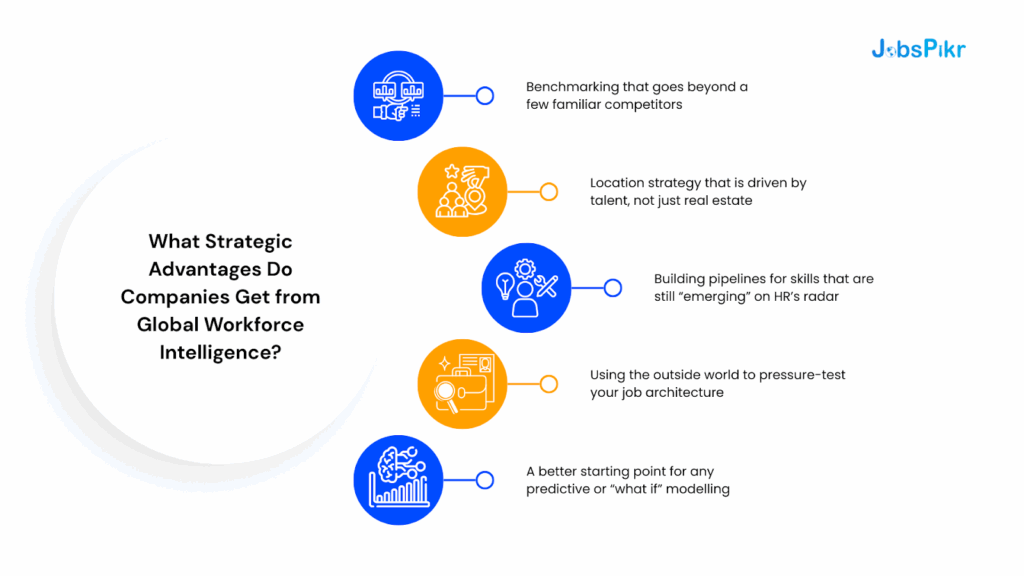
What Strategic Advantages Do Companies Get from Global Workforce Intelligence?
Most workforce plans are built on internal dashboards. Headcount, churn, offers, vacancy days. All useful, but all backward-looking. You only see the problem once it shows up inside your company.
Global workforce intelligence flips that around. Instead of waiting for “We can’t hire this role anymore” emails from recruiters, you see tension building in the market ahead of time. When job postings for cloud security engineers start climbing in multiple regions, you know that:
- Time to hire is about to get worse
- Salary expectations will creep up
- Competitors are likely investing in that capability
That gives you room to move first. You can change your hiring plan, adjust internal learning tracks, or re-scope roles before it becomes a fire drill.
Benchmarking that goes beyond a few familiar competitors
Most benchmarking conversations sound the same: “What are X and Y doing?” or “What’s the range you’re seeing in your network?” That’s helpful, but narrow.
With broad global job data, you stop guessing. You can see how hundreds or thousands of employers describe similar roles across different markets. For example:
- Are most companies now asking for product analytics skills inside marketing roles.
- Are your “senior” roles actually mid-level compared to how the market defines them.
- Are competitors quietly shifting certain jobs to lower-competition markets.
Instead of relying on anecdote, you have a real baseline to check your own decisions against.
Location strategy that is driven by talent, not just real estate
A lot of hub decisions are still made on the back of tax breaks, office costs, or leadership preference. Talent is discussed, but not always measured in detail.
With global workforce intelligence, you can treat location strategy like a data problem. You can compare:
- How deep the local talent pool is for a specific skill
- How intense the demand is from other employers
- How quickly new roles are appearing in that market
- Whether the skills you care about are growing or flat
That is very different from “We heard this city is good for engineers.” It lets you find cities where talent is strong, competition is reasonable, and long-term sustainability looks better than piling into the same three hot hubs as everyone else.
Building pipelines for skills that are still “emerging” on HR’s radar
New skills very rarely appear out of nowhere. They creep into job descriptions quietly. A line item here, a tool requirement there, a new title popping up in one or two regions. If you only watch your internal roles, you will always be late.
When you track workforce data across 70+ markets, you can see:
- Where skills like AI governance, MLOps, or ESG analytics first start to appear
- Which industries are adopting them first
- Whether they stay experimental or become mainstream
That gives you time to do the unglamorous but important work: updating learning paths, adjusting career tracks, and deciding which of these skills you want to build versus buy.
Using the outside world to pressure-test your job architecture
Job architecture is one of those things that is painful to change, so it often lags reality. Titles get reused. Ladders don’t reflect how work is actually done. Skills that are now “table stakes” still sit in the “nice to have” bucket internally.
Global workforce intelligence acts like a mirror. When you compare your roles and skill expectations with what the market is asking for, a few things usually pop out quickly:
- Roles that are too broad and need splitting
- Roles that are out of sync with how candidates understand the job
- Skill combinations that don’t match what talent actually offers in different regions
That makes conversations about redesigning roles a lot easier. You are not debating opinions; you are reacting to how thousands of employers already position similar jobs.
A better starting point for any predictive or “what if” modelling
Finally, there is the analytics side. Once you have a stable view of how the world is hiring, you can start asking harder questions.
What happens if we try to build a full analytics team in this market instead of that one? What is the risk that a critical role will become almost impossible to hire in twelve months? If demand for a certain skill keeps growing at the current pace, where will we be under-supplied?
You can’t answer those questions with just HRIS data. You need the external view. Global workforce intelligence gives you that baseline so your scenarios are grounded in how markets behave, not in how you hope they behave.
Real-World Examples: How Organizations Use Global Workforce Data
How a global tech company reset its hub strategy
Imagine a tech company with engineering teams scattered across four big cities. For years, they assumed those locations were “the only sensible hubs” because everyone in their space was there.
Once they plugged into global workforce data, a different picture showed up. Two of their preferred cities had:
- Very high demand for the exact roles they were hiring
- Slower growth in relevant skills
- Rising competition from non-tech industries moving into the same talent pool
At the same time, a few second-tier cities in other regions showed strong supply of similar skills, steady posting activity, and far lower competitive pressure.
Instead of opening yet another office in the usual suspects, they used this data to test a smaller hub in one of these “quietly strong” markets. Over time:
- Time-to-fill for critical roles dropped
- Hiring managers had more candidate choice
- Compensation pressure eased compared to their legacy hubs
Nothing about this decision came from gut feel. It came from comparing real demand and skill patterns across markets, side by side.
How a consulting firm moved from theory to evidence
Consulting firms love frameworks, but clients increasingly ask for proof. One strategy team advising a manufacturing client on “future of skills” work kept hitting the same wall: internal data was thin, and traditional labor reports were out of date.
By layering global job data across 70+ markets into their analysis, they could:
- Show where automation-related skills were actually appearing in job descriptions
- Compare how fast different regions were updating their skill expectations
- Highlight which roles were morphing into new hybrids (analytics + operations, AI + quality, and so on)
Instead of a generic slide that said “skills are changing,” they could point to clear trends by country, by function, and by role level. That changed the client conversation. It gave HR and business leaders a concrete base to redesign job families and plan reskilling programs.
How a people analytics team pressure-tested internal assumptions
Another example comes from a people analytics team inside a large enterprise. Internally, they believed they had “strong career paths for data talent” and “competitive compensation in all major markets.”
When they compared their internal job structure with global workforce data, a few surprises appeared:
- External postings for similar roles in their main markets asked for more advanced tools than their job descriptions
- Titles they considered “senior” looked mid-level compared to how other employers defined them
- Some markets they thought were “mature but stable” were actually seeing heavy new demand from adjacent industries
This didn’t trigger a panic. It triggered a structured rethink. They refreshed job descriptions, adjusted some salary bands, and updated their internal skill frameworks to match what the market was already doing.
The key point: without that external mirror, they would have kept managing to an outdated mental model of their own jobs.
What Should Leaders Look for in a Global Workforce Data Partner?
“Global” is an easy word to put on a website. It is harder to back up. When you evaluate any workforce data or global job data provider, start with something simple:
- Which countries and regions do you actually cover
- How many sources feed into each market
- How often is the data refreshed
- What gaps do you openly acknowledge
A serious partner will show you country-level coverage maps, refresh frequencies, and examples of how they handle smaller or harder-to-reach markets. You want honest breadth, not a punchy claim.
Depth that goes beyond posting counts
Posting counts alone won’t help you plan. You need data depth:
- Standardized titles and job families
- Skill extraction that surfaces what is truly being asked for
- Location resolution down to city or metro level
- Industry tagging and job level classification
If all you get is “we have millions of postings,” you will end up doing most of the heavy lifting yourself. The right partner hands you data that is already usable for workforce planning, talent intelligence, and AI use cases.
Strong normalization and localization foundations
Ask very direct questions about normalization and localization:
- How do you handle “creative” titles that don’t map cleanly
- How do you keep skill taxonomies updated as new tools and methods appear
- How do you treat bilingual or multilingual postings
- How do you normalize locations in markets where address formats are messy
The answers will tell you whether the provider has built an actual infrastructure or just a one-off scraping setup. For global workforce data to be useful, there has to be a repeatable, well-maintained process behind it.
Clear policies on data quality, ethics, and usage
This part often gets skipped in demos. It shouldn’t. You want to know:
- How the provider handles source reliability and robots.txt
- What quality checks run before data lands in your environment
- How they think about compliance and responsible data use
A partner that is casual about this will also be casual about the integrity of your workforce models. For CXOs and HR transformation leaders, this is not a technical detail; it is a risk conversation.
Integrations that match your stack
Finally, think practically. How will this data live inside your world? You want:
- APIs or feeds that your existing data platform can consume
- Schemas that play well with your HRIS, data warehouse, or analytics tools
- Documentation that your internal team can actually follow
The goal is simple: you should be able to plug global workforce data into your environment without turning every project into a multi-year integration effort.
Ready To Unlock Workforce Intelligence Across 70+ Markets?
If you strip away the buzzwords, most organizations want the same thing: a clearer, more honest picture of how the talent market is moving, and enough lead time to act on it.
That is what a global workforce data layer gives you.
- It helps you see where roles and skills are heading, not just where they’ve been
- It grounds your job architecture, location strategy, and compensation decisions in the outside world
- It gives your AI and analytics projects clean, structured input instead of messy text feeds
You do not need to rebuild your entire HR tech stack to start. You can:
- Take one problem, like deciding where to place a new analytics hub
- Bring in global job data for a defined set of roles and markets
- Compare what the external world is doing with how your internal plans are structured
From there, you build outward: more roles, more regions, deeper integration into your planning cycles.
If you are serious about talent strategy and AI readiness, this kind of external, normalized workforce signal is no longer a nice-to-have. It is part of the core infrastructure.
Build Your Next Workforce Plan on Actual Market Intelligence
Compare roles, skills, and hiring patterns across real global data, not assumptions.
FAQs:
1. What is workforce data?
Workforce data is simply the information that describes how work is organized and who does it. Think job titles, skills listed in roles, where those roles are based, how senior they are, and how often they show up in the market. Inside a company, this comes from your HR systems and org charts. Outside, it comes from job postings and labor market signals. When people talk about “using workforce data well,” what they really mean is bringing these internal and external views together so you can see both your current team and the wider talent pool side by side.
2. How does global job data help companies plan better?
Global job data gives you a view of the talent market that is bigger than your own four walls. Instead of guessing where demand for data engineers, cybersecurity roles, or AI talent is rising, you can see which regions are posting more of those jobs and what skills they ask for. That helps in very practical ways: deciding where to open a new team, which roles will be hard to staff next year, or which skills you should start building internally. It turns workforce planning from “we think this might happen” into “the market is already moving this way, and here is the evidence.”
3. Why is market coverage important in workforce analytics?
Market coverage tells you how much of the real world your data is capturing. If your view is limited to a few big countries or one or two job boards, the patterns you see can be very misleading. You might think a role is rare or a skill is niche simply because your dataset is too narrow. When your workforce analytics are built on broad coverage across many regions and sources, the trends you spot are far more reliable. You are not just seeing one corner of the market; you are seeing how the global workforce behaves, with enough scale to trust the signal.
4. What makes global workforce data useful for AI models?
Global workforce data becomes useful for AI when it is cleaned up and made consistent. Models struggle with messy inputs like “rockstar dev,” “SDE III,” and “backend engineer” all meaning roughly the same thing. Once those titles, skills, locations, and industries are normalized, AI can do the work it is good at: grouping similar roles, spotting patterns across markets, suggesting related skills, or flagging emerging job families. In that sense, structure matters more than buzzwords. If the data is well organized, the same dataset can power talent intelligence tools, internal copilots, and planning dashboards without constant manual fixing.
5. How does local depth improve hiring and skills forecasting?
Local depth means you are not just looking at a country average; you are looking at specific cities, metros, and industries. That is where hiring happens. Two cities in the same country can behave like completely different markets: one might be saturated with senior engineers, another might be rich in early-career analytics talent. When your data shows that level of detail, you can make much sharper decisions about where to hire, what to pay, and which skills will be hard to find in a year or two. It turns forecasting from a generic “global trend” slide into something that reflects how real markets work on the ground.