


- **TL;DR**
- What Is Hiring Intelligence?
- How Do Job Postings Predict Future Talent Needs?
- See the Signals Before Everyone Else
- What Signals Can Recruiters Extract from Job Postings?
- How AI Is Powering Modern Hiring Intelligence Platforms
- How Companies Use Hiring Intelligence Strategically
- How to Combine Job Posting Data with Internal Talent Data
- How to Get Started with Hiring Intelligence
- Job Postings as Predictive Workforce Signals
- See the Signals Before Everyone Else
**TL;DR**
Hiring intelligence lets you read the market early. Track how job postings shift: skills, titles, locations, and compensation, and you’ll see demand forming months before hiring pressure hits. Plan headcount sooner, set realistic budgets, and stop scrambling.
Key takeaways
- New skill mentions across postings = demand building.
- Repeated openings in a city signal expansion or cost strategy.
- Same title, bigger scope means the role is evolving.
- Perks and pay shifts hint at tightening markets.
- Pair market signals with your skills inventory before opening reqs.
What Is Hiring Intelligence?

Image Source: Crosschq
Hiring intelligence is a simple idea: use live job-market signals to plan talent moves before they become urgent. Instead of waiting for a headcount request to land in your inbox, you watch how roles, skills, and locations are shifting in the market and line up your pipeline early.
Job postings are practical for this. They tell you what a company is trying to build next. If a fintech starts advertising for five “Data Engineers (payments)” in Pune with Kubernetes and Kafka, plus a new “Head of Platform Reliability” in London, you can read that as a push into real-time payments and a maturing platform team. Multiply that kind of reading across thousands of postings and you get a clear view of where demand is moving—skills, seniority, pay bands, and even team structure.
This matters because recruiting is still hard. Nearly seven in ten organizations (69%) report difficulty hiring for full-time roles in 2025, so the teams that can see demand forming—even a quarter earlier—win the speed and quality game. SHRM
Hiring intelligence helps you:
- Spot skills that are gaining ground so you can adjust job descriptions and training plans.
- See where competitors are staffing up and decide whether to match, differentiate, or shift markets.
- Forecast budget pressure by watching compensation language and benefits creep in similar postings.
Most hiring still runs on habit. Hiring intelligence asks you to look at the market first, then act. Read enough postings, and you see which industries are adding headcount, which roles are getting redefined, and which skills are suddenly in short supply.
And that matters a lot today. As skill cycles get shorter and talent shortages intensify, the companies that can spot hiring shifts early are the ones that stay ahead.
How Do Job Postings Predict Future Talent Needs?
Short answer: they show what teams are building next. When a company lists the skills, tools, and seniority it’s willing to pay for, it’s telling you where its roadmap is headed. Track enough of these listings over time and you can see demand forming before it shows up in quarterly reports or industry recaps.
Two things make postings useful as an early read:
What changes first: skills, titles, and location
Role names and skill stacks shift before org charts do. A wave of openings that add “GenAI” to product or data roles, or that swap “reporting” for “analytics,” usually means a retooling is underway. Location moves matter too. If a firm starts hiring the same role in a new metro at scale, it’s testing or expanding there. None of this requires guesswork; it’s all written in the descriptions.
Why this is timely right now
Employers themselves expect large skill shifts in the next few years. The World Economic Forum’s 2025 analysis reports that 39% of workers’ core skills are expected to change by 2030—down from 44% in 2023, but still a major reset. That kind of churn tends to show up in postings first, in the form of new requirements, fresh titles, and revised team structures
If you’re wondering whether this is just “nice to know,” consider the hiring side: over three in four organizations struggled to recruit for full-time roles in 2024, according to SHRM. Teams that spot demand early can adjust requirements, sourcing channels, and budgets before the market gets tight.
Early signals vs. late signals (keep it simple)
- Early signals: wording inside postings (skills, frameworks, certifications), repeated openings in a new city, an unusual mix of senior vs. mid-level roles.
- Late signals: wage inflation, longer time-to-hire, analyst reports summarizing what’s already happened.
Watch the early signals and you can make practical moves: refresh JD language to match how candidates describe skills today, build short upskilling paths for must-have tools, and line up sourcing in the locations where demand is just starting to rise.
See the Signals Before Everyone Else
Hiring intelligence isn’t about reacting faster. It’s about knowing first. Turn job postings into clear, early signals that shape your talent strategy.
What Signals Can Recruiters Extract from Job Postings?
Job postings are more than a list of requirements. They carry clear, often overlooked signals about what’s changing in the market. If you look closely, patterns appear—skills that are rising fast, locations that are heating up, seniority levels that shift, and compensation language that hints at budget changes. These are the early signs smart teams use to plan talent strategies before the pressure builds.
Let’s break down the four big categories of signals you can use.
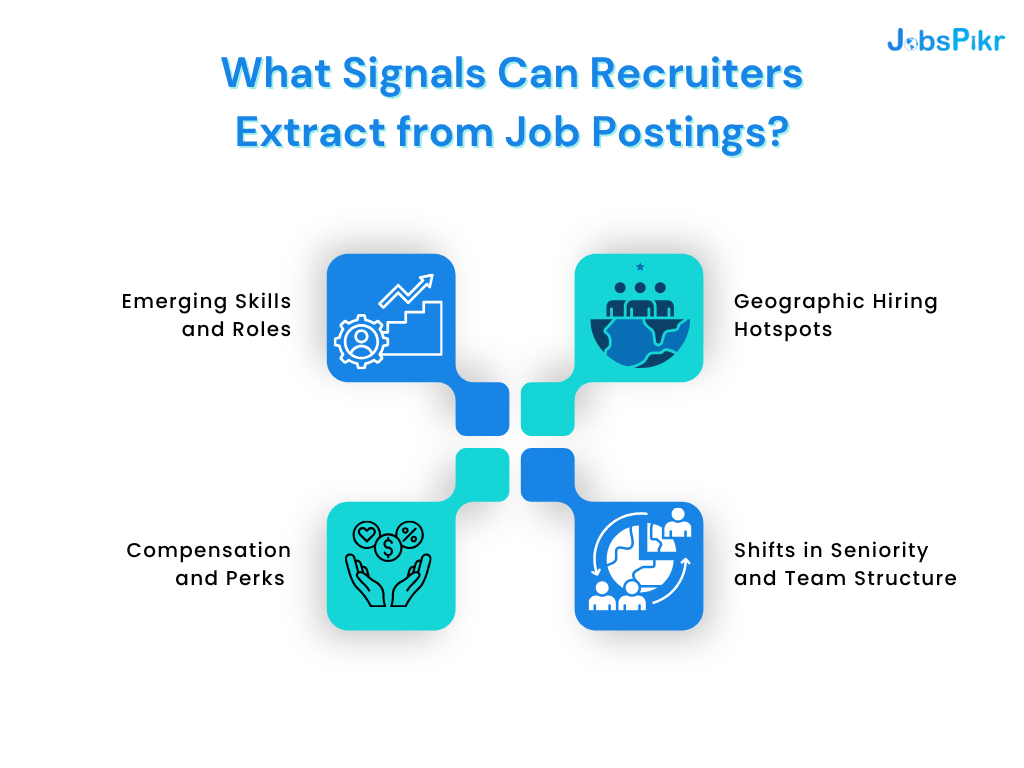
Emerging Skills and Roles
Skills are usually the first thing to move. You might see the same job title one month and notice new skills tagged onto it the next. When enough companies start asking for a specific tool or capability, that’s a sign the role is evolving.
For example, when job postings for marketing roles quietly started adding “prompt engineering” and “genAI content creation”, it wasn’t just wordplay—it reflected a shift in how teams were building content. By the time industry reports caught up, the talent market for those skills was already tight.
This kind of signal helps you do two things:
- Rework job descriptions to match how roles are evolving in the market.
- Anticipate which skills will be hard to hire for in six to twelve months.
Geographic Hiring Hotspots
Where companies hire tells you just as much as what they hire for. A sudden wave of openings in a new city often signals expansion, cost optimization, or access to a new talent pool.
For instance, when multiple SaaS companies began listing engineering roles in Warsaw around 2021, it wasn’t random. They were shifting talent operations there for both cost and depth of technical talent. Similar trends today can be seen in markets like Bengaluru, Berlin, and Toronto for AI-related roles.
Tracking this helps recruiting teams decide where to build their pipelines, not just how.
Shifts in Seniority and Team Structure
Seniority levels often reveal where a company is in its growth curve. A flood of junior or mid-level openings usually signals scaling. A sudden demand for principal engineers, product leads, or VPs often means re-architecture or strategic pivots are underway.
If you’re hiring in the same space, reading these shifts early lets you prepare for competition—for talent, budget, and time.
Compensation and Perks
This signal is subtle but powerful. Companies tweak their benefits and salary bands when markets tighten. If postings for a niche skill suddenly start including sign-on bonuses, relocation support, or “competitive above-market compensation,” it’s a clear sign supply is thin and competition is rising.
Compensation language also helps you set realistic expectations—both internally and with candidates. Instead of waiting to feel the shortage, you can get ahead of it.
Reading postings isn’t just about keyword extraction. It’s about connecting these signals to real workforce decisions. When you combine skills, location, seniority, and compensation insights, you get a live view of where the talent market is heading—not just where it’s been.
How AI Is Powering Modern Hiring Intelligence Platforms
There’s a reason hiring intelligence is starting to sound a lot like data science. Tracking a few postings manually might give you hints. But understanding market-wide shifts—across industries, geographies, and roles—needs more than human eyes. That’s where AI comes in.
Modern hiring intelligence platforms use machine learning and natural language processing to process millions of job postings in real time. Instead of recruiters trying to “spot trends” on a spreadsheet, AI systems surface the patterns automatically—skills on the rise, roles that are changing shape, compensation language that’s shifting, and new hiring clusters popping up across the map.
How AI Turns Raw Postings into Hiring Signals
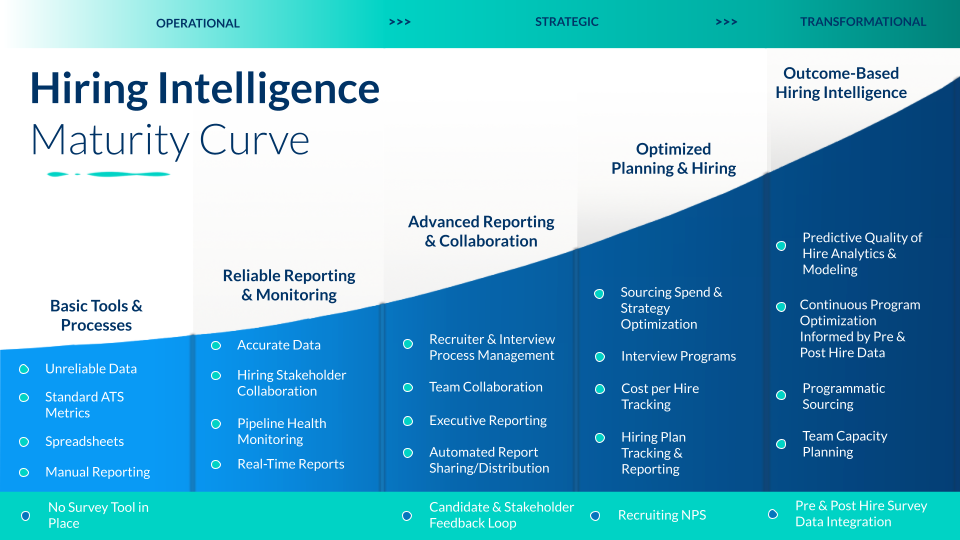
Image Source: Crosschq
Every job posting contains structured and unstructured data. The structured part is easy: job title, location, company name. The real gold is in the unstructured part—the description itself. This is where AI models come in.
- Skill extraction: NLP models identify the exact skills companies are prioritizing, even when they’re phrased differently.
- Role clustering: AI can group thousands of postings and surface emerging job families, showing new role patterns months before they’re recognized officially.
- Trend detection: When enough companies start adding the same new skills to their listings, the algorithm flags that shift as an early signal.
- Market movement: AI can detect location spikes, compensation changes, and shifts in seniority distribution that would be invisible in a manual scan.
As HR leaders plan to increase their use of AI in talent acquisition over the next two years, this isn’t about replacing recruiters. It’s about giving them market intelligence they can actually act on.
Why This Matters for Recruiters and HR Teams
Without intelligence, hiring is reactive. You wait for a role to open, scramble to source, and fight for candidates already in high demand. With AI-powered signals, your team can:
- Spot skill trends early and adjust job descriptions, learning programs, or sourcing strategies before everyone else is chasing the same talent.
- Understand where to hire, using location trends and compensation language to optimize cost and time.
- Plan with data, not instinct, which makes conversations with leadership faster and more credible.
This shift is already visible in fast-scaling industries like AI, fintech, clean energy, and advanced manufacturing. In these sectors, the lead time between “posting spike” and “talent shortage” can be less than six months.
How Companies Use Hiring Intelligence Strategically
Good hiring strategy isn’t built on instincts anymore. The smartest teams aren’t just reacting to open roles—they’re using hiring intelligence to decide what to hire, when to hire, and where to hire, long before the pressure hits. Job postings, when analyzed at scale, are a map of where the market is heading. Companies that read this map early get more leverage, shorter time-to-fill, and lower cost-per-hire.
Here’s how hiring intelligence is actually being used inside organizations right now.
Strategic Workforce Planning
Before a business enters a new market or doubles down on a product line, workforce teams want to know one thing: what skills are going to be hard to find. By tracking posting trends, companies can anticipate these pressure points early.
For example, if multiple competitors start hiring cloud security architects or AI ethics leads, it’s a safe bet demand will spike in that area. Teams that move first can build pipelines, reskill internally, or create better comp packages before the market overheats.
This makes workforce planning proactive rather than reactive. Instead of waiting for requisitions to pile up, talent teams walk into quarterly planning with data on what’s trending and where bottlenecks will be.
Skills Gap Forecasting
Hiring intelligence is also used to pinpoint future skill gaps inside the organization. If the external market is moving faster than your internal capability, that gap turns into a hiring bottleneck.
A company might realize, for example, that 30% of roles they’ll need in 12 months demand Python proficiency for data-heavy work—but only a small share of their current workforce has it. With that signal in hand, they can build training programs, hire early, or plan blended teams.
This isn’t just about chasing talent. It’s about timing. Filling these roles too late can stall product launches or increase hiring costs dramatically.
Competitive Benchmarking
Job postings are public, but they also tell competitive stories if you know what to look for. When a direct competitor starts hiring aggressively for specialized engineering roles in a new market, that’s not a coincidence—it’s strategy in plain sight.
Hiring intelligence platforms surface these shifts quickly. That lets your team decide whether to adjust your own hiring strategy, change location focus, or make the business case for earlier investment. This kind of early read can give you months of advantage.
Budget and Offer Strategy
Compensation signals buried inside postings are also used to shape offer strategies. When competitors quietly adjust their benefits or salary bands, those changes ripple through the market fast. Reading them early means you can make your packages competitive before offer declines start stacking up.
Companies that use hiring intelligence this way don’t just fill roles faster. They make better strategic decisions—about markets, budgets, and skills. They stop reacting and start forecasting.
How to Combine Job Posting Data with Internal Talent Data
Job postings alone give you a sharp view of what’s happening outside your company. Internal data tells you what’s happening inside. When the two are layered together, you stop working in the dark. You know not just what skills the market is chasing, but whether you’re ready to compete for them.
This is where hiring intelligence gets genuinely strategic.
Why the Outside View Isn’t Enough
A spike in job postings for a certain skill doesn’t automatically mean you should hire for it. Maybe you already have that skill in-house but haven’t deployed it at scale. Or maybe your internal team has the foundation and just needs targeted upskilling. Without the internal view—your skills inventory, workforce data, and role architecture—you’re only getting half the picture.
Imagine seeing a surge in postings for data security engineers. If your internal data shows only a handful of people with relevant certifications, you now have a clear choice: build or buy. Either train the team early or start hiring before demand peaks.
How Companies Pair External and Internal Signals
- Skills inventory mapping: Internal HRIS or LMS systems give you visibility into what skills your workforce already has. Matching this against external posting trends tells you where the gaps and overlaps are.
- Scenario planning: If postings for a skill are trending upward, teams can run scenarios: What happens if we build this skill internally vs. compete in a heated external market? This directly informs hiring timelines and budget allocations.
- Workforce forecasting: Merging both data sets helps companies plan for future headcount in a way that isn’t purely reactive. If you know that 40% of new demand in your industry is shifting toward AI skills, and only 10% of your current team has that expertise, the gap is visible and measurable.
- Faster decision-making: With both datasets aligned, talent leaders can make confident calls—whether it’s opening a new req, funding a training program, or building partnerships in new regions.
Why This Integration Matters
The biggest advantage of combining internal and external data is speed. Teams no longer spend months debating whether a skill gap exists—they can prove it with data. They don’t guess where to hire—they see exactly where competitors are scaling. They don’t wait for a crisis—they act ahead of it.
This approach turns hiring from firefighting into a forecasting discipline. It’s the difference between reacting to a shortage and shaping the supply before the market tightens.
How to Get Started with Hiring Intelligence
Hiring intelligence sounds complex, but the starting point is simple: begin by listening to the market before it forces your hand. Most teams already have access to job boards, talent platforms, and internal workforce data—they just don’t connect the dots early enough. The real advantage comes from making this a repeatable process.
Here’s what that looks like in practice.
Step 1: Centralize Your Market Signals
Right now, most teams scan a few job boards when a role opens. That’s a lagging approach. Instead, build a habit of monitoring postings at scale, continuously—not just when requisitions land.
Start by centralizing job posting feeds from multiple sources. This gives you a clean, consistent view of how demand is shifting across skills, roles, and regions. Even tracking a few key signals regularly—like new skill mentions or sudden geographic spikes—can give you a competitive edge.
Step 2: Layer Technology on Top of Human Insight
No recruiter can manually read thousands of job descriptions. This is where a hiring intelligence platform pays off. AI and NLP help extract patterns that humans would miss—new skill clusters, changing titles, or compensation trends.
But the tech doesn’t replace human judgment. It surfaces signals so recruiters and workforce teams can decide how to act on them. It’s the difference between digging through noise and working with clean, usable insights.
Step 3: Connect External and Internal Data
External market signals are only half the story. Your workforce data—skills inventory, hiring velocity, training capacity—makes the picture real. When you match what the market wants with what you already have, you know whether to train, hire, or pivot.
This step is also where your planning becomes faster. Instead of lengthy debates, teams can point to data and make targeted moves.
Step 4: Make Hiring Intelligence Part of Your Planning Cycle
The biggest mistake companies make is treating hiring intelligence as an ad-hoc research exercise. It works best when baked into quarterly and annual planning.
For example:
- Before new product launches, review external signals to forecast skill demand.
- When entering new markets, check how competitors are hiring there.
- Before training investments, validate that those skills are growing in demand externally.
Once this rhythm is built, you’re not just reacting to trends—you’re steering ahead of them.
Step 5: Start Small but Be Consistent
You don’t need a massive data operation to see value. Many teams start by tracking just three or four role families critical to their business. Over time, the insights deepen, and the process becomes part of how the organization plans for talent. Consistency matters more than scale at the beginning.
Getting started with hiring intelligence isn’t about adding more dashboards. It’s about creating an early warning system for talent. One that tells you when a role is heating up, where competition is building, and how fast you need to move.
Job Postings as Predictive Workforce Signals
The most valuable workforce signals rarely come from glossy industry reports. They show up quietly, weeks or months earlier, in job postings. Every new opening is a clue: what a company plans to build, which skills are about to get expensive, and where the next hiring bottleneck will be. The teams that read those clues early don’t scramble—they plan.
This is why hiring intelligence matters. It turns job postings from noise into forward-looking strategy. Instead of guessing where the market is going, you see it taking shape in real time. When your hiring strategy is built on live signals instead of lagging data, everything changes—budget planning, time-to-hire, sourcing strategy, and retention.
This approach works because it’s grounded in something simple: job postings are public and constant. Unlike trend reports or analyst briefings, they don’t arrive months later. They appear as companies make actual hiring decisions. That makes them one of the clearest indicators of where demand is heading next.
For recruiters, workforce planners, and HR leaders, this shift means moving from reaction to foresight. You’re no longer chasing the market—you’re reading it as it moves.
See the Signals Before Everyone Else
Hiring intelligence isn’t about reacting faster. It’s about knowing first. Turn job postings into clear, early signals that shape your talent strategy.
FAQs
1. What is hiring intelligence?
It’s a way to plan hiring with live market signals instead of old reports. You watch how roles, skills, and locations are shifting in job postings, then use that to decide what to hire, when to hire, and where to look. Think of it as a practical layer on top of your recruiting and workforce planning.
2. How can job postings help predict future hiring needs?
They show where companies are putting real budget and focus. If you see the same new skills showing up across many postings, or a spike in one location, demand is forming. Read that early and you can shape job descriptions, sourcing, and timelines before the market gets tight.
3. What kind of signals can be extracted from job postings?
Four stand out. New skills added to familiar roles. Shifts in seniority that hint at team shape. Location patterns that point to expansion or cost strategy. Compensation and benefits language that tells you how competitive the market is becoming. Together, those signals power your hiring intelligence.
4. How does AI improve hiring intelligence?
AI helps you see patterns you would miss by hand. It finds recurring skills, clusters similar roles, spots sudden changes in titles or benefits, and flags location spikes. You get a clearer picture, faster, with less manual digging.
5. How can companies get started with a hiring intelligence platform?
Start small and make it routine. Track a handful of critical roles, centralize postings from multiple sources, and compare those signals with your internal skills data. Layer a hiring intelligence platform to automate the heavy lifting, then use the insights to update job descriptions, training plans, and headcount timing.