
- **TL;DR**
- Why the Internal vs External HR Data Debate Matters
- What Internal HR Data Really Tells You
- What External Data Brings to the Table
- Turn External Signals into Real Workforce Intelligence
- Internal vs External HR Data — A Real-World Example
- A Three-Layer Stack to Blend Internal and External Data
- Enrichment Workflows and Compliance
- Strategic Wins of Blended HR Data
- Getting Started — Practical Next Steps
- From Reporting Lag to Market Timing
- Turn External Signals into Real Workforce Intelligence
- FAQs:
**TL;DR**
Internal data shows you what your people are doing. External data shows you what everyone else is doing. You need both to make talent decisions that hold up six months from now.
Relying only on internal dashboards means you’re always looking in the rearview mirror — headcount trends, turnover rates, performance metrics. Useful, but narrow. External job market data widens the frame. It tells you what roles competitors are hiring for, which skills are getting expensive, and where pay bands are shifting.
When you layer those signals, patterns start to make sense. A dip in retention might trace back to rising demand for the same roles outside your walls. A promotion gap might reflect a market skills gap you haven’t addressed yet. External data doesn’t replace internal signals. It gives them context.
The real advantage isn’t more data. It’s better timing. You move from reacting to exits to anticipating them. From hiring late to hiring early. From “what happened?” to “what’s next?”
Why the Internal vs External HR Data Debate Matters
Most HR teams sit on a mountain of internal data and assume that’s enough. It’s not. Internal dashboards tell you what’s happening inside your four walls, how fast people are being hired, promoted, or leaving. But the real world doesn’t stop at your org chart. External data shapes everything around it.
The labor market shifts faster than internal systems can catch up. A role that was easy to fill six months ago might suddenly face triple the competition. A skill that no one talked about last year might become the new baseline. If your view is only inward, you end up solving problems that are already outdated.
This isn’t a theoretical issue. It’s a timing problem. Internal data lags. External data leads. Relying on only one side creates blind spots:
- You’ll see attrition after it happens, not the warning signs before.
- You’ll plan compensation based on last year’s rates while the market has already moved on.
- You’ll miss early signals of emerging roles or skill shifts your competitors are acting on.
When you blend the two, the conversation inside HR changes. You stop reacting to events and start predicting them. Instead of waiting for turnover spikes, you catch pay shifts in job market data early. Instead of being surprised by a skill shortage, you see the demand curve forming months in advance.
That’s why this debate matters. It’s not internal or external. It’s how the two feed each other.
What Internal HR Data Really Tells You
Internal data is the part everyone feels comfortable with. It lives in your HRIS, ATS, payroll system, and engagement surveys. It’s neat, structured, and directly tied to your own people. That’s also why most organizations build their entire workforce strategy around it.
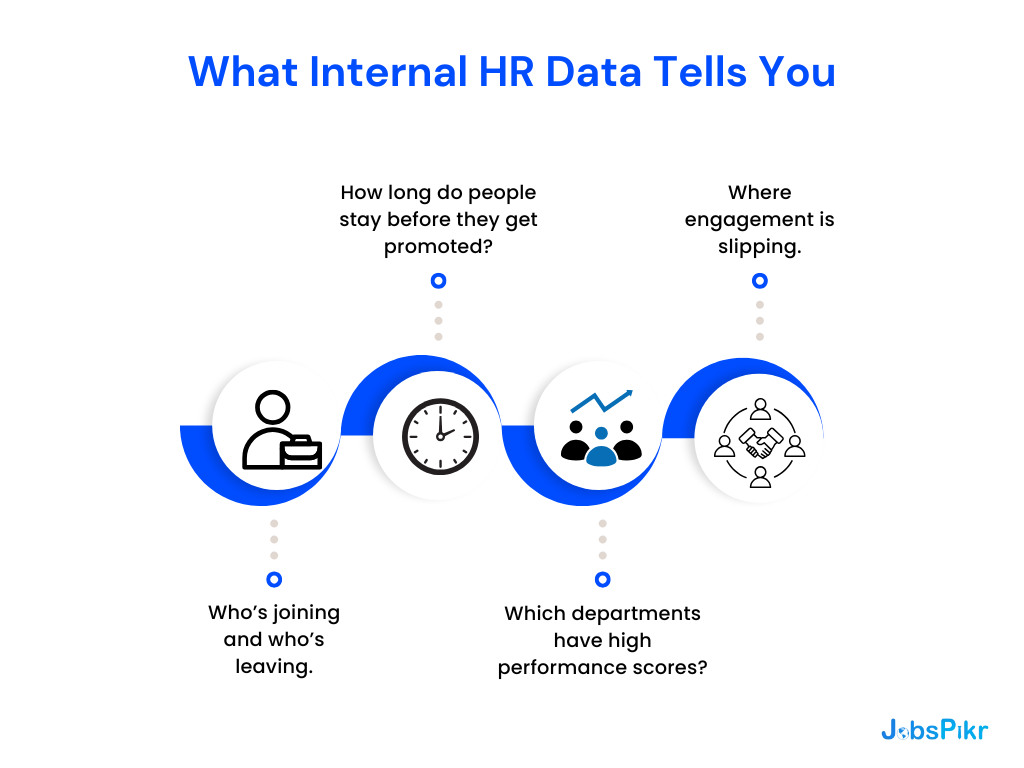
It gives you clear answers to operational questions:
- Who’s joining and who’s leaving.
- How long do people stay before they get promoted?
- Which departments have high performance scores?
- Where engagement is slipping.
It’s the kind of data that translates easily into charts and dashboards: turnover rates, time-to-hire, internal mobility percentages, and performance curves. It’s familiar territory.
But internal data has a built-in limitation: it’s a closed loop. It reflects what’s already happened inside your company, not what’s shifting outside it. It can tell you attrition spiked, but not why recruiters at your competitors are suddenly pulling your best people. It can show declining engagement in a function, but not that the same role is now paying 20% more two blocks away.
And because internal data is lagging, it creates a dangerous illusion of control. Everything looks stable, until it isn’t.
That doesn’t make internal data less valuable. It just means it’s only one half of the story. When used right, it gives you the texture of your organization: how your culture behaves, how your teams grow, and where talent frictions build up. But on its own, it can’t tell you what’s about to happen.
That’s where external data steps in.
What External Data Brings to the Table
External data sits outside your HR systems, but it shapes everything your internal data reacts to. It’s the signal that shows up first, before attrition spikes, before offer acceptance rates dip, before hiring costs go up.
Think of external data as your early warning system. It tells you where the talent market is moving, not just where it’s been. And it comes from sources that are rich, messy, and full of strategic insight: job market data, competitive hiring trends, real-time pay signals, skill demand shifts, and even how job descriptions are evolving across your industry.
Job posting data is one of the strongest signals here. When a skill starts appearing in job ads more frequently, that’s not a coincidence. It’s a marker of rising demand. And when competitors start hiring aggressively for the same roles you rely on, it’s a quiet indicator that your retention risk just went up.
There’s evidence to back this up. According to LinkedIn’s Global Talent Trends report, 76% of HR leaders who use external market data say it directly improves their ability to anticipate workforce gaps. That matters because those gaps often surface months before your internal dashboards register the problem.
The other edge external data gives you is perspective. Internal metrics are personal to your organization. External signals are comparative. They help you benchmark compensation, skill requirements, and hiring velocity against the real market, not just your history.
But external data has its own catch. On its own, it lacks context. You might see rising demand for data engineers, but without knowing how your internal teams are structured, that insight doesn’t turn into action. That’s why it works best when it’s not treated as a separate stream but as a layer on top of your internal data.
Turn External Signals into Real Workforce Intelligence
See how real-time job market data can layer into your existing HR stack without ripping anything apart.
Internal vs External HR Data — A Real-World Example
To see how these two signals play together, let’s ground it in something real.
A large fintech company noticed an uptick in backend engineering exits. Their internal dashboards flagged a retention drop: turnover in that function had jumped from 8% to 14% over six months. But the dashboards couldn’t tell them why. Engagement scores were steady, promotion rates hadn’t changed, and compensation bands hadn’t been touched in a year.
When they layered in external data, the picture sharpened fast. Job postings for backend engineers in their region had surged by 38% during that same period. Competitors had quietly raised their median salaries by 18% and started advertising hybrid work options that this company didn’t offer.
Suddenly, the attrition spike wasn’t a mystery. It was a market shift they hadn’t seen coming soon enough.
Here’s what that kind of contrast often looks like when you line it up side by side:
| Signal Type | Internal Data | External Data | Insight |
| Attrition Trend | 14% turnover in backend team | +38% job postings for backend roles regionally | Market demand pulling key talent |
| Compensation | Flat pay bands for 12 months | +18% median salary increase across competitor postings | Compensation misaligned with current market |
| Engagement | 7.9/10 engagement score | Increased remote/hybrid offers in similar roles | External flexibility becoming a differentiator |
| Skills Demand | Stable skill stack in job descriptions | Surge in demand for Go and Rust in competitor job ads | Skill demand evolving faster outside the company |
| Hiring Velocity | Time-to-fill steady at 45 days | Competitors closing similar roles in under 30 days | Market moving faster than internal processes |
The internal metrics were correct but incomplete. The external signals completed the sentence. And once they connected the dots, the company adjusted salary bands, added hybrid options, and built a reskilling program for emerging backend skills.
That’s what blending internal and external really looks like in practice: not replacing one with the other but letting the outside world explain what your internal numbers are trying to tell you.
A Three-Layer Stack to Blend Internal and External Data
Blending internal and external data isn’t about dumping everything into one dashboard and hoping it makes sense. It works when there’s structure—when each layer has a clear role and feeds into the next.
Most companies that do this well build around a three-layer architecture. It’s clean, scalable, and works whether you’re a 500-person org or a global enterprise.
Layer 1 — Internal HR Systems
This is your base. All your structured people data lives here: HRIS records, ATS data, performance scores, payroll, learning records, engagement results. It’s the backbone that tells you what’s happening inside your organization.
You want this layer stable and standardized. This means cleaning data, aligning fields across systems, and ensuring your core metrics are trustworthy. If this layer is messy, nothing above it will work.
Typical sources: Workday, SAP SuccessFactors, BambooHR, engagement survey tools, learning platforms.
Layer 2 — External Signals
The second layer is where job market intelligence flows in. This is where external data starts giving your internal signals context.
Job posting feeds, job data APIs, market compensation data, and skill demand signals all live here. These sources pick up early movements—roles heating up in the market, skill premiums forming, competitor hiring patterns changing. This layer tells you what’s shifting outside your walls.
Typical sources: JobsPikr job market data, LinkedIn job signals, compensation benchmarks, labor market reports.
Layer 3 — Enrichment and Decision Layer
This is the layer where things get powerful. It’s where your internal and external streams converge. Clean internal data feeds into a data lake architecture, external signals layer on top, and enrichment workflows run to match, normalize, and aggregate.
The output isn’t just more data, it’s decision-ready intelligence. Dashboards highlight where pay is drifting from the market. Skill maps show gaps before they turn into hiring problems. Forecasting models detect risk points months ahead of time.
Common stack elements: ETL pipelines, Snowflake or BigQuery, visualization tools like Power BI or Tableau, custom dashboards.
Here’s a simplified view of the stack:

This is the layer where most teams either break down or break through. If you get it right, your analytics shifts from “descriptive” to “predictive.” You stop guessing why attrition is happening and start seeing it build up weeks in advance.
Enrichment Workflows and Compliance
Once you have the three-layer structure in place, the real work begins: making the data actually talk to each other. That’s where enrichment workflows come in.
Enrichment isn’t about adding more data just for the sake of volume. It’s about linking internal signals with external market context in a way that’s traceable, structured, and secure. The cleaner this layer is, the stronger your workforce intelligence gets.
Building the Enrichment Flow
The first step is mapping your internal data fields to external signals. Titles, skills, and compensation structures rarely match perfectly between your internal systems and the job market. Standardizing that language is critical. For example:
- A “Software Engineer II” in your system may map to multiple external job titles across different companies.
- Skill fields in your ATS might be unstructured, while external job market data uses standardized taxonomies.
- Pay bands may be defined internally in levels, but external benchmarks use currency ranges.
Once mapped, enrichment workflows run automated joins to match these elements against external data streams — like job posting feeds or compensation APIs. The result isn’t just a bigger dataset. It’s a dataset with context.
Compliance and Data Governance
Adding external data doesn’t mean throwing compliance out the window. HR data already sits in a sensitive space, and layering market intelligence on top demands a thoughtful governance approach.
A strong compliance layer usually includes:
- Access control: Not everyone needs to see enriched data. Limit visibility based on roles and purpose.
- Data retention rules: External data often updates fast. Keep only what’s relevant, purge what’s outdated.
- Transparency: Ensure downstream users (like HRBPs or analytics teams) know the source and refresh cadence of each field.
- Regulatory alignment: Labor market data isn’t personal data, but your internal layer may contain PII. Keeping those streams cleanly separated is key.
Why Enrichment Matters
Without enrichment, you’re just toggling between dashboards. With it, your HR team can answer questions like:
- “Which roles are most at risk of attrition in the next 90 days?”
- “Where are our pay bands drifting from the market?”
- “Which skills are heating up externally but missing internally?”
It’s the bridge between operational reporting and strategic decision-making.
Strategic Wins of Blended HR Data
When internal and external data finally sit in the same room, decision-making shifts gears. You stop reacting to what already happened and start acting on what’s coming next. The wins aren’t vague; they show up in sharper forecasts, cleaner workforce strategies, and faster pivots.
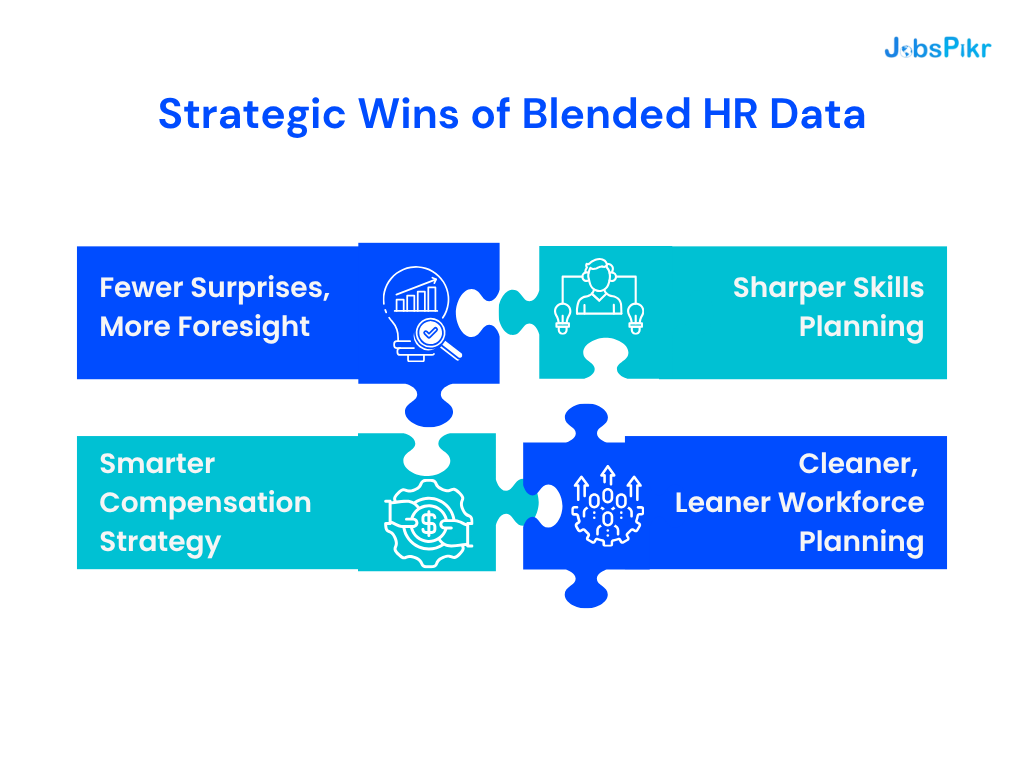
Fewer Surprises, More Foresight
When your retention dashboard lights up red, it’s already too late. External job market signals—like sudden hiring spikes or rising salary ranges—let you see these shifts before they hit your attrition charts. That early warning buys you time to adjust compensation, launch retention plays, or open new pipelines before you’re scrambling to fill empty seats.
Sharper Skills Planning
Internal data shows you your current bench strength. External job market data shows where that bench will fall short. If 40% of your roles are built around skills that are losing market relevance, you don’t find out when revenue drops—you see it months in advance.
Blending both lets you shape reskilling programs, build new pipelines, and target future capabilities with actual evidence instead of guesswork.
Smarter Compensation Strategy
It’s not just about what you pay today. It’s about what others will pay tomorrow. When your pay bands are benchmarked only against internal history, they age fast. When they’re enriched with real-time job posting data and external salary shifts, your comp team works with live market context.
That’s how you avoid the common trap: losing good talent not because you weren’t competitive, but because you were slow to adjust.
Cleaner, Leaner Workforce Planning
Most workforce plans collapse under stale assumptions. With a blended model, those plans become living, data-fed structures. You can model headcount growth against external hiring velocity. You can predict which roles will heat up and which ones will cool down. You can align talent supply and business goals without blind spots.
Here’s a quick contrast:
| Decision Area | Internal Data Only | Blended Internal + External Data |
| Retention Forecast | Reactive to attrition spikes | Proactive risk detection from market signals |
| Skills Planning | Based on current org skills | Anticipates skill demand shifts months in advance |
| Compensation | Adjusts annually or post-attrition | Adapts dynamically to real-time market trends |
| Workforce Planning | Driven by headcount history | Informed by external hiring velocity and competitor moves |
| Strategy Speed | Lagging, slow to course-correct | Forward-looking, faster pivots and smarter decisions |
This is what happens when data stops living in silos. It’s not a fancier dashboard. It’s a shift in how decisions are made, and when they’re made.
Getting Started — Practical Next Steps
Blending internal and external data doesn’t have to be a massive transformation project on day one. The teams that do this well usually start small, build a clean foundation, and scale with intent. The key is to pick one high-impact use case, set up a simple enrichment flow, and let results do the convincing.
1. Start with One Strategic Use Case
Pick the part of your HR strategy that hurts the most when you’re late. For most companies, that’s either compensation drift, critical role retention, or skills forecasting.
For example, if backend engineers are leaving faster than you can hire, start there. Bring in external job market data on those roles, map it against your attrition trends, and build a simple dashboard that connects the dots. You don’t need a full analytics stack to make that visible.
2. Identify the Right External Signals
Not every external dataset is worth your time. You want signals that are early, clean, and directly tied to your talent priorities.
Job posting data is usually the most actionable starting point. It shows you real-time demand shifts, pay trends, and role evolution. Compensation benchmarks and skill taxonomies add depth. The idea is to pick a few reliable streams—not drown in noise.
3. Build a Lightweight Enrichment Flow
This doesn’t require a massive overhaul of your HR tech stack. A basic pipeline that maps internal job titles to external postings, cleans the fields, and refreshes data on a set cadence is enough to start. Once you have that, the insights practically reveal themselves.
4. Keep It Clean and Compliant
Data governance isn’t optional here. You’re combining sensitive internal signals with external feeds. Make sure you know who can access what, how long you store enriched data, and where compliance boundaries sit. A clean governance model early on saves you headaches later.
5. Expand Only When the First Layer Works
The fastest way to stall this kind of project is trying to integrate everything at once. Prove the value with one layer—one role, one signal, one dashboard. Then grow outwards. Once stakeholders see the forecasting power, the expansion sells itself.
Here’s a simple path most teams follow:
| Step | Focus Area | Goal |
| Use Case Selection | Identify high-impact role or segment | Target where lagging signals hurt most |
| Signal Selection | Pick clean, early external data streams | Avoid data noise, keep scope narrow |
| Enrichment Setup | Map and match internal-external signals | Build a lightweight pipeline |
| Governance Setup | Define access and compliance boundaries | Keep things clean and scalable |
| Scale Up | Add roles, regions, and layers | Expand after proving early value |
This isn’t about making your dashboards fancier. It’s about making them smarter and earlier.
From Reporting Lag to Market Timing
When internal data stands alone, you’re always a step behind the market. By the time your dashboards light up, the talent has already moved. External job market signals flip that dynamic. They give your internal data context, timing, and teeth.
Blending the two isn’t about building a perfect system. It’s about seeing workforce shifts while they’re still forming, not months after they’ve hit you. That’s what separates reactive reporting from actual workforce intelligence.
For most teams, the biggest unlock isn’t a bigger tech stack. It’s a tighter loop between what’s happening inside the company and what’s shifting outside it. And once that loop is built, decisions stop being hunches. They become early, informed, and grounded in real market movement.
Turn External Signals into Real Workforce Intelligence
See how real-time job market data can layer into your existing HR stack without ripping anything apart.
FAQs:
1) What do you actually mean by “external data” in HR?
It’s the market view you don’t get from your HRIS. Think job market data, live job postings, compensation benchmarks, and skill demand trends. Internal data tells you how your people are doing; external data shows how the wider talent market is moving. Put together, they turn guesswork into timing.
2) How is internal data different—and why do I need both?
Internal data is your house view: hiring, promotions, performance, engagement, payroll. It’s precise but mostly backward-looking. External data is the neighborhood view: who’s hiring, what they’re paying, and which skills are heating up. You need both because the first explains your present; the second warns you about what’s next.
3) Why focus so much on job market data specifically?
Because it moves first. When competitors change pay, add hybrid options, or rewrite requirements, those shifts show up in job postings before they show up in your attrition report. That makes job market data a practical early signal for workforce intelligence—especially for roles where time-to-hire and replacement cost are high.
4) How does external data help with retention in real life?
It surfaces risk early. If postings for your critical roles spike in your region, or advertised salaries jump, you can act before resignations start—tighten bands, offer growth paths, or launch targeted upskilling. Instead of reacting to exits, you’re reducing the chance they happen.
5) Is blending internal and external data compliant and safe?
Yes—if you keep the boundaries clean. Treat internal people data (PII) and external market data as separate streams, control access by role, and document refresh and retention rules. Most teams handle this in a data lake with clear enrichment workflows so you get context without exposing sensitive details.