


- Pay Equity at Scale: How Real-Time Salary Analytics Close Compensation Gaps Faster
- The Pay Equity Problem Most HR Leaders Don't Talk About Openly
- Stop Benchmarking Against Yesterday's Market
- Why Traditional Compensation Data Makes Pay Equity Audits Harder Than They Need to Be
- How JobsPikr's Salary Intelligence Changes the Pay Equity Audit Process
- From Data to Action: The Pay Equity Workflow in Practice
- The Results: What Pay Equity Looks Like When You Have the Right Data
- Why Pay Equity Is Now a Business Performance Issue, Not Just an HR One
- Pay Equity Does Not Fix Itself, but the Right Data Makes It Fixable
- See What Your Pay Equity Picture Really Looks Like
- Frequently Asked Questions
Pay Equity at Scale: How Real-Time Salary Analytics Close Compensation Gaps Faster
Pay equity is no longer just a compliance checkbox it is a retention and business performance issue that enterprises can no longer afford to get wrong. But most HR and Total Rewards teams are still trying to close pay gaps using compensation data that is months old, sourced from surveys that do not reflect what the market is paying right now. This case study walks through how a composite enterprise customer used JobsPikr’s job data API and salary intelligence feeds to run a faster, more accurate pay equity audit and what changed because of it.
Key Takeaways:
- Pay equity audits built on annual survey data miss real-time market shifts, which means the gaps you think you are closing may already have moved.
- JobsPikr functions as a talent intelligence and workforce intelligence platform, not just a data feed; it gives comp teams the market context to make defensible, data-backed pay decisions at scale.
- The composite enterprise customer in this case study reduced their compensation benchmarking cycle from several weeks to a matter of days, identified pay gaps they had no visibility into before, and saw measurable improvement in voluntary turnover within the affected employee groups.
- Pay transparency legislation is accelerating globally, and organizations that build live benchmarking into their comp workflows now will be far better positioned for what is coming.
The Pay Equity Problem Most HR Leaders Don’t Talk About Openly
There is a conversation happening in boardrooms and HR leadership meetings that does not always make it into public statements or annual reports. It goes something like this: “We know we probably have pay gaps somewhere. We just do not have the data to know exactly where, how big they are, or what it would actually cost to fix them.”
That is not a niche problem. It is one of the most common challenges facing Total Rewards and compensation teams at mid-to-large enterprises right now, and it is more complicated than it looks from the outside.
Pay equity, at its core, is about making sure people doing comparable work are being paid relative to each other and relative to the market. It sounds straightforward until you try to measure it. Because the moment you start digging, you run into questions that do not have clean answers without good data. What is the right market rate for this role in this city right now? How do you compare two roles that have different titles but similar scope? Are the gaps you are seeing driven by gender, tenure, geography, or something else entirely? And critically, how do you know the benchmark you are using to measure against is current?
Most enterprises are still trying to answer those questions using compensation data that is, at best, six to twelve months old. Annual salary surveys, third-party benchmark reports, and self-reported platforms are the dominant tools in most comp teams’ arsenals. They are familiar, they are structured, and they have been part of the compensation workflow for decades. But they were built for a slower labor market, and the labor market is no longer slow.
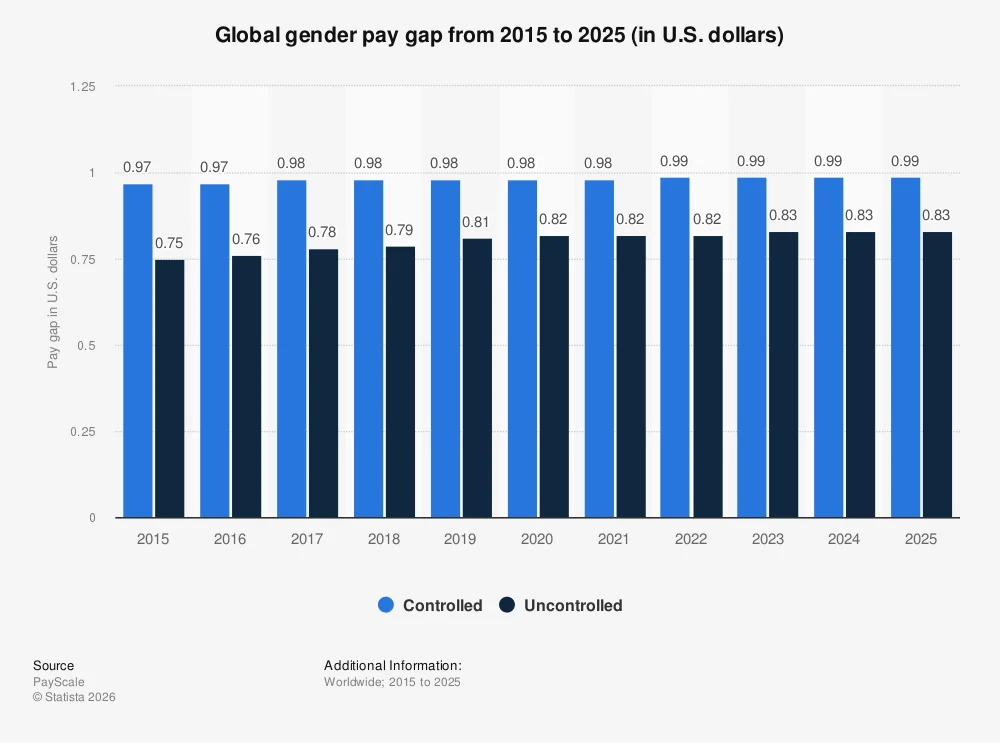
Image Source: Statista
According to the World Economic Forum, the gender pay gap still sits at around 20% globally. What that headline figure does not capture is the variation underneath it, the roles where the gap is wider, the geographies where it is more pronounced, and the cases where the gap is not gender-driven at all but is instead a function of inconsistent benchmarking over time.
That last point is worth sitting with for a moment. A significant share of pay inequity inside large organizations is not intentional. It accumulates quietly, through years of offer decisions made without consistent market data, merit increases applied unevenly, and comp bands that were never refreshed to reflect what the market moved to. The intent was never to create a gap. The gap showed up anyway because the data infrastructure was not good enough to prevent it.
Further compounding this is the pace of regulatory change. The EU Pay Transparency Directive, which requires employers to disclose pay information and close unjustified pay gaps, is being transposed into national laws across member states with deadlines beginning in 2026. In the US, pay transparency laws have already been passed in states like California, New York, and Colorado, with more states following. For enterprises operating across multiple regions, this is no longer a future compliance consideration. It is an active one.
This is the environment in which the enterprise customer at the center of this case study found themselves. A large, multi-region organization with thousands of employees across functions, they knew pay equity was a priority. They had run internal audits before. But every time they tried to get to a clear picture of where their compensation stood relative to the market, they hit the same wall: the external data they were using was too old, too broad, and too disconnected from the specific roles and geographies they were trying to benchmark. They were not flying blind exactly, but they were flying with instruments that were showing them last year’s weather.
That is where JobsPikr came in, not as a data vendor handing over a spreadsheet, but as a talent intelligence and workforce intelligence platform that gave their comp team the live market signal they had been missing.
Stop Benchmarking Against Yesterday’s Market
Your compensation decisions are only as good as the data behind them. Get the live salary intelligence your team needs.
Why Traditional Compensation Data Makes Pay Equity Audits Harder Than They Need to Be
Here is something most comp teams already know but rarely say out loud: the data they are using to run pay equity audits is almost always behind the market by the time it gets used.
The typical workflow looks something like this. A Total Rewards team decides it is time to run a compensation audit. They pull the benchmark report they purchased last year, or they submit to an annual salary survey and wait several weeks for the results to come back. By the time the data is cleaned, validated, and sitting in front of the people who need to make decisions with it, anywhere from six to eighteen months have passed since it was collected. In a stable labour market, that lag is manageable. In the current environment, it is a real problem.
And it is not just a timing issue. It is a structural one.
The survey participation problem nobody talks about
Annual compensation surveys rely on employers voluntarily submitting pay data through standardized templates. That means the quality and relevance of the resulting benchmarks depend entirely on who chose to participate. If the companies contributing to a survey skew toward large, established enterprises in a handful of industries, the output will reflect that sample not the broader market your organization is competing in for talent.
For a mid-sized technology company trying to benchmark a product manager role against what the market is paying right now, a survey dominated by Fortune 500 responses is not particularly useful. The number it produces is technically a market benchmark. It is just not a useful one.
Role definitions drift, but survey categories do not
This is a subtler problem, but it compounds quickly at scale. Job titles evolve faster than survey taxonomy does. A “Compensation Analyst” today may carry responsibilities that would have sat with a “Senior Compensation Manager” five years ago. When you map your internal roles to survey categories that have not kept pace with how actual job scopes have changed, the benchmark you get back is measuring the wrong thing.
For pay equity purposes, this matters enormously. If you are auditing whether your female employees in mid-level analytical roles are paid relative to the market, and the market benchmark you are using is mapped to a category that undersells the actual scope of those roles, you will systematically underestimate the gap. The audit looks clean. The gap is still there.
The internal data problem is just as real
The external data challenge gets most of the attention in these conversations, but the internal side is equally messy. Most large enterprises are managing compensation data across multiple HRIS systems, spreadsheets, and legacy platforms that do not talk to each other cleanly. Pay history lives in one place, job grades in another, performance ratings somewhere else. Running a meaningful pay equity analysis requires pulling all of that together into a single, consistent view and in most organizations, that process alone takes weeks.
When the Institute for Women’s Policy Research notes that pay discrimination remains a persistent and measurable problem across industries, part of what that reflects is not malicious intent but a systemic lack of data infrastructure to even see the problem clearly, let alone fix it.
What this means in practice
The enterprise customer in this case study had experienced exactly this. Their previous pay equity audit had taken nearly two months to complete. A significant portion of that time was spent not on analysis, but on data gathering, pulling compensation records, reconciling job titles across business units, and trying to find an external benchmark that was recent enough to be credible. By the time the analysis was done, the market had already shifted enough that some of the conclusions were questionable before they were even presented to leadership.
They needed a different approach. Not just better data, but a fundamentally different way of getting it, one that did not require rebuilding the wheel every time someone needed to know whether their compensation was still in market.
That is the gap JobsPikr was built to close.
How JobsPikr’s Salary Intelligence Changes the Pay Equity Audit Process
Most compensation tools give you data. JobsPikr gives you a live view of the market.
That distinction sounds like marketing language until you understand what it means in practice. When the enterprise customer in this case study first integrated JobsPikr’s job data API into their compensation workflow, the immediate difference was not the volume of data available to them. It was the freshness of it. Instead of working from benchmark reports that had been collected, cleaned, and published over a cycle of six to twelve months, their Total Rewards team was suddenly looking at what employers were actively advertising for comparable roles, in their specific geographies, right now.
That shift changed what was possible in their pay equity audit almost immediately.
What JobsPikr Actually Does in a Pay Equity Context
JobsPikr is a talent intelligence and workforce intelligence platform that tracks and structures job postings from across the web in real time. For compensation and pay equity work specifically, that means three things.
- First, the salary intelligence feeds pull advertised compensation ranges from live job postings across industries, geographies, and role types normalized and queryable, so comp teams are not spending hours cleaning data before they can use it.
- Second, the job data API connects directly into existing HRIS and compensation management systems, which means the market data does not sit in a separate report that someone must manually cross-reference. It becomes part of the workflow.
- Third, because the underlying data is drawn from actual job postings rather than survey submissions, it reflects real hiring intent what employers are willing to pay to bring someone in the door today, not what they reported paying twelve months ago.
For a pay equity audit, that combination matters more than it might seem at first glance. The benchmark you use to measure internal pay against the external market is only as good as the market signal behind it. If that signal is stale, your audit conclusions are stale too, even if the internal analysis is rigorous.
How the Integration Worked
The enterprise customer’s Total Rewards team connected JobsPikr’s API to their existing compensation platform in a matter of days. From there, they were able to pull live salary benchmarks segmented by role title, seniority level, geography, and industry, the four variables that matter most when you are trying to build a defensible pay equity case.
Critically, they were also able to track how those benchmarks were moving over time. Rather than a static snapshot, they had a running view of market compensation trends for their key roles, which meant they could see not just where gaps existed today, but where they were likely to emerge if left unaddressed.
See exactly how JobsPikr’s salary benchmarking works in the demo below.
Moving From Data to Diagnosis
Once the market benchmarks were live and connected, the team was able to do something they had not been able to do cleanly before: layer their internal compensation data directly against current market ranges, by role and by geography, and identify where they were paying below, within, or above the market band.
What they found was not a single large gap in one part of the organization. It was a pattern of smaller, quieter gaps distributed across mid-level roles in specific geographies, exactly the kind of thing that gets missed in a broad-brush annual audit because no single instance looks alarming enough to flag. Taken together, they told a different story.
This is where JobsPikr functions as more than a data vendor. The platform’s salary intelligence capabilities gave the comp team the context to interpret what they were seeing, not just a number, but a position within a live market distribution. That context is what turns a data point into a decision.
From Data to Action: The Pay Equity Workflow in Practice
Good data is only half the equation. The other half is knowing what to do with it, in what order, and how to build a process that does not fall apart the next time someone asks for an updated audit.
This is where a lot of pay equity initiatives stall. The organization runs an audit, finds some gaps, makes a few adjustments, and then does not look at it again for another eighteen months. By the time the next review comes around, the market has moved, new gaps have opened, and the team is essentially starting from scratch. It becomes a reactive exercise rather than a proactive one, and the business cost of that cycle adds up quietly in the background through turnover, disengagement, and employer brand erosion.
The enterprise customer in this case study was determined to build something more durable. With JobsPikr’s salary intelligence integrated into their workflow, they mapped out a four-step process that turned pay equity from a periodic audit into an ongoing function.
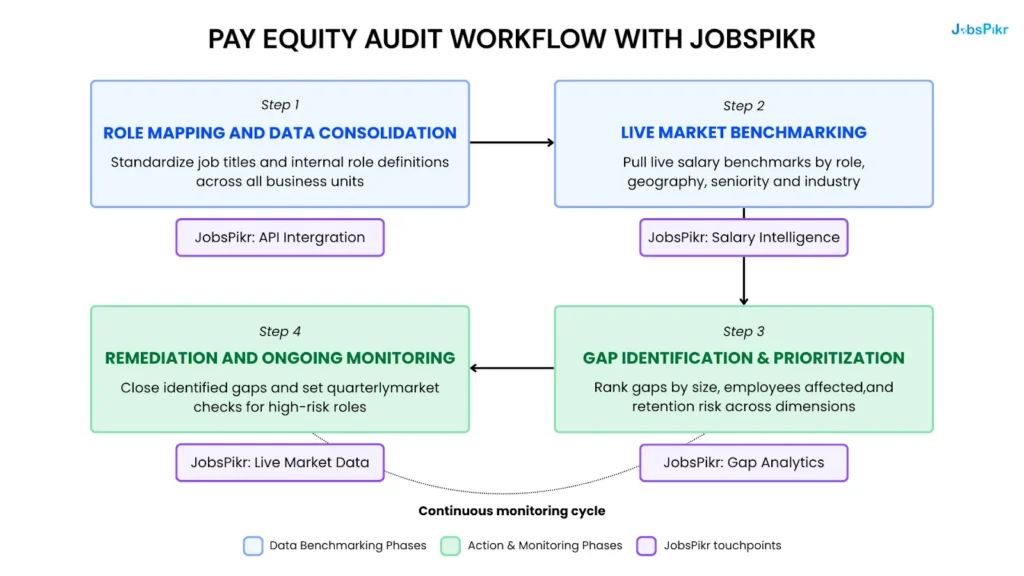
Step 1: Role Mapping and Internal Data Consolidation
Before any external benchmark is useful, the internal picture must be clean. The team started by standardizing job titles and role definitions across business units, collapsing inconsistent naming conventions into a consistent taxonomy that could be reliably mapped to external market data. This step is unglamorous, but it is non-negotiable. If your internal role definitions are inconsistent, any benchmark you apply to them will produce comparisons that are not meaningful.
Using JobsPikr’s job data, they were also able to validate their internal taxonomy against how the market was titling and scoping comparable roles. In several cases, they found that roles their organization had been categorizing as mid-level were being posted externally at a senior level with significantly higher compensation ranges. That discrepancy alone explained part of the gap they had been seeing in certain teams.
Step 2: Live Market Benchmarking by Role, Geography, and Seniority
With clean internal data in hand, the team pulled live salary benchmarks from JobsPikr’s salary intelligence feeds for each role in scope, segmented by geography and seniority level. Rather than applying a single national average, they benchmarked each role against the specific market it was competing in, which meant a product manager role in their New York office was measured against New York market rates, and the same role in their Austin office was measured against Austin rates.
This level of granularity is exactly what broad survey benchmarks tend to flatten out. A national average for a mid-level product manager role might look reasonable on paper while simultaneously undershooting the New York market and overshooting the Austin one. For a multi-region enterprise, that kind of averaging creates pay equity problems even when no one intended to create them.
Step 3: Gap Identification and Prioritization
With internal compensation mapped against live market salary benchmarks, the gaps became visible in a way they had not been before. The team ran their analysis across three dimensions: gender, tenure, and geography. What they found confirmed what they had suspected, the most significant gaps were not concentrated in a single demographic cut but were distributed across mid-level roles in specific geographies where the market had moved faster than their comp bands had been updated.
The prioritization framework they used was straightforward. Gaps were ranked by size, by the number of employees affected, and by the retention risk associated with the roles in question. This gave leadership a clear view of where to act first and what the estimated cost of remediation looked like before any decisions were made, which is a very different conversation to walk into than one where you are presenting a problem without a proposed solution.
Step 4: Remediation, Adjustment, and Ongoing Monitoring
Closing identified pay gaps was only part of the outcome. The more durable change was building a monitoring cadence that did not require a full audit cycle every time the team needed to check whether their compensation was still in market.
With JobsPikr’s API connected to their compensation platform, the team set up quarterly market checks for their highest-risk roles, essentially a lightweight benchmarking refresh that flagged any role where the live market rate had moved meaningfully outside their current comp band. This meant that instead of discovering gaps eighteen months after they had opened, they were catching drift within a quarter and addressing it before it became a retention issue.
According to Mercer’s 2024 Global Talent Trends Report, organizations that conduct pay equity reviews more frequently than once a year are significantly more likely to report improved employee trust and reduced voluntary turnover in affected groups. That finding aligns closely with what this enterprise customer experienced, which we will get into in the next section.
The Results: What Pay Equity Looks Like When You Have the Right Data
At some point, every pay equity conversation must answer the same question from leadership: what did we get for this?
It is a fair question. Pay equity initiatives require real investment, in technology, in time, and in the organizational will to act on what the data shows. The case for that investment needs to be made in terms that go beyond compliance and moral imperative, as important as both of those are. It needs to show up in numbers that connect to business outcomes leadership already cares about.
Here is what the enterprise customer in this case study was able to point to after integrating JobsPikr’s salary intelligence and completing their first full pay equity workflow cycle.
Benchmarking Cycle Time Dropped Significantly
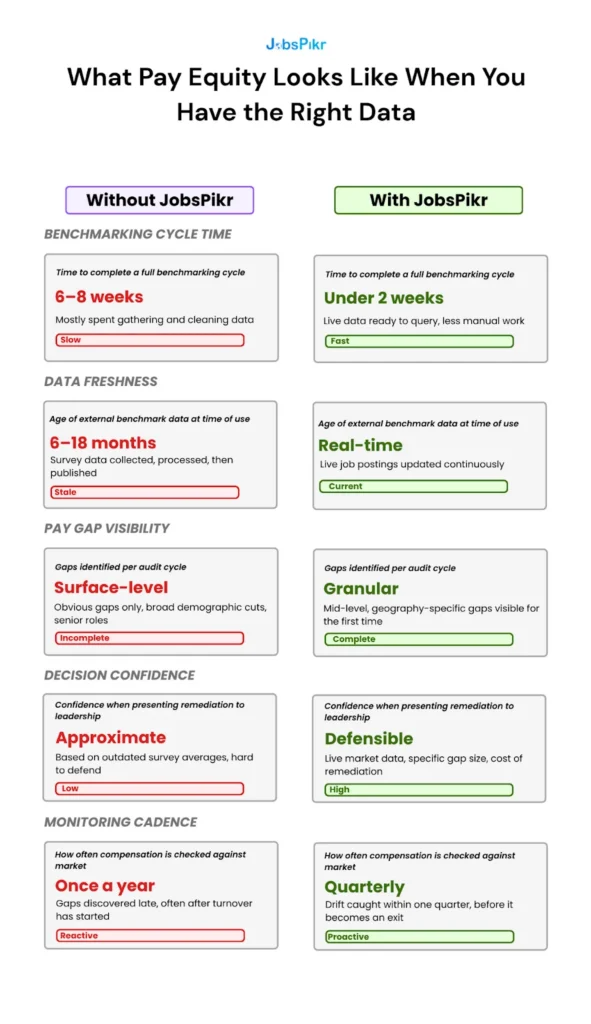
Before JobsPikr, completing a compensation benchmarking cycle took the Total Rewards team between six and eight weeks. A significant portion of that time was not spent on analysis. It was spent on data gathering, pulling external benchmarks, reconciling them against internal role definitions, and manually cleaning inconsistencies before anything useful could be done with the numbers.
After integrating JobsPikr’s job data API, that cycle came down to under two weeks for the same scope of analysis. The external benchmark data was live, structured, and queryable by role, geography, and seniority, which meant the team could spend their time on interpretation and decision-making rather than data preparation. For a team managing compensation across thousands of employees in multiple regions, that time saving compounded quickly across every review cycle.
Pay Gaps That Had Been Invisible Became Visible
This was perhaps the most significant outcome, and the one that had the most direct downstream impact. The previous audit methodology had identified a handful of pay gaps in obvious places, senior roles, well-documented demographic cuts. What it had missed was a pattern of smaller gaps distributed across mid-level roles in secondary geographies, where the market had moved faster than the organization’s comp bands had kept pace with.
JobsPikr’s live salary benchmarks made those gaps visible because the market data was granular enough to reflect what was happening at the role and geography level, rather than averaging it out into a national benchmark that obscured the variation underneath.
Once those gaps were identified and prioritized, the team moved to remediation with a clear evidence base. They were not asking leadership to approve pay adjustments based on a feeling or a rough estimate. They were presenting a specific gap, a live market benchmark, and a cost of remediation, which is a fundamentally different and more actionable conversation.
Voluntary Turnover Improved in Affected Employee Groups
This is the outcome that tends to get leadership’s attention most quickly, because turnover has a cost that is relatively straightforward to calculate. According to the Society for Human Resource Management, the average cost of replacing an employee sits between 50% and 200% of their annual salary depending on seniority and role complexity. For mid-level roles in competitive markets, that number sits toward the higher end of that range.
In the twelve months following their first JobsPikr-informed pay equity remediation cycle, the enterprise customer saw measurable improvement in voluntary turnover among the employee groups where pay gaps had been closed. The improvement was not dramatic enough to attribute entirely to compensation, employee retention is never driven by a single variable, but the correlation was clear enough to be included in the business case for continuing and expanding the program.
What the data also showed was that the improvement was strongest in the geographies where the gaps had been most significant before remediation. That specificity matters, because it is exactly the kind of evidence that turns a one-time pay equity project into a funded, ongoing workforce intelligence function.
Compensation Decision-Making Became Faster and More Defensible
Beyond the audit itself, the integration had a quieter but equally important effect on how the team made day-to-day compensation decisions. When a hiring manager needed to know whether an offer was competitive, the answer was no longer “let me check the benchmark report from last year.” It was a live query against current market data, returned in minutes.
That speed matters not just for efficiency but for defensibility. In an environment where pay transparency legislation is expanding and employees have more access than ever to external salary information, comp decisions that cannot be backed by current market data are increasingly difficult to stand behind. Having a live, auditable data source as the foundation of every significant pay decision changes the nature of that conversation entirely.

“Before JobsPikr, we were always benchmarking against where the market had been. Now we are benchmarking against where it is. That difference sounds small until you see what it does to your audit conclusions.”
VP Total Rewards
Enterprise Technology Company
Why Pay Equity Is Now a Business Performance Issue, Not Just an HR One
For a long time, pay equity lived primarily in the compliance and HR risk management conversation. It was something organizations addressed when regulators asked, when litigation loomed, or when an employee survey came back with numbers that were hard to ignore. The business case existed, but it was often framed defensively, here is what it costs us if we do not fix this, rather than here is what we gain when we do.
That framing is changing, and it is changing fast.
Pay equity has moved from the HR function into the boardroom not because the moral argument got stronger, it was always strong, but because the business evidence has become impossible to set aside. The organizations that are getting this right are not just avoiding legal exposure. They are outperforming on the metrics that matter most to enterprise leadership: retention, productivity, employer brand, and the ability to attract talent in competitive markets.
The Retention Cost of Getting Pay Equity Wrong
Turnover is where the business case for pay equity is most immediately visible, and most immediately quantifiable. Employees who discover they are being paid below market or below colleagues doing comparable work do not always leave immediately. But they disengage first, and then they leave. That sequence is expensive at every stage.
According to Gallup’s State of the Global Workplace Report, disengaged employees cost organizations an estimated 18% of their annual salary in lost productivity before they ever hand in their notice. When you layer that on top of the replacement cost of losing them, the financial argument for proactive pay equity management becomes very straightforward very quickly.
What makes this particularly relevant for enterprises is that the employees most likely to discover pay inequity are also the ones most likely to have options elsewhere. Mid-to-senior level professionals in competitive fields have access to salary transparency tools, active recruiter networks, and peer communities where compensation gets discussed openly. The idea that pay gaps stay hidden is increasingly a fiction. They surface, and when they do, the cost of not having addressed them proactively is always higher than the cost of addressing them would have been.
Employer Brand Is a Compensation Story Now
The second business performance dimension that pay equity directly affects is employer brand, and this one tends to catch leadership off guard because the impact is harder to see in a single quarter but substantial over time.
LinkedIn’s 2025 Talent Trends Report found that fair pay and pay transparency consistently rank among the top factors candidates consider when evaluating employers, sitting alongside career growth and flexibility as primary decision drivers. For enterprises competing for talent in markets where candidates have multiple offers on the table, being known as an organization that takes pay equity seriously is a competitive advantage, not just a compliance posture.
The inverse is equally true. Organizations that appear in pay equity litigation, that score poorly on compensation fairness in employee reviews, or that are visibly behind on pay transparency compliance tend to see that reputation show up in offer decline rates and sourcing difficulty before it shows up anywhere else. By the time it is visible in the data, the damage is already done.
Pay Transparency Legislation Is Removing the Option to Wait
If the business performance argument were not enough on its own, the regulatory environment is making inaction increasingly untenable. The EU Pay Transparency Directive requires employers with 100 or more employees to report on gender pay gaps and take corrective action where unjustified gaps exist, with enforcement mechanisms that carry real financial consequences. Across the US, pay range disclosure requirements have now passed in enough states that any enterprise with a distributed workforce is almost certainly operating in at least one jurisdiction where compliance is already mandatory.

Image Source: Celential.ai
According to Deloitte’s 2025 Human Capital Trends Report, organizations that have proactively built pay transparency into their HR infrastructure report significantly lower compliance burden when new pay equity regulations come into effect, because the data infrastructure and audit processes are already in place. The organizations scrambling to comply are the ones that treated pay equity as a future problem rather than a present one.
This is precisely the position the enterprise customer in this case study had been in before integrating JobsPikr. They were not non-compliant, but they were operating reactively, running audits when required rather than maintaining a continuous view of their compensation position relative to the market. The shift to a live, ongoing benchmarking workflow did not just improve their pay equity outcomes. It changed their compliance posture entirely, from reactive to proactive, which is a fundamentally different place to be when a regulator or a board asks for an update.
Workforce Intelligence Is the Infrastructure Behind Pay Equity at Scale
The deeper point that this case study illustrates is that pay equity is not a project you complete. It is a function you build. And like any function that depends on data, it is only as good as the data infrastructure behind it.
JobsPikr’s role in this is not to tell organizations what their pay equity policy should be. That is a leadership decision that involves values, strategy, and organizational context that no platform can substitute for. What it does is give the people making those decisions the live, accurate, granular market intelligence they need to make them well and to keep making them well as the market continues to move.
For CHROs, VP Total Rewards leaders, and the procurement teams evaluating workforce intelligence platforms, that is the distinction that matters at the evaluation stage. The question is not whether pay equity is important. Everyone agrees it is. The question is whether the data infrastructure your organization has in place is good enough to deliver on that commitment not just at audit time, but continuously, at the speed the market moves.
If the answer to that question is uncertain, that uncertainty is itself the answer.
Pay Equity Does Not Fix Itself, but the Right Data Makes It Fixable
Pay equity is one of those problems that organizations know they have, broadly intend to fix, and consistently underestimate how hard it is to get right without the right infrastructure behind it. The gap between wanting to achieve pay equity and achieving it is almost always a data gap, not a values gap, not a budget gap, and not a lack of organizational will.
What this case study makes clear is that the traditional approach to compensation benchmarking, annual surveys, static reports, and manually reconciled spreadsheets was never built for the pace at which labor markets move today. It produces conclusions that are accurate for a moment in time that has already passed, and in a regulatory and competitive environment that is moving as fast as this one, that lag has real consequences. Gaps that could have been caught and closed quietly become visible publicly. Retention problems that could have been prevented become exit conversations. Compliance postures that could have been proactive become reactive scrambles.
The enterprise customer in this case study did not solve pay equity by finding a better spreadsheet. They solved it by replacing a periodic, backward-looking process with a live, continuous one, powered by JobsPikr’s job data API and salary intelligence feeds. The outcomes they achieved were not just about closing specific gaps, as important as that was. They were about building the kind of compensation infrastructure that makes pay equity a sustainable organizational capability rather than a one-time project.
For CHROs and VP Total Rewards leaders who are evaluating where their current data infrastructure falls short, the starting point is simpler than it might seem. The question to ask is not “do we have pay equity data?” Most organizations have some. The question is “is our data current enough, granular enough, and connected enough to our actual decision-making workflow to be genuinely useful?” For most enterprises, that answer reveals the gap more clearly than any audit ever could.
JobsPikr is built for exactly that gap. As a talent intelligence and workforce intelligence platform, it gives compensation teams the live market signal they need to benchmark accurately, audit confidently, and act decisively, not once a year, but as continuously as the market demands.
Pay equity is not a destination you arrive at and then stop moving. It is a function you maintain. And maintaining it well starts with having data that is keeping pace with the world your employees are living and working in.
See What Your Pay Equity Picture Really Looks Like
Most organizations are one data upgrade away from compensation decisions they can stand behind. Let JobsPikr show you how.
Frequently Asked Questions
1. What is pay equity and why does it matter for enterprise organizations?
Pay equity means ensuring that employees doing comparable work are compensated relative to each other and relative to what the external market is paying for that work. For enterprise organizations specifically, pay equity matters on three levels simultaneously. There is the compliance dimension, which is becoming harder to ignore as pay transparency legislation expands across the US, EU, and beyond. There is the retention dimension, where unaddressed pay gaps quietly drive disengagement and turnover among the employees who are most likely to have options elsewhere. And there is the employer brand dimension, where an organization’s reputation for fair compensation increasingly affects its ability to attract talent before a single offer is ever made. Getting pay equity right is not a peripheral HR concern anymore. It is a core business performance issue.
2. What are the best practices for conducting a pay equity analysis?
A meaningful pay equity analysis starts with clean internal data and a current external benchmark, and both of those things matter equally. On the internal side, the first step is standardizing job titles and role definitions across business units so that comparisons are apples to apples. Inconsistent titling across teams is one of the most common reasons pay equity audits produce conclusions that do not hold up under scrutiny. On the external side, the benchmark data you use needs to be current enough to reflect what the market is paying right now, not six to twelve months ago. From there, the analysis should cut across multiple dimensions gender, tenure, geography, and seniority level because gaps rarely concentrate in one place. The most durable pay equity programs treat the analysis not as a one-time project but as an ongoing workflow, with regular market checks built into the compensation review cadence rather than triggered only when an audit is formally required.
3. What are the best software tools to analyze pay equity in a company?
The most effective pay equity tools share a few characteristics worth looking for during vendor evaluation. First, they should connect to live market data rather than relying solely on annual survey benchmarks, because the freshness of the external reference point directly affects the quality of the analysis. Second, they should be able to segment benchmarks by role, geography, seniority, and industry not just produce a single national average that flattens out the variation that matters. Third, they should integrate with your existing HRIS and compensation management systems so that market data becomes part of the workflow rather than a separate report someone must manually reconcile. JobsPikr’s job data API and salary intelligence feeds are built specifically for this use case giving Total Rewards teams a live, queryable view of market compensation that connects directly into their existing compensation infrastructure, rather than sitting in a standalone tool that adds another step to an already complex process.
4. How do you develop a transparent salary structure?
A transparent salary structure starts with clearly defined pay bands for each role and level in your organization ranges that are grounded in current market data, internally consistent, and documented well enough to be explained to employees when asked. The market data foundation is critical here. Pay bands built on survey benchmarks that are more than a year old will drift out of market faster than most organizations realize, and when employees discover the gap which they increasingly do, thanks to pay transparency tools and peer networks the credibility of the entire structure is called into question. Beyond the bands themselves, transparency requires a clear, consistent methodology for how employees move within and between ranges what drives merit increases, how promotions affect compensation, and how the organization responds when market rates move significantly. According to the Institute for Women’s Policy Research, organizations with clearly documented and consistently applied salary structures report stronger employee trust scores and lower pay equity complaint rates than those managing compensation on a largely discretionary basis.
5. How do you compare pay equity statistics across industries?
Comparing pay equity data across industries requires accounting for the fact that industries do not just pay differently they also define and scope roles differently, weight seniority differently, and compete in different talent markets. A straightforward comparison of median salaries across industries will tell you something, but it will not tell you whether the gaps you are seeing reflect genuine inequity or simply the structural differences between how a financial services firm and a healthcare organization build their compensation frameworks. The most useful cross-industry pay equity comparisons are role-specific and geography-specific, controlling for seniority level and company size before drawing any conclusions. Live job posting data is particularly valuable for this kind of analysis because it captures what employers across industries are actively advertising for comparable roles in the same market which is a more direct signal of competitive compensation intent than survey-derived industry averages. For enterprises managing talent across multiple industries or competing for talent that moves between sectors, that granularity is the difference between a benchmark that is directionally interesting and one that is decision ready.