
- **TL;DR**
- Why are teams upskilling now (and not next quarter)?
- What’s the connection between upskilling and real-time job market data?
- How do real-time labor market signals help spot skill gaps early?
- Turn Live Job Data into Targeted Upskilling Plans
- How can HR teams use workforce intelligence to prioritize what to upskill first?
- What are the real benefits of upskilling employees using live market signals?
- How do you build an upskilling strategy that actually follows the market?
- A real-world example: How one team closed its AI skills gap before it became a hiring crisis
- Why upskilling should be treated like a market strategy, not an HR side project
- Upskilling is a Strategy, Not a Checkbox
- Turn Live Job Data into Targeted Upskilling Plans
- FAQs
**TL;DR**
If you’re planning next year’s training calendar without looking at live job market signals, you’re guessing. Real-time postings show which skills are heating up (and where), so HR and L&D can prioritize the right upskilling instead of running generic courses. Recent data from the World Economic Forum shows ~39% of core skills will change by 2030, still a big shift, even as the pace stabilizes. Pair that with LinkedIn’s finding that most L&D leaders want to build skills proactively, and the message is simple: use market data to pick the few skills that matter, build programs employees want, and track whether the market is moving faster than your curriculum.
Why are teams upskilling now (and not next quarter)?
Let’s be honest — most “learning plans” are built once a year and then left to age. Meanwhile, the market keeps moving. You feel it when a hiring manager asks for a data analyst who can also wrangle prompt engineering, or when a client wants AI-ready delivery but your team hasn’t touched those tools yet.
What changed? The market started sending louder, faster signals. When the roles your competitors post begin asking for a new certification, a new framework, or a new workflow, that’s your early warning. The World Economic Forum estimates that two out of five core skills will shift by 2030, not doomsday, but enough to make “wait and see” a riskier strategy than it used to be.
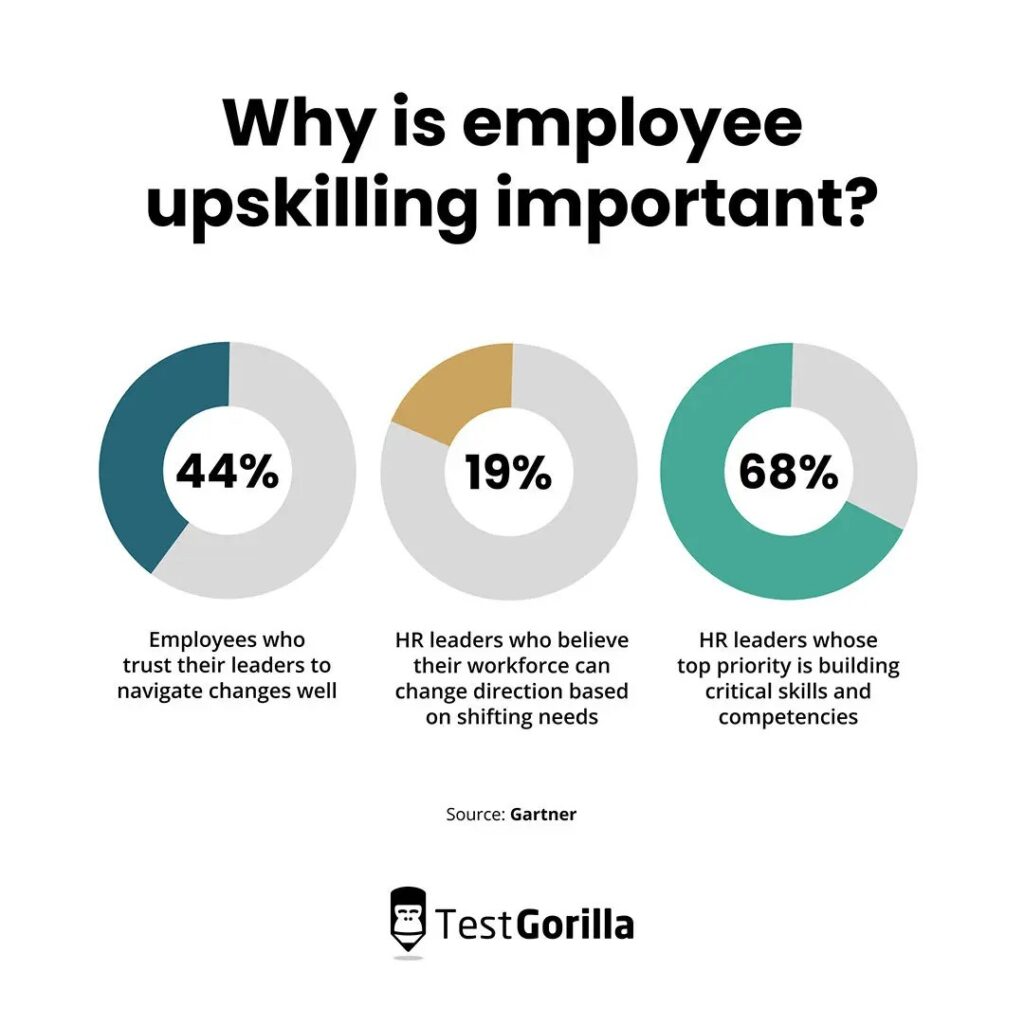
Image Source: testgorilla
Here’s the pattern we’re seeing with HR and L&D leaders:
- Employees want direction, not a course catalog. They’ll engage when you show a line from “this skill” to “that role” to “this pay band.”
- Business leaders want evidence. If you can say, “Cloud security demand is up in our sector and region; here’s the posting trend and here’s our gap,” budgets loosen quickly.
- Hiring is not a safety net. In some locations, the very skills you need are the ones everyone else is chasing. Upskilling employees becomes the faster, cheaper path than fighting the market every quarter.
The other shift is mindset. Upskilling used to be framed as “employee development.” Now it’s capacity planning. You don’t train because it’s nice. You train because the work you want to win requires it. And you don’t guess which skills to back — you let job market data help you choose.
Mini playbook you can start this week
- Pull a 90-day slice of postings for your top five roles (title + location).
- Extract the skills that appear most often — and the ones that are new compared to last year.
- Map those skills to your current team: who’s close, who’s far, where can a short sprint close the gap.
- Pick one skill per role to back for the next quarter. Build a short, assessed track and tie it to role progression.
Do that once, and you’ll feel the difference: fewer debates, clearer priorities, better uptake.
What’s the connection between upskilling and real-time job market data?
When most companies talk about “upskilling employees,” they’re really talking about internal needs: new tools, updated workflows, fresh certifications. But here’s the catch — your internal goals aren’t the full picture. The market is writing its own script, quietly setting the pace for what skills actually matter.
And that script is easy to read — if you’re looking in the right place. Job postings are more than open roles. They’re early indicators of where work is shifting. When thousands of companies start listing AI workflow skills for operations roles, that’s not a trend you “discover” next year. That’s a signal you act on this quarter.
Real-time labor market data is essentially a live feed of what the world is hiring for. It tells you:
- Which skills are becoming must-haves instead of nice-to-haves?
- Where your competitors are doubling down on certain roles.
- How fast is demand moving compared to your internal learning cycles?
This is where upskilling stops being reactive. Instead of waiting for a gap to show up in performance reviews or failed hiring cycles, L&D teams can see it coming months earlier.
A good way to think about this:
- Traditional skill planning is like looking in the rearview mirror.
- Real-time job market data is the windshield.
Take cybersecurity as an example. The U.S. Bureau of Labor Statistics projects a 32% growth in information security roles from 2022 to 2032, much faster than the average for all occupations. That’s not just a hiring challenge; it’s a workforce planning problem. If your analysts aren’t being upskilled today, you’ll be hiring tomorrow in one of the most competitive talent markets out there.
When teams use job market signals correctly, something shifts:
- Training stops being a wishlist.
- Learning investments become surgical.
- And employees see that what they’re learning lines up with where the market is headed, not just where the company has been.
How do real-time labor market signals help spot skill gaps early?
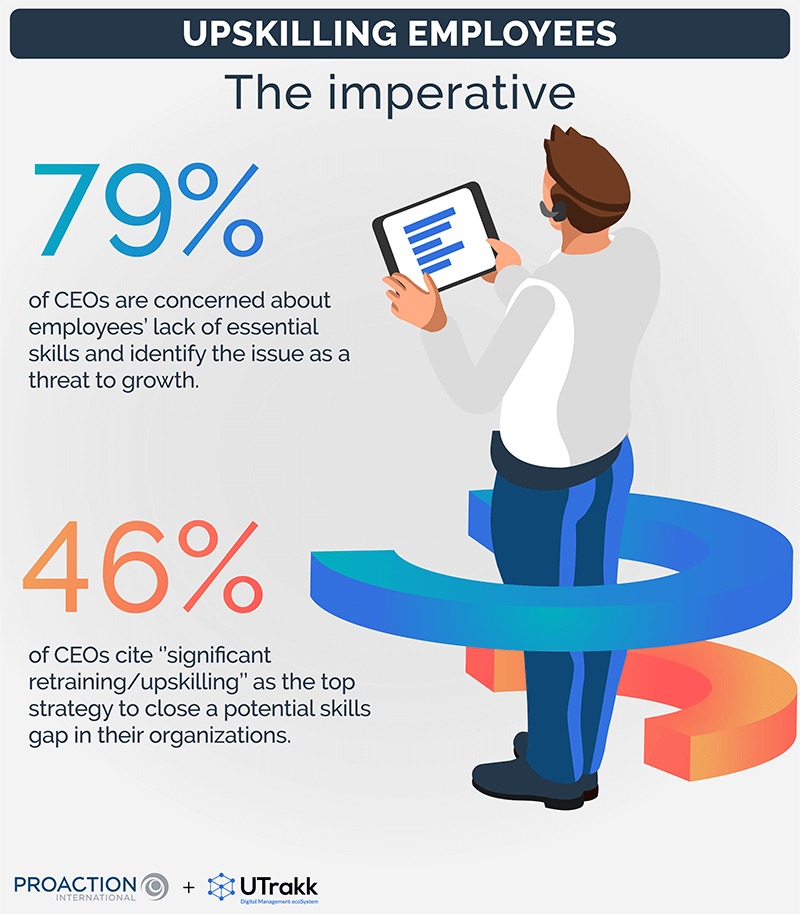
Image Source: Proaction
Skill gaps rarely appear overnight. They creep in quietly. A team that was perfectly capable a year ago can suddenly feel misaligned with the kind of work coming in. Not because the people changed, but because the market did.
Here’s what usually happens. A specific skill starts showing up more frequently in job postings across your industry. Maybe it’s a new data visualization tool, maybe a workflow framework, maybe a compliance certification. At first, no one in your team has it, but it doesn’t matter because the work hasn’t hit your doorstep yet. Then, clients start asking questions. Hiring managers start losing candidates to faster-moving competitors. Projects start slipping.
That six-month lag between market signal and internal action is where most companies lose their edge.
Real-time labor market data shortens that lag dramatically. It shows you:
- Which skills are gaining velocity in your market (not just volume).
- Which roles are evolving faster than your training plans.
- Where your internal capability curve is drifting away from what’s being demanded outside.
Consider this: the LinkedIn Economic Graph 2024 reported a sharp rise in demand for AI and automation skills across operational roles — not just engineering. That means skills once considered “specialized” are now baseline expectations.
When you can see those shifts in real time, you don’t need to guess which learning path to back. You can say, “The data shows this skill appearing in 40% of postings for our top roles, that’s our priority this quarter.”
And here’s the part most teams miss: this isn’t about chasing every shiny new tool. It’s about catching the few critical shifts early, training selectively, and letting that compound over time.
Turn Live Job Data into Targeted Upskilling Plans
See exactly which skills are surging in your market and build your upskilling strategy around it.
How can HR teams use workforce intelligence to prioritize what to upskill first?
The hardest part of upskilling isn’t launching the program. It’s choosing what to bet on.
Most companies overcomplicate this. They try to build training calendars that cover every tool, every framework, every buzzword in the market. The result? Bloated programs, poor adoption, and very little actual business impact.
The smarter approach is simple: treat workforce intelligence like a lens, not a catalog.
When you overlay real-time job market data on your internal skills inventory, patterns emerge fast.
Here’s how most high-performing L&D teams approach it:
Step 1: Identify skills with real external momentum
Not every trending skill is worth your time. But if a skill consistently shows up across competitors’ postings, especially in core roles, that’s not a blip. That’s a market signal.
For example, CompTIA’s 2024 Workforce Trend report showed a 27% increase in demand for cloud security skills across mid-level IT roles. If your team handles infrastructure, ignoring that trend now means paying a hiring premium later.
Step 2: Layer internal readiness on top
Market demand is just one side of the puzzle. The other is your current skill baseline. If you already have a handful of employees sitting at 70% readiness on a rising skill, it’s easier and cheaper to upskill them fully than to hire from scratch.
This is where workforce intelligence platforms help visualize that gap clearly: external demand curve vs. internal supply curve.
Step 3: Tie skills to outcomes, not enthusiasm
A skill shouldn’t make the list just because it’s trending. It should make the list if it moves a business needle — reduces time-to-hire, unlocks a new service line, strengthens delivery, or supports a critical transformation.
When teams frame upskilling this way, executives don’t see it as an “HR initiative.” They see it as capability building tied to revenue.
Upskilling employees works best when it’s narrow and deliberate. One skill per role per quarter beats a 30-topic calendar no one touches.
Workforce intelligence gives you that focus. It keeps you from being swept up by hype and helps your team stay anchored in what actually matters to the business.
What are the real benefits of upskilling employees using live market signals?
Upskilling isn’t just about employee development anymore. When done with real-time job market data, it becomes a strategic advantage. Companies that catch skill shifts early don’t just keep their people — they move faster, spend less on hiring, and build capabilities their competitors are still trying to rent.
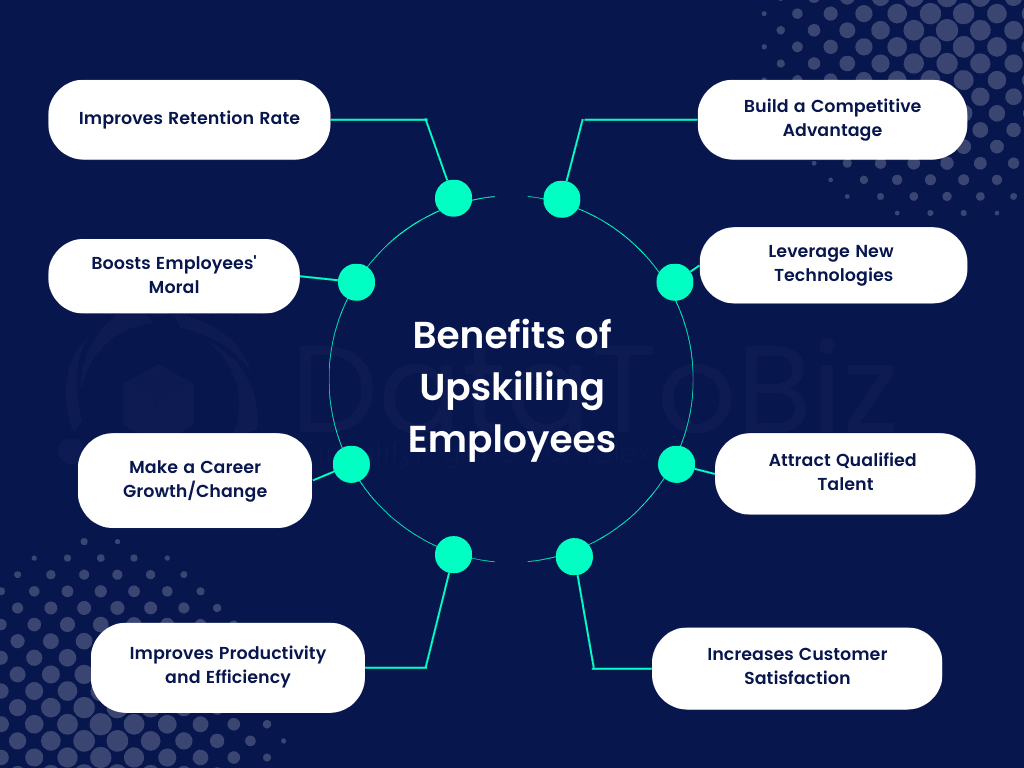
Image Source: prepai
Let’s break that down a bit more.
1. Retention starts with relevance
Employees don’t leave just because of pay. They leave when their skills stop growing. According to PwC’s 2024 Global Workforce Hopes and Fears Survey, 77% of employees say they’re ready to learn new skills or completely retrain, but only a fraction feel their companies make that easy.
When you build programs based on real market signals, employees can see the value. They know the skill they’re learning isn’t just another internal checkbox; it’s what top employers are hiring for right now.
That sense of market relevance turns upskilling from a perk into a career multiplier.
2. Lower hiring pressure
Every skill gap that isn’t addressed through upskilling eventually lands on the talent acquisition team. And the more niche the skill, the more expensive it gets to hire for it.
If you’re ahead of the curve, that pressure eases. Your pipeline isn’t constantly playing catch-up. You can promote from within, shift resources, and create smoother transitions when new work comes in.
It’s not about replacing hiring entirely; it’s about buying yourself time.
3. Faster adaptability to market shifts
When the market changes, the slowest-moving organizations are the ones that break. Teams that bake live labor market signals into their planning can pivot faster.
Say your industry suddenly pivots toward regulatory tech compliance. If your L&D team has already seen that signal six months earlier, training pathways are in motion before the shift hits full speed. That’s how you stay ahead.
4. Stronger business case for L&D investments
Upskilling programs built on “gut feeling” are hard to defend. Programs built on market data are easy to fund.
Executives don’t just want engagement metrics; they want evidence: “This skill is appearing in 42% of competitor postings in our region. We’re at 20% internal coverage. Here’s the cost if we hire vs. upskill.”
That’s a different kind of conversation, one that moves budgets.
When upskilling is tied to live market intelligence, it stops being a cost center and starts looking like a growth strategy. You’re not training for the sake of training; you’re aligning your people to the work that’s already forming outside your walls.
How do you build an upskilling strategy that actually follows the market?
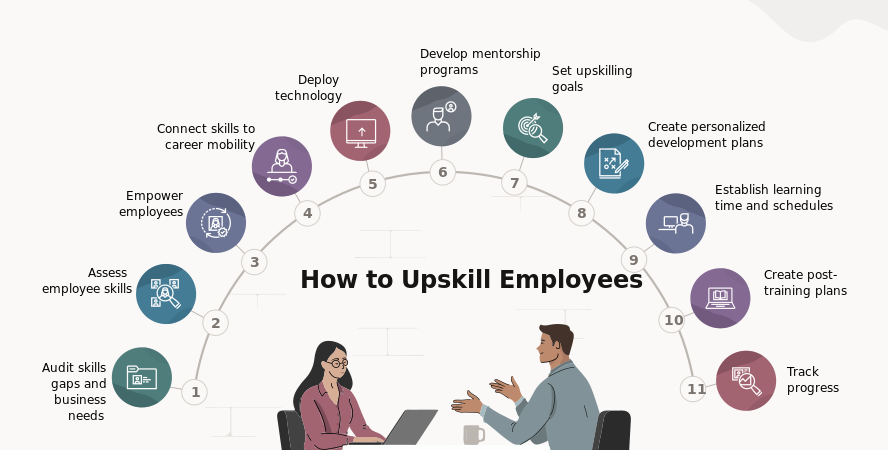
Image Source: Oracle
Most upskilling strategies fall apart in execution, not intent. HR and L&D leaders know they need to keep pace with the market — but their plans are built on static reports, old survey data, or vague “future skills” decks from vendors. By the time training programs go live, the goalpost has already moved.
The better way is to build an adaptive strategy, one that stays connected to real-time labor market signals at every step.
Step 1: Start with skill signals, not job titles
Job titles shift slowly. Skills shift fast. Before designing a training path, pull a 90-day or 6-month window of job posting data for your top 5–7 roles. Look for skills that are appearing more frequently over time, not just what’s common right now.
For example, JobsPikr users in logistics noticed early surges in postings requiring AI workflow tools before they became mainstream. Because they acted on signals, their internal teams were ready long before the hiring crunch began.
Step 2: Map market skills to internal baselines
A skill gap isn’t just “we don’t have it.” Sometimes 60% of the team is halfway there — they just need structured learning to close the gap. Workforce intelligence lets you see who’s closest to the new skills and where targeted investment gives the fastest ROI.
This mapping is where most L&D plans gain or lose momentum. When people see a clear path — “learn this skill, move into this higher-value role” — engagement spikes.
Step 3: Build lean learning tracks, not bulky programs
You don’t need a 6-month curriculum to respond to a market signal. You need small, tightly-scoped, assessed learning sprints.
Example: Instead of launching a broad “data literacy” program, a retail company may pick just “SQL querying for merchandisers,” because that’s the one skill appearing in most new postings for that role.
Lean programs are easier to deploy, easier to update, and more aligned with real market demand.
Step 4: Keep monitoring and adjusting
This is the part most organizations skip. Upskilling isn’t a “set it and forget it” initiative. Skills that were hot last year may fade. Others will rise fast.
Tying your upskilling strategy to real-time job market data gives you a built-in feedback loop. You don’t have to rely on quarterly surveys or guesswork. When the signal shifts, your strategy shifts with it.
A good upskilling strategy looks less like a training calendar and more like a market playbook. It’s fluid, data-backed, and tied to what actually drives your business forward.
A real-world example: How one team closed its AI skills gap before it became a hiring crisis
Let’s make this less theoretical.
A mid-sized financial services firm could see AI-enabled work creeping into client briefs. Hiring their way out would be expensive and slow, so HR and L&D teamed up and used JobsPikr to treat upskilling like a market move, not a side project.
Step 1: Set up a live signal, not a quarterly report
Inside JobsPikr, they created a watchlist of ~50 peer and competitor companies, selected their top roles (data analyst, risk analyst, operations analyst), and filtered by their active regions.
- Skills extraction on: They toggled the built-in skills extractor so postings were parsed into a normalized skills list (frameworks, tools, certs).
- Velocity view: Instead of only looking at counts, they used the skills velocity panel to see which skills were accelerating fastest in those roles.
- Alerts: They set weekly email alerts for any skill that crossed a chosen threshold in those postings.
Result: within a few cycles, AI workflow skills (prompt patterns, orchestration, model-aware QA) started showing sustained momentum across their watchlist.
Step 2: Map external demand to internal supply
Next, they uploaded a basic internal skills inventory (CSV export from their HRIS + a short manager survey). JobsPikr’s gap matrix lined up market skills against team proficiency levels, by role and location.
- They found a healthy base in Python and pipelines, but clear holes in applied AI workflows and governance/compliance for model outputs.
- The matrix made prioritization obvious: focus on 2–3 skills per role, not a giant “AI for everyone” program.
Step 3: Build lean tracks, tied to the roles (and the market)
Using the gap matrix, they designed short learning sprints (4–6 weeks) for each role family:
- Analysts: prompt design for data tasks, validation loops, AI-assisted documentation.
- Ops/Risk: model audit trails, exception handling, basic red-teaming for outputs.
- Leads: workflow orchestration, assignment rules, and escalation patterns.
They pulled example job snippets straight from JobsPikr into their internal pages — so employees could see, in plain language, “this is what the market is asking for now.” Engagement rose because the “why” was obvious.
Step 4: Close the loop with systems you already use
They used the JobsPikr API to push the “skills to watch” list into their LMS tags and into a simple Looker dashboard for leaders. Now, course enrollments, completions, and internal project placements could be viewed next to the external demand curve.
- If a skill’s market signal cooled, they throttled the next cohort.
- If a signal strengthened, they expanded the track or added an advanced module.
Step 5: Track impact in business terms, not just learning metrics
Because the signals and training were connected, the impact showed up where it matters:
- Staffing agility: they staffed new AI-tinged projects with upskilled internal analysts rather than opening new reqs.
- Hiring relief: talent acquisition didn’t have to chase every niche skill in a hot market.
- Retention story: people stayed because the company was teaching skills they could trade on in the broader market — not just internal tools.
No heroic budgets. No 6-month curricula. Just live market signals → targeted sprints → measurable capacity. That’s the JobsPikr flywheel in practice.
Why upskilling should be treated like a market strategy, not an HR side project
Here’s where most organizations get it wrong: they still treat upskilling as a learning initiative, tucked somewhere between performance reviews and engagement surveys. The reality is far less polite. In fast-moving markets, skill planning isn’t “learning and development” — it’s strategic capacity building.
Markets reward companies that can adapt faster than the problem hits them. Upskilling with real-time job market signals gives you exactly that edge.
Upskilling as a cost shield, not a cost center
Every skill gap that isn’t filled internally eventually lands on a recruiter’s desk with a price tag attached. By the time it’s a “hiring need,” it’s already expensive. But when you track job market signals, you can see those gaps forming months earlier, and build internal capability before the external cost balloons.
When one of our early users in the retail sector plugged their top 20 roles into JobsPikr’s signal feed, they identified a cluster of rising AI and data analysis skills long before those became mainstream in their geography. Six months later, their competitors were paying a premium to hire the same talent they had already grown in-house.
Upskilling as a competitive moat
When everyone is hiring from the same shallow talent pool, the only sustainable advantage is owning the skills before they hit market saturation. Job postings are a remarkably accurate forecast of where demand is about to spike.
Using JobsPikr’s velocity filters, companies can spot these shifts while the curve is still steep, not flat. That’s the sweet spot — when the skill is valuable, but not yet crowded.
Upskilling as retention insurance
Top performers don’t just want interesting work; they want market-relevant skills. When employees can see that the training they’re doing aligns with actual demand outside, retention isn’t something you have to negotiate — it happens naturally.
This is why users often pair JobsPikr’s skill signal dashboards with internal career pathing tools. It helps them say, “Here’s what’s rising out there, here’s what we’ll train you on, and here’s the role it connects to.”
Upskilling as a market move
If your competitors are reacting while you’re preparing, you’ve already won the timing game. Treating upskilling as a market move means your org’s skill graph evolves in step with external demand, not after it. That’s how you stay ahead without doubling your hiring budget.
Upskilling is a Strategy, Not a Checkbox
The skill landscape isn’t shifting slowly anymore. It’s pulsing — with signals coming from job postings, competitor moves, and technology adoption curves. If you wait for those shifts to show up in your hiring pipeline, you’ve already lost time, money, and momentum.
When HR and L&D teams anchor their upskilling strategy in real-time labor market signals, they stop chasing trends and start shaping their own edge. The result isn’t just better-trained employees — it’s a workforce that moves in sync with the market, not behind it.
JobsPikr makes that shift practical. It pulls live skills from real postings, surfaces what’s heating up, maps it against your internal supply, and gives you the signal to act before everyone else does. That’s how upskilling becomes a market move, not an afterthought.
Turn Live Job Data into Targeted Upskilling Plans
See exactly which skills are surging in your market and build your upskilling strategy around it.
FAQs
1) What is upskilling employees?
Upskilling employees is the simple idea of helping your current team learn the skills the market is starting to value. It’s not “more training for the sake of it.” It’s closing the gap between what your people can do today and what your customers and competitors will expect next quarter. In practice, that means using workforce intelligence and job market data to pick a few high-impact skills, then building focused learning sprints that actually move someone from “familiar” to “can deliver.”
2) What are examples of upskilling?
It depends on the role, but the pattern is the same: make the skill market-relevant and job-ready. A data analyst might learn prompt patterns to automate parts of reporting, then put that to work on real dashboards. A CX lead might learn advanced CRM automation so escalations route faster and cleanly. A finance ops team might add Python for reconciliations and simple anomaly checks. The point isn’t a long list of courses — it’s a short path from “learn it” to “ship it” inside the actual job.
3) How to upskill employees?
Start with signals, not opinions. Pull a live view of job postings for your core roles in your locations and watch which skills are rising; map those to your team’s current baseline; pick one priority skill per role; build lean, assessed tracks that someone can complete in a month or two; then keep watching the signal and adjust. When you do this, upskilling stops feeling like a catalog and starts looking like capacity planning. Tools like JobsPikr help here because the market view (what’s heating up) sits next to your internal reality (who’s close, who needs a push).
4) What is used to upskill employees?
Most teams use a mix: a learning platform to deliver content and assessments, a market-signal source to decide what to teach (this is where JobsPikr is used), and real work to apply the skill quickly. Sometimes that includes vendor certifications, internal mentors, or short rotations on projects that need the new skill. The toolset matters less than the loop: market signal → targeted learning → on-the-job application → back to the signal to see if you should double down or pivot.
5) What are the 5 essential soft skills in the workplace?
Five soft skills show up across industries no matter how the tech stack changes: communication, problem-solving, adaptability, collaboration, and critical thinking. Each one pays rent. Clear communication turns handoffs into progress instead of rework. Problem-solving and critical thinking keep teams from chasing busywork. Adaptability lets people pick up new tools without losing momentum. Collaboration is the glue — it makes the other four visible in real projects. Pair these with a few sharp technical skills from your market signals and you’ve got a workforce that keeps pace with the work, not just the training calendar.