


- **TL;DR**
- Why Workforce Planning and Forecasting Break Even in “Mature” Companies
- If Your Workforce Plan Keeps Getting Rewritten, Start With These Root Problems
- Plan Workforce Decisions With Market Reality
- A Practical Workforce Planning Strategy That Actually Holds Up
- How Hiring Demand Forecasting Works When You Stop Guessing
- Plan Workforce Decisions With Market Reality
- How Skills Forecasting Works When Job Titles Lie to You
- How Location Strategy Breaks Workforce Plans, and How to Fix It
- Plan Workforce Decisions With Market Reality
- Why Compensation and Build-Versus-Buy Decisions Quietly Break Workforce Plans
- How JobsPikr Becomes the Workforce Intelligence Layer That Holds the Plan Together
- Plan Workforce Decisions With Market Reality
- What Problem-Solving Workforce Planning Looks Like Across Teams
- How to Get Started With Smarter Workforce Planning and Forecasting
- Workforce Planning and Forecasting Should Not Feel Like Guesswork
- Plan Workforce Decisions With Market Reality
- FAQs
**TL;DR**
Workforce planning and forecasting looks neat on a spreadsheet. Then the quarter starts.
A business leader asks for 30 hires in one function. Finance pushes back on cost. Recruiting says the market is tight. Hiring managers rewrite role requirements halfway through. Someone suggests a new location because “talent is cheaper there.” And suddenly the plan is not a plan, it is a series of opinions.
The common gap is simple: most plans are built from internal HR data, but the reasons they break sit outside your walls. What competitors are hiring. Which skills are suddenly everywhere. Where roles are piling up. How fast demand is shifting by region.
Key takeaways
- Internal HR data tells you what happened. Labor market intelligence tells you what is changing. You need both for workforce planning and forecasting that stays stable.
- Hiring demand forecasting gets stronger when you can see the market baseline. It is easier to defend your plan when you know whether demand is rising, flattening, or overheating for the roles you need.
- JobsPikr is the workforce intelligence layer. It turns job market data into decision-ready inputs for workforce planning strategy, including skills forecasting, location strategy, and market benchmarking.
Why Workforce Planning and Forecasting Break Even in “Mature” Companies
Most workforce planning and forecasting problems do not show up on day one. They show up three months later, when the plan starts getting “adjusted.”
On paper, mature companies do a lot of things right. They run annual planning cycles. They align headcount with budgets. They track attrition, productivity, and hiring velocity. Some even run scenario models. And yet, plans still collapse the moment the market shifts.
The reason is not execution. It is how the plan is built in the first place.
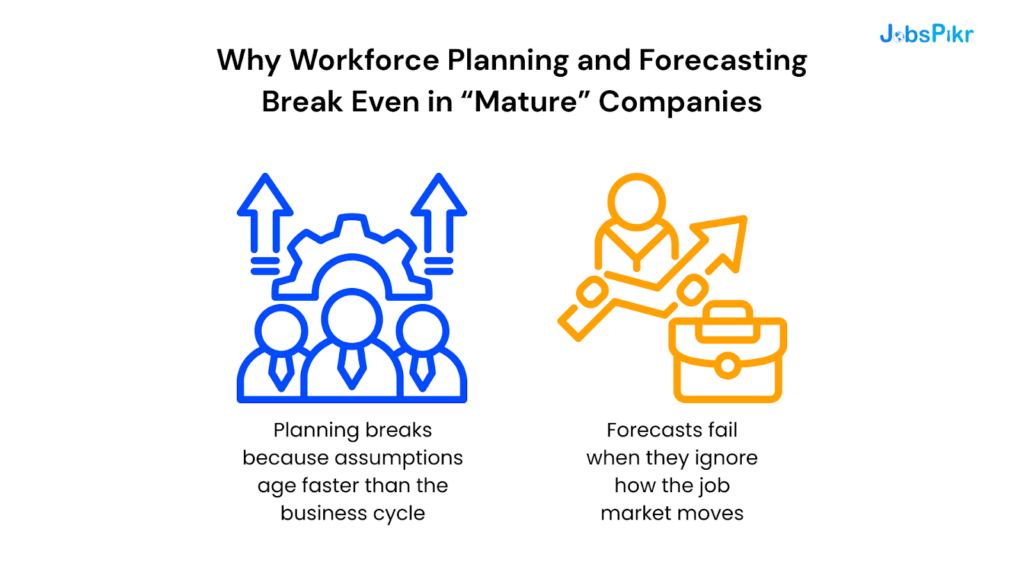
Planning breaks because assumptions age faster than the business cycle
Workforce planning assumes a level of stability that no longer exists. Roles evolve faster than approval cycles. Skills that looked “nice to have” during planning become mandatory by the time hiring starts. New technologies reshape job descriptions mid-quarter.
By the time a workforce plan gets signed off, the assumptions behind it are already outdated. This is why hiring managers keep coming back asking for changes. They are reacting to the market, even if the plan cannot.
Forecasts fail when they ignore how the job market moves
Most workforce forecasting models rely on internal signals. Historical hiring. Past attrition. Internal growth targets. These are useful, but they are incomplete.
The job market moves in waves. Demand spikes for certain roles because of regulation, funding cycles, or technology shifts. Entire skill clusters heat up or cool down within months. When forecasts ignore these external movements, they look precise but behave poorly in reality.
This is why teams often hit “unexpected” hiring delays or cost overruns that were, in fact, predictable from job market data.
The real issue is not lack of data; it is lack of decision-grade signals
Many organizations already have dashboards full of workforce analytics. What they lack is clarity.
Workforce planning and forecasting need signals that help leaders answer uncomfortable questions. Is this role hard to hire right now, or are we just slow? Are we late to a skill trend, or early? Is this location a smart bet, or just familiar?
Without external labor market intelligence, these questions turn into debates. With it, they become decisions.
If Your Workforce Plan Keeps Getting Rewritten, Start With These Root Problems
If your workforce planning and forecasting doc gets reopened every few weeks, it is not because your team is careless. It is because the plan was built on inputs that go stale fast, and the market keeps proving it.
Most teams run into the same set of problems. They just show up with different labels depending on who is complaining.
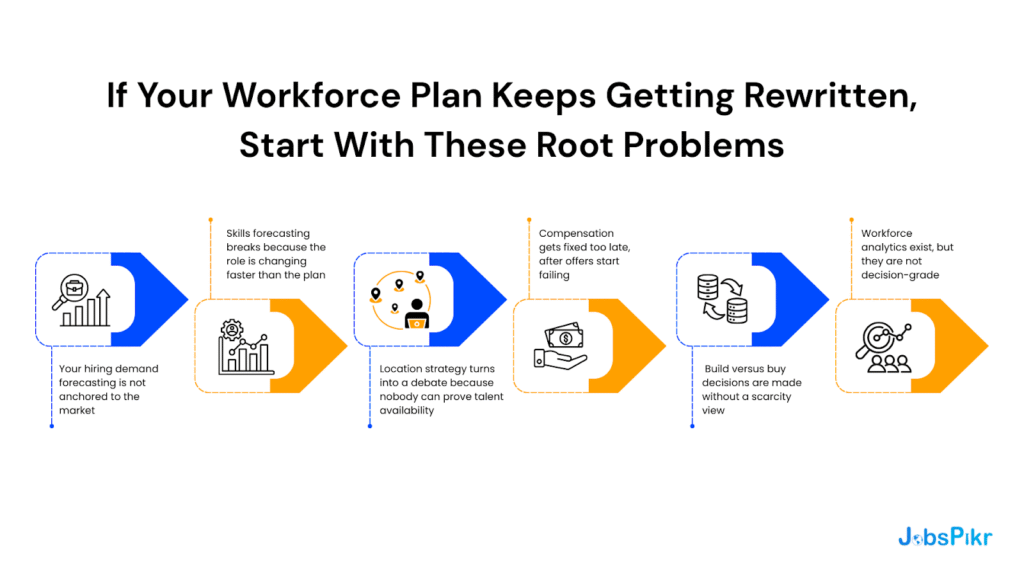
Root problem 1: Your hiring demand forecasting is not anchored to the market
This is the classic one. A leader says, “We need 40 hires.” Another leader says, “Make it 25.” Recruiting says, “The market is brutal.” Finance says, “Costs are up.”
Notice what is missing: nobody can answer a basic question with confidence, “Is demand for these roles rising, falling, or flat in the market right now?”
When workforce planning and forecasting rely only on internal plans and last year’s hiring, demand becomes a negotiation. Job posting data gives you a market baseline so you can pressure-test the number before it becomes a budget line item.
Root problem 2: Skills forecasting breaks because the role is changing faster than the plan
A workforce planning strategy often assumes roles stay stable for a year. In practice, hiring managers rewrite requirements mid-cycle because the job has moved.
This is how you end up hiring for “Data Analyst” but screening for “SQL plus Python plus BI plus stakeholder management plus GenAI tooling.” The title stayed the same. The skill bundle did not.
Skills forecasting should not be a once-a-year taxonomy refresh. It should track what skills are showing up in job postings across your peer set, and how quickly those requirements are changing. Otherwise, you plan for the role you think you have, not the one the market is already hiring for.
Root problem 3: Location strategy turns into a debate because nobody can prove talent availability
Location discussions are where workforce planning meetings go to die.
One side argues for a new city because “talent is cheaper.” Another side argues against it because “we tried it before.” Remote gets proposed, then someone raises concerns about productivity or culture.
All of this happens when talent availability is vague. If you cannot quantify supply and competition by location, location strategy becomes opinion-based. External labor market intelligence helps because you can see where roles are concentrated, where competition is dense, and where demand is overheating.
Root problem 4: Compensation gets fixed too late, after offers start failing
Compensation conversations usually start after pain shows up. Offers get rejected. Time-to-fill stretches. Recruiters say candidates are quoting higher numbers.
At that point, you are not planning. You are patching.
Workforce planning and forecasting improve when you have early signals that compensation pressure is building for specific roles and regions. Job market signals can serve as early context, especially when you look at how peers are leveling roles and how they are positioning seniority for similar titles.
Root problem 5: Build versus buy decisions are made without a scarcity view
This is the decision that quietly drives cost and timelines.
Should you train internal teams or hire from outside? Most companies answer based on budget, leadership preference, or urgency. The missing input is scarcity.
If a skill cluster is getting crowded fast, hiring it will take longer and cost more. If it is becoming more common, hiring may be feasible. Without that scarcity view, your workforce planning strategy can look sensible and still fail in execution.
Root problem 6: Workforce analytics exist, but they are not decision-grade
A lot of workforce analytics tell you what happened. Attrition by quarter. Headcount by team. Hiring funnel conversion.
Useful, yes. But planning needs more than history. It needs decision support.
A workforce plan needs answers like: which roles are likely to slip, which skills are heating up, which locations are saturated, and whether your hiring targets match reality. That requires a workforce intelligence layer, not just internal reporting.
Plan Workforce Decisions With Market Reality
See how real-time labor market intelligence helps you make workforce planning and forecasting decisions that hold up when hiring starts.
A Practical Workforce Planning Strategy That Actually Holds Up
Once you strip away the noise, workforce planning and forecasting come down to one thing: making fewer fragile assumptions.
A plan breaks when it depends on too many “ifs.” If hiring demand stays stable. If skills do not shift. If one location keeps working. If competitors do not move aggressively. Real-world planning needs a structure that expects change and absorbs it.
This is where a problem-solving approach to workforce planning starts to look different from traditional models.
Planning around signals, not static numbers
Instead of locking a single headcount number for the year, stronger workforce planning strategies anchor decisions to signals.
Signals answer questions like: Is demand for this role rising faster than last quarter? Are competitors expanding or pulling back? Is the skill mix changing, or just the volume? These signals come from the job market, not from last year’s org chart.
When workforce planning and forecasting are tied to signals, teams stop defending fixed numbers and start revisiting assumptions with evidence.
Forecasting with ranges and scenarios, not single-point targets
One of the biggest mistakes in workforce forecasting is treating it like a prediction exercise. The market does not reward accuracy on a spreadsheet. It rewards preparedness.
Instead of asking “How many people will we hire?”, better planning asks, “What happens if demand spikes by 20%?” or “What breaks if hiring slows in this function?” Scenario-based forecasting allows teams to move faster when conditions change because the thinking has already been done.
Labor market intelligence makes this possible by showing how volatile or stable demand really is for each role family.
Separating planning decisions from execution noise
Recruiting feedback, hiring manager urgency, and short-term delivery pressure all matter, but they should not constantly rewrite the plan.
A strong workforce planning strategy creates a buffer between planning and execution. Planning sets thresholds and guardrails. Execution operates within them.
This is where workforce intelligence plays a quiet but important role. By grounding plans in external labor market intelligence, teams can distinguish between a real market shift and temporary execution friction.
How Hiring Demand Forecasting Works When You Stop Guessing
Here’s what hiring demand forecasting looks like in a lot of companies.
You start with a business plan. Someone converts it into headcount. The number gets negotiated in a room. Then recruiting is asked to “go make it happen.”
Three weeks later, reality shows up.
The pipeline is thin. Candidates are expensive. Hiring managers complain they are not seeing the right profiles. The plan gets adjusted, and everyone pretends it was always the plan.
The fix is not “work harder.” The fix is building workforce planning and forecasting on inputs that reflect the market you are hiring in.
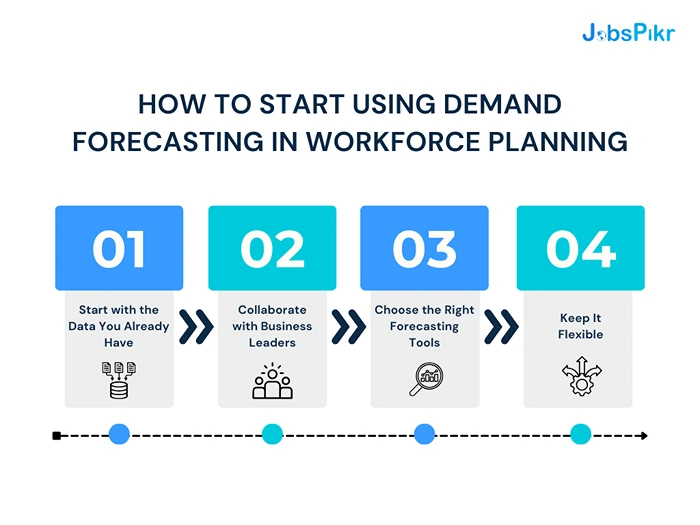
Job postings are a demand signal, not just noise
If ten companies in your space suddenly post the same role in the same region, that is not random. It is demand entering the market. You will feel it in response rates, salary expectations, and time-to-fill, whether you like it or not.
Most teams only notice this once recruiters start escalating. But job posting data lets you see the demand wave earlier, before it becomes a delivery problem.
The point is not to obsess over every posting. The point is to track direction. Is demand for this role family building or cooling? Is it concentrated in one metro or spreading? Are competitors expanding headcount or just replacing attrition? Those are forecasting inputs. They change how aggressive your plan should be.
Demand needs to be forecasted in segments, not as one big number
“We need 100 hires” is not a forecast. It is a headline.
Workforce forecasting becomes useful when you break demand into buckets that behave differently. Senior roles do not move like junior roles. Niche roles do not move like broad roles. Location plays a bigger role than most teams admit.
When you forecast demand by role family, level, and location, you stop getting blindsided by the one segment that is overheating. This is also what makes workforce planning conversations easier. You can be precise about what is risky and what is not, instead of arguing about the entire plan.
Competitor hiring tells you what pressure you are about to face
This is the part teams often avoid because it makes planning uncomfortable.
If your closest competitors are increasing postings for a role family you rely on, your hiring plan just got harder. Period. Even if your internal data looks stable.
Competitor job posting patterns are not about copying them. They are about understanding the environment your workforce planning strategy will operate in. If competitors are pulling back, you may find talent more available. If they are ramping up, you may need to adjust timelines, compensation bands, or location choices before you waste months chasing the wrong plan.
Where JobsPikr fits in hiring demand forecasting
JobsPikr gives workforce planning teams access to structured job market data that makes demand visible by role, location, and company. Instead of waiting for recruiting pain to surface, you can see demand shifts early, validate headcount assumptions, and forecast with fewer surprises.
Plan Workforce Decisions With Market Reality
See how real-time labor market intelligence helps you make workforce planning and forecasting decisions that hold up when hiring starts.
How Skills Forecasting Works When Job Titles Lie to You
Skills forecasting gets messy because job titles are a distraction.
“Data Analyst” can mean three different jobs across three teams. “Product Manager” can quietly turn into “AI PM” without anyone changing the title. Then your workforce planning and forecasting model says you are hiring for Role A, but your hiring managers are screening for Role B.
That gap is why skills forecasting feels frustrating in real life. You are not forecasting skills in a stable role. You are trying to keep up with a role that is changing while everyone pretends it is the same job.
Skill drift is usually the first thing that breaks your plan
You see it when the same role keeps getting rejected for “missing basics.” The role gets reopened. The requirements expand. Someone adds a new tool, a new framework, a new expectation. Recruiters start hearing “this is a tougher profile than we thought.”
That is not bad recruiting. That is the market redefining what “good” looks like for that role, and your internal definition lagging behind.
If your workforce planning strategy does not catch skill drift early, you end up forecasting a headcount number for a role that no longer exists in the same form.
Skills forecasting works better when you focus on bundles, not individual skills
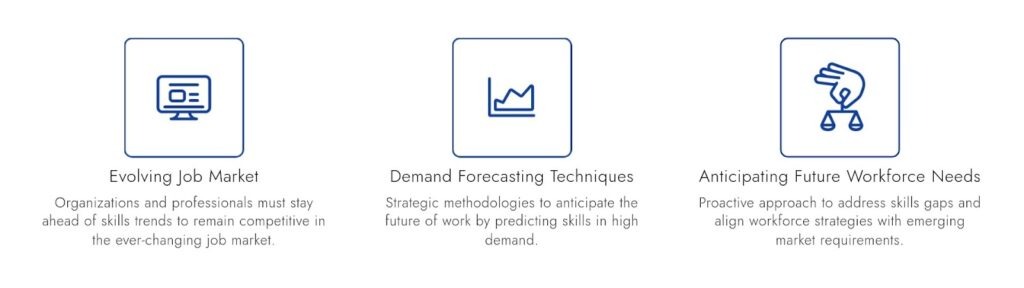
Most teams try to forecast skills like a checklist. That becomes unmanageable fast and it does not match how hiring works.
The market tends to hire bundles. In practice, “SQL” is rarely the hire. It is “SQL plus BI plus stakeholder management.” “Python” is not the hire. It is “Python plus pipelines plus cloud tooling.” The bundle is what defines difficulty, pay pressure, and time-to-fill.
So the job of skills forecasting is to track which bundles are becoming normal for a role family, and which bundles are fading. When you do that, workforce planning and forecasting becomes clearer because you are forecasting the actual hiring requirement, not a simplified label.
The easiest way to spot bundle shifts is to watch what keeps getting added, and what stops being mentioned
You do not need a fancy model to see this. You need a consistent view of job descriptions over time.
When a skill appears occasionally, it is usually a preference. When it appears in most postings for the same role family, it is turning into table stakes. When new skills start appearing alongside old ones, the market is often raising the bar or merging responsibilities.
These shifts matter because they change the economics of the plan. A role that looked hireable in one cycle becomes a “90-day role” in the next. Not because your team got worse, but because the market moved.
Once you see the shift, workforce planning becomes a trade-off decision
This is where skills forecasting becomes useful, not academic.
If a bundle is scarce and expensive, you may need to build it through internal mobility or reskilling. If it is common but highly competitive, you may still buy, but you change location strategy or adjust leveling. If the bundle is actually two jobs smashed into one, the right move is redesigning the role, not asking recruiting to find a unicorn.
Skills forecasting is valuable when it helps you make these calls earlier, before hiring stalls and everyone starts improvising.
How JobsPikr supports skills forecasting inside workforce planning and forecasting
JobsPikr helps you translate job market demand into structured skill signals at scale, by role family, location, and industry. That gives your workforce planning team a current view of how roles are being defined in the market, which skill bundles are rising, and how fast requirements are changing.
The practical outcome is that your workforce planning and forecasting stops relying on static skill lists. You can plan against what the market is actually asking for, and make build versus buy versus redesign decisions with fewer surprises.
How Location Strategy Breaks Workforce Plans, and How to Fix It
Location decisions are where workforce planning and forecasting quietly go off the rails.
Not because teams do not think about location, but because they think about it too loosely. A city gets labeled “good talent.” Another is dismissed as “too competitive.” Remote gets treated as a policy choice instead of a labor market lever. None of this is grounded enough to survive contact with real hiring.
The result is predictable. Roles stay open longer in some locations. Costs creep up in others. Leadership starts asking why hiring is slower than planned, even though the plan never accounted for location pressure in the first place.
Most location strategies are based on familiarity, not availability
A lot of location decisions come down to comfort. Cities where you have hired before feel safer. New markets feel risky. So teams default to what they know, even when the market has changed.
The problem is that talent availability is not static. Cities that worked well two years ago can become saturated quickly if competitors pile in. Other regions quietly build strong talent pools but never make it into planning conversations because no one has hired there before.
Workforce planning and forecasting improve when location strategy is treated as a market question, not an organizational habit.
Competition matters as much as supply, but it is rarely measured
Teams often talk about “talent supply” without talking about competition. A city can have a large talent pool and still be a bad choice if everyone else is hiring from it at the same time.
This is where location strategy usually fails. Planning assumes availability based on headcount estimates or anecdotal recruiter input, but ignores how many companies are actively competing for the same profiles.
Labor market intelligence changes this by showing both sides of the equation. How many relevant professionals are in a region, and how many roles are being posted for them right now. Workforce planning becomes more realistic when both numbers are visible.
Remote and hybrid roles change the equation, but not automatically
Remote work is often positioned as a silver bullet for workforce planning. In reality, it is just another lever, and it needs to be used deliberately.
Remote roles expand reach, but they also increase competition. Hybrid roles can widen the funnel, but only if location expectations align with where talent actually lives. Treating remote as a blanket solution without market data often leads to slower hiring, not faster.
Workforce planning and forecasting work better when remote, hybrid, and onsite roles are chosen based on demand patterns and availability, not policy defaults.
Location strategy works when it is built on rules, not exceptions
The most effective teams do not debate locations role by role. They define rules.
For example, certain role families may only open in markets where supply exceeds demand by a clear margin. Others may require at least two viable location options to reduce risk. Some roles may default to remote unless competition crosses a defined threshold.
These rules only work when they are backed by labor market intelligence. Otherwise, they become just another set of opinions.
How JobsPikr supports location decisions in workforce planning and forecasting
JobsPikr helps planning teams see how roles, skills, and competition are distributed across locations in real time. Instead of guessing where talent is “available,” teams can compare markets, identify saturation early, and choose locations that give hiring plans a real chance of success.
The outcome is not perfect forecasts. It is fewer surprises. Location stops being the reason workforce plans fail halfway through the year.
Plan Workforce Decisions With Market Reality
See how real-time labor market intelligence helps you make workforce planning and forecasting decisions that hold up when hiring starts.
Why Compensation and Build-Versus-Buy Decisions Quietly Break Workforce Plans
This is the part of workforce planning and forecasting that usually gets addressed too late.
The plan looks fine until offers start getting declined. Recruiters flag that candidates are quoting numbers outside the approved band. Hiring managers say, “We need someone stronger.” Finance asks why cost per hire is climbing. At that point, everyone agrees something is off, but changing course feels expensive and political.
The issue is not that compensation or build-versus-buy decisions were ignored. It is that they were made without seeing market pressure early enough.
Compensation pressure does not arrive suddenly, it builds quietly
Most organizations discover compensation problems only when hiring slows down. By then, the market has already moved.
Pay expectations shift because demand shifts. When more companies compete for the same roles or skill bundles, offers go up, even if your internal ranges have not changed. Recruiter feedback helps, but it is a lagging signal. It tells you what already failed, not what is about to.
Workforce planning and forecasting improve when compensation is treated as a risk factor, not a fixed input. Market signals from job postings help planning teams see when roles are being leveled higher, when seniority expectations are creeping up, and when certain locations are becoming more expensive faster than expected.
This does not replace salary benchmarking. It gives you earlier context, so you are not reacting after the plan has already broken.
Build-versus-buy decisions fail when scarcity is invisible
One of the hardest calls in workforce planning strategy is deciding whether to hire skills from the market or develop them internally.
In practice, these decisions are often made on instinct. “This will be hard to hire.” “We should train for this.” “Let’s just hire senior talent.” The missing piece is a shared view of scarcity.
Scarcity shows up in the market before it shows up in your pipeline. When job postings for a skill cluster increase faster than supply, time-to-fill stretches and costs rise. When postings stabilize or decline, hiring becomes easier.
Labor market intelligence gives planning teams a way to see scarcity before committing. That makes build-versus-buy decisions less emotional and more grounded.
This table shows how labor market signals should influence build vs buy decisions in workforce planning and forecasting.
| Decision Signal | What It Looks Like in the Job Market | What It Means for Workforce Planning | Smarter Choice |
| High posting volume, rising fast | Many companies posting the same role or skill bundle within a short time window | Demand is accelerating and competition will intensify quickly | Buy early or redesign role before scarcity worsens |
| Stable postings, wide geographic spread | Roles posted consistently across multiple regions | Talent exists, but is evenly competed for | Buy with location flexibility or hybrid strategy |
| Low posting volume, niche skill mentions | Few postings, highly specialized requirements | Talent is scarce and slow to hire | Build internally if timelines allow |
| Skill appears increasingly bundled | New skills consistently added to existing role descriptions | Role complexity is increasing beyond original scope | Redesign role or split responsibilities |
| Declining postings for a skill | Fewer companies advertising the skill over time | Market demand is cooling | Build selectively or redeploy internally |
| Postings cluster in specific companies | A small set of competitors dominate hiring | Competitive pressure is concentrated | Avoid reactive buying, reassess need or timing |
Planning breaks when compensation and skill decisions are disconnected
Compensation pressure and skill scarcity are not separate problems. They are linked.
When a role quietly absorbs new skills, compensation expectations follow. When competition increases in a location, both pay and time-to-fill shift. If workforce planning treats these as isolated topics, plans become fragile.
Stronger workforce planning and forecasting connect these signals. Skill bundles inform comp risk. Location strategy informs pay variance. Demand trends inform whether building internally is realistic within timelines.
When these connections are visible, planning stops being reactive.
How JobsPikr supports these decisions without replacing existing systems
JobsPikr provides labor market intelligence that helps planning teams see pressure points early. By tracking job posting trends, role definitions, and competitive intensity, teams can identify where compensation is likely to move and where hiring will become harder.
This does not override your comp tools or learning programs. It gives workforce planning leaders the context they need to decide when to stick to the plan, when to adjust, and when to change the approach entirely.
How JobsPikr Becomes the Workforce Intelligence Layer That Holds the Plan Together
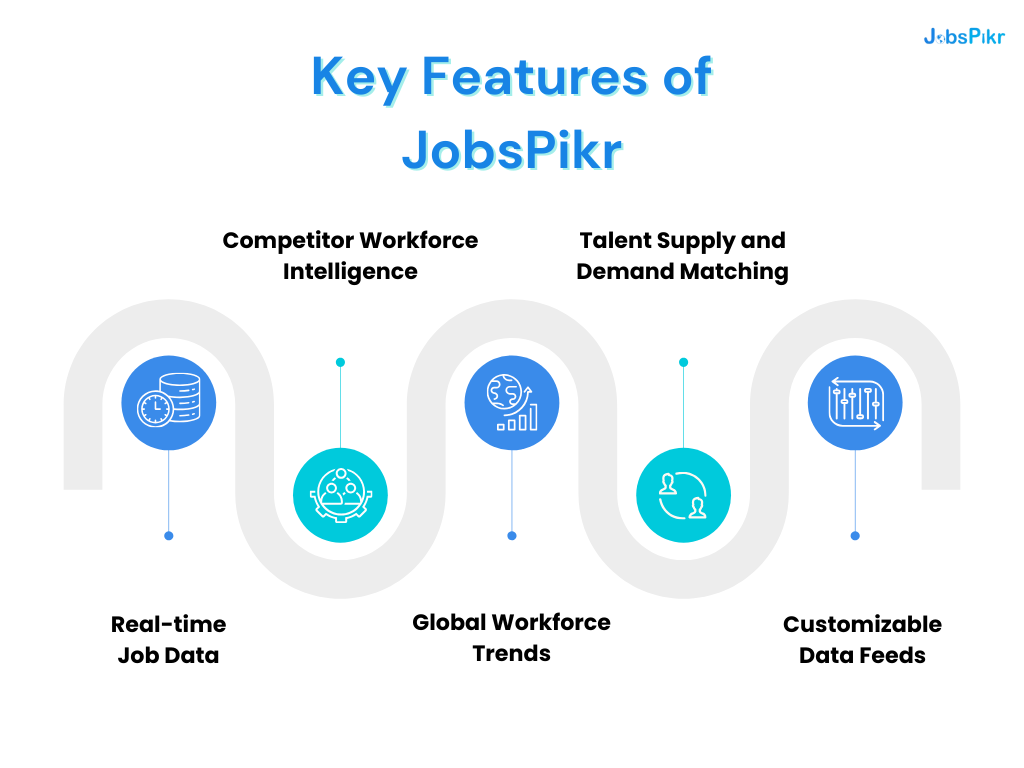
Up to this point, everything we have talked about has one common theme: workforce planning and forecasting break when decisions are made without market context.
This is the gap JobsPikr is designed to fill. Not as another dashboard, and not as a replacement for your HR systems, but as the layer that connects external labor market movement to internal planning decisions.
What most workforce planning stacks are missing
Most organizations already have the basics covered. HRIS for headcount and attrition. ATS data for hiring flow. Finance systems for cost control. People analytics for reporting.
What is missing is a continuous view of the market your workforce plan operates in.
Without that layer, planning teams are forced to react. Recruiter feedback becomes the earliest warning system. Offer rejections become the signal that something changed. Location issues surface only after hiring slows down.
JobsPikr fills this blind spot by turning job market activity into structured workforce intelligence that planning teams can use.
How JobsPikr fits into workforce planning and forecasting without disrupting existing systems
JobsPikr does not sit “on top” of your HR tools. It sits alongside them.
It ingests job posting data at scale and organizes it into planning-ready signals. Hiring demand by role and region. Skill requirements as they appear in the market. Changes in role definitions over time. Competitive pressure across locations.
These signals do not replace your internal data. They contextualize it.
When your internal plan says you need to hire, JobsPikr helps answer whether the market agrees. When skills requirements start drifting, JobsPikr surfaces that shift before it becomes a hiring problem. When location strategy needs a rethink, JobsPikr shows where supply and competition sit.
Turning raw job data into decision inputs, not noise
Raw job postings are messy. Titles vary. Skills are inconsistently named. Locations are vague. On their own, they are not planning-grade inputs.
This is where JobsPikr does the heavy lifting.
Job data is normalized across titles, skills, companies, and geographies so trends can be compared reliably. Role families can be tracked over time. Skill bundles can be observed as they evolve. Demand can be segmented by seniority and location.
The output is not a data dump. It is a set of signals that planning teams can use to stress-test assumptions and make calls earlier.
How workforce planning teams use JobsPikr in practice
In practice, JobsPikr becomes part of the planning rhythm.
Planning teams use it to validate hiring demand before headcount is approved. To flag roles where skills are shifting faster than internal frameworks. To assess whether a location is becoming too competitive to sustain planned hiring volumes. To spot early signs of compensation pressure before offers start failing.
The result is not perfect forecasts. It is fewer surprises.
Workforce planning and forecasting become less about defending a static plan and more about managing change with evidence. That is the difference between planning that looks good in a deck and planning that survives the quarter.
Plan Workforce Decisions With Market Reality
See how real-time labor market intelligence helps you make workforce planning and forecasting decisions that hold up when hiring starts.
What Problem-Solving Workforce Planning Looks Like Across Teams
One reason workforce planning and forecasting feel heavy is that everyone looks at the plan from a different angle. Workforce planning leaders think in scenarios. HR strategy heads think in trade-offs. Talent intelligence teams think in signals. People analytics leaders think in data quality.
When these views are disconnected, planning becomes slow and political. When they are aligned around the same workforce intelligence, planning becomes practical.
Here is how different teams actually use workforce planning and forecasting when it is grounded in labor market intelligence.
How workforce planning leaders use market signals to lock plans earlier
Workforce planning leaders are usually responsible for turning business growth targets into hiring plans that can survive scrutiny. Their biggest risk is approving a plan that looks reasonable in January and collapses by April.
Market-backed hiring demand forecasting changes that dynamic. Instead of relying only on historical hiring or leadership expectations, planning leaders can validate assumptions against external demand. If demand for a role family is accelerating faster than expected, they can flag risk early. If demand is cooling, they can defend slower hiring without looking conservative.
This allows plans to be locked earlier, with clear guardrails, rather than constantly renegotiated mid-cycle.
How HR strategy heads connect workforce plans to long-term capability building
HR strategy leaders care less about this quarter’s hires and more about where the organization is headed. Their challenge is knowing which capabilities to invest in before gaps become visible.
Skills forecasting driven by job market data gives HR strategy teams an external reference point. They can see which skills are becoming standard expectations, which are turning into premium differentiators, and which are fading out. This helps them decide where to invest in reskilling, where to adjust role design, and where to rely on hiring.
Instead of reacting to hiring pain, HR strategy can proactively shape the workforce the business will need twelve to eighteen months out.
How talent intelligence teams move from reporting to influence
Talent intelligence teams often sit closest to labor market data, but struggle to influence decisions. Their insights arrive too late or are seen as “interesting” rather than actionable.
When workforce planning and forecasting explicitly depend on market signals, talent intelligence becomes decision-critical. These teams help define baselines for demand, identify competitive pressure points, and surface early warning signals that inform planning discussions.
Their role shifts from producing reports to shaping planning assumptions.
How people analytics leaders turn workforce analytics into planning inputs
People analytics teams are usually strong on internal data. Attrition trends, internal mobility, hiring efficiency. The missing link is external context.
By pairing internal workforce analytics with labor market intelligence, people analytics leaders can answer deeper questions. Is rising attrition linked to market demand? Are internal mobility bottlenecks aligned with external skill scarcity? Are hiring delays operational, or market-driven?
This connection turns analytics into planning support. Leaders stop asking for more dashboards and start asking better questions.
How to Get Started With Smarter Workforce Planning and Forecasting
Most teams already have a workforce planning process. The issue is that it runs on internal data and meetings, while the job market moves in the background. So the plan looks stable until hiring starts, and then it gets rewritten.
The goal in the first month is simple: keep your existing process, but stop making blind bets.
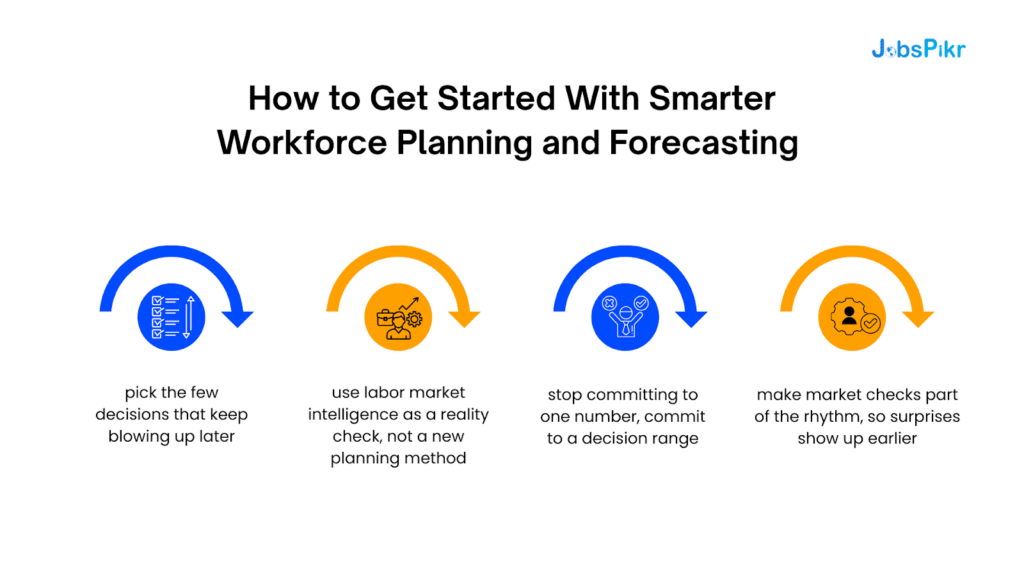
Step one: pick the few decisions that keep blowing up later
If you try to “improve workforce planning” in general, you will end up with more dashboards and the same outcomes.
Instead, start with the decisions that cause the most rework. In most companies, it is some mix of these.
You approve hiring for a role family and then it turns out the market is overheated. You pick a location and realize you are competing with ten companies for the same profiles. You plan for a role and the skill requirements shift before your first offer goes out.
Those are not separate problems. They are the same problem showing up in different ways: missing market context.
So in week one, your job is to decide which two or three decisions you want to make “decision-grade” first. Workforce planning and forecasting get easier once you stop trying to perfect everything at once.
Step two: use labor market intelligence as a reality check, not a new planning method
This is where teams mess up. They either ignore external labor market intelligence entirely, or they treat it like a separate project.
It should be neither.
The clean way to use external signals is as a check on assumptions. If you are planning to hire 30 roles in one region, you should know whether demand for those roles is rising or cooling in that region. If you are planning a new skill push, you should know whether the market is moving in the same direction, or whether the role is turning into something else.
You are not replacing internal HR data. You are adding context so workforce planning and forecasting stop being a debate and start being a set of defensible choices.
Step three: stop committing to one number, commit to a decision range
Single-number forecasts are the easiest thing to approve and the first thing to break.
If your workforce planning strategy is serious, it needs ranges. Not complicated models, just clear boundaries. What is the base plan, what is the stretch plan, and what changes if the market tightens.
This one change reduces drama later because you have already agreed on the “if this, then that” logic. It also makes leadership reviews easier, because you are not claiming certainty in a market that does not behave that way.
Step four: make market checks part of the rhythm, so surprises show up earlier
Most hiring surprises are not sudden. They build over weeks, then become urgent.
A lightweight monthly review is usually enough to catch the big shifts. Demand building up in a role family. Competitors piling into one location. Skills bundling into tougher requirements. Early signs that compensation pressure is rising.
This is how workforce planning and forecasting stop being a one-time event and become something that stays relevant through the quarter.
Where JobsPikr fits in the first 30 days
In the starting phase, JobsPikr is useful for one reason: it stops teams from planning in the dark.
It gives you a structured view of job market signals by role and location, so you can validate demand, spot skill drift, and pressure-test location assumptions before execution pain forces you to react.
That is the win. Fewer rewrites. Fewer surprises. And a workforce plan that does not collapse the moment hiring begins.
Workforce Planning and Forecasting Should Not Feel Like Guesswork
If workforce planning and forecasting keep turning into rework, the issue is rarely effort. It is visibility.
Internal HR data helps you understand your workforce. It does not tell you how the job market is shifting around you. That is why plans get challenged mid-quarter, why “easy” roles become hard, and why location and skills decisions end up driven by opinion.
The fix is not a bigger spreadsheet or a longer planning cycle. It is adding external labor market intelligence so your workforce planning strategy is grounded in what is happening, not what you hope will happen.
When you treat JobsPikr as the workforce intelligence layer, workforce planning becomes simpler in practice. You validate demand before you commit. You spot skill drift before it breaks hiring. You choose locations with evidence. You make build-versus-buy decisions with a clearer view of scarcity.
That is how you plan smarter and forecast with fewer surprises.
Plan Workforce Decisions With Market Reality
See how real-time labor market intelligence helps you make workforce planning and forecasting decisions that hold up when hiring starts.
FAQs
What is workforce planning and forecasting, and why do companies struggle with it?
Workforce planning and forecasting is deciding what roles you need, how many, and when. Companies struggle because plans are built on internal history, then the job market changes. Hiring slows, requirements shift, and the plan gets rewritten mid-quarter.
What is the difference between workforce planning and workforce forecasting?
Workforce planning is the longer-term design of your workforce, roles, skills, and structure. Workforce forecasting is the short-term reality check, how hiring demand, timelines, and constraints will play out in the market.
How does labor market intelligence improve workforce planning strategy?
It stops planning from being guesswork. You can validate role demand, see where competition is heating up, and pick locations based on availability, not opinions. It helps teams make fewer fragile assumptions up front.
What role does skills forecast play in strategic workforce planning?
It helps you keep up with how roles are evolving. Skills shift, bundle, and become table stakes without titles changing. Skills forecasting helps you decide earlier what to hire, what to build internally, and when a role needs redesign.
Who can support workforce planning and forecasting teams?
JobsPikr can. It provides workforce intelligence from job market data, demand trends, skill movement, and location pressure, so workforce planning and forecasting decisions are grounded in what is happening outside your company, not just what happened inside it.