- **TL;DR**
- What is a recruiting funnel?
- Make Your Recruiting Funnel Predictable, Not Reactive
- Recruitment Funnel Stages
- How can AI enhance the recruiting funnel?
- Make Your Recruiting Funnel Predictable, Not Reactive
- Predictive Talent Planning and Funnel Forecasting
- Skills-Based Hiring and the Evolution of Funnel Filtering
- Candidate Experience Analytics
- Building a Smarter Recruiting Funnel
- Make Your Recruiting Funnel Predictable, Not Reactive
- FAQs
**TL;DR**
The recruiting funnel is no longer a static hiring model, it’s a dynamic, data-driven system powered by AI and labor market intelligence. Today, organizations that optimize their recruiting funnel using predictive analytics, skills-based matching, automation, and real-time talent data are reducing time-to-hire, improving candidate experience, and making smarter workforce decisions. This guide explores how AI enhances every stage of the recruiting funnel, from visibility and sourcing to evaluation, background checks, and offer acceptance, plus new trends shaping modern hiring.
Recruitment today is not just about filling open roles. It’s about building a brand, understanding labor market shifts, engaging candidates intelligently, and making confident hiring decisions backed by data.
The traditional recruiting funnel has evolved dramatically over the past few years. In 2026, hiring teams are navigating remote-first talent pools, skills-based hiring models, competitive salary benchmarks, and rising candidate expectations. Artificial intelligence is no longer an experimental add-on—it is central to how organizations optimize their recruiting funnel.
When powered by AI and workforce intelligence platforms like JobsPikr, recruiters gain access to real-time labor market analytics, predictive hiring signals, and structured candidate data. Instead of relying on instinct, teams operate with clarity and measurable performance benchmarks.
This article redefines the modern recruiting funnel, breaks down its stages, and explains how AI enhances each layer to create faster, smarter, and more resilient hiring systems.
What is a recruiting funnel?
A recruitment funnel addresses the whole system and the recruiting process. People call it a funnel because you can divide the whole process into multiple parts. It’s like a pyramid where every level is reduced in itself and at the final level, we get only the best candidates from below the funnel.
At the top level of the funnel, you keep the potential candidates you source. At the base and tightest part is the fresh recruit. The middle part means the whole hiring process that filters out candidates who don’t exactly fit your specifications.
It additionally assists to track how applicants work through the recruitment funnel and gives you the best solutions to ensure a much smoother and more efficient recruitment process.
Make Your Recruiting Funnel Predictable, Not Reactive
Discover how real-time labor market analytics and workforce intelligence can strengthen every stage of your recruiting funnel.
Recruitment Funnel Stages
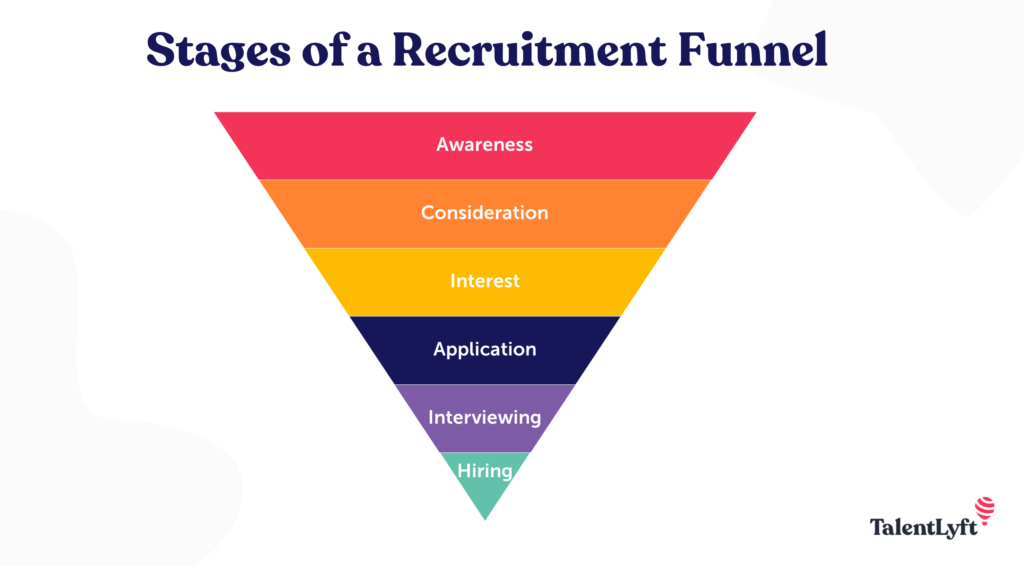
Image Source: TalentLyft
- Growing visibility: Showcasing your organization’s potential and how it can enhance the skill and knowledge of the candidates is the most essential aspect. It attracts the right candidate base to the job profile you’re offering. The best place to start with is a digital platform that gives you various tools to showcase your best and gives you a broader market to explore.
- Sourcing & Connecting: Once you capture the candidate’s attention, get rolling and approach them with your best offers. Effective engagement is what is needed in this stage. After you source the right database, proper screening can help you rule out the unfit applicants. After understanding the candidate you can strategize on the perfect approachable method.
- Interview & evaluation: Candidate experience, adequacy in the process, and speed are significant, so ensuring such aspects is a must to be in the game. Using AI technology comes in handy for a faster hiring process. Such technology enhances your organization’s credibility and smooth experience for the candidates.
- Background checks: Proper verification of the candidate is the final part to ensure their dedication and professional behavior. For instance, cross-check all the information from their resume or CVs. Asking candidates to give the reference person’s information and checking with them is essential to understand the candidate’s true background in the varied working environment.
- Offer the job: Finding the best fit is not the finish line of any recruitment funnel. The candidate actually needs to acknowledge the proposal for the cycle to complete. Only after the candidate accepts the offer, we can say that the recruitment process is complete.
How can AI enhance the recruiting funnel?
When AI integrates across every stage, the recruiting funnel becomes:
- Measurable
- Adaptive
- Predictable
- Scalable
Recruiters move from reactive hiring to proactive talent strategy.
Better Sourcing
AI-driven candidate sourcing will glance through data sets and job boards and will give you a sorted list of certified applicants from the bulk of data. In doing so, there are various AI-driven platforms like JobsPikr Insights, which are best for analyzing the latest market trends and giving recruiters an accurate picture of both the talent market and your database. Then there is the LinkedIn job wrapping service, which improves the recruiter’s efficiency, gives the maximum ROI with efficient service, regular job updates with sophisticated selection criteria, and lastly, 360-degree usage of the great platform is what you get.
Smooth evaluation process
To enlist the right ability, you want your hiring process to work like a buttery floor. At the point when certain regions begin to squeak, top applicants might get lost. To guarantee you’re getting the right candidates through the whole process and make it as effective as you can, you need to watch out for the higher perspective. AI can give you the right solution. All things considered, AI means statistical accurate data and some AI tools give you very specific data that help you get clear insight, and with that, you can plan your process in a much better way.
Improve Candidate Experience
Recruiters focus on better candidate experience for various reasons. Candidates are known to turn down offers because of awful experiences they may encounter. 72% of such candidates share their experiences with the broader population through various social platforms, ultimately ruining your company’s name. To further develop the candidate’s experience, ensure that your hiring process is simple and well thought through to avoid any mess-ups. Proper communication and regular updates with advanced AI tools like automated emails, candidate tracking systems, and chatbots on the website, should be implemented to enhance the candidate experience.
Better decision making
Artificial intelligence aids the pre-selection process by using predictive analysis to understand the candidate’s abilities for any job profile. This allows recruiters to go with data-driven decision-making instead of choices in light of what they think is right. AI can help organizations track down the best candidates by analyzing portfolios, screening them, and generating data-driven information that makes the complete process simpler and more accurate. With recruiters, the candidates can also use a matching calculation to look at soft and hard skills, job specifications, roles, training, experience, industry type, location, and so on in a fraction of seconds. This leads to better decision-making from both sides.
Make Your Recruiting Funnel Predictable, Not Reactive
Discover how real-time labor market analytics and workforce intelligence can strengthen every stage of your recruiting funnel.
Predictive Talent Planning and Funnel Forecasting
One of the biggest shifts is the integration of predictive workforce planning into the recruiting funnel.
Rather than waiting for vacancies, organizations now forecast:
- Skill shortages
- Attrition risks
- Future hiring surges
- Talent pipeline gaps
AI models analyze internal workforce data combined with external labor market signals. This transforms the recruiting funnel from a reactive system into a forward-looking strategy engine.
For example, if data suggests rising demand for AI engineers in a particular region, companies can strengthen their recruiting funnel months before competitors begin hiring.
This proactive model reduces hiring pressure and improves talent acquisition agility.
Skills-Based Hiring and the Evolution of Funnel Filtering
The traditional recruiting funnel often filtered candidates by degrees, job titles, or years of experience.
Today, organizations are shifting toward skills-based hiring frameworks.
AI systems now map:
- Transferable skills
- Skill adjacencies
- Emerging technical capabilities
- Certifications and micro-credentials
This evolution makes the recruiting funnel more inclusive and effective.
By focusing on skill clusters instead of rigid role histories, companies access broader and more diverse talent pools while maintaining quality standards.
Candidate Experience Analytics
Candidate experience is no longer measured through post-interview surveys alone.
Modern recruiting funnel optimization includes experience analytics such as:
- Response time tracking
- Interview delay analysis
- Communication frequency metrics
- Funnel drop-off diagnostics
If a spike in candidate withdrawal occurs at the interview stage, AI dashboards flag it immediately.
Recruiters can then investigate whether compensation gaps, slow feedback loops, or unclear job descriptions are impacting the recruiting funnel.
Data transparency improves employer brand perception and candidate trust.
Building a Smarter Recruiting Funnel
Being a recruiter, you have to ensure that there is an efficiency you maintain on every level of the recruiting funnel and how you provide the candidate with the best and quality experience. The funnel helps you define the required steps at every level, which initiate with the sourcing and ends with hiring the best candidate. The middle part always plays a vital role, as it will give you the top candidates from the complete database. Ensure that you are making the best of the data you’ve generated.
Make Your Recruiting Funnel Predictable, Not Reactive
Discover how real-time labor market analytics and workforce intelligence can strengthen every stage of your recruiting funnel.
FAQs
What is a recruiting funnel?
A recruiting funnel is a structured framework that represents the hiring process from initial candidate awareness to final job acceptance. It narrows a large talent pool into a selected hire through multiple filtering stages.
How does AI improve the recruiting funnel?
AI enhances the recruiting funnel by automating sourcing, standardizing screening, predicting candidate success, optimizing compensation decisions, and reducing hiring delays. It introduces measurable insights at every stage.
Why is candidate experience important in the recruiting funnel?
Poor communication, slow response times, and unclear expectations cause candidate drop-offs. Monitoring candidate experience metrics ensures smoother movement through the recruiting funnel and improves employer branding.
What metrics should be tracked in a recruiting funnel?
Key metrics include conversion rates between stages, time-to-hire, cost-per-hire, offer acceptance rates, and quality-of-hire indicators.
How does skills-based hiring impact the recruiting funnel?
Skills-based hiring broadens talent pools and improves matching accuracy. AI identifies transferable and adjacent skills, making the recruiting funnel more inclusive and efficient.