

- The Data-Driven Recruiting Playbook That Actually Works
- Why Most Recruiting Playbooks Fail Before the First Interview
- Your Competitors Are Not Waiting for Better Data. Neither Should You.
- What a Data-Driven Recruiting Playbook Actually Looks Like
- Stage 1: Build a Smarter Sourcing Strategy Using Job Posting Data
- Stage 2: Size Your Market and Calibrate Screening with Real Demand Signals
- Turn Market Intelligence Into Your Recruiting Advantage
- Stage 3: Build Competitive, Defensible Offers Using Real-Time Compensation Data
- Turn Market Intelligence Into Your Recruiting Advantage
- Stage 4: Monitor Competitor Hiring to Catch Talent Availability Windows
- How JobsPikr Fits Into Your Existing Recruiting Tech Stack to Make This Playbook Operational
- Your Recruiting Playbook Is Only as Good as the Data Behind It
- Turn Market Intelligence Into Your Recruiting Advantage
- Frequently Asked Questions About Data-Driven Recruiting
The Data-Driven Recruiting Playbook That Actually Works
Most recruiting teams have a process. What they don’t have is the right data to back it up. If your hiring decisions still rely on gut feel, last quarter’s spreadsheets, or anecdotal market knowledge, you’re not really running a data-driven recruiting strategy; you’re running a guess dressed up in a workflow.
This article walks through a four-stage recruiting playbook built on real workforce data and talent intelligence insights from JobsPikr. So every decision you make, from sourcing to offer, is grounded in what’s actually happening in the market right now.
Here’s what you’ll take away:
- Why most recruitment playbooks underperform and what’s missing from them
- How to use job posting data to build a sharper sourcing strategy, not just a longer candidate list
- What real-time demand signals tell you about screening and market sizing that your ATS never will
- How compensation data from live job postings helps you build offers that don’t fall apart at the finish line
- Why monitoring competitor hiring activity is one of the most underused moves in talent acquisition
A recruitment playbook without job data insights is just a checklist. With the right HR intelligence platform behind it, it becomes a competitive advantage, one that reduces time-to-hire, lowers acquisition costs, and helps your team make calls they can actually defend with data.
Why Most Recruiting Playbooks Fail Before the First Interview
Here is a question worth sitting with: if your recruiting team ran the same playbook this quarter that it ran two years ago, would anyone notice?
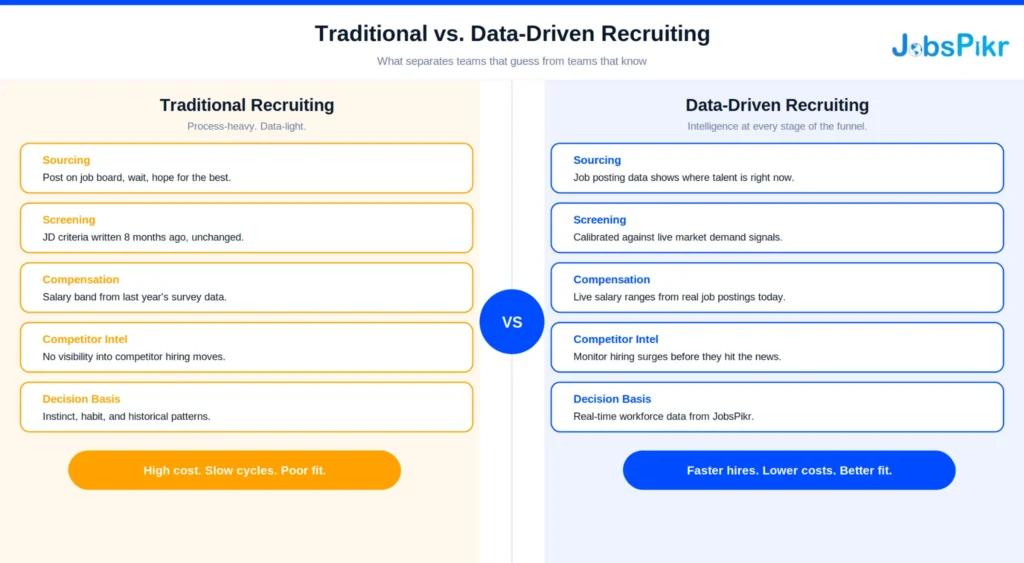
For many talent acquisition teams, the honest answer is no. The process looks structured. There are stages, scorecards, SLAs, and handoff checkpoints. But underneath all of that, the decisions are still being made on instinct, relationship bias, and outdated assumptions about where talent lives and what it costs to compete for it.
That is the core problem with most recruitment playbooks in use today. They are process-heavy but data-light. They tell your team what to do and when to do it, but they offer almost no guidance on what the market is actually doing while your req sits open.
And the market does not wait. According to SHRM’s 2025 Benchmarking Survey, both average cost-per-hire and time-to-hire have increased over the past three years, even as recruiting technology has grown more sophisticated. That is not a coincidence. It is what happens when teams invest in tools that automate the process without questioning whether the process itself is built on the right information.
Think about how most sourcing decisions actually get made. A recruiter pulls up a job board, searches a title, filters by location, and starts reaching out to whoever shows up. There is no real analysis of where the highest concentration of relevant talent is, which employers are actively releasing that talent into the market, or what the going rate looks like for the specific combination of skills on the job description. The recruiter is working hard, but they are essentially navigating without a map.
The same blind spots show up further down the funnel. Screening decisions get made against internal benchmarks that may have nothing to do with how the real-time market has shifted. Offers get built from salary bands that were last updated six months ago. And by the time a candidate declines or accepts a competing offer, nobody has the data to understand why it happened or how to avoid it next time.
According to SHRM’s 2025 Benchmarking Report, the average cost per hire for non-executive roles sits at $5,475, with executive hires costing nearly seven times more at $35,879. Those numbers reflect a direct recruiting spend only. Factor in the productivity loss from an open seat, the internal recruiter time spent on roles that close slowly, and the downstream cost of a bad hire, and the real number climbs considerably higher.
The point is not that recruiting is expensive. The point is that most of those costs are driven by uncertainty. Uncertainty about where to look, who to prioritize, what to pay, and when to move. A data-driven recruiting approach does not eliminate that uncertainty, but it replaces a significant part of it with real market signals.
That is what a recruitment playbook built on workforce data actually does. It does not just tell your team how to run a process. It tells your team what is happening in the talent market at every stage of that process, so decisions are faster, more defensible, and more likely to result in the right hire at the right cost.
In the sections that follow, we will walk through exactly how that works in practice, using JobsPikr’s talent intelligence capabilities as the engine behind each stage of the funnel.
Your Competitors Are Not Waiting for Better Data. Neither Should You.
Every day your recruiting strategy runs on assumptions is a day a better-informed competitor is pulling ahead in the same talent market.
What a Data-Driven Recruiting Playbook Actually Looks Like
Before we get into the individual stages, it helps to understand what we actually mean when we say “data-driven recruiting.” Because the phrase gets thrown around a lot, and most of the time it just means someone is tracking time-to-fill in a spreadsheet.
A real data-driven recruiting strategy means that at every stage of your hiring funnel, your team is making decisions based on what is happening in the external talent market right now, not just what happened inside your company last quarter. It means your sourcing strategy is shaped by where target talent is actually concentrated. It means your screening criteria are calibrated against live demand signals, not a job description someone wrote two years ago. It means your offers are built from real compensation data, not a salary band that has not been reviewed since your last comp cycle.
That is a meaningfully different way of running a recruiting function. And it requires a different kind of infrastructure to support it.
This is where JobsPikr comes in. JobsPikr is a job market intelligence platform that aggregates and structures job posting data at scale, across geographies, industries, and employer types. It gives talent acquisition teams access to real-time workforce data that most recruiting functions simply do not have: where demand is surging, what skills employers are actually requiring, what compensation ranges are showing up in live postings, and which competitors are quietly ramping up their hiring.
The playbook we are laying out here is built around four stages of the recruiting funnel, and each stage maps directly to a specific JobsPikr capability.
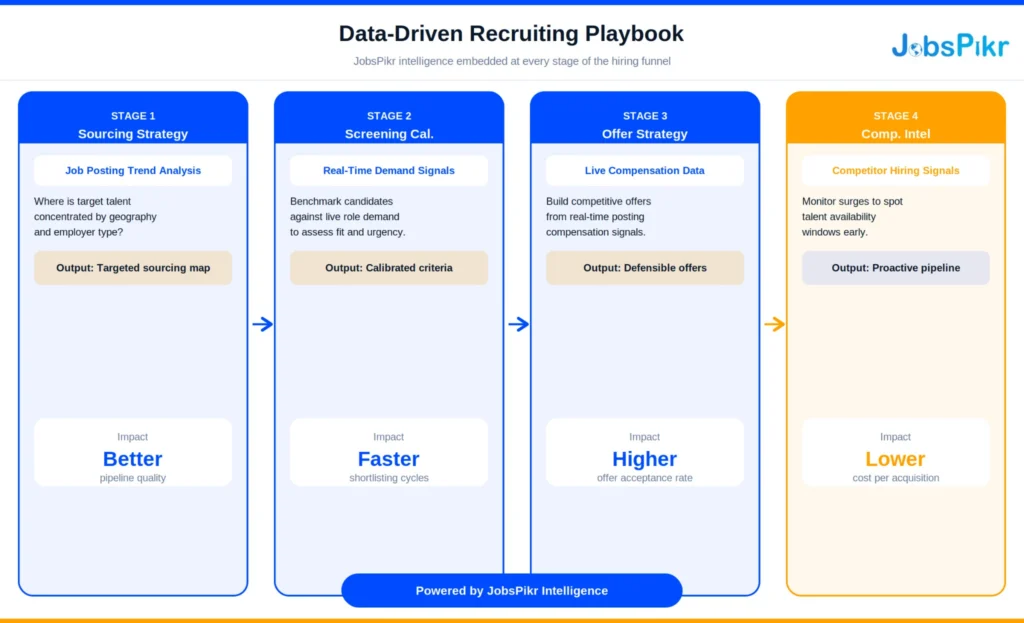
Stage 1 covers sourcing strategy, where job posting trend data helps your team identify where target talent is concentrated by geography and employer type, before you spend a single outreach credit.
Stage 2 covers market sizing and screening calibration, where real-time role demand signals help your team assess candidate fit relative to what the broader market is asking for, not just what your internal JD says.
Stage 3 covers offer strategy, where compensation data pulled from live job postings gives your team the market grounding to build offers that are competitive, defensible, and far less likely to fall apart at the finish line.
Stage 4 covers competitive intelligence, where monitoring competitor hiring activity helps your team spot talent availability windows and act on them before the market catches up.
Each stage builds on the one before it. Together, they turn a standard recruitment playbook into something that actually reflects the market your candidates are living in. Here is a quick look at how JobsPikr approaches talent strategy in practice before we go stage by stage.
See how JobsPikr’s job data insights power smarter hiring decisions across the full recruiting funnel.
Stage 1: Build a Smarter Sourcing Strategy Using Job Posting Data
Most sourcing strategies start with a title and a location. A recruiter opens a search, types in “Senior Data Engineer,” picks a city, and starts working through whoever comes up. It is a reasonable place to start, but it is also where a lot of sourcing budgets quietly go to waste.
The problem is that title-and-location searches tell you nothing about the shape of the talent market you are stepping into. They do not tell you whether the city you are targeting actually has a deep bench of the profile you need, or whether that talent is heavily concentrated in the hands of two or three dominant employers who rarely let people go. They do not tell you which adjacent markets might have a stronger supply of the same skills at lower competition.
And they definitely do not tell you whether your job posting is going up at a moment of high demand saturation, where every other company in your space is fishing in the same small pond.
Where Most Sourcing Strategies Break Down
The gap is not effort. Most recruiting teams are working hard. The gap is market visibility. Without access to real-time workforce data, sourcing decisions get made on assumptions: where talent has historically been, which cities your team knows well, which job boards have worked before. None of that tells you what is actually happening in the market right now.
This is the problem JobsPikr’s job posting trend analysis is built to solve.
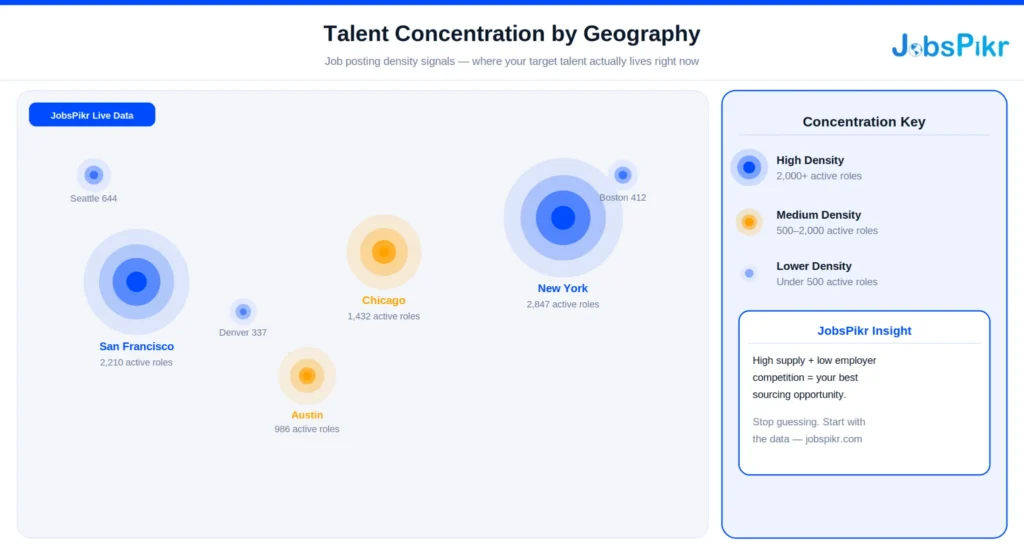
By aggregating job posting data across thousands of employers, geographies, and role categories in real time, JobsPikr gives your sourcing team a ground-level view of where target talent is actually concentrated. Not where you assume it is based on last year’s hiring, but where it demonstrably exists based on where employers are actively posting and where hiring activity is pulling that talent into the workforce.
What Your Sourcing Team Can Actually See
In practical terms, this means your team can answer questions that most recruiting functions cannot:
- Where is the deepest talent pool for this role type? JobsPikr’s job data insights show which metro areas carry the strongest supply for a given profile, so your team is targeting markets with real density rather than familiar ones.
- Which employer categories hold the most of this talent? If a significant concentration of the skills you need sits inside a handful of mid-sized companies in a specific region, that is not a coincidence to scroll past. That is a sourcing thesis your recruiters can build targeted outreach around.
- Where is supply strong but employer competition low? This is the signal most teams miss entirely. A market where your target profile is abundant but where fewer employers are actively competing for them is not just a sourcing opportunity. It is a cost efficiency opportunity too.
The Downstream Impact on Sourcing Efficiency
When your team knows where to look before they start looking, the whole sourcing function gets sharper. Fewer wasted outreach attempts. More relevant pipelines. Sourcing spend that is allocated against actual market data rather than educated guesswork.
The key shift is moving sourcing from a reactive activity, where you post and hope, into a proactive strategy grounded in real job data insights about where talent supply and employer demand actually intersect. That is what separates a sourcing function that fills pipelines from one that consistently fills roles.
Stage 2: Size Your Market and Calibrate Screening with Real Demand Signals
Once your sourcing strategy is grounded in real job data, the next question is: who among the candidates you are finding actually fits the market reality of this role right now?
That sounds like a screening question, and it is. But it is also a market sizing question, and most recruiting teams conflate the two in a way that creates problems further down the funnel.
Here is what that typically looks like in practice. A hiring manager writes a job description based on what they want in an ideal candidate. The recruiter screens against that description. Everyone who does not tick every box gets filtered out. The problem is that the job description was written in isolation, with no reference to what the external market actually looks like for this role. So your team ends up either screening too narrowly and missing strong candidates, or screening too broadly and wasting time on profiles that do not reflect what the market is actually producing.
Real-time demand signals from JobsPikr change that dynamic entirely.
Understanding What the Market Is Actually Asking For
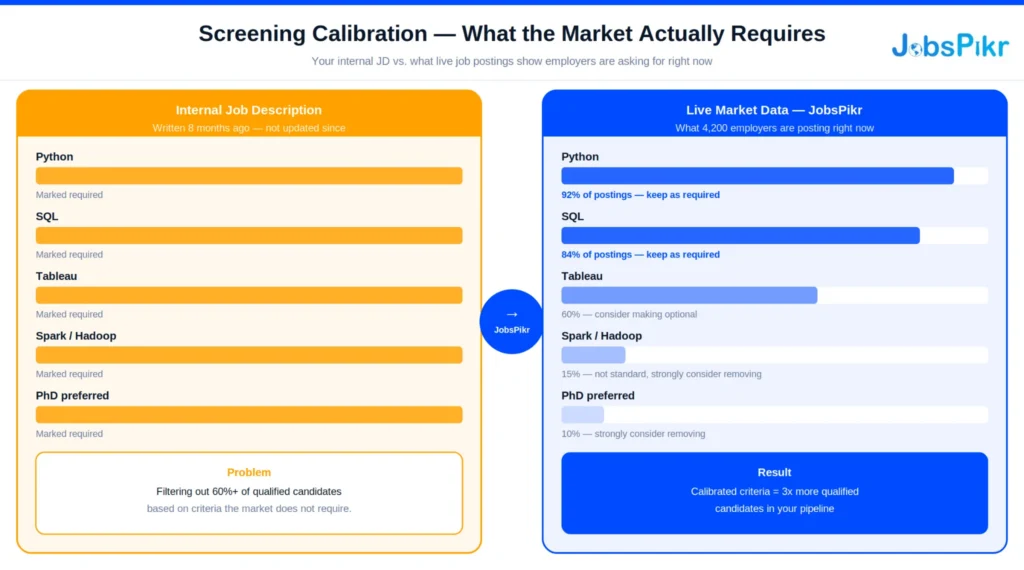
When you look at live job posting data for a specific role, you get a clear picture of what employers across the market are actually requiring, not what one hiring manager thinks the ideal candidate looks like. You can see which skills are appearing consistently across postings, which ones are becoming more or less common, and which requirements are genuinely table stakes versus nice-to-haves that only a handful of employers are asking for.
This is recruitment intelligence that most TA teams simply do not have access to. And it matters enormously for screening calibration.
If the market data shows that 80% of postings for a role require three specific technical skills, but your job description is filtering candidates out for not having a fourth skill that only 15% of employers are asking for, you now have a defensible case to take back to the hiring manager. You are not arguing on instinct. You are arguing with job data insights that reflect what the real talent market looks like.
Using Demand Signals to Assess Fit and Urgency
Beyond calibrating your screening criteria, real-time demand signals also help your team understand the urgency of a given hire in the market context. This is something standard ATS data cannot tell you.
JobsPikr’s workforce data allows your team to look at role demand trends over time. If postings for a specific profile have been rising sharply over the past 90 days across your target geographies, that tells you something important: the talent pool is being absorbed faster than it is being replenished. That is a signal to move quickly, compress your screening timeline where possible, and not let strong candidates sit in a holding pattern while a hiring manager takes two weeks to give feedback.
On the flip side, if demand for a role type is flat or declining, your team has more room to be selective and move at a measured pace without the risk of losing candidates to competing offers mid-process.
A Smarter Way to Benchmark Candidates
The practical output of all of this is a screening process that is calibrated against the real market, not just internal expectations. Your team can:
- Benchmark candidates against what the market is actually producing, so you are assessing fit relative to a realistic talent pool rather than a theoretical ideal.
- Adjust screening criteria based on live demand data, giving hiring managers the market context they need to make informed decisions about where to flex and where to hold firm.
- Prioritize pipeline velocity when demand signals indicate urgency, so your team is not caught flat-footed when a strong candidate goes off the market faster than expected.
This is what HR intelligence looks like when it is embedded into the screening stage rather than bolted on as an afterthought. It makes your process smarter, your decisions more defensible, and your conversations with hiring managers far more grounded in what is actually happening outside your four walls.
Turn Market Intelligence Into Your Recruiting Advantage
One session. Real data. Your roles, your markets, your team’s biggest hiring challenges.
Stage 3: Build Competitive, Defensible Offers Using Real-Time Compensation Data
Of all the stages where data-driven recruiting pays for itself most visibly, offer strategy is probably it. This is where the absence of good market data is most expensive, and where the consequences show up fastest.
Think about what typically happens when a recruiter builds an offer. They pull up an internal salary band, check a compensation survey that was published six to twelve months ago, maybe cross-reference a couple of data points from Glassdoor or Levels.fyi, and land on a number that feels reasonable. The hiring manager approves it. The offer goes out.
And then the candidate comes back and says they have another offer for significantly more. Or worse, they just decline without explaining why, and your team has no idea whether compensation was even the issue.
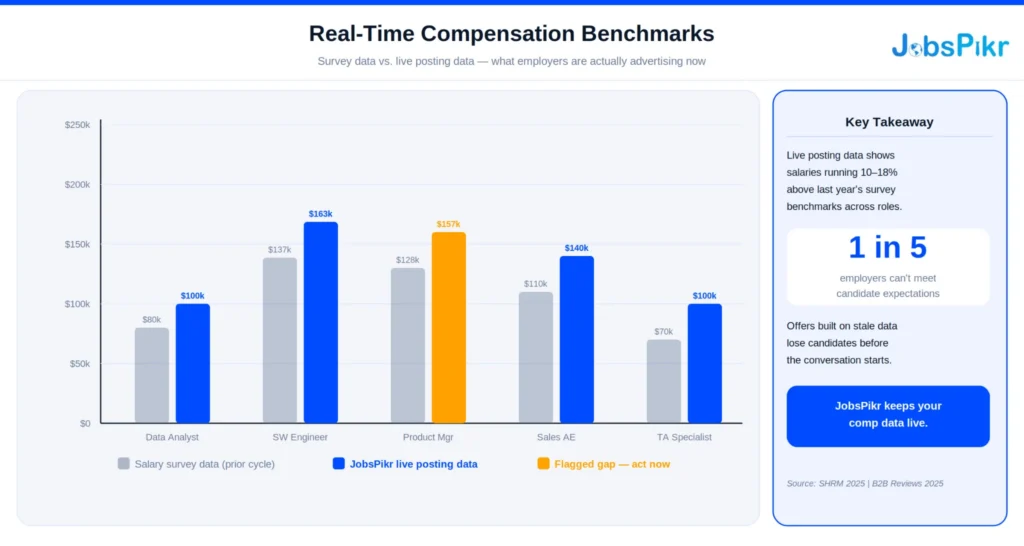
The problem is not that the recruiter did something wrong. The problem is that static compensation data, no matter how reputable the source, is always a lagging indicator. It tells you what the market looked like when the survey was conducted, not what employers in your space are actually posting right now for the specific combination of skills and experience on your offer letter.
Why Static Salary Bands Are Letting Your Offers Down
Compensation benchmarking has traditionally relied on annual or bi-annual surveys. Those surveys are useful for broad planning, but they have a fundamental limitation: by the time the data reaches your hands, it is already months old. In a market where compensation expectations for certain roles can shift meaningfully within a single quarter, that lag matters.
According to recruitment data compiled by B2B Reviews, salary competition remains a significant hurdle, with 20% of employers unable to meet candidate expectations during the hiring process. That gap between what employers offer and what candidates expect does not come from nowhere. It comes from offer strategies that are built on outdated market data while candidates are comparing those offers against current postings they can see in real time.
Your candidates are not working from last year’s salary survey. They are looking at live job postings right now, and they know exactly what the market is paying for their profile. If your offer does not reflect that reality, no amount of culture pitch or equity upside will reliably close the gap.
How JobsPikr Brings Compensation Data Into the Present
JobsPikr addresses this by pulling compensation signals directly from live job postings at scale. Rather than relying on survey data that was collected months ago, your team gets access to what employers are actually advertising right now for specific roles, skill combinations, seniority levels, and geographies.
This is a meaningfully different data source. Job postings are not self-reported compensation figures from employees or anonymized survey responses. They are active market signals from employers who are currently competing for the same talent you are. When a competitor posts a role with a compensation range, they are telling the market exactly what they are willing to pay. JobsPikr captures that signal and puts it in your hands before your offer goes out.
Building Offers That Hold Up at the Finish Line
In practical terms, this changes how your team approaches the offer stage in a few important ways:
- Your compensation ranges reflect current market reality, not a salary survey from the previous fiscal year. That makes your initial offer more likely to land in a range the candidate finds credible, which reduces the back-and-forth that extends time-to-hire and creates candidate anxiety.
- You can segment compensation data by geography, seniority, and skill set, so your offer for a senior backend engineer in Austin is not being benchmarked against a generalized national average that includes entry-level roles and unrelated specializations.
- You have the data to defend your offer to a hiring manager, which matters when you need to make the case for going above band for a high-priority role. “The market data from live postings shows this is where employers are currently competing” is a much stronger argument than “I think this candidate might have other options.”
- You can anticipate counteroffers before they happen, because you already know what competitors in your space are posting for equivalent roles. That gives your team the option to build a stronger initial offer rather than scrambling to revise after a candidate pushes back.
This is what it means to embed HR intelligence into the offer stage. It does not guarantee every offer closes, but it does mean that when an offer falls through, compensation data is far less likely to be the reason.
Turn Market Intelligence Into Your Recruiting Advantage
One session. Real data. Your roles, your markets, your team’s biggest hiring challenges.
Stage 4: Monitor Competitor Hiring to Catch Talent Availability Windows
There is a sourcing opportunity that most talent acquisition teams are sitting on without realizing it, and it has nothing to do with posting better job ads or optimizing your InMail response rate.
It is competitor hiring data. And when you know how to read it, it tells you exactly when to move.
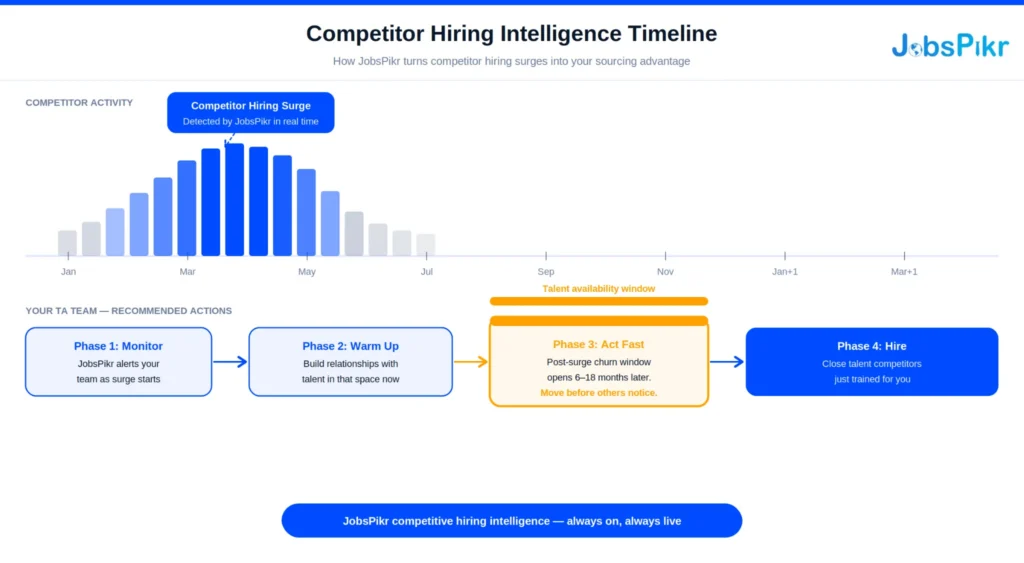
Here is the underlying logic. When a competitor goes on a significant hiring surge, a few things happen in sequence. They absorb a portion of the available talent pool in that space. They create internal pressure, new managers, new team structures, shifting priorities, and competing agendas. And somewhere between six and eighteen months later, a meaningful share of the people they hired during that surge start looking around. Either the role did not turn out to be what was advertised, the reorganization that followed the growth phase disrupted their team, or the promises made during the interview process did not materialize at the pace they expected.
That post-surge talent availability window is one of the most underused signals in recruiting. And it is almost impossible to act on without real-time workforce data showing you when the surge happened in the first place.
What Competitor Hiring Surges Actually Signal
JobsPikr’s job posting intelligence allows your team to monitor hiring activity across specific competitors or across a broader category of employers in your space, in real time. When a competitor starts posting aggressively for a specific role type or function, that pattern is visible in the data before it shows up anywhere else.
This gives your team two distinct advantages, depending on where you sit in the timeline.
The first advantage is immediate talent availability. When a large competitor announces layoffs or a hiring freeze, the talent that was either just hired or just let go does not disappear. It enters the market, often all at once, and it is highly concentrated in the exact profiles you are likely looking for. Teams that are watching competitor hiring signals through an HR intelligence platform like JobsPikr can move on that window within days rather than weeks. By the time most recruiting teams notice the news and spin up a sourcing push, the best candidates from that pool are already in late-stage conversations elsewhere.
The second advantage is a longer-range pipeline strategy. If you can see that a competitor has been ramping hiring aggressively in a particular function over the past quarter, you can start warming up relationships with talent in that space now, before the post-surge churn begins. You are not poaching. You are simply being present and visible to people who are likely to be open to a conversation in the not-too-distant future. That is just smart talent pipeline management, backed by job data insights rather than guesswork.
Turning Competitive Intelligence Into a Recruiting Calendar
One of the more practical applications of this capability is building what you might call a recruiting calendar around competitor hiring cycles. This is something very few TA teams do systematically, largely because they have not had access to the data needed to make it work.
With JobsPikr’s workforce data, your team can:
- Track hiring velocity by competitor and function, so you know which organizations are growing fast in areas that overlap with your talent needs and can anticipate when that growth might create downstream availability.
- Identify hiring pauses or pullbacks, which are often early indicators of internal restructuring that will eventually release talent into the market. A competitor that was posting 30 roles a month and suddenly drops to five is telling you something worth paying attention to.
- Map competitor hiring patterns against your own pipeline gaps, so your team is proactively sourcing against predicted availability rather than reactively scrambling when a req opens and the pipeline is empty.
The Bigger Picture on Competitive Talent Intelligence
Most recruiting teams think about competition in terms of offers. Who else is the candidate talking to? What are they offering? How do we counter?
That is the right question to ask at the offer stage. But competitive recruitment intelligence, used well, starts much earlier than that. It starts at the market monitoring stage, where understanding what your competitors are doing in the talent market gives your team a structural advantage that plays out across the entire funnel.
When you know a competitor is surging, you can prepare. When you know they are pulling back, you can pounce. And when you have that intelligence running continuously in the background through a platform like JobsPikr, it stops being a reactive capability and becomes a genuine strategic edge.
How JobsPikr Fits Into Your Existing Recruiting Tech Stack to Make This Playbook Operational
One of the most common objections talent acquisition leaders raise when evaluating any new data platform is a fair one: we already have tools. We have an ATS, a CRM, a sourcing platform, maybe a market intelligence add-on that came bundled with our job board contract. What does adding another layer actually solve?
It is a reasonable question, and the honest answer requires being clear about what JobsPikr is and what it is not.
JobsPikr is not a replacement for your ATS or your CRM. It does not manage candidate workflows, track application stages, or automate recruiter tasks. What it does is feed the decision layer that sits above all of those tools. It provides the external market context that your existing stack was never designed to generate on its own.
Think of it this way. Your ATS is excellent at telling you what is happening inside your hiring funnel. How many candidates are at each stage, how long they have been there, what your conversion rates look like from application to offer. That is internal data, and it is genuinely useful for managing process efficiency.
What your ATS cannot tell you is what is happening outside your funnel. Where the talent you need is concentrated right now. What competitors are paying for the same profiles. Which employers are releasing talent into the market. How demand for a specific skill set has shifted over the past 90 days. That is external market data, and it is exactly what JobsPikr is built to surface.
Where JobsPikr Connects in a Typical TA Tech Stack
The integration does not have to be complicated to be effective. Here is how JobsPikr typically sits alongside the tools most enterprise and growth-stage recruiting teams are already running:
- Alongside your ATS, JobsPikr provides the external demand and compensation context that helps your team calibrate job descriptions, screening criteria, and offer ranges before they ever enter the applicant tracking workflow. The two tools are complementary, not competitive.
- Alongside your sourcing platform, JobsPikr’s geographic and employer-level job posting data helps your team decide where to focus outreach before they start spending sourcing credits. Instead of running broad searches and hoping for the best, your sourcers are working from a market map that tells them where the density is.
- Alongside your compensation benchmarking tools, JobsPikr adds a live data layer that most traditional comp tools cannot provide. Annual or bi-annual survey data gives you a baseline. Real-time job posting compensation signals give you the current market. Used together, they give your team a much more complete picture when building and defending offers.
- Alongside your recruiting analytics and BI tools, JobsPikr’s structured job market data can be piped into existing dashboards to give leadership a view of external market conditions alongside internal performance metrics. That combination is what allows TA leaders to tell a complete story about why time-to-hire moved in a particular direction, or why a specific req is taking longer than expected.
From Theoretical Playbook to Operational Reality
The reason most data-driven recruiting initiatives stall is not a lack of ambition. It is a lack of integration. Teams buy a data product, spend a few weeks exploring it, and then struggle to embed it into the day-to-day workflow in a way that actually changes how decisions get made. The data becomes a reporting artifact rather than a decision-making input.
JobsPikr is designed to avoid that outcome. The platform is built to deliver structured, actionable job market intelligence in formats that slot into existing workflows rather than requiring teams to build entirely new ones. Whether your team needs API access to pipe job posting data directly into internal tools, or a more turnkey interface for recruiters and TA managers to work from directly, the goal is the same: making the intelligence operational, not theoretical.
That is ultimately what separates a recruitment playbook that gets used from one that gets filed. The tools have to work together, the data has to show up where decisions are actually being made, and the insights have to be specific enough to act on without requiring a data science team to interpret them first.
JobsPikr is built to be that layer. Not a replacement for the recruiting stack you have already built, but the market intelligence foundation that makes everything in that stack smarter.
Your Recruiting Playbook Is Only as Good as the Data Behind It
Most talent acquisition teams are not failing because they lack process. They are failing because their process is disconnected from the market it is supposed to be operating in. Job descriptions written in isolation, offers built from stale salary surveys, sourcing strategies based on habit rather than data. These are not edge cases. They are the norm, and they are expensive.
The playbook laid out across these four stages is not about adding complexity to your recruiting function. It is about replacing the guesswork that is already there with something more reliable. When your sourcing strategy is grounded in real job posting data, when your screening criteria reflect live market demand, when your offers are benchmarked against what competitors are actively advertising right now, and when your team can see competitor hiring shifts before they become common knowledge, every stage of your funnel gets sharper.
That is what data-driven recruiting looks like when it is actually embedded into the work, not just talked about in a strategy deck.
JobsPikr is not a silver bullet, and no honest vendor should tell you otherwise. But as a workforce intelligence partner, it gives your team the market visibility to make decisions that are faster, more defensible, and more likely to result in the right hire at the right cost. That is a meaningful shift, and it compounds over time.
The teams that will win on talent over the next few years are not necessarily the ones with the biggest recruiting budgets. They are the ones who know the market better than everyone else competing for the same people.
Turn Market Intelligence Into Your Recruiting Advantage
One session. Real data. Your roles, your markets, your team’s biggest hiring challenges.
Frequently Asked Questions About Data-Driven Recruiting
1. What is data-driven recruiting and how is it different from traditional recruiting?
Data-driven recruiting is the practice of using real-time external market data, such as job posting trends, compensation signals, and talent demand patterns, to inform hiring decisions at every stage of the funnel. Traditional recruiting relies heavily on internal benchmarks, historical hiring data, and recruiter intuition. The core difference is that data-driven recruiting grounds your decisions in what is actually happening in the talent market right now, rather than what happened inside your organization last quarter. This means your sourcing strategy, screening criteria, offer ranges, and competitive positioning are all calibrated against live market reality rather than lagging indicators. For enterprise TA teams and growth-stage companies alike, this shift translates directly into faster hiring, more competitive offers, and lower acquisition costs over time.
2. How does job posting data help with building a recruitment playbook?
Job posting data is one of the richest and most underused sources of recruitment intelligence available to talent acquisition teams. When aggregated at scale across employers, geographies, and role types, it tells you where talent is concentrated, what skills the market is actually requiring for a given role, what compensation ranges employers are actively advertising, and which companies are ramping or pulling back their hiring. A recruitment playbook built on this kind of job data insight is fundamentally more responsive to market conditions than one built on internal assumptions alone. Rather than treating your playbook as a fixed process document, job posting data allows you to treat it as a living framework that adjusts as the market shifts, which is what makes it genuinely useful in practice.
3. Can small or mid-sized TA teams realistically implement a data-driven recruiting strategy?
Yes, and in many ways smaller TA teams have more to gain from it than large enterprise functions. When you are running a lean recruiting operation, every decision carries more weight. A bad sourcing bet, a miscalibrated offer, or a missed talent availability window has an outsized impact on a team of five recruiters versus a team of fifty. Workforce data and HR intelligence platforms like JobsPikr are not exclusively built for large enterprises with dedicated analytics teams. The goal is to make market intelligence accessible and actionable for recruiters who are doing the work day to day, without requiring a data science background to interpret what the numbers mean. The key is starting with one stage of the funnel, proving the value, and expanding from there rather than trying to overhaul everything at once.
4. How does real-time compensation data from job postings differ from traditional salary surveys?
Traditional salary surveys are collected at a point in time, typically annually or bi-annually, and then published after a processing and analysis period that can add several more months of lag. By the time that data reaches your compensation team, it is reflecting market conditions from six to twelve months ago. Real-time compensation data from job postings, on the other hand, reflects what employers are actively advertising right now for specific roles, skill combinations, seniority levels, and geographies. This is a live market signal, not a historical average. For fast-moving talent segments where compensation expectations can shift meaningfully within a single quarter, that difference matters enormously. Used alongside traditional survey data, real-time job posting compensation signals give your team a much more complete and current picture of where the market actually sits when your offer goes out.
5. How does monitoring competitor hiring activity improve recruiting outcomes?
Competitor hiring intelligence gives your talent acquisition team a form of market visibility that most recruiting functions simply do not have. When you can see that a competitor is surging on hiring for a specific function, you can anticipate that a post-surge talent availability window is likely to follow, typically six to eighteen months later when newly hired employees who joined during a growth phase start reassessing their options. Conversely, when a competitor pulls back or pauses hiring significantly, that is often an early signal of internal restructuring that will release talent into the market in the near term. Both signals allow your team to move proactively rather than reactively, building pipeline against predicted availability rather than scrambling when a req opens and you are starting from zero. Over time, this kind of recruitment intelligence compounds into a genuine structural advantage in how your team manages talent pipelines.