
- **TL;DR**
- What Talent Intelligence Actually Means in 2025
- Bring Market Reality Into Workforce Planning
- How Talent Intelligence is Transforming HR Strategies?
- How Eightfold AI Leads the Talent Intelligence Space?
- Eightfold AI vs Competitors
- Bring Market Reality Into Workforce Planning
- How HR Leaders Can Leverage AI-Powered Talent Intelligence?
- Why Talent Intelligence Fails Without Timing
- Building a Real Talent Intelligence Stack
- Essential Tips Every HR Leader Should Know
- Talent Intelligence Works Only When Strategy Comes First
- Bring Market Reality Into Workforce Planning
- Frequently Asked Questions
**TL;DR**
Most enterprises don’t fail at hiring because they lack AI. They fail because they optimize the wrong view of the talent market.
Platforms like Eightfold AI are exceptionally good at making sense of internal talent—skills inference, internal mobility, career pathing, and role matching at scale. When an organization already knows which roles matter and has a reasonably stable workforce strategy, Eightfold can dramatically improve how talent is allocated and retained.
Where things break down is earlier in the decision cycle.
Internal talent intelligence tools assume your workforce plan is directionally correct. They don’t tell you whether the market agrees with your assumptions, whether demand for a role is accelerating or collapsing, or whether competitors are quietly hiring the same skills in entirely different locations.
That’s why talent intelligence in 2025 is no longer a single-platform decision. Enterprises are increasingly pairing internal AI systems like Eightfold AI with external labor market intelligence platforms such as JobsPikr to understand not just who they have, but what the market is actually doing right now.
Job market insights have become crucial for enterprises looking to stay competitive. From understanding shifts in workforce demand to anticipating future hiring needs, businesses must navigate an increasingly complex labor market. To do so effectively, they need cutting-edge tools that can analyze and provide actionable intelligence on talent trends. This is where AI-driven talent intelligence platforms come into play, offering solutions to address critical challenges in recruitment, workforce planning, and talent retention.
Among these tools, Eightfold AI has emerged as a leading player, leveraging talent intelligence developed over time to provide predictive insights. But how does Eightfold AI stack up against its competitors in the market? In this article, we’ll explore the role of talent intelligence in today’s HR ecosystem, compare Eightfold AI with other platforms, and offer practical tips for HR leaders to make smarter hiring and talent management decisions.
What Talent Intelligence Actually Means in 2025
Talent intelligence used to be a vague umbrella term. In practice, it often meant dashboards, reports, or retrospective analytics that explained what had already happened.
That definition no longer holds.
In 2025, talent intelligence is about decision timing.
It’s about knowing:
- Which skills are becoming scarce before hiring slows down
- Which roles are stabilizing versus accelerating in demand
- Whether your internal mobility plans align with real market pull
- How competitors are reshaping teams quietly, role by role
At its core, talent intelligence now sits at the intersection of three data streams:
- Internal workforce data
Skills inventories, career paths, performance signals, mobility patterns. - External labor market data
Job postings, skill demand shifts, role evolution, geographic hiring patterns. - Business context
Growth plans, product direction, automation strategy, and cost constraints.
Most platforms do an excellent job with one or two of these. Very few cover all three.
This is where confusion creeps in.
When vendors talk about being a “Talent Intelligence Solution,” they often mean very different things. Eightfold AI, JobsPikr, SeekOut, and others all sit under the same label—but they answer fundamentally different questions.
Understanding that difference is the first step toward choosing correctly.
Bring Market Reality Into Workforce Planning
JobsPikr gives HR and strategy teams continuous visibility into how roles, skills, and locations are evolving across the job market.
How Talent Intelligence is Transforming HR Strategies?
Historically, recruitment and workforce planning relied on basic tools and manual processes, making it difficult to keep up with rapidly changing market trends. Today, the rise of AI-powered talent intelligence platforms has revolutionized how HR departments operate. By analyzing vast amounts of data, these platforms provide predictive insights, enabling businesses to make informed decisions about hiring, talent management, and future workforce needs.
Talent intelligence, in simple terms, refers to the ability to gather, analyze, and interpret data related to the labor market and workforce. These platforms collect information from various sources, including job boards, social media, internal HR systems, and even competitor data, to offer comprehensive insights. The results help organizations identify skill gaps, predict hiring trends, and optimize talent strategies.
How AI Redefines Talent Intelligence for Smarter Hiring?
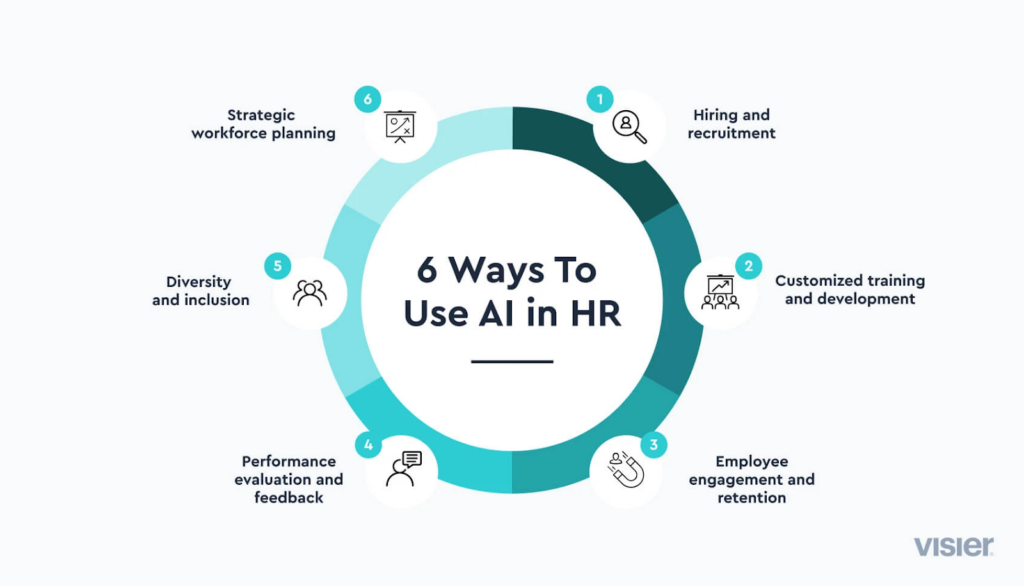
Image Source: Visier
AI-driven talent intelligence tools like Eightfold AI leverage machine learning and predictive analytics to enhance recruitment and workforce planning. These platforms can analyze both structured and unstructured data, allowing them to offer deep insights into candidate behavior, workforce trends, and industry shifts. AI’s ability to process large datasets at speed means that HR teams can respond more quickly and accurately to market changes, ensuring they remain competitive in the search for top talent.
For example, Eightfold AI’s talent intelligence capabilities enable businesses to:
- Predict future hiring needs based on industry trends.
- Identify internal talent that can be upskilled or promoted.
- Optimize diversity and inclusion initiatives through bias-free AI algorithms.
- Increase employee retention by predicting which workers are at risk of leaving.
How Eightfold AI Leads the Talent Intelligence Space?
Eightfold AI stands out in the talent intelligence space with its ability to provide deep insights into both internal and external labor markets.
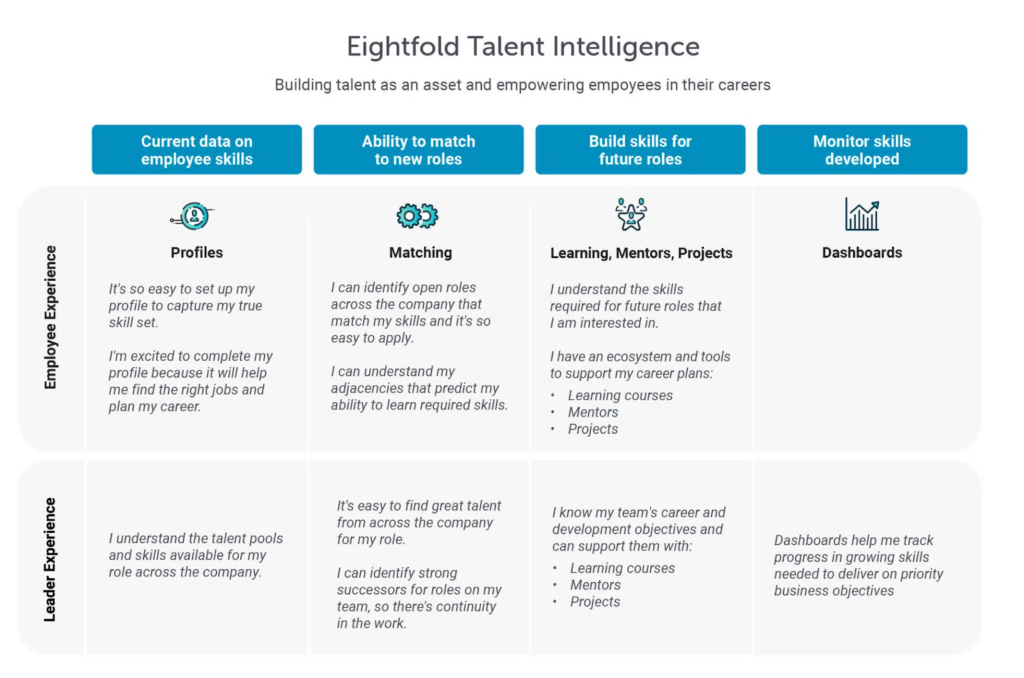
Image Source: Eightfold.ai
The platform offers:
- Predictive Insights: Eightfold AI leverages talent and intelligence developed over time to forecast job market shifts and predict which skills will be in demand in the future. This helps HR teams proactively plan their recruitment strategies.
- Talent Matching: One of Eightfold AI’s most lauded features is its AI-powered talent matching capability. The platform uses machine learning to match candidates with open roles, even if their resumes don’t list exact matches for job requirements. This helps organizations discover hidden talent.
- Bias Elimination: The platform emphasizes diversity and inclusion by removing bias from the hiring process. Eightfold AI uses AI algorithms to focus on skills and potential rather than traditional resume filters, ensuring more equitable hiring.
- Workforce Planning: Eightfold AI provides comprehensive workforce planning tools. By analyzing labor market trends, businesses can gain insights into skills shortages and workforce attrition, allowing them to adjust their talent strategies accordingly.
While Eightfold AI offers robust features, it’s essential to examine how it compares to other platforms in the talent intelligence space, such as JobsPikr, Pymetrics, Seekout and HiredScore.
Eightfold AI vs Competitors
In the crowded talent intelligence space, Eightfold AI isn’t the only player. Below is a comparison between Eightfold AI and other top platforms, including JobsPikr, a competitor that offers a comprehensive alternative for organizations looking for job market insights.
1. JobsPikr: AI-Driven Labor Market Data
JobsPikr is a powerful alternative to Eightfold AI, particularly for businesses looking to gain granular insights into the labor market. While Eightfold AI focuses on predictive talent matching and workforce planning, JobsPikr specializes in real-time job market data.
- Features: JobsPikr scrapes job postings from across the web to provide businesses with real-time data on job trends, skill requirements, and compensation benchmarks. This enables HR departments to stay ahead of the competition by understanding the current demand for roles and skills.
- Benefits: Unlike Eightfold AI, which focuses more on internal workforce planning, JobsPikr emphasizes external labor market trends, giving businesses the data they need to benchmark compensation and refine their hiring strategies based on current demand.
2. Pymetrics
Pymetrics uses neuroscience-based assessments and AI to match candidates with roles that best suit their abilities. It focuses heavily on cognitive and emotional intelligence, providing a unique approach to talent intelligence. However, it lacks the predictive labor market insights and comprehensive workforce planning tools that Eightfold AI offers.
3. SeekOut
SeekOut is another major player in the talent intelligence space, specializing in sourcing diverse candidates and providing deep insights into their skills and backgrounds. Its diversity-focused approach sets it apart, but its predictive analytics capabilities are not as robust as Eightfold AI’s.
4. HiredScore
HiredScore uses AI to match candidates with open roles by analyzing job descriptions and resumes. While effective for automating candidate screening, its platform doesn’t provide the same level of predictive insights for workforce planning as Eightfold AI.
| Platform | Primary Strength | What It Does Well | Where It Falls Short | Best Used When |
|---|---|---|---|---|
| Eightfold AI | Internal talent intelligence & mobility | Infers skills, matches employees to roles, supports reskilling and internal movement at scale | Limited visibility into real-time external labor market shifts; assumes workforce strategy is already directionally right | You already know which roles matter and want to optimize internal talent allocation |
| JobsPikr | External labor market intelligence | Tracks real-time job demand, skills trends, competitor hiring, and geographic shifts | Does not manage internal mobility or employee-level matching | You need to validate workforce plans against what the market is actually doing |
| SeekOut | Talent sourcing & diversity intelligence | Maps external talent pools, supports DEI sourcing, surfaces hard-to-find candidates | Not designed for long-term workforce planning or market forecasting | You are actively sourcing and want visibility into candidate availability |
| Pymetrics | Behavioral and cognitive fit | Uses neuroscience-based assessments to evaluate role fit and potential | Limited labor market context; not a standalone talent intelligence platform | You want to reduce mis-hires by assessing cognitive and emotional traits |
| HiredScore | Screening automation & compliance | Automates resume screening and prioritization while supporting compliance goals | Minimal strategic insight; no market-level intelligence | You need to improve hiring efficiency at the top of the funnel |
Bring Market Reality Into Workforce Planning
JobsPikr gives HR and strategy teams continuous visibility into how roles, skills, and locations are evolving across the job market.
How HR Leaders Can Leverage AI-Powered Talent Intelligence?
With so many talent intelligence platforms available, how can HR leaders choose the right one for their organization? Here are some practical tips for leveraging AI-powered tools:
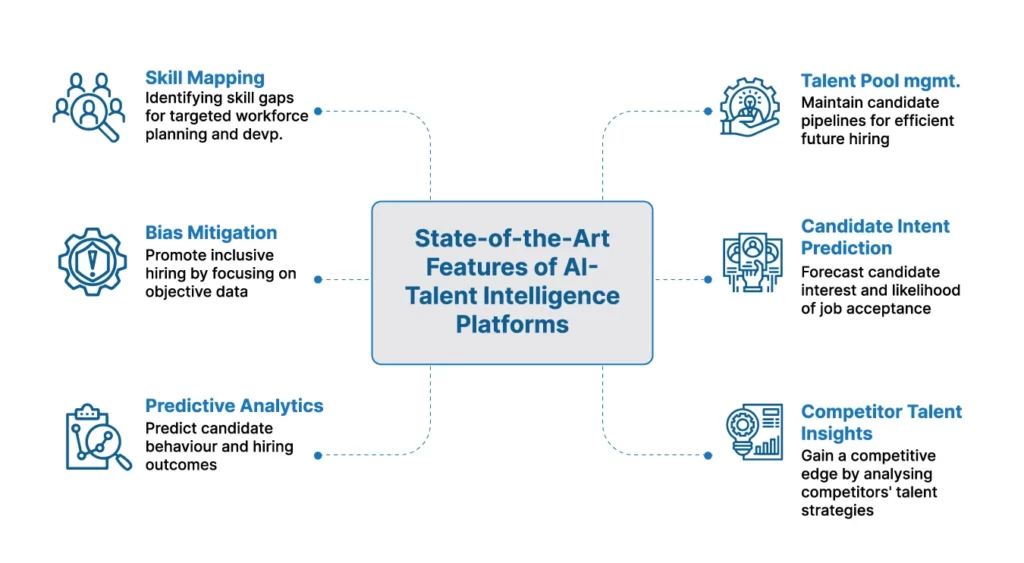
Image Source: Draup
1. Focus on Predictive Insights
When selecting a talent intelligence platform, ensure it offers predictive job market insights. These insights help organizations stay ahead of trends, allowing them to adjust their hiring strategies accordingly. Eightfold AI, with its focus on long-term workforce planning, is particularly strong in this area.
2. Assess Integration Capabilities
Make sure the platform can integrate with your existing HR tools and systems. This is critical for seamless data flow and more comprehensive talent insights. Platforms like Eightfold AI and SeekOut are designed with robust integration features, making them ideal for enterprises with complex HR ecosystems.
3. Optimize Diversity and Inclusion
Diversity and inclusion initiatives are increasingly important for enterprises looking to attract top talent. Look for platforms that offer AI-driven, bias-free algorithms to help you achieve your D&I goals. Eightfold AI and SeekOut excel in this area.
4. Leverage Internal Talent
AI-driven platforms can help organizations identify employees who are ready for promotion or upskilling. By leveraging internal talent, businesses can reduce external hiring costs and improve employee retention.
Why Talent Intelligence Fails Without Timing
Most talent intelligence failures don’t come from bad data or weak AI models. They come from late insight.
By the time a role shows up as “hard to hire” internally, the market has usually been signaling trouble for months. Job postings start staying open longer. Skill requirements quietly change. Salaries creep up in competitor listings. Entire hiring clusters shift cities without any announcement.
Internal talent platforms like Eightfold AI are excellent at answering the question:
“Given our current workforce, what should we do next?”
What they are not built to answer is:
“Is this still the right problem to be solving?”
That timing gap is where organizations lose leverage.
The hidden cost of late intelligence
Consider how workforce decisions actually get made:
- Annual plans lock budgets and headcount early
- Role definitions are standardized and approved
- Hiring targets cascade across teams
Once that machinery is in motion, changing direction is expensive—politically and operationally. Even when internal data later suggests friction, the organization is already committed.
External labor market signals show up before that lock-in happens.
They reveal:
- Demand inflection points before roles go “critical”
- Skills that are becoming premium before compensation breaks
- Locations that are saturating before attrition rises
When talent intelligence arrives late, AI doesn’t save you—it simply optimizes a decision that’s already drifting off course.
Why timing matters more in 2025 than ever before
Three forces have compressed decision windows:
- Faster skill decay
Technical and hybrid roles evolve faster than job architectures can be updated. By the time a skill gap is formally identified, the market may have moved on. - Compressed hiring cycles
Competitors now enter and exit hiring cycles quickly, using contractors, nearshoring, or automation to stay flexible. Waiting for quarterly reviews means missing the signal. - Distributed labor markets
Remote and hybrid work have fragmented traditional location assumptions. Demand doesn’t move city by city anymore—it jumps.
Talent intelligence only works if it arrives early enough to change direction. That’s why external market visibility is no longer a “nice supplement.” It’s a timing advantage.
Building a Real Talent Intelligence Stack
The idea that one platform can fully “own” talent intelligence is increasingly outdated.
Not because vendors are weak—but because the problem itself is too broad.
Modern talent decisions span:
- Market sensing
- Strategic planning
- Internal optimization
- Hiring execution
- Retention and mobility
No single system excels at all of these simultaneously.
Why single-platform thinking breaks down
Most Talent Intelligence Solutions are designed with a primary data anchor:
- Internal employee data
- External candidate profiles
- Job market signals
- Behavioral assessments
They optimize around that anchor.
When organizations expect one platform to answer every talent question, two things happen:
- Blind spots get mistaken for certainty
- AI outputs get over-trusted because they look precise
This is how teams end up confidently hiring for roles the market is already abandoning.
What mature organizations do instead
High-performing talent teams build layered intelligence, not monoliths.
A typical modern stack looks like this:
- External labor market intelligence (JobsPikr)
Used first, to understand:- What skills are gaining or losing traction
- Where hiring pressure is rising or falling
- How competitors are shaping teams
- Internal talent intelligence (Eightfold AI)
Used next, to determine:- Whether existing talent can meet future needs
- Who can be reskilled or redeployed
- How to reduce external hiring risk
- Execution and optimization tools
ATS, assessments, sourcing platforms, and screening tools handle speed and compliance once direction is clear.
This sequencing matters.
External data informs strategy.
Internal AI optimizes against it.
Execution tools scale it.
Why this stack is becoming the norm
In 2025, workforce strategy is no longer static enough to be planned once and optimized endlessly. It’s iterative.
Organizations are:
- Revisiting role definitions quarterly
- Adjusting hiring locations mid-year
- Rebalancing build-vs-buy decisions dynamically
A layered stack allows each system to do what it’s best at—without forcing it to answer questions it was never designed to solve.
Eightfold AI remains central in this model, but it’s no longer expected to be omniscient. JobsPikr fills the gap where internal systems cannot see: the market itself.
Essential Tips Every HR Leader Should Know
To fully leverage AI-driven talent intelligence platforms, HR leaders should:
- Invest in Data-Driven Tools: Whether you choose Eightfold AI, JobsPikr, or another competitor, ensure that your platform offers comprehensive job market insights and predictive analytics.
- Emphasize Workforce Planning: Use talent intelligence platforms to align workforce planning with business strategy, ensuring you have the right skills in place to meet future demands.
- Promote Diversity: Leverage AI to eliminate hiring biases and create more equitable recruitment processes.
- Monitor Job Market Trends: Use tools like JobsPikr to stay updated on the latest job market trends and compensation benchmarks, ensuring your company remains competitive.
Talent Intelligence Works Only When Strategy Comes First
AI-driven talent intelligence platforms have become indispensable for HR teams aiming to optimize recruitment, workforce planning, and employee retention. While Eightfold AI leads in predictive insights and internal workforce planning, competitors like JobsPikr offer robust job market data that provide a broader view of external labor trends.
The right platform for your organization will depend on your specific needs—whether you’re looking for predictive talent matching, internal mobility, or real-time job market insights. Ultimately, by leveraging talent intelligence tools, organizations can make smarter hiring decisions, improve retention, and stay ahead of labor market trends.For organizations seeking comprehensive job market insights, JobsPikr stands as a strong alternative to Eightfold AI, offering real-time labor data to enhance recruitment and workforce strategies. Sign up today!
Bring Market Reality Into Workforce Planning
JobsPikr gives HR and strategy teams continuous visibility into how roles, skills, and locations are evolving across the job market.
Frequently Asked Questions
What does talent intelligence mean?
Talent intelligence refers to the process of gathering and analyzing internal and external workforce data to help organizations make better hiring, development, and retention decisions. It blends market insights, behavioral analytics, and business needs to provide a strategic, data-driven view of talent.
It typically includes:
Labor market trends
Competitor hiring activity
Skills demand forecasting
Candidate sourcing analysis
Workforce planning insights
With the help of technology, talent intelligence allows HR teams to move beyond gut feeling and make informed talent decisions that align with business goals.
What is the difference between talent intelligence and people analytics?
While both talent intelligence and people analytics are data-driven approaches used in HR, they differ in scope and focus:
Talent Intelligence focuses on external and forward-looking data — including labor market trends, competitor behavior, and future talent needs.
People Analytics is primarily internal, examining employee data (e.g., engagement, performance, turnover) to improve operations, culture, and retention.
In short:
Talent intelligence = external + predictive
People analytics = internal + diagnostic
When combined, they give organizations a 360° view of talent opportunities and challenges.
What is the talent intelligence strategy?
A talent intelligence strategy is a structured plan that uses talent-related data to guide HR decisions and align workforce planning with long-term business goals.
Key components include:
Identifying critical roles and future skill gaps
Benchmarking talent availability and costs across markets
Using AI to optimize sourcing and recruitment
Monitoring competitor hiring trends and employer branding
Aligning insights with DEI, succession planning, and retention efforts
This strategy enables HR leaders to anticipate talent needs and compete more effectively in a changing workforce landscape.
What is the talent intelligence market?
The talent intelligence market includes the tools, platforms, services, and data providers that help businesses collect, analyze, and act on workforce insights. It sits at the intersection of HR tech, AI, market research, and workforce analytics.
Leading companies in this space include:
Eightfold AI
SeekOut
42Signals (for competitive labor and digital shelf insights)
LinkedIn Talent Insights
Gartner TalentNeuron
This market is growing rapidly as companies seek predictive tools to improve workforce planning, close skill gaps, and stay competitive in talent acquisition.