

- Global Recruiting This Quarter: What the Data Is Telling You
- What Global Job Posting Volume Actually Looked Like This Quarter
- Stop Sourcing From Markets That Have Already Moved Against You
- The Roles Seeing the Sharpest Demand Surges in Global Recruiting Right Now
- Emerging Talent Markets vs. Cooling Markets: Where Smart TA Leaders Are Sourcing
- Where Salary Pressure Is Rising and Which Skills Are Commanding Premiums
- Sector Spotlight: Finance and Healthcare Are Writing the Hiring Story This Quarter
- Reading the JobsPikr Talent Availability Index: What the Supply-Demand Data Is Really Saying
- What These Global Recruiting Trends Mean for TA Leaders Going Into Next Quarter
- The Bottom Line on Global Recruiting This Quarter
- See the Global Recruiting Data Behind This Report
- Frequently Asked Questions
Global Recruiting This Quarter: What the Data Is Telling You
The global recruiting market in Q1 2026 is not moving in one direction; it’s fracturing by region, role, and skill set. Here’s what the data shows:
- Job posting volumes surged in Sydney (up 50% in a single quarter) and London (up 165,000 postings), but high volume is masking a deeper shortage; roles are being reposted, not filled.
- Southeast Asia is the clearest talent surplus signal in the market right now, with AI/ML roles in Kuala Lumpur and Manila being absorbed in as little as 2 days after posting.
- Cybersecurity and Data Engineering face the most structurally constrained supply of any role category, demand is rising in every region, with no relief in sight.
- Finance Analyst salaries rose nearly 20% between 2024 and Q1 2026, while workers with AI skills are commanding a 56% wage premium over peers in identical roles without them.
- Finance and Healthcare are the two sectors driving the most hiring confidence globally this quarter, with cross-industry competition making the candidate pool more contested than ever.
TA leaders who are still running headcount planning off annual labor market reports are already behind. The signal-to-noise gap between stale data and real-time intelligence has never been wider.
What Global Job Posting Volume Actually Looked Like This Quarter
Here’s something worth sitting with for a moment. When posting volumes spike in a major city, most people read that as a sign of a healthy hiring market. The reality is often the opposite.
According to JobsPikr’s real-time job posting data, London recorded 583,000 job postings in Q4 2025. By Q1 2026, that number had climbed to 748,000, a jump of 165,000 postings in a single quarter. New York moved from 302,000 to 314,000 over the same period. Sydney was the real outlier, leaping from 152,000 postings in Q4 2025 to 228,000 in Q1 2026, a 50% increase in just three months. Houston also grew, from 209,000 to 225,000.
On paper, that looks like momentum. But here’s what those numbers don’t tell you on their own: when posting volumes surge this sharply in a short window, a significant portion of that activity is reposting. Roles that didn’t get filled the first time, or the second time, are showing up again with a slightly different title or a revised salary range. That pattern is not a sign of growth. It’s a sign of a talent desert forming underneath an otherwise busy-looking market. Volume and availability are two completely different things, and confusing them is one of the most common and expensive mistakes in global recruiting strategy.
Bangalore tells a different but equally important story. With 381,000 postings in Q1 2026, up marginally from 379,000 in Q4 2025, it is the second busiest hiring market in the JobsPikr dataset. The volume is enormous. But as we’ll get into in the talent availability section, Bangalore’s posting duration data tells you that supply is nowhere near keeping pace with demand, particularly for senior technical roles. High volume with long posting durations is the market’s way of saying: there are plenty of jobs, but not enough of the right people to fill them.
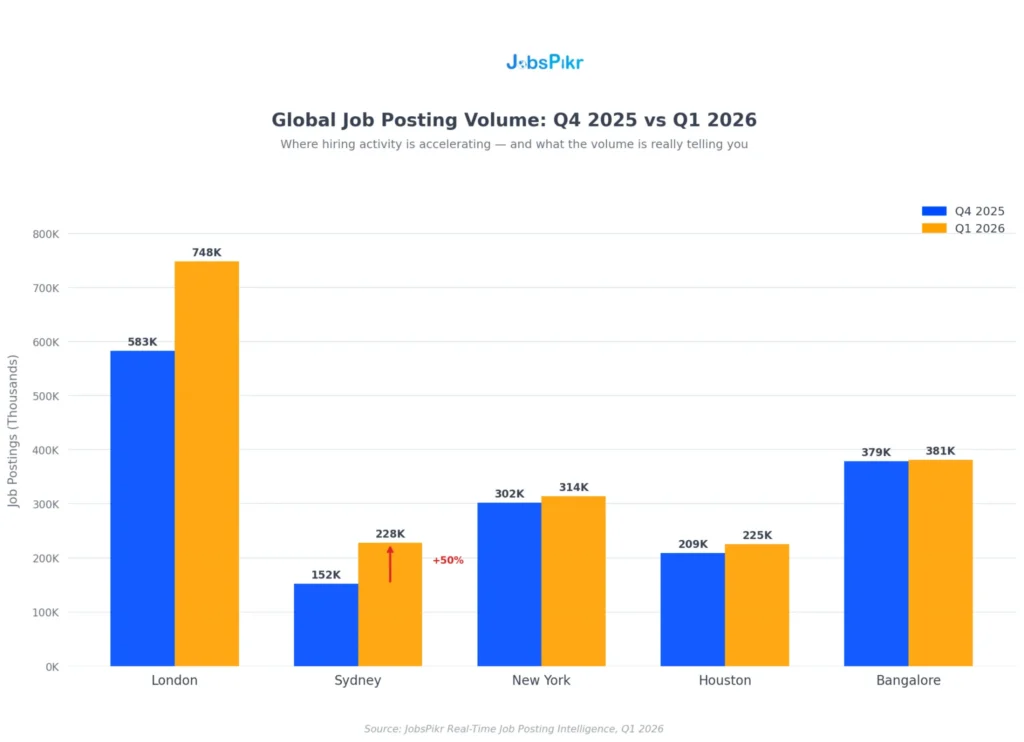
What this quarter’s posting data is really telling global recruiting leaders is that the markets that look the busiest are often the hardest to hire in. The smarter question to ask is not where are the most jobs being posted, but where are roles actually being filled, and how fast.
Stop Sourcing From Markets That Have Already Moved Against You
The regional shifts, salary signals, and supply-demand imbalances in this report are updated every quarter. Your sourcing strategy should be too.
The Roles Seeing the Sharpest Demand Surges in Global Recruiting Right Now
Not every role is feeling the same pressure this quarter. A few categories are pulling so far ahead of available supply that they deserve their own conversation, because if your headcount plan touches any of these, your sourcing timeline and your offer strategy both need to adjust.
Cybersecurity Engineers
This is the most structurally constrained role in the entire JobsPikr dataset right now. Demand grew in every single region tracked between Q3 2025 and Q1 2026. North America, Western Europe, APAC, and Southeast Asia all showed posting volume increases, and there is no credible supply-side relief on the horizon. The global cybersecurity workforce gap currently stands at 4.8 million professionals, according to ISC2’s 2024 Workforce Study. When demand is rising across every region simultaneously, and the talent pool has a structural ceiling, compensation pressure follows. If you are hiring cybersecurity talent right now without real-time market data guiding your offer positioning, you are likely either overpaying out of panic or losing candidates to competitors who moved faster.
AI and Machine Learning Engineers
The demand picture for AI/ML engineers is more nuanced than the headlines suggest. North America saw a contraction in Q4 2025, with postings dropping from 25,100 to 19,600, largely tied to the wave of AI-related hiring pauses that defined that period. But Q1 2026 shows a clear recovery signal in the JobsPikr data. The broader global picture reinforces this: AI-related job postings climbed 25.2% year-over-year in Q1 2025 in the US alone, and the Asia-Pacific region added close to 1.1 million new AI-related positions in 2025. The role itself is also shifting. Enterprise teams are no longer hiring for AI experimentation. They are hiring for production-grade deployment, and that changes the skill profile and the salary conversation significantly.
Data Engineers
Data Engineering is the highest-volume role category in the JobsPikr talent availability dataset, consistently, across every region tracked. The reason is straightforward: companies rebuilding their data infrastructure to support AI initiatives need data engineers first, before almost anything else. What makes this role particularly tricky to hire for right now is that the skill mix inside the title is changing fast. A data engineer role posted in early 2025 looks meaningfully different from one posted today, with cloud-native stacks, real-time streaming systems, and AI-adjacent pipeline work now standard expectations rather than nice-to-haves.
Finance Analysts
This one surprises people, but the data is hard to argue with. Finance Analyst advertised salaries rose nearly 20% between 2024 and Q1 2026, according to JobsPikr’s Compensation Intelligence Report. That kind of salary movement in a traditionally stable role category is a demand signal, not a compensation anomaly. Financial services firms are competing aggressively for analytically strong talent, and they are now going head-to-head with technology companies for people who can sit at the intersection of data and financial decision-making.
Supply Chain and Logistics Specialists
This category does not get the attention it deserves in most global recruiting trend reports, but the hiring momentum is real and consistent. Across Southeast Asia and parts of Africa, trade lane shifts and the push to shorten delivery timelines are creating steady demand for procurement managers, freight analysts, and warehouse systems leads. The global logistics market is projected to grow at a CAGR of 6.8% through 2030, according to Fortune Business Insights, and workforce demand is tracking that growth closely.
Emerging Talent Markets vs. Cooling Markets: Where Smart TA Leaders Are Sourcing
This is where global recruiting strategy either gets sharper or stays stuck. Most enterprise TA teams are still defaulting to the same talent hubs they have always used. The JobsPikr data this quarter makes a pretty compelling case for why that default is getting more expensive by the month.
Southeast Asia: The Clearest Surplus Signal in the Market
The number that stands out most in the JobsPikr Talent Availability Index this quarter is not a posting volume figure. It is a duration figure. In Southeast Asia, the median posting duration for AI/ML roles collapsed from 7 days in Q3 2025 to just 2 days in Q1 2026. For Data Engineering roles, posting duration has held between 4 and 7 days consistently across three quarters, while posting volumes grew from 2,000 to 2,600 over the same period. Kuala Lumpur, Manila, and Taguig City are the cities leading this activity.
What a 2-day median posting duration tells you is that qualified candidates are available and moving fast. Roles are being absorbed almost as quickly as they are posted, which is the clearest possible signal of a talent market with genuine supply. For enterprise teams exploring remote or offshore hiring strategies, this is not a trend to file away for later. It is a window that will not stay open indefinitely as more competitors catch on.
APAC’s Core Markets: High Volume, Real Constraints
India is a more complicated story. Bangalore alone recorded 381,000 job postings in Q1 2026, making it the second busiest hiring market in the JobsPikr dataset globally. But posting volume tells you demand, not availability. For Data Engineering roles specifically, the median posting duration across APAC improved from 60 days in Q3 2025 to 31 days in Q1 2026, which is progress, but a 31-day median still tells you that supply is running well behind demand. Hyderabad and Pune are showing strong secondary momentum, which suggests hiring is beginning to spread beyond Bangalore, but the overall APAC picture for specialized technical roles remains supply-constrained at the senior and mid level. India’s employer hiring difficulty rate currently sits at 82%, according to ManpowerGroup’s 2026 Talent Shortage Survey, one of the highest of any major economy globally.
Eastern Europe: Worth Watching, Not Yet at Scale
Eastern Europe is a smaller market by volume but the directional trend in the JobsPikr data is worth paying attention to. Postings grew steadily from 1,050 in Q3 2025 to 1,360 in Q1 2026. The median posting duration has been volatile though, jumping from 14 days in Q3 to 50 days in Q4 before settling back at 22 days in Q1 2026. Warsaw, Krakow, and Bucharest are leading activity. The volatility in posting duration suggests this market is still finding its equilibrium. It is developing its talent base but has not yet reached the kind of consistent absorption rates that would make it a primary sourcing market for most enterprise teams. The right move here is to start building relationships and pipelines now, before the market matures and competition intensifies.
The Markets That Look Busy But Are Getting Harder
London’s posting surge from 583,000 to 748,000 in a single quarter sounds impressive until you factor in that 73% of UK employers report significant hiring difficulty, above the global average of 72%, according to ManpowerGroup’s 2026 Talent Shortage Survey. The volume is largely driven by reposting activity, roles that did not get filled cycling back through the market with marginal adjustments. For TA teams hiring in London, reactive hiring will not work. Pipeline building has to happen well before a role opens. North America tells a similar story for cybersecurity and senior AI roles, where demand is growing but the candidate pool with production-grade experience remains genuinely thin.
Where Salary Pressure Is Rising and Which Skills Are Commanding Premiums
Compensation strategy in global recruiting right now has a data freshness problem. Most enterprises are still setting offer ranges based on annual salary surveys that were fielded six to twelve months before the data even gets published. By the time those benchmarks reach a hiring manager’s desk, the market has already moved. In some role categories this quarter, it has moved significantly.
The Roles Where Comp Pressure Is Most Acute
The JobsPikr Compensation Intelligence Report draws on a database of over 100 million live job postings, and the role-level salary movement it is capturing this quarter tells a clear story about where offer positioning is getting harder.
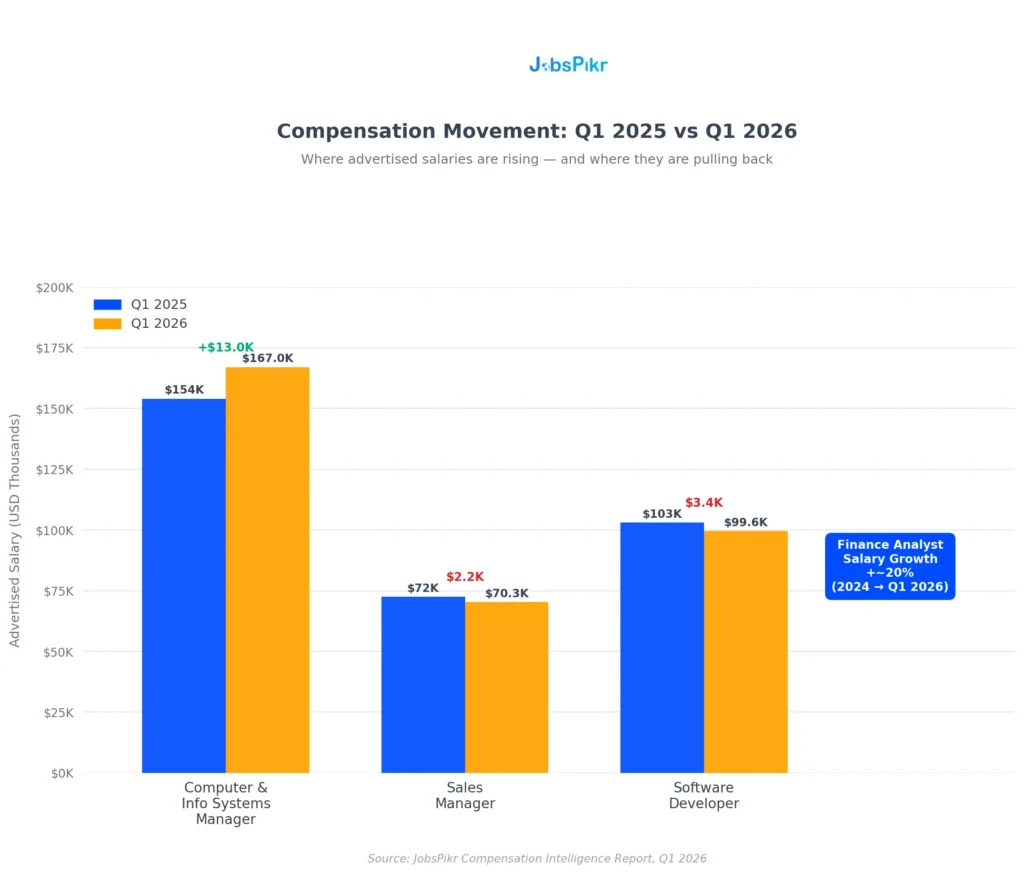
Computer and Information Systems Managers saw advertised salaries jump from $154,000 to $167,000 between Q1 2025 and Q1 2026. That is an 8.4% increase in a single year for a role that most compensation teams would have modeled at 3 to 4% annual movement. If your salary bands for this role were built without a live market refresh in the last six months, you are walking into offer conversations with a structural disadvantage before the negotiation has even started.
Finance Analysts tell an even sharper story. Advertised salaries for this role rose nearly 20% between 2024 and Q1 2026, according to JobsPikr data. That kind of movement in a traditionally stable category reflects the intensifying competition between financial services firms and technology companies for analytically strong talent. Both industries want the same person, and the salary is reflecting that tension.
Pay transparency is also reshaping the dynamics of offer conversations in a way that most TA leaders are still adjusting to. More than 68% of job postings included salary ranges in 2025, up from 45% in 2023, according to the JobsPikr Compensation Intelligence Report. Candidates are walking into interviews already knowing the market range. TA teams that are not working from equally current data are negotiating at an information disadvantage.
The AI Skills Premium Is No Longer Just a Tech Problem
This is the compensation signal that has the widest implications across industries, and it is still being underestimated in most comp planning conversations outside of technology.
Workers with AI skills are earning a 56% wage premium over peers in identical roles without those skills, according to PwC’s 2025 Global AI Jobs Barometer. That premium applies across every industry analyzed, not just technology. A Finance Analyst with AI-driven forecasting capability is not the same hire as one without it, and the market has already priced that difference in. Most compensation bands have not caught up.
At the specialized end, the gap is even wider. Specialized AI skills such as LLM fine-tuning and MLOps at scale carry premiums of 25 to 45% on top of base compensation, according to Rise’s AI Talent Salary Report 2026. For enterprise teams building out AI infrastructure, this means the talent you need most is also the talent that is most expensive and most contested.
Where the Market Is Softening
Not every role is seeing upward pressure, and that context matters for budget planning too. Software Developer advertised salaries moved slightly downward, from $103,000 to $99,600 between Q1 2025 and Q1 2026, according to JobsPikr data. This modest pullback likely reflects a combination of two things: a slight softening in entry-level demand as AI tools begin absorbing some junior development work, and a market correction after a period of aggressive tech hiring. Sales Manager median advertised salaries also dipped slightly, from $72,500 to $70,300, suggesting employers are pulling back on advertised base ranges while leaning more heavily on variable compensation structures to stay competitive.
The practical implication of all this is straightforward. A single salary index number applied across an entire headcount plan will be wrong in multiple directions at the same time. Role-level granularity refreshed from live data is what separates a compensation strategy that holds from one that is perpetually playing catch-up.
Sector Spotlight: Finance and Healthcare Are Writing the Hiring Story This Quarter
Every quarter, a couple of industries tend to set the tone for what global recruiting looks like at the enterprise level. They are the ones where hiring confidence is highest, where competition for talent is most intense, and where the decisions TA leaders make now will have the clearest downstream impact on business performance. This quarter, that distinction belongs to financial services and healthcare, for very different reasons.
Financial Services: The Loudest Hiring Signal in the Market
The Net Employment Outlook for Finance and Insurance globally sits at +30% for Q1 2026, making it the strongest of any sector tracked in ManpowerGroup’s quarterly survey. That is not a marginal lead. It is a meaningful gap above the global average, and it reflects something that is becoming one of the more underappreciated dynamics in enterprise talent strategy right now.
Financial services firms are no longer just competing against each other for talent. They are competing directly and aggressively with technology companies for the same people. JobsPikr’s Job Market Index data shows Software Developers appearing consistently in the top hiring lists for both technology and finance sectors in Q1 2026. Banks and financial institutions have spent years building out their own engineering capabilities, and in this quarter they are making their most aggressive push yet. A software developer weighing offers right now may be choosing between a fintech, a traditional bank, a cloud company, and a retail giant, all of whom are pitching simultaneously.
The Finance Analyst salary surge we covered in the compensation section is a direct output of this dynamic. When two well-funded industries want the same talent profile, the salary moves. But compensation is only part of the story. Financial services firms are also competing on role scope, technology exposure, and the promise of working on genuinely complex problems. For TA leaders in financial services, the message is that your employer value proposition needs to be doing more work than it used to, because the candidate you are pitching to has more options than they did a year ago.
Healthcare: A Rebound That Deserves More Attention
Healthcare’s hiring story this quarter is one of the more interesting shifts in the global recruiting data. The sector, along with public services, showed the strongest quarter-over-quarter improvement in hiring confidence in Q1 2026, gaining 5 points to reach a Net Employment Outlook of 20%, according to NPAworldwide’s analysis of ManpowerGroup data. That rebound reflects a renewal of budgets and an acceleration in demand for services that had been building for some time.
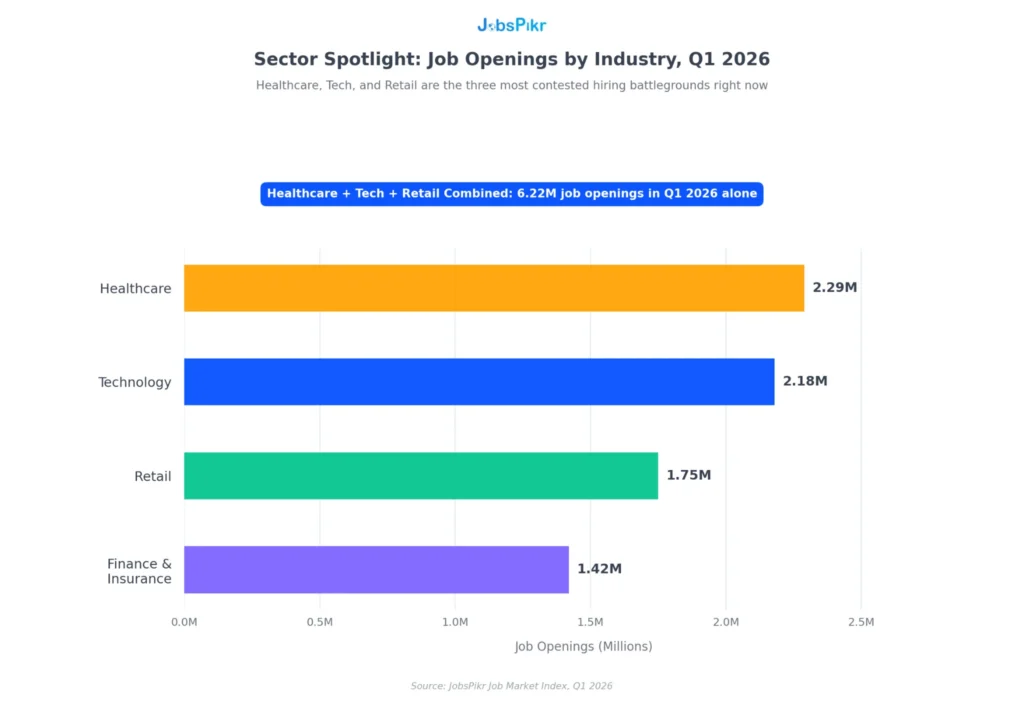
What makes healthcare particularly interesting from a global recruiting lens is the cross-sector competition dimension. Healthcare, Retail, and Technology together posted a combined 6.22 million job openings in Q1 2026 alone, according to JobsPikr’s Job Market Index. That scale of simultaneous demand across three major sectors means that roles with transferable skill sets, think data analysts, operations managers, and project leads, are being contested by employers from completely different industries. A candidate with strong operations experience is getting approached by a hospital system, a logistics company, and a technology firm at the same time. The competitive set for talent is wider than most sector-specific TA teams are planning for.
The Cross-Industry Competition Problem Nobody Is Talking About Loudly Enough
The thread connecting financial services and healthcare this quarter is not just that both are hiring aggressively. It is that their hiring is colliding with technology sector demand in ways that make the candidate pool more contested than a single-industry lens would ever reveal.
JobsPikr’s cross-industry posting data shows that roles like Sales Manager, Software Developer, and Marketing Manager are being posted simultaneously by tech firms, banks, retailers, and construction companies. The implication for TA leaders is significant. Your competition for any given candidate is no longer defined by your industry peer set. It is defined by every organization that needs a similar skill profile, regardless of what sector they operate in. Building a sourcing and offer strategy around industry benchmarks alone, without visibility into cross-sector demand signals, is leaving you with an incomplete picture of the market you are actually competing in.
Reading the JobsPikr Talent Availability Index: What the Supply-Demand Data Is Really Saying
There is a meaningful difference between knowing that a talent market is tight and knowing exactly how tight it is, where it is tightening fastest, and whether the situation is improving or deteriorating quarter over quarter. The first kind of knowledge comes from industry conversation. The second kind comes from data, specifically from tracking posting volumes and median posting durations across regions and role categories over time.
The JobsPikr Talent Availability Index (TAI) is built around a straightforward but powerful insight: how long a job posting stays active before being filled is one of the most honest signals of supply-demand balance in any given market. A role that fills in 3 days tells you something very different from a role that has been sitting open for 45 days. And a market where posting durations are falling tells you something different again from one where they are climbing. A single snapshot is useful context. A trend line across three quarters is what actually changes a workforce plan.
Here is what the Q3 2025 through Q1 2026 TAI data is telling us across the role categories and regions that matter most to enterprise hiring teams right now.
Southeast Asia: The Surplus Signal Most Enterprise Teams Are Still Ignoring
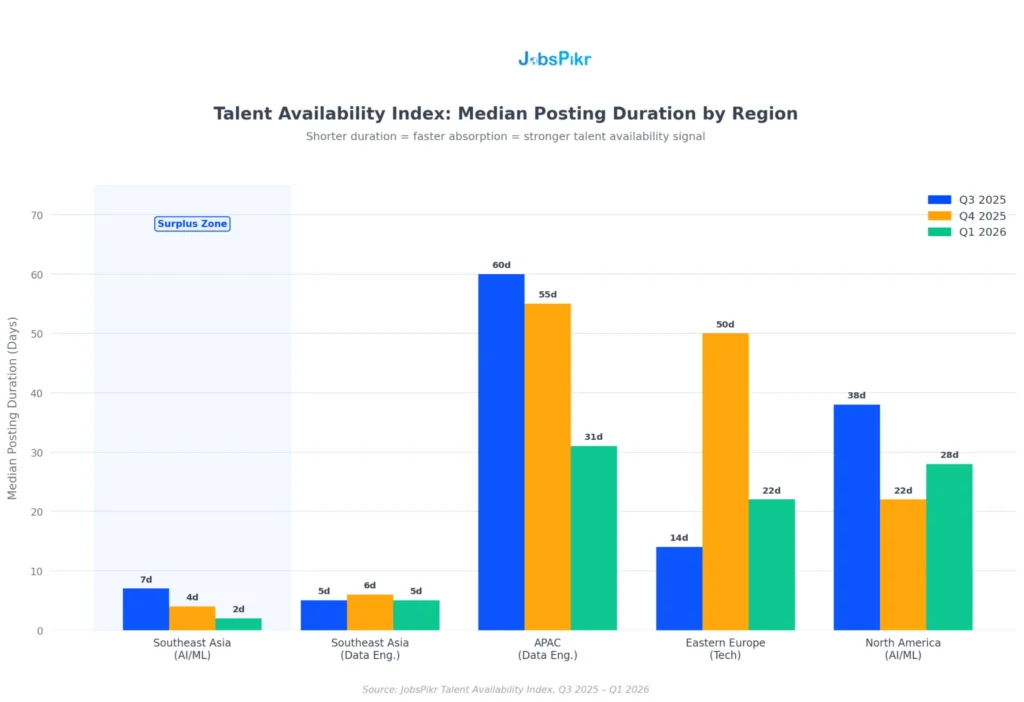
The clearest story in the entire dataset is Southeast Asia for AI/ML roles. Median posting duration collapsed from 7 days in Q3 2025 to just 2 days in Q1 2026. For Data Engineering roles in the same region, posting duration has held consistently between 4 and 7 days across all three quarters, while posting volumes grew from 2,000 to 2,600. Kuala Lumpur, Manila, and Taguig City are leading activity across both role categories.
A 2-day median posting duration is about as clear a surplus signal as labor market data produces. It means qualified candidates are in the market, they are active, and they are being absorbed almost immediately. For enterprise TA teams that have not yet built sourcing pipelines into Southeast Asia, this is the quarter that data is telling you to start. The arbitrage window between genuine talent availability and broad enterprise awareness of that availability will not stay open indefinitely.
APAC’s Core Markets: Improving but Still Supply-Constrained
The APAC picture is more nuanced. For Data Engineering roles, posting volumes peaked at 26,100 in Q4 2025 before settling at 24,100 in Q1 2026. Median posting duration improved from 60 days in Q3 2025 to 31 days by Q1 2026, which represents real progress. But a 31-day median is still telling you that demand in this market is running well ahead of available supply, particularly at the senior and mid levels where production-grade AI and cloud infrastructure experience is required. Bangalore remains the dominant epicenter of demand, with Hyderabad and Pune showing strong secondary momentum as hiring begins to spread beyond the primary hub.
The practical read for TA leaders is this: APAC is not a market to abandon, but it is a market where you need longer pipeline lead times and more competitive offer positioning than you would need in Southeast Asia right now. The gap between what employers need and what the candidate pool can immediately deliver is narrowing, but it has not closed.
Eastern Europe: A Market Finding Its Feet
Eastern Europe’s TAI data tells the story of a market that is developing but has not yet reached equilibrium. Posting volumes grew steadily from 1,050 in Q3 2025 to 1,360 in Q1 2026, which is a healthy directional signal. But median posting duration has been volatile, moving from 14 days in Q3 to 50 days in Q4 before settling back at 22 days in Q1 2026. Warsaw, Krakow, and Bucharest lead activity. The volatility suggests this market is still absorbing demand that has grown faster than its talent infrastructure can consistently support. It is a market worth investing in now, before competition concentrates, but not one to rely on as a primary sourcing channel until the duration trends stabilize further.
North America: Recovery After a Turbulent Quarter
North America’s AI/ML Engineer market showed the clearest improvement story in the Q1 2026 dataset. After posting volumes dropped from 25,100 to 19,600 in Q4 2025, largely tied to the wave of AI-related hiring pauses that characterized that period, Q1 2026 data shows a meaningful recovery signal beginning to emerge. For cybersecurity roles, however, the picture remains structurally challenged. Demand grew in every region tracked between Q3 2025 and Q1 2026, and the global shortage shows no sign of easing. North America is feeling that pressure as sharply as any region.
The Role That Tells the Hardest Story: Cybersecurity
Across every region in the JobsPikr TAI dataset, cybersecurity engineers represent the most constrained supply picture of any role category tracked. Demand is growing everywhere simultaneously. Posting volumes increased in North America, Western Europe, APAC, and Southeast Asia between Q3 2025 and Q1 2026, and there is no credible near-term supply-side response that matches the scale of that demand. For TA leaders with cybersecurity hiring in their plan for next quarter, the TAI data has one clear message: start earlier, build pipelines before roles open, and expect offer cycles to be competitive regardless of which region you are sourcing from.
| Region | Role | Median Posting Duration Q3 2025 | Median Posting Duration Q1 2026 | Signal |
| Southeast Asia | AI/ML Engineer | 7 days | 2 days | Strong surplus |
| Southeast Asia | Data Engineer | 4-7 days | 4-7 days | Consistent surplus |
| APAC | Data Engineer | 60 days | 31 days | Improving, still constrained |
| Eastern Europe | Mixed tech roles | 14 days | 22 days | Volatile, finding equilibrium |
| North America | AI/ML Engineer | High (Q4 contraction) | Recovering | Early recovery signal |
| Global | Cybersecurity | Rising | Rising | Most constrained globally |
Source: JobsPikr Talent Availability Index, Q3 2025 to Q1 2026
What These Global Recruiting Trends Mean for TA Leaders Going Into Next Quarter
Data without a clear line to action is just noise. Everything covered in this edition of the Quarterly Hiring Pulse points toward a set of decisions that TA leaders need to be making now, before next quarter’s headcount pressure makes them reactive rather than deliberate. Here is what the signals are telling you to do.
Stop Treating Talent Markets as Static
The single biggest strategic mistake visible in the global recruiting data right now is enterprise TA teams running next quarter’s headcount plan off last year’s assumptions. The market that existed twelve months ago is not the market that exists today. London looks like a growth market until you factor in reposting rates. Bangalore looks like an abundant talent pool until you look at posting duration. Southeast Asia looks like an emerging market until you realize roles are filling in two days.
The gap between what periodic labor market surveys tell you and what real-time job posting intelligence shows you has never been wider. A LinkedIn study found that companies using data-driven recruiting are twice as likely to improve their hiring process, and the advantage compounds when that data is current rather than historical. The teams winning on talent right now are not smarter than their competitors in any fundamental way. They are simply working from better and more current information.
Shift Your Sourcing Pipeline Toward Southeast Asia Before the Window Closes
The JobsPikr TAI data makes this recommendation as close to unambiguous as labor market intelligence gets. Median posting durations of 2 days for AI/ML roles and 4 to 7 days for Data Engineering roles in Kuala Lumpur and Manila are telling you that qualified candidates are available, active, and moving fast. Most enterprise TA teams have not yet built the sourcing infrastructure to tap this market at scale, which means the competitive intensity is still relatively low compared to what it will be in six to twelve months when broader awareness catches up to the data.
Building a sourcing pipeline into Southeast Asia does not happen overnight. It requires employer brand investment in those markets, relationships with local hiring partners, and compensation structures that reflect local market rates rather than simply discounting home market ranges. The time to start that work is now, not when the market tightens and everyone is competing for the same candidates simultaneously.
Lock In Compensation Bands for Finance and Cybersecurity Roles Immediately
Both of these role categories are showing the kind of salary movement that makes annual comp band reviews genuinely dangerous as a planning tool. Finance Analyst salaries up nearly 20% in two years. Computer and Information Systems Manager salaries up 8.4% in a single year. Cybersecurity demand is growing in every region with no supply-side relief. These are not markets where you can afford to anchor offers to benchmarks that are six months old.
The practical implication is that compensation bands for these roles need to be refreshed from live market data before your next offer cycle, not at the next annual review. JobsPikr’s salary benchmarking tool pulls from over 100 million live job postings, which means the compensation ranges it surfaces reflect what employers are actually advertising today, not what they were advertising when a survey was fielded. That distinction is the difference between making competitive offers and losing candidates at the finish line to organizations that moved faster with better information.
Rethink How You Define Your Competitive Set for Talent
One of the clearest findings in this quarter’s data is that cross-industry competition for talent is more intense than most sector-specific TA strategies account for. Financial services firms competing with technology companies for software developers. Healthcare systems competing with logistics companies for operations talent. Construction firms and retailers posting for the same marketing managers that technology companies are chasing.
If your sourcing and offer strategy is benchmarked only against your industry peers, you are missing a significant portion of the competitive landscape your candidates are actually navigating. A candidate evaluating your offer is not comparing you only to your direct competitors. They are comparing you to every organization that has reached out to them with a compelling pitch, regardless of sector. Workforce analytics that capture cross-industry demand signals are not a luxury for enterprise TA teams at this point. They are a baseline requirement for understanding the market you are actually operating in.
The Cost of Getting This Wrong
Slow hiring is expensive in ways that are easy to underestimate when looking at individual roles. The average cost of a bad hire is estimated at up to 30% of the employee’s first-year salary, according to the US Department of Labor. But the cost of a slow hire, particularly in a fast-moving role category like cybersecurity or AI engineering, goes beyond the direct recruitment cost. It includes delayed product timelines, increased workload on existing team members, and the compounding disadvantage of falling further behind competitors who filled the same role three months earlier with better market intelligence.
The TA leaders who will look back on this quarter as a turning point are the ones who treated the signals in the data as inputs to action rather than interesting context. Southeast Asia is open now. Finance and cybersecurity compensation is moving now. Cross-industry competition is reshaping your candidate’s options now. The question is whether your recruiting strategy reflects the market as it is today or as it was when your last annual report was published.
The Bottom Line on Global Recruiting This Quarter
The global recruiting market in Q1 2026 is not short on activity. It is short on clarity. Posting volumes are up in almost every major market, but volume without context is just noise. The teams that are pulling ahead right now are the ones who know the difference between a market that looks busy and a market that is actually accessible, and they are making sourcing, compensation, and headcount decisions based on that distinction.
The signals in this quarter’s data are specific enough to act on. Southeast Asia is open. Finance and cybersecurity compensation is moving faster than most comp bands are tracking. Cross-industry competition is wider than most sector-specific strategies account for. And the gap between what annual labor market surveys tell you and what real-time job posting intelligence shows you has never been more consequential.
The Quarterly Hiring Pulse is powered by JobsPikr’s real-time global job data intelligence, tracking over 100 million live postings across 100+ markets. Every data point in this edition reflects what the market is doing right now, not six months ago. That is the standard your recruiting strategy deserves.
See the Global Recruiting Data Behind This Report
Every insight in this edition is powered by JobsPikr’s real-time job posting intelligence across 100+ markets. See what the live data looks like for your roles and regions.
Frequently Asked Questions
1. What does global recruiting mean for enterprise TA teams in 2025 and 2026?
Global recruiting at the enterprise level means more than just posting roles across multiple countries. It means building a talent strategy that accounts for regional supply and demand imbalances, cross-industry competition, and compensation differences across markets simultaneously. The data from this quarter makes it clear that the organizations doing this well are the ones treating global recruiting as an intelligence problem first and a logistics problem second. They are asking where the talent actually is, how fast it is moving, and what it costs in each market, before deciding where to source and how to position offers. The ones struggling are the ones applying a single global strategy to markets that are behaving very differently from each other.
2. Which regions have the best talent availability for tech roles right now?
Based on JobsPikr’s Talent Availability Index data for Q1 2026, Southeast Asia is the clearest high-availability signal in the market. Median posting durations for AI/ML roles in Kuala Lumpur and Manila collapsed to just 2 days in Q1 2026, and Data Engineering roles in the same region are filling within 4 to 7 days consistently. That speed of absorption indicates genuine candidate availability, not just posting activity. By contrast, APAC markets like Bangalore, despite enormous posting volumes, are showing median durations of 31 days for Data Engineering roles, which tells you demand is significantly outpacing supply at the senior and mid levels. Eastern Europe is developing steadily but has not yet reached the consistency that would make it a primary sourcing market for most enterprise teams.
3. How is compensation pressure in global recruiting affecting offer strategy?
It is making annual salary benchmarks genuinely unreliable as an offer tool in several key role categories. Finance Analyst salaries rose nearly 20% between 2024 and Q1 2026 according to JobsPikr data. Computer and Information Systems Manager salaries jumped 8.4% in a single year. And workers with AI skills are commanding a 56% wage premium over peers without those skills, according to PwC’s 2025 Global AI Jobs Barometer. If your compensation bands were built on data that is more than six months old in any of these categories, you are likely losing candidates at the offer stage to organizations working from more current intelligence. The fix is not to simply pay more across the board. It is to know exactly where the market has moved and where it has not, so you can make precise adjustments rather than blanket ones.
4. What is the JobsPikr Talent Availability Index and how do TA teams use it?
The JobsPikr Talent Availability Index is a supply-demand tracking tool built on real-time job posting data across 100+ global markets. It measures two things in combination: posting volume, which tells you where demand is concentrated, and median posting duration, which tells you how quickly roles are being filled and therefore how available the talent actually is. TA leaders use it to identify markets where supply is strong before those markets become crowded, to set realistic pipeline lead times for hard-to-fill roles, and to track whether talent availability in a given market is improving or deteriorating quarter over quarter. The core value is that it converts raw job posting data into actionable workforce intelligence, giving recruiting teams a forward-looking view of the market rather than a rear-view one.
5. How can workforce analytics reduce time-to-hire in global recruiting?
The most direct way workforce analytics reduces time-to-hire is by eliminating the lag between market reality and recruiting strategy. When you know in advance which markets have the strongest candidate availability for your open roles, you can build pipelines before vacancies appear rather than scrambling to source after they do. When you know which role categories are seeing the fastest salary movement, you can go into offer conversations with competitive ranges rather than losing days or weeks to back-and-forth on compensation. Companies that use data-driven recruiting approaches are twice as likely to improve their hiring process, according to LinkedIn research. At the enterprise level, where hiring delays carry real business costs, the ROI of real-time workforce analytics is not a strategic nicety. It is a measurable operational advantage.