

- **TL;DR**
- What “Emerging Skills in 2026” Means (And What It Does Not Mean)
- How JobsPikr Identified the Top 20 Emerging Skills from 100M Job Listings
- See Emerging Skills Before They Become Hiring Bottlenecks
- How JobsPikr Identified the Top 20 Emerging Skills from 100M Job Listings
- The Top 20 Emerging Skills in 2026, Backed by Skill Demand Signals
- What the 2026 Skill Demand Report Reveals About Workforce Skill Gaps
- See Emerging Skills Before They Become Hiring Bottlenecks
- How to Use a Skills Index Report Without Turning It Into a Strategy Document Nobody Uses
- Why Job Listings Are the Most Reliable Signal for Emerging Skills in 2026
- See Emerging Skills Before They Become Hiring Bottlenecks
- Why Teams Use JobsPikr to Track Emerging Skills Continuously
- What the 2026 Emerging Skills Index Means for Your Next 12 Months of Hiring and Upskilling
- See Emerging Skills Before They Become Hiring Bottlenecks
- FAQs
**TL;DR**
In 2026, emerging skills are showing up as skill bundles, not standalone keywords. JobsPikr’s skills index, built from 100M job listings, points to the same pattern across industries: applied AI in daily workflows, stronger data reliability habits, and rising demand for security and governance.
Key takeaways
- Emerging skills in 2026 are cross-functional. They now appear in product, ops, HR, finance, and customer teams, not just tech roles.
- · The skills index signal is shifting to bundles. Employers want people who can use AI, validate outputs, and automate work with clean data, together.
- · Governance is becoming baseline. Privacy, access control, and AI risk thinking are moving into mainstream requirements.
- · The workforce skill gap is mostly execution. Many teams understand the concepts but lack repeatable, production-ready application.
A skill demand report grounded in job data helps you prioritize what to hire versus upskill, and where skill gap analysis should focus to reduce delivery risk in 2026.
What “Emerging Skills in 2026” Means (And What It Does Not Mean)
In this article, “emerging skills” does not mean niche or futuristic. It means skills that have moved from early adoption into paid, repeatable demand across job listings, but have not yet become so common that they disappear into generic requirements. That’s the difference between a trend and something employers are actively building teams around.
Two things make emerging skills in 2026 look different. First, companies are hiring for skill bundles, not single keywords, because work now runs through AI-assisted workflows and cross-functional delivery. Second, resumes and certifications tend to lag. Job listings act faster, which is why a skill demand report and skills index report based on postings can surface workforce skill gap risk earlier than internal signals.
How JobsPikr Identified the Top 20 Emerging Skills from 100M Job Listings
If the goal is to talk about emerging skills with credibility, the method matters as much as the list. A skills index report built on weak signals quickly turns into opinion. This section explains, in simple terms, how JobsPikr turns raw job postings into a decision-grade skill demand report.
Why job listings are the strongest signal for emerging skills
Job listings capture intent now money is being allocated. When a company publishes a role, it is committing budget, headcount, and timelines. That makes job data fundamentally different from surveys, think-pieces, or self-reported resumes, which often describe aspiration rather than demand.
Across 100M listings, consistent skill mentions reveal what organizations are struggling to hire for right now. This is especially important for emerging skills, where internal awareness often lags external demand. From a workforce skill gap perspective, job postings surface pressure before it turns into missed delivery or compliance risk.
What qualifies as an “emerging skill” in the skills index
Not every growing keyword makes it into the skills index. JobsPikr applies multiple filters, so the list reflects real adoption, not noise.
First, the skill must show sustained growth across multiple quarters, not a short spike driven by hype. Second, it must appear across roles and industries, not remain locked inside a single niche. Third, it must show skill adjacency, meaning it increasingly appears alongside other operational skills, not in isolation.
This is how the skills index separates experimentation from capability building. A tool mentioned occasionally is not an emerging skill. A capability that shows up repeatedly inside real job requirements is.
How the skills index avoids hype and short-lived trends
One of the biggest risks in any skill demand report is overreacting to buzzwords. To avoid that, JobsPikr normalizes postings, removes duplicates, and tracks persistence over time. Skills that spike briefly but fail to sustain demand are filtered out before ranking.
The index also looks at spread. If a skill shows up only in one geography or one job family, it is flagged as localized, not global. Emerging skills in 2026, by contrast, tend to surface simultaneously across regions, especially in data-heavy and regulated industries.
Why this matters for skill gap analysis

Image Source: Workable
When skill gap analysis is grounded in a skills index like this, it stops being theoretical. Teams can compare internal capabilities against external demand with confidence. More importantly, they can see which emerging skills are stabilizing into long-term requirements and which ones are likely to fade.
That is the foundation for the Top 20 Emerging Skills in 2026 that follow, not as predictions, but as signals pulled directly from the market.
See Emerging Skills Before They Become Hiring Bottlenecks
Get continuous visibility into emerging skills, role redesign signals, and workforce gaps using real-time job data backed by 100M+ listings.
How JobsPikr Identified the Top 20 Emerging Skills from 100M Job Listings
To publish a credible list of emerging skills in 2026, the methodology matters as much as the output. A skills index report that is not grounded in real hiring signals quickly turns into opinion. JobsPikr’s approach starts with raw job data and filters it down into stable, decision-ready signals.
Job listings as direct indicators of paid skill demand
Job postings represent committed intent. When an employer lists a role, they are allocating budget and expecting outcomes. Across 100M listings, repeated skill mentions reflect what organizations are actively willing to pay for, not what they aspire to adopt.
This makes job data especially useful for identifying emerging skills. Unlike surveys or resumes, listings surface pressure early, often before internal teams recognize a workforce skill gap. That early visibility is what makes a job-data-led skill demand report operationally useful.
Skill qualification criteria used in the skills index
Not every trending keyword qualifies as an emerging skill. JobsPikr applies multiple qualification layers before a skill is indexed.
First, the skill must show sustained growth over time rather than a short-lived spike. Second, it must appear across multiple roles or industries, which indicates real adoption rather than isolated experimentation. Third, it must demonstrate skill adjacency, meaning it increasingly appears alongside execution-oriented skills inside job requirements.
This is how the skills index differentiates between curiosity-driven mentions and skills that are becoming core to how work gets done.
Signal normalization and noise reduction at scale
Large job datasets come with inherent noise. Duplicate postings, recycled descriptions, and recruiter templates can distort trends if left unchecked. JobsPikr normalizes listings, removes duplicates, and tracks skills over rolling time windows to ensure consistency.
Skills that surge briefly and then disappear are filtered out. Skills that persist across quarters and expand across regions remain. This persistence filter is critical to avoid overreacting to hype and to keep the skills index report stable enough for planning.
Implications for workforce skill gap analysis
When skill gap analysis is built on a filtered skills index like this, it becomes actionable. Teams can compare internal capability against external demand with confidence, rather than guessing based on anecdotal shortages.
More importantly, this approach highlights which emerging skills are stabilizing into long-term requirements and which are unlikely to last. That distinction is what allows organizations to prioritize hiring, reskilling, or role redesign without overcorrecting.
The Top 20 Emerging Skills in 2026, Backed by Skill Demand Signals
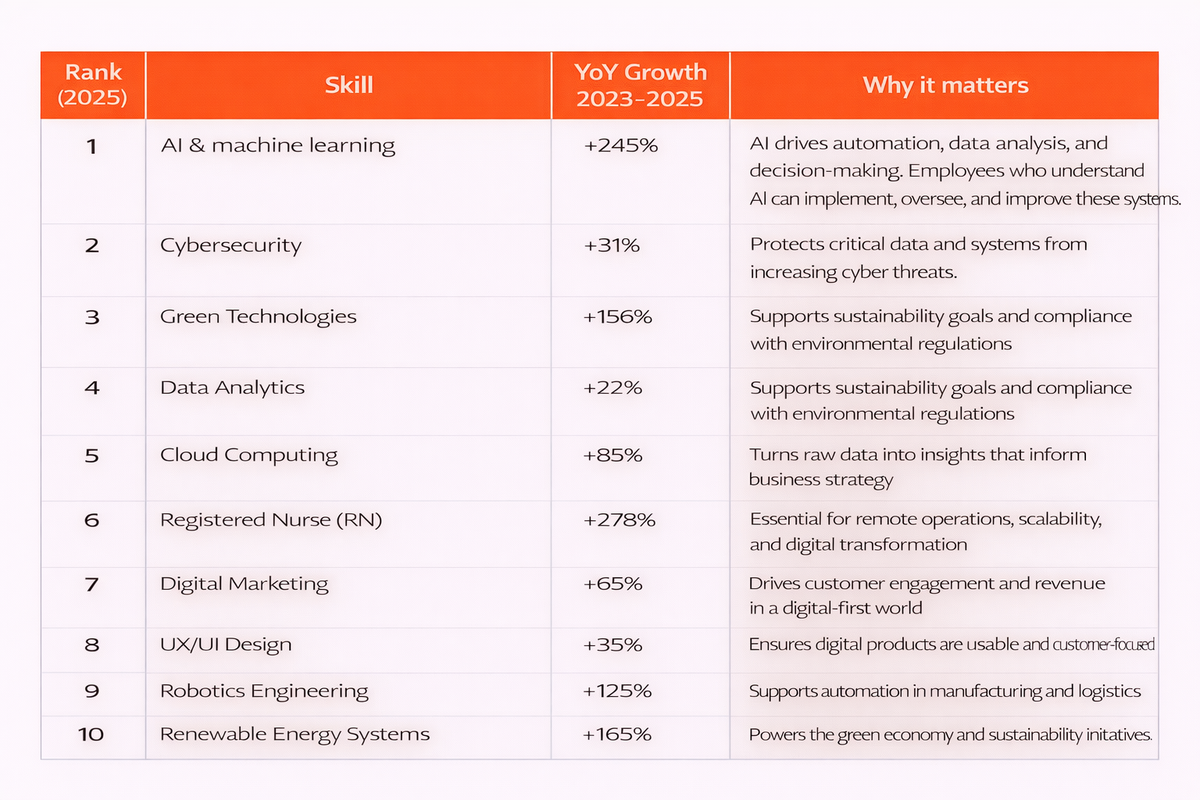
Image Source: Cornerstone OnDemand
If you read enough job descriptions, you start noticing something awkward. The job title says one thing, but the skill expectations tell a different story.
A “program manager” role quietly asks for AI workflow familiarity. A “finance analyst” role slips in automation and data validation. A “customer support lead” role mentions prompt usage and QA checks. That’s the 2026 shift in plain sight: emerging skills are leaking into roles that never used to carry them, because companies want faster execution without adding layers of specialists.
Below are the 20 emerging skills that keep appearing as paid demand across job listings, especially when you look at skill bundles inside a skills index report.
AI-in-the-workflow skills
Applied AI literacy
This is not “knowing what AI is.” It is knowing what AI is good at in your workflow, and where it tends to lie, drift, or hallucinate. In job listings, it often shows up right next to everyday work like summarizing, drafting, categorizing, or analyzing.
Prompting for repeatable outcomes
The signal here is not clever prompts. It is reusable prompts that a team can standardize. In many listings, this sits closer to “process” than to “tech,” which is why it shows up in ops, HR, marketing, and support roles.
Human-in-the-loop review
A lot of companies learned this the hard way: automation increases output, then someone has to own the mistakes. Job descriptions now explicitly ask for people who can review automated outputs, spot failure patterns, and decide when to override.
LLM output evaluation
This reads like QA, because it is QA. Roles mention checking accuracy, tone, bias, and compliance fit, especially where AI touches customer-facing content or internal decision support.
Data reliability and automation skills
Data engineering for AI and analytics
The listings do not romanticize this. They talk about building pipelines, keeping them stable, and dealing with ugly inputs. This is one of the strongest “real work” signals in any skill demand report.
Data quality checks and validation
You’ll see phrases like validation rules, anomaly detection, monitoring, reconciliation. It shows up because teams are tired of dashboards and models that look confident but are built on shaky data.
Workflow automation through APIs
This is the “connect the pipes” skill. Not building a product from scratch, but wiring systems so manual steps disappear. It’s often paired with ownership language: maintain, monitor, document, improve.
Model operations and monitoring
Once models move into production, someone has to watch performance, drift, and breakpoints. The postings that mention this usually signal they are past pilots and are now living with AI as part of the system.
Security, privacy, and governance skills
Security awareness for non-security roles
Many job descriptions now assume basic security judgment, even for general roles. Things like handling sensitive data, recognizing risky access patterns, and following secure practices are no longer “nice to have.”
Identity and access management basics
You do not need to be a security engineer, but you do need to understand permissions, roles, and access boundaries. This keeps showing up because cloud tools made access easy, and mistakes expensive.
Privacy-by-design execution
This has shifted from policy talk to implementation language. Job postings increasingly describe privacy embedded into flows, collection, storage, retention, and sharing. It is practical, not philosophical.
AI governance and risk controls
This is where companies start sounding serious. Documentation, traceability, audit readiness, responsible use. When this shows up in a listing, it is usually tied to regulated industries or customer-impacting AI.
Product and market intelligence skills
Product experimentation and measurement
Many listings ask for experimentation skills but the subtext is decision velocity. Teams want people who can run tests, interpret results, and make calls, not just report numbers.
Customer journey analytics
This is about connecting the dots across touchpoints. In job descriptions, you’ll see requirements around stitching data, identifying drop-offs, and turning the insight into changes that stick.
Competitive intelligence analysis
Not “read competitor blogs.” The demand signal is for structured monitoring: tracking moves, pricing shifts, messaging changes, and market signals that affect roadmap and go-to-market decisions.
Pricing and revenue analytics
This shows up when companies are squeezing margins. Listings mention revenue levers, pricing strategy support, forecasting, and analysis that actually influences how money is made.
Human skills that rise when automation rises
Problem framing
When tools make execution easier, the bottleneck becomes choosing the right problem. Job postings increasingly value people who can structure ambiguity into something teams can act on.
Cross-functional communication
Not generic “good communication.” More like: write clearly, align stakeholders, document decisions, reduce confusion across async tools. It is being treated as an execution skill, not a personality trait.
Learning agility
This shows up when teams expect processes to change quarterly. Employers want people who can adapt fast without breaking quality, and without needing a full reset every time a tool changes.
Decision-making under uncertainty
This is the quiet requirement behind many roles that include ownership. Even with more data and more AI, uncertainty is still there. Employers are looking for people who can decide, explain why, and carry the consequence.
What the 2026 Skill Demand Report Reveals About Workforce Skill Gaps
When people say “we have a workforce skill gap,” they usually mean “we can’t ship fast enough.” The job data backs that up, but it also explains why it keeps happening. The gap in 2026 is rarely about not having smart people. It’s about teams not having the right skills spread across the work, so everything bottlenecks around a few individuals, a few tools, or a few approval gates.
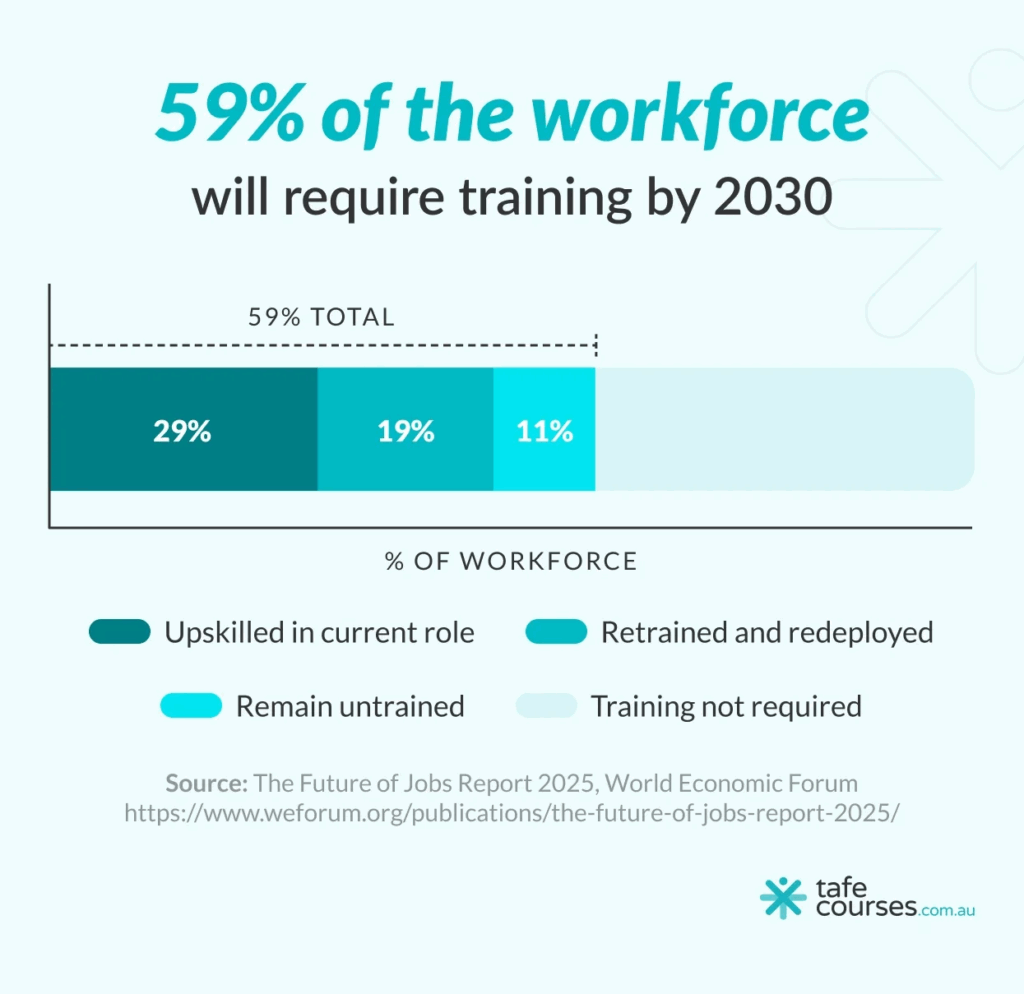
Image Source: Tafe Courses
Skills are present, but they are concentrated in the wrong places
In many companies, emerging skills exist, but they sit in pockets. One person is the “AI person.” One analyst is the “data person.” One security lead is the “risk person.” That setup breaks the moment workflows scale.
Job postings reflect this reality. Employers are not just hiring for expertise, they are hiring to distribute capability. That is why applied AI literacy, data validation, and governance habits show up across roles that used to be “business-only.” The market is telling you something simple: these skills need to live inside day-to-day execution, not as a shared service.
The real gap shows up after output is generated
A lot of teams can generate outputs now. They can draft, summarize, automate a report, even build a quick model. The struggle starts right after that.
The listings keep pointing to the same missing layer: people who can check the output, explain it, and make it usable. That is where skills like AI output evaluation, human-in-the-loop review, data quality monitoring, and decision ownership show up. They are not glamorous. They are the skills that stop a workflow from producing confident nonsense.
Role redesign is creating “hybrid” expectations faster than orgs can adapt
Hiring requirements in 2026 are mixing skill sets that used to sit in separate teams. A product role asks for experimentation plus AI workflow comfort. An op’s role asks for automation plus data checks. A compliance-adjacent role asks for privacy execution plus basic technical fluency.
This is why skill gap analysis often feels confusing internally. Traditional skills frameworks assume clean boundaries. Job listings do not. They reflect how work is being stitched together in modern teams.
Skill gaps look different depending on regulation and customer impact
The market pressure is not the same everywhere. In regulated industries, the workforce skill gap clusters around privacy-by-design, access controls, governance execution, and audit-ready documentation. In high-velocity digital businesses, it clusters around experimentation, customer journey analysis, competitive monitoring, and pricing decisions.
That difference matters because generic upskilling programs miss the point. A skill demand report is useful precisely because it shows where demand is coming from.
See Emerging Skills Before They Become Hiring Bottlenecks
Get continuous visibility into emerging skills, role redesign signals, and workforce gaps using real-time job data backed by 100M+ listings.
How to Use a Skills Index Report Without Turning It Into a Strategy Document Nobody Uses
Most teams don’t fail at skills planning because they lack data. They fail because the data never makes it past a slide deck.
A skills index report is only useful if it changes what you hire for, what you train, and how roles are shaped. When it doesn’t, it becomes background noise. Job data makes this avoidable, but only if you use it with some discipline.
Hiring is the right move when the skill carries execution risk
Some emerging skills are hard to “train into” quickly. If the skill shows up in job listings alongside words like ownership, accountability, compliance, or production systems, that’s a signal. The market is telling you this capability carries real execution risk.
AI governance, data quality ownership, and model monitoring fall into this bucket. These are skills where mistakes are expensive and learning curves are steep. In these cases, hiring is not about adding headcount. It’s about de-risking workflows that already exist.
Upskilling works when the skill is adjacent to existing work
Other emerging skills sit much closer to what teams already do. Applied AI literacy, prompt-driven workflows, and customer journey analysis often fall into this category. Job listings don’t describe these as specialist roles. They describe them as expectations layered onto existing responsibilities.
This is where upskilling makes sense. But only when learning is tied to real work. Courses without application rarely close a workforce skill gap. Skills stick when people use them to ship something that matters.
The skills index helps you stop overcorrecting
One of the quiet benefits of a skills index report is restraint. Not every rising skill deserves action.
Job data shows which skills persist quarter after quarter and which fade once the hype cycle moves on. That perspective prevents teams from overhiring or launching training programs around skills that won’t matter six months later. It also helps leaders say no, which is often harder than saying yes.
Turning skill data into an operating rhythm
The teams that get value from skill demand reports treat them as inputs, not events. They revisit the data regularly, compare it against internal capability, and adjust hiring and learning plans incrementally.
This is how skill gap analysis becomes a system instead of a one-time exercise. The goal is not to chase every emerging skill. It’s to stay aligned with how work is changing in your market.
Why Job Listings Are the Most Reliable Signal for Emerging Skills in 2026
If you want to understand where skills are actually going, job listings are hard to beat. Not because they’re perfect, but because they’re honest in a way most other sources are not.
When a company posts a role, it is reacting to something concrete. A backlog that is not moving. A system that does not scale. A regulatory expectation that just became real. Job listings are where those pressures show up first, long before they are cleaned up into frameworks or trend reports.
Job postings reflect urgency, not aspiration
Surveys and strategy documents tend to describe what organizations want to do. Job listings describe what they need help with right now. That difference matters.
In a skill demand report, recurring skill mentions across listings signal unresolved pain. If a capability keeps appearing, it means teams have not been able to absorb it organically. They are paying to bring it in. That is why job data surfaces emerging skills earlier than resumes or internal assessments.
Resumes describe the past, listings describe the next problem
Resumes are backward-looking by nature. They capture what someone has already done. Job listings, on the other hand, are forward-looking. They describe the problems an organization expects to face over the next 6 to 18 months.
This is especially important for emerging skills in 2026. Many of the capabilities now in demand did not exist as formal roles a few years ago. They show up first as requirements buried inside otherwise familiar job titles. That makes job data a better early-warning system for workforce skill gap risk.
Job data exposes how skills are actually combined
Another advantage of listings is context. Skills rarely appear alone. They show up next to other requirements, revealing how work is being bundled.
For example, AI-related skills often appear alongside data validation, process ownership, or compliance language. That tells you something important: employers are not hiring for experimentation, they are hiring for reliability. A skills index built on this co-occurrence data is far more useful than a flat list of trending terms.
Why this matters for planning, not just reporting
The real value of job listings is not insight, it is timing. They give you a window into demand before it becomes obvious internally. That allows teams to adjust hiring plans, learning investments, and role design before delivery suffers.
This is what makes a job-data-led skills index report different from a static study. It reflects pressure as it builds, not after it has already caused problems.
See Emerging Skills Before They Become Hiring Bottlenecks
Get continuous visibility into emerging skills, role redesign signals, and workforce gaps using real-time job data backed by 100M+ listings.
Why Teams Use JobsPikr to Track Emerging Skills Continuously
Most teams don’t struggle because they lack insight. They struggle because insight arrives too late.
By the time an annual report confirms a skill trend, hiring is already slow, delivery is already strained, and the workforce skill gap has started showing up as missed deadlines or quality issues. This is the gap JobsPikr is designed to close.
JobsPikr is not a one-time skills study. It is a live view of how roles, skills, and expectations are shifting in the market, based on job data that updates continuously.
Skills intelligence that updates as demand shifts
Emerging skills do not move in yearly cycles anymore. They evolve quarter by quarter, sometimes faster. JobsPikr tracks these changes as they happen, so teams can see when a skill is stabilizing into long-term demand versus when it is flattening out.
This matters because hiring and upskilling decisions are hard to reverse. A skills index report that reflects current demand helps teams avoid locking into outdated assumptions.
Visibility into how skills spread across roles and industries
One of the most common blind spots in skill planning is assuming a skill belongs to a single function. Job data shows otherwise. Skills migrate. They start in specialist roles and then spread into adjacent teams.
JobsPikr makes this visible by showing where emerging skills appear, how often they recur, and which roles are absorbing them fastest. That context is critical for workforce planning, especially when roles are being redesigned rather than replaced.
From static skill lists to practical workforce planning
Static lists answer the wrong question. The real question teams ask is: What should we act on now?
JobsPikr connects skill demand signals to hiring pressure, role evolution, and geographic trends. That allows HR, product, and strategy teams to prioritize action, whether that means hiring, targeted upskilling, or rethinking how work is structured.
This is how a skill demand report becomes operational, and how skill gap analysis stops being theoretical.
Designed for ongoing decisions, not one-off insights
Teams that use JobsPikr well treat it as part of their planning rhythm. They check skill signals alongside hiring metrics, attrition data, and delivery goals. Over time, patterns emerge that are hard to see in snapshots.
That continuity is what turns raw job data into workforce intelligence, and why teams rely on JobsPikr to stay ahead of emerging skills instead of reacting to them.
What the 2026 Emerging Skills Index Means for Your Next 12 Months of Hiring and Upskilling
If there’s one clean takeaway from emerging skills in 2026, it’s this: skill demand is moving faster than most internal planning cycles. That mismatch is what creates the workforce skill gap leaders feel as “we’re busy but not moving.”
The Top 20 list is useful, but the bigger value is the pattern behind it. Employers are hiring for skills that make work reliable in AI-assisted environments: applied AI usage, output evaluation, data quality habits, automation through integration, and governance that can stand up to scrutiny. These are not trends you wait out. They are becoming the normal requirements for execution.
A good skill demand report or skills index report is not meant to sit in a drive folder. It’s meant to drive decisions: which roles need redesign, which skills must be distributed across teams, and where skill gap analysis should focus so training turns into measurable output. Teams that treat skills data as a live signal will hire with fewer surprises and upskill with more precision.
See Emerging Skills Before They Become Hiring Bottlenecks
Get continuous visibility into emerging skills, role redesign signals, and workforce gaps using real-time job data backed by 100M+ listings.
FAQs
1) What are emerging skills, and how are they different from in-demand skills?
Think of emerging skills as the “just became real” category. They are showing up repeatedly in job descriptions, but they are not yet baked into every role template. In-demand skills are already everywhere and often stop being listed because they’re assumed. Emerging skills still get spelled out because hiring teams are actively trying to plug a gap.
2) How often do emerging skills change in job listings?
They move in waves, not on a neat calendar. You’ll see some skills climb steadily for quarters because they map to structural changes in work, like AI-enabled workflows or stricter governance. Others pop up for a few months and then flatten once the hype cools or the tool gets replaced. That’s why “once a year” skills planning tends to feel outdated the moment it’s published.
3) What is a skills index report, and who should use it?
A skills index report is basically a market mirror. It pulls skills signals from job listings and shows what employers are repeatedly asking for, and where those skills are spreading. HR and workforce planning teams use it to avoid hiring blind spots. Product and strategy teams use it to understand how roles are being reshaped in the market, which often affects delivery speed and operating models.
4) How can companies run skill gap analysis using job data?
Start simple: list your top role families and what you currently hire and train for. Then compare that to what the market is asking for in similar roles, using job listings as the reference point. The clearest gaps usually show up where demand is persistent and cross-functional, but internally the skill lives with one specialist or one team. That’s the moment to decide whether you need to hire, spread the skill through upskilling, or redesign the workflow so the dependency disappears.
5) Why are emerging skills critical for workforce planning in 2026?
Because they show you where execution is about to get expensive. When a skill starts appearing broadly in listings, it’s usually tied to a real operational pressure, like quality control in AI outputs, data reliability, or governance expectations. Waiting until a skill is “standard” often means you are already behind and catching up costs more. Tracking emerging skills early lets you plan before it turns into missed timelines, slower decisions, or risk issues.