

- **TL;DR**
- Why the Lump-of-Labor Story Still Spreads (Even When the Data Disagrees)
- Why the Labor Market Isn’t a Static Pie
- Turn Job-Posting Signals into Real Insight
- Job-Posting Data Is a Real-Time Labor Barometer
- Automation Rewrites Tasks, Not the Whole Job Map
- Real-World Example: Demand Swings in Emerging Sectors
- Why Policymakers, Students, and Analysts Should Care
- The Fixed Job Myth Needs to Go
- Turn Job-Posting Signals into Real Insight
- FAQs
**TL;DR**
The lump of labor fallacy is the mistaken idea that there’s a fixed number of jobs to go around. In reality, labor demand moves—by title, skill, industry, and location—and modern job-posting data shows those shifts in near-real time. You can see this in headline indicators: even after cooling from pandemic highs, the U.S. still showed ~7.23 million job openings in August 2025, which is a large, ongoing flow of demand rather than a “fixed pie.” Bureau of Labor Statistics
Technology doesn’t simply delete roles; it rearranges tasks and creates adjacent work. Major studies estimate about 14% of existing jobs could be automated in the next 15–20 years, while another 32% will change significantly—a story of re-mixing, not disappearance. OECD At the same time, employers are adding new skill needs: postings that mention generative-AI skills climbed sharply through 2024–2025, with Lightcast counting tens of thousands of such listings and noting premium pay for roles that require AI competencies.
Big-picture forecasts echo this churn. The World Economic Forum expects 23% of jobs to change by 2027—with large numbers created and eliminated—underscoring that labor markets evolve rather than shrink to a preset total. World Economic Forum
In this explainer, we’ll use modern postings signals—titles, skills, locations, and velocity—to show why the lump of labor fallacy doesn’t hold up, how to read postings responsibly, and where to expect new roles to surface when automation arrives. If you want to see these demand swings for your sector or country, book a quick JobsPikr walkthrough and we’ll show you clean, normalized charts built for analysts and media.
Why the Lump-of-Labor Story Still Spreads (Even When the Data Disagrees)
People don’t cling to bad ideas for fun. They do it because those ideas feel true in the moment. The lump of labor fallacy sticks around for three simple reasons: we remember layoffs, we love simple villains, and we rarely see the new jobs until they’re everywhere.
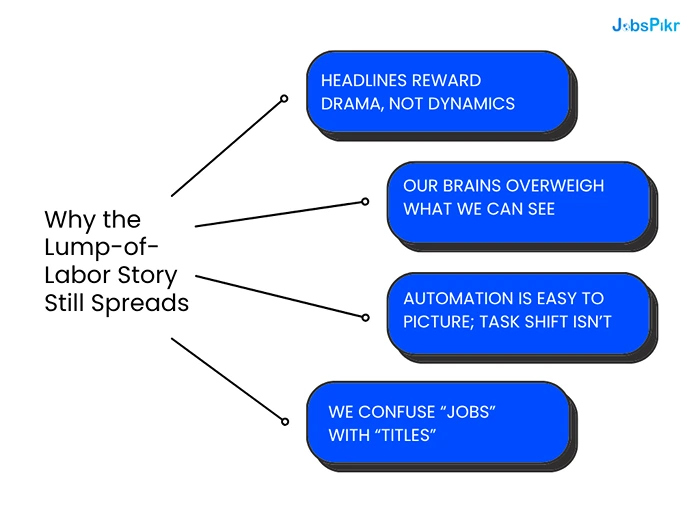
Headlines Reward Drama, Not Dynamics
A factory cuts 400 roles. That’s a headline. A year later, the same region adds 600 roles across logistics, maintenance, data ops, and customer success. That’s a spreadsheet. News cycles amplify loss and underplay reallocation. The result: a narrative that jobs vanish and never come back, when what actually happens is labor demand moves—by task, title, and sector.
Our Brains Overweigh What We Can See
You can point to a closed store. It’s harder to point to “skills demand” in job-posting data. The visible loss beats the invisible creation every time. That’s availability bias at work. When you track postings over time, you see labor market trends for what they are: elastic, not fixed.
Automation Is Easy to Picture; Task Shift Isn’t
“Robot replaces clerk” is a clean mental image. “Clerk role splits into inventory ops, POS integrator, and customer experience lead” takes more effort. But that split is the norm. Automation rarely deletes entire occupations; it shuffles tasks and raises the skill floor. That’s labor elasticity in action.
We Confuse “Jobs” with “Titles”
Titles change faster than we think. Five years ago, almost nobody hired for “AI product analyst,” “prompt ops,” or “risk labeling.” Today, these are normal searches. If you only watch titles you already know, the market looks like it’s shrinking. If you track skills across postings, the picture flips: demand is reshaping, not receding.
Why the Labor Market Isn’t a Static Pie
What “labor” means in economics
In economics, “labor” refers to the supply of human effort, skill, or work that can be applied to produce goods or services. It’s not just the total number of employed people—it includes variation in skill levels, hours worked, task content, and sectoral mix. So when we talk about “labor meaning in economics,” we’re emphasizing that labor is diverse, flexible, and responsive—not a block of fixed units.
When someone says professional labor definition, they generally mean higher-skill work (e.g., engineers, consultants, analysts) characterized by specialized knowledge or credentials. But even within “professional labor,” roles shift. An “analytics engineer” of today may replace “data analyst + ETL specialist” of earlier years. So even professional labor isn’t static—it morphs.
Shifting demand: elastic, not fixed
One of the strongest counters to the lump-of-labor fallacy is the idea of labor elasticity—how sensitive demand for labor is in response to changes in wages, output, or technology. Empirical work shows that labor demand is elastic in many settings, especially over longer time frames. For example:
- Meta-analyses estimate the own-wage elasticity (how demand for labor changes when wages change) often lies between –0.1 to –0.6, depending on skill and regulation. (From a meta-analysis of demand elasticity studies) EconStor
- Another study notes long-run elasticities tend to be higher than short-run ones—over time, firms and labor markets adjust, substitute tasks, invest in capital, or reorganize roles. Econlib
- Research also shows that lower-skilled labor, part-time, or atypical employment tends to have more elastic demand than rigid, highly regulated roles. Econlib
What this means in practice is that when technology, consumer demand, or regulation changes, labor demand shifts—not in a binary on/off way, but along a curve. New jobs are created in response to new needs, and old jobs shrink or evolve.
Real macro signs: growth + demand swings
Another helpful lens is through employment projections. For instance, the U.S. Bureau of Labor Statistics (BLS) forecasts that total employment will grow 4.0 percent from 2023 to 2033, adding about 6.7 million jobs overall. Bureau of Labor Statistics
That’s not a tiny number. It contradicts the idea that jobs only get redistributed. Over a decade, demand across sectors changes—healthcare, tech, clean energy expand; some traditional roles contract.
In the OECD context, unemployment rates remain low in many countries (around 4.9 percent in May 2024) despite major shocks like the pandemic, showing labor markets are resilient and responsive. OECD
These signals hint that labor markets are not fixed pies but landscapes of shifting peaks and valleys.
Turn Job-Posting Signals into Real Insight
Go beyond outdated labor myths. Use real-time job data to track, analyze, and anticipate workforce change.
Job-Posting Data Is a Real-Time Labor Barometer
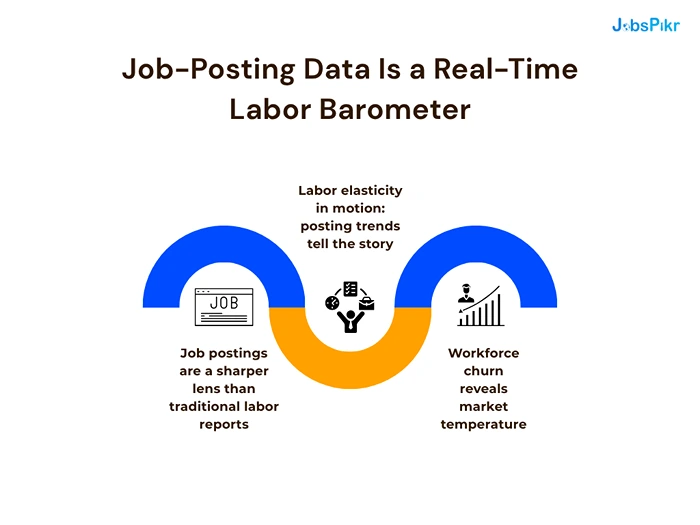
Job postings are a sharper lens than traditional labor reports
Traditional labor statistics—like unemployment rates or quarterly employment surveys—are lagging indicators. By the time they tell us something changed, the shift has already happened. Job-posting data, on the other hand, reflects demand as it forms. When companies anticipate growth, they post openings. When they expect contraction, postings drop even before layoffs begin.
That makes postings one of the clearest signals for how elastic and dynamic labor markets actually are. They reveal what the lump of labor fallacy hides: work demand is not static; it moves in waves.
Labor elasticity in motion: posting trends tell the story
Take one of the clearest examples in the last five years—AI and data roles. In 2018, “Prompt Engineer” wasn’t a recognized title. By 2024, Indeed reported over a 2,000% increase in AI-related postings compared to five years prior, with particularly sharp spikes after the public adoption of generative AI. (Source: Indeed Hiring Lab)
Meanwhile, postings for traditional data entry roles declined steadily over the same period. This isn’t a transfer of a fixed number of jobs from one bucket to another—it’s the creation of new categories in response to new technologies.
Similarly, the U.S. BLS notes that occupations in computer and mathematical fields are projected to grow 16.2% from 2023 to 2033, compared to just 2.8% for the overall labor market. (BLS Employment Projections). That’s real-time elasticity at work.
Workforce churn reveals market temperature
Another way postings expose labor market trends is through workforce churn—the continuous movement of people between jobs, industries, and roles. High churn doesn’t just signal instability; it often indicates opportunity.
For example, LinkedIn’s Global Talent Trends report found that around 45% of job changers in 2023 moved into a different industry altogether. (LinkedIn Economic Graph). That’s evidence against the notion of a fixed pool of work. People aren’t just swapping seats; they’re shifting into entirely new types of work as demand evolves.
Why this matters for labor market analysis
If the lump of labor fallacy were true, these kinds of surges and shifts would be impossible. The total number of jobs would stay flat, only redistributing across existing categories. But what job-posting data shows, week after week, is sectoral expansion and role evolution.
This is exactly why platforms like JobsPikr matter: they make it possible to track changes not just yearly or quarterly, but as they happen. Analysts, journalists, and policymakers can see which roles are emerging, which are cooling, and which skills are climbing in real demand.
Automation Rewrites Tasks, Not the Whole Job Map
The fear vs. the footage
“Robots took our jobs” makes a catchy headline. It also leans on the lump of labor fallacy—the idea that if machines do more, humans must do less because the total amount of work is fixed. Real labor markets don’t behave that way. They reallocate tasks, shift skills, and expand into new lines of work. A simple, well-documented example: when ATMs spread in the 1990s, U.S. banks didn’t phase out tellers; they opened more branches and redesigned what tellers did. The role moved toward customer service and sales while machines handled routine cash handling (Federal Reserve Bank of Boston).
What the data actually shows
If automation simply deleted jobs, you’d expect a steady contraction in total demand. That’s not what broad evidence shows. The World Economic Forum’s Future of Jobs 2023 finds a mixed but dynamic picture—roles heavy on repetitive tasks decline while new roles in analytics, green sectors, and tech services expand (WEF, 2023). The OECD estimates only about 14% of jobs across member countries face high risk of full automation; far more—roughly a third—face task transformation, meaning the job changes shape rather than disappears (OECD, Employment Outlook). And zooming out to the macro lens, McKinsey Global Institute estimates automation could lift productivity growth by around 0.8–1.4 percentage points annually—economic momentum that tends to pull new activity (and jobs) into the system (MGI).
Put plainly: automation is mostly a task story, not a headcount apocalypse. The composition of work changes. Demand for different skill mixes rises. That’s labor elasticity in action.
Where the new work is turning up
You can see the shift sector by sector. Clean energy is a clear case: as policy and investment scale up, hiring follows. U.S. Bureau of Labor Statistics projections put wind turbine technicians and solar PV installers among the fastest-growing roles through 2033, with growth rates north of 40–50% (BLS, Occupational Outlook). Healthcare keeps expanding too—not because technology replaces care, but because tech augments diagnostics, coordination, and remote monitoring, which increases the surface area of work. And in data and AI, the story isn’t just “more engineers.” It’s new job families—MLOps, AI governance, safety, data quality, domain specialists—plus hybrid roles that blend analytics with operations.
Across all three, you get the same pattern: as some tasks get automated, adjacent roles appear around oversight, integration, troubleshooting, compliance, and productization. It isn’t zero-sum. It’s additive.
Why this matters for how we plan
Treating automation as subtraction leads to defensive policy and stale curricula. Treating it as task reallocation leads to better choices: faster reskilling, earlier curriculum updates, and smarter workforce programs that track where postings are heating up. That’s where job-posting data helps. Because postings move before payroll totals and headlines, they’re a practical early signal of workforce churn—new titles showing up, skill requirements shifting, locations tilting. For labor market trends, it’s the difference between reacting late and moving with the wave.
Real-World Example: Demand Swings in Emerging Sectors
Economic debates often sound abstract, but job-posting data make the story real. When new technologies or policies reshape industries, labor demand doesn’t just shift titles—it creates entire ecosystems of work. Let’s look at three high-impact sectors where demand swings have exposed the lump of labor fallacy for what it is: an outdated assumption.
1. The AI Boom: New Job Families in Less Than 5 Years
A decade ago, most companies weren’t hiring for AI engineers, prompt engineers, or MLOps leads. Fast forward to 2024, and AI-related postings are up more than 2,000% since 2018. (Source: Indeed Hiring Lab)
But it’s not just about a few technical roles. Around those core AI jobs, entirely new clusters have emerged—policy analysts to handle AI regulation, ethicists, data annotators, synthetic data specialists, AI safety researchers, and AI solution architects. What began as a niche technical wave now stretches across marketing, operations, healthcare, finance, and manufacturing.
This is classic labor elasticity at work. The total job pool didn’t shrink—it expanded as the task structure evolved.
2. Green Energy: Policy + Tech = Hiring Spikes
Renewable energy is another clear example. As governments pushed clean energy transitions, companies followed with aggressive hiring. According to the U.S. Bureau of Labor Statistics, wind turbine technician roles are projected to grow 45% and solar photovoltaic installers 52% between 2023 and 2033. (BLS Occupational Outlook)
These aren’t “replacement” jobs; they’re net new. And they drive second-order effects—logistics, maintenance, local construction, data monitoring, regulatory compliance, and even education and training jobs. A single wind farm project can create opportunities in a dozen different skill categories.
This completely breaks the notion of a fixed job pie. When green energy grows, it creates surface area for new work.
3. Healthcare: A Sector That Keeps Expanding
Healthcare is often underestimated in labor debates because it looks stable. But in practice, it has been one of the most consistent job creators globally.
BLS data projects healthcare occupations will grow 13% between 2023 and 2033, adding nearly 2 million jobs in the U.S. alone. (BLS Employment Projections)
Technological advancement here doesn’t eliminate work—it multiplies it. Telehealth creates new patient coordination roles. AI diagnostics open space for specialized technicians. Remote monitoring expands the need for data interpretation. The sector adapts to new tools by broadening its labor structure, not compressing it.
Why these three matter
These three sectors prove the same point from different angles:
- AI shows how fast new skills can create entirely new job families.
- Green energy demonstrates how policy triggers job creation cascades across industries.
- Healthcare proves that technology can augment human work rather than replace it.
If the lump of labor fallacy held true, job postings would show one sector’s growth mirrored by another’s loss. Instead, what we observe is net creation and diversification.
This is why real-time job-posting data is more than just hiring information—it’s economic intelligence. It shows where industries are going, not just where they’ve been.
Why Policymakers, Students, and Analysts Should Care
The lump of labor fallacy isn’t just an academic misconception. When it influences how governments design workforce policies, how universities plan curricula, or how young workers make career decisions, it has real consequences. Assuming that the number of jobs is fixed makes economies slow to adapt. Treating labor demand as dynamic—which it actually is—unlocks better planning, faster reskilling, and smarter investment.
For policymakers: Planning ahead instead of reacting
Labor market trends are early warning systems. Job-posting data surfaces shifts in demand months or even years before official reports. For example, AI-related roles started showing posting spikes in 2018, well before regulatory discussions picked up in most countries.
That kind of lead time allows governments to:
- Allocate training budgets where demand is actually growing.
- Anticipate workforce churn in vulnerable sectors.
- Shape immigration or reskilling programs before shortages escalate.
Countries that built rapid-response workforce strategies after COVID-19—using real-time job market signals—recovered employment faster than those that waited for quarterly surveys.
(Source: OECD Employment Outlook 2024 — oecd.org)
For students: Choosing skills that match tomorrow’s demand
If you’re entering the workforce, knowing what’s hiring right now matters less than knowing what will keep hiring in two to five years. Job-posting data can reveal which roles are expanding, stabilizing, or fading.
For instance, green energy roles didn’t just appear overnight—they climbed steadily for years. Students who paid attention early got ahead of the curve. The same is happening today with AI governance, climate tech, and digital health. By the time these roles dominate job boards, the first wave of talent already has an edge.
(Source: U.S. Bureau of Labor Statistics Employment Projections, 2023–2033 — bls.gov)
For analysts and media: Spotting signals before narratives form
By the time a “job crisis” or “boom” hits the news, the trend has usually been building for months. Analysts who watch real-time labor market trends can catch early signals: skill clusters forming, old titles disappearing, new hybrid roles emerging.
This makes job-posting data not just a resource for hiring intelligence, but a predictive tool for macroeconomic shifts. For example, tracking sharp changes in demand for cybersecurity, renewable energy, or logistics roles can reveal where investment—and geopolitical attention—may follow.
Why letting go of the fallacy matters now
The idea that jobs are finite leads to defensive policymaking, outdated education pipelines, and reactive labor strategies. Seeing labor demand as elastic allows all three groups—governments, students, and analysts—to act ahead of the curve. That’s not just a smarter way to manage change; it’s how countries and individuals stay competitive in fast-moving global markets.
The Fixed Job Myth Needs to Go
The lump of labor fallacy isn’t just a bad economic theory; it’s a barrier to smart decisions. It frames job creation as a zero-sum game, where one group’s gain is another’s loss. But the evidence is overwhelming: labor markets are dynamic systems, not static pies. Jobs don’t just get shuffled; new ones emerge, evolve, and multiply.
Why this matters
- Policy should be built on forward signals, not backward fears. Real-time labor market trends from job postings give governments the lead time to prepare—not panic.
- Students need a map of where demand is going, not where it’s been. Aligning education and training with actual hiring trends closes the skills gap before it widens.
- Analysts and media have the chance to shape accurate narratives. Instead of amplifying fears about “job loss,” they can highlight where new opportunities are forming.
Labor demand is elastic, not fixed. Automation isn’t stealing jobs—it’s rewriting task structures. Green energy, AI, and healthcare aren’t exceptions; they’re proof that when industries evolve, they pull the job graph upward.
If we want labor strategies that work, we need to let go of static thinking and embrace dynamic signals. Job-posting data gives us the clarity to do that.
Turn Job-Posting Signals into Real Insight
Go beyond outdated labor myths. Use real-time job data to track, analyze, and anticipate workforce change.
FAQs
1. What is the lump of labor fallacy in simple terms?
It’s the belief that the number of jobs in an economy is fixed—like a pie with only so many slices. If someone takes a slice, someone else must lose theirs. Real labor markets don’t work this way. Jobs are created, tasks are reshaped, and skill demands shift constantly as industries evolve.
2. How does job-posting data prove this fallacy wrong?
Job postings move faster than official employment stats. When new industries grow or existing ones pivot, postings rise before the workforce numbers catch up. If jobs were truly fixed, we wouldn’t see spikes in new roles (like AI engineers or wind technicians) while others remain stable or transform. Postings are proof of labor elasticity in real time.
3. Is automation actually taking away jobs?
Automation removes certain tasks, not the entire job base. Machines take over repetitive work, while human roles shift toward oversight, strategy, and new services. Think of ATMs expanding bank teller jobs rather than killing them, or AI creating entire job families around model training, governance, and deployment. The total opportunity set grows—it doesn’t collapse.
4. What does ‘labor meaning in economics’ actually cover?
In economics, “labor” isn’t just headcount. It includes time, skills, flexibility, and the structure of work itself. Professional labor, for example, evolves with each wave of innovation. A data analyst from ten years ago and a prompt engineer today sit in different industries but represent the same underlying principle: the labor market adapts.
5. How does workforce churn fit into labor market trends?
Workforce churn—people moving between roles, industries, and sectors—is a feature of dynamic labor markets, not a bug. It signals where demand is shifting. When green energy grows, when healthcare scales, or when AI matures, workers flow toward those opportunities. Churn is how economies redistribute talent to new growth areas.