- **TL;DR**
- What is A Workforce Skills Gap?
- See the Skills Gap Before It Hits Your Bottom Line
- What Causes the Workforce Skills Gap?
- How Data-Driven Insights Reveal Hidden Skills Gaps
- What Does a Data-Driven Skills Gap Analysis Look Like in Practice
- How Can Companies Address Workforce Skills Gaps with Job Market Analytics
- Case Example: Addressing the AI Skills Gap in the Workforce
- Building a Continuous Skills Intelligence Framework
- Why the Future of Workforce Planning Depends on Data
- See the Skills Gap Before It Hits Your Bottom Line
- FAQs
**TL;DR**
If you’re trying to close the workforce skills gap, numbers alone won’t cut it. What really helps is combining internal employee data with real-time market signals around job postings and skill demand. That’s the essence of workforce intelligence. With the right job market analytics, you can spot where the gap lives (which roles, which skills, which locations), then align training, hiring, and planning accordingly. At JobsPikr, we help you move from asking “we have a gap?” to “we know exactly which gap and what to do about it.”
The phrase “workforce skills gap” is frequently used in leadership meetings, HR strategy decks, and policy discussions. It sounds important, and it is. But too often it stays vague. We talk about “we don’t have enough digital skills,” or “AI skills are missing,” without ever quantifying exactly where, how big, or in what form that gap shows up.
Here’s the truth: until you can measure the gap, you can’t close it.
That’s why workforce intelligence: real, timely job market analytics matters more than ever. Instead of relying on annual surveys or anecdotal inbox complaints, you can track job postings, skills demand signals, market shifts, and even geographic hotspots of talent shortage. These insights shine a light on the specific gaps: “role X in region Y needs skill Z and we don’t have enough of it yet.”
When organizations combine those external signals with their internal view of people and skills, they unlock something far more powerful than just another learning program. They unlock strategic workforce planning. They can target training dollars where they matter, adjust hiring strategies to match real demand, and prevent the gap from becoming a bottleneck for growth.
Later in this article, you’ll see how you can use job market analytics to carry out a workforce skills gap analysis, align your L&D and hiring to real market demand, and build a continuous intelligence loop so you’re not playing catch-up.
Let’s begin by unpacking exactly what the skills gap looks like today and why traditional responses are falling short.
What is A Workforce Skills Gap?
Most teams don’t struggle because they “don’t have enough talent.” They struggle because they can’t see—clearly and quickly—which skills are missing, where they’re missing, and how fast those needs are shifting. That’s the skills gap in real life: a moving target you can’t hit if you only check the board once a year.
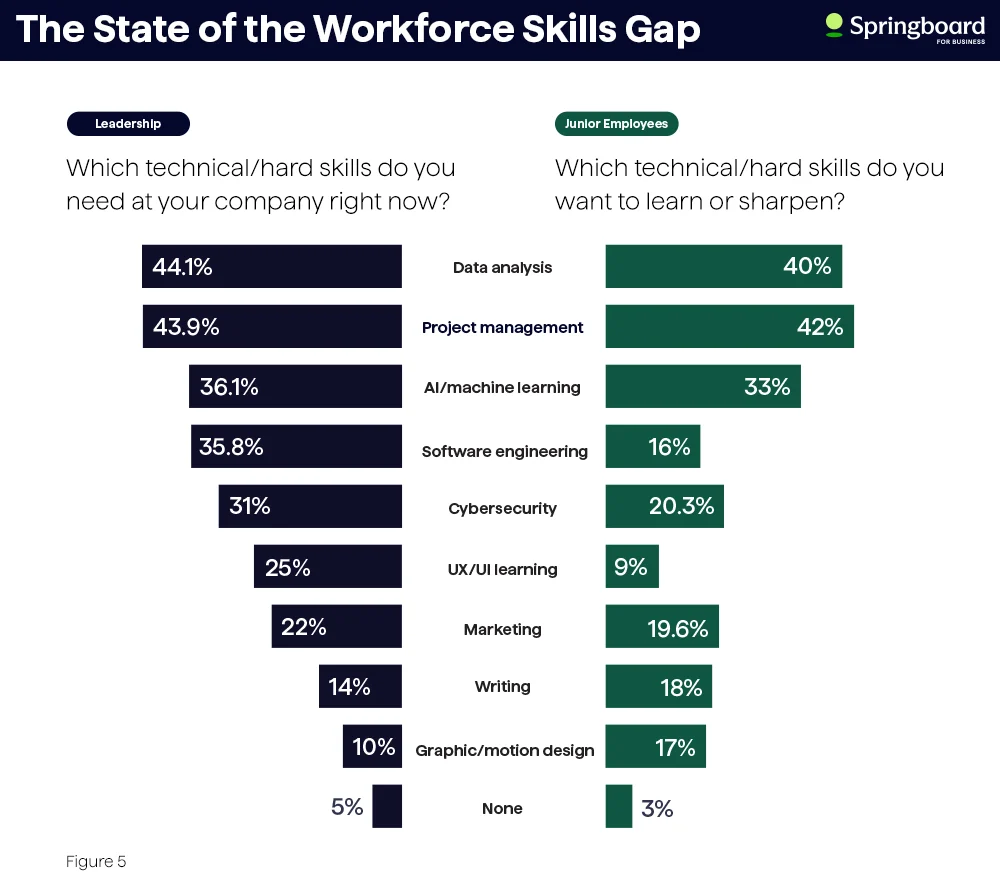
Image Source: springboard
What exactly is a “skills gap” in plain terms?
It’s the distance between the capabilities your people have today and the capabilities your work will actually demand next quarter (not next decade). Sometimes it’s obvious—no one on the team has hands-on experience with the data stack you just adopted. Often it’s quieter—roles that used to be fine with “generalist analytics” now require someone who can build production-ready dashboards or wrangle LLM prompts without breaking workflow. The gap isn’t theoretical; it shows up in missed deadlines, slow hiring cycles, and training plans that land too late.
Why does measuring it matter now?
Because the ground is shifting under your feet. Employers themselves expect substantial churn in what workers need to know: the World Economic Forum reports that 44% of workers’ skills are expected to be disrupted over the next five years.
You don’t have to agree with every forecast to accept the message: static plans won’t cut it. If your skills map is based on last year’s assumptions, you’re planning for a market that’s already gone.
What usually goes wrong (and how to avoid it)
Organizations often treat the gap like a one-time deficit—“run a course, hire a specialist, done.” In practice, it’s a system problem. Role definitions drift, requirements in job postings evolve, and learning catalogs lag behind the work. The fix starts with visibility: a live view of external demand (what the market is hiring for, by role and skill) paired with your internal bench (who has what, where they’re headed, and what can be learned quickly). When you have both, priorities fall out naturally. You can say, with a straight face, “We’ll upskill here, hire there, and sunset that program because the demand line is flattening.”
That’s the difference between talking about a skills gap and closing one: not louder arguments, just better sightlines.
See the Skills Gap Before It Hits Your Bottom Line
Get ahead of market shifts with data that shows exactly where talent shortages are forming
What Causes the Workforce Skills Gap?
Every company says they’re hiring for “new skills.” Few stop to ask why those skills are missing in the first place. The workforce skills gap doesn’t appear out of thin air; it grows in the quiet spaces between how work changes and how fast people can keep up.
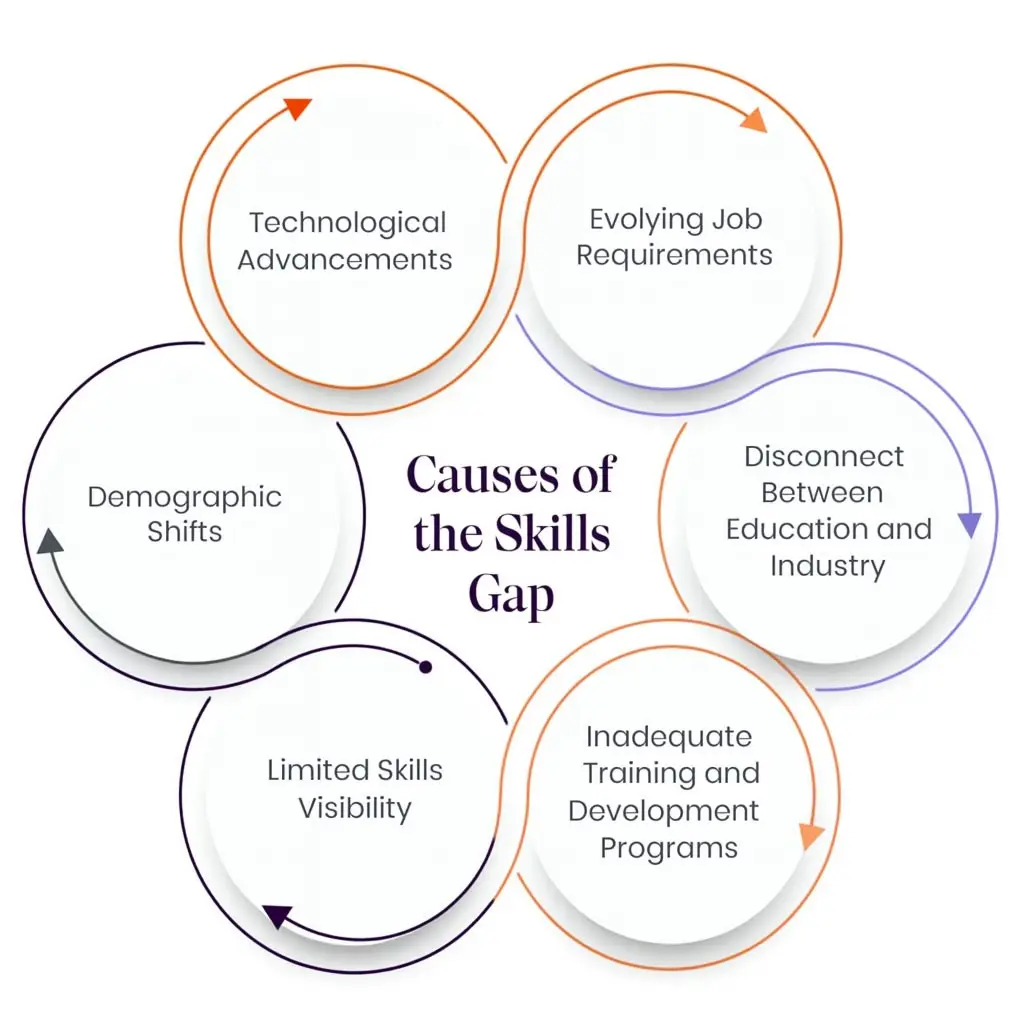
Image Source: iMocha
1. Technology moves faster than training
Innovation rarely waits for curriculum updates. Cloud adoption, automation, and generative AI create new tasks inside old job titles. A marketing analyst suddenly needs SQL fluency; a recruiter is now expected to run AI-assisted sourcing. Learning programs, built on fixed schedules, lag behind. By the time an upskilling plan rolls out, the target has already shifted.
2. Education and work speak different languages
Most formal education still teaches for stability, not velocity. Graduates enter the market fluent in theories but missing the tools employers now demand—especially in data, software, and analytics. The gap widens because the credential pipeline updates on an academic calendar, while market needs update weekly through job postings.
3. Companies misread their own demand
A surprising number of organizations don’t have a current inventory of internal skills. HR databases show job titles, not actual capabilities. Hiring managers then base decisions on gut instinct or recycled job descriptions, not verified skill data. The result: misaligned hiring, repeated training spend, and frustrated teams.
4. Data blind spots slow reaction time
Traditional workforce reports are static, annual, high-level, and backward-looking. Meanwhile, job postings change daily. The only way to catch early signs of a growing gap is through continuous labor-market monitoring. Seeing those shifts early lets you adjust before competitors start hiring for the same skills.
5. The AI effect
AI isn’t just adding new roles; it’s re-shaping old ones. Jobs that never sounded “technical” now carry digital expectations. This is the newest and fastest-moving version of the skills gap—the part that no historical data can predict without real-time context.
The through-line across all of these causes is visibility. You can’t close what you can’t see. That’s why organizations that pair their internal data with external job-market analytics react faster they catch demand curves early, plan training with precision, and hire against verified trends instead of headlines.
How Data-Driven Insights Reveal Hidden Skills Gaps
Most companies know they have a skills gap; few know where it actually sits. The problem isn’t the absence of training programs or career frameworks. It’s that the signals pointing to the gap are scattered, some in HR data, some in performance reviews, and the rest buried in the job market itself.
This is where data-driven workforce intelligence changes the story. It turns vague assumptions into measurable facts. Instead of saying, “We’re short on tech talent,” you can pinpoint, “We’re short on mid-level data analysts with Power BI and Python skills in Bangalore.” That precision is what makes the difference between awareness and strategy.
How job postings reveal the real demand curve
Every new job posting is a data point. It tells you which skills the market currently rewards, what titles are evolving, and which capabilities are fading out. Collect a few hundred thousand of them across regions and industries, and you start to see the real skill economy in motion.
For example, a sudden increase in postings requiring “AI model governance” doesn’t just hint at demand, it signals a structural shift in how organizations are managing AI risk. This kind of signal won’t appear in annual reports or training surveys; it lives in the live market feed.
Pairing internal data with external signals
Internal systems can show what your people can do right now. Job market analytics show what the world expects them to do next. The real insight comes when you overlap those views.
Maybe your engineering team scores high in Python proficiency but low in cloud orchestration. Meanwhile, external data shows employers are rapidly bundling both skills under new job titles. That mismatch visible only when you connect internal data with market signals is the gap you actually need to close.
Why real-time context beats retrospective reports
A static report tells you what happened last year. A live data feed tells you what’s changing this week. When the skills landscape shifts monthly, timing is everything. Real-time analytics allow you to catch those early indicators rising mentions of new tools, changing job titles, or shifting education requirements, before competitors do.
That’s the foundation of workforce intelligence: clarity without delay. The organizations that win on talent aren’t those who train the most they’re the ones who spot the next skill wave before it peaks.
What Does a Data-Driven Skills Gap Analysis Look Like in Practice
Once you have access to workforce data, the next question is simple: what do you actually do with it?
A proper skills gap analysis isn’t about making prettier dashboards; it’s about connecting three simple truths, what skills your people have, what skills the market rewards, and what your business will need next quarter. The moment you align those three, decisions stop being reactive.
Step 1: Start with live demand signals
The best place to begin isn’t inside your HR system; it’s in the job market. Job postings, when cleaned and structured, tell you which skills employers are fighting for right now. They show frequency (how often a skill appears), velocity (how fast it’s rising), and saturation (how widespread it already is).
For example, if “Generative AI tools” start appearing alongside “marketing automation” in thousands of new postings, that’s a clear sign of a role evolution, not a passing trend. Those patterns help you understand where industries are investing, which tools are becoming standards, and which skills are losing relevance.
Step 2: Overlay internal skills inventory
Next, you match external signals with your internal capabilities. This part often surprises leaders because it highlights strengths and blind spots they didn’t know they had.
Let’s say your workforce data shows strong Python adoption but weak cloud fluency. Meanwhile, job postings show that nearly every “Data Engineer” role now lists AWS or GCP proficiency. That overlap tells you exactly where to focus training budgets and hiring.
When done right, the analysis looks like a heat map—showing green zones (skills you already lead in), amber (skills gaining traction), and red (critical shortages). It’s a visual way to shift conversations from opinions to priorities.
Step 3: Validate the signal with outcomes
Not every gap you find will be worth closing. Some skills rise briefly and fade. Others create measurable business drag if ignored. Data-driven gap analysis helps you validate which ones matter most by layering outcome data: turnover rates, time-to-hire, project delays, on top of skill demand.
For instance, if projects tied to cloud infrastructure are consistently delayed, and market data confirms rising demand for those same skills, that’s not just a learning need; it’s a performance risk.
Step 4: Build a living model, not a one-off report
The real goal isn’t to produce a one-time skills report. It’s to maintain a living model that evolves as new roles emerge. When your dataset refreshes continuously—say, through an automated job-market feed, you can update strategies quarterly instead of yearly.
That’s the shift from reporting to forecasting. Instead of saying, “We’re short on data analysts,” you start saying, “We’ll need 30% more data analysts with GenAI exposure by midyear if the market keeps trending this way.”
How Can Companies Address Workforce Skills Gaps with Job Market Analytics
Seeing the gap is only half the work. The harder half is acting on it—making choices that close it measurably. Data helps, but the right kind of data matters even more. Companies that rely on generic “skills in demand” lists end up chasing trends. Companies that build a live connection between job market analytics and their own workforce data end up shaping talent deliberately.
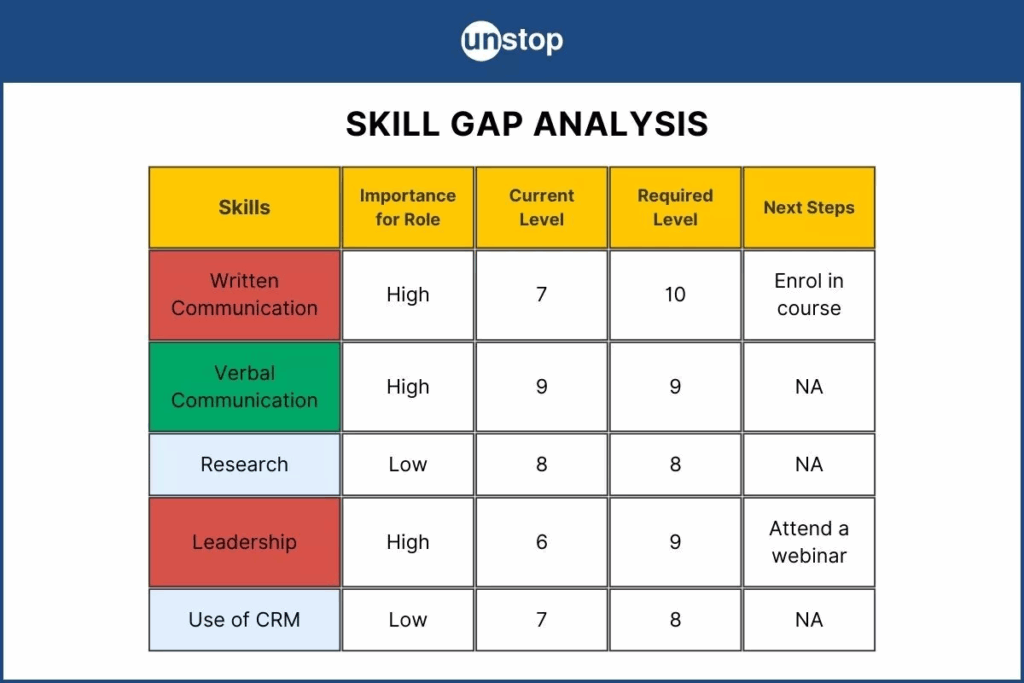
Image Source: unstop
Step 1: Identify emerging skills through live job postings
Start with the external signal. Job postings reflect what the market currently values, not what it valued last year. Track how often a skill appears, how quickly it’s rising, and which industries are driving the demand.
If you’re an HR leader at a logistics firm and see a surge in postings mentioning “supply chain AI optimization,” that’s your early warning. You can start building internal fluency before competitors begin hiring for it.
Step 2: Map those skills against your workforce reality
Once you know what the market wants, see how your people stack up. Internal skills data—certifications, project histories, learning records—shows where you already have a base and where you don’t. When those two views overlap, priorities become obvious: which teams to upskill, which roles to redesign, and where hiring is unavoidable.
This process is what turns workforce intelligence into a decision-making tool instead of a static report. It’s not about saying “we have a gap.” It’s about saying “we have a 9-month runway before this gap becomes a hiring problem.”
Step 3: Recalibrate hiring, training, and mobility
A skills gap analysis only works if it leads to action. That means reshaping hiring criteria, not just adding courses. Job descriptions should mirror what the data shows—specific tools, frameworks, and responsibilities that match live market language.
Training, meanwhile, works best when it targets clusters of related skills rather than isolated modules. A “data literacy” course, for instance, should ladder into visualization, automation, and governance—because that’s how the market defines readiness today.
Internal mobility can close gaps faster than external hiring. When you already have employees halfway up the learning curve, giving them targeted reskilling paths saves time and cost. Job analytics help identify which internal roles can transition naturally into emerging ones.
Step 4: Measure and refresh continuously
Closing the skills gap isn’t a one-time event. As job market trends evolve, so should your playbook. Build a loop: capture new job postings, compare them to your internal data, adjust your training and hiring strategy, and repeat quarterly. The faster your feedback cycle, the smaller the gap stays.
That’s what differentiates adaptive organizations—they treat workforce data like a living system, not an annual audit.
Case Example: Addressing the AI Skills Gap in the Workforce
The AI skills gap is a mirror held up to how fast work is changing. Every company now uses some layer of AI, but the talent pool that can design, deploy, or even audit those systems hasn’t caught up. A report by LinkedIn’s 2024 Future of Skills study shows that demand for AI-related skills has grown about 21-fold since 2016. That’s not a trend curve; it’s a fault line.
What the data shows
Live job-market analytics make the gap visible. When you track postings over time, certain patterns emerge:
- Job titles that didn’t exist three years ago—Prompt Engineer, AI Ethics Specialist, Model Risk Manager—now appear daily.
- Traditional roles are evolving: analysts are expected to automate workflows, marketers to run generative content tools, recruiters to prompt-tune screening bots.
- Demand isn’t limited to tech. Retail, logistics, and healthcare are quietly absorbing AI into everyday operations.
These signals reveal a widening gap not just in technical depth but in baseline literacy—knowing what AI can and can’t do inside a role.
How organizations can act on the signal
- Quantify exposure: Map how many roles in your organization touch AI directly or indirectly. JobsPikr’s dataset makes this visible by tracking how AI-related skills surface across functions.
- Prioritize capability tiers: Not everyone needs to code a model, but everyone will need to interpret AI-driven outputs. Build layered learning: literacy for all, fluency for specialists.
- Redesign job architecture: As roles merge, update descriptions to reflect actual tasks rather than legacy titles. That helps hiring teams source accurately and prevents overlapping requisitions.
- Benchmark pay pressure: Live data shows where AI roles command premium compensation. This lets HR teams decide when to buy talent and when to build it internally.
Why continuous tracking matters
AI skills evolve faster than most L&D catalogs can refresh. What counted as “AI capable” last quarter might already look dated. Organizations using real-time labor analytics see those shifts early and adjust budgets before they feel the pinch.
In practice, companies using live job-posting intelligence reduce time-to-hire for critical AI roles by aligning descriptions and compensation with current market expectations instead of last year’s assumptions.
Building a Continuous Skills Intelligence Framework
Spotting a gap is one thing. Preventing it from reopening is another. Most organizations get stuck after the first round of analysis—they identify a few missing skills, launch a training push, then move on. Six months later, the market has shifted again. The only sustainable fix is to treat skills intelligence as a continuous system, not a one-off project.
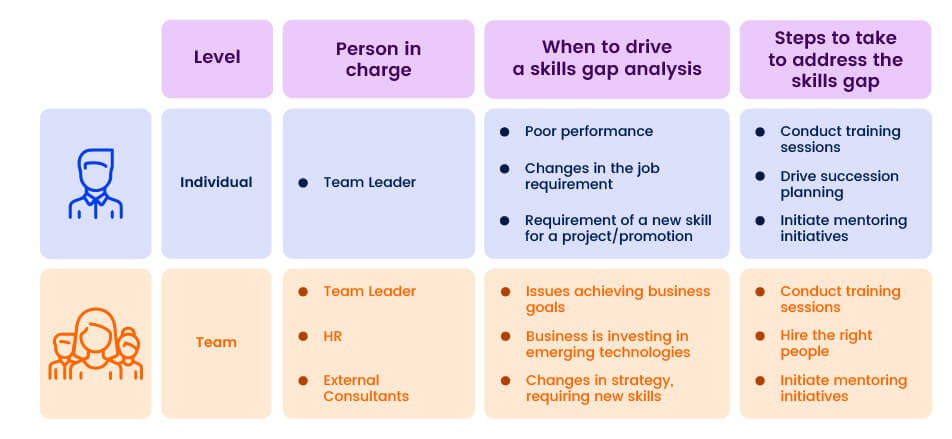
Image Source: iMocha
Step 1: Build a single source of skill truth
The foundation is clarity. That means unifying internal and external data into one live framework:
- Internal data: employee skills, certifications, training progress, performance outcomes.
- External data: job-market signals from live postings, skill frequency, pay benchmarks, and role evolution.
When these datasets sit together, you stop arguing about who has which skill and start discussing how quickly to build what’s missing. Tools like JobsPikr make this pairing easier by structuring market data in the same taxonomy HR teams already use internally.
Step 2: Automate signal detection
Manual research can’t keep pace with shifting job markets. Automating how you collect and refresh market data keeps your decisions current. Real-time APIs and scraping pipelines can track emerging skills daily—flagging new tools, frameworks, or role titles as they appear.
When alerts are built into dashboards, you don’t need quarterly briefings; you see change as it happens.
Step 3: Connect insights to business actions
Data has no impact unless it drives an operational decision.
- Learning teams use it to design targeted programs aligned with real demand.
- Recruiters use it to update job descriptions and compensation benchmarks.
- Finance and strategy teams use it to model the ROI of upskilling versus hiring.
The framework’s value isn’t in the data itself but in how smoothly it flows into existing decisions.
Step 4: Keep feedback loops alive
Every plan to close a skills gap should include validation points. Track adoption rates, course completions, hiring velocity, and project outcomes. Feed those metrics back into the system so each new cycle starts with better context.
When a workforce intelligence loop runs continuously, it stops being an HR tool and becomes part of how the organization senses and adapts to change.
The real advantage: readiness
Companies with continuous skills intelligence don’t need crisis hiring or emergency training—they anticipate shifts months ahead. They budget smarter, communicate clearer, and keep their workforce aligned with the market without periodic disruption.
JobsPikr’s continuous data feeds and analytics framework make this kind of foresight achievable. You get the visibility to detect, the context to plan, and the timing to act.
Why the Future of Workforce Planning Depends on Data
Workforce planning used to be about headcount. Today, it’s about capability. The question isn’t “how many people do we need?” but “how ready are the people we already have?” That shift, from counting people to measuring skills, is what separates reactive organizations from adaptive ones.
Data turns workforce planning from annual to continuous
Traditional planning happens in yearly cycles: define roles, project demand, fill seats. The problem is that skills don’t move in annual increments. They shift week to week, shaped by new tools, regulations, and business models. When your data comes from static reports, you’re planning for a version of the labor market that no longer exists.
With live labor analytics, planning becomes dynamic. You can see when a skill starts trending up in postings, when competitors begin hiring for it, and when demand plateaus. That lets HR teams act with timing, redirecting training budgets, adjusting headcount, or experimenting with automation before the wave peaks.
The new foundation: real-time workforce intelligence
To plan effectively, you need more than headcount spreadsheets. You need data that explains who can do what, where that capability sits, and how it compares to market demand. That’s where tools like JobsPikr fit naturally into planning workflows: they provide a direct feed of job market data, organized by role, skill, location, and trend velocity.
With that visibility, workforce planning moves closer to business forecasting. You’re no longer reacting to shortages, you’re forecasting them. You can predict when an internal skill will fall below market parity, when to buy talent, when to build it, and when to let automation take over.
How organizations benefit from a data-first approach
Companies that operationalize workforce data consistently report three practical gains:
- Better accuracy – Planning based on verified skill data reduces mismatched hires and redundant training spend.
- Faster execution – Access to live market signals shortens the cycle between recognizing a need and acting on it.
- Higher adaptability – When leadership can see real-time shifts, strategy meetings turn into scenario planning, not crisis response.
This isn’t about having “more” data, it’s about having the right data, refreshed often enough to make it useful.
Looking ahead
The organizations that win the next decade won’t just have talent; they’ll have visibility. Workforce strategy will become a data discipline, driven by live analytics rather than HR intuition. And as AI accelerates market shifts, the gap between what’s measured and what’s managed will define who leads and who follows.
JobsPikr helps close that gap, turning live job-market data into a workforce strategy. With it, you don’t just react to the skills gap. You plan around it.
See the Skills Gap Before It Hits Your Bottom Line
Get ahead of market shifts with data that shows exactly where talent shortages are forming
FAQs
1. What are the skills gaps in the workforce?
Skills gaps are the places where your current capabilities don’t match the work you’re expected to deliver. You feel them when projects stall because no one on the team has real experience with the tool you’ve just adopted, or when hiring takes months because the market wants a different skill mix than your job description. In short: it’s the distance between what your people can do today and what your business needs them to do next.
2. What are examples of skill gaps?
They show up differently by function. In finance, teams may be strong in Excel but light on Python or BI tools needed for automated reporting. In operations, leaders may know process design but not the data skills to run AI-assisted forecasting. In marketing, many can brief a campaign but fewer can build clean dashboards or prompt-tune content tools. None of these are abstract—these gaps show up as missed deadlines, quality rework, and longer time-to-hire.
3. What does a skills gap mean?
It means the role has moved on, but your capability map hasn’t. The title didn’t change, the tasks did. A “data analyst” who once built weekly spreadsheets now needs to publish live dashboards and automate routine work. When that shift isn’t reflected in skills, hiring criteria, or training, you’ve got a skills gap—visible in outcomes, not just on paper.
4. How can organizations identify their workforce skills gaps?
Start with two views and overlap them. First, your internal reality: what skills people actually have (projects shipped, tools used, certifications in progress). Second, the market’s ask: what current job postings demand for the same roles in your region or industry. Where those two pictures don’t line up is your real gap. Tools like JobsPikr help with the second part—turning live postings into a clear skills map—so you’re not guessing.
5. What is the digital skills gap in the workforce?
It’s the shortfall in everyday digital capability, not just advanced coding. Think: building reliable dashboards, working with APIs, understanding data privacy basics, or using AI tools without breaking the workflow. Teams often have general software familiarity but lack the depth needed to automate, audit, and scale digital work. The impact is subtle at first—manual steps, duplicated effort—then becomes a drag on speed and accuracy.
6. What are fast, practical ways to address a workforce skills gap?
Treat it like product work: ship, learn, iterate. Start by targeting the roles with the biggest performance impact, then design short skill “sprints” tied to real tasks (e.g., “publish a production-ready dashboard,” “deploy a basic ML-assisted forecast”). Update job descriptions to match the market language you’re seeing, and open internal mobility paths for people already halfway there. Measure outcomes—cycle time, quality, time-to-hire—not just course completion.
7. How do workforce intelligence and job market analytics actually help?
They give you timing and precision. Instead of a generic plan to “upskill in data,” you see that mid-level analysts in your market are being hired with cloud + BI + automation in one package. That lets you choose: train your analysts into that bundle, hire for it, or redesign roles. With a live feed, you adjust before the gap widens—because you’re watching the demand curve, not last year’s report.